Privacy-Preserving Clinical Decision Support for Emergency Triage Using LLMs: System Architecture and Real-World Evaluation

 , ,
, ,
Abstract
1. Introduction
1.1. Contributions
- End-to-end, triage-focused architecture. Designed a modular framework that fuses structured (vitals, labs) and unstructured (clinical notes) data, integrates LLMs, FL, big-data infrastructure, and digital-twin concepts, and achieves near-real-time latency under typical inference conditions.
- Real-world infectious disease triage case study. Applied the CDSS to a de-identified infectious disease ED cohort (n ≈ 132), achieving 75.8% first-pass agreement with expert reviewers on diagnosis, justification, and next-step recommendations.
- Large-scale language-model benchmarking. Fine-tuned a Llama 3.1-70B model that achieves up to 74% overall accuracy (83% on USMLE Step 2) across 750 curated USMLE-style questions—substantially outperforming baseline LLMs and medical-student means.
- Privacy-preserving model-development pipeline. Coupled secure FL (differential privacy and secure aggregation) with SGX-isolated inference, enabling multi-institutional collaboration while remaining fully GDPR/HIPAA compliant.
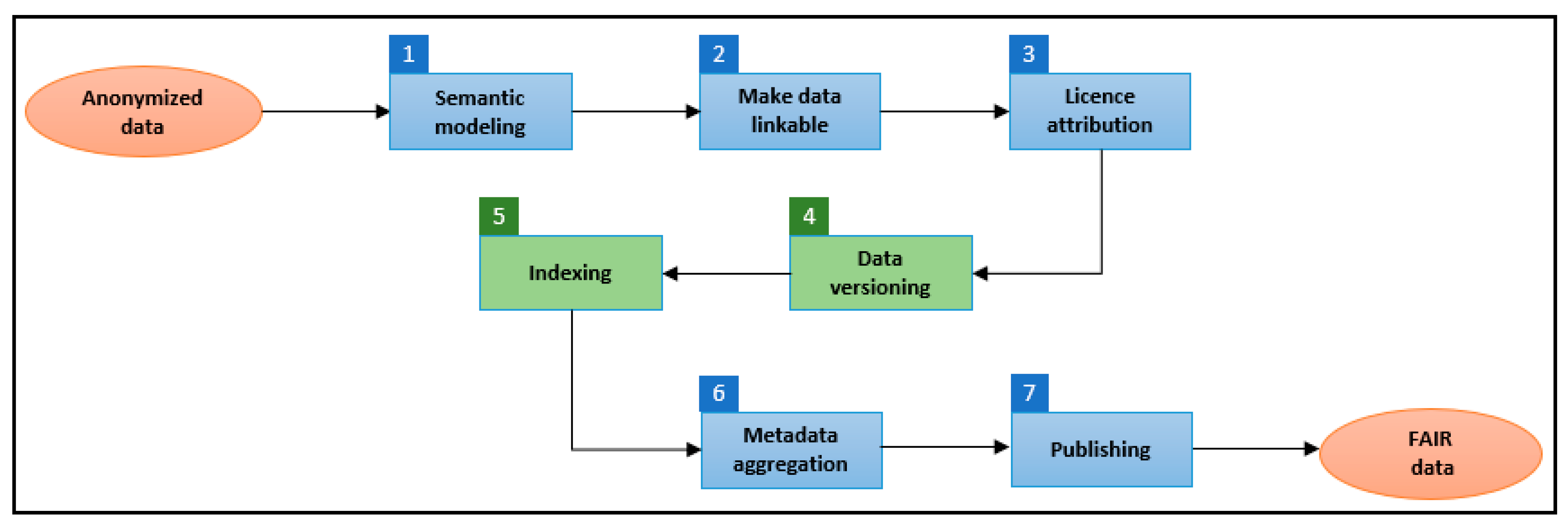
- FAIRification workflow and ontology-mapping service. Implemented a reproducible pipeline that aligns all ingested resources, assigns persistent identifiers, enriches metadata, and harmonizes codes via an Ontology-Mapping and Terminology Service (OMTS)—ensuring data are Findable, Accessible, Interoperable, and Reusable.
- Event-driven, low-latency data-fusion engine. Demonstrated horizontal scalability under doubled ED loads using Apache Kafka, Spark, and Node-RED to orchestrate streaming vitals, IoT signals, and EHR updates without performance loss.
- Four-pillar GDPR compliance framework. Mapped key articles of Regulation (EU) 2016/679 to concrete technical and organizational controls—including automatic DPIA generation, rights-of-erasure workflows, and continuous privacy KPIs—providing verifiable legal conformity.
1.2. Background
2. Materials and Methods
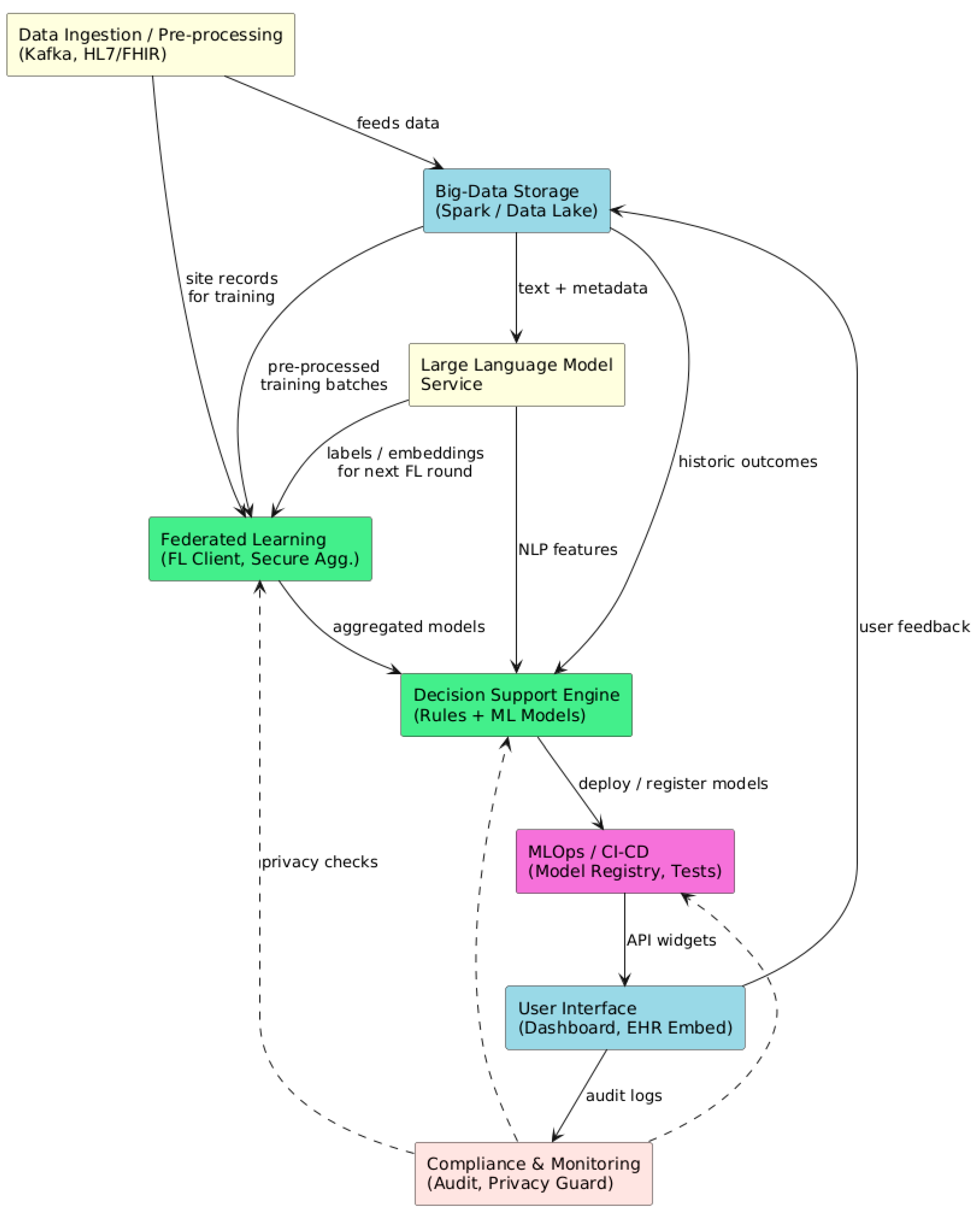
2.1. System Architecture
2.1.1. Modular Layered Design
- Data Ingestion and Pre-processing Layer. This layer continuously captures structured and unstructured data from EHR tables, HL7/FHIR messages [44], and device telemetry. Apache Kafka [45] handles high-throughput streaming, while validation and normalization routines standardize vitals, labs, and other structured fields. Clinical free-text passes through NLP pipelines, and medical images follow standard pre-processing before archival. All events have persisted in the big-data store and forwarded in a unified schema to downstream analytic services, shielding models from source heterogeneity and supporting interactive-latency inference.
- Big Data Management and Storage Layer. All data (both raw and processed) as well as intermediate results need to be stored and managed efficiently. We incorporate a big data framework (e.g., Hadoop/Spark ecosystem) to handle this. Key aspects of this layer:
- Data Lake and Warehousing. A distributed file store holds raw ingested data (Bronze layer in medallion architecture terms) and refined data (Silver/Gold layers) in parquet/orc formats. Structured data may also be stored in a relational warehouse for easy query (SQL) access, while text embeddings or time-series might reside in a NoSQL or specialized time-series database for fast retrieval.
- Parallel Processing. Apache Spark v3.5.0 is used for heavy analytics [46,47] that can be parallelized, such as scanning through millions of records to find similar past cases (for retrieving relevant precedents for a current patient). This ensures the system can be scaled to handle enterprise-level EHR datasets and not just small samples.
- Indexing and Search. For unstructured text, we maintain indexes (possibly leveraging Elasticsearch or Solr) to Support Information retrieval. This is particularly useful if the CDSS includes a knowledge base of medical guidelines or past case summaries: when the Decision Engine needs to gather supporting evidence for a recommendation, it can query these indexes (with the help of the LLM to formulate the query) to fetch relevant documents or data points.
- Data Lifecycle and Security. This layer also enforces data retention policies and encryption at rest. It tags data with metadata for provenance (which is important for auditing—knowing which source a particular piece of information came from). Access controls ensure that only authorized components or users can retrieve sensitive data, aligning with hospital IT security policies.
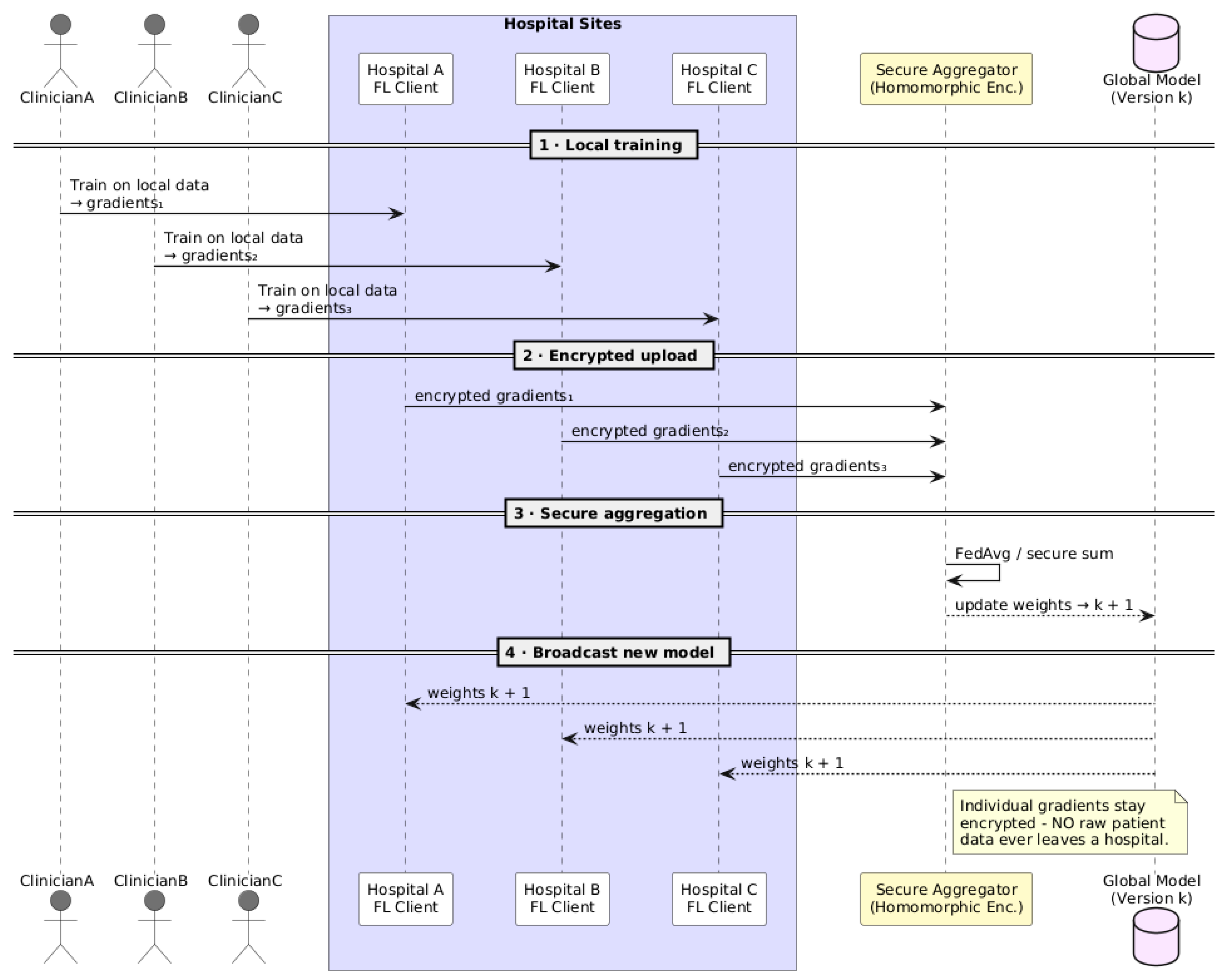
- FL Layer. Once data is preprocessed and ready for model training or updating, the FL layer comes into play for model development in a collaborative but privacy-preserving manner. In a multi-center deployment, each hospital (or clinic) runs an instance of the learning algorithm on its local data. Rather than sending raw patient data to a central server, each site computes updates to the model (e.g., gradient updates) using its local data. A central coordinator (which could be on-premises at a lead institution or in a secure cloud) collects encrypted model updates from the sites and aggregates them (for example, by averaging weights—akin to federated averaging). Only the aggregated model—which now has learned from all participating sites—is sent back to each hospital. This way, the global CDSS model benefits from a wide range of clinical cases (improving its generalization), yet no sensitive patient data ever leaves the source institutions’ control. In our architecture, this layer is crucial for training both the triage decision models and any language models on distributed text corpora (whether labeled or unlabeled, which dictates the specific learning objective but does not alter the underlying privacy guarantees). For example, if several hospitals use the system, they can collaboratively fine-tune an embedded LLM on their combined clinical note data without sharing actual notes with each other, thereby adapting the LLM to their medical domain jargon in a compliant manner. We also incorporate periodic evaluation rounds in FL—e.g., a set of common validation cases—to assess the performance of the global model after each round and ensure it is improving consistently. Figure 2 details the message exchange between local FL clients, the secure-aggregation service, and the privacy monitor.
- 4.
- LLM Layer. This layer embeds one or more LLMs into the CDSS for tasks involving natural language understanding and generation. The LLMs (such as a fine-tuned version of the LlaMA-3 [48] of Meta or an open medical model like MedAlpaca [49]) can serve multiple functions:
- Clinical Text Understanding. The LLM processes unstructured inputs—e.g., the free-text note of a triage nurse describing the symptoms of a patient—and extracts structured information or meaning. It can perform clinical NER (finding mentions of conditions, medications), summarization of patient history, or translation of layperson language into medical terminology.
- Question Answering and Reasoning. Clinicians can query the system in natural language, and the LLM will attempt to answer. For instance, a doctor might ask, “What is the recommended triage level for a 45-year-old patient with chest pain and sweating?”. The LLM, using its medical knowledge and the data of the patient, can provide an answer or explanation. This is akin to having a knowledgeable assistant that has read vast amounts of medical literature and patient cases). Our system uses the LLM to generate differential diagnoses or triage justification texts that accompany the decision support output.
- Integration with Decision Logic. Outputs from the LLM layer feed into the DSE. For example, the LLM might flag that a note of the patient contains the phrase “central crushing chest pain,” which is suggestive of a myocardial infarction. This finding can be passed as a feature into a rule-based triage algorithm or combined with structured data (like an elevated troponin lab result) to determine a high-acuity triage classification. To further improve factual grounding and reduce hallucinations, the LLM can be integrated with Retrieval-Augmented Generation (RAG) pipelines that retrieve relevant documents during inference [50]. The LLM layer thus augments traditional CDSS algorithms with knowledge extracted from text that would otherwise require manual review.
- 5.
- DSE Layer. The DSE is the core analytical brain of the system that generates clinical recommendations (e.g., triage category, likely diagnoses, alerts for abnormal findings). It brings together inputs from the structured data pipelines and the LLM outputs. The engine can utilize a combination of the following:
- Rule-Based Logic. Standard clinical triage protocols—such as the ESI or institution-specific guidelines—are encoded into the decision engine. For example, if systolic blood pressure is <90 mmHg and heart rate > 130 bpm, the patient is flagged for immediate attention. These encoded rules serve as safety nets to ensure the system adheres to established clinical norms and provides conservative recommendations when vital signs are critical.
- Machine Learning Models. Predictive models trained on historical emergency department data are used to assess the risk of critical outcomes (e.g., ICU admission or deterioration). Models such as gradient boosting machines or neural networks process both structured features (age, vitals, lab results) and encoded clinical narratives to generate risk scores. These scores are mapped to triage levels, supporting clinician decision-making with both statistical and semantic context.
- Guideline Retriever Module. This module retrieves relevant clinical guidelines or medical facts from an internal knowledge base and serves as a reference component during the decision-making process. The retrieved content is then provided to the LLM, which integrates this evidence to generate context-aware recommendations. For instance, the system may identify and retrieve similar historical cases—leveraging big data infrastructure and information retrieval techniques—and instruct the LLM to compare those with the current patient presentation.
- Digital Twin Simulation. If applicable, the DSE also checks the digital twin of the patient for any active alerts. For example, if the twin (representing a patient with chronic conditions at home) triggers an event “oxygen saturation dropped below 85%,” the engine would generate a high-priority alert for that patient, possibly even before they arrive at the hospital.
- 6.
- MLOps and CI/CD Pipeline Layer. To keep the AI models of the system up-to-date and reliable, we integrate MLOps principles. This layer handles the continuous integration and deployment (CI/CD) of model updates. When new data becomes available or when the FL rounds produce a new global model, the pipeline automatically validates the model on a hold-out set of cases (or in A/B tests within the live system) before deploying it. The pipeline also monitors model performance metrics over time—for example, if the triage recommendations of the model start to drift or degrade (perhaps due to changes in patient population or emergence of new diseases), it can alert data scientists to retrain or recalibrate. This layer encompasses the following:
- Version Control for Models. Each model (and even each set of rules) is versioned. The system can roll back to a prior stable model if a newly deployed one has issues.
- Automated Testing. Similarly to software testing, we maintain a suite of test scenarios (clinical vignettes with known correct outputs) to rapidly verify that any model update does not break core functionality or violate clinical constraints.
- Continuous Learning. In the long run, as clinicians use the system, their feedback (e.g., whether they accepted or overrode a recommendation) can be fed back into model training. The pipeline could schedule periodic retraining (say monthly) using accumulated new data and feedback, thereby improving the models iteratively. This approach reflects the core principles of a learning health system, where continuous feedback loops refine clinical knowledge and practice [51].
- 7.
- UI Layer. The UI is the touchpoint between the CDSS and the clinicians (doctors, nurses, etc.). It is designed to be intuitive and fit within clinical workflows to avoid alert fatigue or disruption. Key features of the UI include the following:
- Dashboard for Triage Nurses. Displaying incoming patients with their vital signs and any alerts. For each patient, if the system has a triage suggestion, it is shown (e.g., color-coded by severity). The nurse can provide input (confirm or adjust the triage level) and add additional notes, which the system will record—and possibly send back to update the model (with clinician approval).
- Physician View. Where a doctor can query the system for diagnostic support. They might see a summary of the case of the patient compiled by the LLM (including relevant past history, flagged abnormal findings, etc.), and a list of differential diagnoses or management suggestions. The physician can click on any suggestion to see supporting evidence (e.g., guideline links), which could include references to clinical guidelines or similar past cases.
- Alerting Mechanism. Critical alerts (like a patient in the waiting area whose condition is deteriorating according to live-streamed vitals) are prominently displayed or even sent to clinicians’ mobile devices if integrated.
- Feedback and Override. The UI allows clinicians to easily override the recommendations of the system (with a required reason entry, for accountability). It also encourages them to mark if recommendations were useful or if any error is observed, capturing valuable feedback data. The design emphasizes that the CDSS is an aid, not a replacement for clinical judgment.
- 8.
- Compliance and Monitoring Layer. Given the sensitivity of healthcare, the architecture includes a dedicated layer for compliance, audit, and performance monitoring. Our privacy impact assessment follows the practical guidelines for m-health apps under GDPR articulated by Mulder et al. [52]. All data processing components enforce access controls and anonymization where appropriate. For example, when sending data to the LLM layer or to the federated server, patient identifiers are stripped and replaced with pseudonyms or hashed IDs. The system maintains audit logs of who accessed what data and what recommendations were made, which is essential for both troubleshooting and legal purposes (e.g., tracking decisions in case of adverse outcomes). We also incorporate monitoring tools that continuously track system uptime, latency of data flows, and model performance metrics (such as the percentage of cases where the triage level of the AI agreed with the final triage of the clinician). If any anomalies are detected—e.g., a sudden spike in disagreement rates or a component failure—this layer triggers an alert to system administrators.
- Locates the master pseudonym of the patient.
- Sends tombstone events that cascade through Kafka to trigger deletion in the big-data lake, revocation of FL gradients, and cache invalidation in the LLM embedding store.
- Issues signed confirmation to the requester and updates Article 30 of the record of processing activities.
- gdpr_erasure_latency_seconds—time from request to final purge (objective ≤ 72 h).
- fl_dp_epsilon_current—latest global ε reported by the FL aggregator.
- phi_fields_in_logs_total—Grafana alert if >0.
2.1.2. Workflow Integration
- Low-latency Data Capture. A patient arrives at the emergency department. The nurse records initial observations and vitals in the EHR. The Data Ingestion Layer immediately streams these new entries into the CDSS pipeline.
- Preprocessing and Analysis. The vitals of the patient are normalized and checked for extremes, and the free-text note is parsed by the LLM layer, which might extract “chest pain for 2 h, history of hypertension” as key points. Meanwhile, the Big Data layer retrieves the past records of this patient (if any) and relevant medical knowledge (e.g., known risk factors for chest pain).
- Decision Support Generation. The DSE takes the structured data (e.g., blood pressure = 90/60, heart rate = 120) and the LLM annotations (e.g., chest pain characteristics) and runs them through its triage model/rules. Suppose the model, based on learned patterns, outputs a high risk score suggesting this is likely a heart attack. The DSE sets the triage recommendation to Level 1 (Immediate/Emergent). It asks the LLM layer to generate an answer in natural language. The LLM might produce: “Recommendation: Level 1 (Immediate). Rationale: The hypotension, tachycardia, and chest pain characteristics of the patient are indicative of a possible acute coronary syndrome. Similar past cases required immediate intervention.”
- UI Notification. Within seconds, the nurse sees an alert on the triage dashboard that shows both the recommended level and the rationale behind it. The nurse reviews the patient and the input of the system. If the recommendation matches the assessment of the nurse, it is accepted and the patient is fast-tracked for treatment, with the decision documented as CDSS-supported. If the nurse judges—based on appearance, repeat vitals, or new history—that the case is urgent but not at the highest resuscitation tier, they can override the suggestion by downgrading the triage category from Level 1 (Immediate) to Level 2 (Emergent) and enter a brief reason (e.g., “stable vital signs after repeat measurement”). The system records both the adjusted level and feedback from the nurse for audit and future model refinement.
- FL Update (in background). At the end of the day (or a federated training cycle), the data from this case (now labeled with the final outcome and decisions) stays in the database of the hospital. The CDSS at this hospital will use it to update the local model when the next training round occurs. FL will ensure the global model gradually learns from such real cases across all deployment sites, constantly refining the triage predictions.
2.2. Deployment Scenarios
2.2.1. Integration with Clinical Data Sources
- EHR Systems. These are the primary sources of structured data (patient demographics, encounter info, vital signs, lab results, medication orders). Our CDSS can be deployed alongside the EHR, either on premises or on a secure cloud that interfaces via HL7/FHIR APIs. In practice, this means subscribing to the feed of updates of the EHR: for example, using the FHIR Subscriptions API or database triggers that send new entries (like a lab result posting) to the Data Ingestion Layer. We designed an adapter that listens for new triage notes and vital signs in the EHR of the hospital and pushes them into Apache Kafka topics for processing. This adapter maps EHR data fields to the internal schema of the CDSS (ensuring, say, that “blood_pressure_systolic” in the database of Hospital A is recognized as the systolic BP in our system).
- Laboratory and Imaging Systems. If not fully integrated into the EHR, lab and radiology systems can independently send data. Deployment involves setting up interface engines that route lab results to the CDSS. For imaging, the system might receive a notification that an imaging study is available, and possibly a report text once a radiologist has read it. Those reports can be fed to the LLM layer for analysis (e.g., detecting a mention of “acute fracture” in an X-ray report to raise the urgency for an orthopedic consult).
- IoT and Wearable Data. In advanced deployments, patient-worn devices or remote monitoring systems provide continuous data (heart rate, glucose levels, etc.). The CDSS uses an IoT broker (such as MQTT [59] via Eclipse Mosquitto [60]) to ingest this streaming data. For instance, if a patient in an observation unit has a wearable ECG, the signal can be streamed, and the digital twin layer of our system will update the status of the patient continuously. A rule might trigger if a dangerous arrhythmia is detected, generating an immediate alert through the CDSS UI.
- Public Health and Knowledge Databases. Deployment can also include connecting to external knowledge sources or risk calculators. For example, linking to a national poison control database for triage in toxin ingestion cases, or pulling frequently updated COVID-19 prevalence data from public health APIs to adjust triage decisions during an outbreak. These integrations are scenario-dependent; our architecture foresees a Knowledge Base Service that can be configured to fetch such external data and provide it to the Decision Engine when relevant.
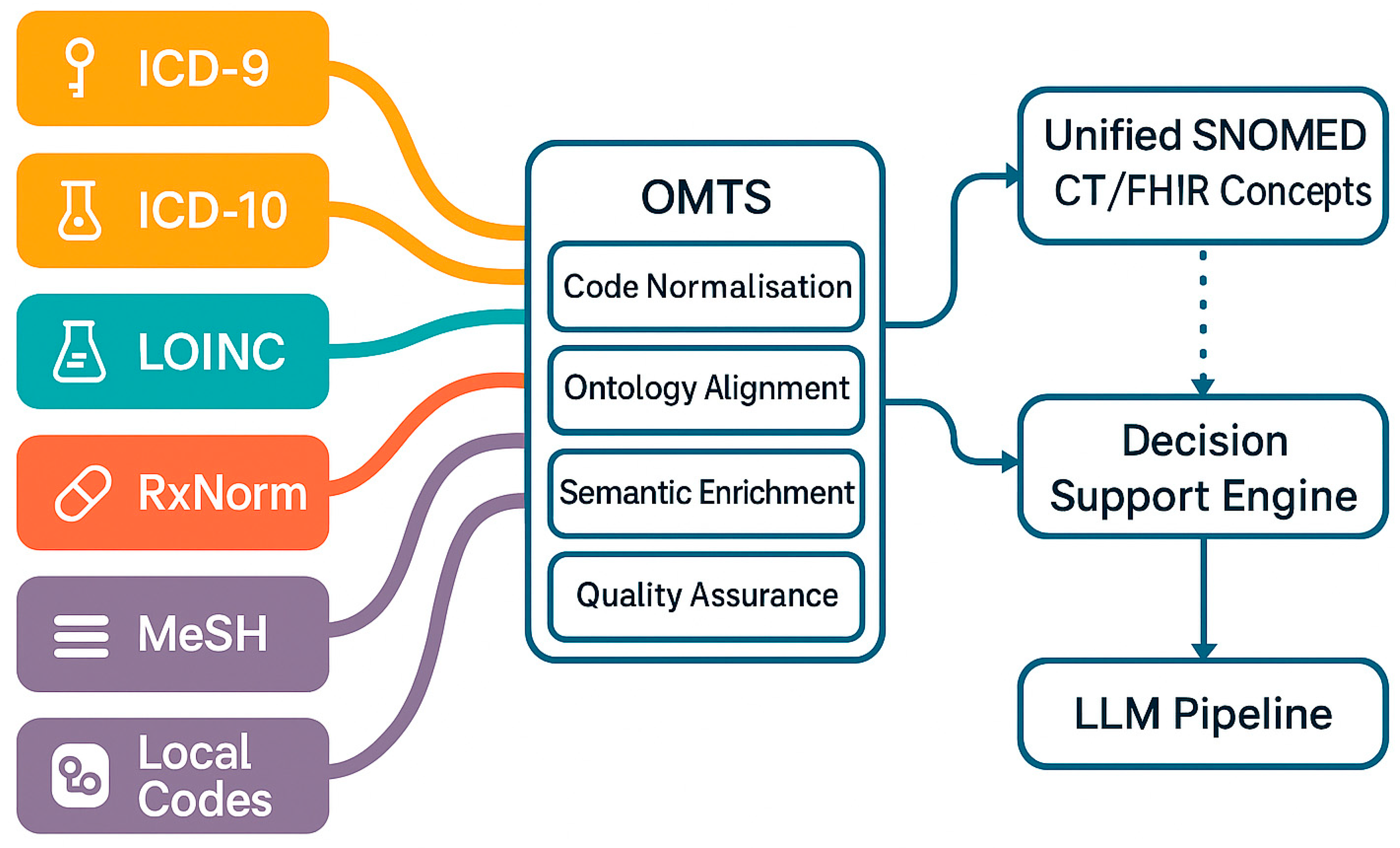
- Ontology-Mapping and Terminology Service. A critical aspect of integration is data normalization. Each source might use different coding systems (ICD, SNOMED CT, LOINC, etc.). In deployment, we include a terminology service that maps synonyms and codes to a common reference. Real-world clinical systems rarely speak the same “vocabulary.” Laboratory feeds use LOINC, medication orders rely on RxNorm, diagnoses may arrive as ICD-10-CM [61], while downstream reasoning modules expect the richer semantics of SNOMED CT.
2.2.2. Event-Driven Architecture
- Data ingestion is continuous via Kafka; each new piece of information is an event (e.g., “new triage note for patient X” or “vital sign update for patient Y”). These events trigger downstream actions. For instance, an incoming event of an abnormal lab result could directly invoke the DSE to re-evaluate the condition of the patient.
- We deployed Node-RED flows as part of the digital twin subsystem to orchestrate IoT events. For example, a Node-RED flow is configured such that if a digital twin of the patient emits an event “SpO2 < 90%”, the flow calls a triage re-assessment function in the DSE, which may upgrade the priority of the patient and send an alert to the UI.
- The components of the system communicate through message queues and RESTful services. In deployment, containerization (using Docker/Kubernetes) proved helpful: each layer or service (ingestion, FL aggregator, LLM service, decision engine, UI backend) runs in its own container/pod. Kubernetes event-driven autoscaling can be employed—e.g., scaling out the LLM service pods if there is a surge of simultaneous user queries.
- Latency is an important deployment metric. In our tests, we aimed for end-to-end latency (from data arrival to recommendation) to be under a few seconds for urgent events. We achieved this by tuning Kafka (ensuring minimal ingestion lag) and by using efficient model serving techniques (such as quantized LLMs for faster inference). Non-urgent analyses (like periodic model retraining) are handled asynchronously to avoid interfering with time-sensitive recommendations.
3. Results
3.1. Evaluation of LLMs on USMLE Benchmarks
- “noquant” indicates the model was not quantized, retaining full precision.
- Numerical suffixes (e.g., 00, 01, 04, 07) represent the sampling temperature used during inference:
- 00 = deterministic output (temperature = 0.0)
- 01 = low variation (temperature = 0.1)
- 04 = moderate variation (temperature = 0.4)
- 07 = high variability (temperature = 0.7)
- “dosample” specifies diverse sampling strategies beyond temperature setting.
- Epochs: 1–3
- Learning rate: 2 × 10⁻⁴
- Micro-batch size: 2
- LoRA rank: 32
- LoRA alpha: 16
- Dropout: 0.05
- Step 1: Foundational knowledge
- Step 2: Clinical reasoning
- Step 3: Management and advanced diagnostics
| You are a helpful medical assistant. For each question, select the most appropriate answer from the provided options. The answer should be one of the letters (A, B, C, etc.). |
- Fine-Tuning Impact. Fine-tuned models outperformed base models significantly, confirming the effectiveness of domain-specific adaptation.
- Model Size. 70B models consistently outperformed 8B models across all steps, especially in complex scenarios.
- Parameters. The three-epoch, temperature-0.1 checkpoint achieves an 83% Step-2 accuracy—within two points of GPT-4 and well above the medical-student mean. Step-1 gains are more modest, suggesting domain-specific fine-tuning benefits reasoning-heavy questions disproportionately.
- Temperature Sensitivity. Lower temperature values produced more deterministic and accurate results, while higher temperatures generated diverse but less reliable outputs.
- 4-bit quantization delivers the highest single-query speed but degrades under high parallelism.
- 8-bit models are more stable under load but slower overall.
- Choosing between q4 and q8 depends on the concurrency and precision needs of the application.
3.2. Real-World Infectious Disease Triage Scenario
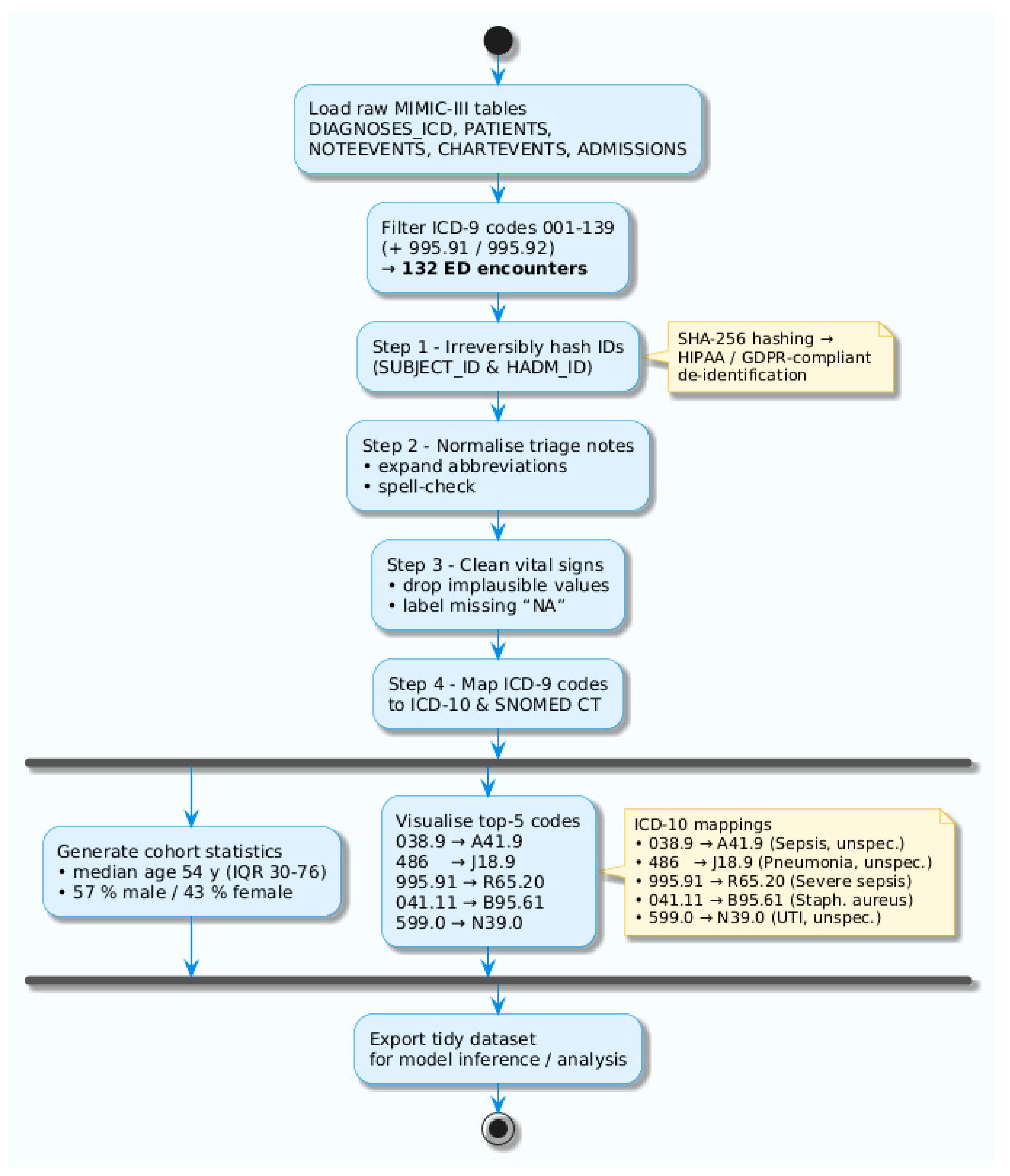
3.2.1. MIMIC-III Infectious Disease Cohort: Data Extraction and Pre-Processing
3.2.2. CDSS Application and Expert Evaluation: Disseminated MRSA Septic Shock Case
- Diagnosis—clinically appropriate, expressed after “Diagnosis:”.
- Justification—≤25 words, highlights key positive findings.
- Next step—single actionable management line beginning “Next step:”.
| ### Instruction Below is an electronic patient note. Rewrite the clinically relevant content (chief complaint, HPI, exam, vitals, labs, imaging) as a single paragraph of **maximum 120 words**. • Remove any PHI masks. • Use plain English. • Do NOT add introductory phrases. End the paragraph with exactly this question: ‘Question: What is the most likely diagnosis?’ ### Note {note} ### Response |
| You are a helpful medical assistant. Write **exactly two lines**, each beginning with the given label, describing the most likely diagnosis and the key findings that justify it. • First line must start with ‘Diagnosis’: followed by the diagnosis. • Second line must start with ‘Justification’: followed by ≤25 words explaining why. Do NOT include any other lines or text. {CLEAN_TEXT} Diagnosis: |
|
You are a helpful medical assistant. Given the patient note, diagnosis, and justification below, write **exactly one line** beginning with ‘Next step’: that states the most appropriate immediate management action for this patient. Do NOT repeat any previous content and do NOT invent new labels. Patient note: {CLEAN_TEXT} Diagnosis: {DX} Justification: {JUST} Next step: |
- Rule-based safety net—Flags lactate ≥ 4 mmol/L, sustained hypotension (SBP < 90 mmHg), or altered mental status for automatic high-acuity escalation.
- Ontology linker—Converts ICD-9/10 predictions to SNOMED CT concepts for downstream analytics and cohorting.
- Clinical UI—Renders a color-coded banner summarizing Diagnosis, Justification keywords, and Next step, and links to sepsis order-set if high-acuity criteria are met.
3.2.3. Domain-Shift Sanity Check—Respiratory-Disease Cohort
4. Discussion
4.1. System Usability and Clinical Acceptance
4.2. Strengths of the Proposed Architecture
- High Diagnostic and Triage Accuracy. By combining data-driven models with rule-based safeguards, the system achieved high sensitivity for emergencies and good overall accuracy. It effectively prioritized true urgent cases. Moreover, the inclusion of LLM-derived suggestions provided diagnostic guidance that went beyond a traditional triage algorithm. For instance, in some urgent (Level 2) cases, the system not only flagged urgency but also hinted at a likely diagnosis. This is a value-add for physicians receiving the patient, potentially accelerating the diagnostic process.
- Privacy-Preserving Learning. The use of federated learning proved to be practically viable and did not diminish performance, which is a major win for data privacy. Hospitals can collaborate to train better models without exposing patient data to each other. This strength means the system can scale to multi-center deployments. As more hospitals use it, the models can become even more robust by learning from a larger collective dataset.
- Scalability and Performance. The architecture of the system handled large data volumes and concurrent user interactions without performance loss. The use of streaming and big data frameworks (Kafka, Spark) ensures that it can scale horizontally—more machines can be added to handle more patients or more data sources.
- Interoperability and Modularity. The layered, API-driven design allowed us to plug in upgrades easily. For example, during experiments, we replaced the initial model with the more advanced LLaMA-3-based model without changing the rest of the pipeline—the contract of the Decision Engine with the LLM module remained the same (input: text of note, output: extracted info). This modularity is a strength in fast-moving AI tech: as better models emerge, they can be slotted into the architecture.
- User-Centric Design. Features like the UI integration and feedback loop illustrate the user-centric nature of the system. It was built not just to produce predictions, but to fit into how clinicians work. The positive simulated user feedback suggests that it could achieve the elusive goal of being embraced rather than resisted by healthcare providers. In particular, the ability of the UI to capture feedback and corrections from clinicians and route that back to model improvement is a practical implementation of a learning health system.
4.3. Limitations and Challenges
- System-Level Validation. The observed 75.8% expert agreement rate indicates promising clinical validity of model-generated recommendations but should not be interpreted as an assessment of overall CDSS effectiveness. Further end-to-end validations—including real-time inference and clinician workflow integration—are required.
- System-Level Validation and Reproducibility Constraints. A full comparison between the proposed CDSS and established triage tools (e.g., ESI, RETTS, or conventional ML models) was not performed due to several constraints. The dataset lacks complete prospectively assigned triage labels, and retrospective inference from clinical notes may introduce inconsistencies. Additionally, fair and reproducible baselines require standardized datasets, open-source implementations, and aligned hyperparameters—many of which are currently unavailable or inconsistent across systems.
- Dataset Composition Bias. Because ~91% of the fine-tuning corpus originates from CORD-19, the model is richly exposed to infectious disease terminology, pathophysiology, and treatment guidelines. This skew is advantageous for the present ID triage use-case, boosting accuracy on sepsis, C. difficile colitis, and pneumonia presentations. The trade-off is narrower coverage of under-represented specialties (e.g., dermatology, neurology, multi-morbidity), which may still require dedicated fine-tuning or specialty-specific model variants in future work.
- Real-World Evaluation Scope. The proposed CDSS was evaluated on 132 de-identified emergency department encounters labeled with infectious or parasitic diseases (ICD-9 001–139) extracted from MIMIC-III. All 132 records underwent expert review, providing a statistically informative benchmark for real-world infectious disease triage. Nonetheless, external validation across larger, multi-center datasets is still required to fully establish sensitivity, specificity, and robustness in real-world deployment scenarios.
- Data Quality and Noise. Our evaluation assumed reasonably good data input. In reality, triage data can be messy—devices might error, notes may be incomplete, or data can be entered in wrong fields. The system currently has basic validation and outlier handling, but it may still be influenced by erroneous data (e.g., a wildly high heart rate reading due to sensor error might trigger an unnecessary alarm). Data quality issues are a limitation; making the system robust to such noise is an ongoing challenge.
- Infrastructure Requirements. Optimal performance requires modest IT resources (e.g., GPU for LLM inference, reliable networking for data streams). While the federated setup allows lightweight client deployment, smaller institutions may still face adoption barriers due to hardware or support limitations.
4.4. Future Work
- Comprehensive System Level Evaluation. While the presented evaluation primarily addresses LLM inference accuracy, comprehensive end-to-end system validation—including real-time performance, clinician acceptance, and integrated workflow efficiency—will be the focus of subsequent evaluations. Planned evaluations will incorporate scenario-driven simulations, multi-center deployments, user acceptance tests, and clinical outcome impact studies to provide holistic system validation. In addition, we plan to incorporate comparative benchmarking against established triage frameworks (e.g., ESI, RETTS) and conventional ML-based classifiers, once standardized, labeled datasets become available.
- Integrating Severity Assessment and Prognosis. Beyond initial triage, we aim to extend the logic of the system to continuously assess patient severity throughout the ED stay. This includes incorporating early warning scores and predictive analytics to forecast patient deterioration. By leveraging time-series data, the system could proactively identify patients whose conditions are worsening, effectively blending triage with short-term prognosis [66].
- Model Context Protocol (MCP). MCP is an open standard that facilitates seamless connections between LLMs and external data sources or tools, enabling dynamic, real-time interactions particularly in complex, multi-agent environments [67]. By adopting MCP, we aim to streamline the integration process, reduce the need for custom connectors, and ensure secure, standardized communication across diverse platforms.
- Expanding Training Data for Rare Cases. To improve generalizability and robustness, additional datasets from specialty hospitals (e.g., oncology centers) will be integrated. Synthetic case generation and reinforcement learning with human feedback will help address rare or atypical scenarios. These enhancements will allow the system to better handle edge cases while reducing diagnostic uncertainty.
- Enhancing Explainability and Transparency. Trust and adoption depend on clinicians understanding how recommendations are generated. Future iterations will add an explanation layer powered by tools such as SHAP (SHapley Additive exPlanations) [68] and LIME (Local Interpretable Model-Agnostic Explanations) [69] to enhance clinician trust.
5. Conclusions
Supplementary Materials
Author Contributions
Funding
Institutional Review Board Statement
Informed Consent Statement
Data Availability Statement
Acknowledgments
Conflicts of Interest
List of Abbreviations
| CDSS | Clinical Decision Support System |
| CI/CD | Continuous Integration/Continuous Deployment |
| CORD-19 | COVID-19 Open Research Dataset |
| DPIA | Data Protection Impact Assessment |
| DSE | Decision Support Engine |
| ED | Emergency department |
| EHR | Electronic Health Record |
| ESI | Emergency Severity Index |
| FAIR | Findable, Accessible, Interoperable, Reusable |
| FHIR | Fast Healthcare Interoperability Resources |
| FL | Federated Learning |
| GDPR | General Data Protection Regulation |
| HADM_ID | Hospital Admission Identifier |
| HIPAA | Health Insurance Portability and Accountability Act |
| ICD-9 | International Classification of Diseases, 9th Revision |
| LIME | Local Interpretable Model-Agnostic Explanations |
| LLM | Large Language Model |
| LOINC | Logical Observation Identifiers Names and Codes |
| LoRA/QLoRa | (Quantized) Low-Rank Adaptation |
| MCP | Model Context Protocol |
| MeSH | Medical Subject Headings |
| MIMIC-III | Medical Information Mart for Intensive Care III |
| MMMLU | Massive Multitask Language Understanding |
| OMTS | Ontology-Mapping and Terminology Service |
| RAG | Retrieval-Augmented Generation |
| SGX | Software Guard Extensions |
| SHAP | SHapley Additive exPlanations |
| SNOMED CT | Systematized Nomenclature of Medicine—Clinical Terms |
| SPDX | Software Package Data Exchange |
| SUBJECT_ID | Patient Identifier |
| UMLS | Unified Medical Language System |
References
- Sutton, R.T.; Pincock, D.; Baumgart, D.C.; Sadowski, D.C.; Fedorak, R.N.; Kroeker, K.I. An overview of clinical decision support systems: Benefits, risks, and strategies for success. NPJ Digit. Med. 2020, 3, 17. [Google Scholar] [CrossRef]
- Wickramasinghe, N.; Ulapane, N. A solution for the health data sharing dilemma: Data-less and identity-less model sharing through federated learning and digital twin-assisted clinical decision making. Electron 2025, 14, 682. [Google Scholar] [CrossRef]
- Rajkomar, A.; Oren, E.; Chen, K.; Dai, A.M.; Hajaj, N.; Hardt, M.; Liu, P.J.; Liu, X.; Marcus, J.; Sun, M.; et al. Scalable and accurate deep learning with electronic health records. NPJ Digit. Med. 2018, 1, 18. [Google Scholar] [CrossRef] [PubMed]
- Esteva, A.; Robicquet, A.; Ramsundar, B.; Kuleshov, V.; DePristo, M.; Chou, K.; Cui, C.; Corrado, G.; Thrun, S.; Dean, J. A guide to deep learning in healthcare. Nat. Med. 2019, 25, 24–29. [Google Scholar] [CrossRef] [PubMed]
- Otto, M. Regulation (EU) 2016/679 on the protection of natural persons with regard to the processing of personal data and on the free movement of such data (General Data Protection Regulation–GDPR). In International and European Labour Law; Nomos Verlagsgesellschaft mbH & Co. KG.: Baden-Baden, Germany, 3 September 2018; pp. 958–981. [Google Scholar]
- Act, A. Health insurance portability and accountability act of 1996. Public Law 1996, 104, 191. [Google Scholar]
- Sheller, M.J.; Reina, G.A.; Edwards, B.; Martin, J.; Bakas, S. Multi-institutional deep learning modeling without sharing patient data: A feasibility study on brain tumor segmentation. In Brainlesion: Glioma, Multiple Sclerosis, Stroke and Traumatic Brain Injuries: 4th International Workshop, BrainLes 2018, Proceedings of the Held in Conjunction with MICCAI 2018; Revised Selected Papers, Part I 4 2019; Springer International Publishing: Granada, Spain, 2018; pp. 92–104. [Google Scholar]
- Pfitzner, B.; Steckhan, N.; Arnrich, B. Federated learning in a medical context: A systematic literature review. ACM Trans. Internet Technol. TOIT 2021, 21, 1–31. [Google Scholar] [CrossRef]
- Morley, J.; Machado, C.C.; Burr, C.; Cowls, J.; Joshi, I.; Taddeo, M.; Floridi, L. The ethics of AI in health care: A mapping review. Soc. Sci. Med. 2020, 260, 113172. [Google Scholar] [CrossRef]
- OpenAI. ChatGPT-3.5 Model Card [Internet]. 2025. Available online: https://platform.openai.com/docs/models/gpt-3-5 (accessed on 1 June 2025).
- Bicknell, B.T.; Butler, D.; Whalen, S.; Ricks, J.; Dixon, C.J.; Clark, A.B.; Spaedy, O.; Skelton, A.; Edupuganti, N.; Dzubinski, L.; et al. Chatgpt-4 omni performance in usmle disciplines and clinical skills: Comparative analysis. JMIR Med. Educ. 2024, 10, e63430. [Google Scholar] [CrossRef]
- Salloum, S.; Dautov, R.; Chen, X.; Peng, P.X.; Huang, J.Z. Big data analytics on Apache Spark. Int. J. Data Sci. Anal. 2016, 1, 145–164. [Google Scholar] [CrossRef]
- United States Medical Licensing Examination (USMLE). About the USMLE [Internet]. Philadelphia (PA): Federation of State Medical Boards. 2025. Available online: https://www.usmle.org (accessed on 1 June 2025).
- Slee, V.N. The international classification of diseases: Ninth revision (ICD-9). Ann. Intern. Med. 1978, 88, 424–426. [Google Scholar] [CrossRef]
- Gligorijevic, D.; Stojanovic, J.; Satz, W.; Stojkovic, I.; Schreyer, K.; Del Portal, D.; Obradovic, Z. Deep attention model for triage of emergency department patients. In Proceedings of the 2018 SIAM International Conference on Data Mining, San Diego, CA, USA, 3–5 May 2018; pp. 297–305. [Google Scholar]
- Li, X.; Li, M.; Yan, P.; Li, G.; Jiang, Y.; Luo, H.; Yin, S. Deep learning attention mechanism in medical image analysis: Basics and beyonds. Int. J. Netw. Dyn. Intell. 2023, 2, 93–116. [Google Scholar] [CrossRef]
- Jiang, D.; Wang, H.; Li, T.; Gouda, M.A.; Zhou, B. Real-time tracker of chicken for poultry based on attention mechanism-enhanced YOLO-Chicken algorithm. Comput. Electron. Agric. 2025, 237, 110640. [Google Scholar] [CrossRef]
- Alsentzer, E.; Murphy, J.R.; Boag, W.; Weng, W.H.; Jin, D.; Naumann, T.; McDermott, M. Publicly available clinical BERT embeddings. arXiv 2019, arXiv:1904.03323. [Google Scholar]
- Lee, J.; Yoon, W.; Kim, S.; Kim, D.; Kim, S.; So, C.H.; Kang, J. BioBERT: A pre-trained biomedical language representation model for biomedical text mining. Bioinformatics 2020, 36, 1234–1240. [Google Scholar] [CrossRef] [PubMed]
- Kung, T.H.; Cheatham, M.; Medenilla, A.; Sillos, C.; De Leon, L.; Elepaño, C.; Madriaga, M.; Aggabao, R.; Diaz-Candido, G.; Maningo, J.; et al. Performance of ChatGPT on USMLE: Potential for AI-assisted medical education using large language models. PLoS Digit. Health 2023, 2, e0000198. [Google Scholar] [CrossRef] [PubMed]
- Teo, Z.L.; Jin, L.; Liu, N.; Li, S.; Miao, D.; Zhang, X.; Ng, W.Y.; Tan, T.F.; Lee, D.M.; Chua, K.J.; et al. Federated machine learning in healthcare: A systematic review on clinical applications and technical architecture. Cell Rep. Med. 2024, 20, 5. [Google Scholar]
- Abbas, S.R.; Abbas, Z.; Zahir, A.; Lee, S.W. Federated Learning in Smart Healthcare: A Comprehensive Review on Privacy, Security, and Predictive Analytics with IoT Integration. Healthcare 2024, 12, 2587. [Google Scholar] [CrossRef]
- Li, T.; Sahu, A.K.; Talwalkar, A.; Smith, V. Federated learning: Challenges, methods, and future directions. IEEE Signal Process. Mag. 2020, 37, 50–60. [Google Scholar] [CrossRef]
- Sheller, M.J.; Edwards, B.; Reina, G.A.; Martin, J.; Pati, S.; Kotrotsou, A.; Milchenko, M.; Xu, W.; Marcus, D.; Colen, R.R.; et al. Federated learning in medicine: Facilitating multi-institutional collaborations without sharing patient data. Sci. Rep. 2020, 10, 12598. [Google Scholar] [CrossRef]
- Taiello, R.; Cansiz, S.; Vesin, M.; Cremonesi, F.; Innocenti, L.; Önen, M.; Lorenzi, M. Enhancing Privacy in Federated Learning: Secure Aggregation for Real-World Healthcare Applications. In International Conference on Medical Image Computing and Computer-Assisted Intervention; Springer Nature: Cham, Switzerland, 7 October 2024; pp. 204–214. [Google Scholar]
- Fan, T.; Kang, Y.; Ma, G.; Chen, W.; Wei, W.; Fan, L.; Yang, Q. Fate-llm: A industrial grade federated learning framework for large language models. arXiv 2023, arXiv:2310.10049. [Google Scholar]
- Yaqoob, M.M.; Nazir, M.; Khan, M.A.; Qureshi, S.; Al-Rasheed, A. Hybrid classifier-based federated learning in health service providers for cardiovascular disease prediction. Appl. Sci. 2023, 13, 1911. [Google Scholar] [CrossRef]
- Ye, R.; Wang, W.; Chai, J.; Li, D.; Li, Z.; Xu, Y.; Du, Y.; Wang, Y.; Chen, S. Openfedllm: Training large language models on decentralized private data via federated learning. In Proceedings of the 30th ACM SIGKDD Conference On Knowledge Discovery and Data Mining, Barcelona, Spain, 25–29 August 2024; pp. 6137–6147. [Google Scholar]
- Zhang, F.; Kreuter, D.; Chen, Y.; Dittmer, S.; Tull, S.; Shadbahr, T.; Schut, M.; Asselbergs, F.; Kar, S.; Sivapalaratnam, S.; et al. Recent methodological advances in federated learning for healthcare. Patterns 2024, 5, 101006. [Google Scholar] [CrossRef] [PubMed]
- Kaissis, G.A.; Makowski, M.R.; Rückert, D.; Braren, R.F. Secure, privacy-preserving and federated machine learning in medical imaging. Nat. Mach. Intell. 2020, 2, 305–311. [Google Scholar] [CrossRef]
- Mugunthan, V.; Polychroniadou, A.; Byrd, D.; Balch, T.H. Smpai: Secure multi-party computation for federated learning. In NeurIPS 2019 Workshop on Robust AI in Financial Services; MIT Press: Cambridge, MA, USA, 2019; Volume 21. [Google Scholar]
- Choudhury, O.; Gkoulalas-Divanis, A.; Salonidis, T.; Sylla, I.; Park, Y.; Hsu, G.; Das, A. Differential privacy-enabled federated learning for sensitive health data. arXiv 2019, arXiv:1910.02578. [Google Scholar]
- Nandimath, J.; Banerjee, E.; Patil, A.; Kakade, P.; Vaidya, S.; Chaturvedi, D. Big data analysis using Apache Hadoop. In Proceedings of the 2013 IEEE 14th International Conference on Information Reuse & Integration (IRI), San Francisco, CA, USA, 14 August 2013; pp. 700–703. [Google Scholar]
- Sharma, K.; Parashar, D.; Mengshetti, O.; Ahmad, R.; Mital, R.; Singh, P.; Thawani, M. Apache spark for analysis of electronic health records: A case study of diabetes management. Rev. D’intelligence Artif. 2023, 37, 1521. [Google Scholar] [CrossRef]
- Dash, S.; Shakyawar, S.K.; Sharma, M.; Kaushik, S. Big data in healthcare: Management, analysis and future prospects. J. Big Data 2019, 6, 54. [Google Scholar] [CrossRef]
- Goh, K.H.; Wang, L.; Yeow, A.Y.; Poh, H.; Li, K.; Yeow, J.J.; Tan, G.Y. Artificial intelligence in sepsis early prediction and diagnosis using unstructured data in healthcare. Nat. Commun. 2021, 12, 711. [Google Scholar] [CrossRef]
- Sivarajkumar, S.; Mohammad, H.A.; Oniani, D.; Roberts, K.; Hersh, W.; Liu, H.; He, D.; Visweswaran, S.; Wang, Y. Clinical information retrieval: A literature review. J. Healthc. Inform. Res. 2024, 8, 313–352. [Google Scholar] [CrossRef]
- Halpern, G.A.; Nemet, M.; Gowda, D.M.; Kilickaya, O.; Lal, A. Advances and utility of digital twins in critical care and acute care medicine: A narrative review. J. Yeungnam Med. Sci. 2024, 42, 9. [Google Scholar] [CrossRef]
- Eclipse Foundation. Eclipse Ditto: Open-Source Framework for Creating and Managing Digital Twins in the Iot [Internet]. 2025. Available online: https://eclipse.dev/ditto (accessed on 1 June 2025).
- Node-RED Project. Node-RED: Low-Code Programming for Event-Driven Applications [Internet]. 2025. Available online: https://nodered.org (accessed on 1 June 2025).
- Zhang, L.; Yang, G.; Li, J.; Liang, J. A novel medical cyber-physical systems based on digital twin-driven platform. Int. J. High Speed Electron. Syst. 2024, 2540129. [Google Scholar] [CrossRef]
- Kommera, A.R. The power of event-driven architecture: Enabling real-time systems and scalable solutions. Turk. J. Comput. Math. Educ. 2020, 11, 3048–3055. [Google Scholar]
- Bekmezci, I.; Sahingoz, O.K.; Temel, Ş. Flying ad-hoc networks (FANETs): A survey. Ad. Hoc Netw. 2013, 11, 1254–1270. [Google Scholar] [CrossRef]
- Bender, D.; Sartipi, K. HL7 FHIR: An Agile and RESTful approach to healthcare information exchange. In Proceedings of the 26th IEEE İnternational Symposium on Computer-Based Medical Systems, Porto, Portugal, 20–22 June 2013; pp. 326–331. [Google Scholar]
- Kreps, J.; Narkhede, N.; Rao, J. Kafka: A distributed messaging system for log processing. Proc. NetDB 2011, 11, 1–7. [Google Scholar]
- Zaharia, M.; Chowdhury, M.; Franklin, M.J.; Shenker, S.; Stoica, I. Spark: Cluster computing with working sets. In 2nd USENIX Workshop on Hot Topics in Cloud Computing; HotCloud 10: Boston, MA, USA, 2010. [Google Scholar]
- Armbrust, M.; Das, T.; Sun, L.; Yavuz, B.; Zhu, S.; Murthy, M.; Torres, J.; van Hovell, H.; Ionescu, A.; Łuszczak, A.; et al. Delta lake: High-performance ACID table storage over cloud object stores. VLDB Endow. 2020, 13, 3411–3424. [Google Scholar] [CrossRef]
- Meta, A.I. Introducing Meta Llama 3 [Internet]. 2025. Available online: https://ai.facebook.com/blog/meta-llama-3 (accessed on 1 June 2025).
- Han, T.; Adams, L.C.; Papaioannou, J.M.; Grundmann, P.; Oberhauser, T.; Löser, A.; Truhn, D.; Bressem, K.K. MedAlpaca—An open-source collection of medical conversational AI models and training data. arXiv 2023, arXiv:2304.08247. [Google Scholar]
- Lewis, P.; Perez, E.; Piktus, A.; Petroni, F.; Karpukhin, V.; Goyal, N.; Küttler, H.; Lewis, M.; Yih, W.; Rocktäschel, T.; et al. Retrieval-augmented generation for knowledge-intensive NLP tasks. In Advances in Neural Information Processing Systems; Larochelle, H., Ranzato, M., Hadsell, R., Balcan, M.F., Lin, H., Eds.; Curran Associates: San Jose, CA, USA, 2020; pp. 9459–9474. [Google Scholar]
- Krumholz, H.M. Big data and new knowledge in medicine: The thinking, training, and tools needed for a learning health system. Health Aff. 2014, 33, 1163–1170. [Google Scholar] [CrossRef]
- Mulder, T. Health apps, their privacy policies and the GDPR. Eur. J. Law. Technol. 2019, 10, 3. [Google Scholar]
- Jacobsen, A.; Kaliyaperumal, R.; da Silva Santos, L.O.; Mons, B.; Schultes, E.; Roos, M.; Thompson, M. A generic workflow for the data FAIRification process. Data Intell. 2020, 2, 56–65. [Google Scholar] [CrossRef]
- Sinaci, A.A.; Núñez-Benjumea, F.J.; Gencturk, M.; Jauer, M.L.; Deserno, T.; Chronaki, C.; Cangioli, G.; Cavero-Barca, C.; Rodríguez-Pérez, J.M.; Pérez-Pérez, M.M.; et al. From raw data to FAIR data: The FAIRification workflow for health research. Methods Inf. Med. 2020, 59, e21–e32. [Google Scholar] [CrossRef]
- Karamanlioglu, A.; Sunar, E.T.; Cetin, C.; Akca, G.; Merdanoglu, H.; Dogan, O.T.; Alpaslan, F.N. GDPR and FAIR compliant decision support system design for triage and disease detection. In International Conference on Information Technology—New Generations; Springer International Publishing: Cham, Switzerland, 2023; pp. 331–338. [Google Scholar]
- Donnelly, K. SNOMED-CT: The advanced terminology and coding system for eHealth. Stud. Health Technol. Inform. 2006, 121, 279. [Google Scholar]
- McDonald, C.J.; Huff, S.M.; Suico, J.G.; Hill, G.; Leavelle, D.; Aller, R.; Forrey, A.; Mercer, K.; DeMoor, G.; Hook, J.; et al. LOINC, a universal standard for identifying laboratory observations: A 5-year update. Clin. Chem. 2003, 49, 624–633. [Google Scholar] [CrossRef] [PubMed]
- Liu, S.; Ma, W.; Moore, R.; Ganesan, V.; Nelson, S. RxNorm: Prescription for electronic drug information exchange. IT Prof. 2005, 7, 17–23. [Google Scholar] [CrossRef]
- MQTT Org. The standard for IoT messaging [Internet]. 2025. Available online: https://mqtt.org (accessed on 1 June 2025).
- Eclipse Foundation. Eclipse Mosquitto: An Open-Source MQTT Broker [Internet]. 2025. Available online: https://mosquitto.org (accessed on 1 June 2025).
- DiSantostefano, J. International classification of diseases 10th revision (ICD-10). J. Nurse Pract. 2009, 5, 56–57. [Google Scholar] [CrossRef]
- Carlson, J. Redis in Action; Simon and Schuster: New York, NY, USA, 2013. [Google Scholar]
- Lipscomb, C.E. Medical subject headings (MeSH). Bull. Med. Libr. Assoc. 2000, 88, 265. [Google Scholar]
- Bodenreider, O. The unified medical language system (UMLS): Integrating biomedical terminology. Nucleic Acids Res. 2004, 32 (Suppl. 1), D267–D270. [Google Scholar] [CrossRef]
- Johnson, A.E.; Pollard, T.J.; Shen, L.; Lehman, L.W.; Feng, M.; Ghassemi, M.; Moody, B.; Szolovits, P.; Anthony Celi, L.; Mark, R.G. MIMIC-III, a freely accessible critical care database. Sci. Data 2016, 3, 1–9. [Google Scholar] [CrossRef]
- Baig, M.M.; Hobson, C.; GholamHosseini, H.; Ullah, E.; Afifi, S. Generative AI in improving personalized patient care plans: Opportunities and barriers towards its wider adoption. Appl. Sci. 2024, 14, 10899. [Google Scholar] [CrossRef]
- Krishnan, N. Advancing multi-agent systems through model context protocol: Architecture, implementation, and applications. arXiv 2025. [Google Scholar] [CrossRef]
- Lundberg, S.M.; Lee, S.I. A unified approach to interpreting model predictions. Adv. Neural Inf. Process Syst. 2017, 30, 4765–4774. [Google Scholar]
- Ribeiro, M.T.; Singh, S.; Guestrin, C. “Why should i trust you?” Explaining the predictions of any classifier. In Proceedings of the 22nd ACM SIGKDD İnternational Conference on Knowledge Discovery and Data Mining, San Francisco, CA, USA, 13 August 2016; pp. 1135–1144. [Google Scholar]





| Component | Function |
|---|---|
| Data Ingestion Layer | Collect and preprocess data with clinically acceptable latency from diverse sources (EHRs, clinical notes, IoT devices, etc.) |
| FL | Train AI models on decentralized data at each site to preserve privacy; aggregate model updates into a global model |
| LLM Layer | Interpret unstructured text (e.g., clinical notes) and perform language tasks like question-answering or summarization |
| Big Data Management | Store and manage large volumes of structured and unstructured data; enable efficient retrieval and parallel processing |
| DSE | Combine observations from data (structured and unstructured) to generate clinical recommendations (e.g., triage level, diagnostic suggestions) |
| MLOps/CI-CD Pipeline | Automate continuous integration and deployment of models; monitor model versions and facilitate updates/improvements |
| UI | Provide clinicians with an interactive interface to view alerts and recommendations; allow data input and feedback |
| Compliance and Monitoring | Ensure all operations comply with privacy regulations (GDPR/HIPAA); log data lineage and monitor system performance and security |
| FAIR Step | Implementation Detail |
|---|---|
| Persistent identifiers | DOI minted via hospital-hosted DataCite node |
| Machine-readable metadata | FHIR DocumentReference resources with JSON-LD context |
| Vocabulary alignment | OMTS maps local codes to SNOMED CT concepts |
| License tagging | SPDX license field added to each dataset manifest |
| Provenance capture | W3C PROV statements emitted by ETL jobs |
| Access control | OAuth 2.0 tokens with “purpose-of-use” claims |
| Quality checks | FAIR-Metrics “R1.3” automated via FAIR-Evaluator CI job |
| Function | Implementation Detail | Example |
|---|---|---|
| Code normalization | Fast hash-based lookups in a local terminology cache (Redis [62]) seeded from the master mapping tables of the institution | Troponin I → LOINC 10839-9 |
| Ontology alignment | Rule-based crosswalks maintained in an Apache Jena Fuseki triple store; SPARQL CONSTRUCT rules materialize equivalence triples nightly | ICD-10 I21.3 (AMI) ↔ SNOMED CT 57054005 |
| Semantic enrichment | Adds transitive “is-a” and “part-of” relationships so downstream reasoners can exploit hierarchy | Severe sepsis inherits parent class Sepsis |
| Quality assurance | Terminology-drift detector flags new local codes or deprecated concepts; discrepancies surface in the Compliance dashboard | Alerts when lab interface starts sending retired LOINC codes |
| Name | Source Repository | Instance Count | License |
|---|---|---|---|
| CORD-19 | medalpaca/medical_meadow_cord19 | 821,007 | CC BY-4.0 |
| Medical Flashcards | medalpaca/medical_meadow_medical_flashcards | 33,955 | CC0 |
| MedGA | medalpaca/medical_meadow_medga | 10,187 | GPL-3.0 |
| WikiDoc | medalpaca/medical_meadow_wikidoc | 10,000 | CC BY-SA-3.0 |
| Health Advice | medalpaca/medical_meadow_health_advice | 8676 | CC BY-4.0 |
| WikiDoc—Patient Info | medalpaca/medical_meadow_wikidoc_patient_information | 5942 | CC BY-SA-3.0 |
| MMMLU (medical) | medalpaca/medical_meadow_mmmlu | 3787 | MIT |
| PubMed Causal | medalpaca/medical_meadow_pubmed_causal | 2446 | CC BY-4.0 |
| MEDIQA | medalpaca/medical_meadow_mediqa | 2208 | CC BY-NC-SA-4.0 |
| Total | — | 898,199 | — |
| Configuration | Step 1 Accuracy (%) | Step 2 Accuracy (%) |
|---|---|---|
| Medical Students | 57.7 | 61.0 |
| Llama 3.1-70B (1 Epoch, T 0.0) | 67.23 | 76.67 |
| Llama 3.1-70B (1 Epoch, T 0.1) | 66.39 | 80.83 |
| Llama 3.1-70B (1 Epoch, T 0.4) | 67.23 | 78.33 |
| Llama 3.1-70B (1 Epoch, T 0.7) | 57.98 | 75.00 |
| Llama 3.1-70B (3 Epoch, T 0.0) | 64.71 | 83.33 |
| Llama 3.1-70B (3 Epoch, T 0.1) | 65.55 | 83.33 |
| Llama 3.1-70B (3 Epoch, T 0.4) | 66.39 | 83.33 |
| Llama 3.1-70B (3 Epoch, T 0.7) | 66.39 | 83.33 |
| GPT-3.5 | 61.1 | 58.9 |
| GPT-4 | 80.3 | 81.9 |
| GPT-4 Omni | 89.9 | 90.9 |
| Model Configuration | Step 1 (%) | Step 2 (%) | Step 3 (%) | Overall (%) |
|---|---|---|---|---|
| 70B_noquant_00 (Base) | 47.06 | 55.00 | 54.01 | 52.13 |
| 70B_finetuned_noquant_dosample | 67.23 | 76.67 | 75.18 | 73.14 |
| 70B_noquant_01 (Base) | 46.22 | 56.67 | 55.47 | 52.93 |
| 70B_finetuned_noquant_01 | 66.39 | 80.83 | 75.18 | 74.20 |
| 70B_noquant_04 (Base) | 46.22 | 57.50 | 52.55 | 52.13 |
| 70B_finetuned_noquant_04 | 67.23 | 78.33 | 72.26 | 72.61 |
| 70B_noquant_07 (Base) | 46.22 | 57.50 | 52.55 | 52.13 |
| 70B_finetuned_noquant_07 | 57.98 | 75.00 | 70.07 | 67.82 |
| Model Configuration | Step 1 (%) | Step 2 (%) | Step 3 (%) | Overall (%) |
|---|---|---|---|---|
| 8B_noquant_00 (Base) | 30.25 | 39.17 | 36.50 | 35.37 |
| 8B_finetuned_noquant_00 | 39.50 | 48.33 | 36.50 | 41.22 |
| 8B_noquant_01 (Base) | 36.97 | 43.33 | 38.69 | 39.63 |
| 8B_finetuned_noquant_01 | 40.34 | 45.83 | 40.15 | 42.02 |
| 8B_noquant_04 (Base) | 37.82 | 40.00 | 35.77 | 37.77 |
| 8B_finetuned_noquant_04 | 39.50 | 45.83 | 39.42 | 41.49 |
| 8B_noquant_07 (Base) | 28.57 | 38.33 | 36.50 | 34.57 |
| 8B_finetuned_noquant_07 | 39.50 | 49.17 | 38.69 | 42.29 |
| Model Configuration | Step 1 (%) | Step 2 (%) | Step 3 (%) | Overall (%) |
|---|---|---|---|---|
| nemo70b_finetuned_noquant_00 | 49.58 | 69.17 | 69.34 | 63.03 |
| nemo70b_finetuned_noquant_01 | 48.74 | 69.17 | 70.80 | 63.30 |
| nemo70b_finetuned_noquant_04 | 52.10 | 67.50 | 66.42 | 62.23 |
| nemo70b_finetuned_noquant_07 | 54.62 | 72.50 | 63.50 | 63.56 |
| Model | Semaphore | Tokens/Sec | Time Per Task (s) |
|---|---|---|---|
| q4_k_m | 1 | 26.81 | 8.27 |
| 2 | 20.22 | 10.55 | |
| 4 | 11.53 | 17.70 | |
| q8_0 | 1 | 19.58 | 11.37 |
| 2 | 16.92 | 12.75 | |
| 4 | 12.05 | 17.69 |
| Step | Action | Rationale |
|---|---|---|
| 1 | Irreversibly hash patient identifiers | Maintains HIPAA/GDPR compliance |
| 2 | Filter ED notes and ICD-9 codes → 132 records remain | Focuses the dataset on acute infectious presentations |
| 3 | Normalize triage text (abbreviation expansion, spell-check) | Reduces linguistic noise for the LLM |
| 4 | Flag implausible vitals (<25 °C or >44 °C, etc.) as “NA” | Prevents outliers biasing inference |
| 5 | Map ICD-9 codes to ICD-10 and SNOMED CT concepts | Enables ontology-level reasoning downstream |
| Variable | Value | Explanation |
|---|---|---|
| Total encounters | 132 | Unique HADM_ID entries. |
| Median age | 54 years (IQR 30–76) | Age at admission; IQR (Inter-Quartile Range). |
| Sex distribution | 57% Male (n = 75) • 43% Female (n = 57) | Derived from PATIENTS.csv. |
| Top five ICD-9 codes |
| Counts are distinct encounter-level occurrences. |
| Metric | Result |
|---|---|
| Accepted as-is | 72/132 (54.5%) |
| Accepted—minor additions | 28/132 (21.2%) |
| Rejected/major revision | 32/132 (24.3%) |
| Metric | Result |
|---|---|
| Accepted as-is | 109/165 (66%) |
| Accepted—minor additions | 30/165 (18%) |
| Rejected/major revision | 26/165 (16%) |
Disclaimer/Publisher’s Note: The statements, opinions and data contained in all publications are solely those of the individual author(s) and contributor(s) and not of MDPI and/or the editor(s). MDPI and/or the editor(s) disclaim responsibility for any injury to people or property resulting from any ideas, methods, instructions or products referred to in the content. |
© 2025 by the authors. Licensee MDPI, Basel, Switzerland. This article is an open access article distributed under the terms and conditions of the Creative Commons Attribution (CC BY) license (https://creativecommons.org/licenses/by/4.0/).
Share and Cite
Karamanlıoğlu, A.; Demirel, B.; Tural, O.; Doğan, O.T.; Alpaslan, F.N. Privacy-Preserving Clinical Decision Support for Emergency Triage Using LLMs: System Architecture and Real-World Evaluation. Appl. Sci. 2025, 15, 8412. https://doi.org/10.3390/app15158412
Karamanlıoğlu A, Demirel B, Tural O, Doğan OT, Alpaslan FN. Privacy-Preserving Clinical Decision Support for Emergency Triage Using LLMs: System Architecture and Real-World Evaluation. Applied Sciences. 2025; 15(15):8412. https://doi.org/10.3390/app15158412
Chicago/Turabian StyleKaramanlıoğlu, Alper, Berkan Demirel, Onur Tural, Osman Tufan Doğan, and Ferda Nur Alpaslan. 2025. "Privacy-Preserving Clinical Decision Support for Emergency Triage Using LLMs: System Architecture and Real-World Evaluation" Applied Sciences 15, no. 15: 8412. https://doi.org/10.3390/app15158412
APA StyleKaramanlıoğlu, A., Demirel, B., Tural, O., Doğan, O. T., & Alpaslan, F. N. (2025). Privacy-Preserving Clinical Decision Support for Emergency Triage Using LLMs: System Architecture and Real-World Evaluation. Applied Sciences, 15(15), 8412. https://doi.org/10.3390/app15158412