Article

A Research Paper on the Influence of Blast Weakening on the Vibrations of Ground Buildings in a Shallow-Buried Extra-Thick Coal Seam

1
School of Mechanics & Civil Engineering, China University of Mining and Technology, Xuzhou 221116, China
2
State Key Laboratory of Intelligent Geotechnics and Tunnelling, Southwest Jiaotong University, Chengdu 610031, China
*
Author to whom correspondence should be addressed.
Appl. Sci. 2025, 15(15), 8364; https://doi.org/10.3390/app15158364
Submission received: 5 June 2025 / Revised: 9 July 2025 / Accepted: 22 July 2025 / Published: 28 July 2025

Abstract

To learn more about the problem of blast weakening in shallow-buried and extra-thick coal seams, Panjin coal mine was used to provide the engineering background for this study. The influence of blast weakening technology on the vibration of ground buildings was investigated. Based on monitoring the vibration data from the final 400 m of the working face, we established the Sadovsky formula for this coal mine through regression. The maximum safe charge of one blast at different distances was obtained. A numerical model was established and compared with field monitoring data to verify its accuracy. This numerical model was used to analyze the influence of blast weakening vibrations on ground buildings during the final mining stage. Finally, the maximum safe charge for one blast at advancing distances from the working face was derived based on numerical calculation results. It was compared with the maximum safe charge obtained from field measurements. The results show that both exhibit significant consistency, and the maximum safe charge of one blast decreases as the working face advances. In addition, the peak vibration velocity at each monitoring point does not exceed 0.2 cm/s for the remaining 400 m of the measured working face, which is lower than the allowable safety value for blasting vibrations. In the numerical simulation of the final mining stage at 200 m, the ground vibration velocity is largest for the district office, second-largest for the chimney, and smallest for the science and technology building. The maximum vibration velocity and effective stress in the three directions of the three buildings are within the allowable range, indicating that the buildings remained in a safe state.

1. Introduction

For thick and extra-thick coal seam mining, fully mechanized top-coal caving mining is an efficient mining method [1,2,3,4]. However, when the coal seam exhibits excessive thickness, shallow burial depth, and high hardness, the coal cannot be fully broken and collapsed in time due to mine pressure and the repeated support of brackets. This will lead to problems of low mining rate and resource waste. Therefore, it is necessary to weaken the overall strength of the coal by injecting it with water or by blasting it. New cracks are produced in the coal so that more effective coal crushing and safer mining can be achieved under mine pressure and the repeated support of brackets. However, attention should be paid to the impact of blasting vibrations on ground buildings in the blast weakening of shallow-buried coal mines. Especially in cases where the working face is advanced to the vicinity of ground buildings, the harm caused by blasting vibrations will further expand. Therefore, it is necessary to effectively control blasting vibrations to reduce damage to the ground buildings and ensure their safety [5,6,7,8,9,10,11,12,13].
Scholars have performed much research on underground blasting vibrations. Roy MP et al. [14] studied ground vibrations caused by underground mine blasting. They analyzed the influence of explosive type, explosive amount, number of blast holes, diameter and length of holes, and different blasting devices on ground vibrations. Shi et al. [15] measured the vibration data for bench blasting on open-pit mines and underground tunnels, and the peak particle velocity of both was compared. It was found that the ground value was higher than the underground value at the same vibration distance, which proved the existence of vibration damping from the ground to the underground. Cao et al. [16] analyzed the influence of blasting seismic waves on adjacent basements. The stress and displacement expression of the circular basement under the action of the blasting seismic wave were derived. The stress and displacement distribution of the surrounding rock under different frequencies of seismic waves and rock blasting conditions is given. Xie et al. [17] used the blast drilling method to carry out the field blasting vibration test. A reasonable blasting method was proposed to reduce blasting vibrations and meet blasting safety regulations. Jin et al. [18] conducted a joint test on the blasting vibrations of the middle rock pillar of an expressway tunnel. They discussed test velocity, regularity of blasting vibrations, and the safe vibration velocity of the tunnel, which provided scientific guidance for a safe blasting method for the tunnel. In actual blasting engineering, safety criterion selection for blasting vibrations is very important and directly affects the safety of surrounding buildings. Therefore, it has always been the focus of many scholars. In an early study, Feng et al. [19] used blasting vibration velocity as the safety criterion. Through further study of blasting hazards, it was found that the damage caused by blasting vibrations to buildings is also related to their frequency and duration. Finally, vibration velocity, frequency, and duration are selected as the main factors contributing to structural damage [20,21,22,23,24]. However, it is difficult to comprehensively evaluate the impact on buildings by traditional theoretical calculations and field testing methods. Numerical calculations can simulate blasting and the dynamic response of buildings [25,26,27,28,29]. The numerical simulation software used in this paper is ANSYS/LS-DYNA (version 2023 R1). The excellent pre-processing ANSYS module and the DYNA solution technology are combined to construct a complete engineering analysis. First, the user completes the modeling and sets parameters in the ANSYS environment. Then, LS-DYNA is used to solve nonlinear problems such as explosion shock. Finally, the dedicated post-processor LS-PREPOST is used to achieve data visualization. In terms of algorithm architecture, the core algorithm system of the software is based on the Lagrange description. It integrates ALE and Euler methods to form a multi-dimensional computing ability, as well as explicit/implicit solutions and static/dynamic analyses [30,31,32,33]. Therefore, the combination of numerical simulation and field monitoring is an effective method for blasting vibration analysis.
In this paper, blast weakening of shallow-buried and extra-thick coal seams and their influence on the vibration of ground buildings are taken as the research objects. Panjin coal mine is taken as the background. Based on field monitoring data of blasting vibrations at a distance of 400 m along the working face, the Sadovsky formula is analyzed using regression analysis. The maximum safe charge of one blast with the advancing distance of the working face is obtained. Then, the numerical simulation analysis of blast weakening within 200 m of the final mining stage is carried out to study the influence on the vibrations of ground buildings. Finally, according to numerical calculation results, the maximum safe charge of one blast with the advancing distance of the working face is derived. It is compared with the maximum safe charge obtained by the measured Sadovsky formula.

2. Test Scheme Design

2.1. Monitoring Scheme of Blasting Vibrations

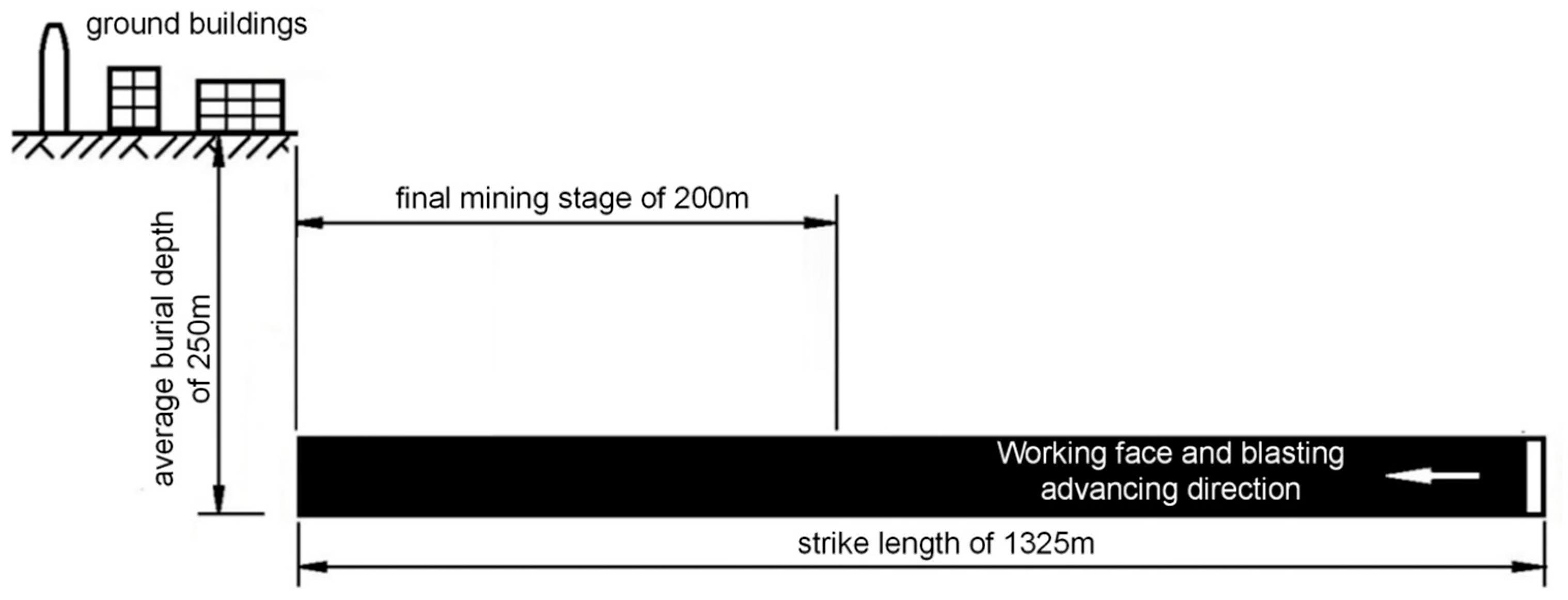
Within the effective range of blasting propagation, it is necessary to monitor and analyze the influence of blasting vibrations on buildings and take relevant measures to minimize the hazards the blasting. Figure 1 presents a schematic figure of ground buildings and advancing blast. The coal seam is classified as an extra-thick coal seam, with a thickness of 10.85–22.67 m and an average thickness of 16.4 m. The average burial depth is 250 m. The working face direction length is 1325 m, and the distance within 200 m of the buildings is defined as the final mining stage.
The main monitoring components of blast weakening vibrations are the vibration velocity of the ground monitoring points and the main vibration frequency under the blasting seismic wave, etc. The NUBOX-8016 intelligent monitoring instrument (Tuopu Measurement & Control Technology Co., Ltd., Chengdu, China) of blasting vibrations was used for measurement. This system includes a meter host for blasting vibrations, a three-dimensional velocity sensor, and a signal connector. The meter host can collect the vibration velocity, duration, and main frequency of the blasting seismic wave at various monitoring points. Three directions, including x, y, and z, are measured using the sensor with three respective channels. The sensor and the meter host are connected through special signal lines. The parameters are adjusted. Then, the blasting vibrations can be monitored and recorded. Finally, the software is used to process, analyze and output the monitoring results.
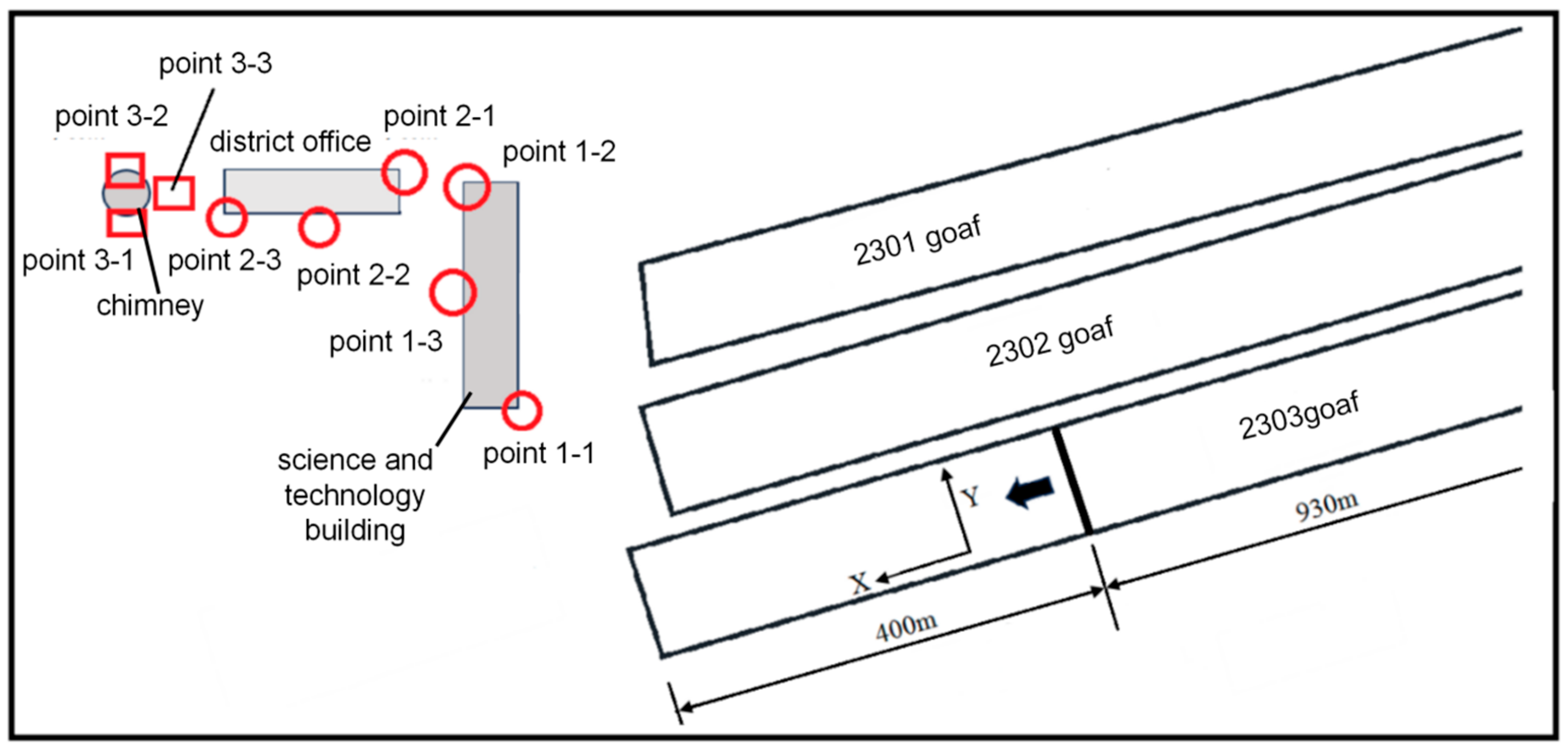
The 2303 working face has advanced about 930 m and remained at about 400 m in the stage of vibration monitoring. Because the ground seismic is already strong, it will cause damage to ground buildings or equipment due to the blasting vibrations. Therefore, the ground vibrations caused by the blast weakening in the 2303 working face of the remaining 400 m are monitored. The layout of monitoring points needs to consider the situation of the ground buildings. In this paper, the monitoring points are arranged on a representative industrial chimney (masonry structure), a six-story district office (frame structure), and a four-story science and technology building (frame structure). Figure 2 presents a schematic figure of ground vibration monitoring for blast weakening at the remaining 400 m of the 2303 working face. Monitoring point 1 monitors the science and technology building. Points 1-1 and 1-2 are located in the two diagonal vertices of the science and technology building and are facing the blast. Point 1-3 is located in the front middle of the building with its back to the blast. Monitoring point 2 monitors the district office and all points facing the blast. Points 2-1 and 2-3 are located in the two diagonal vertices of the district office. Point 2-2 is located in the front middle of the district office. Monitoring point 3 monitors the industrial chimney, and all of the points face the blast. Points 3-1 and 3-2 are located in the front and at the sides of the chimney. Point 3-1 is located in the front middle of the chimney.

2.2. Establishment of a Numerical Model

The numerical calculation model of a three-dimensional “explosive stratum building” is established using a method similar to that used for the geological conditions of the Panjin coal mine. The blasting vibrations of the 2303 working face at the remaining 400 m are simulated and compared with the field monitoring data. The correctness of the numerical model is verified. Therefore, the model is used to simulate the influence of blasting vibrations on buildings final mining stage within 200 m of the advancing distance to working face, which ensurse safe production and improves the mining rate of producing top coal in the final mining stage.
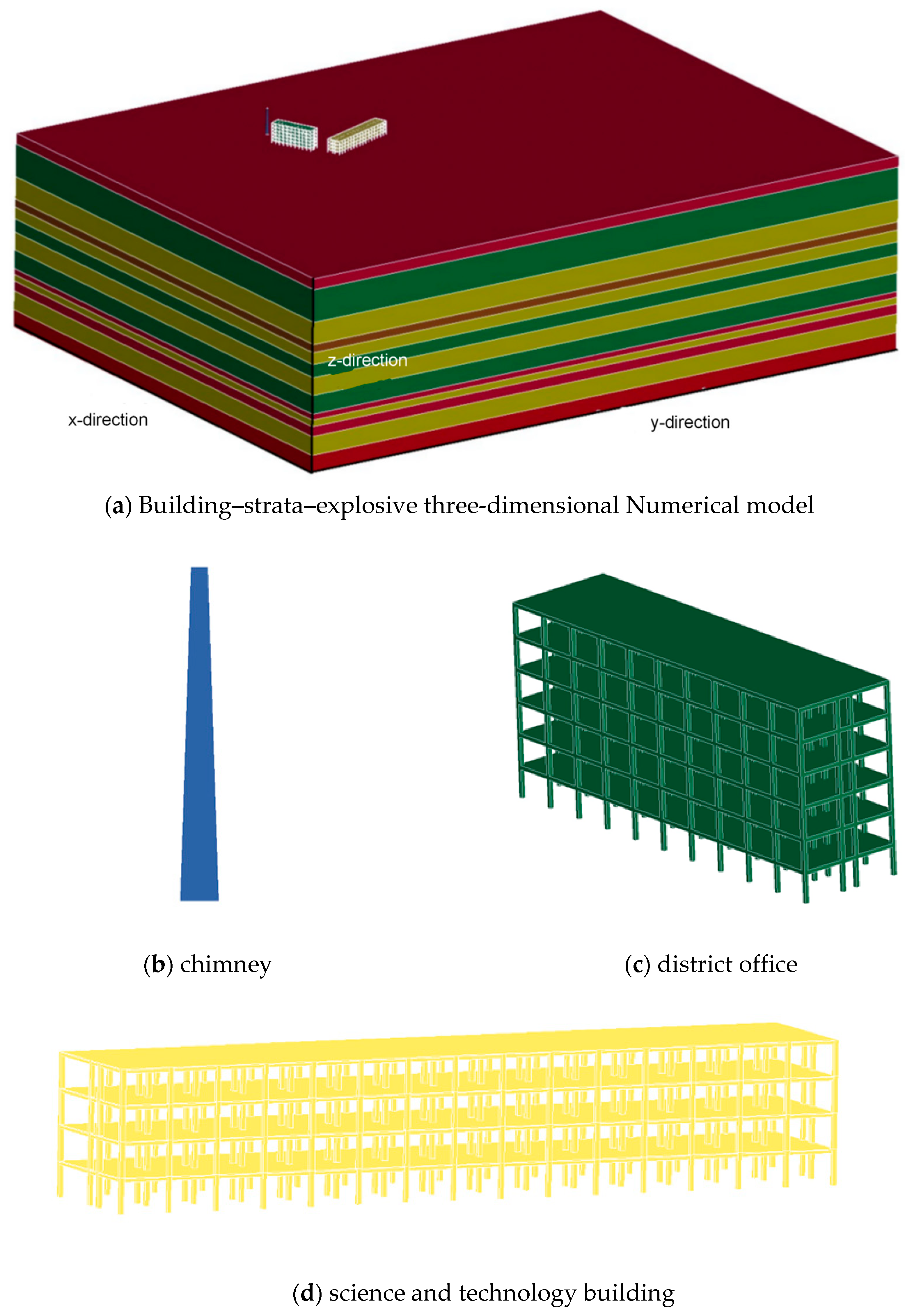
In the numerical model, the geometric similarity ratio Ch is the ratio of actual thickness to the simulated thickness of the coal seam or rock layer, which is taken as 10. The similarity ratio of time Ct and velocity Cv is C h   =   3 .162. Due to using the same type of model, the similarity ratio of bulk density and elastic modulus is 1. Considering the influence of the charge on buildings, the blast hole is treated with an equivalent concentrated charge [34,35,36,37,38]. A similar model of 60 m × 100 m × 25 m is established and analyzed using ANSYS/LS-DYNA software, taking into account the thickness and model size of each simulated layer. The stratum and building models are shown in Figure 3. Because we used the unit system of g-cm- μ s , the stress unit is Mbar (1 Mbar = 1 × 10¹¹ Pa) and the velocity unit is 1 × 106 cm/s.
The surroundings and the bottom of the model are set as non-reflective boundary conditions to simulate the infinite region, and the ground (the top of the model) is set as a freed boundary. The chimney, the district office, and the science and technology building are fixed on the ground through the keyword CONTACT_AUTOMATIC_SURFACE_TO_SURFACE. Ground buildings, stratum and air are modeled using the Solid164 solid element. The maximum grid size is controlled within 0.4 m to meet the accuracy requirements of the wavelength of 1/10–1/8. The size of the stratum grid is relatively sparse, and the size of the building unit is refined to 2.5 cm. Local densification processing is used for the area around the blast hole and provides the connection between the stratum and buildings [39]. C25 concrete is adopted as the building material for the science and technology building and the district office, and the brick level of the chimney is MU15. The overall continuous model is used for analysis. The MAT_JOHNSON_HOLMQUIST_CONCRETE model is used for the rock and building materials; this model is widely used for blasting calculations. The rock’s physical and mechanical parameters are shown in Table 1.
Three scientists—Jones, Wilkins and Lee—have conducted in-depth research on the explosion phenomenon. Based on the experimental data and theoretical analysis, a Jones–Wilkins–Lee model describing explosive behavior is proposed as shown in Equation (1), in which the relationship between the pressure, volume, and energy release of material is established.
P = A 1 ω R 1 v e R 11 v + B 1 ω R 2 v e R 21 v + ω E 0 v ,
where: P represents the detonation pressure of detonation gas, MPa; v represents the relative volume, m3; E0 is the initial specific internal energy, J·cm−3; and A, B, R11, R21, are constants.
The Panjin coal mine adopts the allowable emulsion explosive of a secondary coal mine. Explosive parameters and JWL state equation parameters are shown in Table 2.

3. Dynamic Response Analysis of Ground Buildings Under Blasting

3.1. The Analysis of Field Monitoring of Blast Weakening Vibrations

The vibrations near ground buildings is monitored during the blast weakening of top coal according to the above monitoring scheme. The results of vibration monitoring are shown in Table 3. (The automatic trigger of monitoring point 2-3 does not reach 0.051 cm/s, which does not monitor the data. Therefore, it is not displayed).
The analysis shows that the main frequency of blasting vibrations is between 8.5 and 20 Hz, and results below 10 Hz account for a large proportion. According to ‘Blasting Safety Regulations’ [40], when the main frequency is within 10 Hz, the allowable value of vibration velocity is 1.5 cm/s. The blasting site is far away from the monitoring points. Therefore, the peak value of the vibration velocity at each point is small. The maximum value does not exceed 0.2 cm/s, which is less than the allowable value 1.5 cm/s of blasting vibrations. When the 2303 working face advances to the remaining 400 m, the underground blast weakening uses about 170 kg of the emulsion explosive for a three-level coal mine. The ground buildings are not affected and remain in a safe state. The prediction of blasting vibration velocity is carried out using the Sadovsky formula [41,42,43,44,45]. The ORIGIN is used for fitting according to the peak velocity of the Z-direction in Table 2. The attenuation coefficient α is 1.4, and the empirical coefficient K is 164.34. Equation (2) can be obtained by substituting α and K into the Sadovsky formula:
V = 164.34 ( Q 1 3 R ) 1.4 ,
where V is the allowable safe velocity of blasting vibrations, cm/s, and Q is the explosive charge. The total charge is taken during one blast, and the maximum charge is taken during segmented delayed blasting, kg. R is the distance from the blasting center to the monitoring point, m.
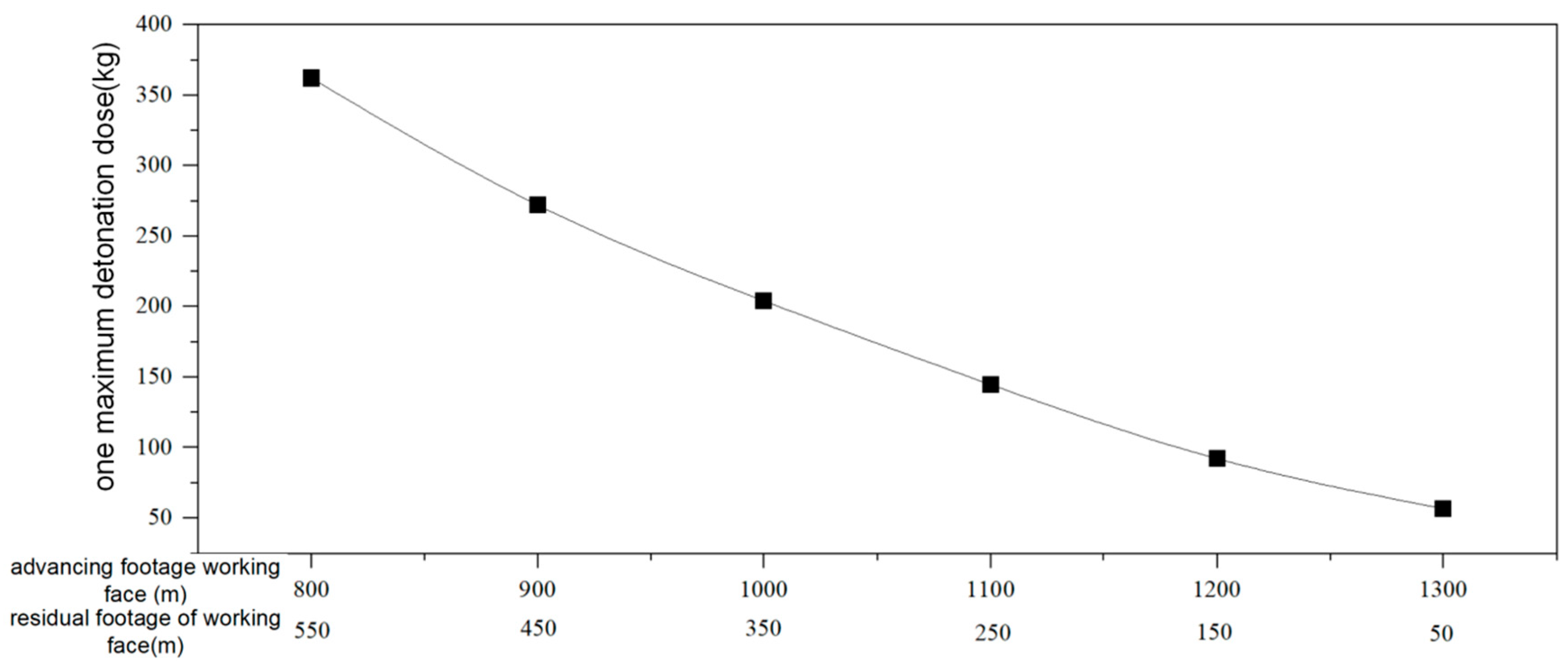
According to Equation (1), the relationship between the advancing distance of the working face and the maximum safe charge of one blast can be obtained from Figure 4.
It can be seen from Figure 4 that the remaining distance of the working face is 550 m and the maximum charge of one blast is 330 kg when the working face advances to 800 m. At present, the charge of one blast in the coal mine is too low. Therefore, it can be appropriately increased to enhance the blast weakening effect of top coal. The maximum charge of one blast decreases with increasing distance from the working face, exhibiting an exponential relationship. When the working face is advanced to 900–1000 m, 1000–1100 m, 1100–1200 m, and 1200–1300 m, the maximum charge of one blast is no more than 200 kg, 145 kg, 90 kg, or 55 kg, respectively. It can be concluded that when the blasting site advances to the final mining stage of the last 200 m of the working face, the maximum charge of one blast, corresponding to the advancing distance, can be determined according to Figure 4 and used in a numerical calculation model.

3.2. Analysis of the Influence of Buildings Under Residual Footage Blasting

The established numerical model is used to simulate the blasting of 170 kg of explosive at the remaining 400 m of the working face, and data are obtained from each monitoring point. The representative data of the monitoring points are selected for comparison with the field monitoring data to verify the accuracy of the model, as shown in Table 4.
From the table, the maximum error between the field monitoring data and the numerical simulation data of selected monitoring points is 13.9%. The heterogeneity of rock and soil mass, the geological structure, and the influence of the top mined area cannot be considered in a numerical calculation process. Therefore, the error of the numerical simulation data is within an acceptable range for engineering. In summary, the numerical calculation model and parameters are accurate and can be used to analyze and evaluate the impact of blasting on the vibrations of ground buildings in the final mining stage of the working face.
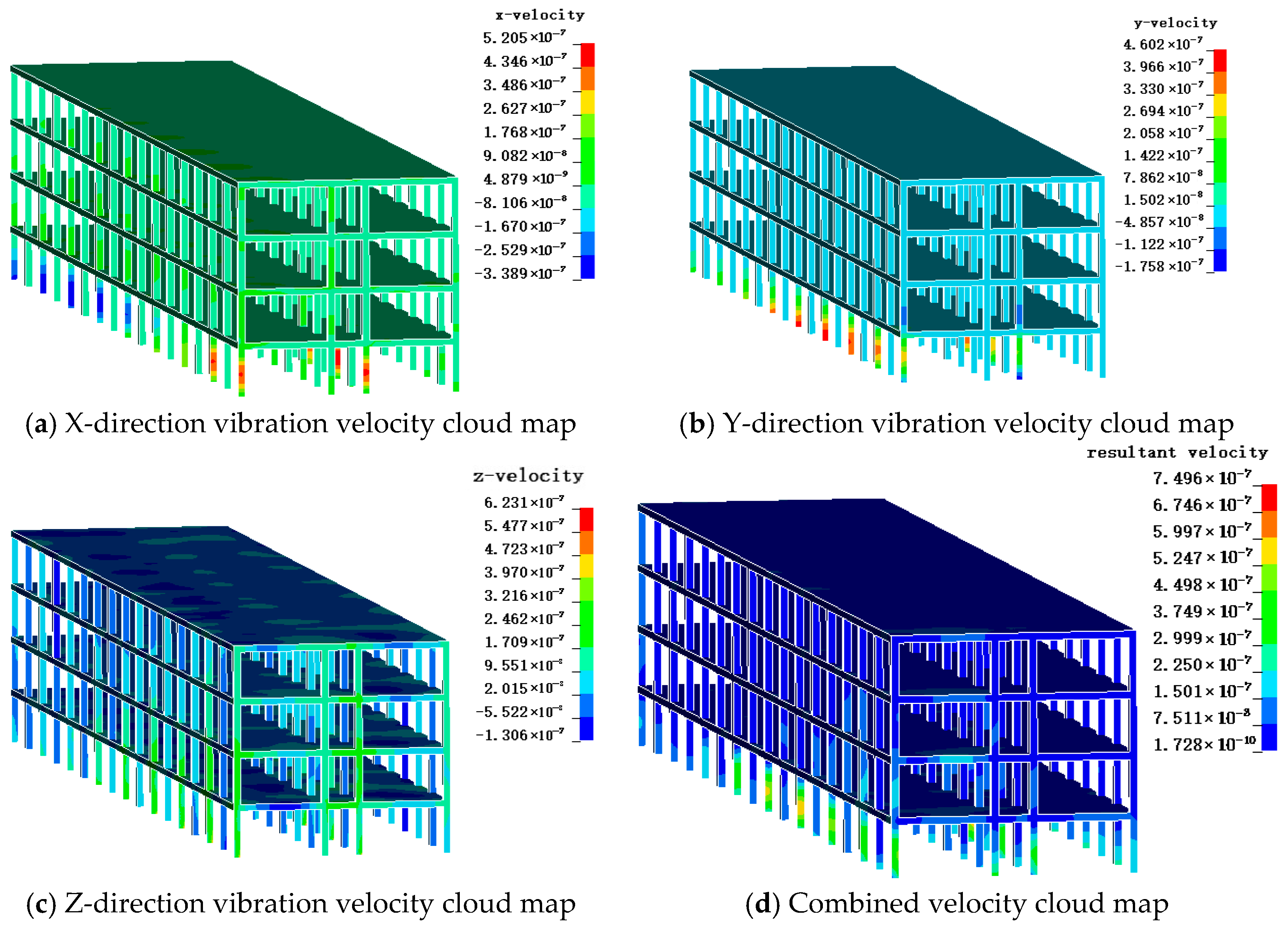
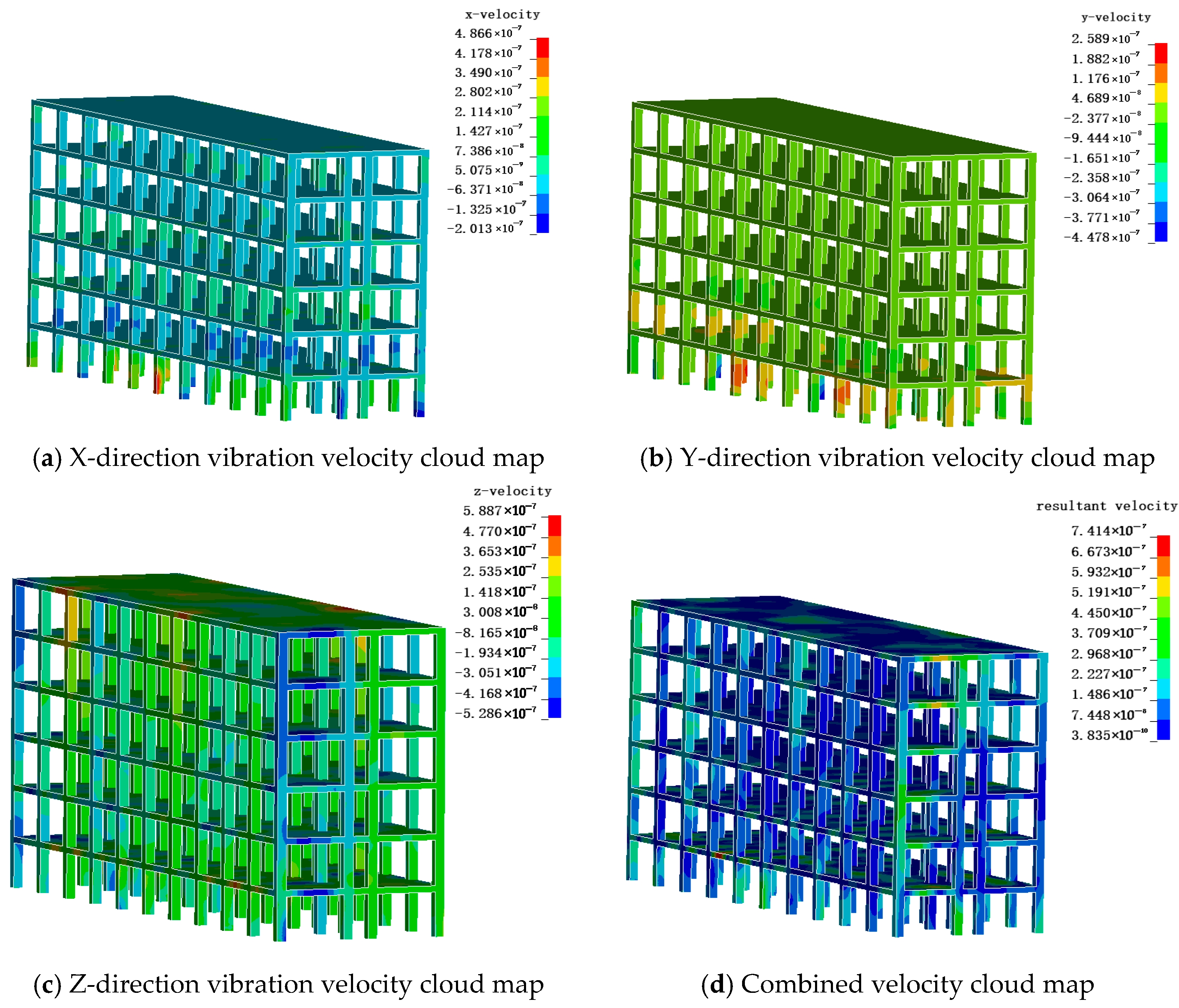
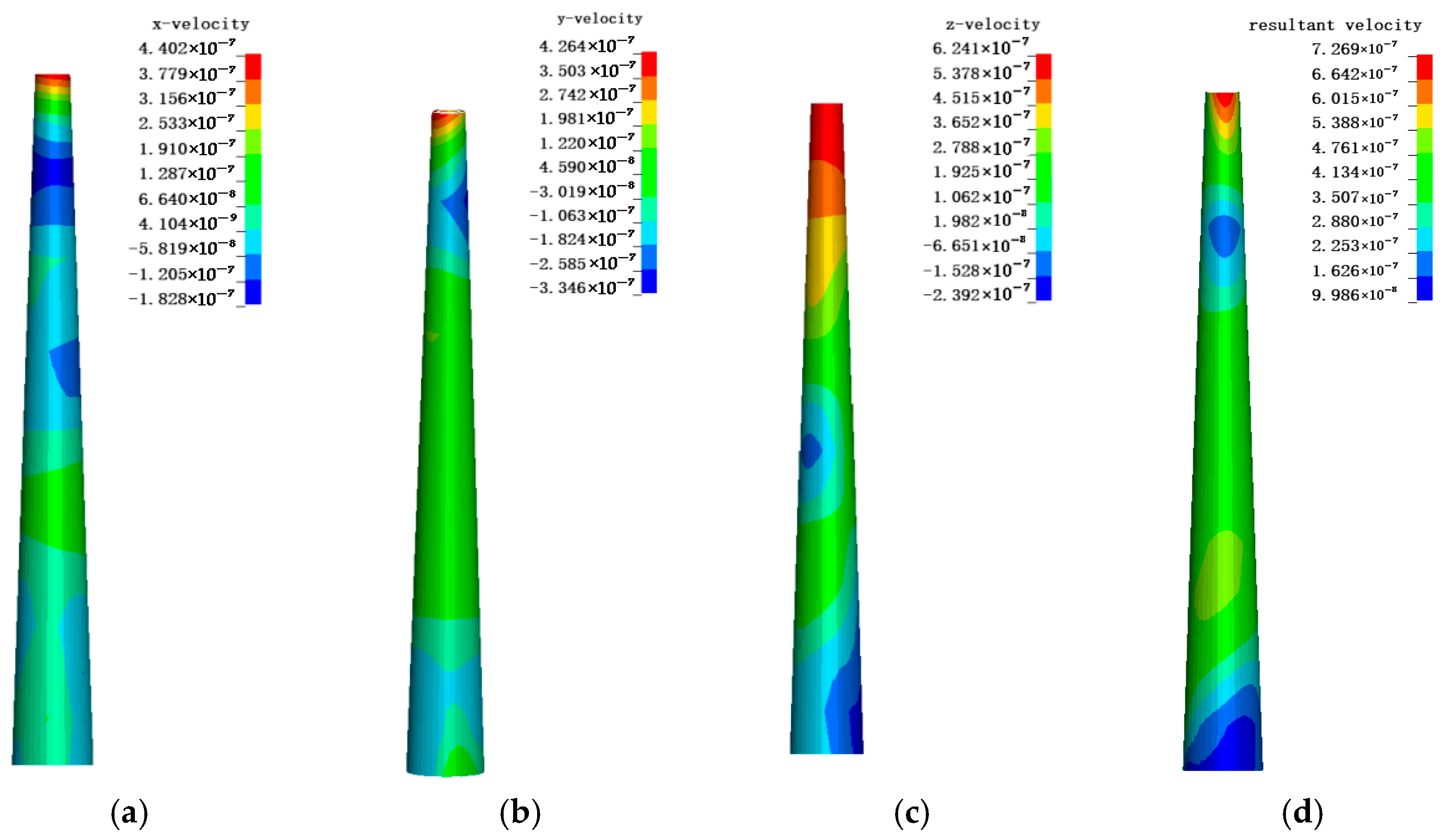
According to Figure 4, when the remaining footage of the working face is 200 m, the maximum charge of one blast is 130 kg. Figure 5, Figure 6 and Figure 7 are the cloud maps of the vibration velocity of different buildings under this situation. From the figure, the maximum vibration velocities in the X, Y, and Z directions in the science and technology building are 0.521 cm/s, 0.462 cm/s, and 0.623 cm/s, respectively, and are all located on the bottom story. The Z-direction velocity is the largest of the three directions. The maximum combined velocity is 0.75 cm/s, which is located at the bottom of the frame column. The maximum vibration velocities in the X and Y directions in the district office are 0.487 cm/s and 0.448 cm/s, respectively, and are located at the contact position between the bottom story of the frame column and the ground. The horizontal vibration velocity decreases as the story rises. The Z-direction vibration velocity of the roof and the bottom of the frame column are large, and the maximum velocity is 0.589 cm/s near the roof. The maximum combined velocity is 0.741 cm/s at the contact position between the roof and the frame column. The maximum vibration velocities in the X, Y, and Z directions, respectively, and the maximum combined velocities in the chimney are 0.44 cm/s, 0.426 cm/s, 0.624 cm/s, and 0.727 cm/s, which are all located on the roof. This is because the roof of the chimney is weakly constrained by the ground, and the roof has a significant amplification effect.
Combined with the cloud maps of the vibration velocity in all directions, the vibration velocity in the Z-direction is higher than in the X and Y directions. Therefore, the buildings are dominated by vertical vibration. The maximum vibration velocity of the ground in the three directions is within the range of 0.8, which is required by the ‘Blasting Safety Regulations’. The buildings are therefore all in a safe state.
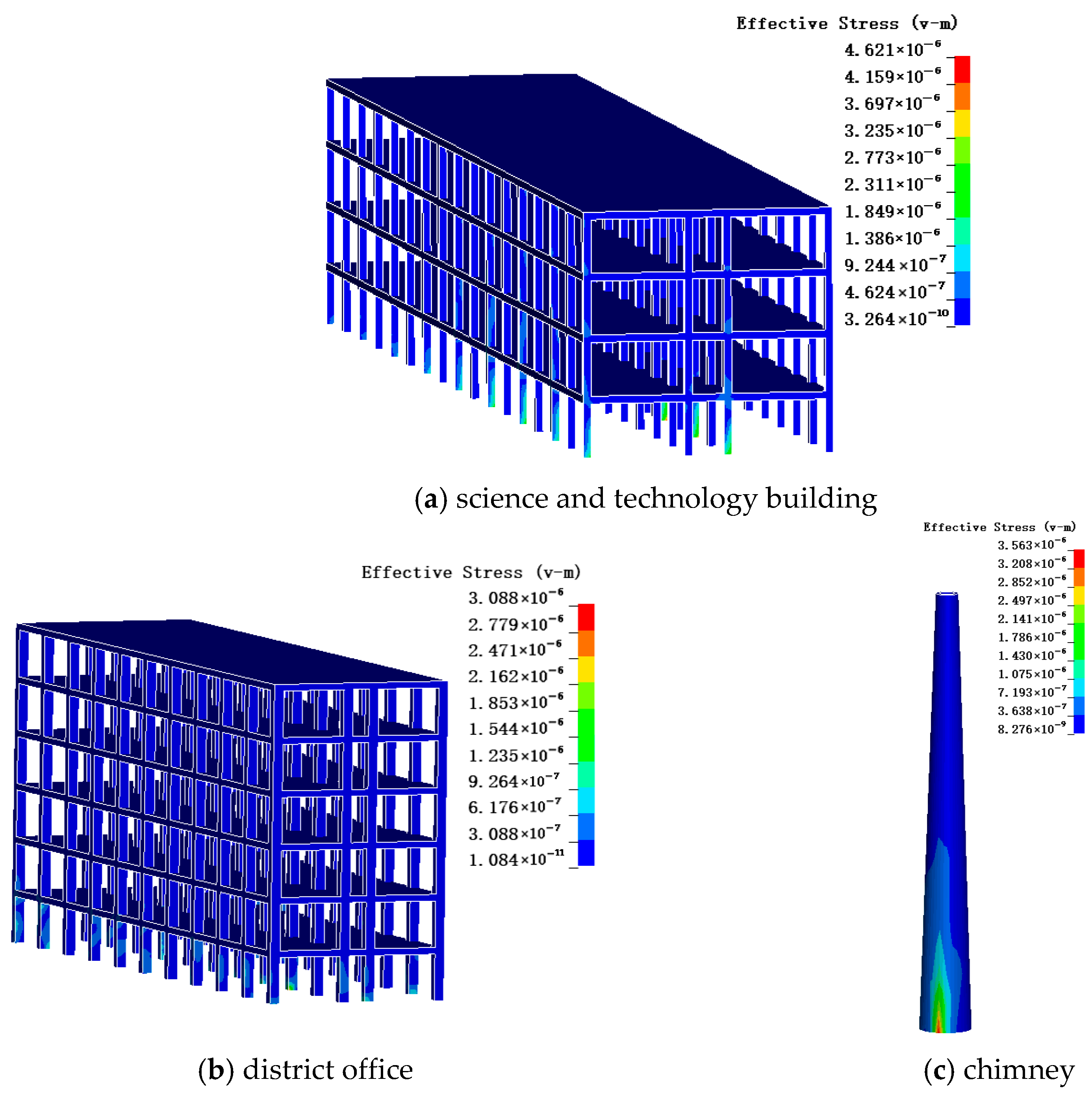
Figure 8 shows the cloud map of the maximum effective stress of the buildings under blasting load. The maximum effective stresses of the science and technology building, the district office, and the chimney are 0.462 MPa, 0.309 MPa, and 0.356 MPa, respectively, and are located at the bottom. The effective stress is the largest for the science and technology building, the second-largest for the chimney, and the smallest for the district office. This is because the science and technology building is close to the blasting site, and the chimney is a masonry structure, which is significantly affected by seismic waves. Combined with the vibration velocity, stress response, and building structure of the ground, the blasting effect has the greatest influence on the chimney compared with the other buildings.
In addition, the blasting numerical analysis is carried out at underground horizontal distances of 50 m, 100 m, 150 m, and 200 m from the buildings. Table 4 presents the influence of vibrations on the buildings under the blasting effect for different remaining distances. The M(kg) explosive blasting under the remaining footage N(m) of the working face is named M-N in this table. It can be seen that the maximum vibration velocity in the buildings’ three directions is 0.72 cm/s, and the maximum effective stress is 0.537 MPa. Therefore, the buildings can be considered safe. Comparing the three different buildings, the ground vibration velocity is the largest for the district office, second-largest for the chimney, and smallest for the science and technology building. Based on the structure and stress response of buildings, the chimney, as a high-rise masonry structure, is greatly affected by the blasting effect.
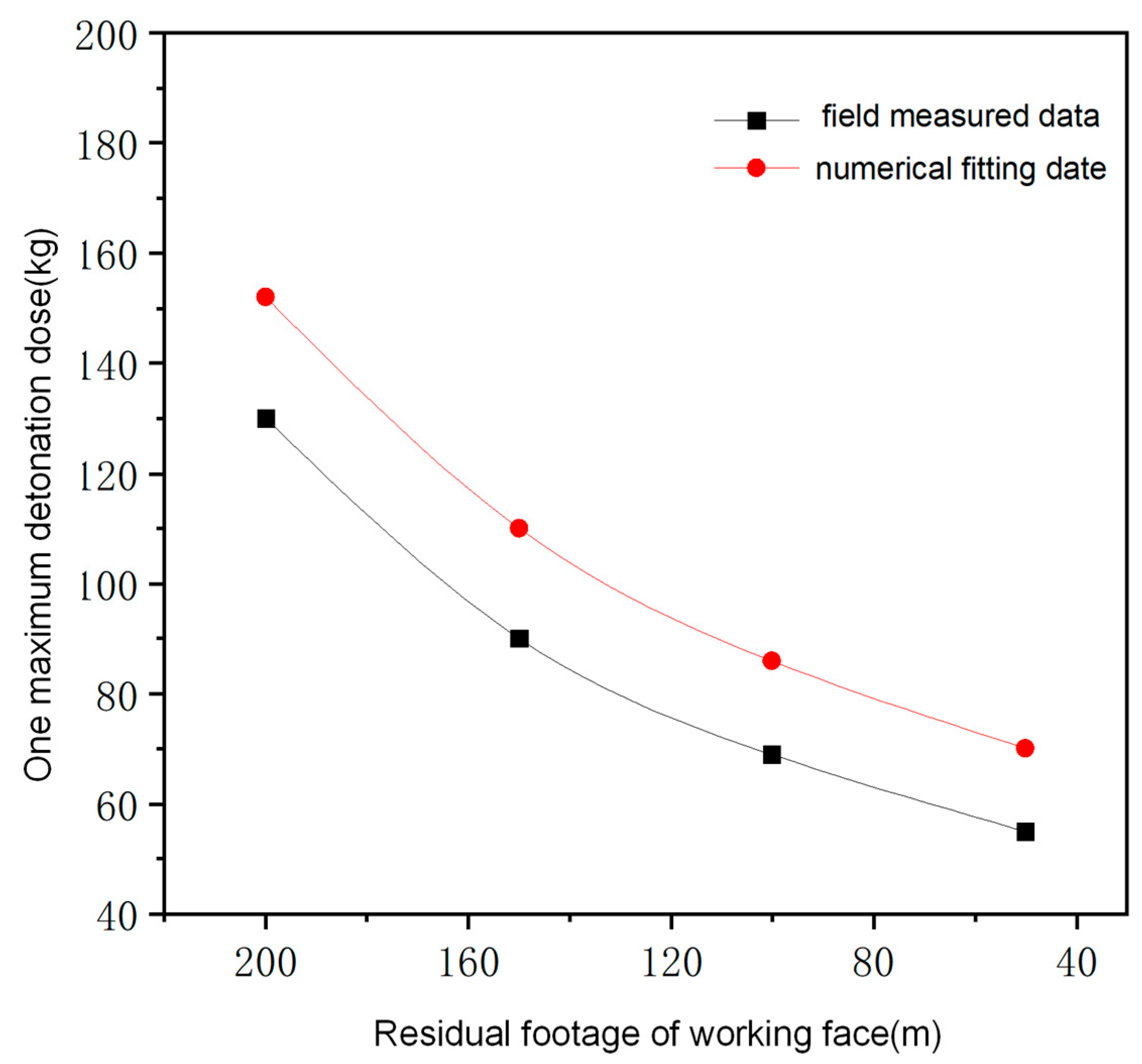
According to Table 5, the Sadovsky formula is derived from four sets of numerical simulation results. The relationship between the remaining footage of the working face and the maximum safe charge of one blast is obtained. It is compared with the maximum safe charge obtained using the Sadovsky formula for the measured field, as shown in Figure 9.
The consistency between the numerical simulation fitting curve and field monitoring data can be seen in the figure. Both show that the maximum safe charge of one blast decreases with the increase of the advancing distance from the working face. However, the maximum charge of one blast obtained using field monitoring data is lower than that of the numerical calculation fitting analysis. Therefore, when the blasting distance is small, the Sadovsky formula used to predict the maximum charge of one blast is small, and the calculation result is safe.

4. Conclusions

Based on the background of the shallow-buried and extra-thick coal seam of Panjin, this paper verifies both field monitoring data and a numerical model against each other. Then, it examines the influence of blasting vibrations on buildings at different advancing distances from the working face.
(1) The maximum error between the established numerical model and field monitoring data is 13.9% for the remaining 400 m of the working face. Therefore, the model can be used to analyze and evaluate the influence of underground blasting on the vibrations of ground buildings in the final mining stage of the working face. The peak value of vibration velocity at each point does not exceed 0.185 cm/s in the field monitoring data, which is less than the allowable safety value for blasting vibrations.
(2) The maximum vibration velocity of the three building directions obtained by numerical simulation is 0.72 cm/s within 200 m of the final mining stage, which is within the allowable range of 0.8 cm/s required by the ‘Blasting Safety Regulations’. The ground vibration velocity is the largest for the district office, second-largest for the chimney, and smallest for the science and technology building. The chimney, as a high-rise masonry structure, is the most susceptible to blasting.
(3) The regression curves of the numerical simulation and the field monitoring data exhibit significant consistency, and the maximum safe charge of one blast decreases as the working face advances. The maximum charge of one blast obtained from field monitoring data is lower than the numerical calculation. When the blasting distance is close, the Sadovsky formula used to predict that the maximum charge of one blast is small, and the calculation result is safe.

Author Contributions

Conceptualization, G.L. and G.N.; methodology, G.L., Z.L., Y.L. and W.Q.; investigation, G.L., Z.L., Y.L., G.N. and W.Q.; writing-original draft, Z.L. All authors have read and agreed to the published version of the manuscript.

Funding

This work was supported by the National Key Research and Development Program of China (Grant No. 2024YFF0507903) and the National Natural Science Foundation of China (Grant No. 52208395).

Institutional Review Board Statement

Not applicable.

Informed Consent Statement

Not applicable.

Data Availability Statement

The data presented in this study are available on request from the corresponding author. The data are not publicly available due to privacy.

Conflicts of Interest

The authors declare that they have no known competing financial interests or personal relationships that could have appeared to influence the work reported in this paper.

References

  1. Wang, H.W.; Wu, Y.P.; Jiao, J.Q.; Cao, P. Stability mechanism and control technology for fully mechanized caving mining of steeply inclined extra-thick seams with variable angles. Min. Metall. Explor. 2021, 38, 1047–1057. [Google Scholar] [CrossRef]
  2. Tan, Y.; Xu, H.; Yan, W.; Guo, W.; Sun, Q.; Yin, D.; Zhang, Y.; Zhang, X.; Jing, X.; Li, X.; et al. Development law of water-conducting fracture zone in the fully mechanized caving face of gob-side entry driving: A case study. Minerals 2022, 12, 557. [Google Scholar] [CrossRef]
  3. Hua, X.Z.; Zhang, J.L.; Xie, G.X. The study on the characteristics of ground pressure behaviors in thick seam coal faces. Sci. Saf. Technol. 2007, 2007(Pts A and B), 189–193. [Google Scholar]
  4. Liu, J.; Chen, S.; Wang, H.; Li, Y.C.; Geng, X. The migration law of overlay rock and coal in deeply inclined coal seam with fully mechanized top coal caving. J. Environ. Biol. 2015, 36, 821–827. [Google Scholar]
  5. Remennikov, A.M.; Rose, T.A. Modelling blast loads on buildings in complex city geometries. Comput. Struct. 2005, 83, 2197–2205. [Google Scholar] [CrossRef]
  6. Smith, P.D.; Rose, T.A. Blast wave propagation in city streets—An overview. Prog. Struct. Eng. Mater. 2006, 8, 16–28. [Google Scholar] [CrossRef]
  7. Cheng, W.; Ye, W.; Chen, X.; Zhou, Z.; Wu, Y. Effect of the rock blasting sequence on buildings adjacent to the hehui expressway. Soil. Mech. Found. Eng. 2024, 61, 170–176. [Google Scholar] [CrossRef]
  8. Su, D.; Kang, Y.; Li, D.; Wang, X.; Yan, F. Analysis and numerical simulation on the reduction effect of stress waves caused by water jet slotting near blasting source. Shock. Vib. 2016, 2016, 18. [Google Scholar] [CrossRef]
  9. Soltys, A.; Pyra, J. The influence of vibrations induced by blasting works in an open-pit mine and seismic events in an underground mine on building structures-a case study. Appl. Sci. 2024, 14, 4414. [Google Scholar] [CrossRef]
  10. Soltys, A. Assessment of the impact of blasting works on buildings located in the vicinity of open-pit mines using matching pursuit algorithm. Arch. Min. Sci. 2020, 65, 199–212. [Google Scholar] [CrossRef]
  11. Baek, S.K.; Choo, S.Y.; Yoon, J.O.; Baek, U.I.; Park, H.S. Case study of blasting pattern design for tunnelling in which considered blast induced vibration affected across buildings. Tunn. Undergr. Space 2006, 5, 377–386. [Google Scholar]
  12. Qi, J.L.; Yin, Z.Q.; Wu, K.B. Study on the effect of geophysical blasting vibration on buildings. In Proceedings of the 2016 5th International Conference on Energy and Environmental Protection (Iceep 2016), Sanya, China, 21–23 November 2016; Volume 98, pp. 802–806. [Google Scholar]
  13. Karakus, D.; Pamukcu, C.; Onur, A.H. Investigation of the effect of ground vibration on buildings due to blasting. Arch. Min. Sci. 2010, 55, 123–140. [Google Scholar]
  14. Roy, M.P.; Singh, P.K.; Sarim, M.; Shekhawat, L.S. Blast design and vibration control at an underground metal mine for the safety of surface structures. Int. J. Rock Mech. Min. Sci. 2016, 83, 107–115. [Google Scholar] [CrossRef]
  15. Shi, X.; Qiu, X.; Zhou, J.; Huang, D.; Chen, X.; Gou, Y. A comparative study of ground and underground vibrations induced by bench blasting. Shock Vib. 2016, 2016, 9. [Google Scholar] [CrossRef]
  16. Cao, Y.; Yi, C.P.; Liang, K.S. Influence of frequency of blasting seismic wave on critical vibration velocity of underground chamber. Min. Sci. Saf. Technol. 2007, 2007(Pts A and B), 826–830. [Google Scholar]
  17. Xie, L.; Lu, W.; Gu, J.; Wang, G.; Pellicano, F. Excavation method of reducing blasting vibration in complicated geological conditions. Shock Vib. 2018, 2018, 12. [Google Scholar] [CrossRef]
  18. Jin, X.G.; Yan, Q.; Zhang, Y.X.; Liu, W. Test on blasting vibration of neighborhood tunnel and discussion of safety vibration velocity. Saf. Sci. Technol. 2005, 5(Pts A and B), 787–793. [Google Scholar]
  19. Feng, X.; Zhang, Q.; Ali, M. Explosion-induced stress wave propagation in interacting fault system: Numerical modeling and implications for chaoyang coal mine. Shock Vib. 2019, 2019, 12. [Google Scholar] [CrossRef]
  20. Yang, J.H.; Lu, W.B.; Jiang, Q.H.; Yao, C.; Zhou, C. Frequency comparison of blast-induced vibration per delay for the full-face millisecond delay blasting in underground opening excavation. Tunn. Undergr. Space Technol. 2016, 51, 189–201. [Google Scholar] [CrossRef]
  21. Chen, M.; Lu, W.B.; Shu, D.Q. Research on blasting vibration safety assessment parameters. Trends Civ. Eng. 2012, 446–449(Pts 1–4), 582–587. [Google Scholar] [CrossRef]
  22. Zhang, G.; Wang, M.; Yang, R.; Si, K. Blasting vibration hazard classification and prediction research. Adv. Mech. Eng. 2023, 15, 13. [Google Scholar] [CrossRef]
  23. Yang, S.; Ning, J.; Xu, X. Fragment theoretical model of concrete blocks subjected to blast loads. Int. J. Impact Eng. 2023, 176, 12. [Google Scholar] [CrossRef]
  24. Gong, J.; Wang, Q.; Nie, B.; Ge, Z. Experimental study on ground vibration caused by the blast loading of an explosion vessel. Int. J. Struct. Stab. Dyn. 2022, 22, 2250003. [Google Scholar] [CrossRef]
  25. Fan, C.H.; Ge, J.F. Dynamic calculation method of vibration response of building blasting based on differential equation. Environ. Technol. Innov. 2020, 20, 12. [Google Scholar] [CrossRef]
  26. Xia, H.B.; Xu, Y.; Zhang, Y.J. Numerical simulation and experimental analysis of roadway surrounding rock loose circle under blasting vibration. In Proceedings of the Fourth International Conference on Digital Manufacturing and Automation (Icdma), Qingdao, China, 29–30 June 2013; pp. 850–854. [Google Scholar] [CrossRef]
  27. Park, Y.H.; Yun, S.; Jang, I. Blast analysis and damage evaluation for reinforced concrete building structures. Ksce J. Civ. Environ. Eng. Res. 2021, 4, 331–340. [Google Scholar]
  28. Tian, X.; Song, Z.; Wang, J. Study on the propagation law of tunnel blasting vibration in stratum and blasting vibration reduction technology. Soil Dyn. Earthq. Eng. 2019, 126, 12. [Google Scholar] [CrossRef]
  29. Choi, B.; Ryu, C. Explosion modelling for crack propagation near blast holes in rock plate. Explos. Blasting 2015, 1, 13–20. [Google Scholar]
  30. Guo, W.; Bi, W.; Ren, S. Simulation analysis of frame structure acceleration response in subway buried blasting. In Proceedings of the 5th International Conference on Environmental Science and Civil Engineering (Esce2019), Nanchang, China, 13–14 April 2019; Volume 283, p. 012048. [Google Scholar] [CrossRef]
  31. Gao, W.L.; Huang, B.; Wang, C. Numerical simulation of soil-structure dynamic interaction system under blasting load. Ind. Civ. Eng. 2012, 204–208 Pts 1–5, 303–307. [Google Scholar] [CrossRef]
  32. Ji, X.; Gao, S.; Zhao, H.; Liu, G.; Zeng, Q. Research on the influence of the number of tunnel blasting free faces on ground vibration based on ansys/lsdyna. In Proceedings of the Sixth International Conference on Electromechanical Control Technology and Transportation (ICECTT 2021), Chongqing, China, 14–16 May 2021; Volume 9, pp. 526–534. [Google Scholar] [CrossRef]
  33. Gong, W.Z.; Duan, B.; Zhang, X.W.; Shen, S.Z.; Sun, K. Vibration response analysis of masonry building under the action of tunnel blasting seismic wave. Sci. Technol. Eng. 2019, 19, 377–383. [Google Scholar]
  34. Yuan, P.; Xu, Y.; Zheng, Z. Time-frequency analyses of blasting vibration signals in single-hole blasting model experiments. J. Vibroeng. 2017, 19, 363–375. [Google Scholar] [CrossRef]
  35. Torano, J.; Rodriguez, R.; Diego, I.; Rivas, J.M.; Casal, M.D. Fem models including randomness and its application to the blasting vibrations prediction. Comput. Geotech. 2006, 33, 15–28. [Google Scholar] [CrossRef]
  36. Kucewicz, M.; Baranowski, P.; Malachowski, J. Dolomite fracture modeling using the johnson-holmquist concrete material model: Parameter determination and validation. J. Rock Mech. Geotech. Eng. 2021, 13, 335–350. [Google Scholar] [CrossRef]
  37. Pajak, M.; Baranowski, P.; Janiszewski, J.; Kucewicz, M.; Mazurkiewicz, Ł.; Łaźniewska-Piekarczyk, B. Experimental testing and 3d meso -scale numerical simulations of scc subjected to high compression strain rates. Constr. Build. Mater. 2021, 302, 21. [Google Scholar] [CrossRef]
  38. Olaleye, K.; Pyka, D.; Bocian, M.; Jamroziak, K. Numerical modelling of an impact resistance analysis of en c45 steel pipe buried beneath the ground surface loaded with a detonation wave generated by an explosion of a cubic tnt charge. Phys. Conf. Ser 2024, 2647, 082006. [Google Scholar] [CrossRef]
  39. Baranowski, P.; Mazurkiewicz, L.; Malachowski, J. Experimental testing and numerical simulations of blast-induced fracture of dolomite rock. Meccanica 2020, 55, 2337–2352. [Google Scholar] [CrossRef]
  40. GB 6722-2014; Safety Regulations for Blasting. Emergency Management Press: Weston, MA, USA, 2014.
  41. Li, H.Y.; Xia, M.Z.; Wu, J.; Guo, D.Y. Modifying sadov’s empirical formula for group-hole blasting in open-pit mine conditions. Int. J. Geomech. 2023, 23, 10. [Google Scholar] [CrossRef]
  42. Li, X.; Hu, H.; He, L.; Li, K. An analytical study of blasting vibration using deep mining and drivage rules. Clust. Comput.-J. Netw. Softw. Tools Appl. 2017, 20, 109–120. [Google Scholar] [CrossRef]
  43. Shi, J.; Guo, S.; Zhang, W. Expansion of blast vibration attenuation equations for deeply buried small clearance tunnels based on dimensional analysis. Front. Earth Sci. 2022, 10, 7. [Google Scholar] [CrossRef]
  44. Pyka, D.; Kurzawa, A.; Zochowski, P.; Bajkowski, M.; Magier, M.; Grygoruk, R.; Roszak, M.; Jamroziak, K.; Bocian, M. Experimental and numerical research on additional vehicles protection against explosives. Arch. Civ. Mech. Eng. 2025, 25, 20. [Google Scholar] [CrossRef]
  45. Gao, Y.; Fu, H.; Rong, X.; Paneiro, G. Ground-borne vibration model in the near field of tunnel blasting. Appl. Sci. 2023, 13, 87. [Google Scholar] [CrossRef]
Figure 1. Propulsion schematic figure of the fully mechanized caving face and blast weakening.
Applsci 15 08364 g001
Figure 2. Monitoring of blasting vibrations.
Applsci 15 08364 g002
Figure 3. The numerical calculation model.
Applsci 15 08364 g003
Figure 4. The relationship between the maximum safe charge of one blast and the advancing distance of the working face.
Applsci 15 08364 g004
Figure 5. The vibration velocity cloud map of the science and technology building.
Applsci 15 08364 g005
Figure 6. The vibration velocity cloud map of the district office.
Applsci 15 08364 g006
Figure 7. The vibration velocity cloud map of the chimney. (a) X-direction vibration velocity cloud map, (b) Y-direction vibration velocity cloud map, (c) Z-direction vibration velocity cloud map, (d) Combined velocity cloud map.
Applsci 15 08364 g007
Figure 8. The maximum effective stress cloud map of buildings.
Applsci 15 08364 g008
Figure 9. Comparison of numerical fitting analysis and field monitoring data.
Applsci 15 08364 g009
Table 1. Physical, mechanical, and building materials parameters.
RockDensity
g/m3
Uniaxial Compressive Strength MPaPoisson Ratio
fine sandstone2.537.80.3
silt stone2.5648.20.31
medium sandstone1.9524.60.28
grit stone2.4225.60.32
C252.4250.22
MU152.15150.2
Table 2. Explosive materials and JWL equation of state parameters.
Explosion
Velocity
m · s 1
A
GPa
B
GPa
R 11 R 21 ω E 0
GPa
3600214.40.1824.20.90.154.192
Table 3. Monitoring results of blasting vibrations.
Monitoring PointChannelVibration
Velocity Peak (cm/s)
Frequency
(Hz)
Combined Velocity (cm/s)Explosive Charge (kg)Z-Directiondistance
(m)
X-Directiondistance
(m)
Y-Directiondistance
(m)
Point 1-1X0.15112.810.281166.5196.3497326
Y0.15410.36
Z0.1819.77
Point 1-2X0.1568.550.285166.5196.3445496
Y0.1518.84
Z0.18510.74
Point 1-3X0.15212.820.286166.5196.3426492
Y0.16510.38
Z0.17614.65
Point 2-1X0.1569.160.284171203.5529441
Y0.17218.31
Z0.16410.98
Point 2-2X0.16610.260.282171203.5526443
Y0.16216.54
Z0.16111.25
Point 3-1X0.1689.160.298166.5208.5566398
Y0.1757.94
Z0.1749.22
Point 3-2X0.1545.4930.282166.5208.5473369
Y0.16820.14
Z0.1669.77
Point 3-3X0.1539.120.283171208.5437378
Y0.16418.31
Z0.1727.94
Table 4. Comparison of peak vibration velocity field data and simulation data.
Field
Monitoring Point
Measured Peak Vibration
Velocity (cm/s)
Simulated Vibration Velocity Peak (cm/s)Relative Error
XYZXYZXYZ
Point 1-10.1510.1540.1810.1330.1360.16411.9%9.4%10.5%
Point 2-10.1560.1720.1640.1360.1540.14813.2%10.5%9.8%
Point 1-30.1520.1650.1760.1380.1420.1589.2%13.9%10.2%
Table 5. Influence of blasting vibrations on buildings at different remaining footage distances.
Working ConditionScience and Technology BuildingDistrict OfficeChimney
200–130X: 0.521 cm/sX: 0.487 cm/sX: 0.440 cm/s
Y: 0.462 cm/sY: 0.448 cm/sY: 0.426 cm/s
Z: 0.623 cm/sZ: 0.589 cm/sZ: 0.621 cm/s
maximum effective stress0.462 MPa0.309 MPa0.356 MPa
150–90X: 0.581 cm/sX: 0.553 cm/sX: 0.511 cm/s
Y: 0.542 cm/sY: 0.525 cm/sY: 0.537 cm/s
Z: 0.636 cm/sZ: 0.608 cm/sZ: 0.621 cm/s
maximum effective stress0.534 MPa0.331 MPa0.401 MPa
100–75X: 0.633 cm/sX: 0.545 cm/sX: 0.595 cm/s
Y: 0.564 cm/sY: 0.539 cm/sY: 0.518 cm/s
Z: 0.684 cm/sZ: 0.619 cm/sZ: 0.653 cm/s
maximum effective stress0.537 MPa0.407 MPa0.467 MPa
50–55X: 0.701 cm/sX: 0.612 cm/sX: 0.657 cm/s
Y: 0.651 cm/sY: 0.618 cm/sY: 0.583 cm/s
Z: 0.719 cm/sZ: 0.665 cm/sZ: 0.680 cm/s
maximum effective stress0.464 MPa0.364 MPa0.427 MPa
Disclaimer/Publisher’s Note: The statements, opinions and data contained in all publications are solely those of the individual author(s) and contributor(s) and not of MDPI and/or the editor(s). MDPI and/or the editor(s) disclaim responsibility for any injury to people or property resulting from any ideas, methods, instructions or products referred to in the content.