Article

Development of Innovative Mediterranean-Style Semi-Hard Goat’s Cheese Supplemented with Seaweeds (Palmaria palmata and Ulva sp.) and Its Characterization


1
UCIBIO—Applied Molecular Biosciences Unit, Department of Chemistry, NOVA School of Science and Technology, NOVA University of Lisboa, 2829-516 Caparica, Portugal
2
LAQV-REQUIMTE—Associated Laboratory for Green Chemistry of the Network of Chemistry and Technology, Department of Chemistry, NOVA School of Science and Technology, NOVA University of Lisboa, Quinta da Torre, 2829-516 Caparica, Portugal
3
Sumol Compal, Estrada Nacional, 118, 2080-023 Almeirim, Portugal
4
Division of Aquaculture, Seafood Upgrading and Bioprospection, Portuguese Institute for the Sea and Atmosphere, I.P. (IPMA), 1495-006 Lisboa, Portugal
5
Linking Landscape, Environment, Agriculture and Food (LEAF) Research Center, Associated Laboratory TERRA, School of Agronomy (ISA), University of Lisboa, Tapada da Ajuda, 1349-017 Lisboa, Portugal
6
Culture and Arts Institute, Federal University of Ceará, Campus Pici, Fortaleza 60020-181, CE, Brazil
7
Granja dos Moinhos, Rua do Moinho 3, 2065-631 Maçussa, Portugal
8
Associate Laboratory i4HB, Institute for Health and Bioeconomy, NOVA School of Science and Technology, NOVA University of Lisboa, 2819-516 Caparica, Portugal
*
Authors to whom correspondence should be addressed.
Appl. Sci. 2025, 15(15), 8232; https://doi.org/10.3390/app15158232
Submission received: 4 April 2025 / Revised: 10 July 2025 / Accepted: 14 July 2025 / Published: 24 July 2025

Abstract

The main objective of this study was the development of two semi-hard goat cheeses supplemented with Palmaria palmata and Ulva sp. with the aim of developing innovative food products, increasing the concentration of nutrients in these cheeses and familiarizing consumers with seaweed-containing foods. The impact of seaweed addition was evaluated through physicochemical, microbiological, and organoleptic properties of the semi-hard goat cheeses. Carbohydrate content was relatively low, whereas the total lipid content was relatively high (particularly in semi-hard goat cheese supplemented with seaweeds). Crude protein content presented higher values in semi-hard goat cheese supplemented with Ulva sp. The semi-hard goat cheese supplemented with Ulva sp. shows increased levels of Ca, Fe, Mn, and Zn. Instrumental color and the textural parameters of semi-hard goat’s cheese varied significantly with seaweed addition. Most of the microbiological load complies with the Portuguese (INSA) and the United Kingdom’s (HPA) guidelines for assessing the microbiological safety of ready-to-eat foods placed on the market. Additionally, the Flash Profile scores of semi-hard goat cheeses supplemented with seaweeds highlighted aroma and flavor complexity. Overall, this study confirms the potential of using seaweeds as a viable alternative to produce semi-hard goat cheeses with less pungency or goat milk flavor, making this product more pleasant and appealing to consumers sensitive to these sensory characteristics.

1. Introduction

1.1. Seaweeds as Food Ingredients

The accelerating pressures of climate change, population growth, and resource scarcity have led to increasing concerns over global food security [1]. As highlighted by Mouritsen et al. [2], seaweeds represent a resilient and sustainable resource with significant potential to address nutritional, economic, and ecological challenges, especially in times of global crisis. Unlike terrestrial crops, seaweed cultivation does not require arable land, fresh water, or synthetic fertilizers, making it an efficient and eco-friendly option in a world facing land degradation and water scarcity [3].
Rich in essential nutrients, seaweeds present a highly valuable nutritional profile characterized by significant levels of proteins, polyunsaturated fatty acids (notably ω-3), dietary fibers, polyphenols, vitamins (including B12), and a wide range of minerals. Remarkably, they often contain higher concentrations of key minerals such as calcium (Ca), iron (Fe), and copper (Cu) when compared to terrestrial plants while maintaining a low environmental footprint [4]. Macroalgae species harvested along the central Portuguese coast have demonstrated particularly high levels of minerals, fibers, and proteins, coupled with low caloric values, reinforcing their potential for inclusion in balanced and health-promoting diets [5].
Recent studies highlighted the potential of seaweeds as functional and flavor ingredients in the development of innovative food products rooted in sustainability, tradition, and familiarity. It is widely acknowledged that the integration of seaweed into regular diets must occur progressively and over time. A sudden shift to daily consumption is unlikely to be accepted by most consumers [6,7,8,9]. One of the most effective and commonly adopted strategies has been the incorporation of seaweed in the form of flour. This ingredient can be utilized in various culinary applications—as a fine powder in baked goods and pasta, or in a granulated form as a salt substitute or seasoning—thereby enabling a more gradual and palatable introduction of seaweed into everyday foods [10,11].
Although seaweed has been consumed for centuries in Eastern countries, its use in Western diets is recent and mainly motivated by health perceptions and sustainability concerns [11]. In traditional seaweed-consuming regions, dairy intake is limited due to widespread lactose intolerance [12]. Consequently, the integration of seaweed into traditional dairy matrices has not been fully explored. Additionally, current challenges to the adoption of seaweeds as food products include concerns over food safety, the need for improved quality preservation and optimization, and consumer resistance due to unfamiliarity [9]. Nevertheless, with the growing interest in seaweed consumption and functional food innovation, its incorporation into dairy products has recently been investigated more intensively in Western food systems [13].

1.2. Current Perspectives on Seaweed Supplementation in Cheeses

Goat’s milk production is a vital component of the rural economy in the Mediterranean and Middle Eastern regions [14,15]. Within the European Union (EU), goat’s milk production is primarily concentrated in Mediterranean countries with marginal pasture lands [14], particularly in Greece, Spain, France, and Italy [16]. In Portugal, annual goat’s milk production is below 38,000 tons and has been declining [17], with most of the milk being processed into cheese [18]. During periods of high milk availability, semi-hard cheese is produced. This rennet-coagulated cheese has a cylindrical shape, a dry rind, and is often described as dry and salty with a mild flavor [18]. As an artisanal dairy product, it holds significant cultural heritage value in the Iberian Peninsula [19].
In Portugal, goat’s milk production is concentrated in three main regions: Beira Interior (28%), Alentejo (24%), and Ribatejo Oeste (19%) [17]. In Ribatejo Oeste, goat cheese has been produced for approximately 30 years at Granja dos Moinhos [20], which collaborated in the development of the cheeses for this study.
Blended milk cheeses, combining goat’s milk with ewe’s milk, are commonly produced in Portugal. Notable examples include “Amarelo da Beira Baixa” (Castelo Branco), “Picante da Beira Baixa” (Castelo Branco), and “Rabaçal” (Coimbra) [19]. However, “Cabra Transmontano”, from the northern Portuguese region (Bragança and Vila Real), is one of the few traditional cheeses made exclusively from goat’s milk [14,19].
Dairy foods are excellent carriers of a wide range of nutrients from various sources, contributing to the physiological and nutritional well-being of consumers [6,21]. In recent years, supplementing dairy foods with seaweed and its extracts has emerged as a promising strategy to enhance their functional, nutritional, and organoleptic properties [13,22,23,24]. Several studies have demonstrated the successful integration of seaweeds into various types of cheese [25]. However, as noted by Nuñez & Picon [21] and Del Olmo et al. [6], scientific research on seaweed supplementation in dairy products remains limited. Additionally, the number of studies on goat’s milk cheeses produced in EU countries does not reflect the sector’s actual economic significance in each nation [14].
Lalić & Berković [26] investigated the incorporation of Undaria pinnatifida and Laminaria japonica at concentrations of 3%, 9%, and 15% in cottage-type cheese. Their findings indicated improved textural properties (consistency and firmness) and increased mineral content (Ca, Fe, and Mg). Another study reported that dehydrated seaweed supplementation influenced the sensory characteristics of yogurt and quark cheese [21]. To develop a functional cheese, Hell et al. [27] examined the effects of adding 2% Palmaria palmata and Saccharina longicruris to camembert-type cheese on antioxidant capacity (ORAC) and angiotensin I-converting enzyme (ACE) inhibitory activity. The results demonstrated that both seaweeds were nutritionally rich and exhibited bioactive properties. Notably, the cheese supplemented with S. longicruris reached peak ACE inhibitory activity on day 10 of storage at 14 °C with 90% relative humidity.

1.3. Tradition, Innovation, and Consumer Acceptance in Functional Dairy Foods

Traditional food products play a vital role in European culture, identity, and heritage [28,29]. This is particularly evident in the case of artisanal cheese production, which embodies both historical practices and regional distinctiveness. However, according to Bishop [30], “innovation is the key to the future growth of the cheese market”. Balancing tradition with innovation remains a challenge, as consumers often resist modifications that alter the defining sensory characteristics of traditional foods [31], which are closely linked to their cultural significance and perceived quality [28].
Sustainability in traditional and Protected Designation of Origin (PDO) food products is a multidimensional concept encompassing environmental, socio-cultural, and economic dimensions. In Europe, many PDO cheeses are rooted in centuries-old artisanal practices that contribute to local food heritage, reinforce rural economies, and promote biodiversity through the maintenance of traditional grazing systems and animal breeds [32,33]. These production systems often rely on low-input methods, short supply chains, and seasonal cycles that reduce environmental footprints while preserving cultural identity [34]. Moreover, traditional cheese production plays a critical role in sustaining livelihoods in marginal areas, fostering social cohesion and safeguarding culinary traditions [35]. The integration of sustainable practices into cheese production—from animal feed management and milk sourcing to energy use and packaging—is increasingly viewed as essential to ensure long-term viability in the face of climate change, market volatility, and consumer demand for responsible food systems [36].
In general, consumers tend to be more critical of unfamiliar food products or significant modifications to familiar ones, which can potentially lead to rejection. This presents a major challenge when introducing new food products to the market. However, familiarity with food is a key determinant of consumer acceptance [29]. Traditional foods, in particular, offer a sense of trustworthiness that aligns with consumer preferences, allowing tradition to serve as a source of inspiration for the development of innovative products [37].
Food neophobia has been identified as a significant barrier to consumer acceptance of seaweeds [38,39]. Therefore, incorporating seaweeds into traditional products—such as goat’s cheese—in small concentrations, without significantly altering its traditional characteristics, can help familiarize consumers with seaweed consumption and enhance its acceptance. This strategy was employed in the present study.
To the best of our knowledge, the supplementation of hard or semi-hard cheeses with seaweeds has not been widely studied. The only available reference is a study by Del Olmo et al. [6] on Iberian cheese made from a blend of cow, ewe, and goat milk supplemented with five seaweed species (Himanthalia elongata, Laminaria ochroleuca, Porphyra umbilicalis, Ulva lactuca, Undaria pinnatifida).
Given the increasing need for sustainable and health-oriented food systems that also preserve cultural and artisanal values, this study explores the integration of two seaweed species—Palmaria palmata and Ulva sp.—into traditional semi-hard goat cheeses (SHGCs) produced in Portugal. Through the characterization of their physicochemical parameters, food safety, and sensory attributes, the research aims not only to advance scientific understanding but also to develop a novel functional food product that combines the nutritional richness and distinctive organoleptic features of seaweeds with the authenticity and heritage of artisanal dairy production. This approach seeks to foster innovation grounded in tradition, addressing contemporary consumer expectations while reinforcing regional identity and promoting responsible food innovation.

2. Materials and Methods

2.1. Manufacture of SHGCs Supplemented with Seaweeds and Sampling Strategies

The artisanal goat cheese was produced at the “Granja dos Moinhos” dairy plant (Maçussa, Azambuja, Portugal; 39.19391, –8.86334) using a traditional local method. Raw goat milk (pH 6.8) from two local herds was heated to 32 °C and supplemented with 0.07% lamb rennet extract (1:15,000 strength, 80% chymosin, 20% pepsin) (Biostar S.A., Toledo, Spain). No starter cultures were added. The cheeses used in this study were produced in a single batch per treatment condition. Thus, the results presented are based on triplicate sampling.
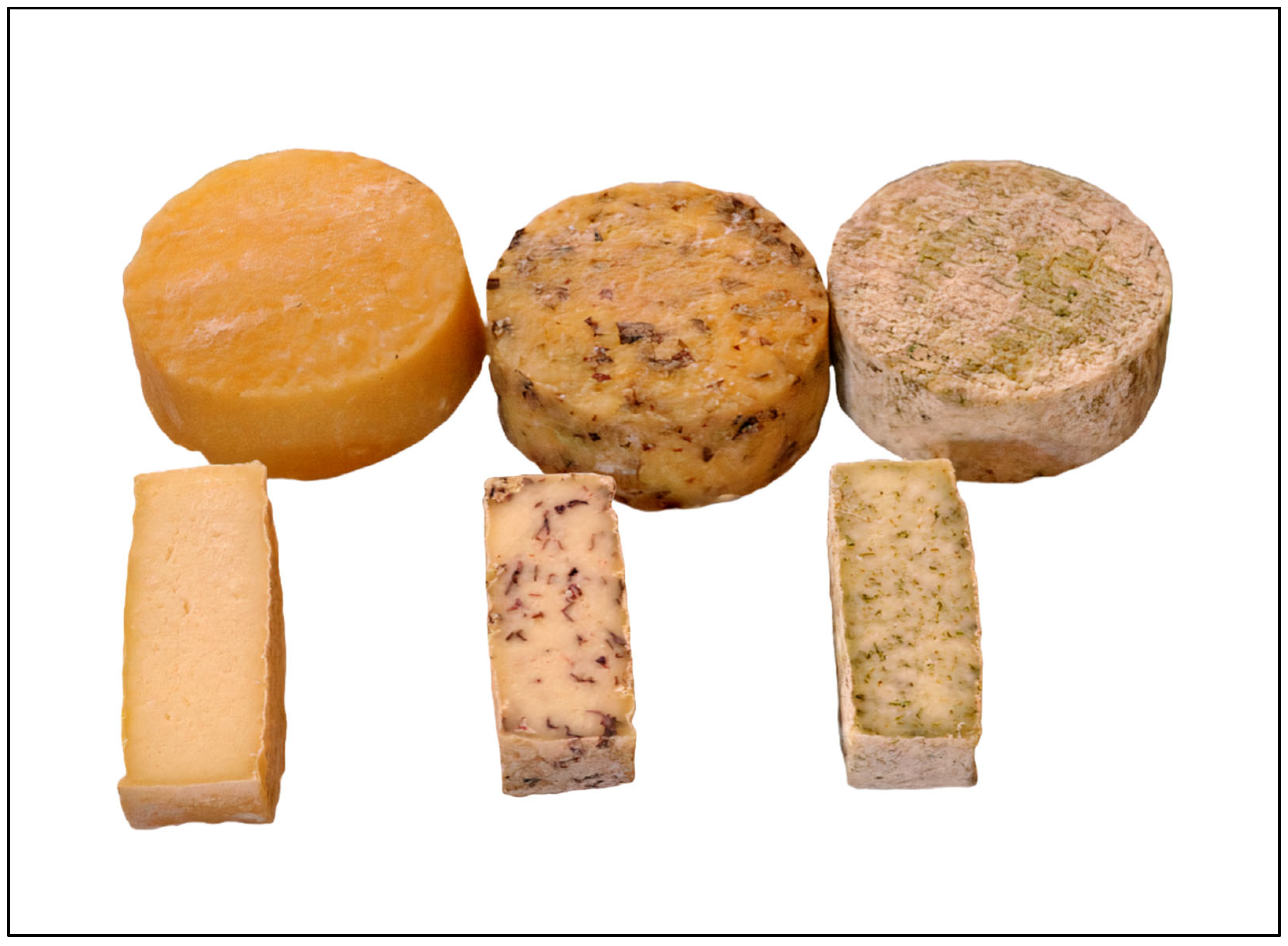
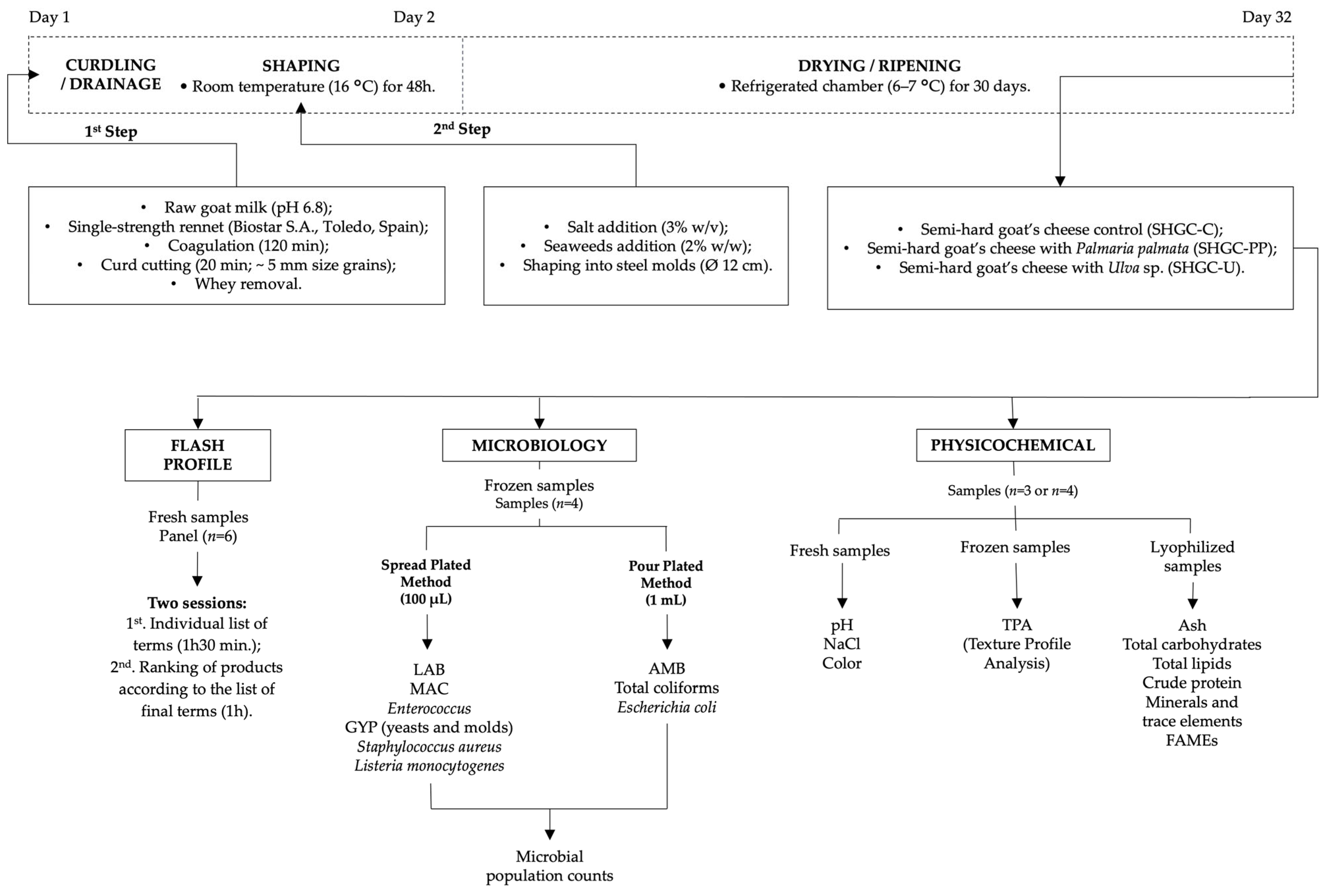
After a coagulation period of 120 min, the curd was cut into small grains (±5 mm) and allowed to settle at the bottom of the vat. The whey was then removed. Following whey drainage, the curd was salted with 3% (w/w) fine salt (Vatel®, Olhão, Portugal) and mixed with 2% (w/w) of seaweeds (Palmaria palmata or Ulva sp.). The mixture was shaped into steel molds (Ø 12 cm) and left at room temperature (±16 °C). After two days, the curds were removed from the molds and transferred to a refrigerated room (7–8 °C, ~90% RH), where they were inverted daily during the 30-day ripening period. Three different types of semi-hard goat cheese were produced: (a) semi-hard goat cheese control (SHGC-C), (b) semi-hard goat cheese supplemented with Palmaria palmata (SHGC-PP), and (c) semi-hard goat cheese supplemented with Ulva sp. (SHGC-U) (Figure 1).
After production, the SHGCs were transported to the laboratory in sterile containers and stored under appropriate conditions based on the requirements of subsequent analyses. A portion of the SHGCs was freeze-dried whole using a laboratory freeze-dryer (ScanVac Cool Safe 4 L, LaboGene, Lillerød, Denmark) at −50 °C and a pressure of 0.0005–0.002 mBar for 48 h. All SHGCs were vacuum-packed (Sammic SU316G, Azkoitia, Spain) in labeled polypropylene bags (90 μm, 180 × 300 mm, PA/PE, Sammic, Azkoitia, Spain). Some were refrigerated (4–6 °C), while others were fast frozen using liquid nitrogen and stored at −24 °C for later analysis.
The dehydrated seaweeds were sourced from the Atlantic coastal waters and industrially air-dried by ALGAplus Ltd. (Ílhavo, Portugal), a certified producer operating under Integrated Multi-Trophic Aquaculture (IMTA) systems. The seaweeds were cultivated and processed by the company following standardized protocols for food-grade applications. As the seaweeds were commercially acquired, detailed procedures concerning harvesting, cleaning, and selection were managed exclusively by the supplier. Species identification and post-harvest processing were also under the company’s responsibility. All samples were provided with proper labeling and certification for human consumption.
The samples were ground into small pieces (1.7 ± 0.65 mm for Palmaria palmata and 1.4 ± 0.44 mm for Ulva sp.) using a mechanical grinder (Orbegozo BV 9600, Murcia, Spain). They were then subjected to UV irradiation (DNA/RNA UV-Cleaner Box, UVC/T-AR, Biosan, Riga, Latvia) for 48 h to prevent contamination before being vacuum-packed (Sammic SU-316G, Azkoitia, Spain) in polypropylene bags. Seaweed samples were stored at room temperature for up to three days before being used in the cheese production and then refrigerated (4–6 °C) for further analysis.
Ulva sp. and Palmaria palmata were selected due to their regular consumption in Western countries [40,41], and their availability in the Portuguese market, where they are commercialized by ALGAplus, Ltd. (Tok de Mar®, Ílhavo, Portugal). The seaweeds used in this study and those incorporated into the supplemented SHGCs were from the same batch.
The SHGC samples were produced in the same batch, with sampling occurring at the final ripening stage (30 days). The SHGC experimental design and general sampling strategy are summarized in Figure 2.

2.2. Physicochemical Analyses

2.2.1. Total Solids and Moisture Content

Total solids (TS) were determined gravimetrically by measuring the weight loss of dried seaweed or refrigerated goat cheese samples (3 g) in a drying oven (TS 9135, Termaks AS®, Bergen, Norway). The samples were dried using 20 g of sea sand (PanReac AppliChem ITW Reagents, Barcelona, Spain) until a constant weight was achieved, following the ISO 5534:2004 standard [42]. TS and moisture content were then calculated and expressed as a percentage of wet weight (%WW).

2.2.2. Ash Content

Ash content (AC) was determined gravimetrically by combusting dried seaweed or freeze-dried cheese samples (5 g) at 550 °C overnight in a laboratory muffle furnace (LV 15/11/P320, Nabertherm GmbH, Bremen, Germany). The resulting ash was cooled in a desiccator for at least 1 h before weighing. The samples were analyzed, and the results were expressed as a percentage of dry weight (%DW).

2.2.3. Sodium Chloride and pH

Sodium chloride (NaCl) content of the cheese was determined using an aqueous extract prepared by mixing 10 g of the refrigerated cheese sample with 90 mL of Milli-Q water at 70 °C. The salt concentration was measured with a Digital Salinity-615 Salt Content Meter (0–199.9 ppt) (Yieryi, Shenzhen, China). The pH of the refrigerated cheese samples was assessed using a Foodcare Cheese pH Tester (HI981032, Hanna Instruments Inc., Póvoa de Varzim, Portugal).

2.2.4. Total Carbohydrates

The assay was conducted following the procedure described by Kostas et al. [43]. Briefly, 30 mg of each dried seaweed or freeze-dried cheese sample was mixed with 1 mL of 11 M sulfuric acid (Honeywell International Inc., Offenbach am Main, Germany) and incubated at 37 °C for 1 h in a digital dry bath (AccuBlock™, Labnet International, Inc., Edison, NJ, USA). After incubation, 10 mL of distilled water was added to adjust the final acid concentration to 1 M, followed by a second incubation at 100 °C for 2 h.
For calibration, 50 µL of glucose standards (Merck, Darmstadt, Germany) ranging from 0 to 1000 μg/mL were added to separate tubes. In parallel, 50 µL of each sample, prepared as described above, was transferred to new centrifuge tubes. Subsequently, 500 µL of 4% (w/v) phenol (TCI Europe N.V., Zwijndrecht, Belgium) and 2.5 mL of 96% sulfuric acid were added to each tube. Finally, 230 µL of each standard or sample was dispensed into a 96-well microplate (Greiner Bio-One, Frickenhausen, Germany), and absorbance was measured at 490 nm using a microplate reader (BioTek Synergy™ HTX Multimode Reader, Agilent, Santa Clara, CA, USA). The concentrations were determined using a calibration curve, and results were expressed as a percentage of dry weight (%DW).

2.2.5. Total Lipid Content

The gravimetric assay was adapted from the method described by Kumari et al. [44]. Briefly, 500 mg of dried seaweed or freeze-dried cheese samples were mixed with 3.0 mL of a chloroform/methanol/50 mM phosphate buffer solution (Honeywell, Offenbach am Main, Germany; Fisher Scientific, Loughborough, UK) in a 2:1:0.8 (v/v/v) ratio. The mixture was then centrifuged (Domel, Centric 150, Otoki, Slovenia) at 2057× g for 15 min.
The organic phases were collected, and the residues were re-extracted three times using 2 mL of a chloroform/methanol/50 mM phosphate buffer solution (1:1:0.8, v/v/v), followed by centrifugation under the same conditions. All resulting supernatants were pooled, filtered, washed with 2 mL of 50 mM phosphate buffer, and centrifuged at 2057× g for 5 min. The lower organic phase was then collected and evaporated under a nitrogen stream.
To validate the methodology and results, NIST Standard Reference Material® 3232—Kelp Powder (Thallus laminariae) was used. The total lipid content was determined gravimetrically using a precision balance (Radwag®, Model PS 450/X, Bracka, Poland) and expressed as a percentage of dry weight (%DW).

2.2.6. Crude Protein Content

Crude protein content was determined using an FP-528 Combustion Nitrogen Analyzer (LECO Corporation, St. Joseph, MI, USA). Dried seaweed and freeze-dried cheese samples (100 mg) were weighed and introduced into the combustion chamber, where covalently bound nitrogen (N) was converted into nitrogen gas (N2) and quantified using a thermal conductivity detector.
An air blank was run to ensure accuracy, and the calibration standard curve was established using EDTA (LECO 502-896, St. Joseph, MI, USA). Protein content was calculated using a nitrogen-to-protein conversion factor of N × 5.85 [45]. All analyses were performed, and results were expressed as a percentage of dry weight (%DW).

2.3. Mineral Content

Dried seaweed and freeze-dried cheese samples were digested and analyzed following the protocol described by the U.S. EPA [46] using Inductively Coupled Plasma–Atomic Emission Spectrometry (ICP-AES) on an Ultima model (Horiba Jobin Yvon, Montpellier, France).
Briefly, 250 mg of each sample was digested in 5 mL of 65% nitric acid (Merck, KGaA, Darmstadt, Germany) and 1 mL of 37% hydrochloric acid (Honeywell, Offenbach am Main, Germany) for approximately 48 h. The mixture was then transferred to a fluoropolymer PFA (perfluoroalkoxy alkanes) microwave vessel, sealed, and heated at 100 °C for 24 h in a digital dry bath (AccuBlock™, Labnet International, Inc., Edison, NJ, USA) to ensure complete digestion.
After cooling, 100 µL of 30% hydrogen peroxide (Sigma-Aldrich/Merck, Darmstadt, Germany) was added, and the samples were diluted with distilled water to a final volume of 10 mL. Blanks were prepared using ultrapure water under identical digestion conditions.
Mineral concentrations were expressed as g·kg−1 DW, while trace element concentrations were reported as mg·kg−1 DW. The methodology was validated using certified reference materials (CRMs) from the National Institute of Standards and Technology (NIST), specifically Kelp Powder (Thallus laminariae) Standard Reference Material® (SRM) 3232.

2.4. Color Analysis

The semi-hard goat cheeses (SHGCs) were sliced into 1 cm thick pieces, and their color parameters were assessed at six distinct points on each slice’s surface using a PCE-CSM 4 colorimeter (PCE Instruments™, Southampton, UK). The color was measured based on the CIE Lab* coordinate system, which includes L* (lightness, ranging from 0 = black to 100 = diffuse white), a* (red–green axis, where a* > 0 indicates redness and a* < 0 indicates greenness), and b* (yellow–blue axis, where b* > 0 indicates yellowness and b* < 0 indicates blueness). Additionally, the C* value, or chroma, represents the color saturation or intensity, with higher values indicating more vivid and saturated hues, while lower values correspond to duller, less intense colors.
The color difference (ΔE) quantifies the overall perceptible variation between two color samples in the CIE Lab* space. In this study, ΔE values were calculated, using the control sample (SHGC-C) as the reference, according with Equation (1):
E t , d = L 2 + a 2 + b 2 o r E t , d = ( L S L C ) 2 + ( a S a C ) 2 + ( b S b C ) 2 ,
where L S , a S , and b S and L C , a C , and b C represent the mean values of the color coordinates ( L * , a * , b * ) measured for the supplemented (S) and control (C) SHGC samples, respectively [47].
Measurements were taken with an aperture of 20 mm, under illuminant D65 (standard daylight conditions), and using a 45°/0° geometry (illumination/viewing angle). Prior to analysis, the colorimeter was calibrated against a standard white reference tile (L* = 93.97, a* = –0.88, b* = 1.21) to ensure accuracy and consistency in readings.

2.5. Texture Profile Analysis (TPA)

Compression testing of cheese samples was conducted using a CT3 Texture Analyzer® (Brookfield, AMETEK, Hadamar-Steinbach, Germany) equipped with a 4.5 Kgf load cell. The optimized test conditions were as follows: TA4/1000, cylinder probe (38.1 mm diameter, 20 mm length); test speed of 2.0 mm/s; pre-test and post-test speed of 2.0 mm/s; trigger force of 2.0 g; 20% compression; and a 5 s pause between cycles.
Cheese samples, after defrosting, were cut into uniform cubes (20 × 20 × 20 mm) and equilibrated at room temperature (~22 °C) for 2 h before testing. The TexturePro CT Software (CT v1.9 build 35, AMETEK Brookfield, Hadamar-Steinbach, Germany) was used for data acquisition and analysis. From the resulting compression curves, the following textural parameters were determined: hardness (N), adhesiveness (J), cohesiveness (dimensionless), springiness (mm), and gumminess (N).

2.6. Microbiological Analyses

Frozen SHGC samples (10–25 g) were aseptically prepared and homogenized in 90 mL of ¼-strength Ringer’s solution (Biokar Diagnostics, Pantin, France) using a stomacher apparatus (BagMixer® 400 P, Interscience, Saint-Nom-la-Bretèche, France) for 90 s at high speed. Serial decimal dilutions were prepared, and microbial populations were enumerated using either the “spread plate method” (100 μL) or the “pour plate method” (1.0 mL) in 90 mm Petri dishes (Frilabo, Maia, Portugal). The following microbial groups were analyzed:
  • Total Aerobic Mesophilic Bacteria (AMB): Plate Count Agar (PCA; Biokar Diagnostics, Pantin, France) (30 °C, 72 h).
  • Lactic Acid Bacteria (LAB): De Man, Rogosa & Sharpe (MRS) agar, acidified to pH 5.4 ± 0.1 with acetic acid (Sigma-Aldrich®, Darmstadt, Germany) (30 °C, 72 h).
  • Marine Bacteria: Marine agar (Condalab, Madrid, Spain) (20–25 °C, 72 h).
  • Enterococcus spp.: Compass® Enterococcus agar (Biokar Diagnostics, Pantin, France) (44 °C, 24 h).
  • Yeasts and Molds: Chloramphenicol Glucose Agar (CGA; Biokar Diagnostics, Pantin, France) (25 °C, 5 days).
  • Coagulase-Positive Staphylococci (Staphylococcus aureus): Baird-Parker RPF agar (BP; Biokar Diagnostics, Pantin, France) (37 °C, 48 h).
  • Total Coliforms (TC) and Escherichia coli: Compass® ECC agar (Biokar Diagnostics, Pantin, France) (37 °C and 44 °C, 24 h, respectively).
  • Listeria monocytogenes: Half-Fraser broth, Fraser broth, and Palcam agar (Biokar Diagnostics, Pantin, France) (37 °C, 5 days).
  • Salmonella spp.: Buffered Peptone Water (BPW), Rappaport-Vassiliadis Soja (RVS) broth, Müller-Kauffmann Tetrathionate-Novobiocin (MKTTN) broth, Xylose Lysine Desoxycholate (XLD) agar, and Brilliant Green Agar (BGA) (Biokar Diagnostics, Pantin, France) (37 °C, 5 days).
Microbiological results were expressed as Log CFU·g−1 and interpreted according to the United Kingdom’s Health Protection Agency (HPA) guidelines [48], the Portuguese National Health Institute (INSA) guidelines [49], and European Commission Regulation (EC) No. 2073/2005 [50] for assessing the microbiological safety of ready-to-eat foods. Additional test methods are detailed in Table S1 (Supplementary Materials).

2.7. Flash Profile (FP)

The sensory analysis was performed using the Flash Profile (FP) method, as originally proposed by Dairou and Sieffermann [51] and further developed by Delarue and Sieffermann [52]. This technique is designed to rapidly characterize and differentiate products based on freely elicited attributes and subsequent individual ranking by trained panelists. Due to COVID-19 restrictions, the evaluation was conducted remotely, in accordance with established guidelines and best practices for at-home sensory testing, which have previously been successfully implemented in other sensory methodologies, such as focus groups [53,54].
A total of six trained panelists (aged 18–65), each with a minimum of one year of experience in the sensory evaluation of seaweed-containing foods, participated in this study. The panel was composed of students and academic staff from the Department of Chemistry at FCT NOVA, Caparica, Portugal.
Each panelist received individually packaged samples of three cheese products, SHGC-C (control), SHGC-PP (enriched with Palmaria palmata), and SHGC-U (enriched with Ulva sp.), each labeled with a three-digit random code. The samples were prepared as 2 × 2 × 2 cm cubes, maintained at 10 ± 1 °C, and delivered under controlled cold chain conditions. A standardized instruction manual and evaluation forms were provided, and a preliminary online meeting was conducted to ensure methodological consistency.
The Flash Profile (FP) test was conducted in two separate sessions:
  • Session 1 (Attribute Generation): All samples were accessed simultaneously. Panelists were asked to independently generate descriptive sensory attributes within the five sensory dimensions: appearance, aroma, flavor, texture, and aftertaste. Examples of terms generated included “yellowish color”, “marine odor”, “fibrous texture”, “salty taste”, and “metallic aftertaste”.
  • Session 2 (Ranking): After a consensus discussion via video call to finalize the attribute list, each panelist ranked the cheeses for each attribute using an ordinal ranking scale, independently per sensory dimension. The order of presentation was randomized for each panelist to minimize order effects. Between samples, panelists were instructed to pause for approximately 60 s and cleanse their palate with still water at room temperature.
All evaluations were conducted individually in quiet home environments, free from external odors or distractions. Each session was supervised virtually by a trained researcher to ensure protocol compliance. The study was approved by the Research Ethics Committee (CEP), and all participants provided informed consent.

2.8. Statistical Analysis

The non-parametric Mann–Whitney U test was employed to determine significant differences between samples, with statistical significance set at p < 0.05. All statistical analyses were performed using STATISTICA software (version 8.0, StatSoft Inc., Tulsa, OK, USA). Data were expressed as mean ± standard deviation (SD), unless stated otherwise.
Flash Profile (FP) results were analyzed using Generalized Procrustes Analysis (GPA) to optimize individual scaling data and minimize variations between panelists [55]. This analysis was conducted with XLSTAT (version 2022, Addinsoft, New York, NY, USA), an add-in for Microsoft Excel. Following GPA consensus configuration, FP data generated biplot maps, which visually represented the differences and similarities among the products based on graphical interpretation.

3. Results and Discussion

3.1. Physicochemical Characterization of SHGCs

Table 1 summarizes the main physicochemical characteristics of the SHGCs (mean ± SD), and Table S2 shows the p-values (see Supplementary Materials).

3.1.1. Total Solids and Moisture Content

Total solids (TS) content ranged from 58% to 68% WW, with statistical analysis revealing significant differences among samples, specifically between SHGC-C and SHGC-U, as well as SHGC-PP and SHGC-U (p = 0.0495). The TS content in SHGC-U decreased by 10%. In general, these values are lower than those reported by Franco et al. [56] for Spanish goat’s cheese “Babia-Laciana” (71.7 g·100 g−1 after 30 days of ripening) and by Bontinis et al. [57] for Greek goat’s cheese “Xinotyri” (80.88 g·100 g−1 after 22 days of ripening). However, the TS value (57.66 g·100 g−1 after 30 days of ripening) reported by Guizani et al. [58] for SHGC is comparable to that of SHGC-U but lower than that of SHGC-C (68.22% WW).
Moisture content ranged from 33% to 43% WW, with significant differences observed between SHGC-C and SHGC-U, as well as SHGC-PP and SHGC-U (p = 0.0495). These values were lower than those reported by Gobbetti et al. [59] for “Taleggio” cheese without supplementation after 35 days of ripening (46% on the surface and 52% in the core) and by Medina et al. [60] for “Gredos” raw goat’s milk cheese (59%) produced in central Spain.
As noted by Del Olmo et al. [6], the incorporation of seaweed into the curd is often associated with higher moisture content or lower total solids, which is consistent with our findings. This effect may be attributed to enhanced whey retention promoted by the hygroscopic properties of seaweeds. However, it is important to note that total solids and moisture content are highly dependent on oven type, drying techniques, temperature, and drying duration [61]. Additionally, differences in cheese preparation methods, both in this study and in the referenced literature, may influence the observed results.

3.1.2. Ash Content

Ash content ranged from 3.9% to 4.4%, with significant differences observed among all goat cheese samples (p = 0.0495). In general, the ash content in hard goat’s cheese without supplementation was higher than values reported by Franco et al. [56] after 30 days of ripening (2.4 g/100 g) and by Bontinis et al. [57] after 22 days (2.67%) and 45 days of ripening (2.93%).
In supplemented cheeses, a reduction in ash content was observed compared to SHGC-C, with SHGC-PP exhibiting lower values than SHGC-U. Previous studies have reported higher ash content in Ulva lactuca (31.62 ± 0.42% DW) [62] compared to Palmaria palmata (13.95 ± 0.33% DW) [27]. However, in the present study, the ash content of these seaweeds was similar (25.5% in Ulva sp. vs. 25.7% in P. palmata). It is important to note that seaweed composition varies depending on several factors, particularly seasonality [63].

3.1.3. Sodium Chloride and pH

Salt (NaCl) levels ranged from 2.08 to 3.13 g/100 g, and significant differences were observed between samples (SHGC-PP vs. SHGC-U; p = 0.0495). The results are within the range referred in the literature, approximately 0.7–4 g/100 g for cheeses made from milk by rennet coagulation [64].
The pH values were in the range of 5.10–5.17 and did not exceed 0.07 pH units between samples (p > 0.05). The control registered a pH of 5.13. In general, the pH values were within the ranges described by other authors for SHGCs (4.95–5.70 pH) [58,65,66].

3.1.4. Total Carbohydrates Content

Carbohydrate content ranged from 2.9% to 4.1%, with statistical analysis revealing significant differences among all samples (p = 0.0431). Cheese supplemented with P. palmata exhibited an increase in carbohydrate content from 3.3% (control) to 4.1%, whereas supplementation with Ulva sp. resulted in a decrease to 2.9%. This trend is consistent with the higher carbohydrate content observed in P. palmata (34%) compared to Ulva sp. (31%), which may explain the differences recorded.
According to Beresford [67], the carbohydrate content of cheese is relatively low as the primary milk carbohydrate, lactose, is largely removed with the whey during cheese production [68]. Additionally, during cheese production, lactic acid fermentation by starter cultures significantly reduces lactose content, often rendering matured cheeses virtually lactose-free [69]. Consequently, most cheeses contain only trace amounts of residual carbohydrates [70]. Although the total carbohydrate content in all the samples was low, it would be expected that the control sample would have the lowest value, given that seaweed typically contains higher carbohydrate levels.

3.1.5. Total Lipid Content

Total lipid content varied slightly among goat cheese samples, ranging from 38.6% to 40.2%. However, significant differences were observed between SHGC-C and SHGC-PP, as well as between SHGC-C and SHGC-U (p = 0.0431). These values are higher than those reported by Cossignani et al. [71] for “Canestrato” goat cheese (23.6%) and “Gouda-style” goat cheese (32.9%), as well as by Di Cagno et al. [66] for various Italian goat cheeses at the end of ripening: “Flor di Capra” (30.3 ± 0.2%, w/w), “Caprino di Cavalese” (33.1 ± 0.5%, WW), “Caprino di Valsassina” (32.7 ± 0.4%, WW), and Capritilla (32.8 ± 0.7%, WW).
Although P. palmata (1.6% DW) and Ulva sp. (2.3% DW) contain relatively low lipid levels, the lipid content in supplemented cheeses increased compared to the control (SHGC-C). This could be considered beneficial, as lipids play a crucial role in cheese organoleptic properties, particularly in enhancing taste, flavor, and texture [72]. Furthermore, while the overall lipid content in seaweeds is low, it is of high nutritional quality. Seaweeds are recognized as a valuable source of essential fatty acids, particularly ω-3 fatty acids, as highlighted by several studies [73].

3.1.6. Crude Protein Content

Crude protein content ranged from 34.8% to 36.9%, with significant differences observed between SHGC-C and SHGC-U, as well as between SHGC-PP and SHGC-U (p = 0.0180). Notably, supplementation with Ulva sp. increased crude protein content by nearly 2% compared to the other samples. This aligns with the higher crude protein content of Ulva sp. (15.6%) relative to P. palmata (14.4%), which may account for the observed differences.
The crude protein content in the control sample (34.8%) exceeded values reported for Italian goat cheeses at the end of ripening (2–4 months), which range from 23.0% to 27.5% WW [66], as well as for Greek “Xinotyri” goat cheese after 22 days of ripening (29.77 ± 0.52%) [57]. However, the determined values are comparable to those reported for Spanish semi-hard goat cheese (“Majorero”, Canary Islands) after 30 days of ripening (36.3%) [74].

3.2. Mineral Content

The concentrations of minerals and trace elements are detailed in Table 2, with p-values provided in Table S3 (see Supplementary Materials). Cheese serves as a significant source of essential elements, including calcium (Ca), phosphorus (P), and magnesium (Mg), with particular emphasis on its bioavailable calcium content [75].
In SHGCs, Ca concentrations ranged from 15.50 to 17.82 g·kg−1, showing a significant difference between SHGC-C and SHGC-U (p = 0.0495), which is attributable to the calcium content in Ulva sp. (5.35 g·kg−1). Calcium is not only a key mineral in the human body but is also abundant in algae, with concentrations ranging from 470 to 1400 mg·100 g−1 DW [76], surpassing those found in common vegetables like apples, oranges, carrots, and potatoes [77].
Potassium (K) levels ranged from 1.68 to 2.15 g·kg−1. Generally, the K content in Ulva spp. (phylum Chlorophyta) is lower than that found in Rhodophyta species [77], which aligns with the results observed in this study—19.20 g·kg−1 for Ulva sp. and 96.11 g·kg−1 for P. palmata. Despite this, no significant differences in K content were found among the SHGCs (p > 0.05).
Magnesium (Mg) levels ranged from 1.18 to 1.51 g·kg−1, showing a significant difference between SHGC-PP and SHGC-U (p = 0.0495). Although Ulva sp. is known for its high Mg content [77], with a concentration of 50.11 g·kg−1 in this study, this was not reflected in the magnesium content of the cheese supplemented with Ulva sp. (SHGC-U).
Sodium (Na) levels ranged from 5.74 to 7.84 g·kg−1, exhibiting significant differences between SHGC-PP and SHGC-U (p = 0.0495). These differences were directly related to the sodium content in the seaweeds, with P. palmata containing 21.25 g·kg−1 and Ulva sp. 31.78 g·kg−1.
Phosphorus (P) levels ranged from 12.81 to 14.67 g·kg−1, with no significant differences observed among the SHGCs (p > 0.05), likely due to the low phosphorus content in the seaweeds used.
Regarding trace elements, iron (Fe) levels ranged from 3.34 to 21.84 mg·kg−1, with significant differences between SHGC-C and SHGC-U, as well as SHGC-PP and SHGC-U (p = 0.0495). The higher Fe content in Ulva sp. (331.81 mg·kg−1) was reflected in SHGC-U. Iron deficiency is one of the most common nutritional deficits in developed countries [78], but seaweeds are an excellent source of iron, essential for health maintenance [77]. While dairy products like cheese are typically poor sources of iron [75], the inclusion of Ulva sp. in this study significantly enriched the Fe content in the goat’s cheese, with levels in Ulva sp. being much higher than those found in U. intestinalis (89 mg·kg−1) and U. lactuca (120 mg·kg−1) [79].
Iodine (I) level was below the quantification limit in all SHGCs, despite P. palmata presenting a moderate iodine concentration (48.38 mg·kg−1). The low iodine content in the supplemented cheeses may be attributed to the small percentage (2%) of seaweed used in supplementation.
Manganese (Mn) levels ranged from 0.83 to 2.50 mg·kg−1, with significant differences observed among all samples (p = 0.0495). P. palmata (5.72 mg·kg−1) and Ulva sp. (37.94 mg·kg−1) contributed to the Mn content of SHGC-PP (1.21 mg·kg−1) and SHGC-U (2.50 mg·kg−1), respectively. Mn is essential for the metabolism of proteins, lipids, and carbohydrates [80], making its presence in the cheese nutritionally important.
Selenium (Se) levels ranged from 1.93 to 2.17 mg·kg−1, with no significant differences among the samples (p > 0.05), likely due to the low selenium content in both seaweeds (1.20–1.74 mg·kg−1).
Zinc (Zn) concentrations ranged from 22.77 to 26.89 mg·kg−1, showing significant differences between SHGC-C and SHGC-PP, as well as between SHGC-PP and SHGC-U (p = 0.0495). Seaweeds, particularly brown (class Phaeophyceae) and red (phylum Rhodophyta) species, are known to be rich in Zn, with concentrations reaching up to 700 mg·kg−1, depending on the species and geographic region [80]. Although Ulva sp. contained a lower Zn level (23.28 mg·kg−1) compared to P. palmata (24.77 mg·kg−1), SHGC-U (26.89 mg·kg−1) had a higher Zn level than SHGC-PP (22.77 mg·kg−1). A slight increase in Zn content was observed in the SHGCs supplemented with seaweeds, with a significant increase in SHGC-PP.

3.3. Color Analysis

The results for the CIELAB color parameters (L*, a*, b*, and C*) after 30 days of ripening are presented in Table 3, with p-values detailed in Table S4 (see Supplementary Materials).
The L* parameter, which measures lightness, ranged from 62.34 to 68.05. Statistical analyses revealed significant differences between SHGC-C and SHGC-PP (p = 0.0004) and also SHGC-C and SHGC-U (p = 0.0232). Although the overall impact of seaweed supplementation was relatively small, supplemented cheeses appeared darker than the control, likely due to the distribution of seaweed particles within the cheese matrix. The L* value of SHGC-C (68) in this study was lower than those reported by Medeiros et al. [81] for goat cheese—91.20 (external) and 92.33 (internal)—but was more consistent with the values (76.8–81) found by Guiné et al. [82] for Portuguese goat cheeses.
The redness to greenness (a* parameter) parameter exhibited significant differences among all samples (p = 0.0002). SHGC-PP had the highest value (8.06), which aligns with the pigment composition of red seaweeds (phylum Rhodophyta). These seaweeds are rich in chlorophylls (a and d), carotenoids (α- and β-carotene), xanthophylls (lutein), and phycobilins [83], particularly R-phycoerythrin (R-PE) [84], a dominant pigment that contributes to their red coloration [85]. Additionally, phycocyanin (PC), a blue-colored pigment, further enhances the characteristic pigmentation of some Rhodophyta by masking other pigments [86]. This interaction ultimately results in a purple hue, as observed in certain seaweeds such as Porphyra spp.
Conversely, SHGC-U exhibited a negative a* value (−0.9), indicating a shift toward the green spectrum. This can be attributed to the high chlorophyll content in green seaweeds (phylum Chlorophyta), which consists of approximately 31% chlorophyll a and 15% chlorophyll b. These pigments, along with smaller amounts of α-carotene (~11%) and 9-cis-β-carotene (~14%) [6,83,87], are responsible for the distinct greenish hue of SHGC-U.
The yellowness-to-blue (b* parameter) values showed statistically significant differences across all cheese samples (p = 0.0002), following the trend SHGC-C > SHGC-U > SHGC-PP. The control cheese exhibited a b* value of 26.5, considerably higher than the 12.03 ± 0.37 reported by Mladenović et al. [88] for goat’s cheese at 21 days of ripening. This increase in b* has been linked to proteolysis and the Maillard reaction, both of which contribute to browning and reduced luminosity [89].
The distinct pigmentation of red seaweeds is attributed to phycobiliproteins (PBPs), chromophore-containing pigments that impart hues ranging from bright crimson to deep blue [83,90]. Specifically, the blue phycocyanin (PC, λmax = 610–625 nm) and blue-green allophycocyanin (APC, λmax = 650–660 nm) [83] significantly influenced the color shift in SHGC-PP, driving its b* value toward the blue spectrum. Conversely, the greener hue of SHGC-U can be attributed to its high chlorophyll a (~31%) and b (~15%) content, which are characteristic of green seaweeds.
Regarding color saturation (chroma, C*), statistical analysis revealed significant differences among all samples (p < 0.05). The control cheese (SHGC-C) exhibited the highest chroma value (26.76), representing the most vivid and pure coloration due to its greater distance from the origin in the (a*, b*) coordinate space [91]. The addition of red and green seaweed pigments reduced chroma by approximately 8–10 units, leading to a more heterogeneous color distribution in the supplemented products.
Both supplemented cheeses (SHGC-PP and SHGC-U) exhibited ΔE values significantly higher than 3.0, the commonly accepted threshold for perceptible color differences to the human eye [92].
Specifically, SHGC-PP showed the most pronounced deviation (ΔE = 13.86 ± 0.84), reflecting substantial changes in all three dimensions of color (L*, a*, b*). This suggests a visually intense transformation caused by the incorporation of Palmaria palmata, which is known to impart red pigments such as R-PE [84]. SHGC-U presented a ΔE of 9.26 ± 0.50, also well above the perceptibility threshold. Statistical analysis revealed significant differences between the SHGC-PP and SHGC-U samples, indicating that the type of seaweed incorporated had a distinct impact on the color variation. Although the change was less intense than that observed with Palmaria palmata, the incorporation of Ulva sp. still led to a visible color shift toward a greener hue, associated with the presence of chlorophylls from the seaweed [87].
These results confirm that both seaweeds significantly alter the visual appearance of the cheeses, making them distinguishable from the control. Such variations may influence consumer perception, acceptance, or expectations, depending on market familiarity with algae-enriched products.
Overall, all samples demonstrated medium to high lightness (L*), with yellowness (b*) dominating over redness (a*), reinforcing the characteristic white-yellowish hue, particularly in the control cheese. These findings align with previous studies [89,93], where the pronounced whiteness of goat cheese was attributed to the species’ ability to convert β-carotene entirely into vitamin A, coupled with the smaller fat globule size in goat’s milk compared to cow’s milk (3.49 vs. 4.55 μm) [81,94].
Although most studies adopt four to six readings per sample for instrumental color evaluation [92], future research would benefit from increasing the number of readings to enhance randomization, improve repeatability, and ensure more reliable results.

3.4. Texture Profile Analysis (TPA)

The TPA results are summarized in Table 4, with p-values presented in Table S5 (see Supplementary Materials). To the best of the author’s knowledge, no prior studies have investigated the texture profile analysis (TPA) of cheeses enriched with algae, making direct comparisons unfeasible.
Hardness values ranged from 5.2 to 19.4 N, showing significant differences among all samples (p = 0.0495). In general, these results do not align with previous findings by Burgos & Maldonado [95] on goat cheese from Quebrada de Humahuaca (Argentina) (34 N) or by Fresno et al. [96] on “Palmero” semi-hard goat cheese (40.67 N) after 40 days of ripening. Prior research has established a direct correlation between hardness and moisture content [97,98], as a lower water content increases the concentration of casein and strengthens casein bonds, both of which contribute to increased hardness [97,99].
In the case of SHGC-PP (5.2 N), its lower hardness may be attributed to the discontinuities introduced by the seaweed particles within the cheese matrix. These particles likely disrupted the curd structure, leading to larger pore sizes and reduced textural firmness.
Adhesiveness values ranged from 0.07 to 0.28 J, though statistical analysis revealed no significant differences among the samples (p > 0.05). These low to relatively low adhesiveness values indicate a drier cheese crust [100], consistent with findings by Guiné et al. [82] for goat’s and sheep’s cheeses.
Cohesiveness values varied significantly (p = 0.0495), with SHGC-U exhibiting the lowest value (0.56) and SHGC-C the highest (0.75). The presence of small seaweed particles in the supplemented cheeses likely contributed to this variation by altering the cheese matrix structure.
Springiness values ranged from 3.36 mm (SHGC-U) to 3.61 mm (SHGC-C), with significant differences observed between them (p < 0.05). Cheese proteolysis negatively correlates with springiness, as protein breakdown leads to a softer texture [101,102]. A lower degree of springiness also reduces resistance to deformation, which explains the lower cohesiveness observed in SHGC-U [103].
Gumminess values also varied significantly (p = 0.0495), with the lowest value recorded for SHGC-PP (4.94 N) and the highest for SHGC-C (14.46 N). The control cheese required approximately 7.5 to 10 N more energy to reach a ready-to-swallow consistency compared to the supplemented cheeses. This difference is likely due to the higher moisture content in the supplemented cheeses, which reduces gumminess and structural integrity.
Whereas freezing may have influenced the texture of the cheeses, long-term storage without freezing would not have been a viable alternative. Prolonged refrigeration also presents limitations, as cheese maturation over time directly affects its textural properties by inhibiting or altering enzymatic activity and chemical reactions. However, given that all the cheeses were frozen, stored, and handled under identical conditions, we consider that the comparison of the relative effects of seaweed supplementation remains valid. Moreover, several studies have shown that in the case of hard and semi-hard cheeses, when rapid freezing methods are applied and storage temperatures are maintained below –20 °C, textural changes tend to be minimal or negligible [104].

3.5. Microbiological Analyses

The microbial load results are summarized in Table 5, with p-values detailed in Table S6 (see Supplementary Materials). While no significant variations were observed among the SHGC samples, the microbial counts for the seaweeds P. palmata and Ulva sp. remained below the limit of quantification—i.e., less than 2 Log CFU·g−1 for most analyzed microorganisms. Consequently, it cannot be concluded that the marginally higher microbial counts in the supplemented cheeses resulted from the added seaweeds. Instead, these slight differences are more likely attributed to the sensitivity of the analytical technique.
Additionally, although microbial loads may be affected by freezing, the occasional impact of this process on certain microorganisms [105] was assumed to apply equally to all samples. It is worth mentioning that some studies on aged cheeses, such as “Manchego”, have reported no significant changes in microbial counts of cheese samples subjected to freezing prior to analysis [106]. Therefore, freezing was not considered to compromise the comparative evaluation between the control and seaweed-supplemented cheeses.
Mean Enterococcus counts did not exceed 6 Log CFU·g−1. This microbial load is relatively low compared to raw goat’s milk hard cheese “Quesailla Arochena” from the Aracena Mountains (Southwest Spain), which recorded 7.36 ± 0.06 Log CFU·g−1 [107], and “Semicotto Caprino” cheese from Southern Italy, which exhibited counts of 7.83 ± 1.20 Log CFU·g−1 after 30 days of ripening [108]. Similar Enterococcus levels have been reported for the Greek goat’s milk cheese “Xinotyri” [57]. Overall, the Enterococcus activity in the studied samples was lower than the range (5.8–7.2 Log CFU·g−1) reported by Franz et al. [109] for late-ripening cheeses in Mediterranean countries.
Previous research has shown that Enterococcus can persist and proliferate in hidden areas of milking machines and bulk tanks, leading to direct milk contamination [110], which subsequently transfers to cheese [111]. Additionally, Enterococcus may enter the milk through direct contamination from animal feces [112]. These bacteria exhibit high resistance to adverse conditions, including elevated temperatures, high NaCl concentrations, and acidic environments [113].
Bacteria are widely distributed in raw-milk cheeses [110] and play a significant role in the ripening process and aroma development due to their caseinolytic and lipolytic activities, as well as diacetyl (2,3-butanedione) production via citrate metabolism [112]. Enterococcus is particularly important in Mediterranean-style cheeses [111,112], whereas in Northern European countries, its presence is often regarded negatively due to its role as an indicator of fecal contamination [112,114]. Another potential concern is its ability to produce biogenic amines, which may have health implications [112].
Lactic Acid Bacteria (LAB) were the dominant microbial group, with counts slightly exceeding 7 Log CFU·g−1—lower than those reported for goat’s milk cheeses from Cádiz and Málaga, Spain (9.01–9.38 Log CFU·g−1) [14], yet higher than the traditional Greek “Batzos” cheese after 30 days of ripening (6.72 Log CFU·g−1) [115]. As key components of the native microbiota in goat’s milk, LAB play a crucial role in cheese ripening [15,116]. Their influence on flavor development stems from their ability to (i) reduce oxidation–reduction potential, (ii) produce dicarbonyl compounds, and (iii) hydrolyze proteins [117]. These biochemical processes enhance key parameters such as aroma, flavor, texture, nutritional value, shelf life, and overall food safety [15,118].
Aerobic Mesophilic Bacteria (AMB) were well represented across samples, with values comparable to those reported by Del Olmo et al. [6] for a cheese supplemented with Ulva lactuca (8.91 Log CFU·g−1), with the control registering 8.89 Log CFU·g−1. In this study, all SHGCs exceeded the microbiological safety threshold of 107 CFU·g−1, with Ulva sp. exhibiting a lower microbial load (3.0 Log CFU·g−1) than P. palmata (4.9 Log CFU·g−1). Although the AMB counts exceeded the limits established by INSA [49] (see Table S7 in Supplementary Materials), these guidelines refer to “ready-to-eat foods” in general and not specifically to cheeses made from raw milk. It should also be noted that these microorganisms are predominantly Lactic Acid Bacteria (LAB), mainly of the genera Lactococcus spp. and Lactobacillus spp., which are naturally abundant in raw goat’s milk [119]. Furthermore, EU Directive No. 92/46/EEC (for cheeses made from raw milk and from thermized milk) does not establish specific limits for this category of microorganisms [120].
Marine Agar Counts (MACs) ranged from 5.98 to 6.26 Log CFU·g−1. These results contrast with findings by Del Olmo et al. [6], where Ulva lactuca-supplemented cheese showed a significantly lower microbial load (2.99 ± 0.35 Log CFU·g−1) after 40 days of ripening.
Mold counts were similar for SHGC-C and SHGC-PP, ranging from 3.08 to 3.52 Log CFU·g−1, whereas SHGC-U exhibited a marginally significant (p-value = 0.1) increase of approximately 2.0 Log units, surpassing the microbiological safety limit (>103 CFU·g−1) defined by INSA [49]. In contrast, Del Olmo et al. [6] reported mold counts below 3 Log CFU·g−1 for cheese supplemented with Ulva lactuca. Direct seaweed counts showed that both P. palmata and Ulva sp. contained <2 Log CFU·g−1, indicating that Ulva sp. was unlikely responsible for the elevated mold levels (5.26 Log CFU·g−1) observed in SHGC-U. In the cheesemaking facility where the samples were produced, the routine production of cheeses, such as “chèvre” and “Camembert-style”, may have led to cross-contamination with molds belonging to the genus Penicillium spp.—especially different varieties of P. camemberti.
Yeast counts exhibited values consistent with levels reported for “Xinotyri” cheese [57]. Overall, yeast levels in the analyzed cheeses were higher than those reported by Psoni et al. [65] for “Batzos” cheese made from raw goat’s milk in winter (2.44 Log CFU·g−1) and spring (2.66 Log CFU·g−1). Yeasts are recognized as secondary microflora in various cheeses [111,121], contributing to ripening by synthesizing lipolytic and proteolytic enzymes that enhance aroma and flavor development [122]. Alongside molds, yeasts participate in the ripening process through lactic acid utilization, proteolysis, and lipolysis [65,113].
Total coliforms and Escherichia coli were detected at very low levels (<2 Log CFU·g−1), except in dried seaweeds, where the levels were slightly higher. These results align with microbiological safety standards set by the UK Health Protection Agency (HPA) [48] and INSA [49], indicating that the studied cheeses were not contaminated during milking, transportation, storage, or production. Such contamination is a frequent concern in raw goat’s milk cheesemaking [65]. However, the addition of seaweeds appeared to impact coliform levels, as P. palmata (2.5 Log CFU·g−1) and Ulva sp. (2.2 Log CFU·g−1) seemed to present slightly higher counts than the control cheese.
Staphylococcus aureus counts were comparable across all cheeses (>4 Log CFU·g−1), falling within the range reported in previous studies on raw goat’s milk cheeses [65,107]. Although S. aureus can tolerate NaCl, its growth in cheese is inhibited by factors such as low pH combined with high salt concentrations, and antagonistic interactions occurring during aging [65].
Pathogenic bacteria, including Salmonella spp. and Listeria monocytogenes, were not detected in any samples through the plating count method (absence in 25 g). This confirms that the studied cheeses maintained satisfactory hygienic quality and food safety standards.
While elevated counts of Aerobic Mesophilic Bacteria (AMB) and filamentous fungi (molds) are not uncommon in artisanal cheeses, they do not necessarily indicate a food safety hazard. AMB levels may reflect natural microbial diversity in raw milk, while mold presence was due to minor hygienic lapses (contamination from surfaces or surrounding air) and must be assessed based on species identification and mycotoxin risk [119,123]. However, it is expected that the molds present in the cheeses originate from species that do not pose a risk to consumers—namely Penicillium camemberti. In the absence of pathogenic bacteria and under controlled maturation, such products may still be considered microbiologically safe. Additionally, it can be concluded that the addition of seaweeds does not appear to have a relevant impact on the microbial load of the supplemented cheeses.

3.6. Flash Profile

The second session of the Flash Profile involved six panelists ranking the cheeses (SHGC-C, SHGC-PP, and SHGC-U) based on predefined sensory attributes. The results were analyzed using Generalized Procrustes Analysis (GPA) to assess consensus among panelists. Samples with the lowest residual variance across attributes exhibited the most consistent rankings. Given the sensory complexity introduced by the seaweed supplementation, the control cheese (SHGC-C) demonstrated the highest level of consensus across all attributes.
In contrast, semi-hard goat’s cheese supplemented with P. palmata exhibited the highest residual variance for aroma (16.899), flavor (7.500), and aftertaste (9.464), while SHGC-U showed the highest residual variance for appearance (10.221) and texture (8.085), indicating a lack of agreement among panelists (see Table 6).
Residuals’ values determined via GPA for each panelist showed those with higher residual variance values—appearance for panelist 6 (8.705), aroma for panelist 4 (11.357), flavor for panelist 5 (7.013), texture for panelist 2 (5.331), and aftertaste for panelist 6 (8.610)—which indicates that the rankings of the referred attributes by these panelists were further from the consensus when compared to the other panelists (see Table S8 in Supplementary Materials).
For panelists whose scaling factors were greater than 1, their rankings had to be stretched to align with the consensus, likely due to their use of the wider end of the ranking scale. Conversely, for panelists with scaling factors below 1, a scaled-down adjustment was applied, as they used the narrower range of the scale. In cases where scaling factors were close to 1, such as panelist 2 for aroma (0.969) and panelist 5 for flavor (0.938), no modifications were required during the GPA scaling.
According to Rodrigues & Teixeira [124], and Ser [125], panelist bias can occur due to variability in individual interpretation of the scale. However, GPA transformations effectively mitigate such inconsistencies, ensuring that results remain robust and meaningful [125,126].
The consensus among panelists was evaluated using a consensus index (Rc) (Table 7). A permutation test was conducted with a significance level of p < 0.0001, and the consensus index was calculated as the percentage of consensus variance within the total variance. To further analyze the discriminative power of the sensory attributes, a correlation coefficient was applied to identify the sensory terms most strongly associated with the principal components (F1 and F2), as these attributes play a key role in characterizing the samples within the sensory space [126].
The consensus index (Rc) indicated a low correlation, reflecting a low level of agreement among the panelists for all studied attributes. These values were lower than those reported by Hernández-Cervantes et al. [127] for the evaluation of “Cuajada-type” cheese from Oaxaca (Mexico), where Rc was 55.3% for non-trained panelists and 75.2% for trained panelists.
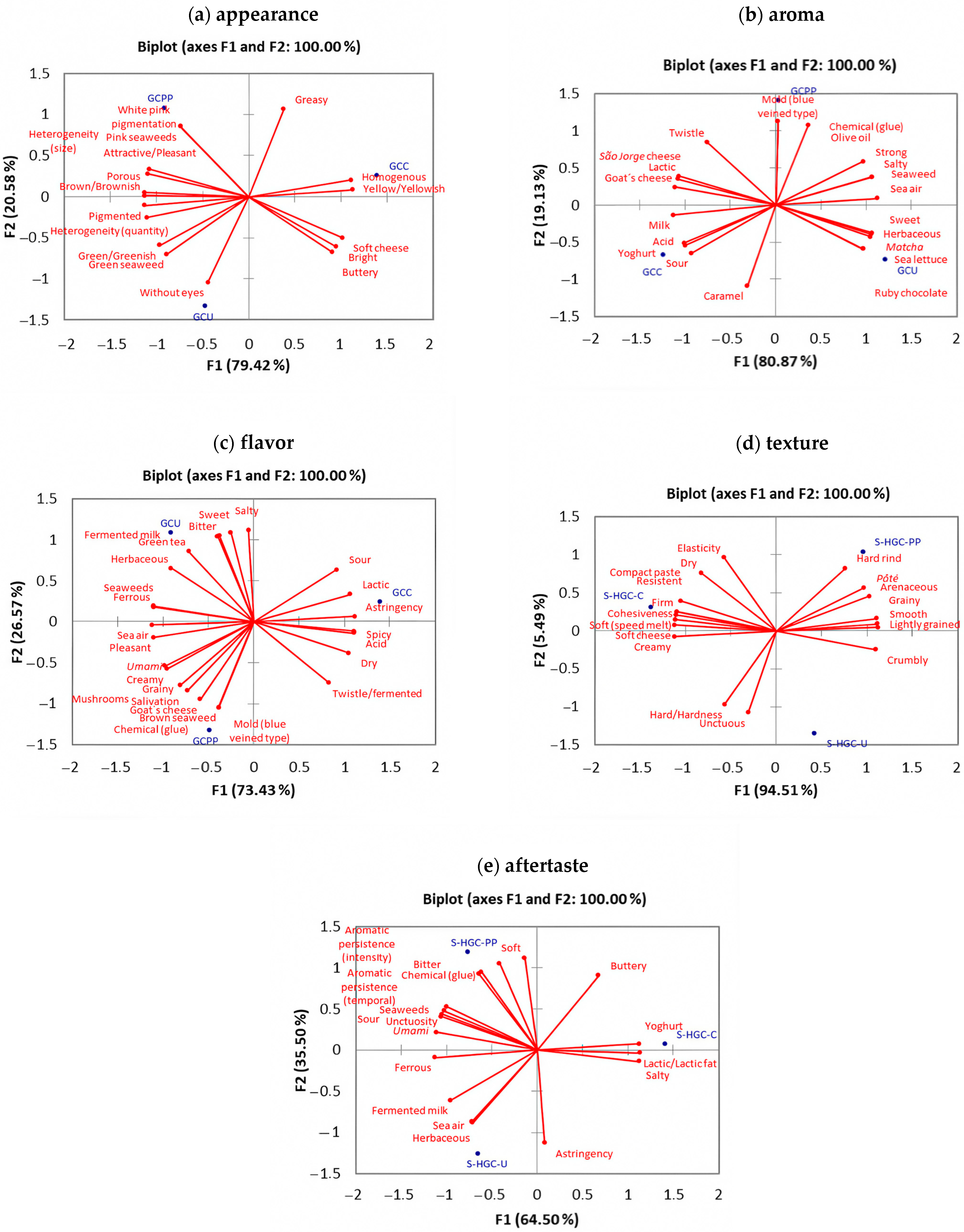
Figure 3 illustrates the spatial positioning of the cheese samples following GPA, along with the correlations between sensory attributes—appearance, aroma, flavor, texture, and aftertaste—and the F1 and F2 dimensions.
The first axis (F1) of the appearance evaluation (Figure 3a) separated SHGC-C from SHGC-PP and SHGC-U. The control semi-hard goat’s cheese (SHGC-C) was described as homogeneous and yellow/yellowish, in line with the measured hardness (19.43 N) and yellowness (b* = 26.54). Semi-hard goat’s cheese supplemented with P. palmata (SHGC-PP) was characterized by pink seaweeds and white-pink pigmentation, while the sample supplemented with Ulva sp. (SHGC-U) was described as without eyes, green seaweed, and green/greenish, consistent with the a* values, which indicate the degree of redness (a* > 0) or greenness (a* < 0), with respective values of 8.06 and –0.91.
Regarding aroma (Figure 3b), SHGC-C was primarily associated with yogurt, acid, and sour notes. SHGC-PP was linked to chemical (glue), mold (blue-veined type), and olive oil, while SHGC-U was characterized by herbaceous, matcha, sea lettuce, and sweet notes. These findings align with previous descriptions of “Bouhezza” goat’s cheese from Algeria as having a strong acidic lactic odor [72]. The aroma attributes of SHGC-U were comparable to those reported for Ulva sp., which has been described as having seaweed, marine, seafood, green grass, and matcha aromas [128,129,130].
In terms of flavor (Figure 3c), SHGC-C was characterized by acid, astringent, dry, lactic, sour, and spicy notes. SHGC-PP exhibited characteristics such as brown seaweed, chemical (glue), grainy, goat’s cheese, mold (blue-veined type), salivation, and mushroom, which is consistent with previous descriptions of P. palmata containing 1-octen-3-ol, a compound responsible for earthy and mushroom-like aromas [131]. SHGC-U was described using terms such as bitter, fermented milk, green tea, herbaceous, salty, and sweet. Ulva sp. has been previously characterized as slightly bitter [130], and the sweet taste was linked to better food acceptance [132]. Salty notes were identified in cheeses supplemented with seaweeds, which is expected due to their high mineral content (e.g., Ca, Fe, K, Mg, Zn), making them useful as flavoring ingredients [133] and salt replacers in the food industry [134].
The flavor profile of cheeses depends on the metabolism of lactose and lactate, as well as the metabolic pathways of lipolysis and proteolysis [89,135]. Some authors suggest that the characteristic flavors of goat’s cheese are closely associated with branched-chain fatty acids such as octanoic, 4-ethyloctanoic, and 4-methyloctanoic [89,136]. Additionally, certain carboxylic acids contribute to rancid and pungent odors [135,137]. These findings correspond to the terms commonly used to describe the aroma and flavor of SHGC-C, namely acid, sour, and spicy.
Regarding texture (Figure 3d), SHGC-PP was associated with hard rind, pâté, and arenaceous descriptors, while SHGC-U was characterized by contrasting attributes, namely hard/hardness and unctuous. SHGC-C exhibited cohesiveness, compact paste, firm, resistant, and soft cheese characteristics, which contrast with crumbly textures. These descriptions match previous evaluations of “Bouhezza” cheese, which is described as smooth and firm [72]. The texture assessments are in line with measured hardness values, where SHGC-C had a hardness of 19.43 N, and SHGC-U had a lower hardness of 12.47 N. According to Queiroga et al. [89], hardness can reflect a particular sensory characteristic of goat’s cheeses.
For aftertaste (Figure 3e), SHGC-C was associated with salty, lactic/lactic fat, and yogurt flavors, while SHGC-PP had the most complex aftertaste, including aromatic persistence (intensity and temporal), chemical (glue), bitter, and soft. The term “soft” is consistent with the texture profile analysis (TPA), where SHGC-PP had the lowest hardness value (5.24 N) and the highest adhesiveness value (0.28 J), indicating a softer texture. SHGC-U was primarily described with herbaceous and sea air aftertaste, mainly due to the addition of Ulva sp., which is rich in dimethyl sulfide—a compound with a marine-like aroma—and various aldehydes that contribute to its characteristic herbaceous notes [138].
The Flash Profile results highlight the unique sensory characteristics of each cheese. One of the main objectives of this study was to develop innovative food products with distinctive sensory attributes when compared to Mediterranean-style SHGCs, and the findings suggest that this goal was successfully achieved.

4. Conclusions

The physicochemical characteristics of semi-hard goat’s cheese were notably influenced by the addition of seaweeds to the curd. The physicochemical composition analysis revealed that SHGC-PP had the highest levels of NaCl, total carbohydrates, and total lipids, whereas SHGC-U exhibited the highest moisture and crude protein content. Seaweed supplementation particularly affected the mineral profile of the cheeses, with SHGC-U being enriched in calcium (Ca), iron (Fe), manganese (Mn), and zinc (Zn). Additionally, color and textural properties were significantly altered by the inclusion of seaweeds in the curd. However, the cheese microbiota was minimally impacted by the addition of seaweeds.
Overall, the supplementation with seaweeds resulted in more complex sensory characteristics, particularly in terms of aroma and flavor. This could make goat’s cheeses with a less pronounced “goat” flavor more appealing to sensitive consumers, thereby increasing their attractiveness.
This study also underscores the potential of integrating seaweeds with dairy products, such as Mediterranean-style goat’s cheeses, without causing any unfamiliarity, undesirable effect, or triggering food neophobia. These findings are particularly relevant for advancing the dairy industry by introducing health-beneficial foods, promoting innovation in the artisanal food sector, and supporting the valorization of small-scale producers, which plays a key role in strengthening regional economies.

Supplementary Materials

The following supporting information can be downloaded at https://www.mdpi.com/article/10.3390/app15158232/s1; Table S1: Methods followed for the various microbiological analyses (Enterococcus, Lactic Acid Bacteria (LAB), Aerobic Mesophilic Bacteria (AMB), Marine Agar Counts (MACs), Glucose–Yeast–Peptone (GYP) molds and yeasts, Escherichia coli, total coliforms, Staphylococcus aureus, Salmonella spp., and Listeria monocytogenes); Table S2: Mann–Whitney U test pairwise comparisons between goat’s cheeses samples for general physicochemical analyses; Table S3: Mann–Whitney U test pairwise comparisons between goat’s cheese samples for trace elements and minerals; Table S4: Mann–Whitney U test pairwise between goat’s cheese samples comparisons for color parameters.; Table S5: Mann–Whitney U test pairwise comparisons between goat’s cheese samples for TPA parameters; Table S6: Mann–Whitney U test pairwise comparisons between goat’s cheese samples * for microbiological analyses; Table S7: Guidance criteria on the interpretation of microbiological results in ready-to-eat foods placed on the market (Enterococcus, Lactic Acid Bacteria (LAB), Aerobic Mesophilic Bacteria (AMB), Marine Agar Counts (MACs), Glucose–Yeast–Peptone (GYP) molds and yeasts, Escherichia coli, total coliforms, Staphylococcus aureus, Salmonella spp., and Listeria monocytogenes); Table S8: Residual variance values, scaling factors, and the percentage variation explained by the first two principal components (F1 and F2) of Generalized Procrustes Analysis (GPA) for each participant on the Flash Profile (FP) analysis of the semi-hard goat cheeses (SHGCs).

Author Contributions

Conceptualization, B.M.C., M.S.D. and P.M.; Data curation, M.M.-F., P.H.M.d.S., M.S.D. and P.M.; Formal analysis, B.M.C., B.S.M.-L., A.S., E.R., I.M., M.M.-F. and P.H.M.d.S.; Funding acquisition, J.P.N., M.S.D. and P.M.; Investigation, B.M.C.; Methodology, B.M.C., A.H., M.S.D. and P.M.; Project administration, J.P.N.; Software, B.S.M.-L. and M.S.D.; Supervision, M.S.D. and P.M.; Validation, M.S.D. and P.M.; Writing—original draft, B.M.C. and B.S.M.-L.; Writing—review and editing, B.M.C., B.S.M.-L., J.P.N., M.S.D. and P.M. All authors have read and agreed to the published version of the manuscript.

Funding

This research was funded by the European Maritime and Fisheries Fund and co-funded by the Operational Program Mar2020 through the project Alga4Food (MAR-01.03.01-FEAMP-0016). This research was also supported by the Applied Molecular Biosciences Unit (UCIBIO) and the Associate Laboratory for Green Chemistry (LAQV), both funded by national funds from FCT/MCTES (10.54499/UIDB/04378/2020) and (10.54499/UID/50006/2020), respectively. This study was also co-financed by the ERDF under the PT2020 Partnership Agreement (POCI-01-0145-FEDER-007265).

Institutional Review Board Statement

Not applicable.

Informed Consent Statement

All participants involved in the sensory analysis tests (Flash Profile) provided their informed consent by completing and signing a written Informed Consent Form prior to participation. The study was conducted in full compliance with the highest ethical standards and was approved by the Research Ethics Committee (“Comitê de Ética em Pesquisa”, CEP) of the Federal University of Ceará (“Universidade Federal do Ceará”), under protocol (“Certificado de Apresentação de Apreciação Ética”, CAAE) nº 41822420.2.0000.5054 and approval nº 4.729.905.

Data Availability Statement

The original contributions presented in this study are included in the article. Further inquiries can be directed to the corresponding authors.

Conflicts of Interest

The authors declare no conflicts of interest. The funding sponsors had no role in the design of the study; in the collection, analyses, or interpretation of data; in the writing of the manuscript, and in the decision to publish the results. Author B.M.C. is currently employed by Sumol Compal. However, at the time this research was conducted, him was not affiliated with that company. Sumol Compal had no role in the design of the study; in the collection, analysis, or interpretation of data; in the writing of the manuscript; or in the decision to publish the results.

References

  1. United Nations. World Population Prospects 2019: Highlights (ST/ESA/SER.A/423); United Nations: New York, NY, USA, 2019; p. 39. [Google Scholar]
  2. Mouritsen, O.G.; Rhatigan, P.; Cornish, M.L.; Critchley, A.T.; Pérez-Lloréns, J.L. Saved by Seaweeds: Phyconomic Contributions in Times of Crises. J. Appl. Phycol. 2021, 33, 443–458. [Google Scholar] [CrossRef] [PubMed]
  3. Rebours, C.; Marinho-Soriano, E.; Zertuche-González, J.A.; Hayashi, L.; Vásquez, J.A.; Kradolfer, P.; Soriano, G.; Ugarte, R.; Abreu, M.H.; Bay-Larsen, I.; et al. Seaweeds: An Opportunity for Wealth and Sustainable Livelihood for Coastal Communities. J. Appl. Phycol. 2014, 26, 1939–1951. [Google Scholar] [CrossRef] [PubMed]
  4. MacArtain, P.; Gill, C.I.R.R.; Brooks, M.; Campbell, R.; Rowland, I.R. Nutritional Value of Edible Seaweeds. Nutr. Rev. 2007, 65, 535–543. [Google Scholar] [CrossRef] [PubMed]
  5. Milinovic, J. Nutritional Benefits of Edible Macroalgae from the Central Portuguese Coast: Inclusion of Low-Calorie ‘Sea Vegetables’ in Human Diet. Int. J. Environ. Sci. Nat. Resour. 2021, 28, 556250. [Google Scholar] [CrossRef]
  6. Del Olmo, A.; Picon, A.; Nuñez, M. Cheese Supplementation with Five Species of Edible Seaweeds: Effect on Microbiota, Antioxidant Activity, Colour, Texture and Sensory Characteristics. Int. Dairy J. 2018, 84, 36–45. [Google Scholar] [CrossRef]
  7. Wells, M.L.; Potin, P.; Craigie, J.S.; Raven, J.A.; Merchant, S.S.; Helliwell, K.E.; Smith, A.G.; Camire, M.E.; Brawley, S.H. Algae as Nutritional and Functional Food Sources: Revisiting Our Understanding. J. Appl. Phycol. 2017, 29, 949–982. [Google Scholar] [CrossRef]
  8. Roohinejad, S.; Koubaa, M.; Barba, F.J.; Saljoughian, S.; Amid, M.; Greiner, R. Application of Seaweeds to Develop New Food Products with Enhanced Shelf-Life, Quality and Health-Related Beneficial Properties. Food Res. Int. 2017, 99, 1066–1083. [Google Scholar] [CrossRef]
  9. Blikra, M.J.; Altintzoglou, T.; Løvdal, T.; Rognså, G.; Skipnes, D.; Skåra, T.; Sivertsvik, M.; Noriega Fernández, E. Seaweed Products for the Future: Using Current Tools to Develop a Sustainable Food Industry. Trends Food Sci. Technol. 2021, 118, 765–776. [Google Scholar] [CrossRef]
  10. McHugh, D.J. A Guide to the Seaweed Industry; FAO Fisheries Technical Paper; FAO: Rome, Italy, 2003; p. 105. ISBN 92-5-104958-0. [Google Scholar]
  11. Mouritsen, O.G.; Rhatigan, P.; Pérez-Lloréns, J.L. The Rise of Seaweed Gastronomy: Phycogastronomy. Bot. Mar. 2019, 62, 195–209. [Google Scholar] [CrossRef]
  12. Lomer, M.C.E.; Parkes, G.C.; Sanderson, J.D. Review Article: Lactose Intolerance in Clinical Practice–Myths and Realities. Aliment. Pharmacol. Ther. 2008, 27, 93–103. [Google Scholar] [CrossRef]
  13. Michalak, I.; Chojnacka, K. Seaweeds As a Component of the Human Diet. In Algae Biomass: Characteristics and Applications; Chojnacka, K., Wieczorek, P.P., Schroeder, G., Michalak, I., Eds.; Springer International Publishing: Cham, Switzerland, 2018; pp. 57–71. ISBN 978-3-319-74702-6. [Google Scholar]
  14. Picon, A.; Garde, S.; Ávila, M.; Nuñez, M. Microbiota Dynamics and Lactic Acid Bacteria Biodiversity in Raw Goat Milk Cheeses. Int. Dairy J. 2016, 58, 14–22. [Google Scholar] [CrossRef]
  15. Pisano, M.B.; Deplano, M.; Fadda, M.E.; Cosentino, S. Microbiota of Sardinian Goat’s Milk and Preliminary Characterization of Prevalent LAB Species for Starter or Adjunct Cultures Development. BioMed Res. Int. 2019, 2019, 6131404. [Google Scholar] [CrossRef] [PubMed]
  16. Castel, J.M.; Ruiz, F.A.; Mena, Y.; Sánchez-Rodríguez, M. Present Situation and Future Perspectives for Goat Production Systems in Spain. Small Rumin. Res. 2010, 89, 207–210. [Google Scholar] [CrossRef]
  17. Tiberio, M.L.; Diniz, F. Sheep and Goat Production in Portugal: A Dynamic View. Mod. Econ. 2014, 5, 703–722. [Google Scholar] [CrossRef]
  18. Barbosa, M. Goat’s Milk Research in Portugal. Dairy Sci. Technol. 1993, 73, 425–429. [Google Scholar] [CrossRef]
  19. Freitas, C.; Xavier Malcata, F. Microbiology and Biochemistry of Cheeses with Appélation d’Origine Protegée and Manufactured in the Iberian Peninsula from Ovine and Caprine Milks. J. Dairy Sci. 2000, 83, 584–602. [Google Scholar] [CrossRef]
  20. Henriques, A. Puro Chevre: Receitas com Queijo de Cabra. In Coração, Cabeça e Estômago/Sabores Exóticos, 1st ed.; Assírio & Alvim: Lisboa, Portugal, 2007; ISBN 978-972-37-1285-8. [Google Scholar]
  21. Nuñez, M.; Picon, A. Seaweeds in Yogurt and Quark Supplementation: Influence of Five Dehydrated Edible Seaweeds on Sensory Characteristics. Int. J. Food Sci. Technol. 2017, 52, 431–438. [Google Scholar] [CrossRef]
  22. Matos, J.; Cardoso, C.; Serralheiro, M.L.; Bandarra, N.M.; Afonso, C. Seaweed Bioactives Potential as Nutraceuticals and Functional Ingredients: A Review. J. Food Compos. Anal. 2024, 133, 106453. [Google Scholar] [CrossRef]
  23. Kumar, A.; Hanjabam, M.D.; Kishore, P.; Uchoi, D.; Panda, S.K.; Mohan, C.O.; Chatterjee, N.S.; Zynudheen, A.A.; Ravishankar, C.N. Exploitation of Seaweed Functionality for the Development of Food Products. Food Bioprocess Technol. 2023, 16, 1873–1903. [Google Scholar] [CrossRef]
  24. Gupta, S.; Abu-Ghannam, N. Recent Developments in the Application of Seaweeds or Seaweed Extracts as a Means for Enhancing the Safety and Quality Attributes of Foods. Innov. Food Sci. Emerg. Technol. 2011, 12, 600–609. [Google Scholar] [CrossRef]
  25. Cofrades, S.; Serdaroğlu, M.; Jiménez-Colmenero, F. Design of Healthier Foods and Beverages Containing Whole Algae. In Functional Ingredients from Algae for Foods and Nutraceuticals; Elsevier: Amsterdam, The Netherlands, 2013; pp. 609–633. ISBN 978-0-85709-512-1. [Google Scholar]
  26. Lalić, L.M.; Berković, K. The Influence of Algae Addition on Physicochemical Properties of Cottage Cheese. Milchwiss.-Milk Sci. Int. 2005, 60, 151–154. [Google Scholar]
  27. Hell, A.; Labrie, S.; Beaulieu, L. Effect of Seaweed Flakes Addition on the Development of Bioactivities in Functional Camembert-type Cheese. Int. J. Food Sci. Technol. 2018, 53, 1054–1064. [Google Scholar] [CrossRef]
  28. Guerrero, L.; Guàrdia, M.D.; Xicola, J.; Verbeke, W.; Vanhonacker, F.; Zakowska-Biemans, S.; Sajdakowska, M.; Sulmont-Rossé, C.; Issanchou, S.; Contel, M.; et al. Consumer-Driven Definition of Traditional Food Products and Innovation in Traditional Foods. A Qualitative Cross-Cultural Study. Appetite 2009, 52, 345–354. [Google Scholar] [CrossRef]
  29. Guerrero, L.; Claret, A.; Verbeke, W.; Sulmont-Rossé, C.; Hersleth, M. Innovation in Traditional Food Products: Does It Make Sense? In Innovation Strategies in the Food Industry; Elsevier: Amsterdam, The Netherlands, 2022; pp. 87–95. ISBN 978-0-323-85203-6. [Google Scholar]
  30. Bishop, R. Cheese Innovation: Market Driven vs. Regulatory Standards. Aust. J. Dairy Technol. 2006, 61, 196–197. [Google Scholar]
  31. Almli, V.L.; Næs, T.; Enderli, G.; Sulmont-Rossé, C.; Issanchou, S.; Hersleth, M. Consumers’ Acceptance of Innovations in Traditional Cheese. A Comparative Study in France and Norway. Appetite 2011, 57, 110–120. [Google Scholar] [CrossRef] [PubMed]
  32. Grigg, D. An Introduction to Agricultural Geography, 2nd ed.; Routledge: Abingdon, UK, 2003; ISBN 978-1-134-88764-4. [Google Scholar]
  33. Belletti, G.; Marescotti, A.; Touzard, J.-M. Geographical Indications, Public Goods, and Sustainable Development: The Roles of Actors’ Strategies and Public Policies. World Dev. 2017, 98, 45–57. [Google Scholar] [CrossRef]
  34. Wattiaux, M.A. Sustainability of Dairy Systems through the Lenses of the Sustainable Development Goals. Front. Anim. Sci. 2023, 4, 1135381. [Google Scholar] [CrossRef]
  35. Dubeuf, J.-P.; Ruiz Morales, F.D.A.; Castel Genis, J.M. Initiatives and Projects to Promote the Mediterranean Local Cheeses and Their Relations to the Development of Livestock Systems and Activities. Small Rumin. Res. 2010, 93, 67–75. [Google Scholar] [CrossRef]
  36. Priyashantha, H. World Dairy System Sustainability: A Milk Quality Perspective. Front. Sustain. Resour. Manag. 2025, 4, 1572962. [Google Scholar] [CrossRef]
  37. Oliveira, S.; Fradinho, P.; Mata, P.; Moreira-Leite, B.; Raymundo, A. Exploring Innovation in a Traditional Sweet Pastry: Pastel de Nata. Int. J. Gastron. Food Sci. 2019, 17, 100160. [Google Scholar] [CrossRef]
  38. Mellor, C.; Embling, R.; Neilson, L.; Randall, T.; Wakeham, C.; Lee, M.D.; Wilkinson, L.L. Consumer Knowledge and Acceptance of “Algae” as a Protein Alternative: A UK-Based Qualitative Study. Foods 2022, 11, 1703. [Google Scholar] [CrossRef]
  39. Losada-Lopez, C.; Dopico, D.C.; Faína-Medín, J.A. Neophobia and Seaweed Consumption: Effects on Consumer Attitude and Willingness to Consume Seaweed. Int. J. Gastron. Food Sci. 2021, 24, 100338. [Google Scholar] [CrossRef]
  40. Klnc, B.; Cirik, S.; Turan, G.; Tekogul, H.; Koru, E. Seaweeds for Food and Industrial Applications. In Food Industry; Muzzalupo, I., Ed.; InTech: Houston, TX, USA, 2013; ISBN 978-953-51-0911-2. [Google Scholar]
  41. Mouritsen, O.G.; Dawczynski, C.; Duelund, L.; Jahreis, G.; Vetter, W.; Schröder, M. On the Human Consumption of the Red Seaweed Dulse (Palmaria Palmata (L.) Weber & Mohr). J. Appl. Phycol. 2013, 25, 1777–1791. [Google Scholar] [CrossRef]
  42. 5534:2004(E); Cheese and Processed Cheese—Determination of the Total Solids Content (Reference Method). ISO International Organization for Standardization: Geneva, Switzerland, 2004.
  43. Kostas, E.T.; Wilkinson, S.J.; White, D.A.; Cook, D.J. Optimization of a Total Acid Hydrolysis Based Protocol for the Quantification of Carbohydrate in Macroalgae. J. Algal Biomass Util. 2016, 7, 21–36. [Google Scholar]
  44. Kumari, P.; Reddy, C.R.K.; Jha, B. Comparative Evaluation and Selection of a Method for Lipid and Fatty Acid Extraction from Macroalgae. Anal. Biochem. 2011, 415, 134–144. [Google Scholar] [CrossRef] [PubMed]
  45. Mariotti, F.; Tomé, D.; Mirand, P.P. Converting Nitrogen into Protein—Beyond 6.25 and Jones’ Factors. Crit. Rev. Food Sci. Nutr. 2008, 48, 177–184. [Google Scholar] [CrossRef]
  46. U.S. EPA. Method 3051A (SW-846): Microwave Assisted Acid Digestion of Sediments, Sludges, and Oils; Revision 1; United States Environmental Protection Agency: Washington, DC, USA, 2007.
  47. Wrolstad, R.E.; Smith, D.E. Color Analysis. In Food Analysis; Nielsen, S.S., Ed.; Food Science Text Series; Springer International Publishing: Cham, Switzerland, 2017; pp. 545–555. ISBN 978-3-319-45774-1. [Google Scholar]
  48. HPA Health Protection Agency. Guidelines for Assessing the Microbiological Safety of Ready-to-Eat Foods Placed on the Market; HPA Health Protection Agency: London, UK, 2009. [Google Scholar]
  49. INSA Instituto Nacional de Saúde Doutor Ricardo Jorge. Interpretação de Resultados de Ensaios Microbiológicos em Alimentos Prontos para Consumo e em Superfícies do Ambiente de Preparação e Distribuição Alimentar: Valores-Guia; INSA Instituto Nacional de Saúde Doutor Ricardo Jorge: Lisboa, Portugal, 2019. [Google Scholar]
  50. European Commission. Regulation (EC) No 2073/2005 of 15 November 2005 on Microbiological Criteria for Foodstuffs; European Commission: Brussels, Belgium, 2005; Volume L338, pp. 1–26, CELEX: 32005R2073; Available online: https://eur-lex.europa.eu/legal-content/EN/TXT/PDF/?uri=CELEX:32005R2073 (accessed on 8 July 2025).
  51. Delarue, J.; Sieffermann, J.-M. Sensory Mapping Using Flash Profile. Comparison with a Conventional Descriptive Method for the Evaluation of the Flavour of Fruit Dairy Products. Food Qual. Prefer. 2004, 15, 383–392. [Google Scholar] [CrossRef]
  52. Dairou, V.; Sieffermann, J.-M. A Comparison of 14 Jams Characterized by Conventional Profile and a Quick Original Method, the Flash Profile. J. Food Sci. 2002, 67, 826–834. [Google Scholar] [CrossRef]
  53. Almujlli, G.; Alrabah, R.; Al-Ghosen, A.; Munshi, F. Conducting Virtual Focus Groups During the COVID-19 Epidemic Utilizing Videoconferencing Technology: A Feasibility Study. Cureus 2022, 14, e23540. [Google Scholar] [CrossRef]
  54. Maciel, J.B.; De Oliveira Silva, Y.; Santos, S.S.; Dionísio, A.P.; Machado De Sousa, P.H.; Garruti, D.D.S. Plant-Based Gastronomic Products Based on Freeze-Dried Cashew Fiber. Int. J. Gastron. Food Sci. 2022, 30, 100603. [Google Scholar] [CrossRef]
  55. Bredie, W.L.P.; Liu, J.; Dehlholm, C.; Heymann, H. Flash Profile Method. In Descriptive Analysis in Sensory Evaluation; Kemp, S.E., Hort, J., Hollowood, T., Eds.; Wiley: Hoboken, NJ, USA, 2018; pp. 513–533. ISBN 978-0-470-67139-9. [Google Scholar]
  56. Franco, I.; Prieto, B.; Bernardo, A.; González Prieto, J.; Carballo, J. Biochemical Changes throughout the Ripening of a Traditional Spanish Goat Cheese Variety (Babia-Laciana). Int. Dairy J. 2003, 13, 221–230. [Google Scholar] [CrossRef]
  57. Bontinis, T.G.; Mallatou, H.; Alichanidis, E.; Kakouri, A.; Samelis, J. Physicochemical, Microbiological and Sensory Changes during Ripening and Storage of Xinotyri, a Traditional Greek Cheese from Raw Goat’s Milk. Int. J. Dairy Technol. 2008, 61, 229–236. [Google Scholar] [CrossRef]
  58. Guizani, N.; Al-Attabi, Z.; Kasapis, S.; Mahgoub Gaafar, O. Ripening Profile of Semi-Hard Standard Goat Cheese Made From Pasteurized Milk. Int. J. Food Prop. 2006, 9, 523–532. [Google Scholar] [CrossRef]
  59. Gobbetti, M.; Lowney, S.; Smacchi, E.; Battistotti, B.; Damiani, P.; Fox, P.F. Microbiology and Biochemistry of Taleggio Cheese during Ripening. Int. Dairy J. 1997, 7, 509–517. [Google Scholar] [CrossRef]
  60. Medina, M.; Gaya, P.; Nuñez, M. Gredos Goats’ Milk Cheese: Microbiological and Chemical Changes throughout Ripening. J. Dairy Res. 1992, 59, 563–566. [Google Scholar] [CrossRef] [PubMed]
  61. Mauer, L.J.; Bradley, R.L. Moisture and Total Solids Analysis. In Food Analysis; Nielsen, S.S., Ed.; Food Science Text Series; Springer International Publishing: Cham, Switzerland, 2017; pp. 257–286. ISBN 978-3-319-45774-1. [Google Scholar]
  62. Boisvert, C.; Beaulieu, L.; Bonnet, C.; Pelletier, É. Assessment of the Antioxidant and Antibacterial Activities of Three Species of Edible Seaweeds: Antioxidant and Antibacterial Activities of Edible Seaweeds. J. Food Biochem. 2015, 39, 377–387. [Google Scholar] [CrossRef]
  63. Marinho, G.S.; Holdt, S.L.; Angelidaki, I. Seasonal Variations in the Amino Acid Profile and Protein Nutritional Value of Saccharina Latissima Cultivated in a Commercial IMTA System. J. Appl. Phycol. 2015, 27, 1991–2000. [Google Scholar] [CrossRef]
  64. El-Bakry, M. Salt in Cheese: A Review. Curr. Res. Dairy Sci. 2011, 4, 1–5. [Google Scholar] [CrossRef]
  65. Psoni, L.; Tzanetakis, N.; Litopoulou-Tzanetaki, E. Microbiological Characteristics of Batzos, a Traditional Greek Cheese from Raw Goat’s Milk. Food Microbiol. 2003, 20, 575–582. [Google Scholar] [CrossRef]
  66. Cagno, R.D.; Evan Miracle, R.; Angelis, M.D.; Minervini, F.; Rizzello, C.G.; Anne Drake, M.; Fox, P.F.; Gobbetti, M. Compositional, Microbiological, Biochemical, Volatile Profile and Sensory Characterization of Four Italian Semi-Hard Goats’ Cheeses. J. Dairy Res. 2007, 74, 468–477. [Google Scholar] [CrossRef]
  67. Beresford, T. The Microbiology of Cheese Ripening. In Cheese Problems Solved; Elsevier: Amsterdam, The Netherlands, 2007; pp. 117–132. ISBN 978-1-84569-060-1. [Google Scholar]
  68. Tuure, T.; Korpela, R. Lactose Intolerance and Low-Lactose Dairy Products. In Handbook of Functional Dairy Products; Shortt, C., O’Brien, J., Eds.; CRC Press: Boca Raton, FL, USA, 2003; pp. 89–108. ISBN 978-0-429-21455-4. [Google Scholar]
  69. McSweeney, P.L.H. Biochemistry of Cheese Ripening. Int. J. Dairy Technol. 2004, 57, 127–144. [Google Scholar] [CrossRef]
  70. O’Brien, N.M.; O’Connor, T.P. Nutritional Aspects of Cheese. In Cheese: Chemistry, Physics and Microbiology; Elsevier: Amsterdam, The Netherlands, 2004; Volume 1, pp. 573–581. ISBN 978-0-12-263652-3. [Google Scholar]
  71. Cossignani, L.; Giua, L.; Urbani, E.; Simonetti, M.S.; Blasi, F. Fatty Acid Composition and CLA Content in Goat Milk and Cheese Samples from Umbrian Market. Eur. Food Res. Technol. 2014, 239, 905–911. [Google Scholar] [CrossRef]
  72. Medjoudj, H.; Aouar, L.; Zidoune, M.N.; Hayaloglu, A.A. Proteolysis, Microbiology, Volatiles and Sensory Evaluation of Algerian Traditional Cheese Bouhezza Made Using Goat’s Raw Milk. Int. J. Food Prop. 2017, 20, S3246–S3265. [Google Scholar] [CrossRef]
  73. Lopes, D.; Rey, F.; Leal, M.C.; Lillebø, A.I.; Calado, R.; Domingues, M.R. Bioactivities of Lipid Extracts and Complex Lipids from Seaweeds: Current Knowledge and Future Prospects. Mar. Drugs 2021, 19, 686. [Google Scholar] [CrossRef] [PubMed]
  74. Martín-Hernández, M.C.; Juarez, M.; Ramos, M. Biochemical Characteristics of Three Types of Goat Cheese. J. Dairy Sci. 1992, 75, 1747–1752. [Google Scholar] [CrossRef]
  75. O’Callaghan, Y.C.; O’Connor, T.P.; O’Brien, N.M. Nutritional Aspects of Cheese. In Fundamentals of Cheese Science; Springer: Boston, MA, USA, 2017; pp. 715–730. ISBN 978-1-4899-7679-6. [Google Scholar]
  76. Bocanegra, A.; Bastida, S.; Benedí, J.; Ródenas, S.; Sánchez-Muniz, F.J. Characteristics and Nutritional and Cardiovascular-Health Properties of Seaweeds. J. Med. Food 2009, 12, 236–258. [Google Scholar] [CrossRef]
  77. Circuncisão, A.R.; Catarino, M.D.; Cardoso, S.M.; Silva, A.M.S. Minerals from Macroalgae Origin: Health Benefits and Risks for Consumers. Mar. Drugs 2018, 16, 400. [Google Scholar] [CrossRef]
  78. Mohammed, H.O.; O’Grady, M.N.; O’Sullivan, M.G.; Hamill, R.M.; Kilcawley, K.N.; Kerry, J.P. An Assessment of Selected Nutritional, Bioactive, Thermal and Technological Properties of Brown and Red Irish Seaweed Species. Foods 2021, 10, 2784. [Google Scholar] [CrossRef]
  79. Olsson, J.; Toth, G.B.; Albers, E. Biochemical Composition of Red, Green and Brown Seaweeds on the Swedish West Coast. J. Appl. Phycol. 2020, 32, 3305–3317. [Google Scholar] [CrossRef]
  80. Lozano Muñoz, I.; Díaz, N.F. Minerals in Edible Seaweed: Health Benefits and Food Safety Issues. Crit. Rev. Food Sci. Nutr. 2022, 62, 1592–1607. [Google Scholar] [CrossRef]
  81. Medeiros, E.J.L.D.; Queiroga, R.D.C.R.D.E.; Medeiros, A.N.D.; Bomfim, M.A.D.; Batista, A.S.M.; Félex, S.S.D.S.; Madruga, M.S. Sensory Profile and Physicochemical Parameters of Cheese from Dairy Goats Fed Vegetable Oils in the Semiarid Region of Brazil. Small Rumin. Res. 2013, 113, 211–218. [Google Scholar] [CrossRef]
  82. Guiné, R.; Correia, P.; Correia, A. Avaliação Comparativa de Queijos Portugueses de Cabra e Ovelha. Millenium-J. Educ. Technol. Health 2016, 49, 111–130. [Google Scholar]
  83. Freitas, M.V.; Pacheco, D.; Cotas, J.; Mouga, T.; Afonso, C.; Pereira, L. Red Seaweed Pigments from a Biotechnological Perspective. Phycology 2021, 2, 1–29. [Google Scholar] [CrossRef]
  84. Miyabe, Y.; Furuta, T.; Takeda, T.; Kanno, G.; Shimizu, T.; Tanaka, Y.; Gai, Z.; Yasui, H.; Kishimura, H. Structural Properties of Phycoerythrin from Dulse Palmaria palmata: Structural properties of dulse phycoerythrin. J. Food Biochem. 2017, 41, e12301. [Google Scholar] [CrossRef]
  85. Lalegerie, F.; Stiger-Pouvreau, V.; Connan, S. Temporal Variation in Pigment and Mycosporine-like Amino Acid Composition of the Red Macroalga Palmaria Palmata from Brittany (France): Hypothesis on the MAA Biosynthesis Pathway under High Irradiance. J. Appl. Phycol. 2020, 32, 2641–2656. [Google Scholar] [CrossRef]
  86. Bonanno, G.; Orlando-Bonaca, M. Chemical Elements in Mediterranean Macroalgae. A Review. Ecotoxicol. Environ. Saf. 2018, 148, 44–71. [Google Scholar] [CrossRef]
  87. El-Baky, H.H.A.; El Baz, F.K.; l Baroty, G.S.E. Evaluation of Marine Alga Ulva Lactuca as a Source of Natural Preservative Ingredient. Am.-Eurasian J. Agric. Environ. Sci. 2008, 3, 434–444. [Google Scholar]
  88. Mladenović, K.G.; Grujović, M.Ž.; Kocić-Tanackov, S.D.; Bulut, S.; Iličić, M.; Degenek, J.; Semedo-Lemsaddek, T. Serbian Traditional Goat Cheese: Physico-Chemical, Sensory, Hygienic and Safety Characteristics. Microorganisms 2021, 10, 90. [Google Scholar] [CrossRef]
  89. Queiroga, R.D.C.R.D.E.; Santos, B.M.; Gomes, A.M.P.; Monteiro, M.J.; Teixeira, S.M.; De Souza, E.L.; Pereira, C.J.D.; Pintado, M.M.E. Nutritional, Textural and Sensory Properties of Coalho Cheese Made of Goats’, Cows’ Milk and Their Mixture. LWT-Food Sci. Technol. 2013, 50, 538–544. [Google Scholar] [CrossRef]
  90. Dobychina, E.; Ryzhik, I.; Klindukh, M.; Machkarina, O.; Glukhikh, Y. Seasonal Changes in the Concentration of Photosynthetic Pigments Palmaria Palmata (Linnaeus) F. Weber & D. Mohr. KnE Life Sci. 2020. Available online: https://knepublishing.com/index.php/KnE-Life/article/download/6170/11565 (accessed on 8 July 2025). [CrossRef]
  91. Picon, A.; Alonso, R.; Van Wely, K.H.M.; Nuñez, M. Microstructural, Textural and Colour Characteristics During Ripening of Hispánico Cheese Made Using High-Pressure-Treated Ovine Milk Curd. Food Bioprocess Technol. 2013, 6, 3056–3067. [Google Scholar] [CrossRef]
  92. Milovanovic, B.; Djekic, I.; Miocinovic, J.; Djordjevic, V.; Lorenzo, J.M.; Barba, F.J.; Mörlein, D.; Tomasevic, I. What Is the Color of Milk and Dairy Products and How Is It Measured? Foods 2020, 9, 1629. [Google Scholar] [CrossRef]
  93. Paz, N.F.; Gonçalvez De Oliveira, E.; Villalva, F.J.; Armada, M.; Ramón, A.N. Effect of pH at Drainage on the Physicochemical, Textural and Microstructural Characteristics of Mozzarella Cheese from Goat Milk. Food Sci. Technol. 2017, 37, 193–201. [Google Scholar] [CrossRef]
  94. Lucas, A.; Rock, E.; Agabriel, C.; Chilliard, Y.; Coulon, J.B. Relationships between Animal Species (Cow versus Goat) and Some Nutritional Constituents in Raw Milk Farmhouse Cheeses. Small Rumin. Res. 2008, 74, 243–248. [Google Scholar] [CrossRef]
  95. Burgos, L.; Pece, N.; Maldonado, S. Proteolysis, Texture and Microstructure of Goat Cheese. Int. J. Eng. Appl. Sci. IJEAS 2016, 3, 14–19. [Google Scholar]
  96. Fresno, M.R.; Álvarez, S.; Rodríguez, V.; Castro, N.; Argüello, A. Evaluation of the Effect of Rennet Type on the Texture and Colour of Goats Cheese. J. Appl. Anim. Res. 2006, 30, 157–160. [Google Scholar] [CrossRef]
  97. Tejada, L.; Gómez, R.; Fernández-Salguero, J. Sensory Characteristics of Ewe Milk Cheese Made with Three Types of Coagulant: Calf Rennet, Powdered Vegetable Coagulant and Crude Aqueous Extract from Cynara cardunculus. J. Food Qual. 2007, 30, 91–103. [Google Scholar] [CrossRef]
  98. Pompei, C.; Casiraghi, E.; Lucisano, M.; Dellea, C. Characterization of Provolone Cheese. I. Selection of Variables. Ital. J. Food Sci. 1991, 2, 101–112. [Google Scholar]
  99. Álvarez, S.; Fresno, M. Effect of the Ripening Period and Intravarietal Comparison on Chemical, Textural and Sensorial Characteristics of Palmero (PDO) Goat Cheese. Animals 2020, 11, 58. [Google Scholar] [CrossRef]
  100. Guiné, R.P.F.; Fontes, L.; Lima, M.J. Evaluation of Texture in Serra Da Estrela Cheese Manufactured in Different Dairies. Open Agric. 2019, 4, 475–486. [Google Scholar] [CrossRef]
  101. Kumar, S.; Kanawjia, S.K.; Kumar, S.; Khatkar, S. Effect of Rate of Addition of Starter Culture on Textural Characteristics of Buffalo Milk Feta Type Cheese during Ripening. J. Food Sci. Technol. 2014, 51, 800–804. [Google Scholar] [CrossRef]
  102. Lawrence, R.C.; Creamer, L.K.; Gilles, J. Texture Development During Cheese Ripening. J. Dairy Sci. 1987, 70, 1748–1760. [Google Scholar] [CrossRef]
  103. Salvador, A.; Igual, M.; Contreras, C.; Martínez-Navarrete, N.; Del Mar Camacho, M. Effect of the Inclusion of Citrus Pulp in the Diet of Goats on Cheeses Characteristics. Small Rumin. Res. 2014, 121, 361–367. [Google Scholar] [CrossRef]
  104. Nájera, A.I.; Nieto, S.; Barron, L.J.R.; Albisu, M. A Review of the Preservation of Hard and Semi-Hard Cheeses: Quality and Safety. Int. J. Environ. Res. Public Health 2021, 18, 9789. [Google Scholar] [CrossRef] [PubMed]
  105. Metzger, N.; Alvarez-Ordóñez, A.; Leong, D.; Hunt, K.; Jordan, K. Survival of Foodborne Pathogens during Frozen Storage of Cheese Made from Artificially Inoculated Milk. Dairy Sci. Technol. 2015, 95, 759–767. [Google Scholar] [CrossRef]
  106. Tejada, L.; Sánchez, E.; Gómez, R.; Vioque, M.; Fernández-Salguero, J. Effect of Freezing and Frozen Storage on Chemical and Microbiological Characteristics in Sheep Milk Cheese. J. Food Sci. 2002, 67, 126–129. [Google Scholar] [CrossRef]
  107. Martín-Platero, A.M.; Maqueda, M.; Valdivia, E.; Purswani, J.; Martínez-Bueno, M. Polyphasic Study of Microbial Communities of Two Spanish Farmhouse Goats’ Milk Cheeses from Sierra de Aracena. Food Microbiol. 2009, 26, 294–304. [Google Scholar] [CrossRef]
  108. Suzzi, G.; Caruso, M.; Gardini, F.; Lombardi, A.; Vannini, L.; Guerzoni, M.E.; Andrighetto, C.; Lanorte, M.T. A Survey of the Enterococci Isolated from an Artisanal Italian Goat’s Cheese (Semicotto Caprino). J. Appl. Microbiol. 2000, 89, 267–274. [Google Scholar] [CrossRef]
  109. Franz, C.M.A.P.; Holzapfel, W.H.; Stiles, M.E. Enterococci at the Crossroads of Food Safety? Int. J. Food Microbiol. 1999, 47, 1–24. [Google Scholar] [CrossRef]
  110. Gelsomino, R.; Vancanneyt, M.; Cogan, T.M.; Condon, S.; Swings, J. Source of Enterococci in a Farmhouse Raw-Milk Cheese. Appl. Environ. Microbiol. 2002, 68, 3560–3565. [Google Scholar] [CrossRef]
  111. Centi, V.; Matteucci, F.; Lepidi, A.; Gallo, M.D.; Ercole, C. Microbiological and Biochemical Aspects of Inland Pecorino Abruzzese Cheese. Heliyon 2017, 3, e00258. [Google Scholar] [CrossRef]
  112. Ogier, J.; Serror, P. Safety Assessment of Dairy Microorganisms: The Enterococcus Genus. Int. J. Food Microbiol. 2008, 126, 291–301. [Google Scholar] [CrossRef] [PubMed]
  113. Zárate, V.; Belda, F.; Pérez, C.; Cardell, E. Changes in the Microbial Flora of Tenerife Goats’ Milk Cheese during Ripening. Int. Dairy J. 1997, 7, 635–641. [Google Scholar] [CrossRef]
  114. Terzić-Vidojević, A.; Veljović, K.; Popović, N.; Tolinački, M.; Golić, N. Enterococci from Raw-Milk Cheeses: Current Knowledge on Safety, Technological, and Probiotic Concerns. Foods 2021, 10, 2753. [Google Scholar] [CrossRef]
  115. Psoni, L.; Tzanetakis, N.; Litopoulou-Tzanetaki, E. Characteristics of Batzos Cheese Made from Raw, Pasteurized and/or Pasteurized Standardized Goat Milk and a Native Culture. Food Control 2006, 17, 533–539. [Google Scholar] [CrossRef]
  116. González, L.; Zárate, V. Influence of an Autochthonous Starter Culture and a Commercial Starter on the Characteristics of Tenerife Pasteurised Goats’ Milk Cheese. Int. J. Dairy Technol. 2012, 65, 542–547. [Google Scholar] [CrossRef]
  117. Steele, J.L. Contribution of Lactic Acid Bacteria to Cheese Ripening. In Chemistry of Structure-Function Relationships in Cheese; Malin, E.L., Tunick, M.H., Eds.; Advances in Experimental Medicine and Biology; Springer: Boston, MA, USA, 1995; Volume 367, pp. 209–220. ISBN 978-1-4613-5782-7. [Google Scholar]
  118. Alessandria, V.; Dolci, P.; Rantsiou, K.; Pattono, D.; Dalmasso, A.; Civera, T.; Cocolin, L. Microbiota of the Planalto de Bolona: An Artisanal Cheese Produced in Uncommon Environmental Conditions in the Cape Verde Islands. World J. Microbiol. Biotechnol. 2010, 26, 2211–2221. [Google Scholar] [CrossRef]
  119. Tornadijo, M.E.; Fresno, J.M.; Bernardo, A.; Martin Sarmiento, R.; Carballo, J. Microbiological Changes throughout the Manufacturing and Ripening of a Spanish Goat’s Raw Milk Cheese (Armada Variety). Le Lait 1995, 75, 551–570. [Google Scholar] [CrossRef]
  120. EEC. Council Directive 92/46/EEC of 16 June 1992 Laying down the Health Rules for the Production and Placing on the Market of Raw Milk, Heat-Treated Milk and Milk-Based Products. 1992, Volume L268, pp. 1–32, CELEX: 31992L0046. Available online: https://eur-lex.europa.eu/legal-content/EN/TXT/PDF/?uri=CELEX:31992L0046 (accessed on 8 July 2025).
  121. Schirone, M.; Tofalo, R.; Mazzone, G.; Corsetti, A.; Suzzi, G. Biogenic Amine Content and Microbiological Profile of Pecorino Di Farindola Cheese. Food Microbiol. 2011, 28, 128–136. [Google Scholar] [CrossRef]
  122. Macedo, A.C.; Malcata, F.X.; Hogg, T.A. Microbiological Profile in Serra Ewes’ Cheese during Ripening. J. Appl. Bacteriol. 1995, 79, 1–11. [Google Scholar] [CrossRef]
  123. Hymery, N.; Vasseur, V.; Coton, M.; Mounier, J.; Jany, J.; Barbier, G.; Coton, E. Filamentous Fungi and Mycotoxins in Cheese: A Review. Compr. Rev. Food Sci. Food Saf. 2014, 13, 437–456. [Google Scholar] [CrossRef]
  124. Rodrigues, S.; Teixeira, A. Use of Generalized Procrustes Analysis (GPA) to Test the Effects of Sex and Carcass Weight on Sensory Quality Evaluations of Terrincho Lamb Meat. Meat Sci. 2013, 93, 485–488. [Google Scholar] [CrossRef] [PubMed]
  125. Ser, G. Using Generalized Procrustes Analysis for Evaluation of Sensory Characteristic Data of Lamb Meat. Turk. J. Agric.-Food Sci. Technol. 2019, 7, 840–844. [Google Scholar] [CrossRef]
  126. Rodríguez-Noriega, S.; Buenrostro-Figueroa, J.J.; Rebolloso-Padilla, O.N.; Corona-Flores, J.; Camposeco-Montejo, N.; Flores-Naveda, A.; Ruelas-Chacón, X. Developing a Descriptive Sensory Characterization of Flour Tortilla Applying Flash Profile. Foods 2021, 10, 1473. [Google Scholar] [CrossRef] [PubMed]
  127. Hernández-Cervantes, M.; López-Velázquez, J.; Gómez-Alvarado, T.; Santiago-Cabrera, R.; Ramón-Canul, L.G.; Delgado-Vidal, F.K.; Shain-Mercado, A.J.; Huante-González, Y.; Rivera, R.; de Jesús, E. Comparación de la descripción sensorial del queso fresco “cuajada” mediante el análisis descriptivo cuantitativo y el perfil flash. Cienc. Mar. 2010, 14, 3–12. [Google Scholar]
  128. López-Pérez, O.; Picon, A.; Nuñez, M. Volatile Compounds and Odour Characteristics of Seven Species of Dehydrated Edible Seaweeds. Food Res. Int. 2017, 99, 1002–1010. [Google Scholar] [CrossRef]
  129. Moreira-Leite, B.; Noronha, J.P.; Mata, P. Introduction of Seaweeds in Desserts: The Design of a Sea Lettuce Ice Cream. In Experiencing Food, Designing Sustainable and Social Practices; Bonacho, R., Pires, M.J., De Sousa Lamy, E.C.C., Eds.; CRC Press: Boca Raton, FL, USA, 2020; pp. 73–79. ISBN 978-1-003-04609-7. [Google Scholar]
  130. Figueroa, V.; Farfán, M.; Aguilera, J.M. Seaweeds as Novel Foods and Source of Culinary Flavors. Food Rev. Int. 2021, 39, 1–26. [Google Scholar] [CrossRef]
  131. Vilar, E.G.; O’Sullivan, M.G.; Kerry, J.P.; Kilcawley, K.N. A Chemometric Approach to Characterize the Aroma of Selected Brown and Red Edible Seaweeds/Extracts. J. Sci. Food Agric. 2021, 101, 1228–1238. [Google Scholar] [CrossRef]
  132. Stévant, P.; Ólafsdóttir, A.; Déléris, P.; Dumay, J.; Fleurence, J.; Ingadóttir, B.; Jónsdóttir, R.; Ragueneau, É.; Rebours, C.; Rustad, T. Semi-Dry Storage as a Maturation Process for Improving the Sensory Characteristics of the Edible Red Seaweed Dulse (Palmaria Palmata). Algal Res. 2020, 51, 102048. [Google Scholar] [CrossRef]
  133. Vilar, E.G.; Ouyang, H.; O’Sullivan, M.G.; Kerry, J.P.; Hamill, R.M.; O’Grady, M.N.; Mohammed, H.O.; Kilcawley, K.N. Effect of Salt Reduction and Inclusion of 1% Edible Seaweeds on the Chemical, Sensory and Volatile Component Profile of Reformulated Frankfurters. Meat Sci. 2020, 161, 108001. [Google Scholar] [CrossRef]
  134. Gullón, P.; Astray, G.; Gullón, B.; Franco, D.; Campagnol, P.C.B.; Lorenzo, J.M. Inclusion of Seaweeds as Healthy Approach to Formulate New Low-Salt Meat Products. Curr. Opin. Food Sci. 2021, 40, 20–25. [Google Scholar] [CrossRef]
  135. Delgado, F.J.; González-Crespo, J.; Cava, R.; Ramírez, R. Effect of High-Pressure Treatment on the Volatile Profile of a Mature Raw Goat Milk Cheese with Paprika on Rind. Innov. Food Sci. Emerg. Technol. 2011, 12, 98–103. [Google Scholar] [CrossRef]
  136. Poveda, J.M.; Sánchez-Palomo, E.; Pérez-Coello, M.S.; Cabezas, L. Volatile Composition, Olfactometry Profile and Sensory Evaluation of Semi-Hard Spanish Goat Cheeses. Dairy Sci. Technol. 2008, 88, 355–367. [Google Scholar] [CrossRef]
  137. Kilcawley, K.N. Cheese Flavour. In Fundamentals of Cheese Science; Springer: Boston, MA, USA, 2017; pp. 443–474. ISBN 978-1-4899-7679-6. [Google Scholar]
  138. Moreira-Leite, B.; Antunes, R.; Cotas, J.; Martins, N.; Costa, N.; Noronha, J.P.; Mata, P.; Diniz, M. Modified Atmosphere Packaging (MAP) for Seaweed Conservation: Impact on Physicochemical Characteristics and Microbiological Activity. Foods 2023, 12, 2736. [Google Scholar] [CrossRef] [PubMed]
Figure 1. Representative image of semi-hard goat’s cheese supplemented with seaweeds. From left to right: semi-hard goat cheese control (SHGC-C); semi-hard goat cheese supplemented with Palmaria palmata (SHGC-PP); and semi-hard goat cheese supplemented with Ulva sp. (SHGC-U). The image was processed using AI-based tools to enhance visual clarity. These modifications were aesthetic only and did not alter the scientific content of the image.
Applsci 15 08232 g001
Figure 2. Flowchart of the production and analyses processes of the SHGCs.
Applsci 15 08232 g002
Figure 3. Biplot map of Generalized Procrustes Analysis (GPA) performed on Flash Profile (FP) data and the lexicon used to describe the diverse attributes: (a) appearance, (b) aroma, (c) flavor, (d) texture, and (e) aftertaste for the SHGCs (semi-hard goat’s cheese control (SHGC-C), semi-hard goat’s cheese with Palmaria palmata (SHGC-PP), and semi-hard goat’s cheese with Ulva sp. (SHGC-U) at the 1st and 2nd dimensions of GPA.
Applsci 15 08232 g003
Table 1. Physicochemical characterization of the SHGCs * after 30 days of cheese ripening.
Physicochemical
Parameters [a]
SeaweedsControlSupplemented Products
P. palmataUlva sp.SHGC-CSHGC-PPSHGC-U
Total solids (% WW)90.3 ± 0.02 A88.8 ± 0.04 B68.22 ± 0.69 a68.16 ± 1.07 a58.21 ± 0.45 b
Moisture (% WW)9.7 ± 0.02 A11.2 ± 0.04 B32.74 ± 0.87 a33.04 ± 0.95 a42.89 ± 0.86 b
Ash (% DW)25.7 ± 0.12 A25.5 ± 0.09 B4.36 ± 0.02 a3.87 ± 0.04 b4.00 ± 0.07 c
NaCl (g/100 g)n.a.n.a.2.08 ± 0.17 ab3.13 ± 0.31 a2.53 ± 0.15 b
pHn.a.n.a.5.13 ± 0.06 a5.10 ± 0.00 a5.17 ± 0.06 a
Carbohydrates (% DW)34.0 ± 2.23 A31.0 ± 1.37 B3.27 ± 0.25 a4.13 ± 0.40 b2.85 ± 0.03 c
Lipids (% DW)1.6 ± 0.18 A2.3 ± 0.32 B38.60 ± 1.29 a40.20 ± 0.52 b39.90 ± 0.52 b
Crude protein (% DW)14.4 ± 0.87 A15.6 ± 0.13 B34.80 ± 0.06 a34.79 ± 0.05 a36.94 ± 0.51 b
* Legend: SHGC-C = semi-hard goat’s cheese control; SHGC-PP = semi-hard goat’s cheese supplemented with Palmaria palmata; SHGC-U = semi-hard goat’s cheese supplemented with Ulva sp. [a] Data are presented as mean ± SD (n = 3, except for crude protein where n = 4). Different uppercase letters indicate significant differences in the physicochemical parameters between seaweed species, while lowercase letters indicate significant differences among SHGC samples (p < 0.05). n.a. (not available).
Table 2. Contents for minerals and trace elements for the dried seaweeds analyzed (Palmaria palmata and Ulva sp.) and for the SHGCs * after 30 days of cheese ripening.
Minerals and Trace
Elements [a]
SeaweedsControlSupplemented ProductsCertified
Values [b]
P. palmataUlva sp.SHGC-CSHGC-PPSHGC-U
Ca (g·kg−1 DW)1.57 ± 0.03 A5.35 ± 0.08 B15.50 ± 0.80 a15.85 ± 1.58 a17.82 ± 1.00 b12.35 ± 0.22
K (g·kg−1 DW)96.11 ± 2.82 A19.20 ± 0.10 B1.68 ± 0.36 a2.15 ± 0.26 a1.87 ± 0.18 a75.18 ± 1.66
Mg (g·kg−1 DW)2.81 ± 0.20 A50.11 ± 0.70 B1.39 ± 0.17 ab1.51 ± 0.12 a1.18 ± 0.10 b6.08 ± 0.21
Na (g·kg−1 DW)21.25 ± 0.79 A31.78 ± 0.26 B5.74 ± 1.81 ab6.26 ± 0.62 a7.84 ± 0.37 b16.56 ± 0.49
P (g·kg−1 DW)1.77 ± 0.04 A1.61 ± 0.07 B14.67 ± 0.87 a12.81 ± 1.05 a14.46 ± 1.65 a4.58 ± 0.48
Fe (mg·kg−1 DW)47.08 ± 0.64 A331.81 ± 18.24 B3.34 ± 0.43 a3.74 ± 0.24 a21.84 ± 8.82 b661.03 ± 33.11
I (mg·kg−1 DW)48.38 ± 0.20 A13.52 ± 0.34 B<LOQ<LOQ<LOQ918.05 ± 49.52
Mn (mg·kg−1 DW)5.72 ± 0.56 A37.94 ± 0.62 B0.83 ± 0.08 a1.21 ± 0.12 b2.50 ± 0.42 c23.90 ± 1.81
Se (mg·kg−1 DW)1.20 ± 0.25 A1.74 ± 0.13 B2.17 ± 0.35 a2.05 ± 0.11 a1.93 ± 0.23 an.a.
Zn (mg·kg−1 DW)24.77 ± 1.03 A23.28 ± 1.30 A24.60 ± 1.27 a22.77 ± 0.20 b26.89 ± 3.55 a26.52 ± 0.63
* Legend: SHGC-C = semi-hard goat’s cheese control; SHGC-PP = semi-hard goat’s cheese supplemented with Palmaria palmata; SHGC-U = semi-hard goat’s cheese supplemented with Ulva sp. [a] Values are presented as mean ± standard error (n = 3). Different uppercase letters indicate significant differences in the mineral and trace elements composition between seaweed species, while lowercase letters indicate significant differences among SHGC samples (p < 0.05). [b] Certified reference materials (CRMs) from the National Institute of Standards and Technology (NIST) through Kelp Powder (Thallus laminariae) Standard Reference Material® (CRM) 3232. n.a. (“not available” as there was no value in the Standard Reference Material® (CRM) 3232 certificate of analysis for selenium). <LOQ (below the limit of quantification).
Table 3. Color parameters measured for the SHGCs * after 30 days of cheese ripening.
Color
Parameters [a]
ControlSupplemented Products
SHGC-CSHGC-PPSHGC-U
L*68.05 ± 1.82 a62.34 ± 2.90 b65.35 ± 3.22 b
a*3.41 ± 0.30 a8.06 ± 0.88 b–0.91 ± 0.40 c
b*26.54 ± 1.04 a14.80 ± 1.45 b18.81 ± 0.92 c
C*26.76 ± 1.05 a16.89 ± 1.15 b18.84 ± 0.91 c
ΔEn.a.13.86 ± 0.84 a9.26 ± 0.50 b
* Legend: SHGC-C = semi-hard goat’s cheese control; SHGC-PP = semi-hard goat’s cheese supplemented with Palmaria palmata; SHGC-U = semi-hard goat’s cheese supplemented with Ulva sp. [a] Values of color parameters for L* (lightness), a* (redness), b* (yellowness), and C* (chroma) are presented as mean ± SD (n = 4). Different letters indicate significant differences among treatments (p < 0.05). n.a. (“not available” as there is no ΔE value for the control sample.
Table 4. TPA parameters (hardness, adhesiveness, cohesiveness, springiness, and gumminess) for the SHGCs * after 30 days of cheese ripening.
TPA Parameters [a]ControlSupplemented Products
SHGC-CSHGC-PPSHGC-U
Hardness (N)19.43 ± 0.69 a5.24 ± 1.77 b12.47 ± 2.62 c
Adhesiveness (J)0.07 ± 0.04 a0.28 ± 0.24 a0.22 ± 0.17 a
Cohesiveness (1)0.75 ± 0.04 a0.74 ± 0.11 ab0.56 ± 0.17 b
Springiness (mm)3.61 ± 0.14 a3.37 ± 0.26 ab3.36 ± 0.03 b
Gumminess (N)14.46 ± 0.22 a4.94 ± 1.62 b6.81 ± 2.20 b
* Legend: SHGC-C = semi-hard goat’s cheese control; SHGC-PP = semi-hard goat’s cheese supplemented with Palmaria palmata; SHGC-U = semi-hard goat’s cheese supplemented with Ulva sp. [a] Data are expressed as mean ± SD (n = 3). Different letters indicate significant differences among treatments (p < 0.05).
Table 5. Microbiological counts of Enterococcus, Lactic Acid Bacteria (LAB), Aerobic Mesophilic Bacteria (AMB), Marine Agar Counts (MACs), Glucose–Yeast–Peptone (GYP) molds and yeasts, Escherichia coli, total coliforms (TC), Staphylococcus aureus, Salmonella spp., and Listeria monocytogenes for the dried seaweeds (Palmaria palmata and Ulva sp.) and the SHGCs * after 30 days of cheese ripening.
Microbiological Analyses
(Log CFU·g−1) [a]
SeaweedsControlSupplemented Products
P. palmataUlva sp.SHGC-CSHGC-PPSHGC-U
Enterococcus<2<25.15 ± 1.23 a5.58 ± 1.55 a5.92 ± 0.80 a
LAB<2<2 7.30 ± 1.59 a7.40 ± 1.30 a7.40 ± 0.15 a
AMB4.9 ± 0.15 A3.0 ± 0.15 B7.36 ± 0.68 a7.69 ± 0.68 a8.04 ± 0.90 a
MAC5.2 ± 1.76 A3.7 ± 0.15 B5.98 ± 1.43 a6.08 ± 0.72 a6.26 ± 1.45 a
GYP (molds)<2<23.08 ± 0.59 a3.52 ± 0.55 a5.26 ± 0.69 a
GYP (yeasts)<2<24.59 ± 1.09 a4.59 ± 0.93 a5.59 ± 1.43 a
E. coli<1 A1.0 ± 0.00 B1.70 ± 0.15 a<1.0 b<1.0 b
Total coliforms2.5 ± 0.00 A2.2 ± 0.00 B<1.0 a1.60 ± 0.63 b1.0 ± 0.00 b
S. aureus<2<24.18 ± 1.54 a4.08 ± 1.62 a4.72 ± 1.65 a
Salmonella spp.Absent in 25 gAbsent in 25 gAbsent in 25 gAbsent in 25 gAbsent in 25 g
L. monocytogenesAbsent in 25 gAbsent in 25 gAbsent in 25 gAbsent in 25 gAbsent in 25 g
* Legend: SHGC-C = semi-hard goat’s cheese control; SHGC-PP = semi-hard goat’s cheese supplemented with Palmaria palmata; SHGC-U = semi-hard goat’s cheese supplemented with Ulva sp. Different uppercase letters indicate significant differences in the physicochemical parameters between seaweed species, while lowercase letters indicate significant differences among SHGC samples (p < 0.05). [a] Counts are expressed as Log CFU·g−1, except for Salmonella spp. and Listeria monocytogenes, and data as mean ± SD (n = 4).
Table 6. Residual variance from Generalized Procrustes Analysis (GPA) of Flash Profile (FP) for the SHGCs * after 30 days of cheese ripening.
AttributesObjectResidual (%)
SHGC-C2.534
AppearanceSHGC-PP8.724
SHGC-U10.221
SHGC-C5.436
AromaSHGC-PP16.899
SHGC-U8.911
SHGC-C2.446
FlavorSHGC-PP7.500
SHGC-U6.353
SHGC-C2.524
TextureSHGC-PP4.048
SHGC-U8.085
SHGC-C5.931
AftertasteSHGC-PP9.464
SHGC-U7.051
* Legend: SHGC-C = semi-hard goat’s cheese control; SHGC-PP = semi-hard goat’s cheese supplemented with Palmaria palmata; SHGC-U = semi-hard goat’s cheese supplemented with Ulva sp.
Table 7. The consensus index (Rc) among the panelists for each attribute (appearance, aroma, flavor, texture, and aftertaste) for SHGTs after 30 days of cheese ripening.
AttributesRc (%)
Appearance38.7%
Aroma23.9%
Flavor17.6%
Texture10.2%
Aftertaste11.1%
Disclaimer/Publisher’s Note: The statements, opinions and data contained in all publications are solely those of the individual author(s) and contributor(s) and not of MDPI and/or the editor(s). MDPI and/or the editor(s) disclaim responsibility for any injury to people or property resulting from any ideas, methods, instructions or products referred to in the content.