Article

Assessing Land Cover Changes Using the LUCAS Database and Sentinel Imagery: A Comparative Analysis of Accuracy Metrics


by
Beata Hejmanowska
* and
Piotr Kramarczyk
Department of Photogrammetry, Remote Sensing, and Spatial Engineering, Faculty of Geo-Data Science, Geodesy and Environmental Engeneerinf, AGH University, al. A. Mickiewicza 30, 30-059 Krakow, Poland
*
Author to whom correspondence should be addressed.
Appl. Sci. 2025, 15(1), 240; https://doi.org/10.3390/app15010240
Submission received: 4 November 2024 / Revised: 25 December 2024 / Accepted: 26 December 2024 / Published: 30 December 2024

Featured Application

This research underscores the feasibility of utilizing the Copernicus LUCAS 2018 database, including in its original form, to classify basic land cover and land use types across Europe, with overall accuracy ca. 80%. The precise use of classification accuracy metrics enables reliable accuracy analyses across various ML models. The “overall accuracy OA” metric should be reported instead of, or alongside, “average accuracy ACC” to ensure clarity and comparability.

Abstract

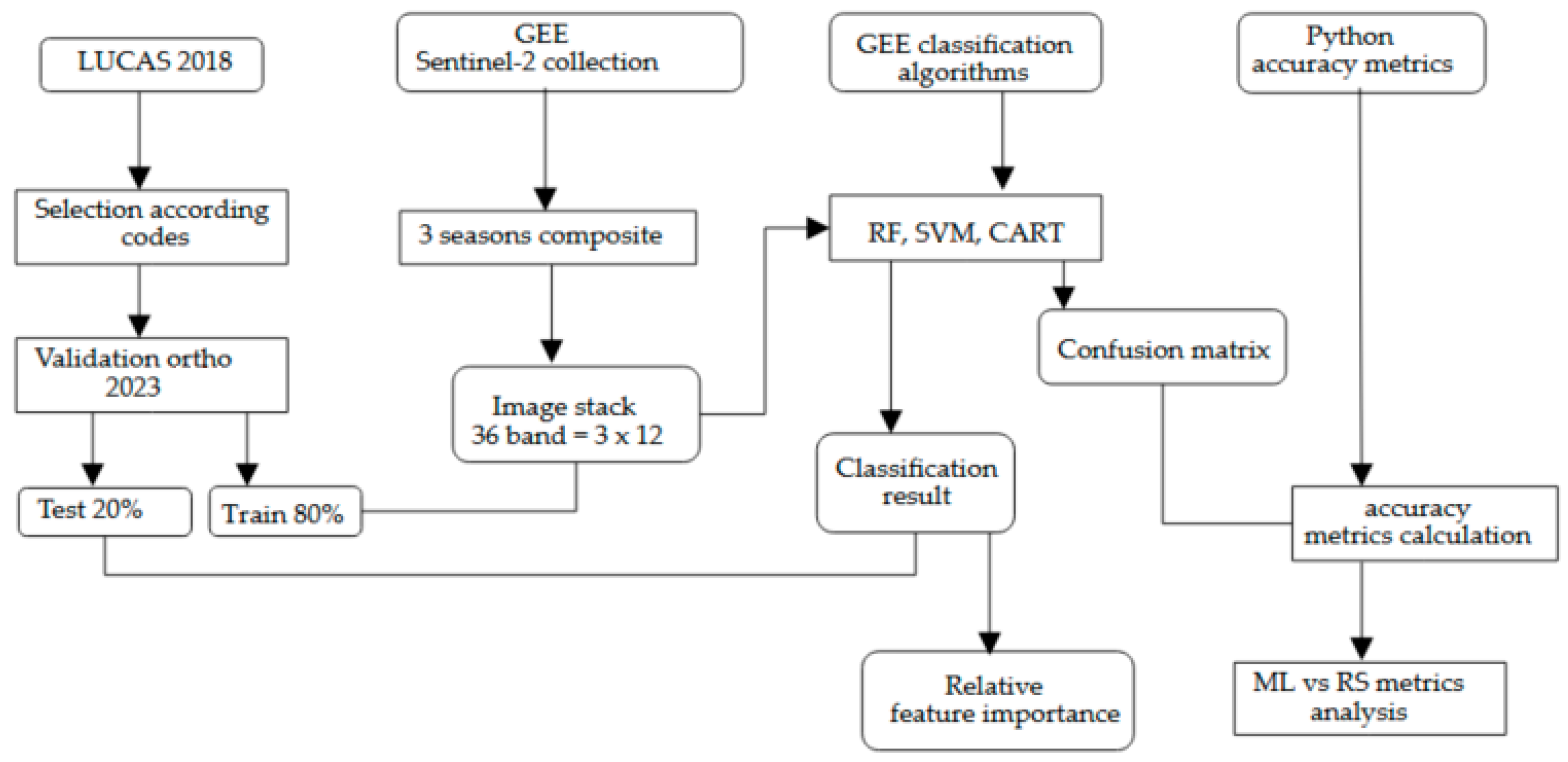
Classification of remote sensing images using machine learning models requires a large amount of training data. Collecting this data is both labor-intensive and time-consuming. In this study, the effectiveness of using pre-existing reference data on land cover gathered as part of the Land Use–Land Cover Area Frame Survey (LUCAS) database of the Copernicus program was analyzed. The classification was carried out in Google Earth Engine (GEE) using Sentinel-2 images that were specially prepared to account for the phenological development of plants. Classification was performed using SVM, RF, and CART algorithms in GEE, with an in-depth accuracy analysis conducted using a custom tool. Attention was given to the reliability of different accuracy metrics, with a particular focus on the widely used machine learning (ML) metric of “accuracy”, which should not be compared with the commonly used remote sensing metric of “overall accuracy”, due to the potential for significant artificial inflation of accuracy. The accuracy of LUCAS 2018 at Level-1 detail was estimated at 86%. Using the updated LUCAS dataset, the best classification result was achieved with the RF method, with an accuracy of 83%. An accuracy overestimation of approximately 10% was observed when reporting the average accuracy ACC metric used in ML instead of the overall accuracy OA metric.
Keywords: LUCAS; Google Earth Engine; Sentinel-2 LUCAS; Google Earth Engine; Sentinel-2