Article

How Does Talking with a Human-like Machine in a Self-Driving Car Affect your Experience? A Mixed-Method Approach


by
Yong Min Kim
1,†,
Jiseok Kwon
2,† and
Donggun Park
3,*
1
Division of Interdisciplinary Studies in Cultural Intelligence (HCI Science Major), Dongduk Women’s University, Seoul 02748, Republic of Korea
2
School of Information, Communications and Electronic Engineering, The Catholic University of Korea, Bucheon 14662, Republic of Korea
3
Media School, Pukyong National University, Busan 48513, Republic of Korea
*
Author to whom correspondence should be addressed.
These authors contributed equally to this work.
Appl. Sci. 2024, 14(19), 8999; https://doi.org/10.3390/app14198999
Submission received: 26 July 2024 / Revised: 4 October 2024 / Accepted: 4 October 2024 / Published: 6 October 2024
(This article belongs to the Special Issue Advanced Technologies for User-Centered Design and User Experience)

Abstract

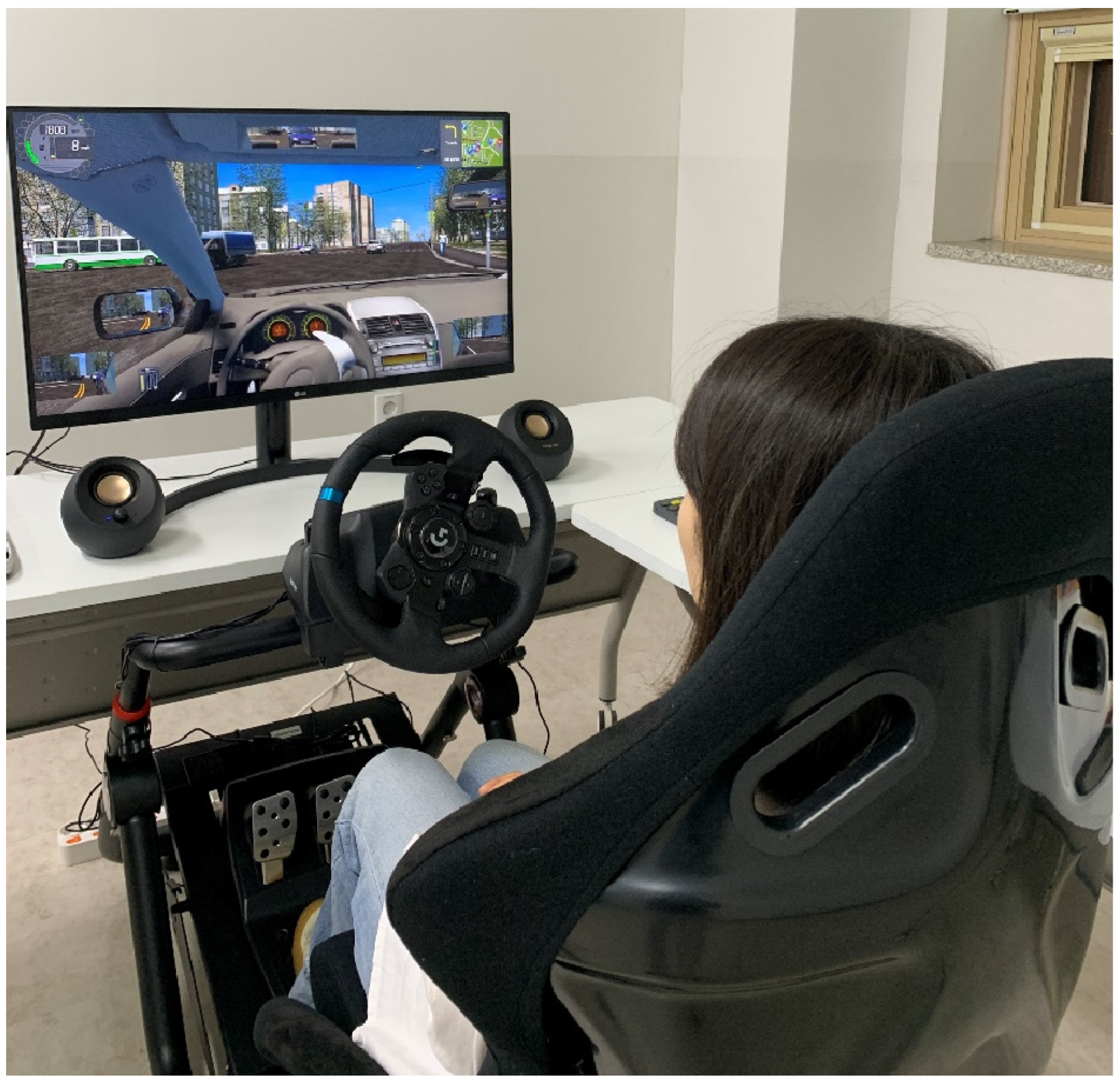
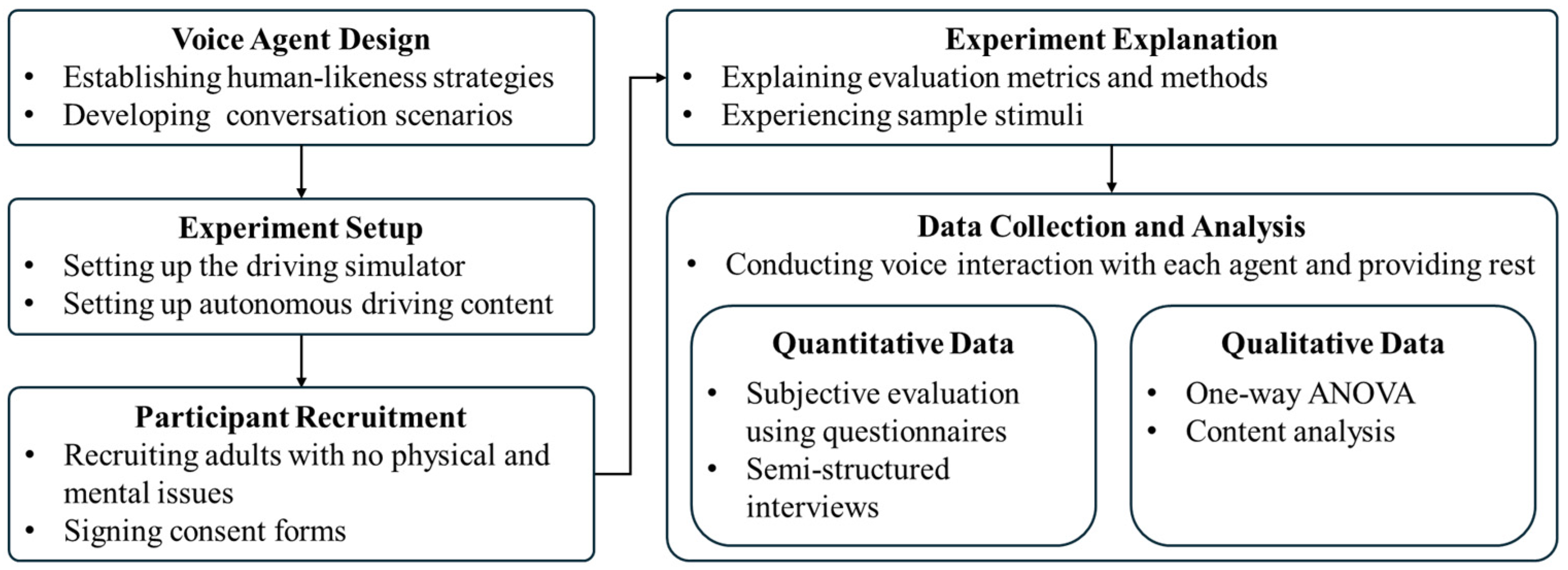
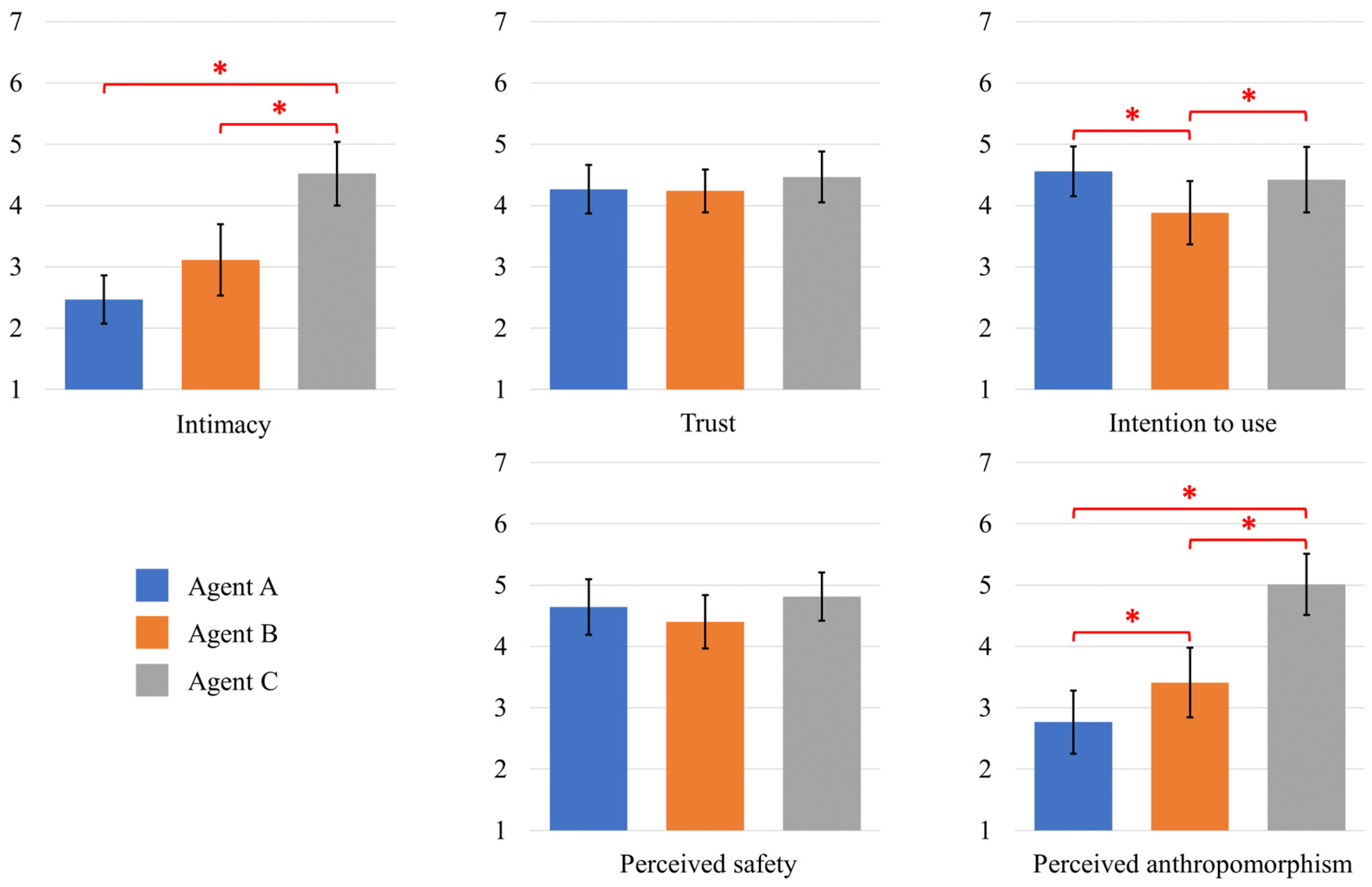
This study investigates the impact of human-like machines (HLMs) on the user experience (UX) of young adults during voice interactions between drivers and autonomous vehicles. A mixed-method approach was employed to evaluate three voice agents with varying levels of anthropomorphism: a machine voice without humanized speech strategies (Agent A), a human voice without humanized speech strategies (Agent B), and a human voice with humanized speech strategies (Agent C). A total of 30 participants were invited to interact with the agents in a simulated driving scenario. Quantitative measures were employed to assess intimacy, trust, intention to use, perceived safety, and perceived anthropomorphism based on a 7-point Likert scale, while qualitative interviews were conducted to gain deeper insights. The results demonstrate that increased anthropomorphism enhances perceived anthropomorphism (from 2.77 for Agent A to 5.01 for Agent C) and intimacy (from 2.47 for Agent A to 4.52 for Agent C) but does not significantly affect trust or perceived safety. The intention to use was higher for Agents A and C (4.56 and 4.43, respectively) in comparison to Agent B (3.88). This suggests that there is a complex relationship between voice characteristics and UX dimensions. The findings of this study highlight the importance of balancing emotional engagement and functional efficiency in the design of voice agents for autonomous vehicles.
Keywords: human-like machines (HLMs); autonomous vehicles; user experience (UX); voice interactions; anthropomorphism human-like machines (HLMs); autonomous vehicles; user experience (UX); voice interactions; anthropomorphism