Article

Transient Friction Analysis of Pressure Waves Propagating in Power-Law Non-Newtonian Fluids

1
Sinopec Key Laboratory of Ultra-Deep Well Drilling Engineering Technology, Beijing 100101, China
2
Sinopec Research Institute of Petroleum Engineering, Beijing 100101, China
3
CNPC North China Petroleum Administration Co., Ltd., Jiangsu Gas Storage Branch, Zhengzhou 450006, China
4
College of Pipeline and Civil Engineering, China University of Petroleum (East China), Qingdao 266580, China
*
Author to whom correspondence should be addressed.
Appl. Sci. 2024, 14(14), 6331; https://doi.org/10.3390/app14146331
Submission received: 17 April 2024 / Revised: 24 June 2024 / Accepted: 18 July 2024 / Published: 20 July 2024

Abstract

Modulated pressure waves propagating in the drilling fluids inside the drill string are a reliable real-time communication technology that transmit data from downhole to the surface during oil and gas drilling. In the analysis of pressure waves’ propagation characteristics, the modeling of transient friction in non-Newtonian fluids remains a great challenge. This paper establishes a numerical model for transient pipe flow of power-law non-Newtonian fluids by using the weighted residual collocation method. Then, the Newton–Raphson method is applied to solve the nonlinear equations. The numerical method is validated by using the theoretical solution of Newtonian fluids and is proven to converge reliably with larger time steps. Finally, the influencing factors of the wall shear stress are analyzed using this numerical method. For shear-thinning fluids, the friction loss of periodic flow decreases with the increase in flow rate, which is opposite to the variation law of friction with the flow rate for stable pipe flow. Keeping the amplitude of pressure pulsation unchanged, an increase in frequency leads to a decrease in velocity fluctuations; therefore, the friction loss decreases with the increase in frequency.

1. Introduction

Mud pulse telemetry (MPT) is a reliable real-time communication technology that transmits data obtained by downhole sensors to the surface during oil and gas drilling [1,2,3]. This technology generates a series of encoded pulse signals inside the drill string by controlling the pressure changes of the drilling fluids [4,5]. These pressure changes are then transmitted to the surface along the drilling fluid column inside the drill string and are sensed by a pressure sensor mounted on the standpipe [6,7]. Due to fluid friction, pressure waves experience severe energy loss during long distance transmission, resulting in very weak pressure signals being received by the surface pressure sensor. In the analysis of pressure waves’ propagation characteristics, modeling unsteady friction remains a great challenge [8].
In order to achieve pressure waves with a higher signal-to-noise ratio in the surface pressure sensor under various drilling conditions, both theoretical and experimental works have been conducted in pressure wave transmission modeling. Chen and Aumann [9] developed a numerical solution for the governing equations of unsteady pipe flow, in which a constant friction coefficient was used. Desbrandes et al. [10] utilized an attenuation equation derived by Lamb for Newtonian fluids, in which the viscosity of the mud remains constant regardless of the shear rate. Liu et al. [11] developed the transfer functions for different components in the pressure wave transmission channel based on a frequency-dependent friction model for Newtonian fluids. Lea and Kyllingstad [12] treated the pressure wave channel as a cylindrical multi-layered waveguide consisting of inner mud, a drill string, annular mud, and the formation, and investigated the coupling effect between the layers. Li et al. [13] discussed the propagation and attenuation of pressure waves transmitted in wellbore gas–liquid two-phase flow. Jia et al. [14] developed a transmission model for MPT by considering the effect of the boundary layer thickness on viscous friction, where a constant dynamic viscosity was used in the model. The studies mentioned above ignored the non-Newtonian fluid characteristics of drilling fluids and did not consider the change in fluid viscosity with a velocity gradient. Therefore, the propagation characteristics of pressure waves in drilling fluids could not be accurately evaluated.
There are few studies on the propagation characteristics of pressure waves that consider drilling fluids as non-Newtonian fluids, but the research on pressure waves’ propagation in non-Newtonian fluids in other fields can provide a reference for the study of MPT. Wang et al. [15] developed a frequency-dependent friction model for non-Newtonian drilling fluids, in which the shear rate of the Newtonian fluids was substituted into the constitutive equation of non-Newtonian fluids to calculate the frequency-dependent friction. Oliveira et al. [16] numerically studied the pressure transmission in Bingham fluids compressed within a closed pipe and showed that the attenuation of pressure waves is significantly increased by increasing the fluid shear stress. Subsequently, Oliveira et al. [17] proposed a mathematical model to simulate the pressure propagation in non-Newtonian drilling fluids and solved the model by using the method of characteristics. Wu et al. [18] analyzed the propagation of the periodic mud pressure waves in Bingham non-Newtonian drilling fluids by correcting the friction factor of Newtonian fluids. Himr et al. [19] investigated the influence of secondary viscosity on pressure pulses, describing the energy loss due to the compressibility of liquid. Santos et al. [20] established a 2D dimensionless model for the power-law fluids hammer problem and showed more consistent results with their experiments than the 1D model by Oliveira et al. [21].
Jia and Fang [22] developed an analytical model for transient power-law non-Newtonian pipe flow by assuming a steady viscosity that varies only with the radius. Their results have not been validated and the applicability needs further research. This article focuses on the transient pipe flow problem of power-law non-Newtonian fluids and establishes a numerical solution model for the pipe flow through the weighted residual collocation method. The numerical results are used to modify the analytical model proposed by Jia and Fang, and the influences of different factors on wall shear stress are analyzed.

2. Mathematical Model and Solution Method

In the MPT, the control system of the pulse generator chooses and encodes various data measured by downhole sensors, then controls the movement of the pulse valve to decrease and increase the flow area of the drilling fluids, thereby producing the pressure waves that propagate in the drill string. During the propagation of pressure wave signals from the downhole to the surface, the drilling fluid channel is affected by the following factors: severe attenuation and distortion caused by fluid friction, absorption of signal energy due to interaction with elastic drill string, multiple reflections of signals at joints, and noise such as drill string collisions with the wellbore and drilling pump pressure pulsation. In this section, a mathematical model for the transient pipe flow of power-law non-Newtonian fluids will be established, which can provide an analytical basis for understanding the attenuation of pressure waves inside the drill string.

2.1. Governing Equations

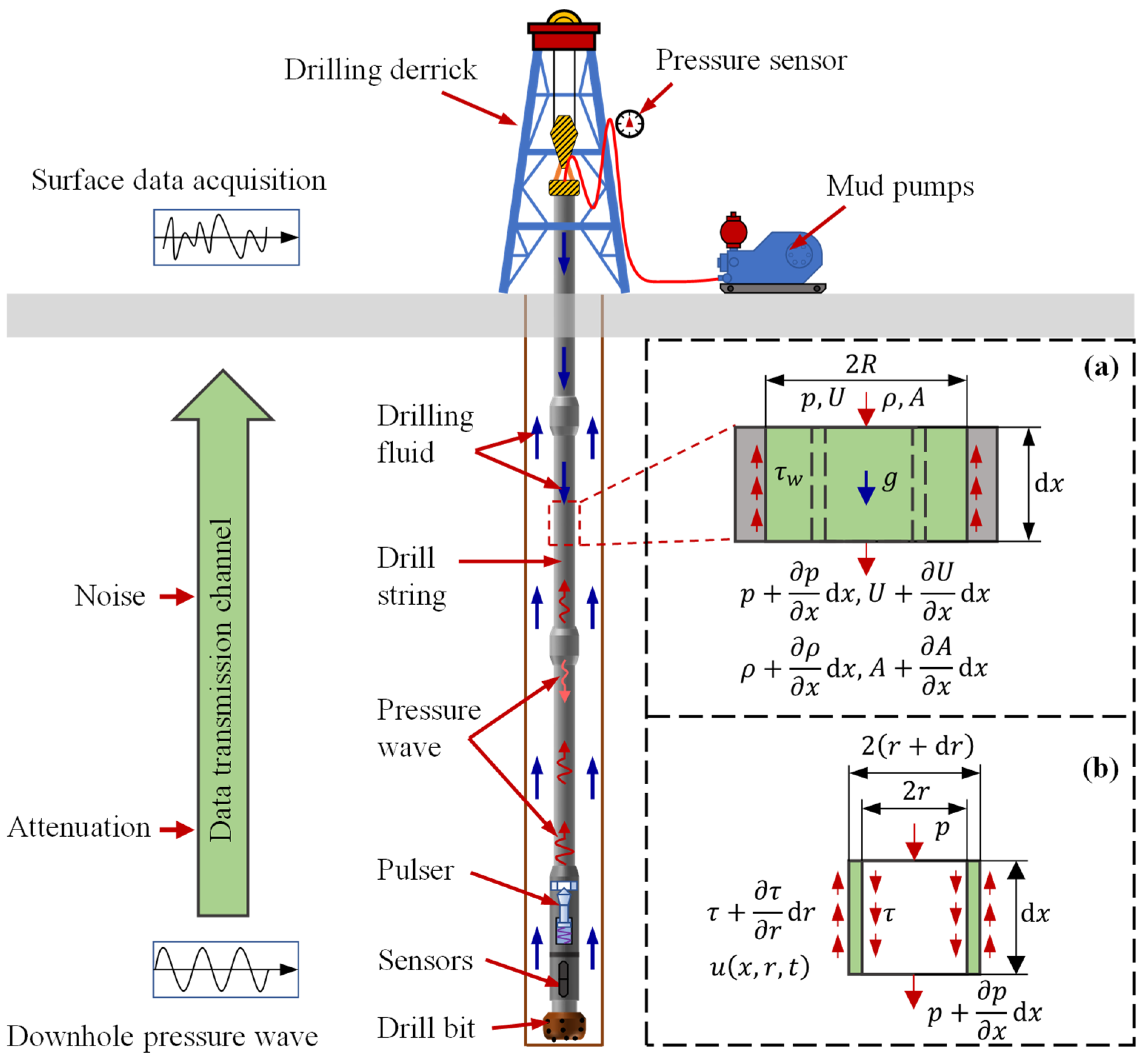
As shown in Figure 1, the pressure waves transmitted in the drill string can be described using a one-dimensional model with time, t , and distance along the axis of the drill string, x , as independent variables, where the positive direction of x is downward. In this model, pressure, p , density, ρ , mean sectional velocity, U , and sectional area, A are the dependent variables. For the fluid microelement in Figure 1a, by applying the principles of continuity and momentum to a segment d x of the drilling fluids, the basic governing equations can be derived. They are the equation of motion
ρ A U t + ρ A U 2 x = 2 π R τ w A p x + ρ A g ,
and the equation of continuity
ρ A t + ρ A U x = 0 ,
where R is the inner radius of the drill string, g is the acceleration due to gravity, and τ w is the shear stress on the inner wall of the drill string, which is determined by the radial gradient of axial velocity at the wall.
The expression for the mean sectional velocity U is
U = U x , t   0 = 0 R 2 π r u x , r , t d r A ,
where u is the velocity that varies with time, the radial coordinate, and the axial coordinate.
When analyzing the transient friction of pipe flow in this study, u is independent of x . The reason for this is that the wall shear stress τ w is related to the radial velocity gradient u / r at the wall on the cross-section at position x . The purpose of this paper is to obtain the transient friction on a certain cross-section, which is determined by the radial distribution of the velocity u on the cross-section. Therefore, we only need to take a certain section to represent all of the pipe sections, without considering its specific location. According to the method in this paper, the friction on a specific cross-section can be determined in Equations (1) and (2).
According to Equation (1), the attenuation of pressure waves is determined by the dissipation term 2 π R τ w at the right hand of Equation (1). In other words, the friction loss during pressure wave transmission is generated by the shear stress at the wall, which depends on the velocity gradient at the wall. In the derivation of this velocity gradient for unsteady laminar flow, the motion equation for parallel axisymmetric flow of incompressible fluids will be used, as shown in Figure 1b. The pressure and density are assumed to be constant throughout the cross-section, but the axial velocity, u , is a function of time, t , and radial coordinate, r , then
ρ u t = p x τ r τ r ,
where τ is the shear stress. In oil and gas engineering, the rheological properties of most drilling fluids conform to the power-law model, which is widely used in drilling engineering [23,24]. For power-law non-Newtonian fluids, the shear stress can be represented by a generalized Newtonian fluid as a function of the apparent viscosity and the shear rate
τ = μ a u r = K u r n 1 u r ,
where μ a is the apparent viscosity, K is the consistency coefficient, n is the power-law index, and u / r is the radial gradient of axial velocity.
To solve Equation (4), it is necessary to determine the initial and boundary conditions for velocity, u .

2.2. Initial Conditions

The initial velocity profile is based on the analytical solution for a steady, fully developed flow of a power-law non-Newtonian fluid [25]
u s = u m 1 r R 1 n + 1 ,
where u m is the maximum value of the velocity, which is the velocity at the center of the drill pipe,
u m = n n + 1 F 2 K 1 n R 1 n + 1 ,
where F is the pressure gradient of the steady flow.

2.3. Boundary Conditions

At the pipe wall, a non-slip condition is assumed, therefore, the axial velocity is zero
u r = R = 0 .
Due to symmetry, the radial gradient of the velocity is zero at the pipe centerline
u r r = 0 = 0 .

2.4. Methods of Solution

In this study, an analytical solution is first obtained by assuming that the apparent viscosity is non time-varying and only changes radially, then a numerical solution is performed for the equation without assumptions to verify the applicability of the analytical solution.

2.4.1. Analytical Solution

When pressure waves propagate within the drilling fluids, the flow is already stable. The amplitude of pressure waves is generally between 0.68 MPa and 1.19 MPa [26]. However, the pressure of the drilling fluid inside the drill string is generally between 20 MPa and 30 MPa to overcome flow friction [27]. Therefore, the fluctuations in velocity and shear rate caused by the pressure changes are relatively small compared to the stable flow. Based on the above reasons, it is assumed that the apparent viscosity μ a changes only with the radial coordinate, but not with time. According to Equations (6) and (7), the shear rate for the steady flow of power-law non-Newtonian fluids is
u s r = F r 2 K 1 n ,
and for a positive pressure gradient, the apparent viscosity becomes
μ a = K 1 n F r 2 n 1 n .
Substituting Equations (11) and (5) into the Equation (4), the motion equation is written as
1 μ a 0 p x = r n 1 n 2 u r 2 + 2 n 1 n r 1 n u r ρ μ a 0 u t ,
where μ a 0 = K 1 / n F / 2 n 1 / n is the constant apparent viscosity.
Jia et al. [28] obtained the solution in Equation (12) in the complex domain using the Laplace transform, which is
V s , y = I σ y 3 n 1 n + 1 y 1 n 1 + n I σ y R 3 n 1 n + 1 y R 1 n 1 + n 1 1 ρ s P s x ,
where s is the Laplace transform variable, V s , y and P s are the Laplace transforms of u and p , I σ is the modified Bessel function of first kind, σ is the order of the Bessel function, which is
σ = 1 n 1 + n ,
and y is the transformation of the radial coordinate
y = ρ s μ a 0 2 n 3 n 1 n + 1 r 1 + n 2 n ,   y R = ρ s μ a 0 2 n 3 n 1 n + 1 R 1 + n 2 n .
When n = 1 , the result provided by Equation (13) is consistent with Zielke’s result [29].

2.4.2. Numerical Solution

The weighted residual method is employed to solve Equation (4) in this section. By substituting Equation (5) into Equation (4), the motion equation can be rewritten as
ρ u t = f + K u r n 1 1 r u r + n 2 u r 2 ,
where f is pressure gradient P / x .
Assuming that the functional form of the approximate solution u r , t is given by
u r , t = i = 1 M a i t cos 2 i 1 π r 2 R = N r a t ,
where a i t ,   i = 1 , 2 , , M is a set of unknown coefficients that vary over time, M is the number of trial functions, N r is a row vector of trial functions that satisfies the boundary conditions represented by Equations (8) and (9)
N r = cos π r 2 R cos 2 i 1 π r 2 R cos 2 M 1 π r 2 R ,
and a is a column vector
a t = a 1 t a 2 t a M t T .
The approximate function assumed by Equation (15) satisfies the boundary conditions Equations (8) and (9). Substituting Equation (15) into Equation (14) yields the residual
R t , r , a = ρ N r d a t d t f t + K N r r a t n 1 1 r N r r + n 2 N r r 2 a t .
The collocation method is used to determine the M unknown coefficients a 1 , , a M . In order to obtain the M equations, we choose M uniformly distributed collocation points r j 0 , R ,   j = 1 , 2 , , M , where we enforce the residual Equation (16) to be zero
R t , r j , a = 0 ,   j = 1 , 2 , , M .
The derivative of time in Equation (16) is discretized using implicit finite difference, and the following equations can be obtained:
R t j = ρ N r j a m a m 1 Δ t f t + K N r j r a m n 1 1 r j N r j r + n 2 N r j r 2 a m = 0 , j = 1 , 2 , , M ;   m = 2 , 3 , ,
where Δ t is the interval between two times steps, the subscript m represents the m th time step to be solved. Equation (18) is a nonlinear algebraic equation, which is solved using the Newton-Raphson method,
R t j a m Δ a m = R t j a m k 1 ,   j = 1 , 2 , , M ; m = 2 , 3 , ; k = 1 , 2 , ,
where Δ a m is the incremental column vector of unknown coefficients, superscript k represents the number of iteration steps, R t j a m k 1 is the residual of the previous iteration step, and R t j / a m is the Jacobian row vector for the j th equation,
R t j a m = ρ Δ t N r j + K n 1 N r j r a m k 1 n 2 a m k 1 T 1 r j N r j r + n 2 N r j r 2 T N r j r + K a m k 1 T N T r j r n 1 1 r j N r j r + n 2 N r j r 2 , j = 1 , 2 , , M ; m = 2 , 3 , ; k = 1 , 2 , .
The matrix form of Equation (19) is
J R a m k 1 Δ a m = R t a m k 1 ,
where J R a m k 1 is the Jacobian matrix,
J R a m k 1 = R t 1 a m T R t 2 a m T R t M a m T T ,
and R t a m k 1 is the right-hand side vector,
R t a m k 1 = R t 1 a m k 1 R t 2 a m k 1 R t M a m k 1 T .
Δ a m can be obtained by solving Equation (21), then a m k in the next iteration step is
a m k = a m k 1 + Δ a m .
When R t a m k < ε , in which ε is the convergence tolerance, the current iteration stops and the iteration for the next time step begins.

3. Results and Discussion

The parameters used in the analysis are shown in Table 1.

3.1. Startup Flow

In Section 2.4.1, the motion equation is solved based on the assumption of steady viscosity. In this section, the verification is conducted by comparing the analytical results with the numerical results provided in Section 2.4.2.
The time domain solution for the startup flow in a circular pipe can be obtained through the inverse Laplace transform of Equation (13) using the partial fraction expansion method. The pressure gradient for the startup flow can be written as
p x = ρ P c F s = 0 ρ P c e s t d t = ρ P c s .
By substituting Equation (23) into Equation (13) and performing an inverse Laplace transform, the following result can be obtained:
u r , t = P c r 1 + 1 n R 1 + 1 n 4 h ν + k = 1 2 P c R 2 h ν h 2 r R h 1 J σ λ k r R h J 1 σ λ k λ k 3 exp λ k 2 R 2 h ν h 2 t ,
where P c is the constant pressure gradient, λ k ,   k = 1 , 2 , are the roots of the Bessel function, t is time, J is the Bessel function of the first kind, and h = n + 1 2 n , ν = μ a 0 ρ .
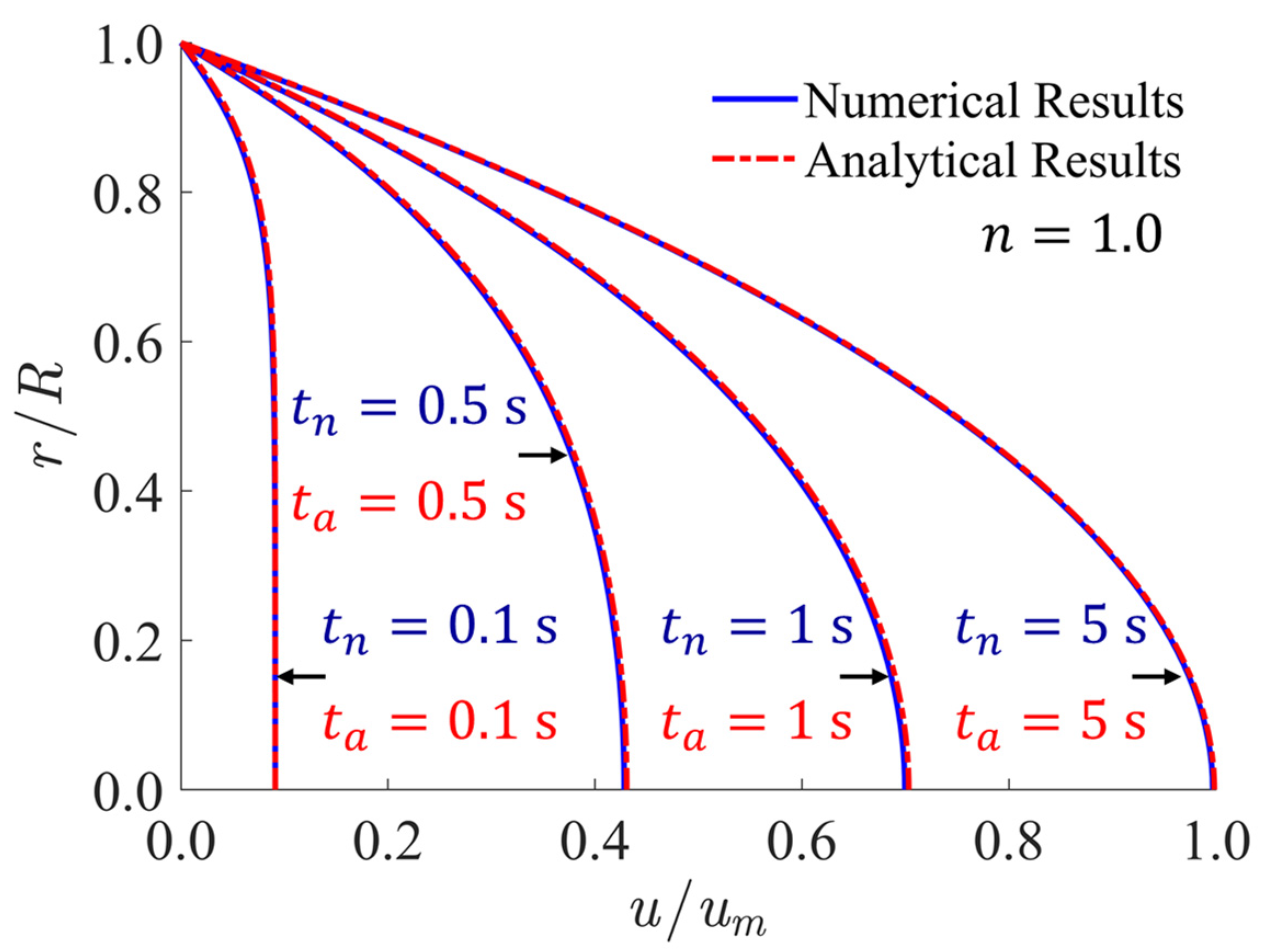
The first term on the right side of Equation (24) represents the steady-state term, while the second term represents the transient term. For the startup flow, when n = 1 , we can obtain the results for Newtonian fluids [30], and the results are shown in Figure 2. As shown in the figure, the numerical method proposed in this article shows good agreement with the theoretical results.
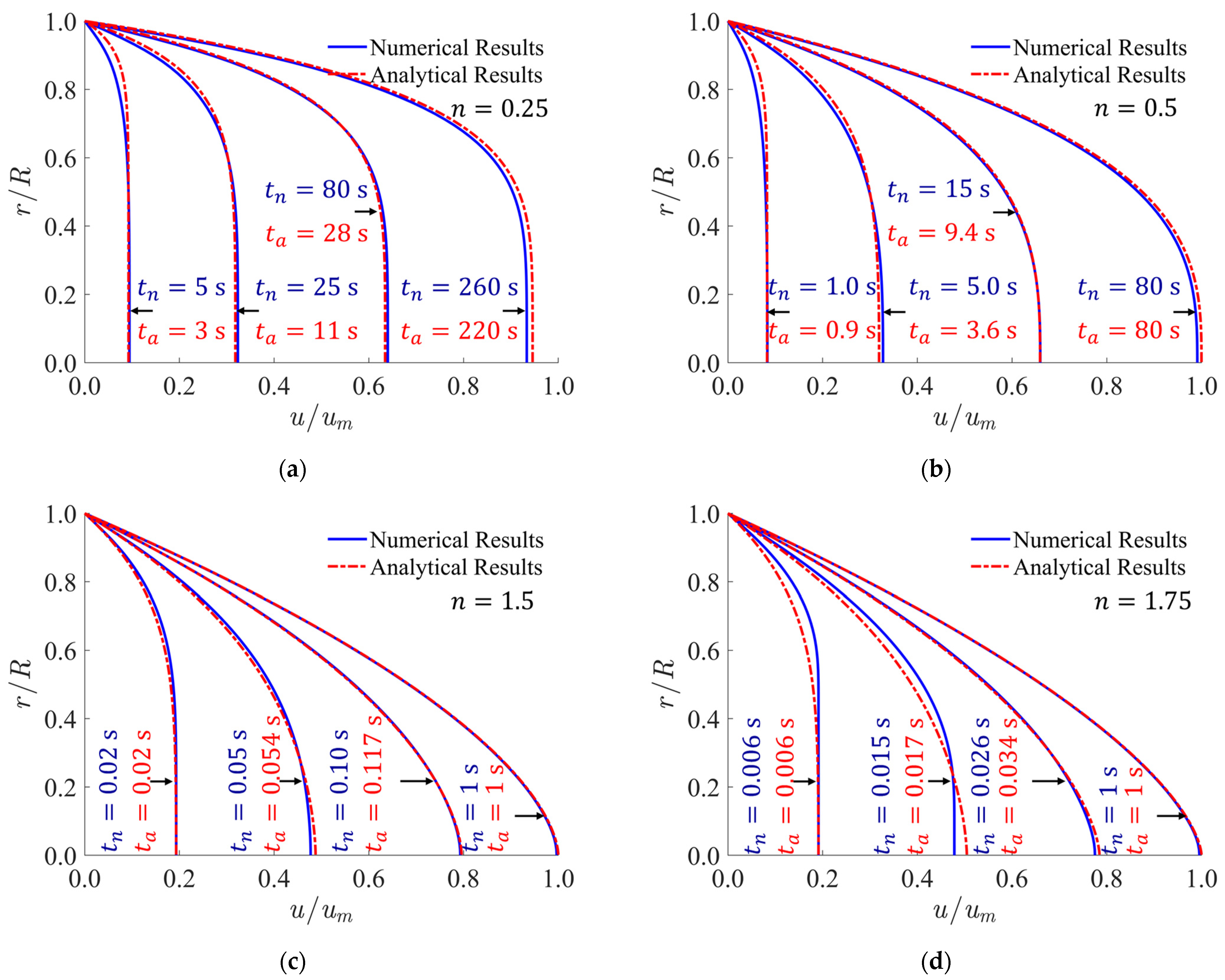
Moreover, we can compare the results of Equation (24) to the numerical results provided in Section 2.4.2, and the results are shown in Figure 3. It can be seen from the figures that the profiles of the analytical and numerical results are very similar for different values of n . However, for the same flow profile, between the numerical and analytical results there is a significant difference in the time required. This difference increases as the deviation between n and 1 increases. For n < 1 , the analytical results indicate the shorter time required to establish a stable flow compared to the numerical results. On the contrary, for n > 1 , the analytical results show that a longer time is required to reach a stable flow compared to the numerical results. The reason for this difference is due to the assumption of the stable apparent viscosity made in the analytical method. The shear rate and apparent viscosity obtained with numerical methods at different times are shown in Table 2.
As shown in the table, the stable flow shear rate used in the analytical methods to calculate the apparent viscosity is the largest among all of the transient flows. Therefore, when n < 1 , the analytical method employs the minimum apparent viscosity, whereas when n > 1 , the analytical method utilizes the maximum apparent viscosity.
For the startup flow, we also investigated the influence of the number of collocation points on the convergence of the numerical method. Table 3 presents the relative errors between numerical and theoretical solutions when the startup flow of power-law non-Newtonian fluids tends to stabilize. As shown in the table, the relative error decreases with the increase in collocation points.
It can also be observed from the figures that during the initial and final stages of the startup flow, the difference in the flow velocity profile is relatively small under the same flow time. Therefore, for small pressure disturbances superimposed on a steady pipe flow or an initial stationary flow, the analytical method proposed in this study can be applied.

3.2. Pressure Waves Transmitted inside the Drill String

In the continuous wave information transmission during the measurement while drilling (MWD), the pressure waves inside the drill string can be regarded as a harmonic periodic flow, ρ P p exp i ω t , superimposed on a steady pipe flow, which is the steady state of the startup flow shown in Equation (23). The velocity fluctuation of the periodic flow is smaller than that of the steady pipe flow. Therefore, in the flow of pressure wave transmission, the viscosity of power-law non-Newtonian fluids only changes along the radial direction and does not change with time.
For the pressure waves superimposed on the steady pipe flow, the pressure gradient can be expressed as
p x = ρ P c + P p exp i ω t F s = ρ P c s + P p s i ω ,
where P p is the amplitude of the pressure waves, P c is the average of the pressure pulsation, and ω is the angular frequency of the pressure waves. The average of the pressure pulsation P c has the same meaning as the constant pressure gradient in the startup flow, which is given in Equation (23).
The first term on the right side of Equation (25) represents the pressure gradient for the startup flow, and its inverse Laplace transform is Equation (24). The second term on the right side of Equation (25) is the pressure gradient for periodic flow, and its inverse Laplace transform is
u r , t = P p i ω 2 r h 1 R h 1 σ 2 + 1 + P p i ω 1 J σ i ω ν 1 h r h r h 1 J σ i ω ν 1 h R h R h 1 exp i ω t P p k = 1 J σ λ k r R h r h 1 J 1 σ λ k λ k R h 1 λ k 2 ν h 2 2 R 2 h + i ω 2 exp λ k 2 R 2 h ν h 2 t .
This study mainly discusses the influence of the magnitude of transient friction on the attenuation of the pressure waves, and the leading or lagging of the phase has no effect on the attenuation of the pressure waves. Therefore, for the periodic flow, only the real part of Equation (26) has been considered. For a long-time steady oscillation, the transient term, which is the third term on the right side of Equation (26), can be neglected. For Newtonian fluids, Equation (26) is an exact solution for pulsating laminar flow in a circular pipe without assumptions, which can be used to verify the accuracy of the numerical results. Figure 4 shows a comparison between the numerical and theoretical solutions of Newtonian fluids. It can be seen from the figure that when the frequency is low, the numerical and theoretical solutions are in good agreement. However, as the frequency increases, the numerical solution of the flow velocity at the center of the pipe is higher than the theoretical solution. Compared with the finite difference method, the time step size of the implicit weighted residual method has little effect on the results. However, reducing the time step can still reduce the difference between numerical and theoretical results, as shown in Table 4.
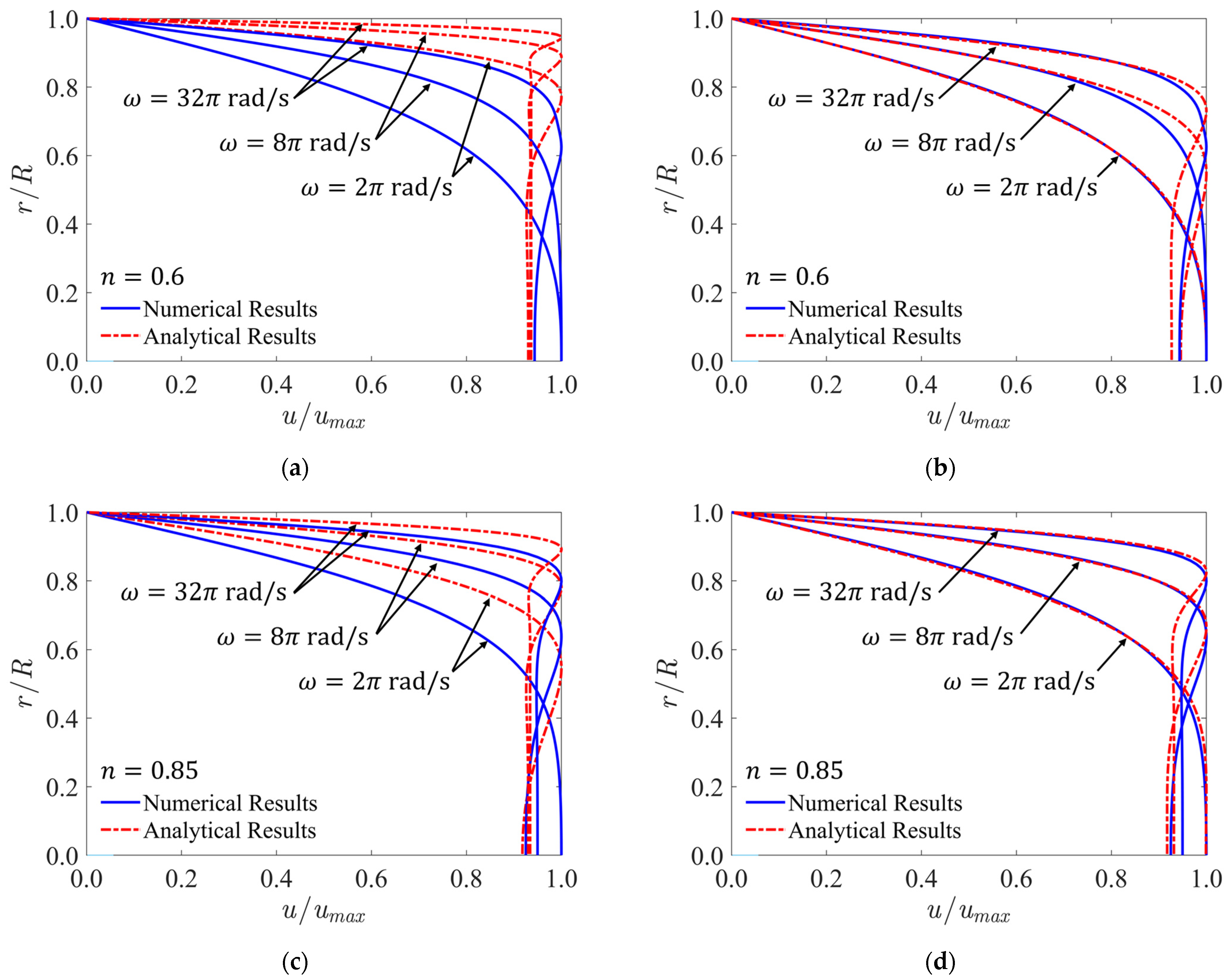
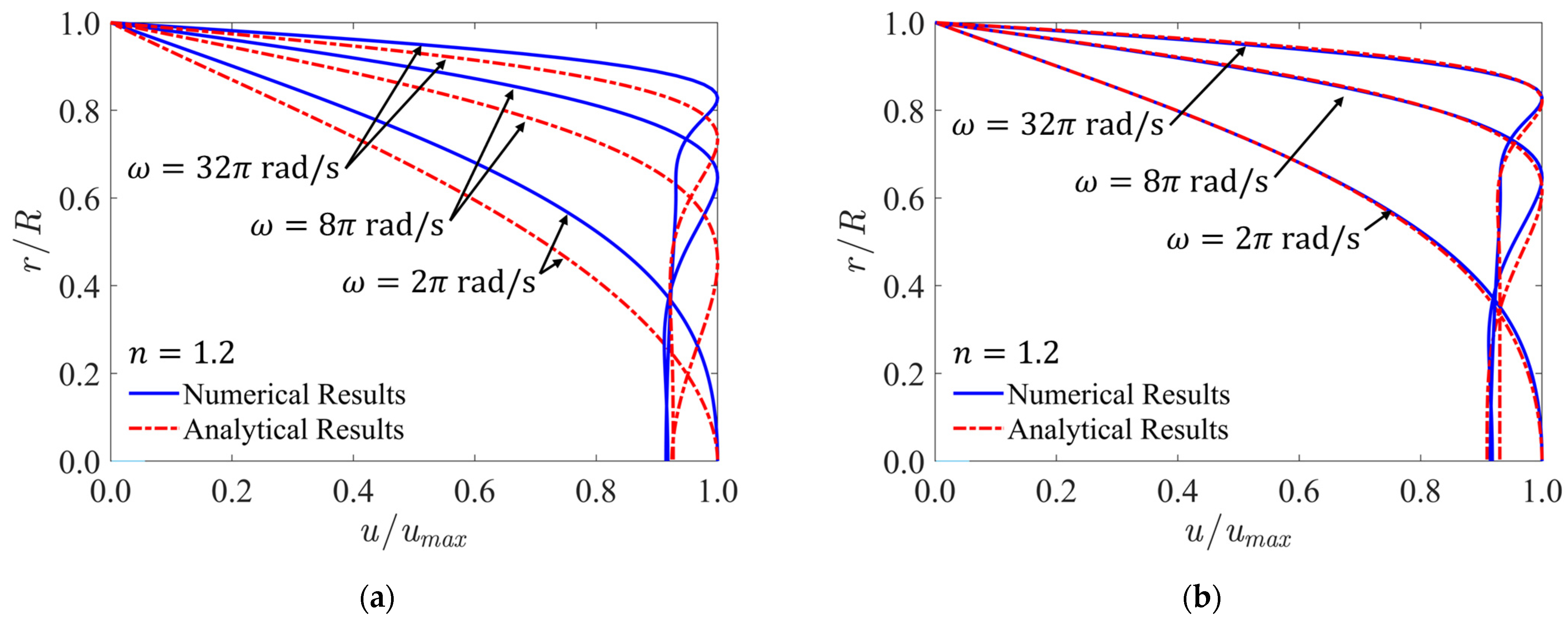
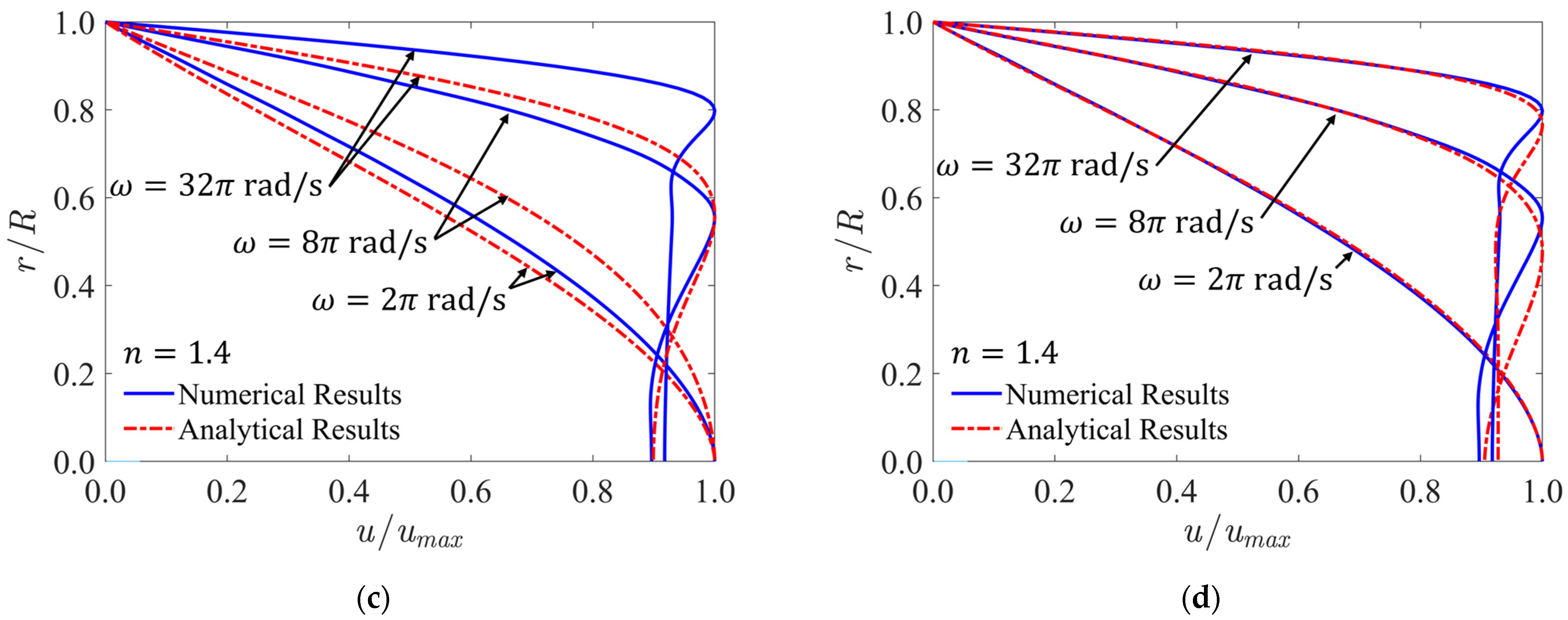
According to Equation (26), the shape of the velocity profile is independent of the amplitude of pressure fluctuation, P p . However, the numerical results indicate that the shape of the velocity profile is related to the amplitude of the pressure fluctuation when n 1 . In addition, the apparent viscosity adopts the maximum shear rate of the stable pipe flow, meaning that when n < 1 , the analytical results for shear rate at the wall are greater than the actual value, as shown in Figure 5a,c, and when n > 1 , the analytical results for shear rate at the wall are smaller than the actual value, as shown in Figure 6a,c. Numerical analyses show that the apparent viscosity is not only dependent on the shear rate, but also on the pulsation frequency, ω . Therefore, in order to consider the influence of amplitude and frequency on the velocity profile in Equation (26), the apparent viscosity is corrected as
μ a 0 = K 1 n F 2 C n ω n 1 n ,
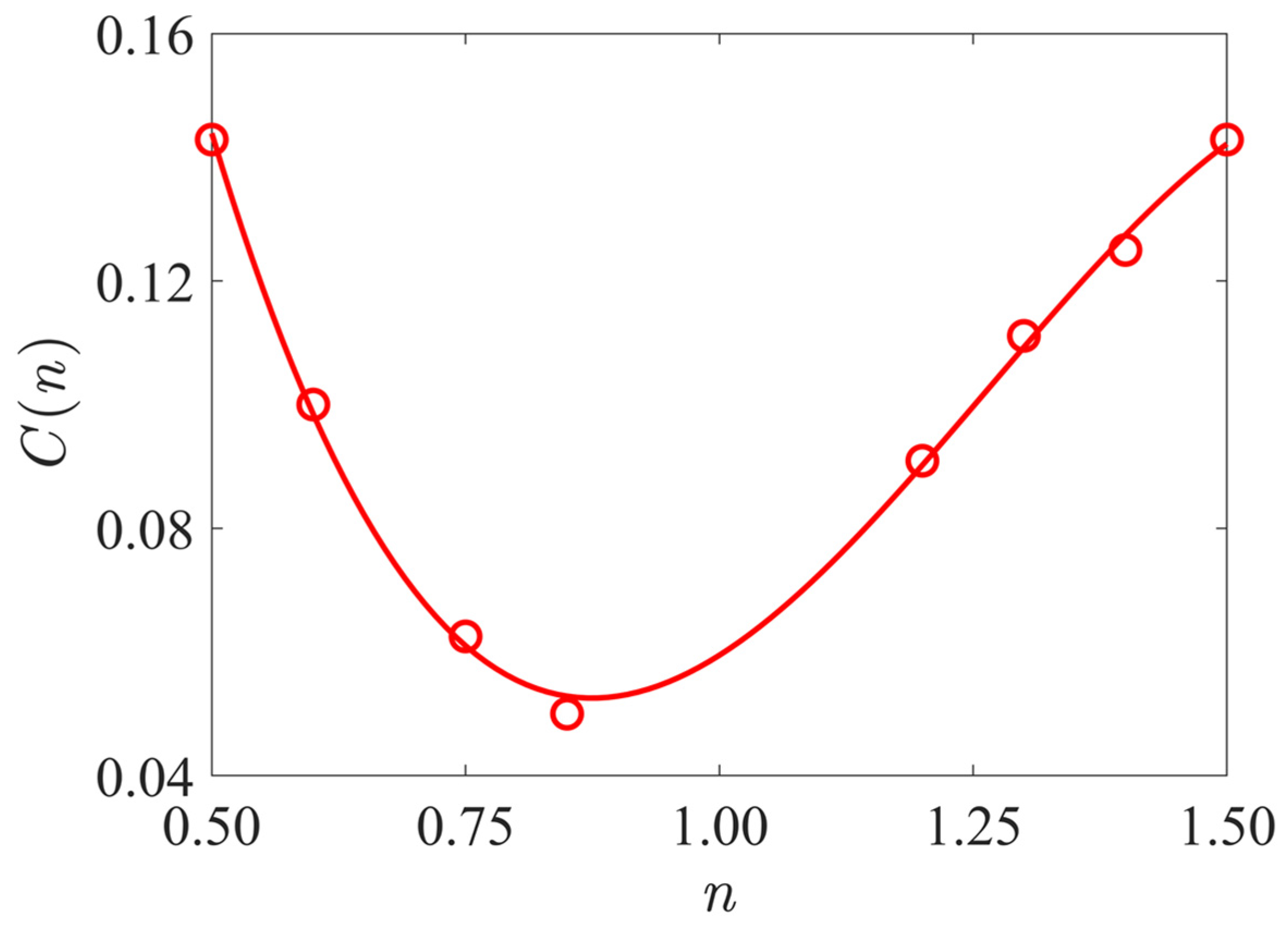
C n is a function of the power-law index n , which needs to be determined by the numerical or experimental results. Equation (27) reduces the apparent viscosity to ensure that the analytical results of the velocity profile follow the same trend as the numerical results.
The corrected velocity profile is shown in Figure 5b,d for n < 1 and Figure 6b,d for n > 1 . It can be seen from the figures that the analytical results for the shear rate at the wall are in good agreement with the numerical results after correction. The closer n is to 1, the better the correction effect. However, there is a significant difference between the analytical and numerical results for the flow near the pipe axis, and this difference increases with the increase in frequency. Moreover, the correction effect for n > 1 is better than that for n < 1 .
It can also be seen from the Figure 5 and Figure 6 that the shear rate at the wall increases with the increase in frequency for the same n . Therefore, the friction loss of the periodic flow increases with the increase in frequency. Additionally, the shear rate at the wall decreases as n increases.
In this study, the trend of C n changing with n based on the numerical results is shown in Figure 7, and the fitted expression for C n is
C n = 0.422 n 3 + 1.600 n 2 1.831 n + 0.712 , 0.5 n 1.5 .
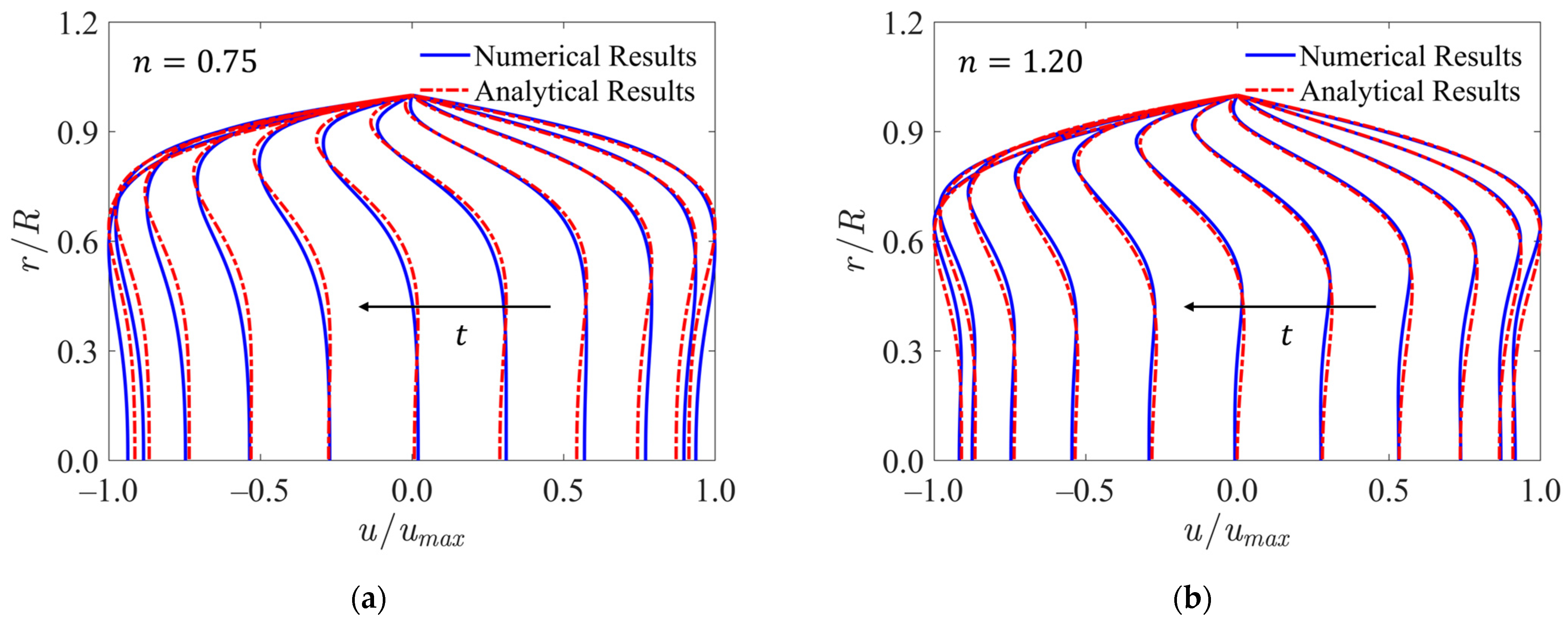
The correction basis for Equations (27) and (28) is the maximum velocity profile in one cycle, and its adaptability to other moments needs further verification. Figure 8 shows the time history curve of the velocity profile within half a cycle for n = 0.8 and n = 1.2 . As shown in the figure, the corrected analytical velocity profiles match the numerical results very well in terms of the occurrence time and shape. In particular, the velocity distributions of the analytical results near the wall almost coincide with the numerical results, ensuring an accurate evaluation of wall friction losses.

3.3. Transient Friction at the Wall

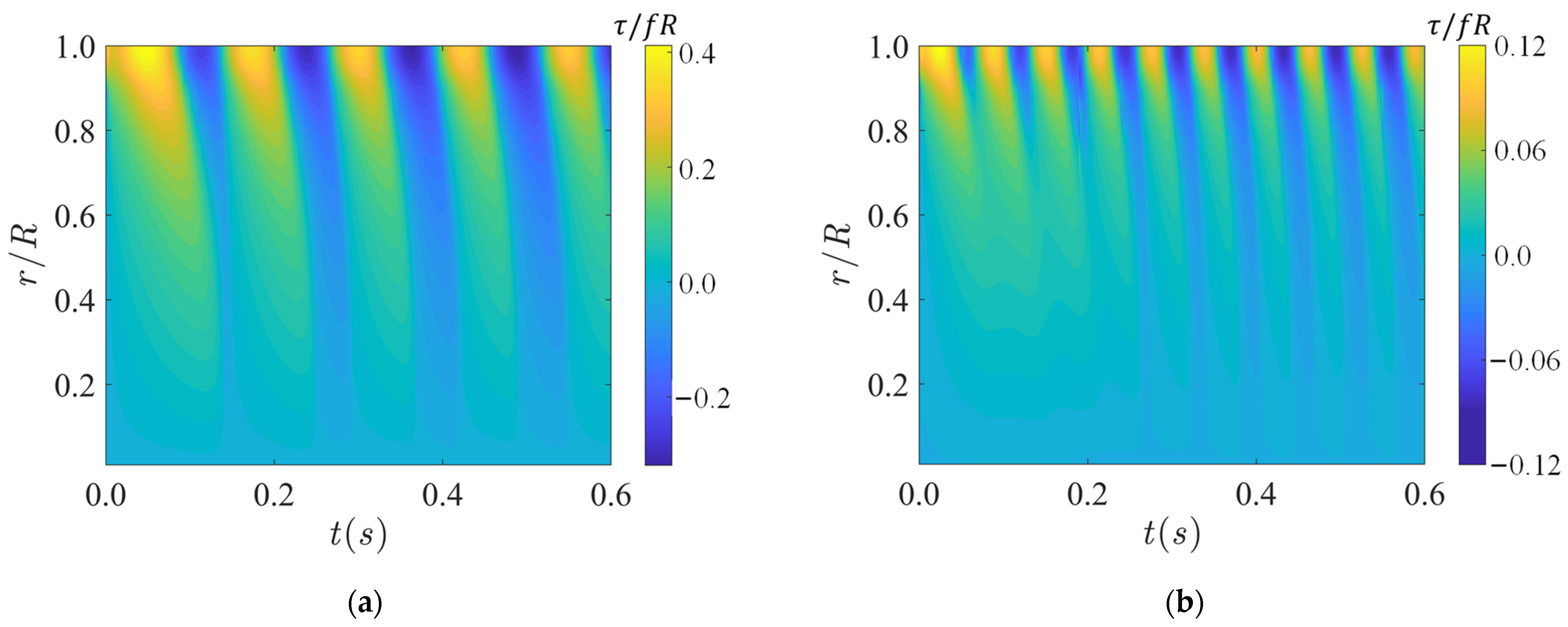
Figure 9 shows the distribution of shear stress in the periodic flow over time and space. As shown in the figure, the shear stress varies greatly near the wall but changes very little near the pipe axis. After several cycles of the transition state, the shear stress enters a stable state of periodic variation. The changing patterns of shear stress are consistent for different frequencies. The shear stress at the wall, τ w , directly determines the friction loss of the pipe flow. Therefore, this section discusses the changing patterns of wall shear stress and its influencing factors. Once the periodic flow stabilizes, the shear stress at the wall varies periodically over time. In this section, the maximum value of the shear stress at the wall in one cycle is taken as the basis for the discussions of the transient friction.

3.3.1. Influence of Stable Pipe Flow on the Wall Friction

The velocity fluctuation of the periodic flow is relatively small compared to the velocity of the stable pipe flow. When the periodic flow is superimposed on the stable pipe flow, it is difficult to distinguish the shear stress generated by pressure pulsation by directly observing the distribution of shear stress. Therefore, it is necessary to separate the pulsating shear stress using the following expression:
τ p = τ τ c ,  
where τ p is the pulsating shear stress, τ c is the stable shear stress, and τ is the total shear stress.
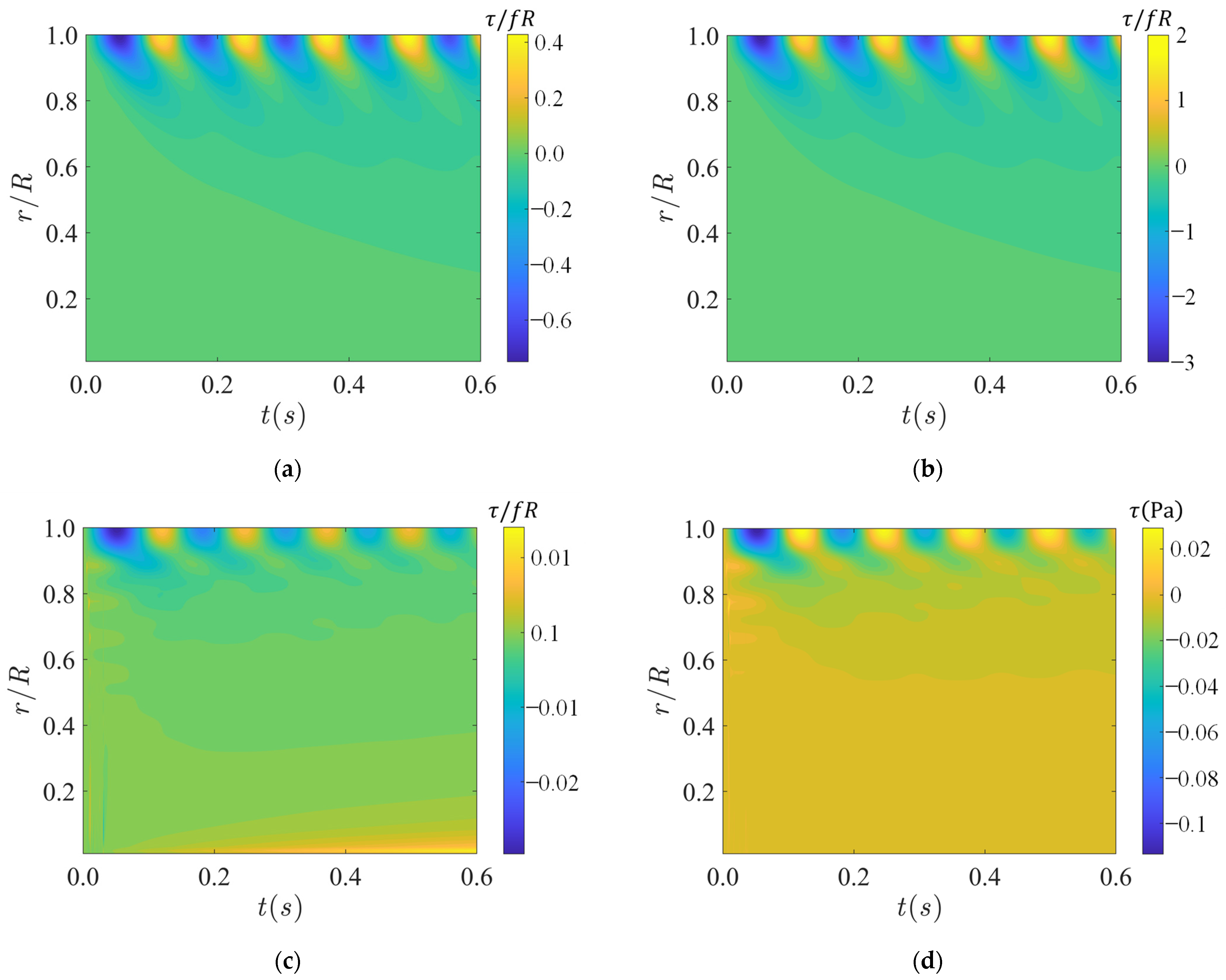
For Newtonian fluids, the different ratios of P c and P p in Equation (25) will not affect the distribution of the shear stress generated by the periodic pressure, as shown in Figure 10a,b. However, for non-Newtonian fluids, different ratios of P c and P p will have different effects on the wall shear stress, as shown in Figure 10c,d. Moreover, even under the same ratio, different values of P c and P p can cause different shear stress distributions.
The unit length pressure drop P c of the stable pipe flow can be expressed by the flow rate Q as
P c = 2 τ w c R = 3 n + 1 Q n π R 3 n 2 K R ,
τ w c is the wall shear stress of the stable pipe flow, which is a power-law relationship with the flow rate.
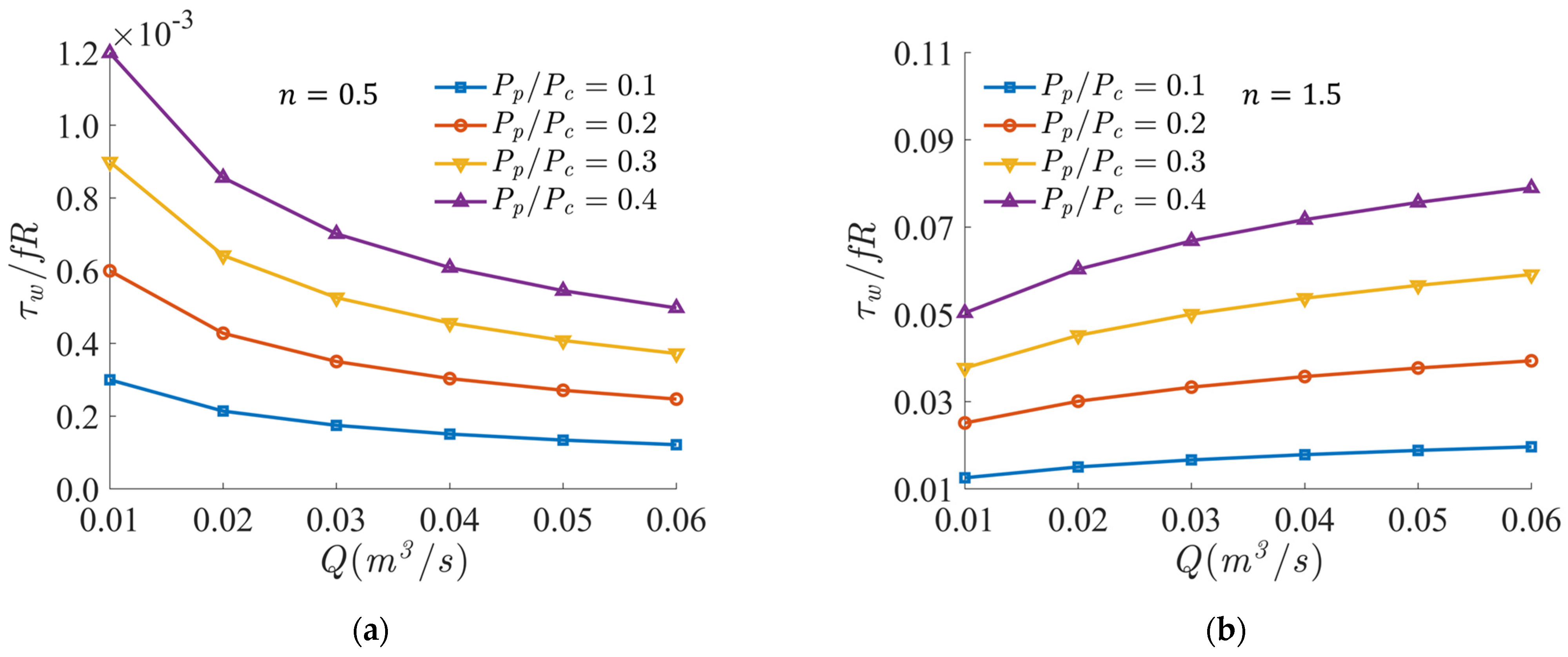
Figure 11 shows the variation curves of pulsating shear stress at the wall with the flow rate under two power-law indexes and four ratios of P p to P c . As shown in the figure, the pulsating shear stress increases with the increase in the ratio of P p to P c , and this pattern remains consistent regardless of whether n is greater than or less than 1. However, for n < 1 or n > 1 , the variation pattern of pulsating shear stress with flow rate is exactly the opposite, which differs from the variation law of wall shear stress with flow rate in the stable pipe flow given in Equation (30). For n < 1 , the wall pulsating shear stress nonlinearly decreases with the increase in flow rate; for n > 1 , the shear stress increases nonlinearly with increasing flow rate. The reasons for these phenomena relate to the shear thinning or thickening of the power-law non-Newtonian fluids. When n < 1 , the apparent viscosity decreases with the increase in shear rate, resulting in lower viscosity at higher flow rates. Therefore, the friction loss of pulsating pressure decreases with the increase in flow rate for n < 1 . On the contrary, the friction loss of pulsating pressure increases with the increase in flow rate for n > 1 .

3.3.2. Influence of Power-Law Index on the Wall Friction

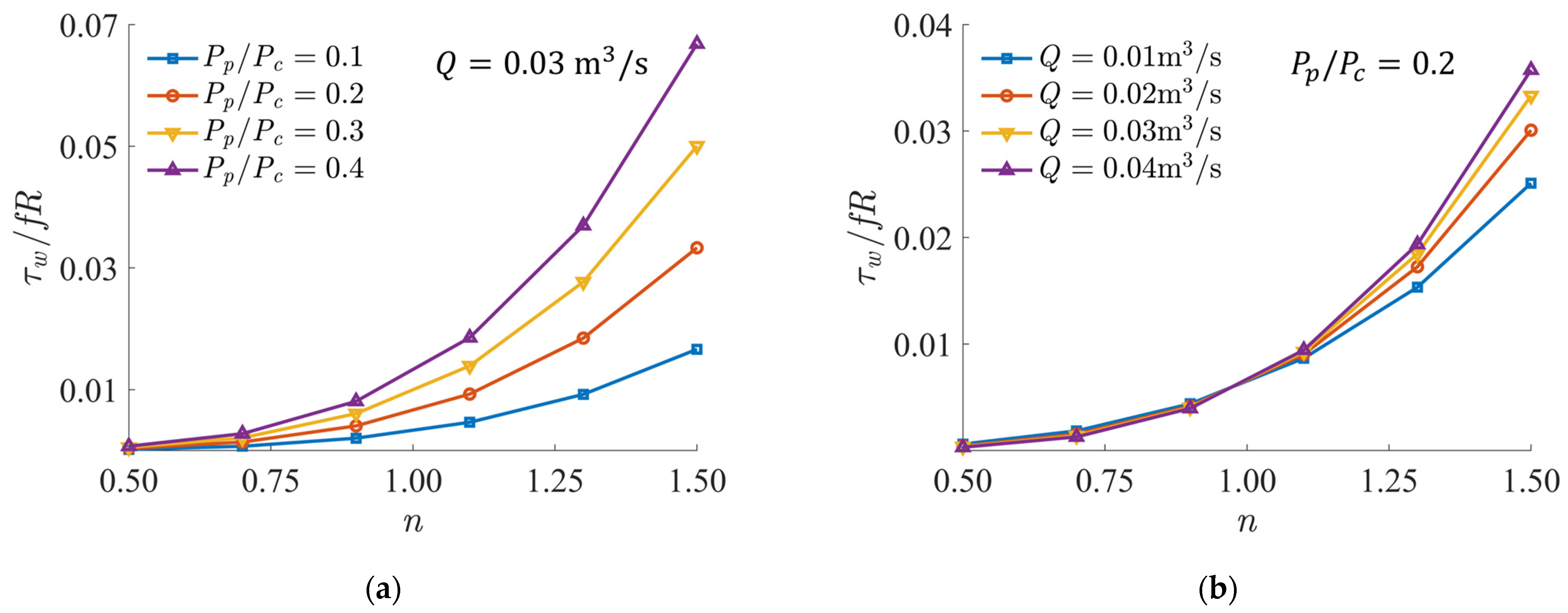
The previous section indicates that when n > 1 and n < 1 , the effect of the flow rate on the pulsating shear stress is exactly the opposite. This section will discuss the influence of the power-law index on pulsating shear stress when the flow rate remains constant or the ratio of P p to P c remains constant, and the results are shown in Figure 12. It can be seen from the figure that regardless of the changes in flow rate and the ratio of P p to P c , the pulsating shear stress at the wall increases with the increase in the power-law index. When n > 1 , the pulsating shear stress changes more dramatically with the power-law index. When n < 1 , the pulsating shear stress decreases with an increase in flow rate, but the amplitude of the change is very small; when n > 1 , the shear stress increases with an increase in flow rate, and the amplitude of change is obvious. The reasons for these patterns are discussed in the previous section.

3.3.3. Influence of Frequency on the Wall Friction

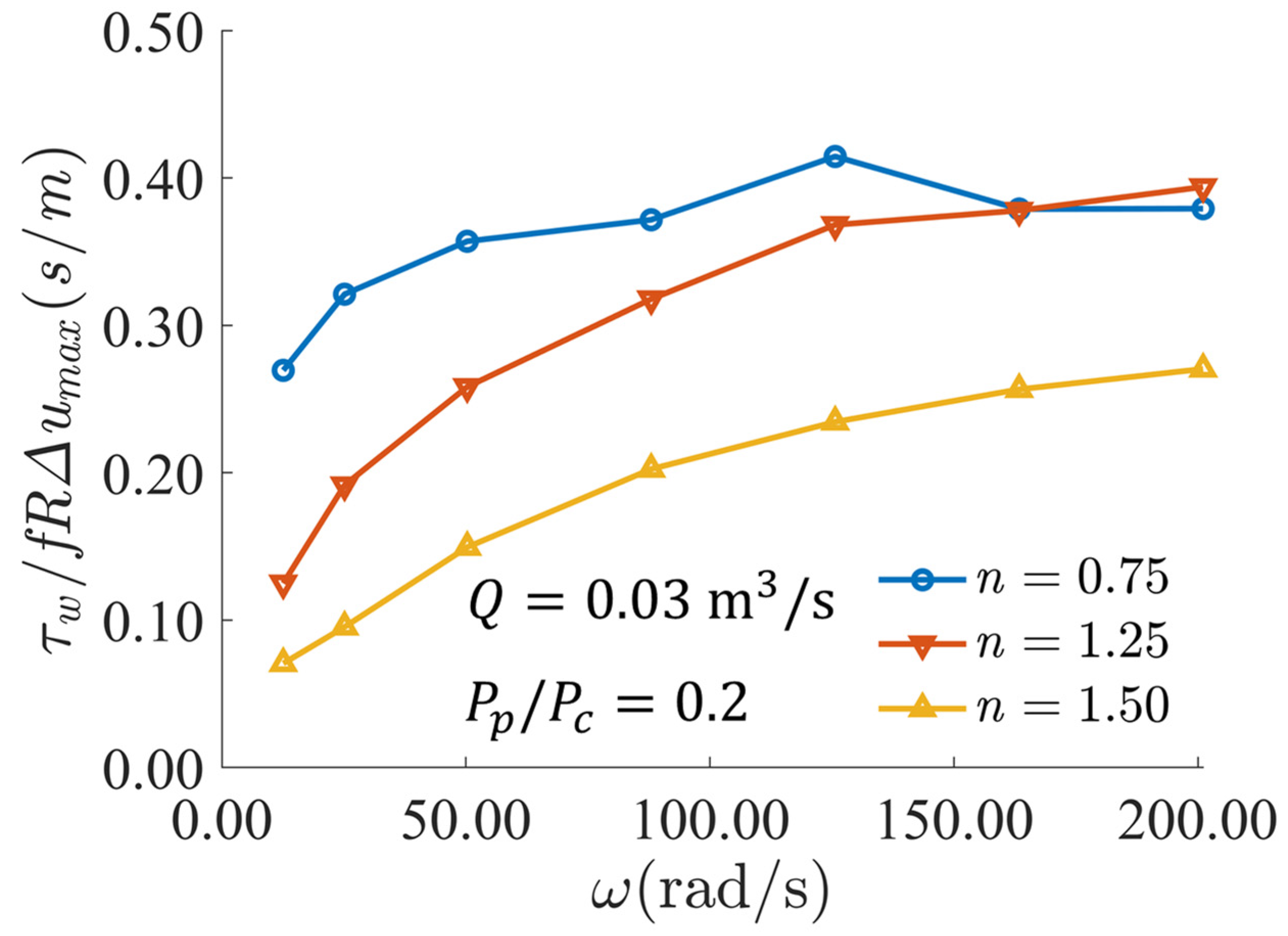
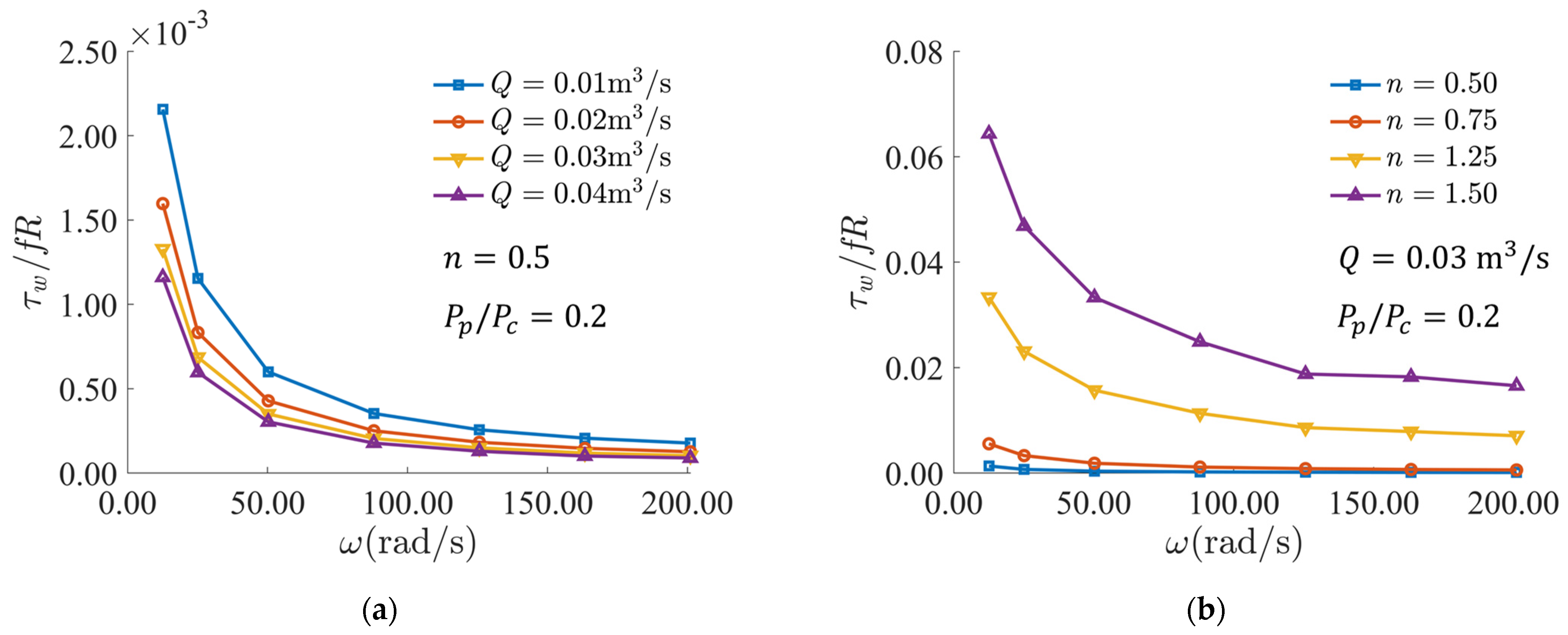
Figure 13 shows the variation of pulsating shear stress with frequency for different flow rates and power-law indexes. It can be seen from the figure that, regardless of how the flow rate and power-law index change, the pulsating shear stress decreases monotonically with an increase in frequency. The reason for this phenomenon is that as the pulsation frequency increases, the response amplitude of the fluid movement decreases, leading to a decrease in the shear rate. Therefore, the pulsation friction loss at the wall decreases. The ratio of the shear stress at the wall to the fluctuation of maximum velocity is referred to as the relative pulsating shear stress. Reorganizing Figure 13b yields the curves shown in Figure 14. The fluctuation of the maximum value of the flow velocity profile increases with the increase in the power-law index. Therefore, the variation pattern of friction loss with the power-law index in Figure 14 is opposite to that in Figure 13b. Moreover, the rate of decrease in velocity fluctuation with the increase in the frequency is greater than that of the shear stress, so the relative pulsating shear stress increases with the increase in frequency.

4. Conclusions

In this study, a numerical model of transient pipe flow of power-law non-Newtonian fluids was established using the weighted residual collocation method. The apparent viscosity of the analytical solution was corrected using frequency and power-law index, resulting in more accurate results with the analytical model. Finally, the influencing factors of the wall shear stress were analyzed and the following conclusions were drawn:
(1)
The apparent viscosity of power-law non-Newtonian fluids is not only related to shear rate, but also to the square root of the pulsation frequency;
(2)
For Newtonian fluids, the ratio of the amplitude, P p , to the average, P c , of the pressure pulsation will not affect the distribution of pulsating shear stress. However, for non-Newtonian fluids, the ratio of the amplitude to the average of the pressure pulsation has different effects on the wall shear stress. Moreover, even under the same ratio, for n < 1 , an increase in the average pressure pulsation will reduce the wall shear stress;
(3)
Because an increase in frequency leads to a decrease in velocity fluctuations, the pulsating shear stress at the wall decreases monotonically with the increase in frequency, regardless of how the flow rate and power-law index change.

Author Contributions

Conceptualization, X.Z.; methodology, H.L. and P.J.; software, P.J. and H.W.; validation, H.L., H.W. and X.Z.; investigation, C.R., Y.S. and X.Z.; resources, P.J. and H.W.; data curation, P.J.; writing—original draft preparation, H.L. and P.J.; writing—review and editing, Y.S., C.R.; supervision, C.R.; funding acquisition, C.R. and H.L. All authors have read and agreed to the published version of the manuscript.

Funding

This research was funded by the National Key Research and Development Program of China (No. 2019YFC1509204), and “the Fundamental Research Funds for the Central Universities (No. 24CX03015A)”.

Institutional Review Board Statement

Not applicable.

Informed Consent Statement

Not applicable.

Data Availability Statement

The original contributions presented in the study are included in the article, further inquiries can be directed to the corresponding author.

Conflicts of Interest

Author Yanlin Su was employed by the company CNPC North China Petroleum Administration Co., Ltd. The remaining authors declare that the research was conducted in the absence of any commercial or financial relationships that could be construed as a potential conflict of interest.

References

  1. Klotz, C.; Bond, P.; Wasserman, I.; Priegnitz, S. A new mud pulse telemetry system for enhanced MWD/LWD applications. In Proceedings of the IADC/SPE Drilling Conference, Orlando, FL, USA, 4–6 March 2008. IADC/SPE Paper 112683-MS. [Google Scholar]
  2. Mwachaka, S.M.; Wu, A.P.; Fu, Q.Q. A review of mud pulse telemetry signal impairments modeling and suppression methods. J. Pet. Explor. Prod. Technol. 2019, 9, 779–792. [Google Scholar] [CrossRef]
  3. Ma, D.; Shi, Y.B.; Zhang, W.; Liu, G.Z. Design of acoustic transmission along drill strings for logging while drilling data based on adaptive NC-OFDM. AEU-Int. J. Electron. Commun. 2018, 83, 329–338. [Google Scholar] [CrossRef]
  4. Han, H.; Xue, L.; Fan, H.H.; Liu, X.B.; Liu, M.; Wang, Z.M. Analysis of pressure wave signal generation in MPT: An integrated model and numerical simulation approach. J. Pet. Sci. Eng. 2022, 209, 109871. [Google Scholar] [CrossRef]
  5. Yang, N.; Yan, Z.D.; Yin, X.; Jia, M.Z.; Geng, Y.F. Mathematical modeling and experimental investigation of a rotary valve generating sinusoidal pressure signals based on fan-arc-straight orifice. J. Pet. Sci. Eng. 2022, 209, 109807. [Google Scholar] [CrossRef]
  6. Yan, Z.D.; Sun, R.R.; Jiang, S.M.; Song, T.T.; Gao, T.Z. Improved variable step adaptive filtering algorithm and its application in time delay estimation for continuous wave dual-sensor pulse signals. Geoenergy Sci. Eng. 2023, 230, 212268. [Google Scholar] [CrossRef]
  7. Jiang, S.M.; Yan, Z.D.; Sun, R.R.; Wang, Z.D.; Sun, H.H. Study on signal decomposition-based pump noise cancellation method for continuous-wave mud pulse telemetry. Geoenergy Sci. Eng. 2023, 228, 211948. [Google Scholar] [CrossRef]
  8. Urbanowicz, K.; Bergant, A.; Stosiak, M.; Deptuła, A.; Karpenko, M.; Kubrak, M.; Kodura, A. Water Hammer Simulation Using Simplified Convolution-Based Unsteady Friction Model. Water 2022, 14, 3151. [Google Scholar] [CrossRef]
  9. Chen, S.J.; Aumann, J.T. Numerical simulation of MWD pressure pulse transmission. In Proceedings of the SPE Annual Technical Conference and Exhibition, Las Vegas, NV, USA, 22–26 September 1985. SPE Paper 14324-MS. [Google Scholar]
  10. Desbrandes, R.; Bourgoyne, A.T.; Carter, J.A. MWD transmission data rates can be optimized. Pet. Eng. Int. 1987, 59, 46–52. [Google Scholar]
  11. Liu, Q.L.; Wu, J.F.; Liu, W.T.; Wang, R.H. A frequency-domain propagation model of bypass downlink system with transfer matrix method. J. Pet. Sci. Eng. 2017, 159, 724–730. [Google Scholar] [CrossRef]
  12. Lea, S.H.; Kyllingstad, A. Propagation of coupled pressure waves in borehole with drillstring. In Proceedings of the International Conference on Horizontal Well Technology, Calgary, AB, Canada, 18–20 November 1996. SPE Paper 37156. [Google Scholar]
  13. Li, H.T.; Chen, R.M.; Li, X.J.; Meng, Y.F.; Zhu, L.; Zhao, J.B. Investigation of pressure wave propagation and attenuation characteristics in wellbore gas-liquid two-phase flow. J. Nat. Gas Sci. Eng. 2016, 35, 1088–1100. [Google Scholar] [CrossRef]
  14. Jia, M.Z.; Geng, Y.F.; Yan, Z.D.; Zeng, Q.F.; Wang, W.L.; Yue, Y.B. Channel modelling and characterization for mud pulse telemetry. Int. J. Electron. Commun. 2023, 165, 154654. [Google Scholar] [CrossRef]
  15. Wang, X.; Wang, R.H.; Ji, G.D. Frequency-dependent friction model for consecutive pulse signal of drilling fluid transmitting in borehole. Acta Pet. Sin. 2009, 30, 444–449. [Google Scholar]
  16. Oliveira, G.M.; Negrao, C.O.R.; Franco, A.T. Pressure transmission in Bingham fluids compressed within a closed pipe. J. Non-Newton. Fluid Mech. 2012, 169–170, 121–125. [Google Scholar] [CrossRef]
  17. Oliveira, G.M.; Franco, A.T.; Negrao, C.O.R.; Martins, A.L.; Silva, R.A. Modeling and validation of pressure propagation in drilling fluids pumped into a closed well. J. Pet. Sci. Eng. 2013, 103, 61–71. [Google Scholar] [CrossRef]
  18. Wu, J.F.; Wang, R.H.; Zhang, R.; Sun, F. Propagation model with multi-boundary conditions for periodic mud pressure wave in long wellbore. Appl. Math. Model. 2015, 39, 7643–7656. [Google Scholar] [CrossRef]
  19. Himr, D.; Haban, V.; Fialova, S. Influence of second viscosity on pressure pulsation. Appl. Sci. 2019, 9, 5444. [Google Scholar] [CrossRef]
  20. Santos, T.G.M.; Oliveira, G.M.; Negrao, C.O.R. Dimensionless analysis of non-Newtonian Power-Law fluid hammer. J. Hydraul. Eng. 2023, 149, 04023034. [Google Scholar] [CrossRef]
  21. Oliveira, G.M.; Franco, A.T.; Negrao, C.O.R.; Vadinal, R.B.; Lomba, B.S.; Fonseca, T.U.; Martins, A.L. Pressure Transmission in Gelled Drilling Fluids. In Proceedings of the SPE/IADC Drilling Conference and Exhibition, London, UK, 17–19 March 2015. SPE/IADC Paper 173128-MS. [Google Scholar]
  22. Jia, P.; Fang, J. Frequency-dependent friction for non-Newtonian power-law fluid in transient pipe flow. In Advances in Engineering Research, Proceedings of the 5th International Conference on Mechanical Engineering, Materials and Energy (ICMEME 2016), 10–11 December 2016, Hong Kong, China; Atlantis Press: Amsterdam, The Netherlands, 2016; Volume 90, pp. 63–67. [Google Scholar]
  23. Sun, X.F.; Zhang, K.B.; Chen, Y.; Li, W.; Qu, J.Y. Study on the settling velocity of drilling cuttings in the power law fluid. Powder Technol. 2020, 362, 278–287. [Google Scholar] [CrossRef]
  24. Quitian-Ardila, L.H.; Andrade, D.E.V.; Franco, A.T. A proposal for a constitutive equation fitting methodology for the rheological behavior of drilling fluids at different temperatures and high-pressure conditions. Geoenergy Sci. Eng. 2024, 233, 212570. [Google Scholar] [CrossRef]
  25. Li, Z.M.; Tai, G.Y. Non-Newtonian Fluid Mechanics; China University of Petroleum Press: Shandong, China, 1998; pp. 74–81. [Google Scholar]
  26. Han, H.; Xue, L.; Sun, L.W.; Sheng, W.K.; Fan, H.H.; Wang, Z.M. A transient flow analysis method for high-rate mud pulse telemetry in rotary steerable system. Geoenergy Sci. Eng. 2024, 232, 212392. [Google Scholar] [CrossRef]
  27. Dokhani, V.; Ma, Y.; Li, Z.L.; Geng, T.; Yu, M.J. Effects of drill string eccentricity on frictional pressure losses in annuli. J. Pet. Sci. Eng. 2020, 187, 106853. [Google Scholar] [CrossRef]
  28. Jia, P.; Gao, D.L.; Fang, J. Analysis of signal attenuation of continuous wave in drill string. Res. J. Appl. Sci. Eng. Technol. 2013, 5, 4018–4022. [Google Scholar] [CrossRef]
  29. Zielke, W. Frequency-dependent friction in transient pipe flow. J. Basic Eng. 1968, 90, 109–115. [Google Scholar] [CrossRef]
  30. White, F.M. Viscous Fluid Flow, 2nd ed.; McGraw-Hill: New York, NY, USA, 1991; pp. 133–134. [Google Scholar]
Figure 1. Pressure waves transmitted in drill string. (a) Fluid microelement segment used for pressure wave transmission analysis and flow parameters that do not vary radially. (b) Flow parameters of cylindrical microelement in transient friction analysis. The blue straight arrows represent the direction of liquid flow. The red curved arrows represent the propagation of pressure waves. The arrows in (a,b) represent the direction of forces.
Applsci 14 06331 g001
Figure 2. Numerical and analytical results for the startup flow of Newtonian fluids, where t n is the time for the numerical result and t a is the time for the analytical result.
Applsci 14 06331 g002
Figure 3. Comparison of analytical and numerical results for startup flow under different power-law indexes n . (a) n = 0.25 , (b) n = 0.5 , (c) n = 1.5 , (d) n = 1.75 .
Applsci 14 06331 g003
Figure 4. Numerical and analytical results for the periodic flow of Newtonian fluids with different frequencies. The time of the curve shown in the figures is the last moment of a pulsating cycle.
Applsci 14 06331 g004
Figure 5. Comparison of analytical and numerical results for periodic flow with different frequency when power-law index n < 1 ; the time of the curve shown in the figures is the last moment of a pulsating cycle. (a) n = 0.6 without correction, (b) n = 0.6 after correction, (c) n = 0.85 without correction, (d) n = 0.85 after correction.
Applsci 14 06331 g005
Figure 6. Comparison of analytical and numerical results for periodic flow with different frequency when power-law index n > 1 . The time of the curve shown in the figures is the last moment of a pulsating cycle. (a) n = 1.2 without correction, (b) n = 1.2 after correction, (c) n = 1.4 without correction, (d) n = 1.4 after correction.
Applsci 14 06331 g006aApplsci 14 06331 g006b
Figure 7. C n varied with power-law index n .
Applsci 14 06331 g007
Figure 8. Time history curve of velocity profile within half a cycle for different n : (a) n = 0.75 ; (b) n = 1.2 .
Applsci 14 06331 g008
Figure 9. Temporal and spatial distribution of shear stress. (a) n = 0.5 and ω = 16 π rad/s, (b) n = 0.5 and ω = 32 π rad/s.
Applsci 14 06331 g009
Figure 10. Temporal and spatial distribution of shear stress. (a) n = 1 , ω = 16 π rad/s, and P p / P c = 0.1 ; (b)   n = 1 , ω = 16 π rad/s, and P p / P c = 0.4 ; (c) n = 0.5 , ω = 16 π rad/s, and P p / P c = 0.1 ; (d) n = 0.5 , ω = 16 π rad/s, and P p / P c = 0.4 .
Applsci 14 06331 g010
Figure 11. Variation of pulsating shear stress at the wall for different flow rate and ratio of P p to P c . (a) n = 0.5 . (b) n = 1.5 .
Applsci 14 06331 g011
Figure 12. Variation of pulsating shear stress at the wall for different power-law indexes. (a) Q = 0.03   m 3 / s ; (b) P p / P c = 0.2 .
Applsci 14 06331 g012
Figure 13. Variation of pulsating shear stress at the wall for different frequencies. (a) n = 0.5 and P p / P c = 0.2 , (b) Q = 0.03   m 3 / s and P p / P c = 0.2 .
Applsci 14 06331 g013
Figure 14. Relative pulsating shear stress at the wall varied with frequency.
Applsci 14 06331 g014
Table 1. Parameters of the system being analyzed.
ParametersValues
Density   of   drilling   fluids ,   ρ ,   ( k g / m 3 )1220
Inner   radius   of   drill   string ,   R , (m)0.05431
Consistency   coefficient   of   drilling   fluids ,   K ,   ( P a · s n )1.0
Power   law   index ,   n 0.25~1.75
Flow   rate ,   Q ,   ( m 3 / s )0.03
Amplitude   of   pressure   waves ,   P p ,   ( M P a )0.5~2.0
Table 2. Shear rate and apparent viscosity for different power-law indexes and times.
n = 0.5 n = 1.5
Time (s) u / r m a x (1/s) μ a (Pa·s)Time (s) u / r m a x (1/s) μ a (Pa·s)
1.00 32.100.1760.0275.008.659
5.00 88.600.1060.05111.810.57
15.0 149.80.0820.10139.111.79
  (Stable)204.90.070   (Stable)157.712.56
Table 3. Influence of the number of collocation points on the convergence of the numerical methods.
Number of collocation points M = 9 M = 12 M = 15 M = 18 M = 21
Relative error (%)−0.28−0.23−0.12−0.090.06
Table 4. Error between the numerical and theoretical results at different time steps.
Time step (s) 2 × 10 2 10 2 10 3 10 4 10 5
Relative error (%)0.8750.1230.1190.0730.069
Disclaimer/Publisher’s Note: The statements, opinions and data contained in all publications are solely those of the individual author(s) and contributor(s) and not of MDPI and/or the editor(s). MDPI and/or the editor(s) disclaim responsibility for any injury to people or property resulting from any ideas, methods, instructions or products referred to in the content.