You are currently viewing a new version of our website. To view the old version click .
Applied Sciences
  • Article
  • Open Access

28 May 2024

Research on an Index System for the Earthquake Disaster Resistance Capability of Highway Tunnels

,
,
,
,
and
1
Research Institute of Highway Ministry of Transport, Beijing 100088, China
2
College of Civil Engineering, Taiyuan University of Technology, Taiyuan 030024, China
3
Shanxi Provincial Key Laboratory of Civil Engineering Disaster Prevention and Control, Taiyuan 030024, China
4
CCCC Highway Consultants Co., Ltd., Beijing 100010, China
This article belongs to the Special Issue Advances in Tunnel and Underground Construction

Abstract

To evaluate the earthquake disaster resistance capability of highway tunnels, it is necessary to study an index system for the earthquake disaster resistance capability of highway tunnels. This paper uses a literature research method. The damage of highway tunnels in 12 earthquake disasters recorded in detail in China and abroad was investigated. According to the types of hazard-beating bodies and damage forms, 17 seismic damage scenes of highway tunnels are classified. According to different damage scenes, the fault tree analysis model is used to identify the damage-causing factors. Combined with the industry standards, norms and research results related to the earthquake resistance of highway tunnels, the evaluation indices are analyzed from three perspectives: engineering geological factors, tunnel structural factors and operation management factors. According to the principle of index system construction, a four-level index system is constructed, which takes the earthquake disaster resistance capability of highway tunnels as the target layer; engineering geological factors, tunnel structural factors and operation management factors as the criterion layer indices; 12 indicators as the index layer and 35 specific indicators. The established index system for the earthquake disaster resistance capability of highway tunnels has strong scientific, rational and application value and can provide a reference for the evaluation of the earthquake disaster resistance capability of highway tunnels and can also provide important support for the safe operation and sustainable development of highway tunnels.

1. Introduction

Earthquake disasters have occurred frequently in China in recent years, especially in the central and western regions, where many earthquakes with high seismic magnitudes have occurred. As a result, some highway tunnels in earthquake areas have damaged tunnel structures due to their insufficient seismic capability [1,2,3,4,5,6,7], resulting in traffic obstructions and even personal and property losses. Therefore, it is necessary to evaluate the earthquake resistance capability of highway tunnels to enable relevant construction companies to prepare for advanced prevention in operation and maintenance, and the most important step in this process is to establish an index system for the earthquake disaster resistance capability of highway tunnels.
At present, scholars have carried out relevant research on the seismic damage impact factors, evaluation indices and methods of structural safety of highway tunnels. Gong Zhihong [8] established an index system for the seismic safety evaluation of mountain tunnels that includes more than 10 factors, such as the surrounding rock classification, unfavorable geology, geometric characteristics of the tunnel, seismic magnitudes and stress state of the tunnel lining. Guan, M.S. et al. [9] summarized and analyzed the established seismic performance parameters and, based on damage mechanics and experimental results, proposed the interlayer displacement angle as the seismic performance index of structures. Wang Zhengzheng et al. [10] summarized seismic damage factors, geological factors and structural factors as the main factors of earthquake disasters at tunnel portal sections through the statistical analysis of seismic damage data from portal sections of mountain tunnels during the Wenchuan Earthquake. Cui Guangyao et al. [11] evaluated the seismic capability of a tunnel in an earthquake area based on seismic damage data from a highway tunnel during the Wenchuan Earthquake through three factors: seismic intensity, lithology of the surrounding rock and fault features. Guo Yonghua et al. [12] established an evaluation grade index system for the damage of existing tunnel lining structures by starting with 13 independent factors of the damage to the lining structure of existing tunnels from the three aspects of engineering construction, the natural environment and engineering geology. Li Dongping [13] described the reasons and influencing factors of the construction of a safety evaluation management system for the current service status of highway tunnels, listed the damage problems existing in tunnel operation and, finally, determined the safety evaluation index of highway tunnels according to their composition and structure. Jin Yuhao et al. [14] summarized the main damage to the structural health of operational tunnels and the corresponding structural health evaluation indices of operational tunnel structures applicable to actual engineering projects.
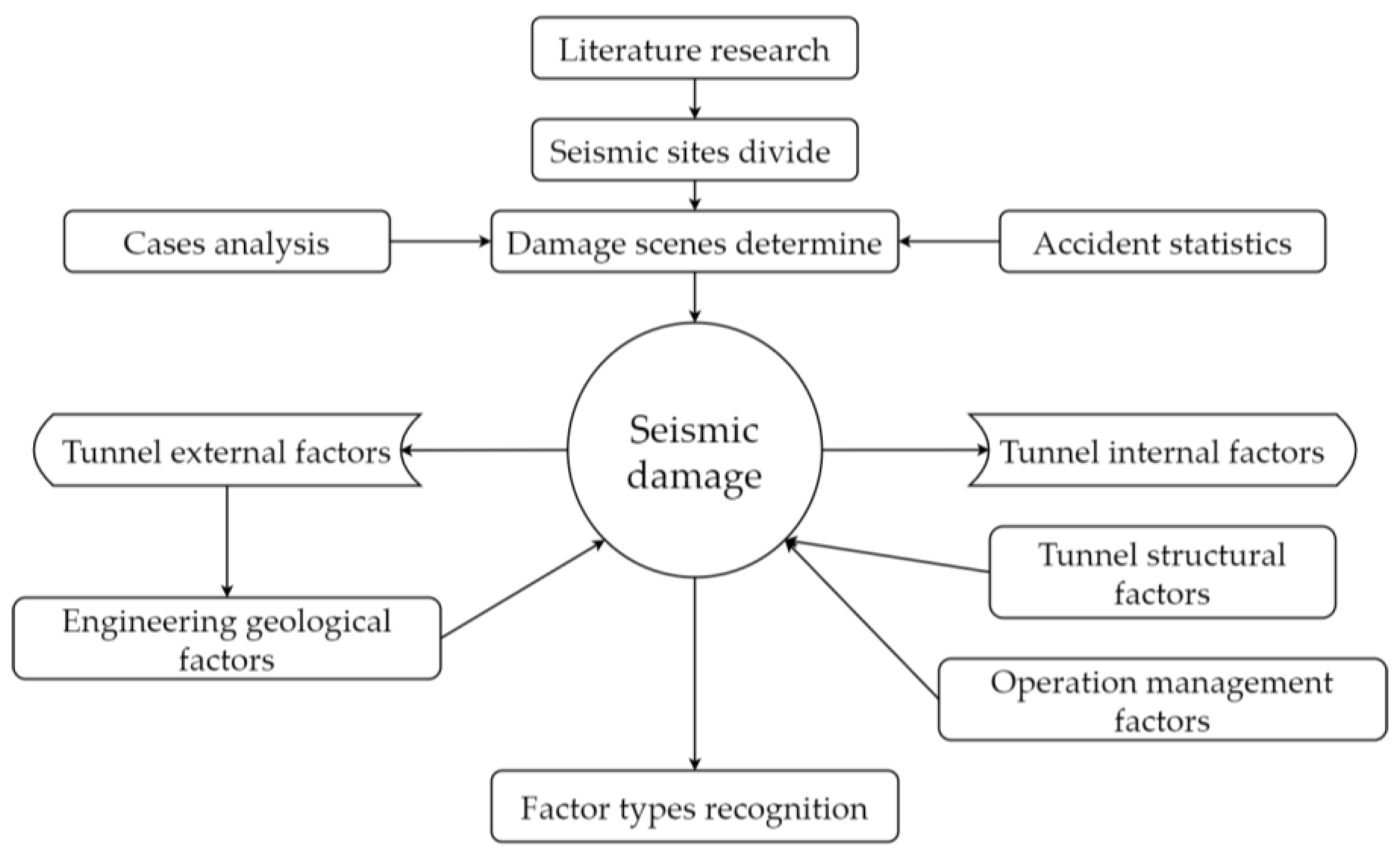
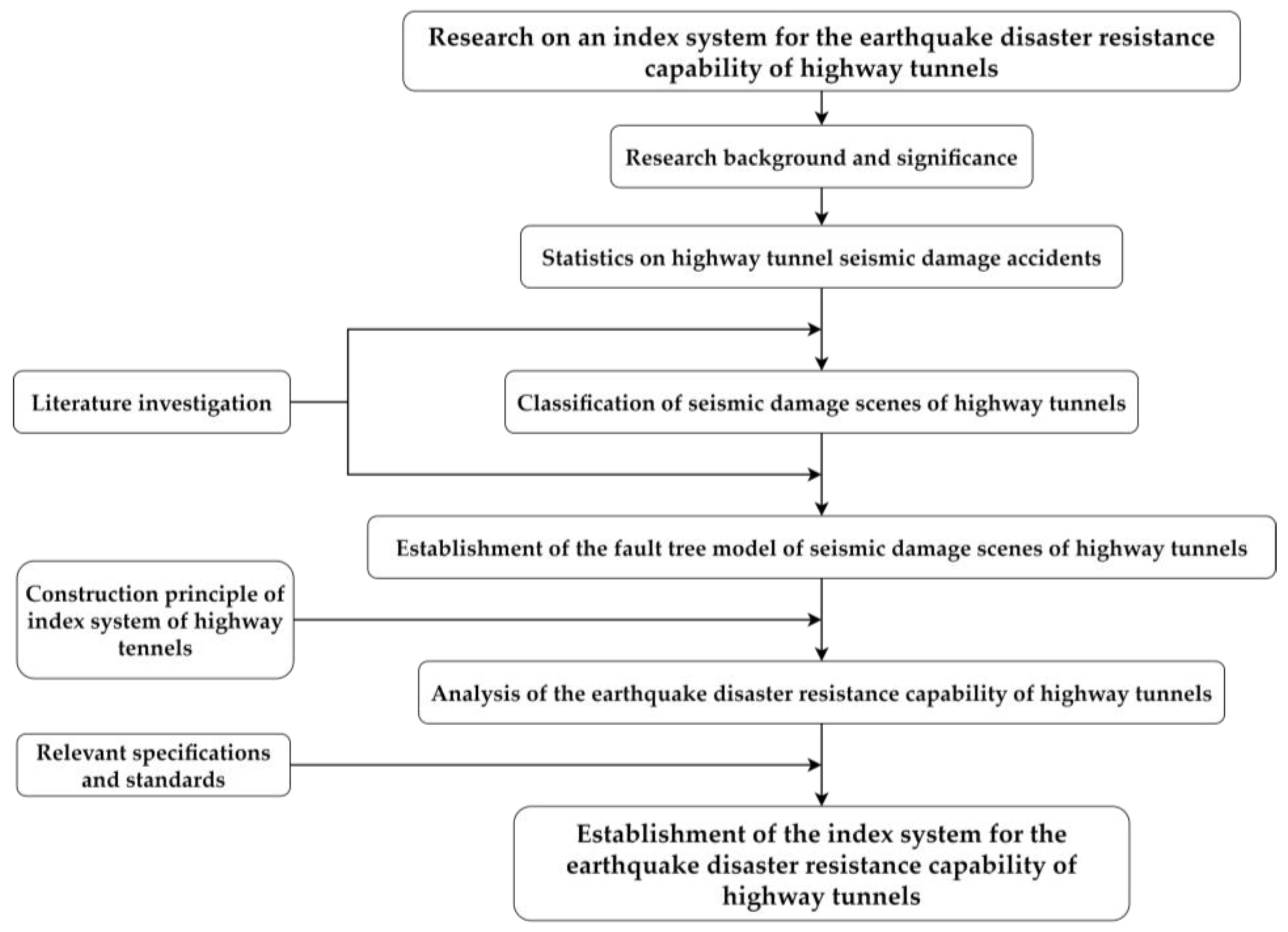
All these studies provided good methods and ideas for the construction of an index system for the earthquake disaster resistance capability of highway tunnels. However, the types of influencing factors considered in the evaluation index of earthquake disaster resistance capability are limited and cannot comprehensively reflect the earthquake disaster resistance capability of highway tunnels. This paper will conduct detailed investigations and statistics on highway tunnel seismic damage accidents during the operation period; analyze the scenes of seismic damage accidents of highway tunnels; use the fault tree analysis (FTA) model to identify the damage-causing factors and combine the industrial standards, specifications and research results related to the earthquake disaster resistance capability of highway tunnels, starting from three aspects: engineering geologic factors, tunnel structural factors and operation management factors. The evaluation indices suitable for the earthquake disaster resistance capability of highway tunnels are screened out, and a comprehensive index system can be constructed to guide the evaluation of the earthquake disaster resistance capability of highway tunnels. The research approach of this article is shown in Figure 1.
Figure 1. Research flowchart.

2. Analysis of Seismic Damage Scenes in Highway Tunnels

This paper uses a literature investigation method to investigate and calculate statistics on seismic damage in highway tunnels. A total of 56 typical earthquakes that have occurred worldwide since 1923 are investigated. The seismic damage cases of highway tunnels with relatively detailed records are mainly in Japan, the United States, China and other regions. In view of the damage conditions of highway tunnels in 12 typical earthquakes, detailed statistics were obtained on the damage conditions of 42 tunnels [15,16,17,18,19,20,21,22,23], and the damage sites of the tunnels were classified after the occurrence of tunnel earthquake disasters. The statistical results show that the seismic damage sites of highway tunnels are mainly concentrated in the portal section, the body section and the section passing through the fault crushing belt, of which the portal section accounts for 56.14%, the body section accounts for 33.3% and the section through the fault crushing belt accounts for 10.53%. Further statistical analysis of the disaster results in the above cases shows that the concrete forms of highway tunnel seismic damage mainly include the following:
A: Tunnel-side slope collapse; B: Portal cracking; C: Open cut tunnel breaking; D: Lining structure cracking; E: Concrete chipping; F: Lining structure collapse; G: Pavement cracking; H: Inverted arch cracking; I: Inverted arch dislocation; J: Construction joint cracking; K: Lining structure dislocation; L: Lining seepage.
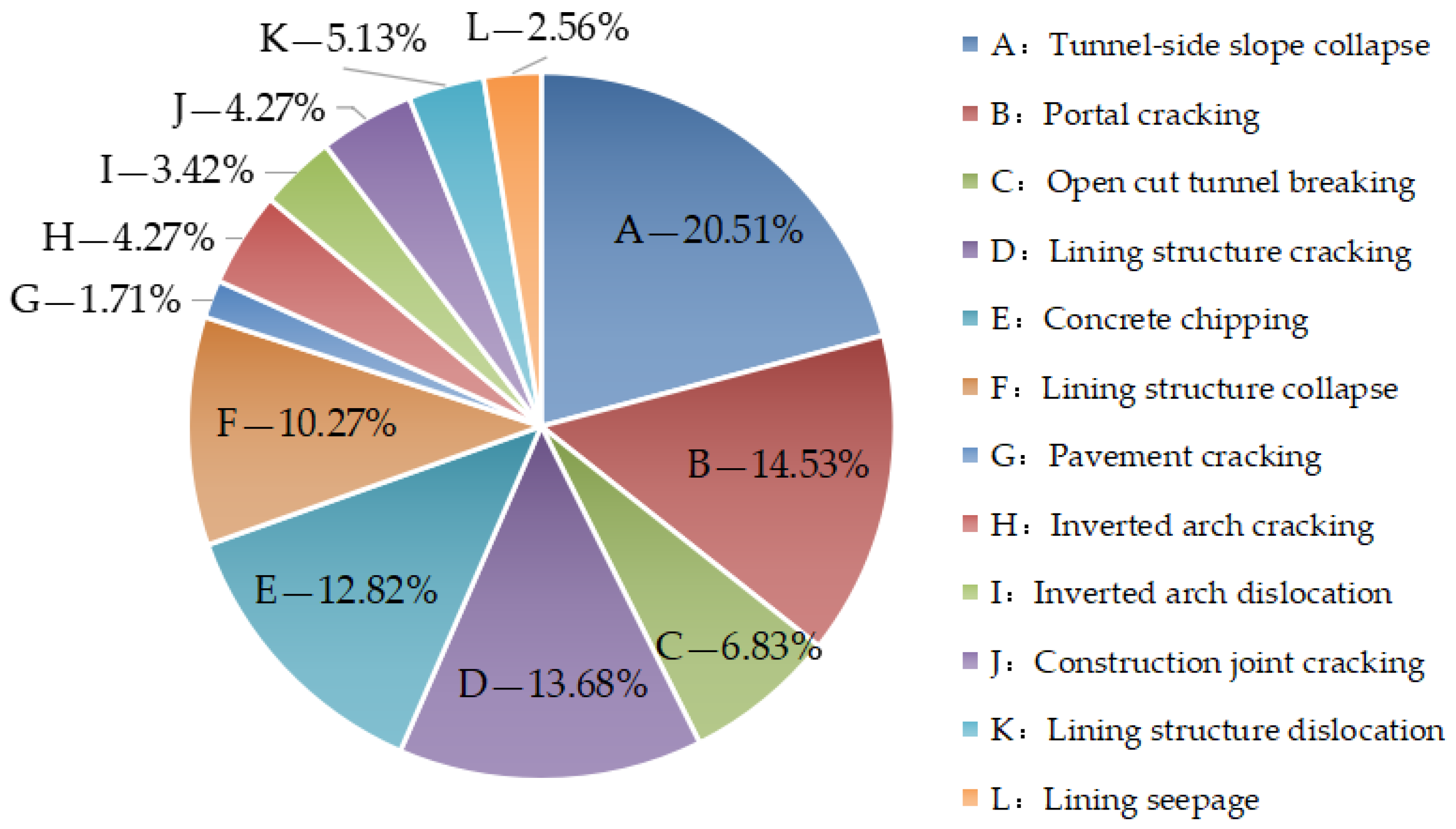
The statistics of the percentage of each type of earthquake disaster are shown in Figure 2.
Figure 2. Percentage of each type of seismic damage in highway tunnels.
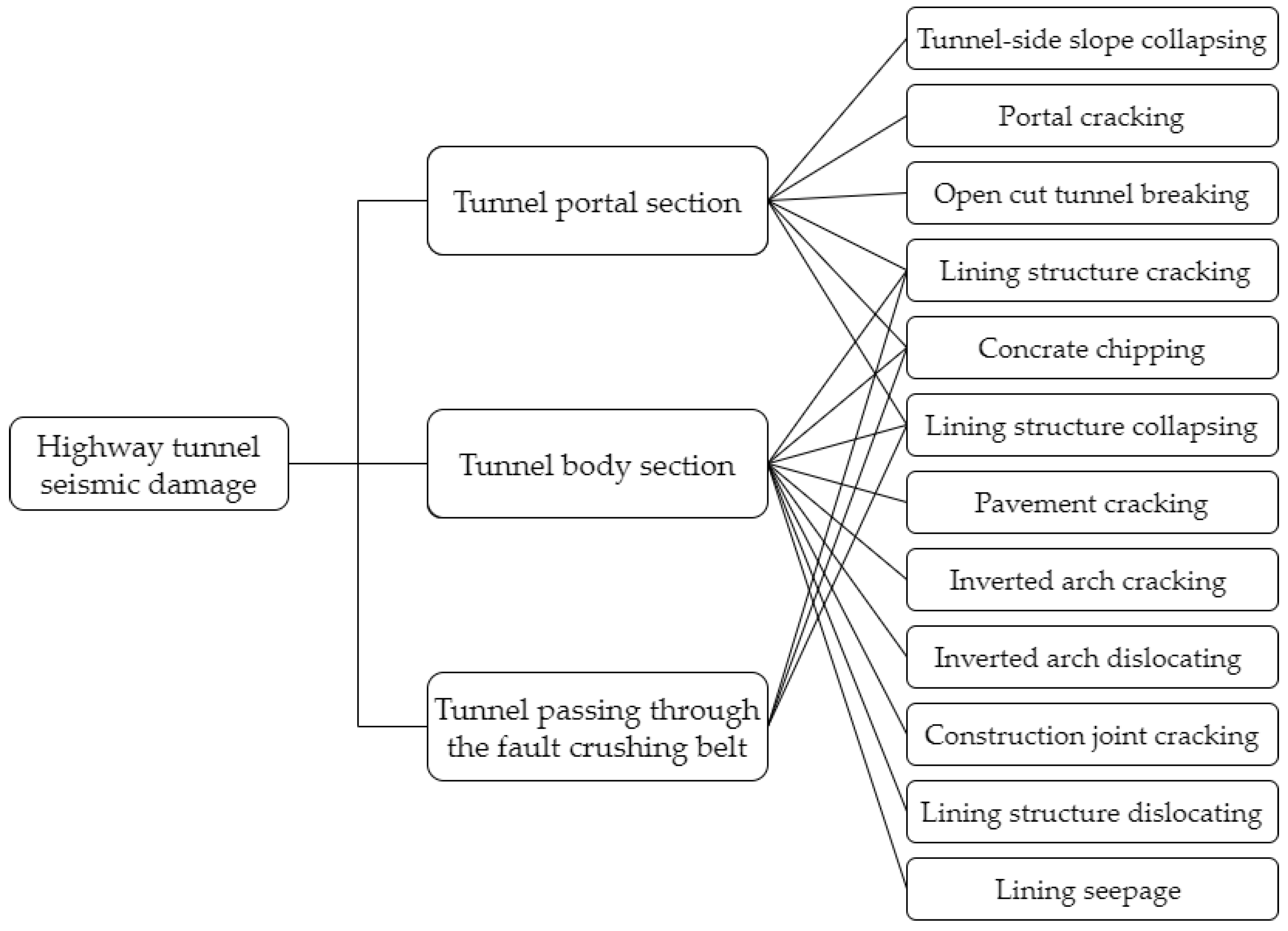
Figure 1 shows that the main damage types of highway tunnel earthquake disasters in the investigated cases are tunnel-side slope collapse, which accounts for 20.51%; portal cracking, which accounts for 14.53%; and lining structure cracking, which accounts for 13.68%. According to the damage locations and types, highway tunnel seismic damage can be specifically divided into three kinds of damage sites and a total of 17 kinds of seismic damage scenes in highway tunnels, as shown in Figure 3.
Figure 3. Seismic damage scenes in highway tunnels.

3. Identification of the Factors Influencing the Earthquake Disaster Resistance Capability of Highway Tunnels

3.1. Identification Process of the Influencing Factors of Seismic Damage in Highway Tunnels

According to the relevant specifications and standards of highway tunnels and referring to the studies of related scholars [24], the influencing factors of highway tunnel seismic damage can be divided into external and internal factors of tunnels and further subdivided into three aspects: engineering geological factors, tunnel structural factors and operation management factors.
The FTA model can be used to analyze the cause of an accident and reveal the various causes of the accident, which can not only analyze the direct cause of the accident but also reveal the potential causes of the accident. This paper combines collected and investigated tunnel seismic damage cases and adopts the FTA model to analyze and identify the influencing factors of 17 kinds of seismic damage scenes in highway tunnels from three aspects: engineering geological factors, tunnel structural factors and operation management factors. The specific identification process is shown in Figure 4.
Figure 4. Identification process of earthquake disaster factors in highway tunnels.

3.2. Analysis of the Influencing Factors of Earthquake Disasters in Portal Sections of Highway Tunnels

3.2.1. Tunnel-Side Slope Collapse

Tunnel-side slope collapse is damage caused by the collapse of the side slope at the tunnel portal section under the action of an earthquake. It is also the root cause of secondary tunnel damage. In the case of the investigation, the landslide phenomenon occurred in the earthquake at the side slope of the Baiyun Tunnel portal section, and the earth–rock falling from the slope blocked the portal section. The reason is that the rock mass of the side slope is weathered hard rock, and its nature is relatively loose. The landslide and collapse occurred on both sides of the portal section of the grass slope tunnel. The lithology of the side slope is argillaceous limestone with a loose structure and steep slope, which is mainly composed of rock and soil.
As shown in the above cases, the specific reasons leading to the collapse of the side slope are mainly loose rock (soil) mass on the side slope, the accumulation of gravel soil, the high and steep slope and the tendency of landslides. Under the action of an earthquake, the rock (soil) mass becomes unstable, collapses, slides and smashes and blocks the portal section and road. Therefore, it can be considered an engineering geological factor.

3.2.2. Portal Cracking and Open Cut Tunnel Breaking

Portal cracking and open cut tunnel breaking are caused by the direct action of seismic force and the indirect action of secondary damage caused by soil collapse on the side slope. The structure of Gengda Tunnel was damaged due to the excessive length of the open cut tunnel and the large seismic inertial force during the Wenchuan Earthquake. The Baiyunding Tunnel and Taoguan Tunnel are located on thick, covered soil. When seismic waves pass through the thick soil covering the tunnel portal section, the tunnel portal section bears more seismic inertial force, resulting in end wall cracking, fracture and arch ring damage. Longxi Tunnel tends to collapse and slide due to the extroversion trend of the side slope under the action of earthquakes. Under the combined action of the active earth pressure and the seismic inertial force behind the wing wall, the external force on the portal structure and open cut tunnel structure is greatly increased. In addition, the structure of the tunnel portal and open cut tunnel is plain concrete, with low tensile and shear strength, which causes shear and tensile damage. Moreover, the tunnel entrance section and exit section are located in the landslide area of the side slope, and the impact of a large number of falling stones causes damage to the tunnel portal structure. The portal section of the Taoguan Tunnel is located at the interface between the soft and hard rock layers. The structure of this section is affected by the forced displacement, seismic inertial force and terrain bias during the earthquake, which causes the tunnel portal to crack. Moreover, the structure of the portal section is weakly constrained by mountains during an earthquake, resulting in a “whipping effect”, and the large structural deformation causes damage to the open cut structure.
As shown in the above cases, the tunnel entrance and section exit section are located in an engineering environment with large risks and hidden dangers, such as landslide areas and rockfall areas, and it is easy to crush the structure after side slope collapse. The side slope collapse increases the earth pressure of the portal structure. The special properties of the surrounding rock of the portal section lead to the expansion of the effect of seismic force on the portal section, resulting in the cracking of the tunnel portal and the destruction of the open cut tunnel, which are engineering geological factors. The irrational design of tunnel portal structures increases the influence of seismic shear force. The structure of the tunnel portal and open cut tunnel is plain concrete with low tensile and shear strength, which easily causes damage under the combined effect of seismic inertial force and earth pressure, which are tunnel structural factors.

3.2.3. Lining Structure Collapse and Concrete Chipping

Lining structure collapse and concrete chips are forms of seismic damage to tunnel structures caused by the seismic force exceeding the bearing capacity of the lining structure. The entrance section of the Baiyunding Tunnel is located at the interface of soft and hard rock. During an earthquake, interlayer staggering occurs, and the horizontal displacement changes greatly, resulting in lining structure collapse. The arch and waist of the entrance section of both lines of Longxi Tunnel produced lining structure collapse and concrete chipping. The reason is also that the structure is located at the interface of rock layers, and the fault movement caused by the earthquake has a tremendous shear force, which exceeds the ultimate bearing capacity of the structure. Another reason for the severe collapse of the lining of Longxi Tunnel [25] is that the surrounding rock underwent a large deformation during the construction period; the left wall was extruded; the vault severely sank and the steel arch was twisted, deformed and sheared. Although the construction companies actively remedied it, the supporting effect was poor, and the structure was not maintained and managed in time during the operating period, which allowed the deformation to be seriously damaged during the earthquake.
The main reason for the lining structure collapsing and concrete chipping is that the tunnel is located at the interface of weak rock, or the tunnel portal section is located in the weak rock zone, and the seismic inertial force transmitted during the earthquake is large, which is an engineering geological factor. The structure of the tunnel portal section is plain concrete with low tensile and shear strength, and the bearing capacity is insufficient, resulting in lining structure collapse and concrete chipping, which are tunnel structural factors. For the hidden dangers such as large deformation of the structure during the construction period, support and reinforcement measures were not taken in time, resulting in poor structural health after the tunnel entered the operation period and insufficient resistance to the external force generated by the earthquake, which is an operation management factor.
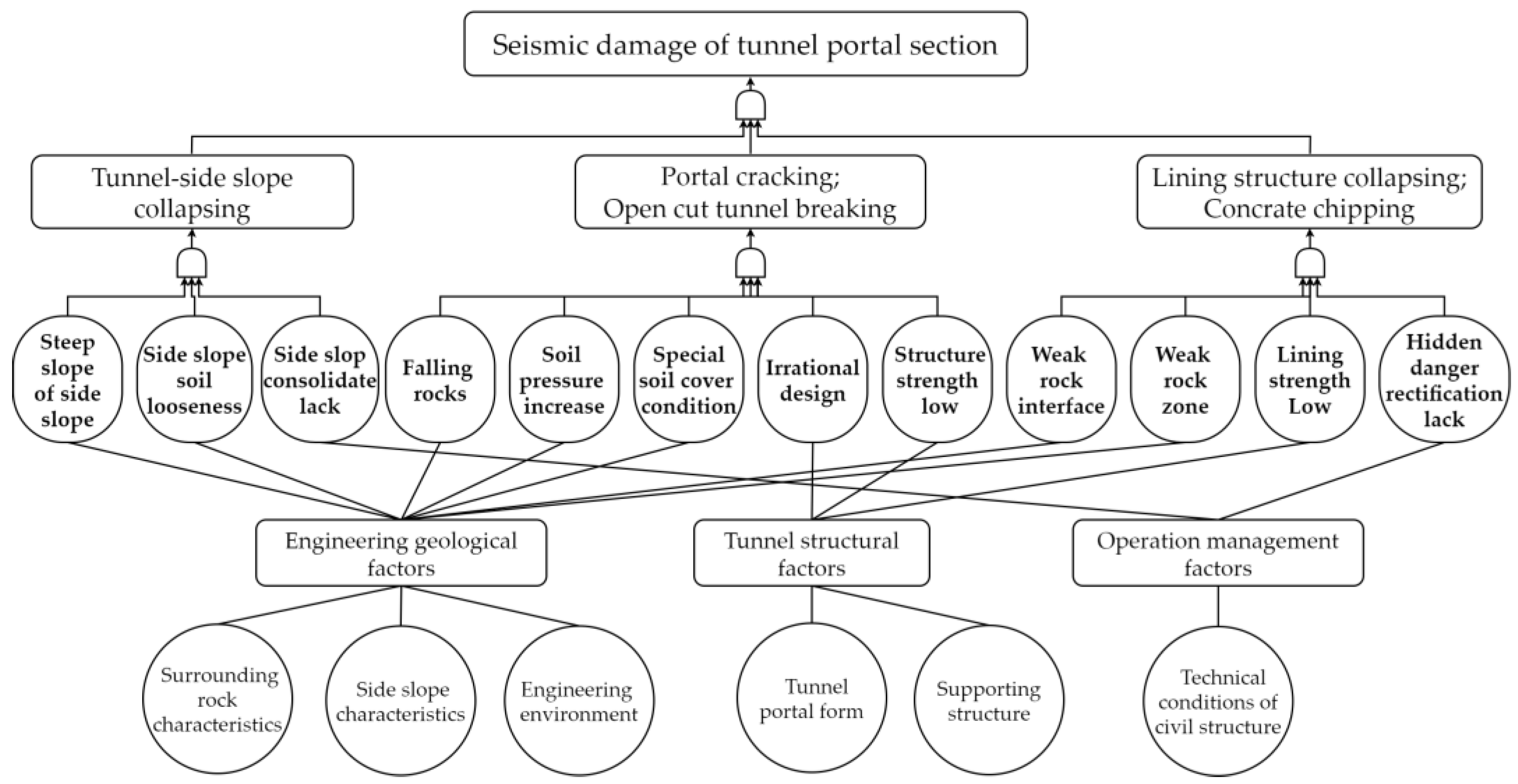
In summary, the causes of seismic damage in the portal section of highway tunnels can be identified. The engineering geological factors include the characteristics of the surrounding rock, the characteristics of the side slope and the engineering environment. Tunnel structural factors include tunnel portal forms and supporting structures. The operation management factor is the technical condition of the structure. On this basis, the FTA model of seismic damage at the portal section of highway tunnels is established, as shown in Figure 5.
Figure 5. Fault tree of seismic damage scenes of the highway tunnel portal section.

3.3. Analysis of the Factors Influencing the Seismic Damage in the Tunnel Body Section of Highway Tunnels

3.3.1. Lining Structure Cracking, Lining Structure Dislocating and Lining Structure Collapsing

Lining structure cracking, lining structure dislocation and lining structure collapse are caused by the action of seismic force on the tunnel body section, which causes damage to the tunnel lining structure. There is a progressive relationship between them, which is accompanied by the general situation. Through a case investigation [26], during the Wenchuan Earthquake, a large number of transverse cracks occurred in the right line lining of Zipingpu Tunnel, among which, the right arch to the sidewall was the most severe, with a crack width of 5~10 mm, accompanied by a small amount of lining structure dislocation and lining structure collapse. Lining longitudinal cracks with a length of approximately 5 m and a width of approximately 2 mm appear on both sidewalls of Youyi Tunnel, and lining network cracks are formed in the local area; Ma’anshi Tunnel experiences dense diagonal lining cracking, and the cracking width is 0.5~3 mm. The lining structure of Baiyunding Tunnel has continuous cracks accompanied by staggered lining structure dislocating cracks. The reasons for the damage of the above tunnels are roughly the same and include the nonuniform surrounding rock, such as the junction zone of the two surrounding rocks. At the interface, the displacement difference is generated due to the different vibration characteristics of the surrounding rock on both sides, which, in turn, affects the local deformation of the tunnel and causes damage to the tunnel lining. In the construction process of Longxi Tunnel, the collapse accident was caused by excessive ground stress and too-loose surrounding rock, and monitoring revealed that there were holes behind the lining, which caused the overall collapse of the lining when the earthquake occurred. Due to the weak surrounding rock, the seismic damage to Jiujiaya Tunnel is serious, and the lining structure has collapsed.
As shown in the above cases, there are two causes of lining structure cracking: lining structure dislocation and lining structure collapse. One is that the relaxation of the surrounding rock has a poor constraint on the tunnel structure. During an earthquake, the effect of the seismic inertial force increases, and the surrounding rock passes through different lithologies. Different displacements in earthquakes cause large fault movements, which are considered engineering geological factors. The tensile and shear strengths of concrete are very low. When the tensile force, shear force and bending moment generated by ground vibration act on the lining during an earthquake, the local tensile stress and shear stress of the lining increase and cause damage, which are tunnel structural factors.

3.3.2. Construction Joint Cracking

Construction joint cracking refers to the cracking of the connecting parts of adjacent lining structures under the action of seismic force. As the connection between two adjacent main structures, the construction joint is different from the main structure in the material and is prone to damage caused by external forces. During the earthquake, the six construction joints of Shaohuoping Tunnel all had circumferential cracks, and one of them was staggered; construction joint cracking occurred in Ma’anshi Tunnel; almost all the construction joints of Youyi Tunnel cracked, and the maximum width of the joints reached 30 mm. The main reason for the above damage is that the tunnel is subjected to a large stress caused by the earthquake, and the construction joint link strength of the construction joint cannot adapt to the bearing capacity of the main structure.
It is concluded that the main reason for the construction joint cracking is that the construction joint is located at the connection part of the two main structural members and the link strength of the construction joint is insufficient, resulting in structural damage, which is a tunnel structural factor.

3.3.3. Pavement Cracking

Pavement cracking refers to the excessive cracks produced by pavement under the action of an earthquake, which affects normal use. Under the influence of seismic forces, asphalt or plain concrete pavement materials cannot resist the load generated by an earthquake alone. In addition, the pavement is a consumption structure, which will cause pavement cracking when the loss is too large and the maintenance is insufficient. During the Wenchuan Earthquake, there were many pavement cracks in the tunnel body section of the Shaohuoping Tunnel and Baiyunding Tunnel, and the pavement cracks were clear and had a certain direction. There are also small distributions in Longxi Tunnel, Longdongzi Tunnel and Jiujiaya Tunnel; the pavement of Ma’anshi Tunnel is cracked horizontally, and there are many inclined cracks in the lining near the pavement.
In the case of investigation, due to the defects of the operation management company in pavement maintenance, the technical condition of the pavement structure is poor. During operation, the pavement shrinks due to vehicle load and pavement temperature and cracks under the action of seismic force. Therefore, the main causes of pavement cracking can be divided into operation management factors.

3.3.4. Dislocating Inverted Arch Cracking and Inverted Arch

Inverted arch cracking and inverted arch dislocation are caused by damage caused by the lower pressure exceeding the ultimate bearing capacity of the inverted arch structure due to the seismic force, and these two types of damage usually occur together. The inverted arch structure is subjected to a large surrounding rock stress under the action of an earthquake. Under the action of mountain stress and gravity, the concrete on both sides of the sidewall and the arch foot is squeezed to the axis of the tunnel, resulting in the upward extrusion of the inverted arch concrete, which results in cracking and dislocation [27]. During the Wenchuan Earthquake, the inverted arch and the floor of Longxi Tunnel were uplifted at many sites and were accompanied by longitudinal and transverse tension cracks. The maximum uplift height was 1.2 m, and the maximum cracking of the inverted arch of Longdongzi Tunnel reached 10 cm. The reason for the damage of the inverted arch of the two tunnels is that the large extrusion pressure on both sides of the tunnel indirectly acts on the inverted arch during the earthquake, resulting in the uplift and cracking of the inverted arch. The section of Zipingpu Tunnel is a large-span section, the external force on the inverted arch is greater than that on the ordinary section and insufficient seismic design and a lack of seismic measures cause cracking.
The main reasons for inverted arch cracking and inverted arch dislocation are the insufficient concrete strength of the inverted arch, the large section span and the lack of seismic measures, which cannot effectively bear the seismic load and are tunnel structural factors.

3.3.5. Lining Seepage

Lining seepage, which is usually accompanied by lining damage, is highly prone to occur during earthquake disasters in highway tunnels. It mainly occurs in the vault and the sidewall. During the Wenchuan Earthquake, the damage to Longxi Tunnel was the most severe. The lining structure was destroyed, the waterproof board was exposed and a large amount of water was poured into the rock mass. Shenjiashan Tunnel is rich in groundwater, and lining seepage occurred after the earthquake.
The above cases show that the main reason for the lining seepage is that there is a large amount of groundwater around the tunnel, which penetrated into the tunnel along the cracks generated by the lining after the earthquake, which was influenced by engineering geological factors.
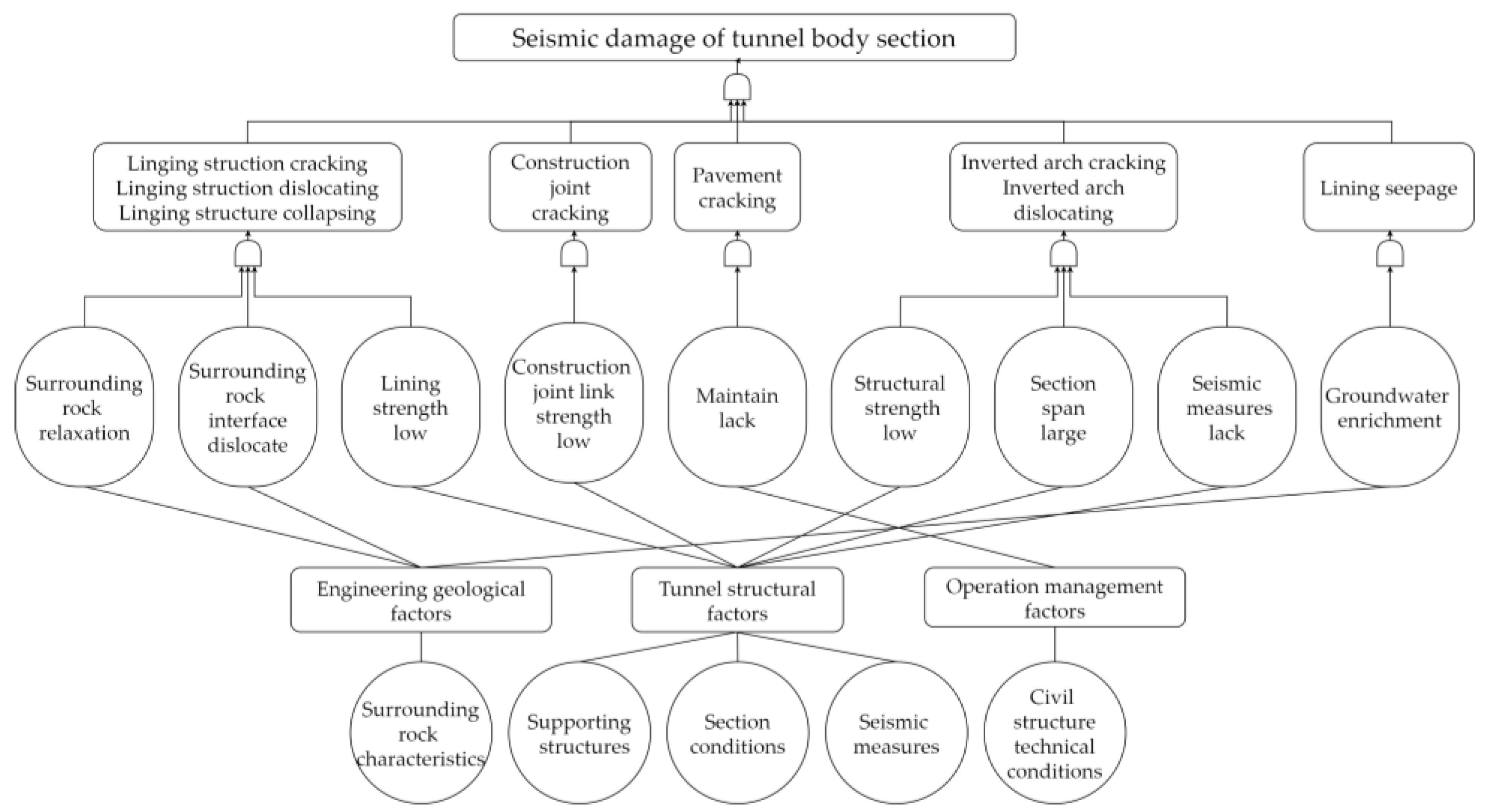
In summary, the causes of seismic damage in the tunnel body section of highway tunnels can be summarized, and the engineering geological factors are the characteristics of the surrounding rock. The tunnel structural factors include the supporting structure, section conditions and seismic measures. The operation management factor is the technical condition of the civil engineering structure. The FTA model of the seismic damage of highway tunnels is established, as shown in Figure 6.
Figure 6. Fault tree of seismic damage senses of the highway tunnel body section.

3.4. Analysis of the Factors Influencing the Seismic Damage of Highway Tunnel Sections Passing through the Fault Crushing Belt

3.4.1. Concrete Chipping and Lining Structure Collapse

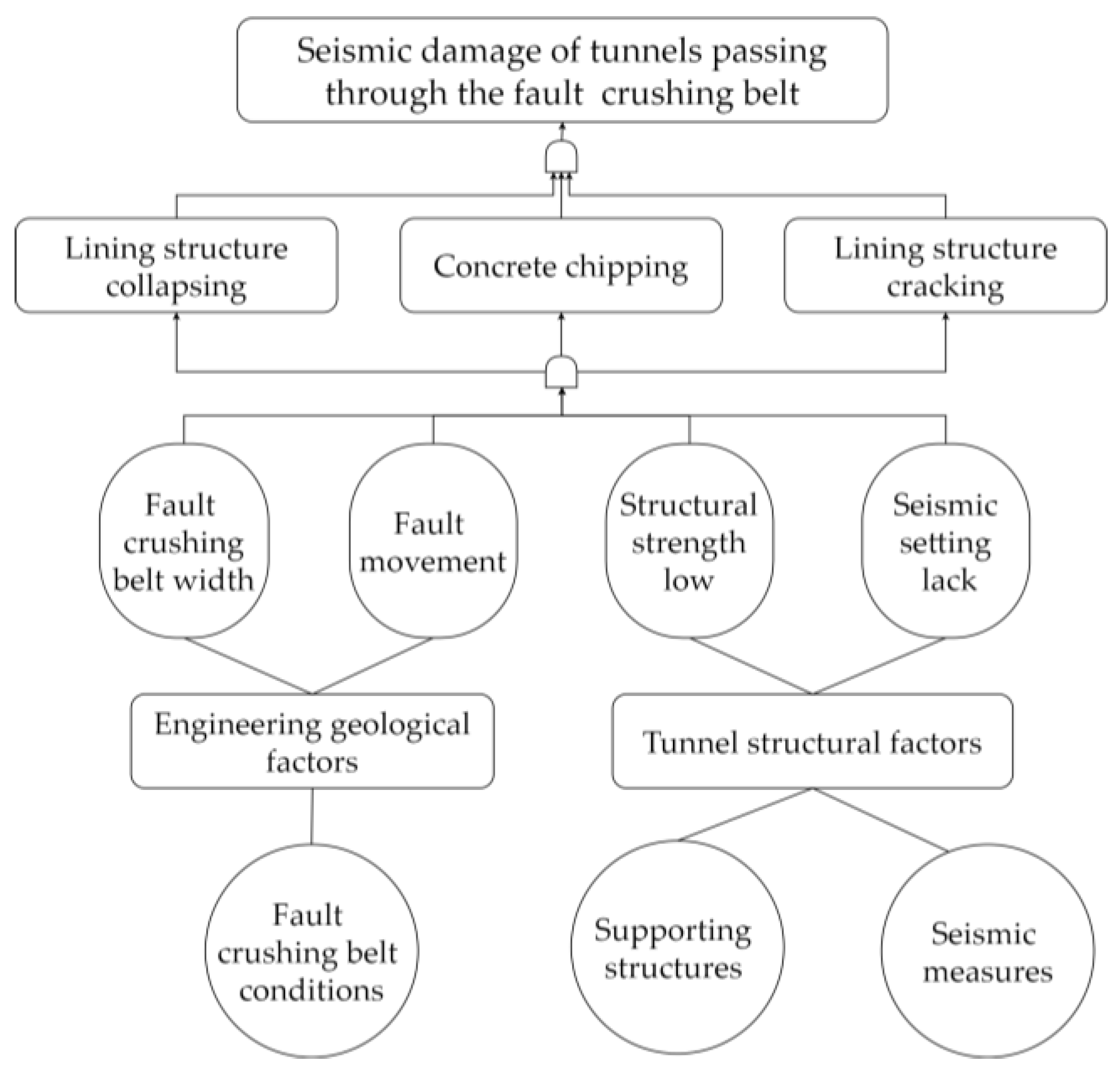
Concrete chipping and lining structure collapse are the most common types of damage in highway tunnel sections passing through fault crushing belts. The main reason for this is that the tunnel structure suffers from a large shear force due to the large fault movement caused by the earthquake, and the tunnel lining structure cannot resist this shear force. During the Wenchuan Earthquake, the Longxi Tunnel and Jiujiaya Tunnel passed through fault crushing belts with widths of 10 m and 64 m, respectively, and the lining structure collapsed with concrete chipping, which were the most seriously damaged parts of the two tunnels. The reason is that a large amount of elastic strain energy is released during an earthquake, and the upper and lower walls of the fault produce different displacement and stress responses due to different mechanical properties, resulting in mutual extrusion and fault movement, resulting in a large fault movement of the tunnel structure on the faulted surface to produce a large shear force. The lining structure of the tunnel itself cannot resist this external force, and the lack of seismic measures leads to the occurrence of this damage.
The fault crushing belts of the two tunnels are wider, and the fault movement is greater when an earthquake occurs, which causes a large displacement between the lining structures of the tunnel in the crossing section, resulting in concrete chipping and lining structure collapse, which are engineering geological factors. The strength of the tunnel structure cannot resist the external force at the fault fracture zone, and no special seismic measures are set up, resulting in concrete chipping and lining structure collapse of the tunnel structure, which are tunnel structure factors.

3.4.2. Lining Structure Cracking

Lining structure cracking is a mild damage to the tunnel structure passing through the faulted fracture zones, but the damage degree is still greater than that of the ordinary section of the tunnel. During the Wenchuan Earthquake, Youyi Tunnel passed through a narrow fault crushing belt with a width of 0.5 m. Although the lining did not collapse, a large number of penetrating cracks appeared in the lining structure of this section. Zipingpu Tunnel passed through a fault crushing belt with a width of 3 m, resulting in a clear crack and a certain trend of lining cracks, and no lining structure collapse occurred. Lining structure cracking is formed by the influence of the giant shear force caused by staggered faults, which is the initial stage of lining structure collapse.
In the case of narrow crushing belts, there will be no fatal damage [28], such as lining structure collapse, but there will still be a large number of lining cracks. This is due to the strong shear force generated at the fault crushing belts, but the width is narrow. The fault movement during an earthquake is small, and the lining can be supported by its own strength without collapse, but the formation of a large number of cracks still makes the tunnel dangerous, so it can be divided into engineering geological factors. The strength of the lining structure here is low, and no seismic measures are set up for the fault crushing belts, which are tunnel structural factors.
In summary, the causes of seismic damage to highway tunnels crossing fault crushing belts can be summarized, and engineering geological factors include fault crushing belts. Tunnel structural factors include supporting structures and seismic measures. The FTA model of the seismic damage of highway tunnels is established, as shown in Figure 7.
Figure 7. Fault tree of seismic damage scenes for highway tunnel sections passing through a fault crushing belt.

4. Seismic Capability Index System of Highway Tunnels

The earthquake disaster resistance of highway tunnels refers to the ability of highway tunnels to absorb and resist disasters and to control damage and accidents quickly and effectively when they are subjected to earthquake disasters. It is related to the geological conditions, tunnel structures, protective measures, maintenance and management of highway tunnels [29]. Based on the influencing factors identified by highway tunnel seismic damage accidents, this paper determines the important influencing factors of the earthquake disaster resistance capability of highway tunnels in combination with the relevant norms and literature [30,31,32] and then constructs a seismic capability index system for highway tunnels. The established index system should follow the scientific principle, relative completeness principle, hierarchy principle, independence principle and quantitative and qualitative combination principle.

4.1. Analysis of the Evaluation Index

In the past, the project was evaluated in terms of three aspects: environmental factors, material factors and human factors. In the evaluation of the earthquake disaster resistance capability of highway tunnels during the operation period, environmental factors can be defined as engineering geological factors, material factors can be defined as tunnel structural factors and human factors can be defined as operation management factors.

4.1.1. Index Analysis of the Engineering Geological Factors

Through the preliminary identification of the influencing factors of seismic damage in highway tunnels, it is concluded that the indicators of engineering geological factors include the surrounding rock characteristics, side slope characteristics, fault crushing belts and engineering environment. However, according to engineering experience [33,34,35,36,37,38,39,40,41,42,43,44,45,46,47,48] and relevant specifications, foundation conditions also have an important impact on the seismic capability of highway tunnels. Therefore, the foundation conditions are included in the impact indices of engineering geological factors.
By consulting the relevant specifications and engineering experience (see Table 1 for details of the relevant regulations or experience), the surrounding rock indicators can be expressed by the surrounding rock grade, surrounding rock cavity, high ground stress, bias, burial depth, underground water and surrounding rock interface. The characteristic indicators of the side slopes include the side slope gradient, side slope height and weathering degree. The indicators of fault crushing belts can be expressed by the fault movement and fault width. The engineering environmental indicators are evaluated by the presence or absence of rockfall sites and adjacent engineering activities. The foundation condition indicators are evaluated by the bearing capacity of the foundation and the possibility of liquefaction of the foundation soil.
Table 1. Index analysis of the engineering geological factors.

4.1.2. Index Analysis of the Tunnel Structural Factors

Through the identification of the factors influencing the seismic damage of highway tunnels, tunnel structural indicators include portal forms, supporting structures, section conditions and seismic measures.
By consulting the relevant specifications and engineering experience (see Table 2 for details of the relevant regulations or experience), the portal form indicators can be expressed by the tunnel portal type and tunnel portal size. The supporting structure indicators include the lining material, lining thickness, reinforcement, inverted arch setting and construction joint link strength. The cross-sectional condition indicators can be expressed by the cross-sectional shape and cross-sectional size. The indicators of seismic measures are evaluated by the setting of seismic joints and special seismic measures.
Table 2. Index analysis of the tunnel structural factors.

4.1.3. Index Analysis of the Operation Management Factors

Through the preliminary identification of the factors influencing the seismic damage of highway tunnels, according to the implications of the earthquake disaster resistance capability of highway tunnels, it is necessary to consider not only the technical conditions of the tunnel civil structure but also the maintenance management level and emergency management level of the highway tunnel. The maintenance management level can reflect the maintainability of the earthquake disaster resistance capability of highway tunnels, and the emergency management level of the operation department plays a decisive role in an earthquake.
By consulting the relevant specifications and engineering experience (relevant regulations or experience are shown in Table 3), the technical condition indicators of civil engineering structures can be expressed by the technical conditions of the tunnel portal section structure, portal structure, lining structure and pavement structure. Emergency management level indicators include the use of an emergency management system and the use of emergency plan drills. Maintenance management level indicators can be evaluated by establishing and improving the maintenance management system and inspecting maintenance. The emergency management system is embodied in having a complete set of emergency organizations and emergency plans and responding to sudden earthquake disasters through coordination and cooperation among multiple departments. The emergency plan drill included the drill method and the number of drills. The emergency plan drill can provide the corresponding experience for the tunnel custody unit and improve the emergency response capacity. The maintenance management system refers to the implementation of a hierarchical responsibility system for tunnel management and should regularly assess the quality of tunnel maintenance and train technical personnel; inspection and maintenance conditions refer to whether the daily inspection, regular inspection, regular inspection, daily maintenance and maintenance work are comprehensive and timely.
Table 3. Index analysis of the operation management factors.

4.2. Construction of the Index System

Based on the principle of establishing the index system, combined with the analysis of the evaluation indicators of the earthquake disaster resistance capability of highway tunnels, the evaluation index system is constructed by using hierarchy theory in system science, and a four-level comprehensive evaluation index system is proposed, including the target layer (seismic resistance of highway tunnels [U]), the criterion layer (engineering geological factors [U1], tunnel structural factors [U2], operation and management factors [U3]), 12 indicator layers and 35 specific indicator layers. The evaluation index system of the earthquake disaster resistance capacity of highway tunnels is shown in Table 4.
Table 4. Index system for the earthquake capacity of highway tunnels.

5. Conclusions

(1)
The damage of highway tunnels in 12 earthquake disasters recorded in detail in China and abroad was investigated and counted, and 17 seismic damage scenes of highway tunnels were classified according to the types of hazard-beating bodies and damage forms. According to different damage scenes, the fault tree analysis (FTA) model was used to identify the damage-causing factors.
(2)
Combined with the industry standards, norms and research results related to the earthquake resistance of highway tunnels, the evaluation indices are analyzed from three perspectives: engineering geological factors, tunnel structural factors and operation management factors. According to the principle of index system construction, a four-level index system is constructed, which takes the earthquake disaster resistance capability of highway tunnels as the target layer; engineering geological factors, tunnel structural factors and operation management factors as the criterion layer indices; 12 indicators as the index layer and 35 specific indicators.
(3)
The establishment of an index system for the earthquake disaster resistance capability of highway tunnels provides a reference for the quantitative evaluation of the earthquake disaster resistance capability of highway tunnels and can also provide important support for the safe operation and sustainable development of highway tunnels.
In the next step, through the analysis of the importance of the evaluation index, the indicator weights can be determined, and the corresponding scoring method can be formulated and quantified to evaluate the earthquake disaster resistance capability of highway tunnels.

Author Contributions

Conceptualization, F.W. and N.Z.; methodology, Z.L., N.Z. and F.W.; software, Z.L., X.Y. and Y.Z.; formal analysis and investigation, N.Z., Z.L., Y.Z., J.Y. and F.W.; writing—original draft preparation, F.W., N.Z., Y.Z. and X.Y.; writing—review and editing, F.W., N.Z., X.Y. and Z.L.; funding acquisition, N.Z. and F.W.; and resources, F.W. and J.Y. All authors have read and agreed to the published version of the manuscript.

Funding

This research was supported in part by the Pilot Project of Country with Strong Transportation Network of Research Institute of Highway Ministry of Transport (No. QG2021-1-3-3), in part by the Central Government Guides Local Science and Technology Development Fund Project (No. YDZJSX20231A021) and in part by the Shanxi Province Graduate Practice and Innovation Project (No. 2023SJ070).

Institutional Review Board Statement

Not applicable.

Data Availability Statement

The data presented in this study are available upon request from the corresponding author. The data are not publicly available due to privacy.

Acknowledgments

The authors are grateful for the comments provided by the anonymous reviewers.

Conflicts of Interest

Author Fei Wan was employed by the company Research Institute of Highway Ministry of Transport. And author Jiang Yu was employed by the company CCCC Highway Consultants Co., Ltd. The remaining authors declare that the research was conducted in the absence of any commercial or financial relationships that could be construed as a potential conflict of interest.

References

  1. Xu, G.; Zhu, W.; Zhang, W. Summarization of Tunnel Seismic Research. Traffic Stand. 2011, 2011, 44–47. [Google Scholar]
  2. Li, T.; Yin, Y. Seismic Damage Analysis of Tunnel Structure in Wenchuan Earthquake. Eng. Blasting 2011, 17, 24–27. [Google Scholar]
  3. Wang, W.L.; Wang, T.T.; Su, J.J.; Lin, C.H.; Huang, T.H. Assessment of Damage in Mountain Tunnels Due to the Taiwan Chi-Chi Earthquake. Tunnellingand Undergr. Space Technol. 2001, 16, 133–150. [Google Scholar] [CrossRef]
  4. Wang, Z.Z.; Zhang, Z. Seismic damage classification and risk assessment of mountain tunnels with a validation for the 2008 Wenchuan earthquake. Soil Dyn. Earthq. Eng. 2013, 45, 45–55. [Google Scholar] [CrossRef]
  5. Yu, H.T.; Chen, J.T.; Yuan, Y.; Zhao, X. Seismic Damage of Mountain Tunnels During the 5.12 Wenchuan Earthquake. J. Mt. Sci. 2016, 13, 1958–1972. [Google Scholar] [CrossRef]
  6. Rodríguez, C.A.; Rodríguez-Pérez, Á.M.; López, R.; Hernández-Torres, J.A.; Caparrós-Mancera, J.J. A Finite Element Method Integrated with Terzaghi’s Principle to Estimate Settlement of a Building Due to Tunnel Construction. Buildings 2023, 13, 1343. [Google Scholar] [CrossRef]
  7. Rodríguez, C.A.; Rodríguez Pérez, Á.M.; López, R.; Caparrós Mancera, J.J. Comparative Analysis and Evaluation of Seismic Response in Structures: Perspectives from Non-Linear Dynamic Analysis to Pushover Analysis. Appl. Sci. 2024, 14, 2504. [Google Scholar] [CrossRef]
  8. Gong, Z. Study on the Aseismatic Safety Evaluation of Huangcaoping Tunnel of National Road No.318. Master’s Thesis, Chengdu University of Technology, Sichuan, China, 2007. [Google Scholar]
  9. Guan, M.S.; Han, D.J.; Du, H.B.; Wu, Y. A new seismic performance index for reinforced concrete frame structures. J. Shenzhen Univ. Sci. Eng. 2011, 28, 200–205. [Google Scholar]
  10. Wang, Z.; Zhang, Z.; Gao, B. Factors of seismic damage and fuzzy synthetic evaluation on seismic risk of mountain tunnel portals. J. Cent. South Univ. Sci. Technol. 2012, 43, 1122–1130. [Google Scholar]
  11. Cui, G.; Wang, M.; Yu, L. Evaluation and Suggestion of Seismic Fortification Standard Based on Earthquake Damage Characteristics of Wenchuan Earthquake Tunnel. J. Catastrophology 2013, 28, 20–24. [Google Scholar]
  12. Guo, Y.; Gong, S.; Kang, S. Disease Evaluation of Existing Tunnel Lining Based on AHP-Extenics Model. Tunn. Constr. Chin. Engl. 2020, 40, 115–122. [Google Scholar]
  13. Li, D. Construction of Safety Evaluation Management System of Highway Tunnel. Heilongjiang Jiaotong Keji 2023, 46, 118–120. [Google Scholar]
  14. Jin, Y.; Wang, G.; Xie, W. Health Evaluation Index and Detection Analysis of Ying Tunnel Structure. Transp. Manag. World 2023, 2023, 82–84. [Google Scholar]
  15. Lai, J.; He, S.; Qiu, J.; Chen, J.; Wang, L.; Wang, K.; Wang, J. Characteristics of Seismic Disasters and Aseismic Measures of Tunnels in Wenchuan Earthquake. Environ. Earth Sci. 2017, 76, 94. [Google Scholar] [CrossRef]
  16. Cheng, M.; Li, S.; Yin, Q. Disaster Prevention and Mitigation Technology of Yingwen Expressway Earthquake Secondary Disasters. Sichuan Archit. 2021, 41, 70–73. [Google Scholar]
  17. Yin, Q. Discussion on Seismic Design of Yingxiu to Wenchuan Expressway Bridge. Sichuan Archit. 2014, 34, 154–156. [Google Scholar]
  18. Sun, Y.; Li, P.; Bo, J. Damage Investigation and Cause Analysis of Longxi Tunnel in Wenchuan Great Earthquake. World Earthq. Eng. 2010, 26, 187–191. [Google Scholar]
  19. Chen, Z.; Chen, Z.; Yang, C. Statistical Analysis of Slope Collapse from Dujiangyan to Yingxiu Section of line. Highway 2015, 60, 51–56. [Google Scholar]
  20. Zhang, J. Earthquake Damage Diagnosis and Functional Repair of the Damaged Tunnel in Wenchuan Earthquake. J. China Foreign Highw. 2016, 36, 251–255. [Google Scholar]
  21. Xu, D.; Chen, Y.; Fang, J. Analysis of Deformation and Failure Causes of Longxi Tunnel on Duwen Highway. Resour. Environ. Eng. 2009, 23, 76–84. [Google Scholar]
  22. Zhu, J.; Deng, G.; Tan, S. Damage to Highway Tunnel Caused by Wenchuan Earthquake and Repair Measures of Road Surface in Tunnel. TranspoWorld 2021, 2021, 93–95. [Google Scholar]
  23. Zhu, G.Q.; Tao, J.L.; Liu, X.L. Research on Safety Evaluation System of Reinforced Concrete Structures Based on the Blasting Damage. Adv. Mater. Res. 2015, 1065, 1217–1221. [Google Scholar] [CrossRef]
  24. Huang, M.; Liu, M.; Wang, A. The Research of Tunnel Earthquake Damage Forms and the Reasons. Technol. Econ. Areas Commun. 2010, 12, 60–62. [Google Scholar]
  25. Li, J. Study on Deformation Mechanism and Treatment Measures of Longxi Tunnel’s Initial Support. Subgrade Eng. 2009, 2009, 200–201. [Google Scholar]
  26. Zang, W. Research on Earthquake Damage Law of Highway Tunnel in Wenchuan Earthquake. Mod. Tunn. Technol. 2017, 54, 17–25. [Google Scholar]
  27. Gao, F.; Wei, J. Influence of Invert Form on Seismic Response Analysis of Long-span Tunnel. West-China Explor. Eng. 2012, 24, 187–190+195. [Google Scholar]
  28. Kang, H.; Wang, Z.; Zhao, G. Review on Seismic Response of Cross-fault Tunnel Structures. Sichuan Archit. 2020, 40, 256–259. [Google Scholar]
  29. Chen, Q.; Yang, W.; Zhu, D. Analysis on Impact Factors on Seismic Responses of Tunnel. Water Resour. Hydropower Eng. 2014, 45, 60–64+68. [Google Scholar]
  30. Li, Z.; Meng, X.; Liu, D.; Tang, Y.; Chen, T. Disaster Risk Evaluation of Superlong Highways Tunnel Based on the Cloud and AHP Model. Adv. Civ. Eng. 2022, 2022, 8785030. [Google Scholar] [CrossRef]
  31. Cui, H.; Chen, G.; Zhu, M.; Su, Y.; Liu, J. Health State Assessment of Road Tunnel Based on Improved Extension Cloud Model. Appl. Sci. 2023, 13, 8554. [Google Scholar] [CrossRef]
  32. Zhang, Q.; Zhang, W. Health and Safety Evaluation System of Tunnel Structure under Complex Geological Conditions. Sichuan Archit. 2022, 42, 184–187+190. [Google Scholar]
  33. Gao, Q.; Wen, Z.; Wang, D. Instability process of frozen soil slope based on direct shear test at freeze–thaw interface. Rock Soil Mech. 2018, 39, 2814–2822. [Google Scholar]
  34. Jiang, S.H.; Huang, J.; Griffiths, D.V.; Deng, Z.P. Advances in reliability and risk analyses of slopes in spatially variable soils: A state-of-the-art review. Comput. Geotech. 2022, 141, 104498. [Google Scholar] [CrossRef]
  35. Zheng, Z.; Sun, Q. Sichuan-tibet Railway Tunnel Project. Tunn. Constr. 2017, 37, 1049–1054. [Google Scholar]
  36. Shen, J.Y.; Karakus, M. Three-dimensional numerical analysis for rock slope stability using shear strength reduction method. Can. Geotech. J. 2013, 51, 164–172. [Google Scholar] [CrossRef]
  37. Xing, J.; Dong, X.; He, X. Stability Analysis of Surrounding Rock in Tunnel Construction in Fault fracture Zone. J. Catastrophol. 2018, 33, 164–168. [Google Scholar]
  38. Cui, G.; Ji, L.; Jin, H. Damping Shake Technology of the Shock Absorption Layer of Fault-crossing Tunnels in a Dangerous Mountainous Area with High-Intensity Earthquakes. China Earthq. Eng. J. 2019, 41, 286–291. [Google Scholar]
  39. Qi, W.; Gao, Y. Study on Comprehensive Construction and Monitoring Technology of Highway Tunnel Crossing Weak and Fractured Surrounding Rock. J. Highw. Transp. Res. Dev. 2021, 38, 88–96+105. [Google Scholar]
  40. Yang, X.; Shi, Z. Study on the Construction Technology of Tunnel Portal section Collapse Caused by Slope Instability. Yunnan Water Power 2016, 32, 83–86+91. [Google Scholar]
  41. Kontoe, S.; Zdravkovic, L.; Potts, D.M.; Menkiti, C.O. Case study on seismic tunnel response. Can. Geotech. J. 2008, 45, 1743–1764. [Google Scholar] [CrossRef]
  42. Zhang, H.; Xiang, X. Anti Liquefaction of Silty Soil Foundation and Seismic Performance of Tunnel in High Earthquake Intensity Area. Chin. J. Undergr. Space Eng. 2017, 13, 332–338. [Google Scholar]
  43. Li, T. Failure Characteristics and Influence Factor Analysis of Mountain Tunnels at Epicenter Zones of Great Wenchuan Earthquake. J. Eng. Geol. 2008, 16, 742–750. [Google Scholar]
  44. Meng, G.; Zhou, J. Limit State Design Method of Railway Tunnel Portal Based on Reliability Theory. J. Southwest Jiaotong Univ. 2016, 51, 31–35. [Google Scholar]
  45. Suo, R.; Wang, Y. Seismic Fortification Length of Tunnel Portal section Under Rayleigh Wave Action. Mod. Tunn. Technol. 2011, 48, 13–18. [Google Scholar]
  46. Cui, G.; Li, P.; Wang, Q. Analysis on the Effect of Pile-raft Anti-seismic Measures for the Tunnel Section of Weak Surrounding Rock in Strong Earthquake Area. Chin. J. Geol. Hazards Prev. 2021, 32, 106–112. [Google Scholar]
  47. Luo, J. Analysis of Seismic and Damping Measures for Shallow Buried Tunnel in City. Sci. Technol. Innov. Appl. 2015, 2015, 213. [Google Scholar]
  48. Zhou, J. Investigation and Analysis of Highway Tunnel Diseases in Henan Province and Thinking on Operation Management. Mod. Tunn. Technol. 2018, 55, 1–10. [Google Scholar]
  49. JTG/T 3660-2020; Technical Specifications for Construction of Highway Tunnel. China Communications Press: Beijing, China, 2020.
  50. JTG 3370.1-2018; Specifications for Design of Highway Tunnels Section 1 Civil Engineering. China Communications Press: Beijing, China, 2018.
  51. JTG/T 2232-01-2019; Specification for Seismic Design of Highway Tunnels. China Communications Press: Beijing, China, 2019.
  52. JTG-C20-2011; Code for Highway Engineering Geological investigation. China Communications Press: Beijing, China, 2011.
  53. JTG/T D70-2010; Guidelines for Design of Highway Tunnel. China Communications Press: Beijing, China, 2010.
  54. GB50011-2010; Code for seismic design of buildings. China Architecture & Building Press: Beijing, China, 2010.
  55. JTG H12-2015; Technical Specifications for Maintenance of Highway Tunnel. China Communications Press: Beijing, China, 2015.
Disclaimer/Publisher’s Note: The statements, opinions and data contained in all publications are solely those of the individual author(s) and contributor(s) and not of MDPI and/or the editor(s). MDPI and/or the editor(s) disclaim responsibility for any injury to people or property resulting from any ideas, methods, instructions or products referred to in the content.

Article Metrics

Citations

Article Access Statistics

Multiple requests from the same IP address are counted as one view.