

How Does the Metaverse Shape Education? A Systematic Literature Review


 ,
, 

Abstract
1. Introduction
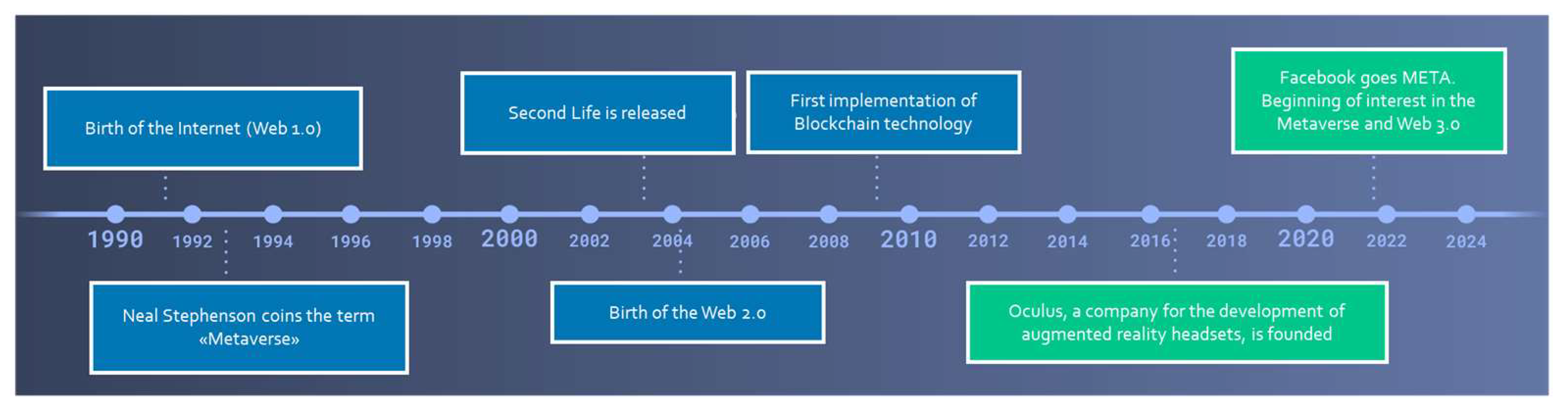
1.1. The Historical Origins of the Metaverse
1.2. Technologies behind the Metaverse
1.3. Exploring the Potential of the Metaverse
1.4. Motivation of the Study and Research Gap
1.5. Research Structure
2. Materials and Methods
2.1. Phase#1: Research Question (RQ)
2.2. Phase#2: Database Searching Identification (DB)
2.3. Phase#3: Eligibility Criteria Definition (EC)
2.4. Phase#4: Quality Criteria
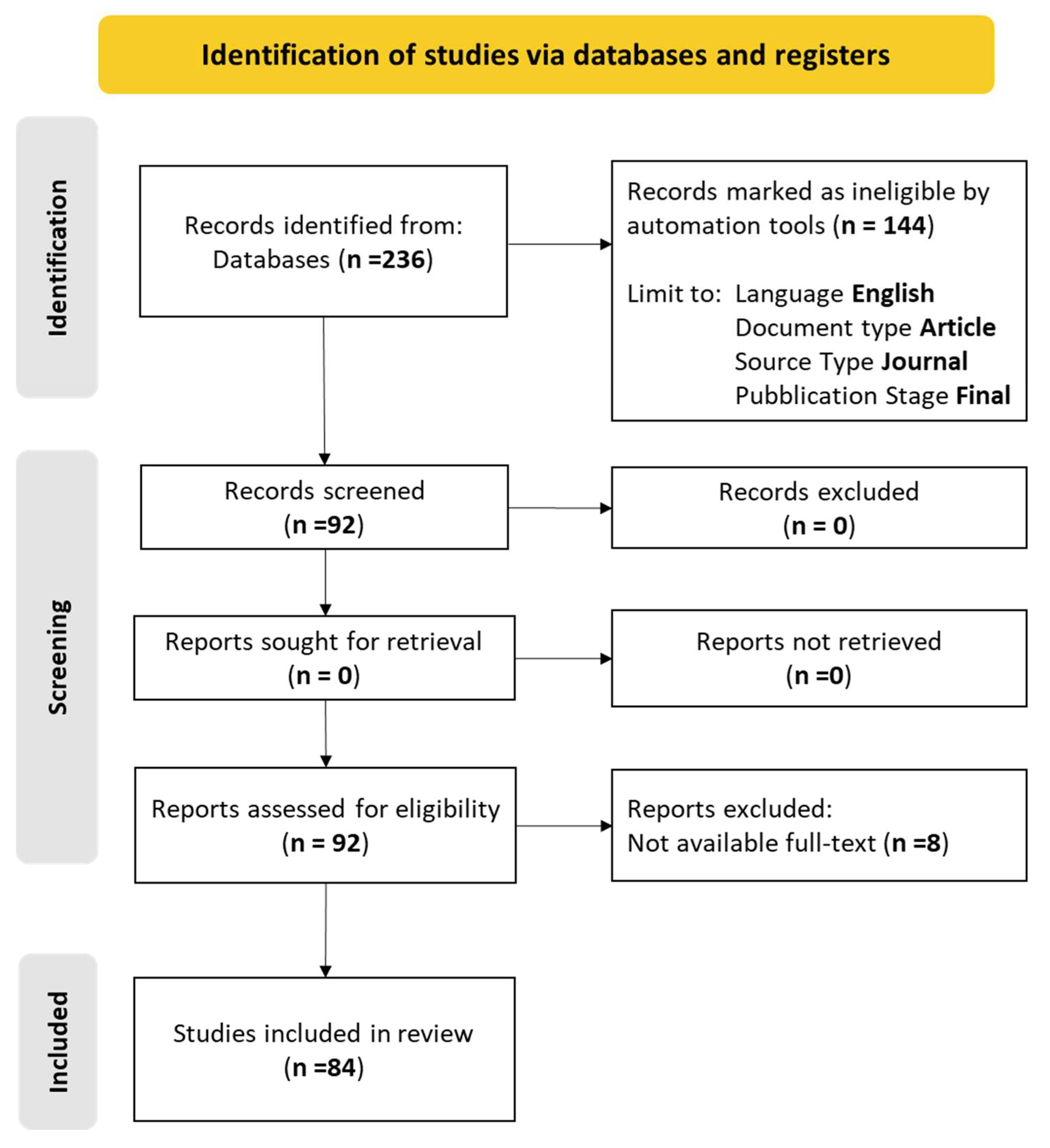
2.5. Phase#5: Screening and Data Extraction (SD)
3. Results of Systematic Literature Review
3.1. Publication by Years and by Source
3.2. Country Analysis
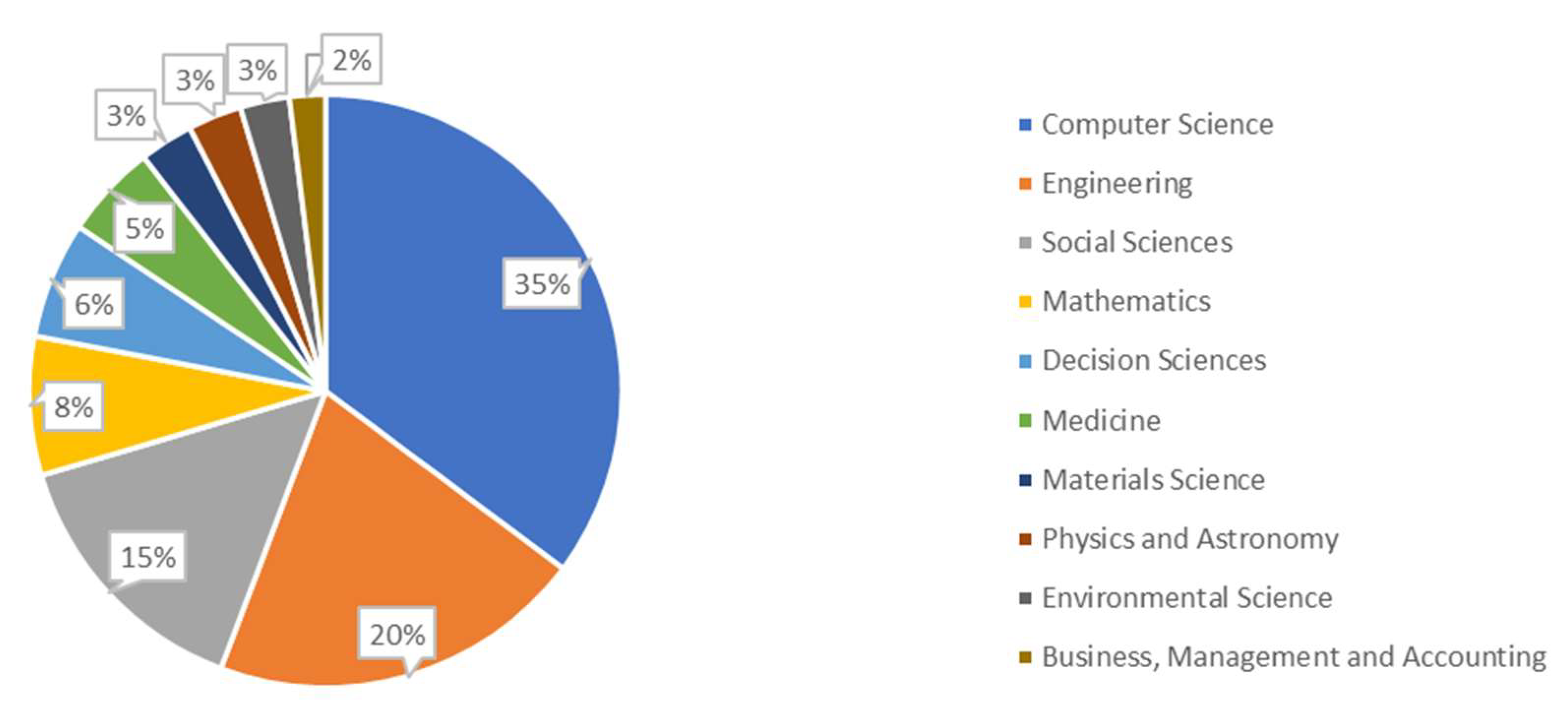
3.3. Subject Area
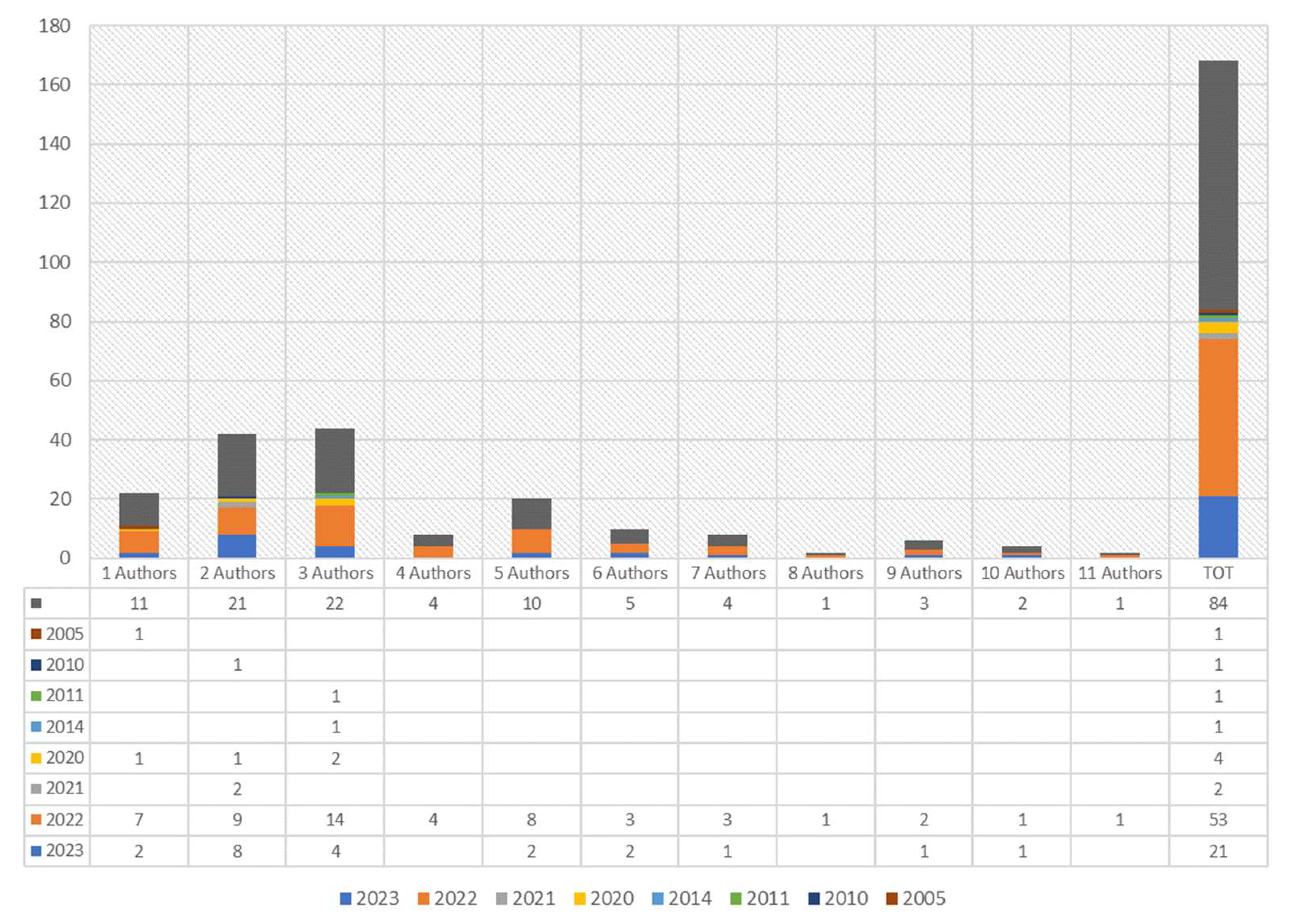
3.4. Most Collaborative Authors
3.5. Most Cited Documents
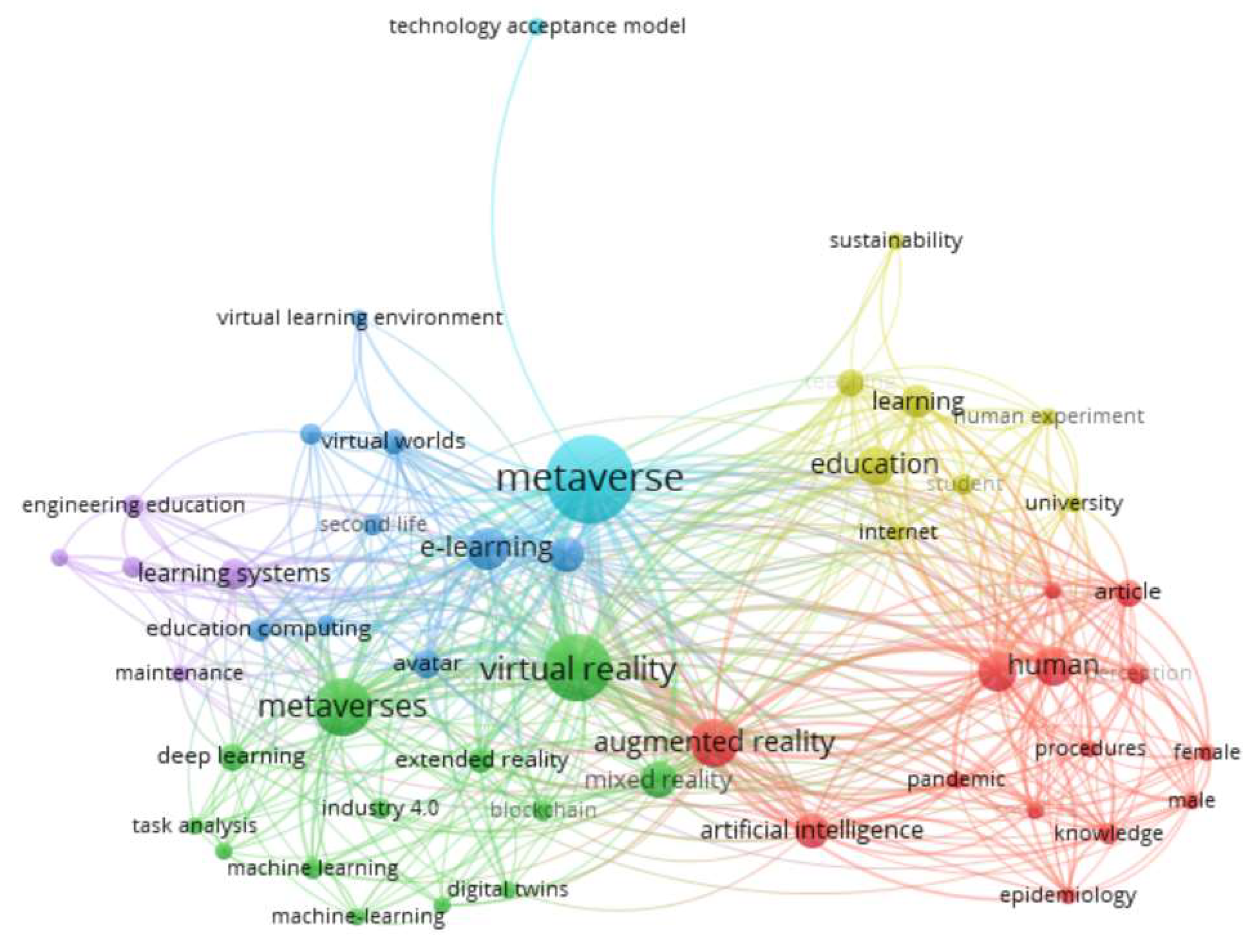
4. Mapping of Research Trends through Nvivo and VOSviewer Analysis
4.1. Red Cluster “Knowledge”
4.2. Green Cluster “Technologies”
4.3. Blue Cluster “Platform”
4.4. Yellow Cluster “Academic”
4.5. Purple Cluster “Ecosystems”
5. Discussion
5.1. RQ1: What Platforms Are Used to Access the Metaverse?
5.2. RQ2: Who Are the Main Users?
5.3. RQ3: What Are the Main Technologies Integrated into the Metaverse?
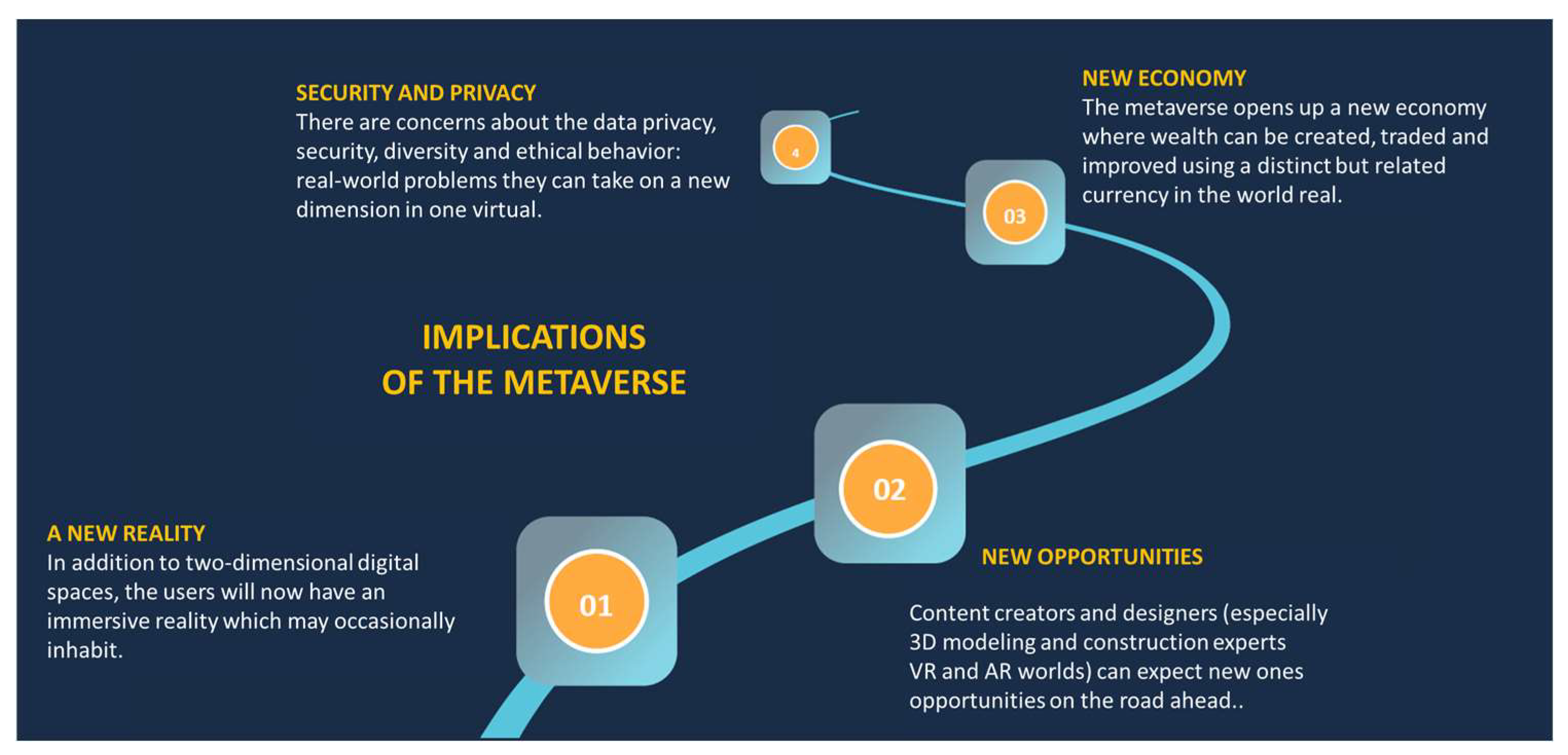
5.4. RQ4: What Are the Social and Ethical Implications of the Metaverse?
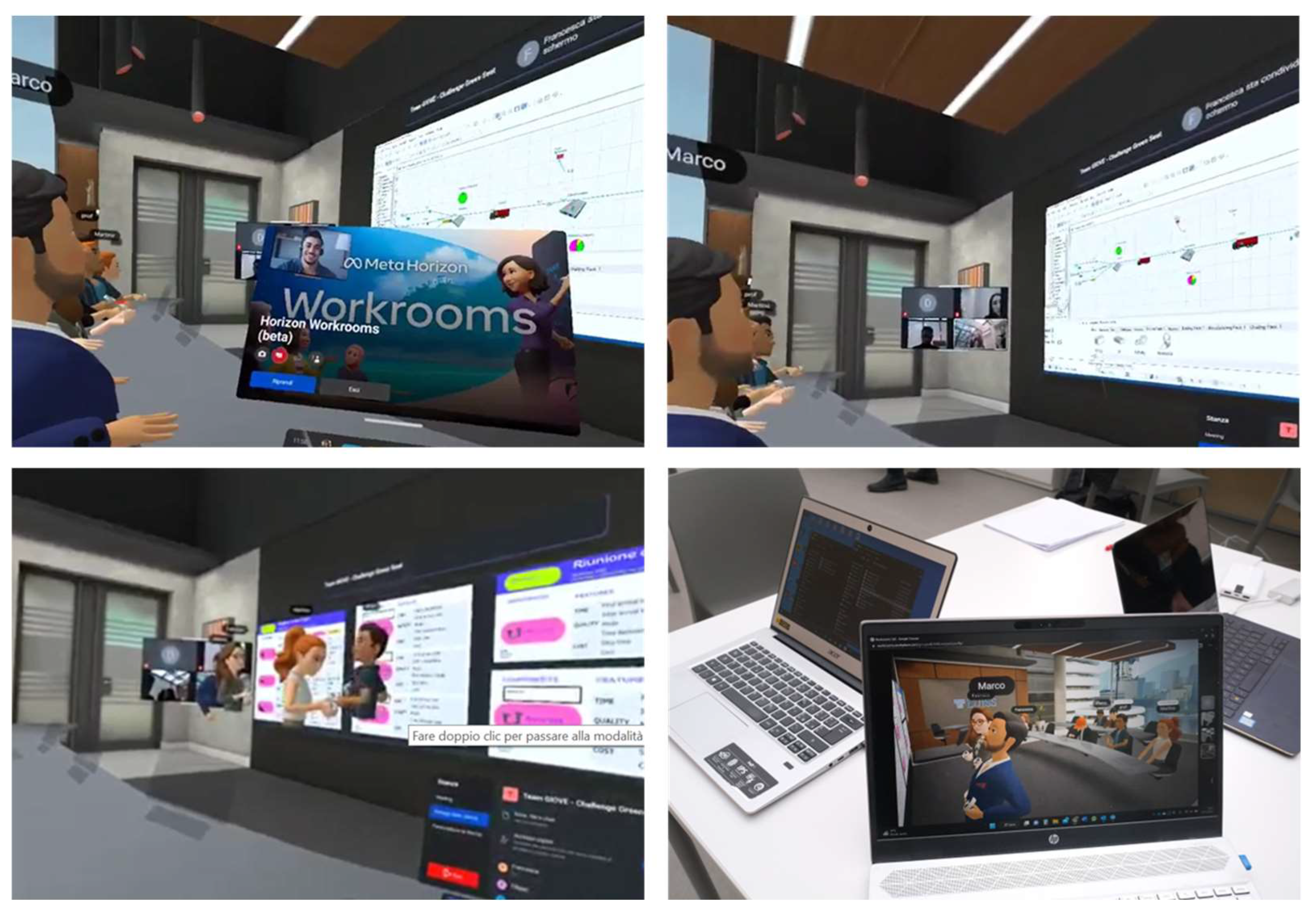
6. Main Challenges of Metaverse to Empower Work Environment
- ⋅ interoperable, thus ensuring the interconnection of data, objects, digital resources, and identities;
- ⋅ able to guarantee the ownership of the assets, i.e., that the user will be the owner of his/her digital assets;
- ⋅ modular, with the user being able to create assets and/or customize the space;
- ⋅ freely accessible, with users being able to join the metaverse by participating in specific events, places, and activities at the same time;
- ⋅ representative, with the possibility for users to be represented through the creation of customizable avatars;
- ⋅ persistent, i.e., continuing to exist indefinitely and independently of the presence or absence of a subject;
- ⋅ immersive, i.e., able to provide an experience that combines the real world and the virtual world, providing creative and customization tools.
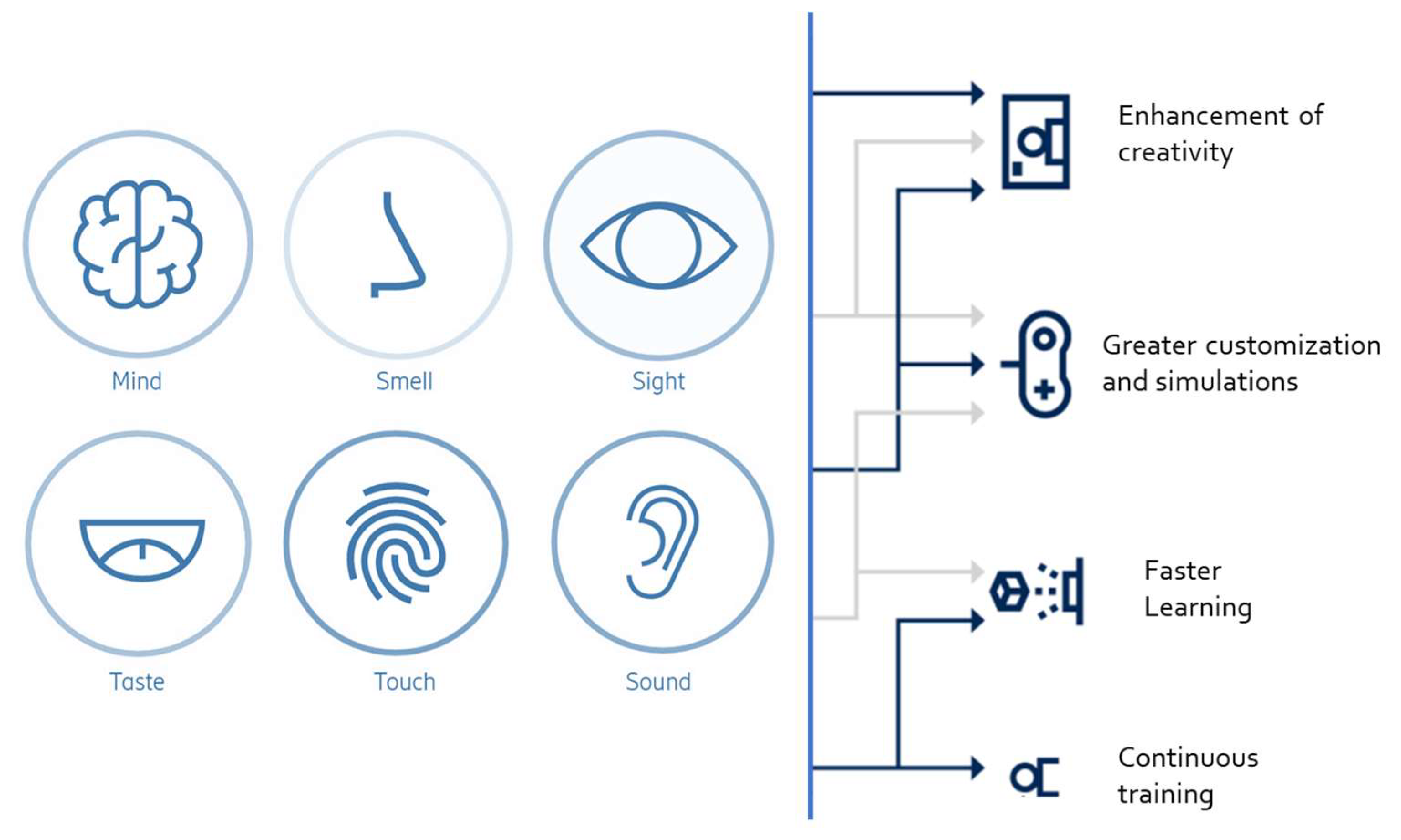
- ⋅ Enhancement of creativity, enhanced by the use of new technologies, their interaction, and the shared context.
- ⋅ Greater customization and simulations tailored to the individual user.
- ⋅ Faster learning, four times higher than traditional training and two times higher than a “simple” e-learning course.
- ⋅ Strengthening of continuous training, which becomes more flexible and engaging thanks to the possibility of lowering the various modules into tangible and recognizable situations.
7. Conclusions
7.1. Concluding Remarks
7.2. Limitations and Future Research Developments
Supplementary Materials
Author Contributions
Funding
Institutional Review Board Statement
Informed Consent Statement
Data Availability Statement
Conflicts of Interest
References
- Kim, J. Advertising in the metaverse: Research agenda. J. Interact. Advert. 2021, 21, 141–144. [Google Scholar] [CrossRef]
- Song, S.W.; Chung, D.H. Explication, and rational conceptualization of metaverse. Informatiz. Policy 2021, 28, 3–22. [Google Scholar]
- Stephenson, N. Snow crash: Un romanzo. In Snow Crash; Spectra: New York, NY, USA, 1992; p. 440. ISBN 0-553-08853-X. [Google Scholar]
- Sra, M.; Danry, V.; Maes, P. Situated VR: Toward a Congruent Hybrid Reality Without Experiential Artifacts. IEEE Comput. Graph. Appl. 2022, 42, 7–18. [Google Scholar] [CrossRef] [PubMed]
- Dear, K. Beyond the ‘geo’in geopolitics: The digital transformation of power. RUSI J. 2022, 166, 20–31. [Google Scholar] [CrossRef]
- Ahn, S.J.; Kim, J.; Kim, J. The bifold triadic relationships framework: A theoretical primer for advertising research in the metaverse. J. Advert. 2022, 51, 592–607. [Google Scholar] [CrossRef]
- Kemec, A. From reality to virtuality: Re discussing cities with the concept of the metaverse. Int. J. Manag. Account. 2022, 4, 12–20. [Google Scholar]
- Cammack, R.G. Location based service use: A metaverse investigation. J. Locat. Based Serv. 2010, 4, 53–65. [Google Scholar] [CrossRef]
- Kemp, J.; Livingstone, D. Putting a Second Life “metaverse” skin on learning management systems. In Proceedings of the Second Life education Workshop at the Second Life Community Convention, San Francisco, CA, USA, 20 August 2006; Volume 20. [Google Scholar]
- Ludlow, P.; Wallace, M. The Second Life Herald: The Virtual Tabloid that Witnessed the Dawn of the Metaverse; MIT Press: Cambridge, MA, USA, 2007. [Google Scholar]
- Fernandez, P. Facebook, Meta, the metaverse and libraries. Libr. Hi-Tech. News 2022, 39, 1–5. [Google Scholar] [CrossRef]
- Allam, Z.; Sharifi, A.; Bibri, S.E.; Jones, D.S.; Krogstie, J. The metaverse as a virtual form of smart cities: Opportunities and challenges for environmental, economic, and social sustainability in urban futures. Smart Cities 2022, 5, 771–801. [Google Scholar] [CrossRef]
- Dwivedi, Y.K.; Hughes, L.; Baabdullah, A.M.; Ribeiro Navarrete, S.; Giannakis, M.; Al Debei, M.M.; Wamba, S.F. Metaverse beyond the hype: Multidisciplinary perspectives on emerging challenges, opportunities, and agenda for research, practice and policy. Int. J. Inf. Manag. 2022, 66, 102542. [Google Scholar] [CrossRef]
- Nevelsteen, K.J. Virtual world, defined from a technological perspective and applied to video games, mixed reality, and the Metaverse. Comput. Animat. Virtual Worlds 2018, 29, e1752. [Google Scholar] [CrossRef]
- Mourtzis, D.; Panopoulos, N.; Angelopoulos, J.; Wang, B.; Wang, L. Human centric platforms for personalized value creation in metaverse. J. Manuf. Syst. 2022, 65, 653–659. [Google Scholar] [CrossRef]
- Lee, L.H.; Braud, T.; Zhou, P.; Wang, L.; Xu, D.; Lin, Z.; Hui, P. All one needs to know about metaverse: A complete survey on technological singularity, virtual ecosystem, and research agenda. arXiv 2021, arXiv:2110.05352. [Google Scholar]
- Hwang, G.J.; Chien, S.Y. Definition, roles, and potential research issues of the metaverse in education: An artificial intelligence perspective. Comput. Educ. Artif. Intell. 2022, 3, 100082. [Google Scholar] [CrossRef]
- Jayawardena, N.S.; Thaichon, P.; Quach, S.; Razzaq, A.; Behl, A. The persuasion effects of virtual reality (VR) and augmented reality (AR) video advertisements: A conceptual review. J. Bus. Res. 2023, 160, 113739. [Google Scholar] [CrossRef]
- Hannan, A.; Hussain, A.; Tab, M.A. Towards a more general theory of blockchain technology adoption–Investigating the role of mass media, social media and technophilia. Technol. Soc. 2023, 73, 102225. [Google Scholar] [CrossRef]
- Song, Y.; Chen, Y.; Yu, Z.; Huang, S.; Shen, C. CloudPSS: A high performance power system simulator based on cloud computing. Energy Rep. 2020, 6, 1611–1618. [Google Scholar] [CrossRef]
- McKinnel, D.R.; Dargahi, T.; Dehghantanha, A.; Choo, K.K.; Robinson, A. A systematic literature review and meta analysis on artificial intelligence in penetration testing and vulnerability assessment. Comput. Electr. Eng. 2019, 75, 175–188. [Google Scholar] [CrossRef]
- Wu, T.C.; Ho, C.T.B. A scoping review of metaverse in emergency medicine. Australas. Emerg. Care 2022, 26, 75–83. [Google Scholar] [CrossRef]
- Yang, D.; Zhou, J.; Song, Y.; Sun, M.; Bai, C. Metaverse in medicine. Clin. eHealth 2022, 5, 39–43. [Google Scholar] [CrossRef]
- Michalikova, K.F.; Suler, P.; Robinson, R. Virtual Hiring and Training Processes in the Metaverse: Remote Work Apps, Sensory Algorithmic Devices, and Decision Intelligence and Modeling. Psychosociol. Issues Hum. Resour. Manag. 2022, 10, 50–63. [Google Scholar]
- Hyun, J.J. A study on education utilizing metaverse for effective communication in a convergence subject. Int. J. Internet Broadcast. Commun. 2021, 13, 129–134. [Google Scholar]
- Jaung, W. Digital forest recreation in the metaverse: Opportunities and challenges. Technol. Forecast. Soc. Chang. 2022, 185, 122090. [Google Scholar] [CrossRef]
- Hennig Thurau, T.; Aliman, D.N.; Herting, A.M.; Cziehso, G.P.; Linder, M.; Kübler, R.V. Social interactions in the metaverse: Framework, initial evidence, and research roadmap. J. Acad. Mark. Sci. 2022, 1, 1–25. [Google Scholar] [CrossRef]
- Kitchenham, B. Procedures for Performing Systematic Reviews; Technical Report TR/SE 0401; Keele University: Newcastle, UK, 2004. [Google Scholar]
- Abrar, M.F.; Khan, M.S.; Ali, S.; Ali, U.; Majeed, M.F.; Ali, A.; Rasheed, N. Motivators for large scale agile adoption from management perspective: A systematic literature review. IEEE Access. 2019, 7, 22660–22674. [Google Scholar] [CrossRef]
- Hinderks, A.; Mayo, F.J.D.; Thomaschewski, J.; Escalona, M.J. An SLR tool: Search process in practice: A tool to conduct and manage systematic literature review (SLR). In Proceedings of the ACM/IEEE 42nd International Conference on Software Engineering: Companion Proceedings, Seoul, Republic of Korea, 5–11 June 2020; pp. 81–84. [Google Scholar]
- van Dinter, R.; Tekinerdogan, B.; Catal, C. Automation of systematic literature reviews: A systematic literature review. Inf. Softw. Technol. 2021, 136, 106589. [Google Scholar] [CrossRef]
- Moher, D.; Liberati, A.; Tetzlaff, J.; Altman, D.G.; The PRISMA Group. Reprint—Preferred Reporting Items for Systematic Reviews and Meta Analyses: The PRISMA Statement. Phys. Ther. 2009, 89, 873–880. [Google Scholar] [CrossRef]
- Swygart Hobaugh, M. Bringing method to the madness: An example of integrating social science qualitative research methods into NVivo data analysis software training. IASSIST Q. 2019, 43, 1–16. [Google Scholar] [CrossRef]
- Nandiyanto, A.B.D.; Al Husaeni, D.F. A bibliometric analysis of materials research in Indonesian journal using VOSviewer. J. Eng. Res. 2021, 16, 37. [Google Scholar] [CrossRef]
- De Felice, F.; Baffo, I.; Petrillo, A. Critical Infrastructures Overview: Past, Present and Future. Sustainability 2022, 14, 2233. [Google Scholar] [CrossRef]
- Parmentola, A.; Petrillo, A.; Tutore, I.; De Felice, F. Is blockchain able to enhance environmental sustainability? A systematic review and research agenda from the perspective of Sustainable Development Goals (SDGs). Bus. Strategy Environ. 2022, 31, 194–217. [Google Scholar] [CrossRef]
- De Felice, F.; Petrillo, A. Green transition: The frontier of the digicircular economy evidenced from a systematic literature review. Sustainability 2021, 13, 11068. [Google Scholar] [CrossRef]
- Wang, J.; Kim, H.-S. Visualizing the Landscape of Home IoT Research: A Bibliometric Analysis Using VOSviewer. Sensors 2023, 23, 3086. [Google Scholar] [CrossRef] [PubMed]
- Kirby, A. Exploratory Bibliometrics: Using VOSviewer as a Preliminary Research Tool. Publications 2023, 11, 10. [Google Scholar] [CrossRef]
- Hou, Y.; Yu, Z. A Bibliometric Analysis of Synchronous Computer-Mediated Communication in Language Learning Using VOSviewer and CitNetExplorer. Educ. Sci. 2023, 13, 125. [Google Scholar] [CrossRef]
- Jia, C.; Mustafa, H. A Bibliometric Analysis and Review of Nudge Research Using VOSviewer. Behav. Sci. 2023, 13, 19. [Google Scholar] [CrossRef] [PubMed]
- Gu, J.; Wang, J.; Guo, X.; Liu, G.; Qin, S.; Bi, Z. A metaverse-based teaching building evacuation training system with deep reinforcement learning. IEEE Trans. Syst. Man. Cybern. Syst. 2023, 53, 2209–2219. [Google Scholar] [CrossRef]
- Hare, R.; Tang, Y. Hierarchical deep reinforcement learning with experience sharing for metaverse in education. IEEE Trans. Syst. Man. Cybern. Syst. 2023, 53, 2047–2055. [Google Scholar] [CrossRef]
- Zheng, W.; Yan, L.; Zhang, W.; Ouyang, L.; Wen, D. D→K→I: Data-knowledge-driven group intelligence framework for smart service in education metaverse. IEEE Trans. Syst. Man. Cybern. Syst. 2023, 53, 2056–2061. [Google Scholar] [CrossRef]
- Shu, X.; Gu, X. An empirical study of A smart education model enabled by the edu-metaverse to enhance better learning outcomes for students. Systems 2023, 11, 75. [Google Scholar] [CrossRef]
- Tran, N.C.; Wang, J.; Vu, T.H.; Tai, T.; Wang, J. Anti-aliasing convolution neural network of finger vein recognition for virtual reality (VR) human–robot equipment of metaverse. J. Supercomput. 2023, 79, 2767–2782. [Google Scholar] [CrossRef] [PubMed]
- Guo, B. Highlighting effects of flipped learning on mental health through metaverse: Moderating impact of e-learning and cyber resilience. Am. J. Health Behav. 2022, 46, 683–694. [Google Scholar] [CrossRef]
- Gattullo, M.; Laviola, E.; Evangelista, A.; Fiorentino, M.; Uva, A.E. Towards the evaluation of augmented reality in the metaverse: Information presentation modes. Appl. Sci. 2022, 12, 12600. [Google Scholar] [CrossRef]
- Sunardi, R.A.; Abdurachman, E.; Trisetyarso, A.; Zarlis, M. Acceptance of augmented reality in video conference based learning during COVID-19 pandemic in higher education. Bull. Electr. Eng. Inform. 2022, 11, 3598–3608. [Google Scholar] [CrossRef]
- Park, J.; Lee, K.; Chung, D.R. Public interest in the digital transformation accelerated by the COVID-19 pandemic and perception of its future impact. Korean J. Intern. Med. 2022, 37, 1223–1233. [Google Scholar] [CrossRef]
- Dou, W.; Tian, Y.; Ye, G.; Zhu, J. Antenna artificial intelligence: The relentless pursuit of intelligent antenna design [industry activities]. IEEE Antennas Propag. Mag. 2022, 64, 128–130. [Google Scholar] [CrossRef]
- Yong, Y.J.; Lee, J.H.; Kim, Y.S. A study on the possibility of a change in culture and arts education curriculum by shooting “METACLASSROOM” in the COIVD19 pandemic era. Cypriot J. Edu Sci. 2022, 17, 1603–1621. [Google Scholar]
- Suh, W.; Ahn, S. Utilizing the metaverse for learner-centered constructivist education in the post-pandemic era: An analysis of elementary school students. J. Intell. 2022, 10, 17. [Google Scholar] [CrossRef]
- Ng, D.T.K. What is the metaverse? definitions, technologies and the community of inquiry. Australas. J. Educ. Technol. 2022, 38, 190–205. [Google Scholar] [CrossRef]
- Alsaleh, S.; Tepljakov, A.; Kose, A.; Belikov, J.; Petlenkov, E. ReImagine lab: Bridging the gap between hands-on, virtual and remote control engineering laboratories using digital twins and extended reality. IEEE Access. 2022, 10, 89924–89943. [Google Scholar] [CrossRef]
- Lee, S.H.; Lee, H.; Kim, J.H. Enhancing the prediction of user satisfaction with metaverse service through machine learning. Comput. Mater. Continua 2022, 72, 4983–4997. [Google Scholar]
- Akour, I.A.; Al-Maroof, R.S.; Alfaisal, R.; Salloum, S.A. A conceptual framework for determining metaverse adoption in higher institutions of gulf area: An empirical study using hybrid SEM-ANN approach. Comput. Educ. 2022, 3, 201. [Google Scholar] [CrossRef]
- Siyaev, A.; Jo, G. Towards aircraft maintenance metaverse using speech interactions with virtual objects in mixed reality. Sensors 2021, 21, 2066. [Google Scholar] [CrossRef]
- Siyaev, A.; Jo, G. Neuro-symbolic speech understanding in aircraft maintenance metaverse. IEEE Access. 2021, 9, 154484–154499. [Google Scholar] [CrossRef]
- Belei, N.; Noteborn, G.; De Ruyter, K. It’s a brand new world: Teaching brand management in virtual environments. J. Brand. Manag. 2011, 18, 611–623. [Google Scholar] [CrossRef]
- Bhattacharya, P.; Saraswat, D.; Savaliya, D.; Sanghavi, S.; Verma, A.; Sakariya, V.; Tanwar, S.; Sharma, R.; Raboaca, M.S.; Manea, D.L. Towards future internet: The metaverse perspective for diverse industrial applications. Mathematics 2023, 11, 941. [Google Scholar] [CrossRef]
- Ricci, M.; Scarcelli, A.; Fiorentino, M. Designing for the metaverse: A multidisciplinary laboratory in the industrial design program. Future Internet 2023, 15, 69. [Google Scholar] [CrossRef]
- Kliestik, T.; Nagy, M.; Valaskova, K. Global value chains and industry 4.0 in the context of lean workplaces for enhancing company performance and its comprehension via the digital readiness and expertise of workforce in the V4 nations. Mathematics 2023, 11, 601. [Google Scholar] [CrossRef]
- Tlili, A.; Huang, R.K. Metaverse for climbing the ladder toward ‘Industry 5.0’ and ‘Society 5.0’? Serv. Ind. J. 2023, 43, 260–287. [Google Scholar] [CrossRef]
- Wu, C.; Liu, C. Educational applications of non-fungible token (NFT). Sustainability 2023, 15, 7. [Google Scholar] [CrossRef]
- Penaherrera-Pulla, O.S.; Baena, C.; Fortes, S.; Baena, E.; Barco, R. KQI assessment of VR services: A case study on 360-video over 4G and 5G. IEEE Trans. Netw. Serv. Manag. 2022, 19, 5366–5382. [Google Scholar] [CrossRef]
- Crolla, K.; Goepel, G. Entering hyper-reality: “Resonance-in-sight, ” a mixed-reality art installation. Front. Virtual Real. 2022, 3, 24. [Google Scholar] [CrossRef]
- Pregowska, A.; Osial, M.; Dolega-Dolegowski, D.; Kolecki, R.; Proniewska, K. Information and communication technologies combined with mixed reality as supporting tools in medical education. Electronics 2022, 11, 3778. [Google Scholar] [CrossRef]
- Hyun, J.; Choi, H.; Kim, J. Deriving improvement plans through metaverse technology and implications. Int. J. Intel. Syst. Appl. Eng. 2022, 10, 197–204. [Google Scholar]
- Alpala, L.O.; Quiroga-Parra, D.J.; Torres, J.C.; Peluffo-Ordóñez, D.H. Smart factory using virtual reality and online multi-user: Towards a metaverse for experimental frameworks. Appl. Sci. 2022, 12, 6258. [Google Scholar] [CrossRef]
- Lee, H.; Woo, D.; Yu, S. Virtual reality metaverse system supplementing remote education methods: Based on aircraft maintenance simulation. Appl. Sci. 2022, 12, 2667. [Google Scholar] [CrossRef]
- Ryu, J.; Son, S.; Lee, J.; Park, Y.; Park, Y. Design of secure mutual authentication scheme for metaverse environments using blockchain. IEEE Access 2022, 10, 98944–98958. [Google Scholar] [CrossRef]
- Estudante, A.; Dietrich, N. Using augmented reality to stimulate students and diffuse escape game activities to larger audiences. J. Chem. Educ. 2020, 97, 1368–1374. [Google Scholar] [CrossRef]
- Díaz, J.E.M. Virtual world as a complement to hybrid and mobile learning. Int. J. Emerg. Technol. Learn. 2020, 15, 267–274. [Google Scholar] [CrossRef]
- AbuKhousa, E.; El-Tahawy, M.S.; Atif, Y. Envisioning architecture of metaverse intensive learning experience (MiLEx): Career readiness in the 21st century and collective intelligence development scenario. Future Internet 2023, 15, 53. [Google Scholar] [CrossRef]
- Hwang, S.; Koo, G. Art marketing in the metaverse world: Evidence from south korea. Cogent Soc. Sci. 2023, 9, 5429. [Google Scholar] [CrossRef]
- Yang, S.; Kang, M. Efficacy testing of a multi-access metaverse-based early onset schizophrenia nursing simulation program: A quasi-experimental study. Int. J. Environ. Res. Public. Health 2023, 20, 449. [Google Scholar] [CrossRef]
- Wang, G.; Shin, C. Influencing factors of usage intention of metaverse education application platform: Empirical evidence based on PPM and TAM models. Sustainability 2022, 14, 17037. [Google Scholar] [CrossRef]
- Sánchez-López, I.; Roig-Vila, R.; Pérez-Rodríguez, A. Metaverse and education: The pioneering case of minecraft in immersive digital learning. Prof. Inf. 2022, 31, 3145. [Google Scholar] [CrossRef]
- López-Belmonte, J.; Pozo-Sánchez, S.; Lampropoulos, G.; Moreno-Guerrero, A. Design and validation of a questionnaire for the evaluation of educational experiences in the metaverse in spanish students (METAEDU). Heliyon 2022, 8, e11364. [Google Scholar] [CrossRef]
- Lo, S.; Tsai, H. Design of 3D virtual reality in the metaverse for environmental conservation education based on cognitive theory. Sensors 2022, 22, 8329. [Google Scholar] [CrossRef]
- Cortés Rodríguez, F.; Dal Peraro, M.; Abriata, L.A. Online tools to easily build virtual molecular models for display in augmented and virtual reality on the web. J. Mol. Graph. Model. 2022, 114, 442. [Google Scholar] [CrossRef]
- Dahan, N.A.; Al-Razgan, M.; Al-Laith, A.; Alsoufi, M.A.; Al-Asaly, M.S.; Alfakih, T. Metaverse framework: A case study on E-learning environment (ELEM). Electronics 2022, 11, 1616. [Google Scholar] [CrossRef]
- Jovanović, A.; Milosavljević, A. VoRtex metaverse platform for gamified collaborative learning. Electronics 2022, 11, 317. [Google Scholar] [CrossRef]
- Kang, D.; Choi, H.; Nam, S. Learning cultural spaces: A collaborative creation of a virtual art museum using roblox. Int. J. Emerg. Technol. Learn. 2022, 17, 232–245. [Google Scholar] [CrossRef]
- Lee, J. A study on the intention and experience of using the metaverse. JAHR 2022, 13, 177–192. [Google Scholar] [CrossRef]
- Teng, Z.; Cai, Y.; Gao, Y.; Zhang, X.; Li, X. Factors affecting learners’ adoption of an educational metaverse platform: An empirical study based on an extended UTAUT model. Mob. Inf. Sys 2022, 2022. [Google Scholar] [CrossRef]
- Afshar, S.V.; Eshaghi, S.; Kim, I. Pattern analysis of virtual landscape within educational games. J. Digital Landsc. Arch. 2022, 2022, 435–442. [Google Scholar]
- Manna, M. Teachers as augmented reality designers: A study on italian as a foreign language teacher perceptions. Int. J. Mob. Blended Learn. 2023, 15. [Google Scholar] [CrossRef]
- Jiao, B.; Li, M. Metaverse inspired VR visualization model of italian design education. Comput.-Aided Des. Appl. 2023, 20 (Suppl. S7), 164–174. [Google Scholar] [CrossRef]
- Battal, A.; Taşdelen, A. The use of virtual worlds in the field of education: A bibliometric study. Particip. Educ. Res. 2023, 10, 408–423. [Google Scholar] [CrossRef]
- Iwanaga, J.; Muo, E.C.; Tabira, Y.; Watanabe, K.; Tubbs, S.J.; D’Antoni, A.V.; Rajaram-Gilkes, M.; Loukas, M.; Khalil, M.K.; Tubbs, R.S. Who really needs a metaverse in anatomy education? A review with preliminary survey results. Clin. Anat. 2023, 36, 77–82. [Google Scholar] [CrossRef]
- Sghaier, S.; Elfakki, A.O.; Alotaibi, A.A. Development of an intelligent system based on metaverse learning for students with disabilities. Front. Robot. AI 2022, 9, 6921. [Google Scholar] [CrossRef]
- Wang, X.; Zhu, Y.; Zhang, Y. An empirical study of college students’ reading engagement on academic achievement. Front. Psychol. 2022, 13, 5754. [Google Scholar] [CrossRef]
- Kshetri, N.; Rojas-Torres, D.; Grambo, M. The metaverse and higher education institutions. IT Prof. 2022, 24, 69–73. [Google Scholar] [CrossRef]
- Sofianidis, A. Why do students prefer augmented reality: A mixed-method study on preschool teacher students’ perceptions on self-assessment AR quizzes in science education. Educ. Sci. 2022, 12, 329. [Google Scholar] [CrossRef]
- Lee, H.J.; Hwang, Y. Technology-enhanced education through VR-making and metaverse-linking to foster teacher readiness and sustainable learning. Sustainability 2022, 14, 4786. [Google Scholar] [CrossRef]
- Guo, H.; Gao, W. Metaverse-powered experiential situational english-teaching design: An emotion-based analysis method. Front. Psychol. 2022, 13, 9159. [Google Scholar] [CrossRef] [PubMed]
- Bhavana, S.; Vijayalakshmi, V. AI-based metaverse technologies advancement impact on higher education learners. WSEAS Trans. Syst. 2022, 21, 178–184. [Google Scholar]
- Ge, J. Multiple influences of intelligent technology on network behavior of college students in the metaverse age. J. Environ. Public. Health 2022, 2022, 1–7. [Google Scholar] [CrossRef] [PubMed]
- Chang, H.; Chung, C.; Cheng, Y.; Lou, S. A study on the development and learning effectiveness evaluation of problem-based learning (PBL) virtual reality course based on intelligence network and situational learning. J. Netw. Intell. 2022, 7, 1–20. [Google Scholar]
- Nurhidayah, N.N.; Halim, N.; Basri, M. Analyzing Student’s learning outcome using systemic approach. Asian EFL J. 2020, 27, 230–247. [Google Scholar]
- Díaz, J.E.M.; Saldaña, C.A.M.; Avila, C.A.R. Virtual world as a resource for hybrid education. Int. J. Emerg. Technol. Learn. 2020, 15, 94–109. [Google Scholar] [CrossRef]
- López-Ojeda, W.; Hurley, R.A. The medical metaverse, part 1: Introduction, definitions, and new horizons for neuropsychiatry. J. Neuropsychiatry Clin. Neurosci. 2023, 35, A4-3. [Google Scholar] [CrossRef]
- Li, K.; Cui, Y.; Li, W.; Lv, T.; Yuan, X.; Li, S.; Ni, W.; Simsek, M.; Dressler, F. When internet of things meets metaverse: Convergence of physical and cyber worlds. IEEE Internet Things J. 2023, 10, 4148–4173. [Google Scholar] [CrossRef]
- Hwang, Y. When makers meet the metaverse: Effects of creating NFT metaverse exhibition in maker education. Comput. Educ. 2023, 194, 104693. [Google Scholar] [CrossRef]
- Koohsari, M.J.; McCormack, G.R.; Nakaya, T.; Yasunaga, A.; Fuller, D.; Nagai, Y.; Oka, K. The metaverse, the built environment, and public health: Opportunities and uncertainties. J. Med. Internet Res. 2023, 25, e43549. [Google Scholar] [CrossRef] [PubMed]
- Yang, D.; Zhou, J.; Chen, R.; Song, Y.; Song, Z.; Zhang, X.; Wang, Q.; Wang, K.; Zhou, C.; Sun, J.; et al. Expert consensus on the metaverse in medicine. Clin. eHealth 2022, 5, 1–9. [Google Scholar] [CrossRef]
- Mahmudiono, T.; Rachmah, Q.; Indriani, D.; Permatasari, E.A.; Hera, N.A.; Chen, H. Food and beverage consumption habits through the perception of health belief model (grab food or go food) in surabaya and pasuruan. Nutrients 2022, 14, 4482. [Google Scholar] [CrossRef]
- Ramesh, P.; Joshua, T.; Ray, P.; Devadas, A.; Raj, P.; Ramesh, S.; Ramesh, M.; Rajasekaran, R. Holographic elysium of a 4D ophthalmic anatomical and pathological metaverse with extended reality/mixed reality. Indian. J. Ophthalmol. 2022, 70, 3116–3121. [Google Scholar] [CrossRef]
- Hutson, J. Social virtual reality: Neurodivergence and inclusivity in the metaverse. Societies 2022, 12, 102. [Google Scholar] [CrossRef]
- Lee, J.; Lee, T.S.; Lee, S.; Jang, J.; Yoo, S.; Choi, Y.; Park, Y.R. Development and application of a metaverse-based social skills training program for children with autism spectrum disorder to improve social interaction: Protocol for a randomized controlled trial. JMIR Res. Prot. 2022, 11, e35960. [Google Scholar] [CrossRef]
- Zhao, J.; Lu, Y.; Zhou, F.; Mao, R.; Fei, F. Systematic bibliometric analysis of research hotspots and trends on the application of virtual reality in nursing. Front. Public. Health 2022, 10, 6715. [Google Scholar] [CrossRef]
- Tan, T.F.; Li, Y.; Lim, J.S.; Gunasekeran, D.V.; Teo, Z.L.; Ng, W.Y.; Ting, D.S.W. Metaverse and virtual health care in ophthalmology: Opportunities and challenges. Asia-Pacific J. Ophthalmol. 2022, 11, 237–246. [Google Scholar] [CrossRef]
- Gupta, R.; He, J.; Ranjan, R.; Gan, W.; Klein, F.; Schneiderwind, C.; Neidhardt, A.; Brandenburg, K.; Valimaki, V. Augmented/Mixed reality audio for hearables: Sensing, control, and rendering. IEEE Signal Process. Mag. 2022, 39, 63–89. [Google Scholar] [CrossRef]
- Park, S.; Kim, S. Identifying world types to deliver gameful experiences for sustainable learning in the metaverse. Sustainability 2022, 14, 1361. [Google Scholar] [CrossRef]
- Bansal, G.; Rajgopal, K.; Chamola, V.; Xiong, Z.; Niyato, D. Healthcare in metaverse: A survey on current metaverse applications in healthcare. IEEE Access 2022, 10, 119914–119946. [Google Scholar] [CrossRef]
- Zhou, B. Building a smart education ecosystem from a metaverse perspective. Mob. Inf. Syst. 2022, 2022, 1938329. [Google Scholar] [CrossRef]
- Alawadhi, M.; Alhumaid, K.; Almarzooqi, S.; Aljasmi, S.; Aburayya, A.; Salloum, S.A.; Almesmari, W. Factors affecting medical students’ acceptance of the metaverse system in medical training in the united arab emirates. South East Euro J. Publ. Health 2022, 19, 205. [Google Scholar]
- Almarzouqi, A.; Aburayya, A.; Salloum, S.A. Prediction of user’s intention to use metaverse system in medical education: A hybrid SEM-ML learning approach. IEEE Access 2022, 10, 43421–43434. [Google Scholar] [CrossRef]
- Masferrer, J.Á.R.; Sánchez, F.E.; Hernández, D.F. Experiences complementing classroom teaching with distance seminars in metaverses and videos. J. Cases Inf. Technol. 2014, 16, 1–12. [Google Scholar] [CrossRef]
- Brennen, B.; dela Cerna, E. Journalism in second life. J. Stud. 2010, 11, 546–554. [Google Scholar] [CrossRef]
- Au, W.J. Taking new world notes: An embedded journalist’s rough guide to reporting from inside the internet’s next evolution. First Monday 2005, 5, 1562. [Google Scholar] [CrossRef]
- Sestino, A.; D’Angelo, A. My doctor is an avatar! The effect of anthropomorphism and emotional receptivity on individuals’ intention to use digital-based healthcare services. Technol. Forecast. Soc. Chang. 2023, 191, 122505. [Google Scholar] [CrossRef]
- Liu, W.; Fu, Y.; Liu, Q. Metadata as a Methodological Commons: From Aboutness Description to Cognitive Modeling. Data Intell. 2023, 5, 289–302. [Google Scholar] [CrossRef]
- Buhalis, D.; Leung, D.; Lin, M. Metaverse as a disruptive technology revolutionising tourism management and marketing. Tour. Manag. 2023, 97, 104724. [Google Scholar] [CrossRef]

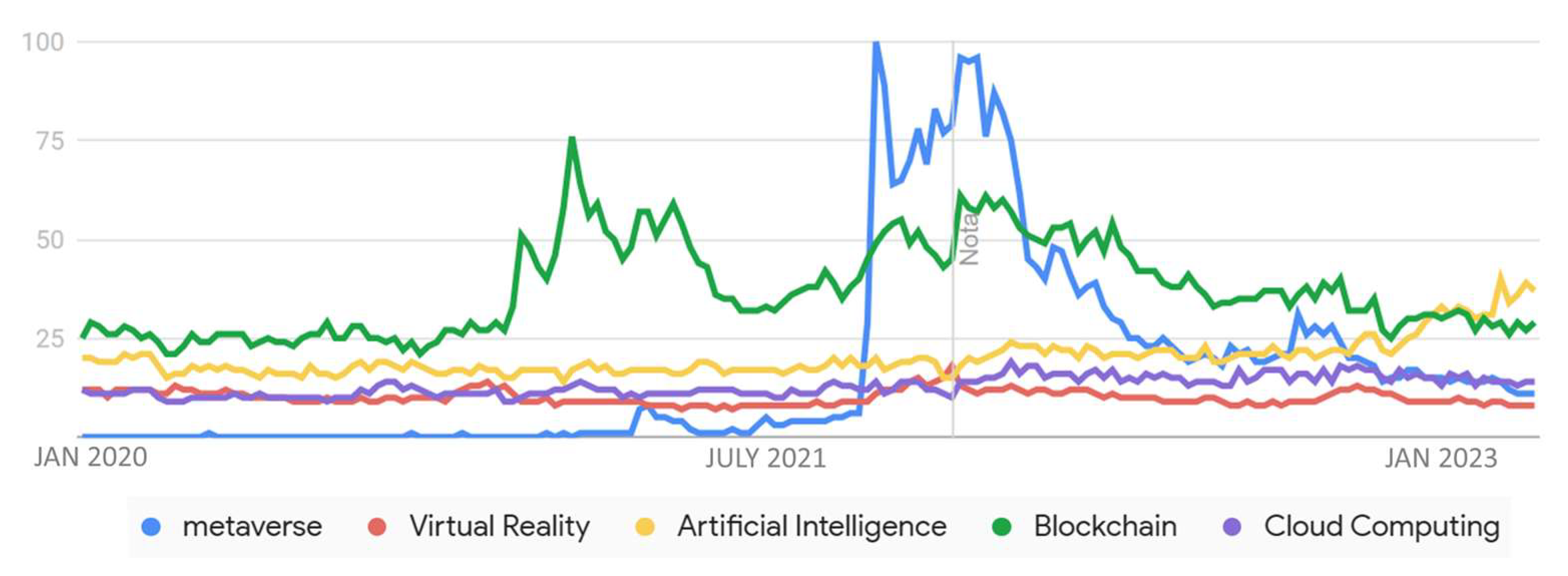
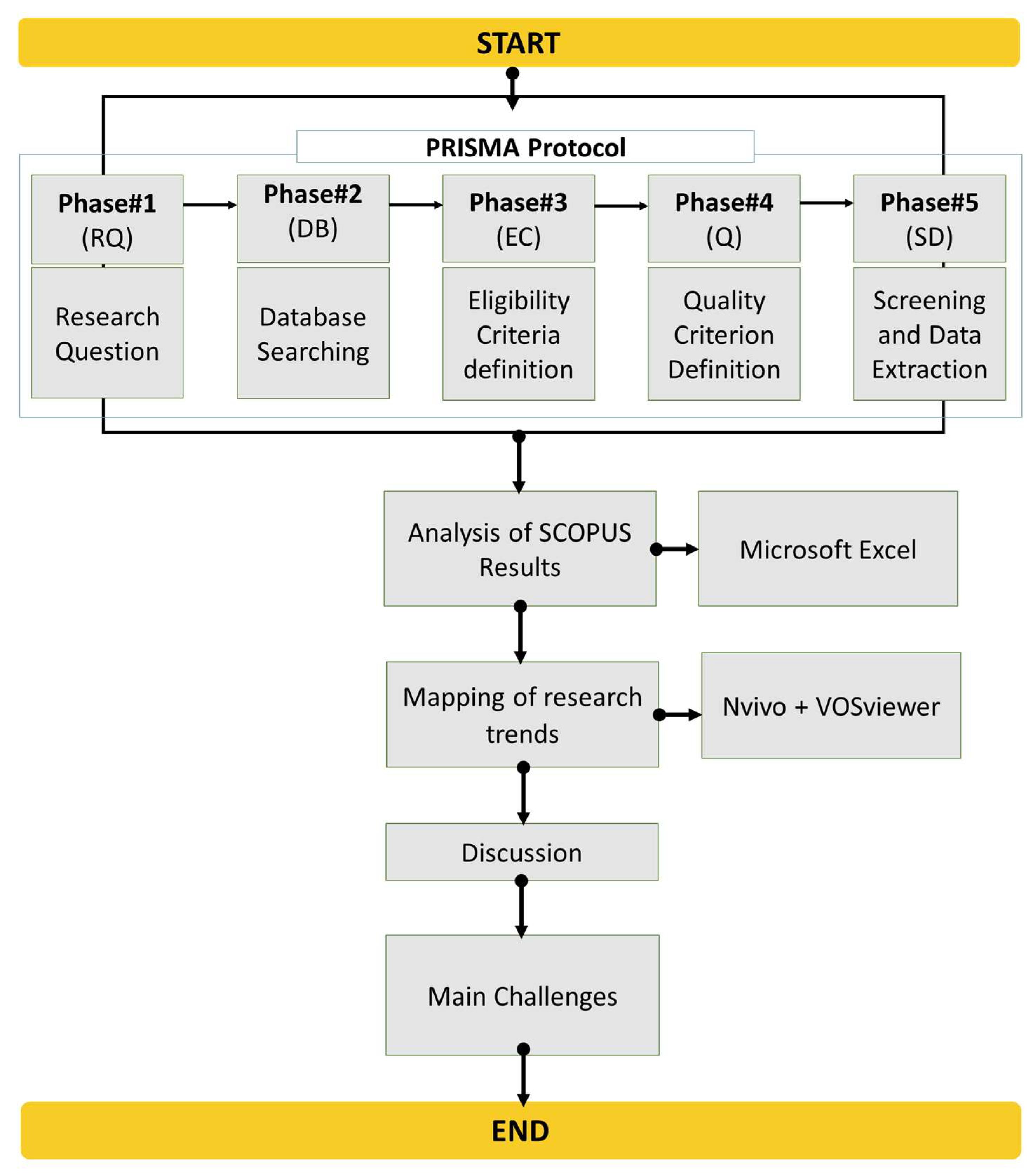

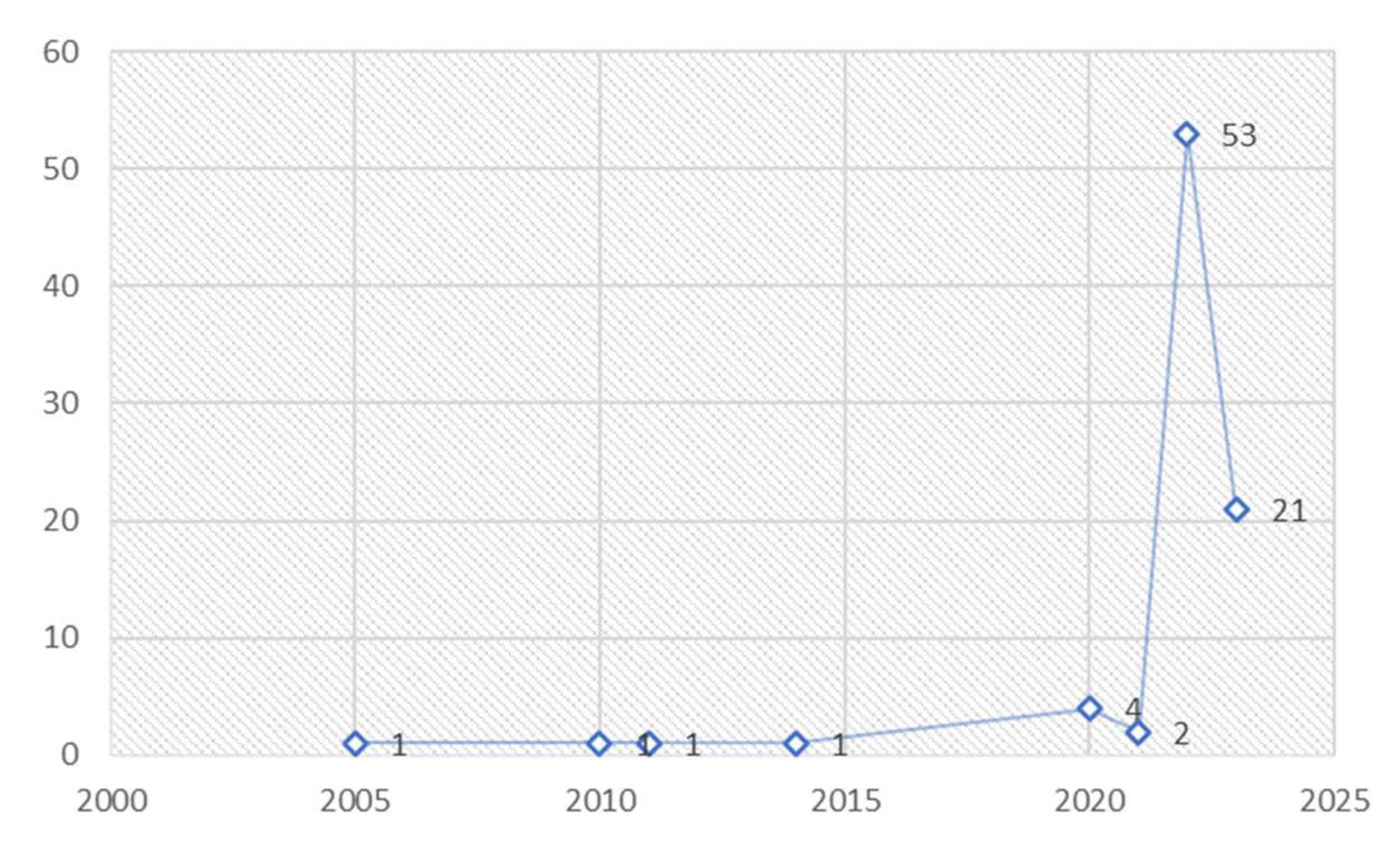
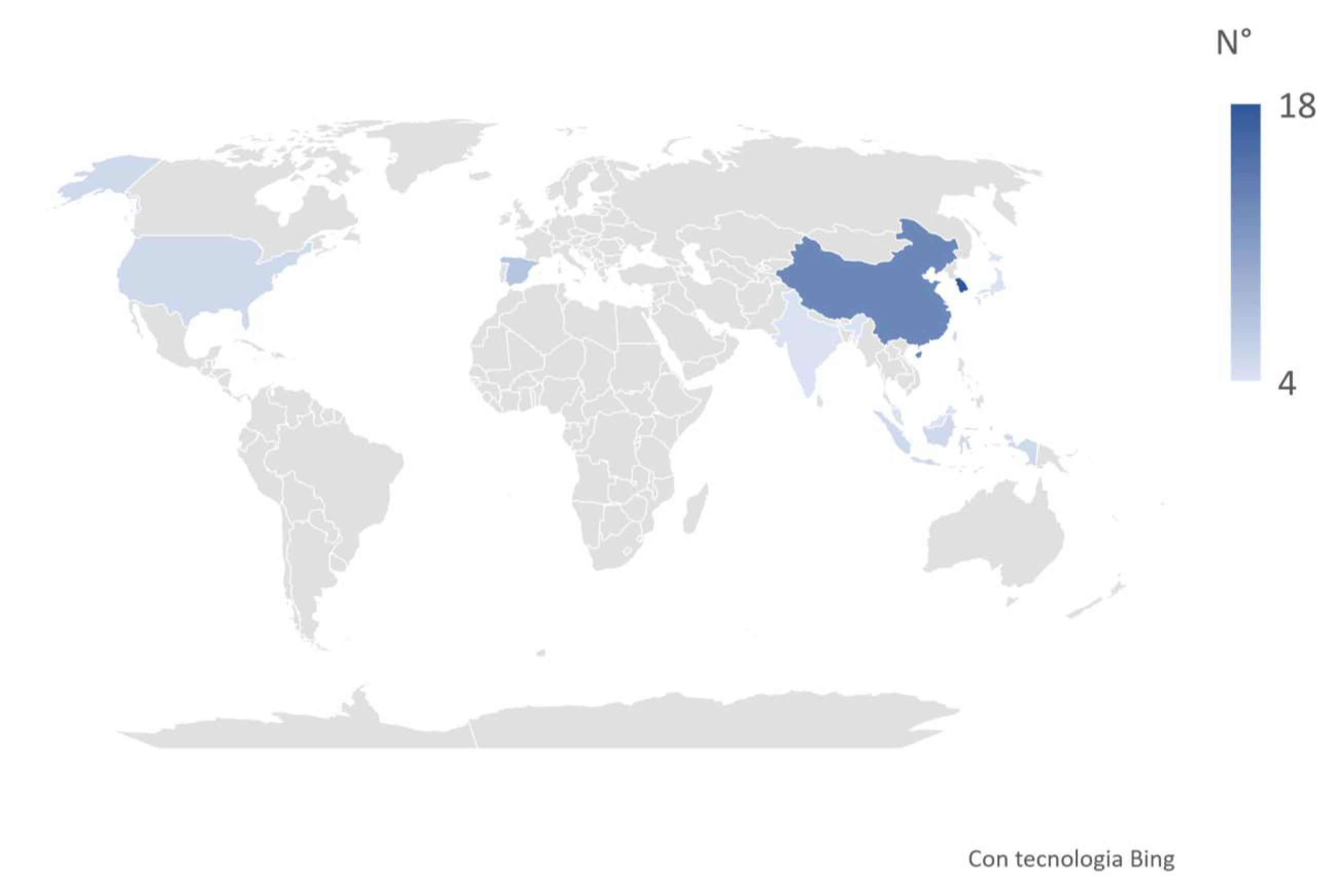



| Database Search Identification | |
|---|---|
| Keywords | Metaverse Education * |
| Boolean operator | AND |
| Time | 2005 2023 (until February) |
| Journal | Publisher | CiteScore 2021 1 | SJR 2021 2 | Percentile |
|---|---|---|---|---|
| IEEE Access | IEEE | 6.7 | 0.927 | 90th |
| Sustainability | MDPI | 5.0 | 0.664 | 86th |
| Electronics | MDPI | 3.7 | 0.590 | 60th |
| Applied Sciences | MDPI | 3.7 | 0.507 | 73rd |
| Heliyon | Elsevier | 4.0 | 0.550 | 82nd |
| Title | Year | Authors | Journal | N° of Citations |
|---|---|---|---|---|
| Metaverse beyond the hype: Multidisciplinary perspectives on emerging challenges, opportunities, and agenda for research, practice and policy | 2022 | Dwivedi et al. | International Journal of Information Management | 95 |
| Definition, roles, and potential research issues of the metaverse in education: An artificial intelligence perspective | 2022 | Hwang and Chien | Computers and Education: Artificial Intelligence | 51 |
| Virtual world as a resource for hybrid education | 2020 | Díaz et al. | International Journal of Emerging Technologies in Learning | 40 |
| Using Augmented Reality to Stimulate Students and Diffuse Escape Game Activities to Larger Audiences | 2020 | Estudante and Dietrich | Journal of Chemical Education | 39 |
| Towards aircraft maintenance metaverse using speech interactions with virtual objects in mixed reality | 2021 | Siyaev and Jo | Sensors | 38 |
| Title | Keywords | ||
|---|---|---|---|
| AR/VR | AI | I4.0 | |
| Metaverse beyond the hype: Multidisciplinary perspectives on emerging challenges, opportunities, and agenda for research, practice and policy | X | X | X |
| Definition, roles, and potential research issues of the metaverse in education: An artificial intelligence perspective | X | X | |
| Virtual world as a resource for hybrid education | X | ||
| Using Augmented Reality to Stimulate Students and Diffuse Escape Game Activities to Larger Audiences | X | X | |
| Towards aircraft maintenance metaverse using speech interactions with virtual objects in mixed reality | X | X |
| Cluster | Color | No. of Items | Cluster Label | Details Items (VOSviewer) | Main Authors (Author’s Own Elaboration) |
|---|---|---|---|---|---|
| Cluster 1 | Red | 14 | Knowledge | Artificial intelligence, augmented reality, knowledge, pandemic/COVID-19, human, procedures. | A2, A3, A4, A8, A13, A23, A25, A26, A37, A39, A48, A54, A59, A66, A70, A72, A74, A75, A76, A82 |
| Cluster 2 | Green | 13 | Technologies | Blockchain, deep learning, digital twins, extended reality, I4.0, IoT, machine learning. | A9, A11, A12, A15, A20, A27, A29, A33, A38, A44, A55, A62, A78, A79 |
| Cluster 3 | Blue | 9 | Platform | Avatar, e-learning, educations, training, platforms, virtual worlds, virtual learning environment. | A10, A16, A19,A24, A32, A34, A35, A43, A51, A57, A58, A63, A65, A69 |
| Cluster 4 | Yellow | 8 | Academic | Human experiment, university, sustainability, teaching, internet, student. | A14, A17, A18, A21, A22, A30, A31, A49, A52, A53, A61, A68, A73, A77, A80 |
| Cluster 5 | Purple | 7 | Ecosystems | Ecosystems, learning systems, technology acceptance. | A1, A5, A6, A7, A28, A36, A40, A41, A42, A45, A46, A47, A50, A56, A60, A64, A67, A71, A81, A83, A84 |
| Platform | Year of Release | Type of Metaverse | Type of Experience | |||
|---|---|---|---|---|---|---|
| Gaming | Cultural | Real Estate Market | Fashion | |||
| Second Life | 2003 | Desktop-based metaverse (non-blockchain) | X | |||
| VRCha | 2017 | Metaverse in virtual reality | X | |||
| Roblox | 2006 | Desktop-based metaverse (non-blockchain) | X | |||
| Decentralan | 2020 | Metaverse on blockchain, desktop-based | X | |||
| Horizon Worlds | 2021 | Metaverse in virtual reality | X | X | ||
| Minecraft | 2009 | Desktop-based metaverse (non-blockchain) | X | X | ||
Disclaimer/Publisher’s Note: The statements, opinions and data contained in all publications are solely those of the individual author(s) and contributor(s) and not of MDPI and/or the editor(s). MDPI and/or the editor(s) disclaim responsibility for any injury to people or property resulting from any ideas, methods, instructions or products referred to in the content. |
© 2023 by the authors. Licensee MDPI, Basel, Switzerland. This article is an open access article distributed under the terms and conditions of the Creative Commons Attribution (CC BY) license (https://creativecommons.org/licenses/by/4.0/).
Share and Cite
De Felice, F.; Petrillo, A.; Iovine, G.; Salzano, C.; Baffo, I. How Does the Metaverse Shape Education? A Systematic Literature Review. Appl. Sci. 2023, 13, 5682. https://doi.org/10.3390/app13095682
De Felice F, Petrillo A, Iovine G, Salzano C, Baffo I. How Does the Metaverse Shape Education? A Systematic Literature Review. Applied Sciences. 2023; 13(9):5682. https://doi.org/10.3390/app13095682
Chicago/Turabian StyleDe Felice, Fabio, Antonella Petrillo, Gianfranco Iovine, Cinzia Salzano, and Ilaria Baffo. 2023. "How Does the Metaverse Shape Education? A Systematic Literature Review" Applied Sciences 13, no. 9: 5682. https://doi.org/10.3390/app13095682
APA StyleDe Felice, F., Petrillo, A., Iovine, G., Salzano, C., & Baffo, I. (2023). How Does the Metaverse Shape Education? A Systematic Literature Review. Applied Sciences, 13(9), 5682. https://doi.org/10.3390/app13095682