Article

Inversion of Surrounding Red-Bed Soft Rock Mechanical Parameters Based on the PSO-XGBoost Algorithm for Tunnelling Operation


1
College of Harbour, Coastal and Offshore Engineering, Hohai University, Nanjing 210098, China
2
Key Laboratory of Ministry of Education for Geomechanics and Embankment Engineering, Hohai University, Nanjing 210098, China
*
Author to whom correspondence should be addressed.
Appl. Sci. 2023, 13(24), 13341; https://doi.org/10.3390/app132413341
Submission received: 9 November 2023 / Revised: 13 December 2023 / Accepted: 14 December 2023 / Published: 18 December 2023
(This article belongs to the Special Issue Advances in Failure Mechanism and Numerical Methods for Geomaterials)

Abstract

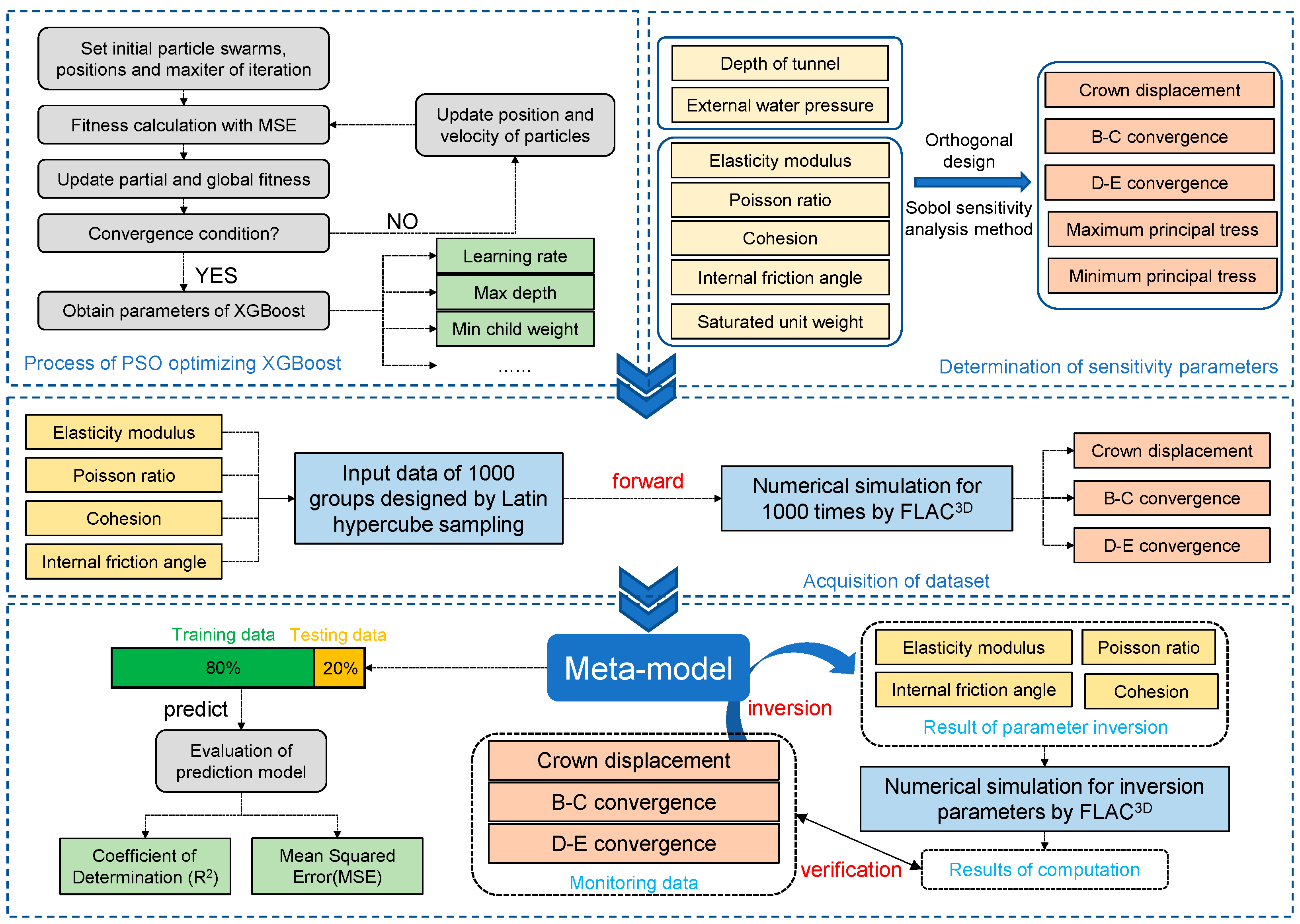
In constructing hydraulic tunnels, construction disturbances and complex geological conditions can induce variations in the surrounding rock parameters. To navigate the complex non-linear interplay between rock material parameters and tunnel displacement during construction, this study proposes a hybrid learning model. It employs particle swarm optimization (PSO) to refine the hyperparameters of the eXtreme Gradient Boosting (XGBoost) technique. Sensitivity analysis and inversion of rock parameters is performed by using orthogonal design and the Sobol method to analyze the sensitivity of environmental and rock material factors. The findings indicate that the tunnel depth, elastic modulus, and Poisson ratio are particularly sensitive parameters. Mechanical parameters of the rock mass, identified through sensitivity analysis, are the focal point of this research and are integrated into a three-dimensional computational model. The resulting tunnel displacement calculations serve as datasets for the inversion of the actual engineering project’s surrounding rock mechanical parameters. These inverted parameters were fed into the FLAC3D software (version 7.0), yielding results that align closely with field measurements, which affirms the PSO-XGBoost model’s validity and precision. The insights garnered from this research offer a substantial reference for determining rock mass parameters in tunnel engineering amidst complex conditions.
Keywords: sensitivity analysis; inversion; soft rock tunnel; PSO-XGBoost; numerical simulation; machine learning sensitivity analysis; inversion; soft rock tunnel; PSO-XGBoost; numerical simulation; machine learning