Article

Environment-Aware Knowledge Distillation for Improved Resource-Constrained Edge Speech Recognition

1
Institut National de la Recherche Scientifique (INRS-EMT), Université du Québec, Montreal, QC H5A 1K6, Canada
2
INRS-UQO Mixed Research Unit on Cybersecurity, Gatineau, QC J8X 3X7, Canada
*
Author to whom correspondence should be addressed.
Appl. Sci. 2023, 13(23), 12571; https://doi.org/10.3390/app132312571
Submission received: 18 October 2023 / Revised: 18 November 2023 / Accepted: 20 November 2023 / Published: 22 November 2023
(This article belongs to the Special Issue Advances in Speech and Language Processing)

Abstract

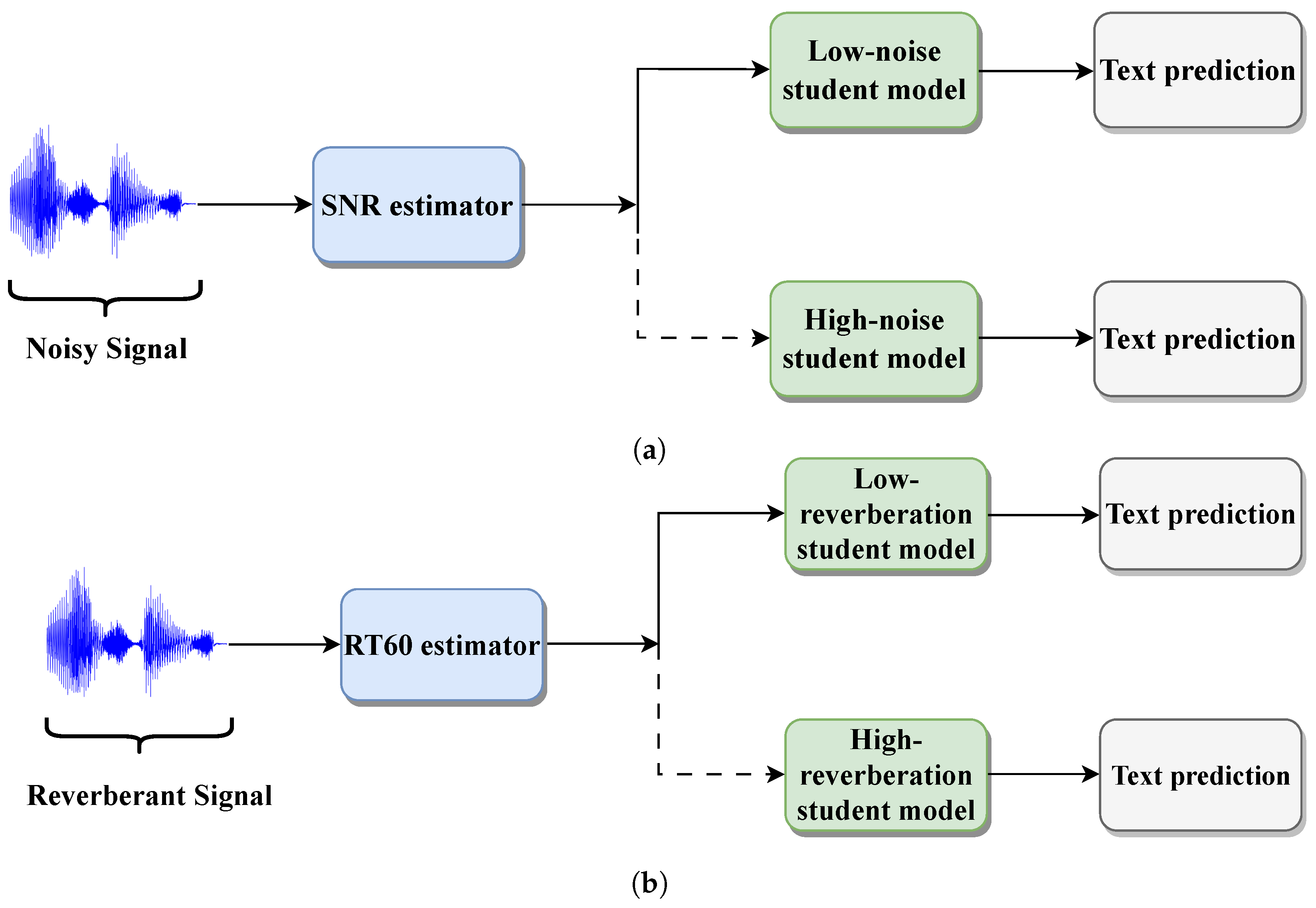
Recent advances in self-supervised learning have allowed automatic speech recognition (ASR) systems to achieve state-of-the-art (SOTA) word error rates (WER) while requiring only a fraction of the labeled data needed by its predecessors. Notwithstanding, while such models achieve SOTA results in matched train/test scenarios, their performance degrades substantially when tested in unseen conditions. To overcome this problem, strategies such as data augmentation and/or domain adaptation have been explored. Available models, however, are still too large to be considered for edge speech applications on resource-constrained devices; thus, model compression tools, such as knowledge distillation, are needed. In this paper, we propose three innovations on top of the existing DistilHuBERT distillation recipe: optimize the prediction heads, employ a targeted data augmentation method for different environmental scenarios, and employ a real-time environment estimator to choose between compressed models for inference. Experiments with the LibriSpeech dataset, corrupted with varying noise types and reverberation levels, show the proposed method outperforming several benchmark methods, both original and compressed, by as much as 48.4% and 89.2% in the word error reduction rate in extremely noisy and reverberant conditions, respectively, while reducing by 50% the number of parameters. Thus, the proposed method is well suited for resource-constrained edge speech recognition applications.
Keywords: automatic speech recognition; knowledge distillation; self-supervised learning; modulation spectrum; context awareness automatic speech recognition; knowledge distillation; self-supervised learning; modulation spectrum; context awareness