Article

A Hybrid DNN Multilayered LSTM Model for Energy Consumption Prediction

by
Mona AL-Ghamdi
1,*,
Abdullah AL-Malaise AL-Ghamdi
1,2 and
Mahmoud Ragab
3,4
1
Information Systems Department, Faculty of Computing and Information Technology, King Abdulaziz University, Jeddah 21589, Saudi Arabia
2
Information Systems Department, School of Engineering, Computing and Design, Dar Al-Hekma University, Jeddah 22246, Saudi Arabia
3
Information Technology Department, Faculty of Computing and Information Technology, King Abdulaziz University, Jeddah 21589, Saudi Arabia
4
Mathematics Department, Faculty of Science, Al-Azhar University, Naser City, Cairo 11884, Egypt
*
Author to whom correspondence should be addressed.
Appl. Sci. 2023, 13(20), 11408; https://doi.org/10.3390/app132011408
Submission received: 24 August 2023 / Revised: 1 October 2023 / Accepted: 15 October 2023 / Published: 18 October 2023

Abstract

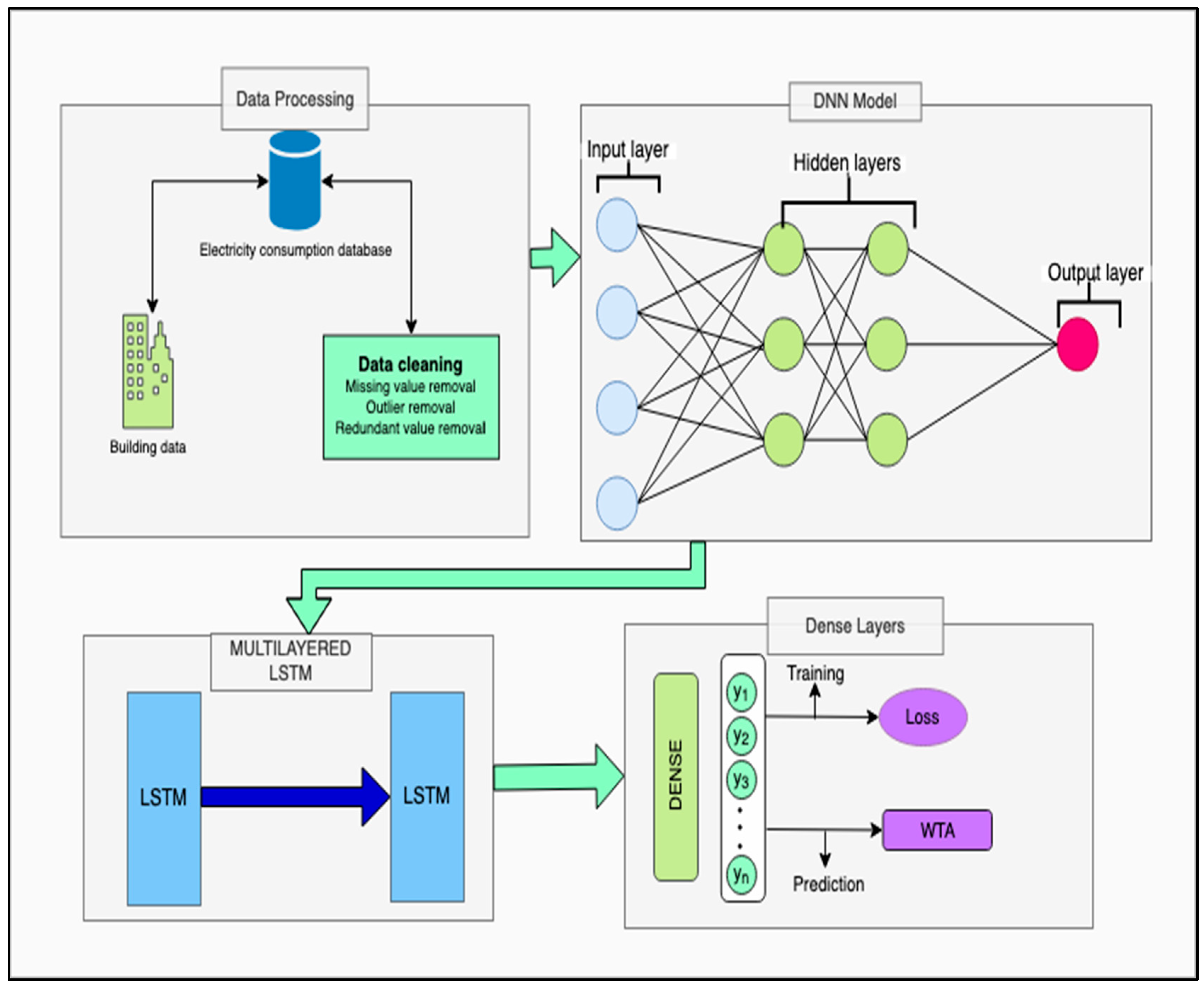
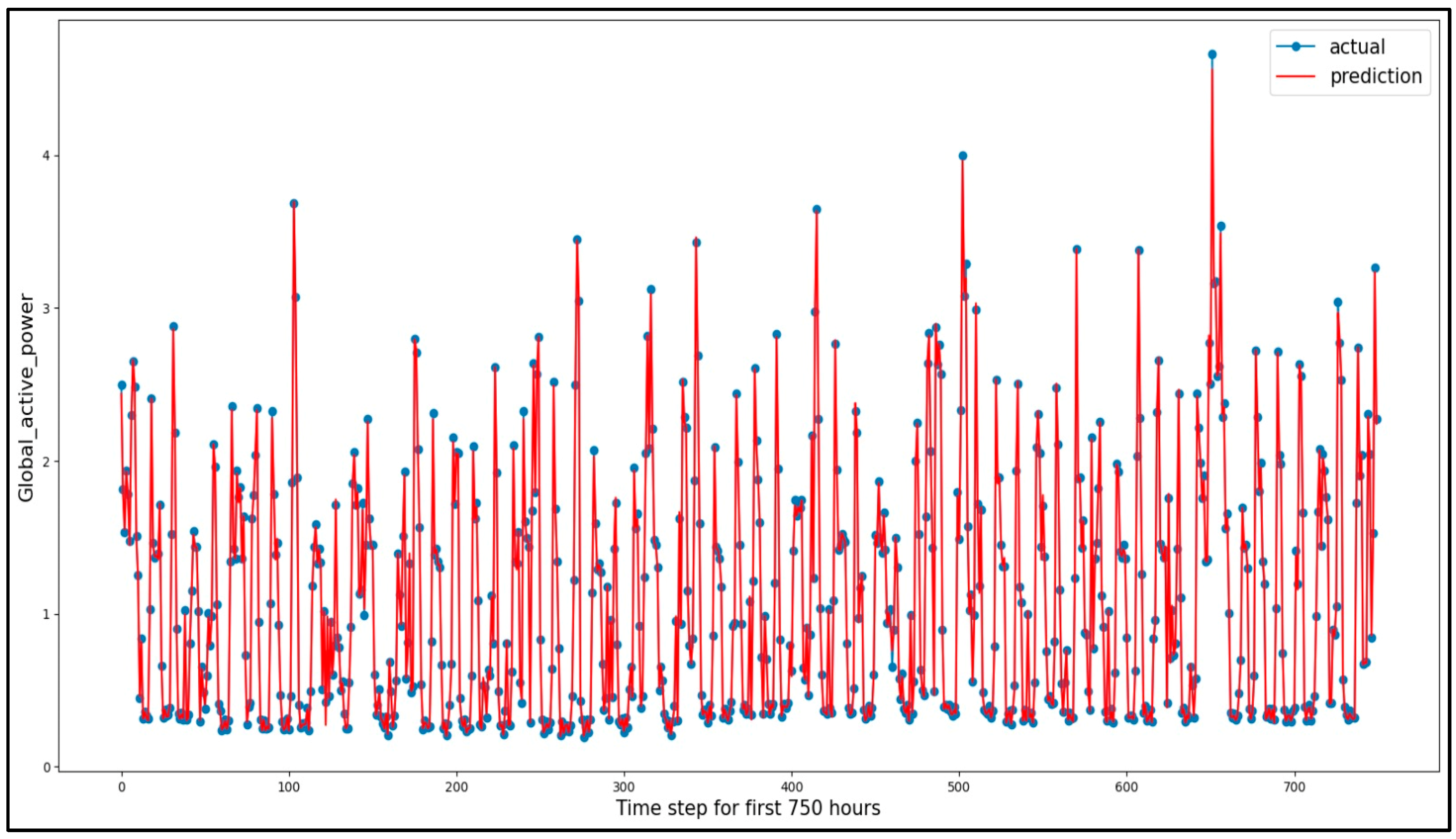
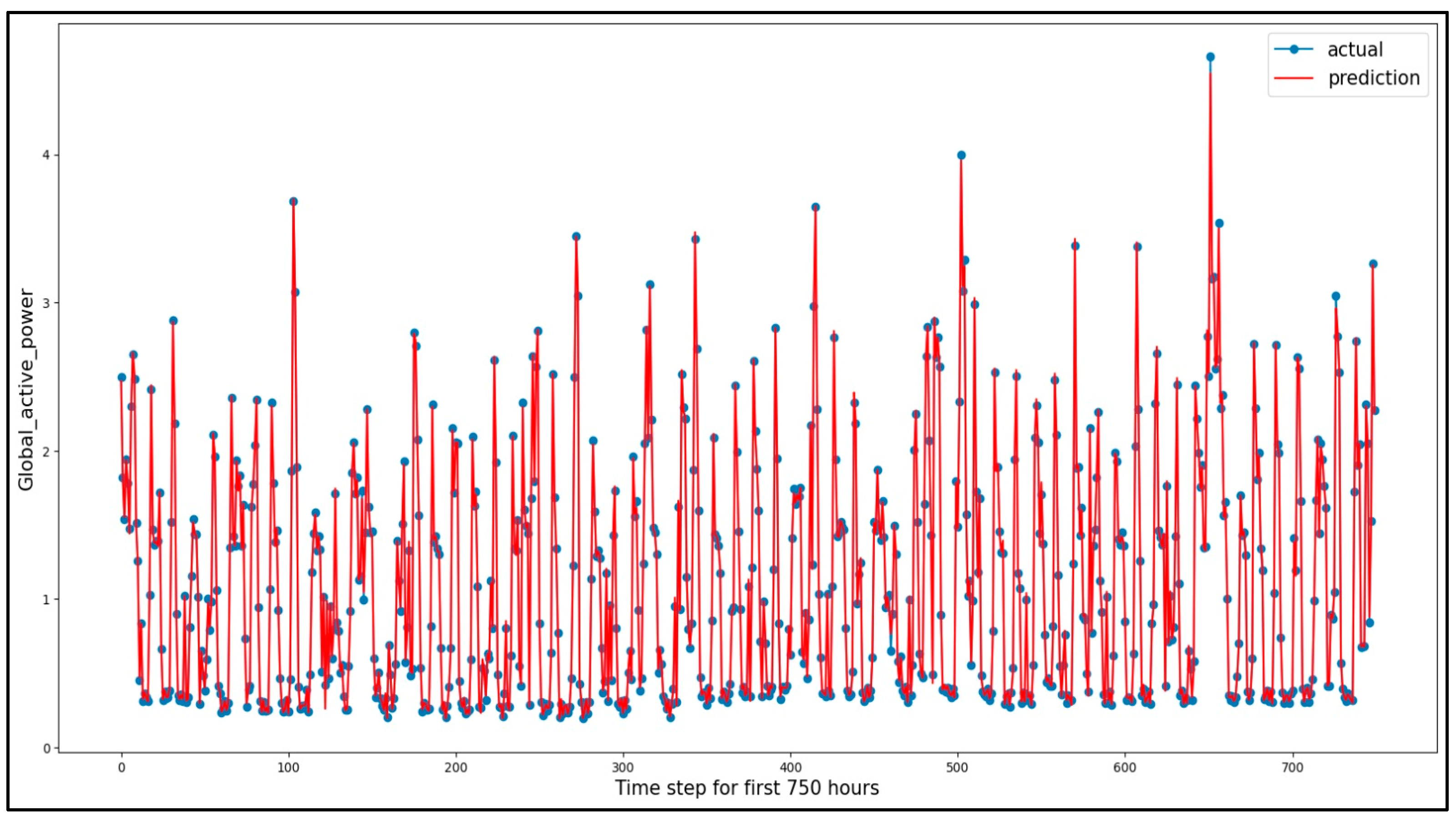
The ability to predict energy consumption in a world in which energy needs are ever-increasing is important for future growth and development. In recent years, deep learning models have made significant advancements in energy forecasting. In this study, a hybrid deep neural network (DNN) multilayered long short-term memory (LSTM) model was used to predict energy consumption in households. When evaluating the model, the individual household electric power consumption dataset was used to train, validate, and test the model. Preprocessing was applied to the data to minimize any prediction errors. Afterward, the DNN algorithm extracted the spatial features, and the multilayered LSTM model was used for sequential learning. The model showed a highly accurate predictive performance, as the actual consumption trends matched the predictive trends. The coefficient of determination, root-mean-square error, mean absolute error, and mean absolute percentage error were found to be 0.99911, 0.02410, 0.01565, and 0.01826, respectively. A DNN model and LSTM model were also trained to study how much improvement the proposed model would provide. The proposed model showed better performance than the DNN and LSTM models. Moreover, similar to other deep learning models, the proposed model’s performance was superior and provided accurate and reliable energy consumption predictions.
Keywords: DNN; LSTM; deep learning; prediction DNN; LSTM; deep learning; prediction