Improving the Coatability of Zn–Mg–Al Alloy on Steel Substrate by the Surface Pretreatment of SnCl2-Added Zinc Ammonium Chloride

Abstract
1. Introduction
2. Materials and Methods
3. Results
3.1. Surface Evaluation
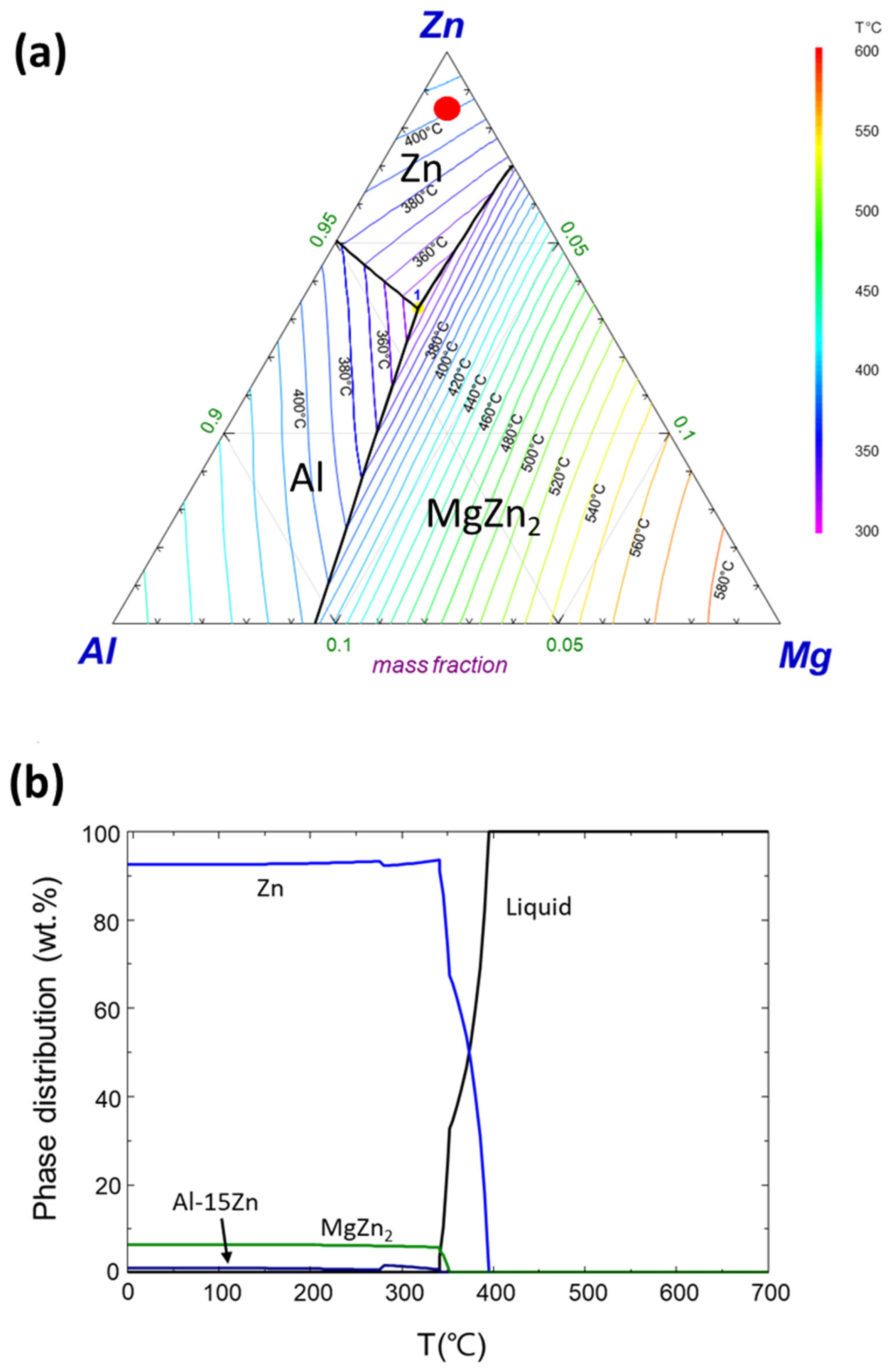
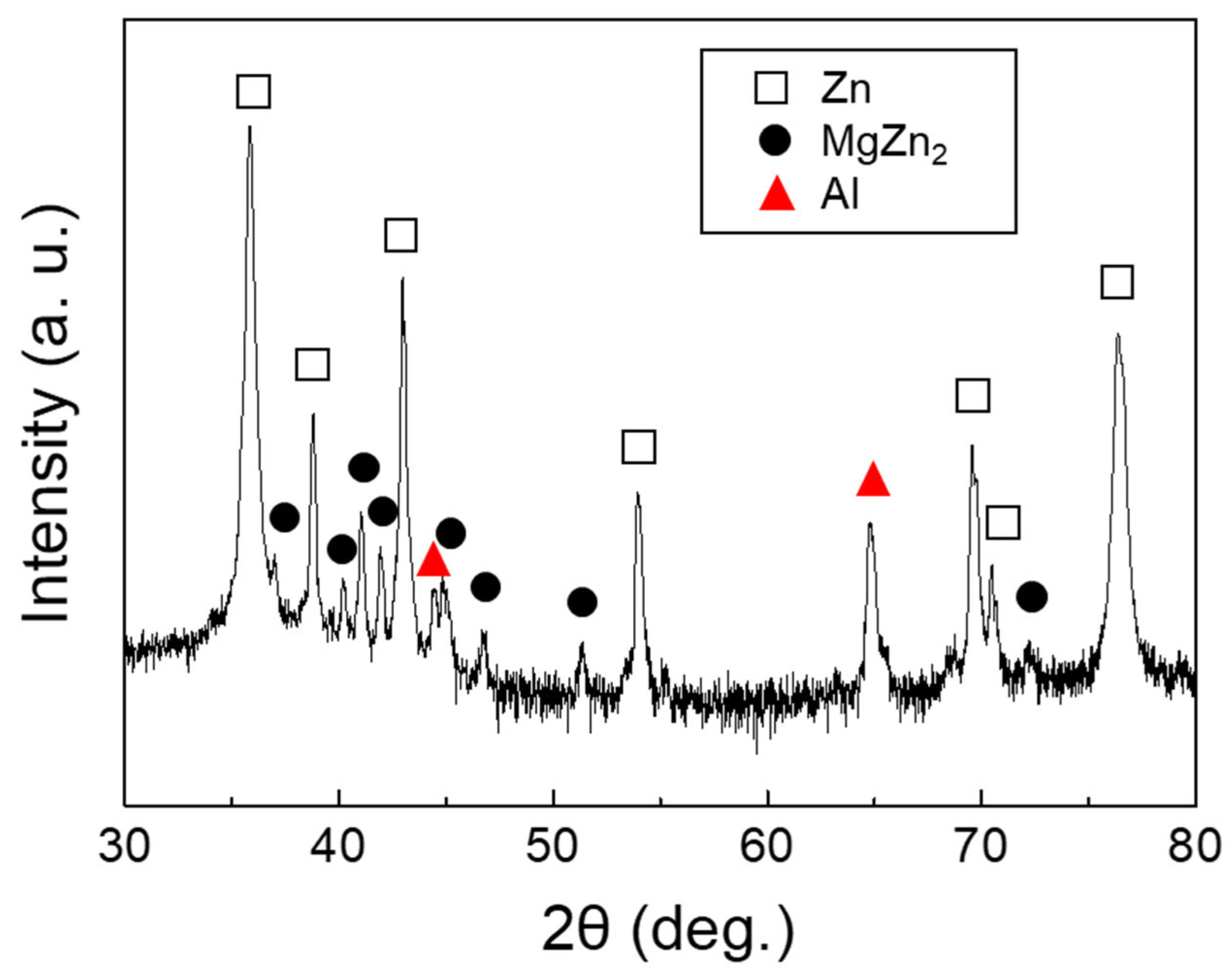
3.2. Microstructural and Crystallographic Characterization of the Hot-Dipped Coatings
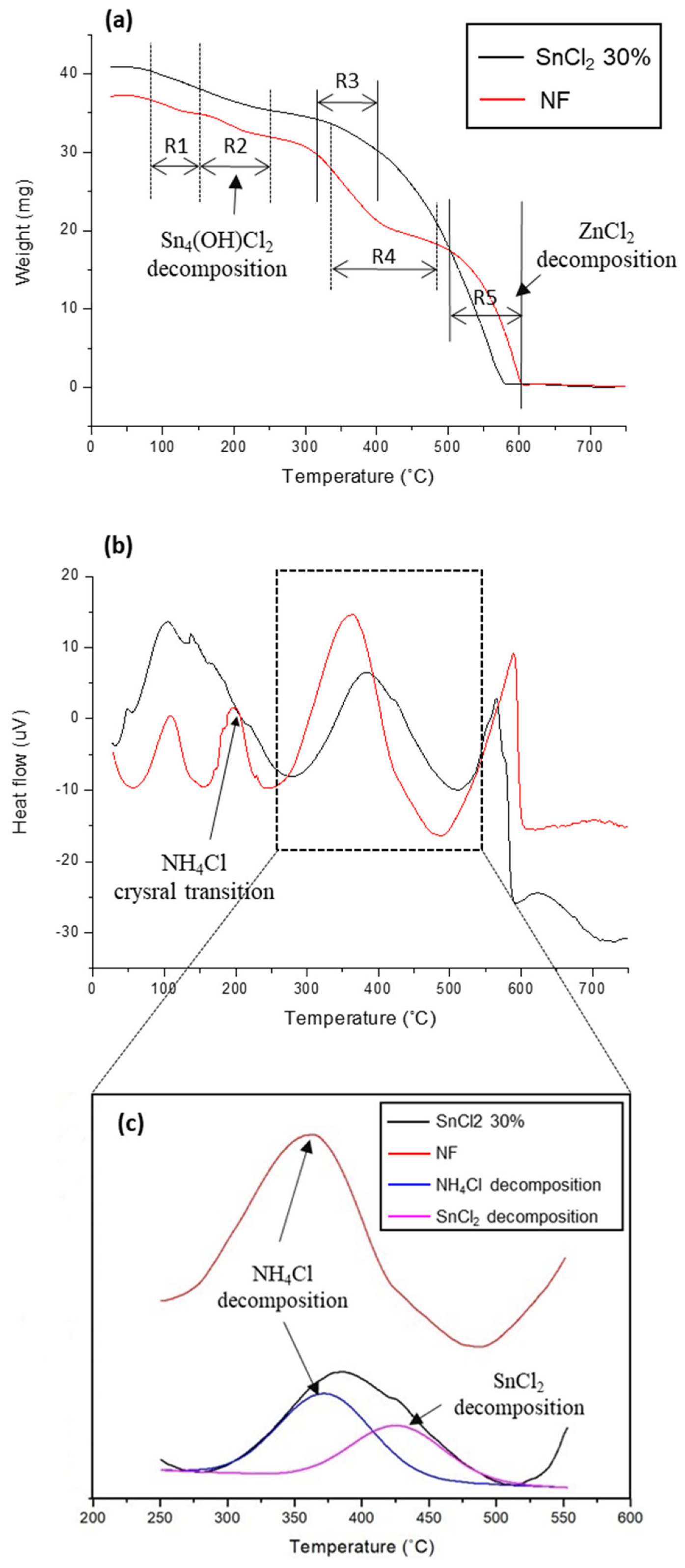
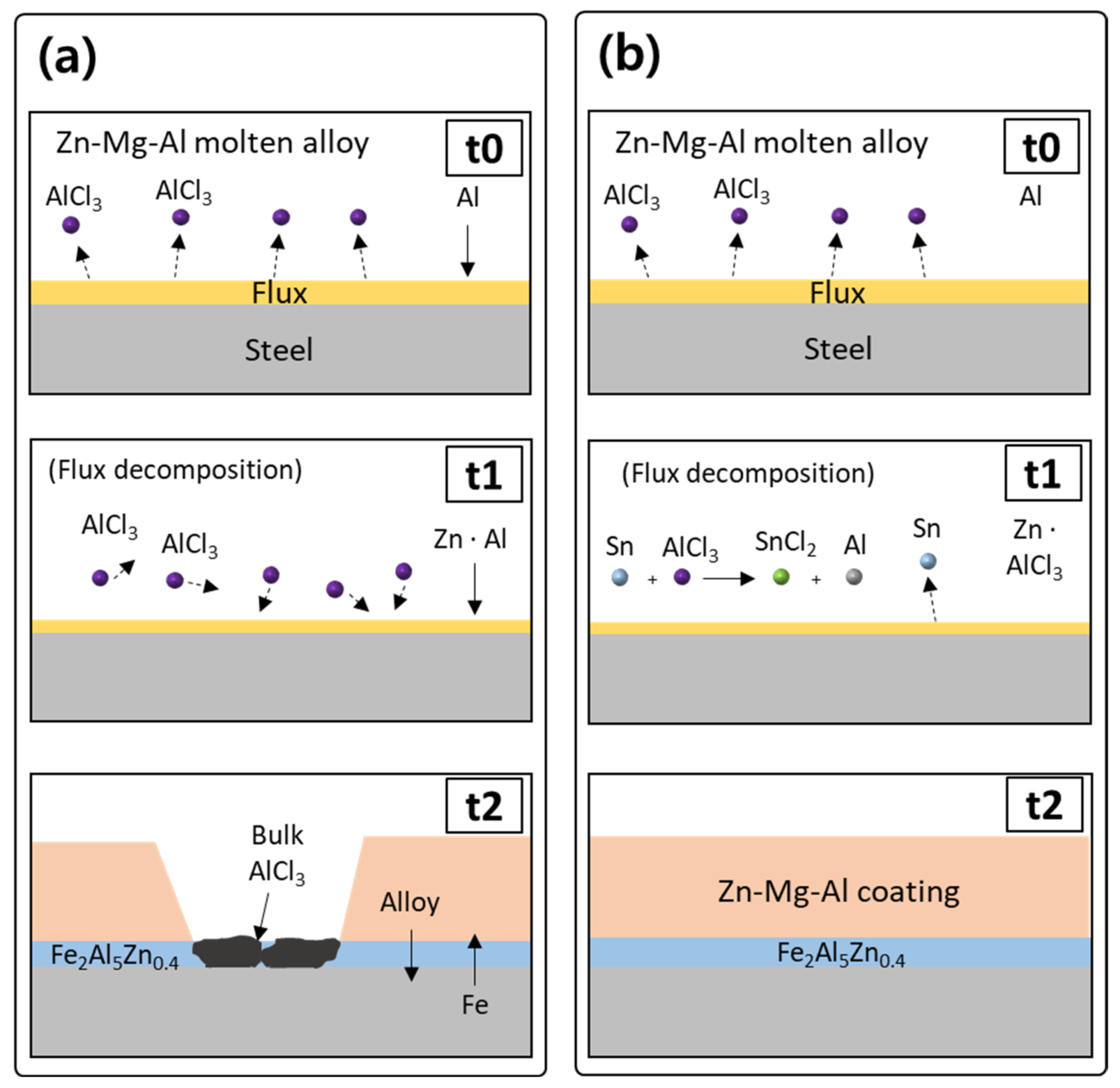
3.3. Thermal Decomposition of the NF and SF30 Samples
3.4. Adhesion Test
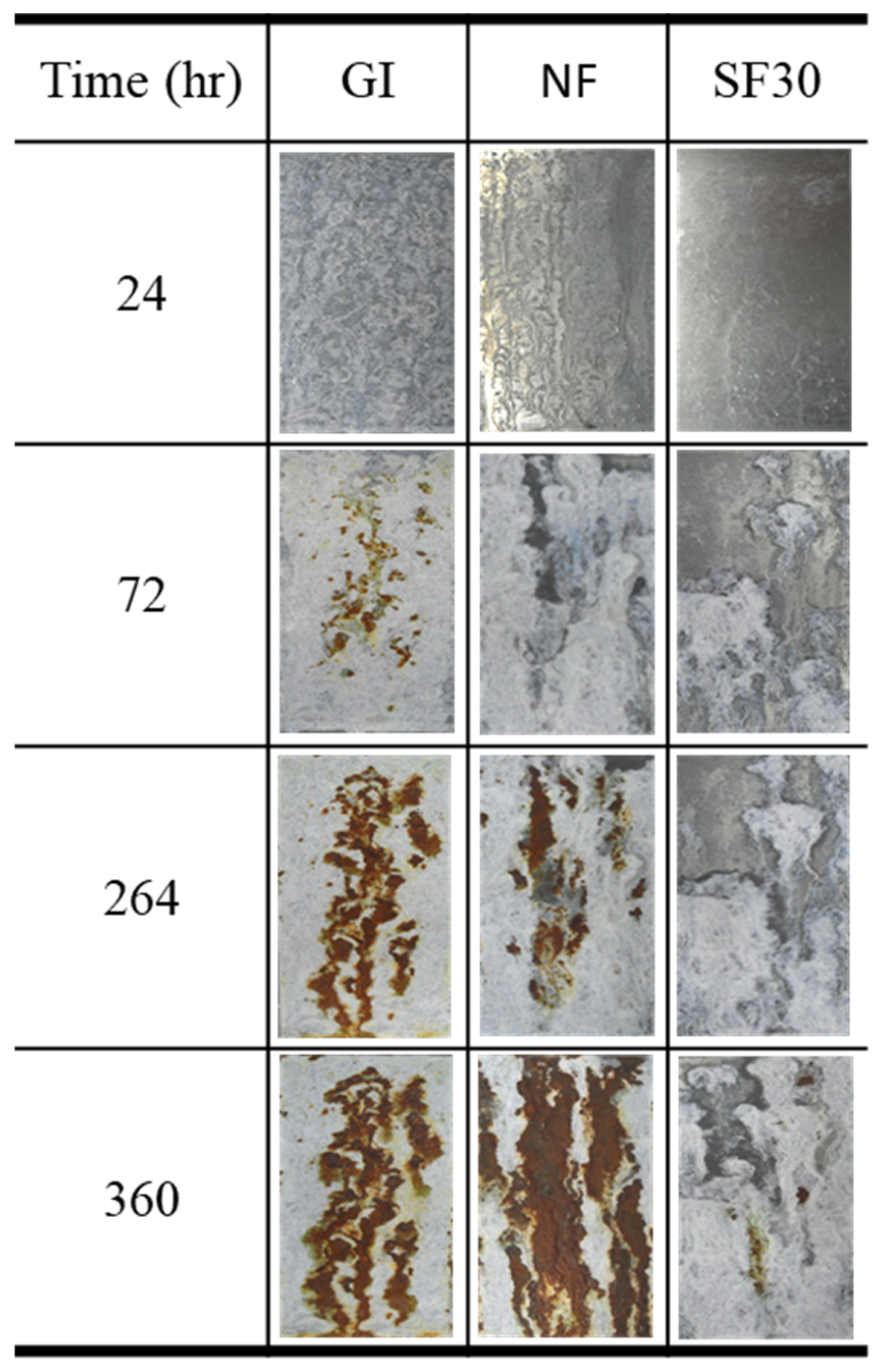
3.5. Corrosion Test
4. Conclusions
Author Contributions
Funding
Institutional Review Board Statement
Informed Consent Statement
Data Availability Statement
Conflicts of Interest
References
- Shih, H.C.; Hsu, J.W.; Sun, C.N.; Chung, S.C. The Lifetime Assessment of Hot-Dip 5% Al-Zn Coatings in Chloride Environments. Surf. Coatings Technol. 2002, 150, 70–75. [Google Scholar] [CrossRef] [Scilit]
- Pistofidis, N.; Vourlias, G.; Konidaris, S.; Pavlidou, E.; Stergiou, A.; Stergioudis, G. Microstructure of Zinc Hot-Dip Galvanized Coatings Used for Corrosion Protection. Mater. Lett. 2006, 60, 786–789. [Google Scholar] [CrossRef] [Scilit]
- Lee, J.W.; Oh, S.Y.; Park, B.; Oh, M.S.; Kim, S.J. Corrosion Behaviors of the Eutectic Structure in Zn-Al-Mg Alloy Coated Steel in Chloride Containing Aqueous Environment. J. Korean Inst. Met. Mater. 2020, 58, 610–616. [Google Scholar] [CrossRef] [Scilit]
- Marder, A.R. The Metallurgy of Zinc-Coated Steel. Prog. Mater. Sci. 2000, 45, 191–271. [Google Scholar] [CrossRef] [Scilit]
- Amadeh, A.; Pahlevani, B.; Heshmati-Manesh, S. Effects of Rare Earth Metal Addition on Surface Morphology and Corrosion Resistance of Hot-Dipped Zinc Coatings. Corros. Sci. 2002, 44, 2321–2331. [Google Scholar] [CrossRef] [Scilit]
- Sjoukes, F. Chemical Reactions in Fluxes for Hot Dip Galvanizing. Anti-Corros. Methods Mater. 1990, 37, 12–14. [Google Scholar] [CrossRef] [Scilit]
- Pistofidis, N.; Vourlias, G.; Konidaris, S.; Pavlidou, E.; Stergioudis, G.; Tsipas, D. The Effect of Preflux Bath Additives on the Morphology and Structure of the Hot-Dip Galvanized Coatings. Cryst. Res. Technol. 2006, 41, 759–765. [Google Scholar] [CrossRef] [Scilit]
- Cook, T.H. Composition, Testing, and Control of Hot Dip Galvanizing Flux. Met. Finish. 2003, 101, 22–35. [Google Scholar] [CrossRef] [Scilit]
- Lee, J.W.; Park, B.R.; Oh, S.Y.; Yun, D.W.; Hwang, J.K.; Oh, M.S.; Kim, S.J. Mechanistic Study on the Cut-Edge Corrosion Behaviors of Zn-Al-Mg Alloy Coated Steel Sheets in Chloride Containing Environments. Corros. Sci. 2019, 160, 108170. [Google Scholar] [CrossRef] [Scilit]
- Oh, M.S.; Kim, S.H.; Kim, J.S.; Lee, J.W.; Shon, J.H.; Jin, Y.S. Surface and Cut-Edge Corrosion Behavior of Zn-Mg-Al Alloy-Coated Steel Sheets as a Function of the Alloy Coating Microstructure. Met. Mater. Int. 2016, 22, 26–33. [Google Scholar] [CrossRef] [Scilit]
- Schuerz, S.; Fleischanderl, M.; Luckeneder, G.H.; Preis, K.; Haunschmied, T.; Mori, G.; Kneissl, A.C. Corrosion Behaviour of Zn-Al-Mg Coated Steel Sheet in Sodium Chloride-Containing Environment. Corros. Sci. 2009, 51, 2355–2363. [Google Scholar] [CrossRef] [Scilit]
- Du, A.; Huo, Y.; Hu, J. Study of Fluxing Process for Hot Dipping Galfan Alloy on Steel Wire. Adv. Mater. Res. 2012, 433–440, 111–115. [Google Scholar]
- Manna, M. Effect of Fluxing Chemical: An Option for Zn-5wt.%Al Alloy Coating on Wire Surface by Single Hot Dip Process. Surf. Coatings Technol. 2011, 205, 3716–3721. [Google Scholar] [CrossRef] [Scilit]
- Liu, T.; Ma, R.; Fan, Y.; Du, A.; Zhao, X.; Wen, M.; Cao, X. Effect of Fluxes on Wettability between the Molten Galfan Alloy and Q235 Steel Matrix. Surf. Coat. Technol. 2018, 337, 270–278. [Google Scholar] [CrossRef] [Scilit]
- Rocha, L.A.; Barbosa, M.A. Microstructure, Growth Kinetics, and Corrosion Resistance of Hot-Dip Galvanized Zn-5% Al Coatings. Corrosion 1991, 47, 536–541. [Google Scholar] [CrossRef] [Scilit]
- Utigard, T.A.; Friesen, K.; Roy, R.R.; Lim, J.; Silny, A.; Dupuis, C. The Properties and Uses of Fluxes in Molten Aluminum Processing. Jom 1998, 50, 38–43. [Google Scholar] [CrossRef] [Scilit]
- Leychkis, D.; Zervoudis, J. Flux and Process for Hot Dip Galvanization. US Patent 7,811,389B2, 21 June 2007. [Google Scholar]
- Shawki, S.; Hamid, Z.A. Effect of Aluminium Content on the Coating Structure and Dross Formation in the Hot-Dip Galvanizing Process. Surf. Interface Anal. 2003, 35, 943–947. [Google Scholar] [CrossRef] [Scilit]
- Gao, L.; Li, Z.; Kuang, X.; Yin, F.; Ji, H. Formation of Periodic Layered Structure during Hot-Dip Galvanizing in Al-Zn-Mg Bath. Surf. Coat. Technol. 2016, 304, 306–315. [Google Scholar] [CrossRef] [Scilit]
- Xie, Y.; Du, A.; Zhao, X.; Ma, R.; Fan, Y.; Cao, X. Effect of Mg on Fe–Al Interface Structure of Hot–Dip Galvanized Zn–Al–Mg Alloy Coatings. Surf. Coat. Technol. 2018, 337, 313–320. [Google Scholar] [CrossRef] [Scilit]
- Bale, C.W.; Chartrand, P.; Degterov, S.A.; Eriksson, G.; Hack, K.; Ben Mahfoud, R.; Melançon, J.; Pelton, A.D.; Petersen, S. FactSage Thermochemical Software and Databases. Calphad 2002, 26, 189–228. [Google Scholar] [CrossRef] [Scilit]
- Bale, C.W.; Bélisle, E.; Chartrand, P.; Decterov, S.A.; Eriksson, G.; Hack, K.; Jung, I.H.; Kang, Y.B.; Melançon, J.; Pelton, A.D.; et al. FactSage Thermochemical Software and Databases - Recent Developments. Calphad Comput. Coupling Phase Diagr. Thermochem. 2009, 33, 295–311. [Google Scholar] [CrossRef] [Scilit]


| C | Mn | S | P | Si | Al | N | Fe |
|---|---|---|---|---|---|---|---|
| 0.140 | 0.300 | 0.010 | 0.015 | 0.025 | 0.030 | 0.004 | Bal. |
| Sample Designation | Flux | Flux Composition (wt.%) | ||
|---|---|---|---|---|
| NH4Cl | ZnCl2 | SnCl2·H2O | ||
| NF | Normal Flux | 75.0 | 25.0 | - |
| SF10 | NF + 10% SnCl2 | 67.5 | 22.5 | 10.0 |
| SF20 | NF + 20% SnCl2 | 60.0 | 20.0 | 20.0 |
| SF30 | NF + 30% SnCl2 | 52.5 | 17.5 | 30.0 |
| SF40 | NF + 40% SnCl2 | 45.0 | 15.0 | 40.0 |
Disclaimer/Publisher’s Note: The statements, opinions and data contained in all publications are solely those of the individual author(s) and contributor(s) and not of MDPI and/or the editor(s). MDPI and/or the editor(s) disclaim responsibility for any injury to people or property resulting from any ideas, methods, instructions or products referred to in the content. |
© 2023 by the authors. Licensee MDPI, Basel, Switzerland. This article is an open access article distributed under the terms and conditions of the Creative Commons Attribution (CC BY) license (https://creativecommons.org/licenses/by/4.0/).
Share and Cite
Kim, K.-y.; Grandhi, S.; Oh, M.-S. Improving the Coatability of Zn–Mg–Al Alloy on Steel Substrate by the Surface Pretreatment of SnCl2-Added Zinc Ammonium Chloride. Appl. Sci. 2023, 13, 950. https://doi.org/10.3390/app13020950
Kim K-y, Grandhi S, Oh M-S. Improving the Coatability of Zn–Mg–Al Alloy on Steel Substrate by the Surface Pretreatment of SnCl2-Added Zinc Ammonium Chloride. Applied Sciences. 2023; 13(2):950. https://doi.org/10.3390/app13020950
Chicago/Turabian StyleKim, Ki-yeon, Srinivasulu Grandhi, and Min-Suk Oh. 2023. "Improving the Coatability of Zn–Mg–Al Alloy on Steel Substrate by the Surface Pretreatment of SnCl2-Added Zinc Ammonium Chloride" Applied Sciences 13, no. 2: 950. https://doi.org/10.3390/app13020950
APA StyleKim, K.-y., Grandhi, S., & Oh, M.-S. (2023). Improving the Coatability of Zn–Mg–Al Alloy on Steel Substrate by the Surface Pretreatment of SnCl2-Added Zinc Ammonium Chloride. Applied Sciences, 13(2), 950. https://doi.org/10.3390/app13020950