Article

Least Squares Reverse Time Migration of Ground Penetrating Radar Data Based on Modified Total Variation


1
Key Laboratory of Metallogenic Prediction of Nonferrous Metals and Geological Environment Monitoring, Changsha 410083, China
2
School of Geosciences and Info-Physics, Central South University, Changsha 410083, China
3
School of Civil Engineering, Central South University, Changsha 410075, China
*
Author to whom correspondence should be addressed.
Appl. Sci. 2023, 13(18), 10028; https://doi.org/10.3390/app131810028
Submission received: 1 August 2023 / Revised: 31 August 2023 / Accepted: 3 September 2023 / Published: 5 September 2023
(This article belongs to the Special Issue Ground Penetrating Radar (GPR): Theory, Methods and Applications)

Abstract

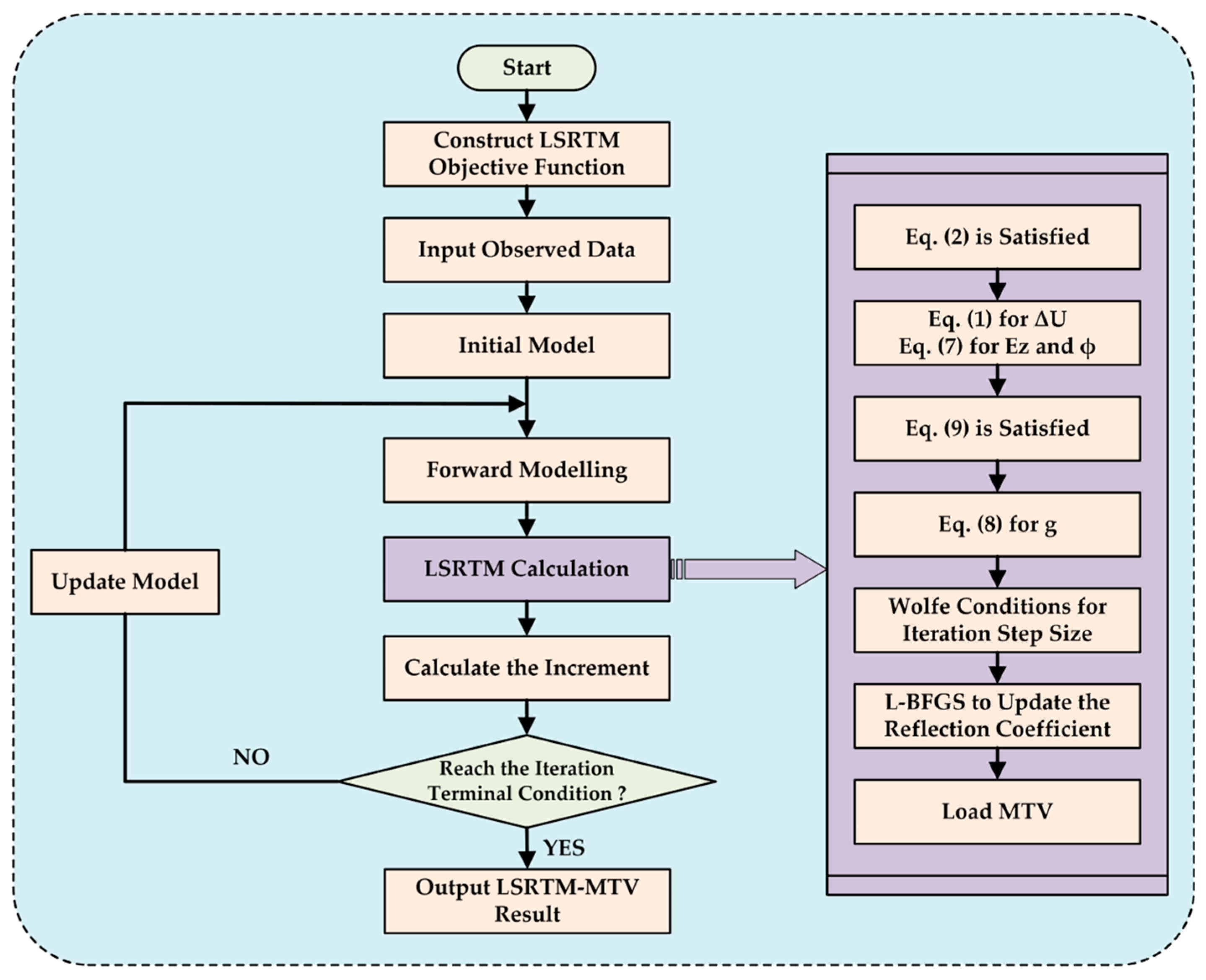
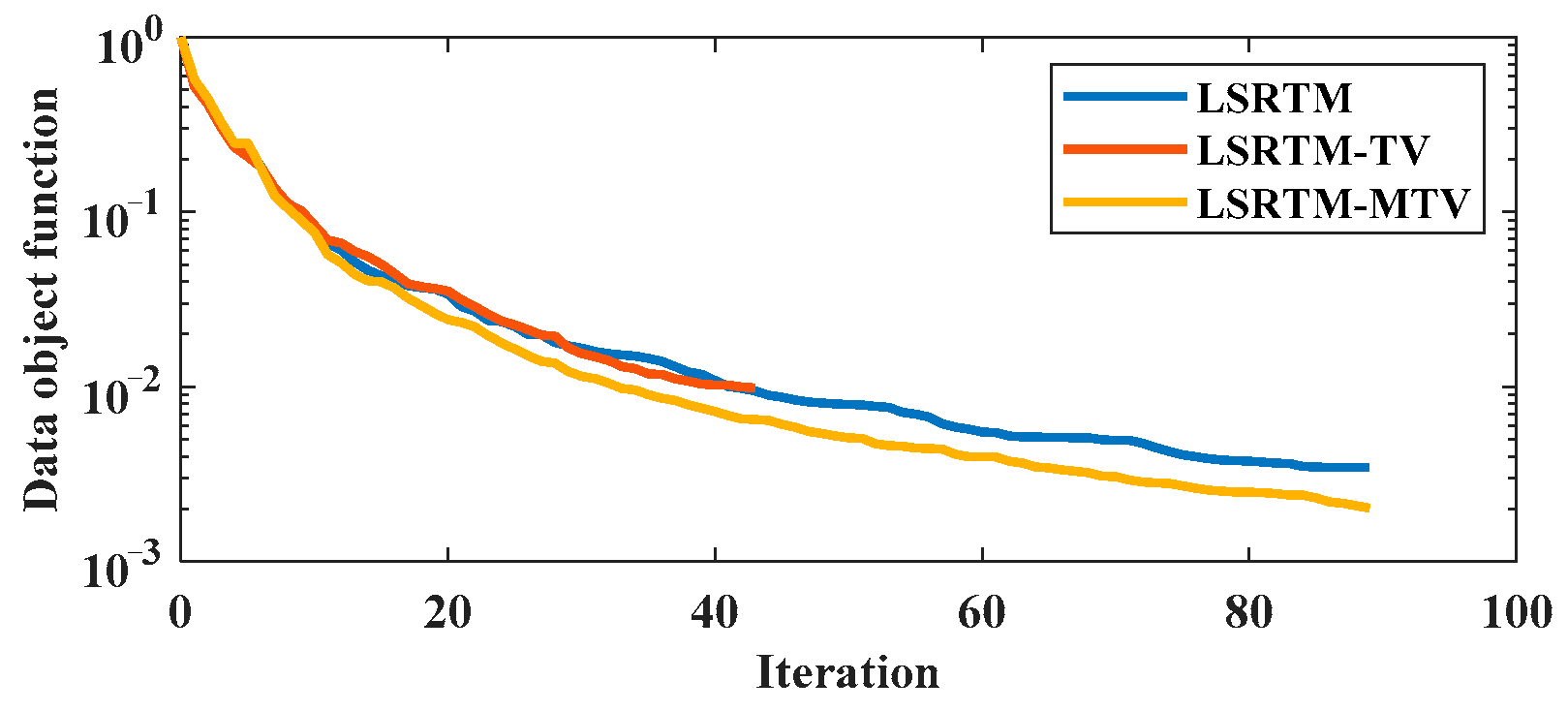
As a fundamental part of ground penetrating radar (GPR) data processing, reverse time migration (RTM) can correctly position reflection waves and focusing diffraction waves on the proper spatial position. Least-squares reverse-time migration (LSRTM) is widely used in the seismic field for its ability to suppress artifacts and generate high-resolution images in comparison to conventional RTM. However, in the particular case of GPR detection methods, LSRTM is extremely susceptible to aliasing artifacts caused by under-sampling. In pursuit of enhanced precision in underground structure characterization, this paper presents the development of a new LSRTM based on modified total variation (MTV) regularization to improve imaging resolution. Initially, the objective function of LSRTM is derived by combining the Born approximation in 2-D transversal magnetic mode. Next, the adjoint equations and their gradients are solved using the Lagrange multiplier method. The objective function is then constrained by MTV regularization to ensure the precision and convergence of the LSRTM, which delivers a refined edge with reconstruction details. In the numerical experiments, in comparison to the conventional LSRTM method, the LSRTM-MTV algorithm demonstrated a 30.4% increase in computational speed and a 21.1% reduction in mean squared error (MSE). The outperformance of the proposed method is verified in detail through the image resolution and amplitude preservation in the test of synthetic data and laboratory data. Future research efforts will center on applying the proposed method to models featuring dispersive or anisotropic media that closely mimic real-world conditions and extending the application to various imaging techniques involving objective function minimization.
Keywords: ground penetrating radar; least-squares reverse-time migration; modified total-variation regularization ground penetrating radar; least-squares reverse-time migration; modified total-variation regularization