Review

An Overview of Japanese Encephalitis in Australia: Trends, Impact and Interventions

Department of Health Sciences and Biostatistics, School of Health Sciences, Swinburne University of Technology, Hawthorn, VIC 3122, Australia
*
Author to whom correspondence should be addressed.
Appl. Sci. 2023, 13(16), 9184; https://doi.org/10.3390/app13169184
Submission received: 26 May 2023 / Revised: 10 August 2023 / Accepted: 10 August 2023 / Published: 12 August 2023
(This article belongs to the Special Issue Applied Biostatistics for Health Science and Epidemiology)

Abstract

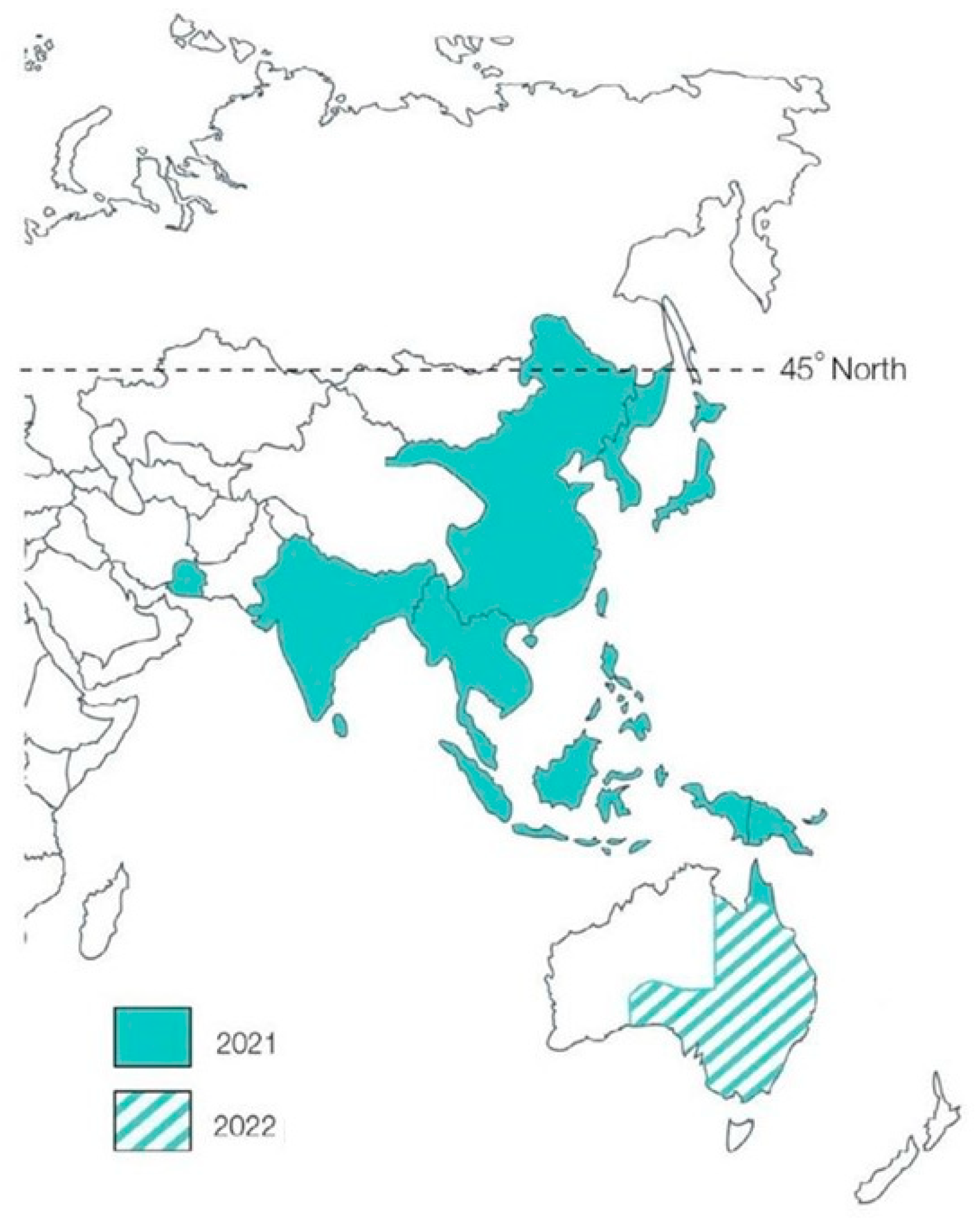
Japanese Encephalitis (JE) is caused by infection with the Japanese encephalitis virus (JEV). This vector-borne disease has been listed as a nationally notifiable public health risk in various countries. Predominantly found in Southeast Asia, JE can result in long-term neurological and psychiatric sequelae in both adults and children and is the leading cause of viral encephalitis in this region. Globally, there are an estimated 100,000 cases of JE and 25,000 associated deaths per year. Despite the significant effort to stop JE transmission through implementing vaccination programmes, JEV infection continues to be a global problem, with recent outbreaks in several countries, including outside of Asia. This raises a public health alert and establishes a need for future surveillance. Here, we reviewed the recent JE epidemic in Australia, focusing on its trends, impact and intervention. We recommend that a collaborative research effort together with a globally unified disease control strategy is urgently required to improve our understanding of JEV transmission and surveillance and to be better prepared for future outbreaks.
Keywords: Australia; endemic; epidemiology; Japanese encephalitis; JE; JEV; vaccination; virus outbreak Australia; endemic; epidemiology; Japanese encephalitis; JE; JEV; vaccination; virus outbreak