Combining Kano’s Model, IPA, and FMEA to Evaluate Service Quality Risk for Bus Service: Case of Bangkok Bus Service


Abstract
1. Introduction
2. Literature Review
2.1. Bus Service Quality
2.2. Kano’s Model
2.3. Importance–Performance Analysis (IPA)
2.4. Failure Mode and Effect Analysis
3. Methods
3.1. Service Quality Risk Evaluation
- Step 1: Development of Composite Satisfaction Index (CSI)
- Step 2: Contributory Improvement Index (CII)
- Calculate the difference index, which equals importance minus satisfaction.
- Rank the difference index from maximum to minimum. If there are some attributes with the same difference index, the attribute with better satisfaction has a higher ranking. This ranking number is called the priority weight () which represents the attribute with a larger value of difference index ranking priors to be improved.
- Calculate the standardized weight () via normalizing the priority weight. The equation is:
- Step 3: Combination of the CII and the FMEA
3.2. Measurements
3.3. Data
4. Results
4.1. Results of Kano’s Model
4.2. Results of IPA
4.3. Results of CII and FMEA
5. Discussion
5.1. Managerial Implications
5.2. Limitations and Suggestions for Future Research
6. Conclusions
Author Contributions
Funding
Institutional Review Board Statement
Informed Consent Statement
Data Availability Statement
Acknowledgments
Conflicts of Interest
References
- Thai Civil Rights and Investigative Journalism. จับตา: จำนวนผู้ใช้รถเมล์และรถไฟฟ้าใน กทม. ปี 2552-2558 (Keep an Eye on: Number of Bus and Electric Train Users in Bangkok, 2009–2015). 2018. Available online: https://www.tcijthai.com/news/2018/4/watch/7890 (accessed on 23 September 2022).
- Traffic and Transportation Department, Bangkok Metropolitan Administration, Traffic Statistics in 2021. Available online: https://office2.bangkok.go.th/dotat/TrafficINFO/StatBook/2021/EN/index.html (accessed on 5 May 2023).
- Khemapech, I.; Kidbunjong, L. Operational issues and solutions of public transportation system. J. KMUTNB 2014, 24, 355–363. [Google Scholar]
- Kasikorn Research Center. Impacts of Traffic Congestion on Bangkok’s Economy and Life 2016. Available online: https://www.kasikornresearch.com/en/analysis/k-econ/economy/Pages/35760.aspx (accessed on 23 September 2022).
- Ministry of Transport Thailand. Transport Infrastructure Investment Action Plan 2017: Towards Sustainable Transport. 2017. Available online: https://www.mot.go.th/file_upload/2559/2016.12.12_MOT_Action_Plan_2560ENG.pdf (accessed on 23 September 2022).
- Pokwanvit, M.R. Factors Influencing Bangkok Commuters to Switch from Driving Cars to Using Buses. Ph.D. Thesis, Thammasat University, Bangkok, Thailand, 2017. [Google Scholar]
- Zulfahri, A.F.; Widodo, C.E.; Gernowo, R. Implementing Importance-Performance Analysis (IPA) for Measuring Students Satisfaction Levels. In Proceedings of the 2019 International Seminar on Research of Information Technology and Intelligent Systems (ISRITI), Yogyakarta, Indonesia, 5–6 December 2019; pp. 363–367. [Google Scholar]
- Mikulić, J.; Prebežac, D. A critical review of techniques for classifying quality attributes in the Kano model. Manag. Serv. Qual. 2011, 21, 46–66. [Google Scholar] [CrossRef] [Scilit]
- Office of the Prime Minister. Performance Summary about People’s Complaints in Fiscal Year 2014; Office of the Prime Minister, Government House: Bangkok, Thailand, 2014. [Google Scholar]
- Wethyavivorn, P.; Sukwattanakorn, N. Problems and barriers affecting sustainable commuting: Case study of people’s daily commute to Kasetsart University, Bangkok, Thailand. IOP Conf. Ser. Earth Environ. Sci. 2019, 329, 12011. [Google Scholar] [CrossRef] [Scilit]
- Ueasangkomsate, P. Service quality of public road passenger transport in Thailand. Kasetsart J. Soc. Sci. 2019, 40, 74–81. [Google Scholar]
- Susilawati, M.; Nilakusmawati, D.P.E. Study on the factors affecting the quality of public bus transportation service in Bali Province using factor analysis. J. Phys. Conf. 2017, 855, 12051. [Google Scholar] [CrossRef] [Scilit]
- Farrar, T.J.; Abiodun, G.J.; Farmer, J. A 2018 Customer Satisfaction Survey with Users of a Subsidised Private Bus Service in Cape Town, South Africa. In Proceedings of the 38th Southern African Transport Conference, Pretoria, South Africa, 8–11 July 2019. [Google Scholar]
- Wijaya, D.H. Service Failure in Jakarta Public Bus Transport; Service Science Project Report; Karlstads Universitet: Karlstad, Sweden, 2009. [Google Scholar]
- Hu, K.C.; Hsiao, M.W. Quality risk assessment model for airline services concerning Taiwanese airlines. J. Air Transp. 2016, 53, 177–185. [Google Scholar] [CrossRef] [Scilit]
- Kuo, N.T.; Chang, K.C.; Lai, C.H. Identifying critical service quality attributes for higher education in hospitality and tourism: Applications of the Kano model and importance-performance analysis (IPA). Afr. J. Bus. Manag. 2011, 5, 12016–12024. [Google Scholar]
- Baki, B.; Basfirinci, C.S.; AR, I.M.; Cilingir, Z. An application of integrating SERVQUAL and Kano’s model into QFD for logistics services: A case study from Turkey. Asia Pac. J. Mark. Logist. 2009, 21, 106–126. [Google Scholar] [CrossRef] [Scilit]
- Parasuraman, A.; Zeithaml, V.A.; Berry, L.L. SERVQUAL: A multiple-item scale for measuring consumer perceptions of service quality. J. Retail. 1988, 64, 12–40. [Google Scholar]
- Jiang, Y.; Wang, C.L. The impact of affect on service quality and satisfaction: The Moderation of service contexts. J. Serv. Mark. 2006, 20, 211–218. [Google Scholar] [CrossRef] [Scilit]
- Turel, O.; Serenko, A. User Satisfaction with Mobile Services in Canada. In Proceedings of the Third International Conference on Mobile Business, M-Business, New York, NY, USA, 12–13 July 2004. [Google Scholar]
- Grujičić, D.; Ivanović, I.; Jović, J.; Đorić, V. Customer perception of service quality in public transport. Transport 2014, 29, 285–295. [Google Scholar] [CrossRef] [Scilit]
- Mahmoud, M.; Hine, J. Measuring the influence of bus service quality on the perception of users. Transp. Plan. Technol. 2016, 39, 284–299. [Google Scholar] [CrossRef] [Scilit]
- Chaikittiphorn, K.; Pavakanun, U. Developing the bus service of Bangkok Mass Transit Authority (BMTA). Thai J. Publ. Adm. 2016, 14, 155. [Google Scholar]
- Deb, S.; Ahmed, M.A. Determining the service quality of the city bus service based on users’ perceptions and expectations. Travel Behav. Soc. 2018, 12, 1–10. [Google Scholar] [CrossRef] [Scilit]
- Sonita, S.U.M.; Jomnonkwao, S.; Champahom, T.; Beeharry, R.; Ratanavaraha, V. Measuring the city bus service quality based on users’ perceptions: City bus service in Phnom Penh, Cambodia. Eng. Appl. Sci. Res. 2020, 47, 47–55. [Google Scholar]
- Moslem, S.; Alkharabsheh, A.; Ismael, K.; Duleba, S. An integrated decision support model for evaluating public transport quality. Appl. Sci. 2020, 10, 4158. [Google Scholar] [CrossRef] [Scilit]
- Napitupulu, D.; Rahim, R.; Abdullah, D.; Setiawan, M.I.; Abdillah, L.A.; Ahmar, A.S.; Simarmata, J.; Hidayat, R.; Nurdiyanto, H.; Pranolo, A. Analysis of student satisfaction toward quality of service facility. J. Phys. Conf. 2018, 954, 12019. [Google Scholar] [CrossRef] [Scilit]
- Boonlertvanich, K. Service quality, satisfaction, trust, and loyalty: The moderating role of main-bank and wealth status. Int. J. Bank Mark. 2019, 37, 278–302. [Google Scholar] [CrossRef] [Scilit]
- Kano, N.; Seraku, N.; Takahashi, F.; Tsuji, S. Attractive quality and must-be quality. Qual. Eng. J. Jpn. Soc. Qual. Control. 1984, 14, 39–48. [Google Scholar]
- Chen, T.L.; Lee, Y.H. Kano two-dimensional quality model and important-performance analysis in the student’s dormitory service quality evaluation in Taiwan. J. Am. Acad. Bus 2006, 9, 324–330. [Google Scholar]
- Huang, J.C. Application of Kano model and IPA on improvement of service quality of mobile healthcare. Int. J. Mob. Commun. 2018, 16, 227–246. [Google Scholar] [CrossRef] [Scilit]
- Högström, C.; Rosner, M.; Gustafsson, A. How to create attractive and unique customer experiences: An application of Kano’s theory of attractive quality to recreational tourism. Mark. Intell. Plan 2010, 28, 385–402. [Google Scholar] [CrossRef] [Scilit]
- Berger, C.; Blauth, R.; Boger, D.; Bolster, C.; Burchill, G.; DuMouchel, W.; Pouliot, F.; Richter, R.; Rubinoff, A.; Shen, D. Kano’s methods for understanding customer-defined quality. Cent. Qual. Manag. J. 1993, 2, 3–36. [Google Scholar]
- Matzler, K.; Hinterhuber, H.H.; Bailom, F.; Sauerwein, E. How to delight your customers. J. Prod. Brand. Manag. 1996, 5, 6–18. [Google Scholar] [CrossRef] [Scilit]
- Löfgren, M.; Witell, L. Kano’s theory of attractive quality and packaging. Qual. Manag. J. 2005, 12, 7–20. [Google Scholar] [CrossRef] [Scilit]
- Kermanshachi, S.; Nipa, T.J.; Nadiri, H. Service quality assessment and enhancement using Kano model. PLoS ONE 2022, 17, e0264423. [Google Scholar] [CrossRef] [Scilit]
- Materla, T.; Cudney, E.A.; Antony, J. The application of Kano model in the healthcare industry: A systematic literature review. Total. Qual. Manag. Bus. Excel. 2019, 30, 660–681. [Google Scholar] [CrossRef] [Scilit]
- Chiang, C.F.; Chen, W.Y.; Hsu, C.Y. Classifying technological innovation attributes for hotels: An application of the Kano model. J. Travel Tour. Mark. 2019, 36, 796–807. [Google Scholar] [CrossRef] [Scilit]
- Backar, S. Integrative Framework of Kansei engineering (KE) and Kano model (KM) applied to light bulb changer. Acad. Res. Community Public 2019, 2, 430–439. [Google Scholar] [CrossRef] [Scilit]
- Pai, F.Y.; Yeh, T.M.; Tang, C.Y. Classifying restaurant service quality attributes by using Kano model and IPA approach. Total. Qual. Manag. Bus. Excel. 2018, 29, 301–328. [Google Scholar] [CrossRef] [Scilit]
- Wong, A.T.T.; Ho, M.W.M. Service quality and customer satisfaction on budget airlines: Kano model approach. J. Econ. Manag. Trade 2019, 24, 1–16. [Google Scholar] [CrossRef] [Scilit]
- Martilla, J.A.; James, J.C. Importance-performance analysis. J. Mark. 1977, 41, 77–79. [Google Scholar] [CrossRef] [Scilit]
- Transistari, R. The use of importance performance analysis to evaluate the satisfaction level of the user of trans Jogja bus. J. Ekon. Kiat. 2017, 22, 95–108. [Google Scholar] [CrossRef] [Scilit]
- Disastra, G.M.; Hanifa, F.H.; Sastika, W. Importance-performance analysis (IPA) on tourists satisfaction (study in Ciamis Regency, Indonesia). Adv. Sci. Lett. 2018, 24, 2922–2925. [Google Scholar] [CrossRef] [Scilit]
- Simpson, G.D.; Parker, J. Data for an importance-performance analysis (IPA) of a public green infrastructure and urban nature space in Perth, Western Australia. Data 2018, 3, 69. [Google Scholar] [CrossRef] [Scilit]
- Das, A.; Basu, T. Assessment of peri-urban wetland ecological degradation through importance-performance analysis (IPA): A study on Chatra Wetland, India. Ecol. Indic. 2020, 114, 106274. [Google Scholar] [CrossRef] [Scilit]
- Koomsap, P.; Charoenchokdilok, T. Improving risk assessment for customer-oriented FMEA. Total. Qual. Manag. Bus. Excel. 2018, 29, 1563–1579. [Google Scholar] [CrossRef] [Scilit]
- Zhu, Q.; Golrizgashti, S.; Sarkis, J. Product deletion and supply chain repercussions: Risk management using FMEA. Benchmarking 2020, 28, 409–437. [Google Scholar] [CrossRef] [Scilit]
- Giannetti, C.; Ransing, M.R.; Ransing, R.S.; Bould, D.C.; Gethin, D.T.; Sienz, J. Product Specific Process Knowledge Discovery Using Co-Linearity Index and Penalty Functions to Support Process FMEA in the Steel Industry. In Proceedings of the 44th International Conference Computer Industrial Engineering, Istanbul, Turkey, 15 January 2014; pp. 14–16. [Google Scholar]
- Vieira, D.R.; Rebaiaia, M.L.; Chain, M.C. The application of reliability methods for aircraft design project management. Am. J. Ind. Bus. Manag. 2016, 6, 967–992. [Google Scholar] [CrossRef]
- Liu, H.C.; Wang, L.E.; You, X.Y.; Wu, S.M. Failure mode and effect analysis with extended grey relational analysis method in cloud setting. Total. Qual. Manag. Bus. Excel. 2019, 30, 745–767. [Google Scholar] [CrossRef] [Scilit]
- Lin, W.T.; Chen, S.C.; Jang, H.F.; Wu, H.H. Performance evaluation of introducing QS-9000 to the Taiwanese semiconductor industry. J. Adv. Manuf. Technol. 2006, 27, 1011–1020. [Google Scholar] [CrossRef] [Scilit]
- Chin, K.S.; Wang, Y.M.; Poon, G.K.K.; Yang, J.B. Failure mode and effects analysis using a group-based evidential reasoning approach. Comput. Oper. Res. 2009, 36, 1768–1779. [Google Scholar] [CrossRef] [Scilit]
- Sutrisno, A.; Kwon, H.M.; Gunawan, I.; Eldridge, S.; Lee, T.R. Integrating SWOT analysis into the FMEA methodology to improve corrective action decision making. Int. J. Product. Qual. Manag. 2016, 17, 104–126. [Google Scholar] [CrossRef] [Scilit]
- Dandachi, E.; El Osman, Y. Application of AHP Method for Failure Modes and Effect Analysis (FMEA) in Aerospace Industry for Aircraft Landing System. Master’s Thesis, Eastern Mediterranean University (EMU)-Doğu Akdeniz Üniversitesi (DAÜ), İsmet İnönü Bulvarı, Gazimağusa, 2017. [Google Scholar]
- Puspitasari, N.B.; Wicaksono, P.A.; Al Aziz, T. Evaluation of quality with risk assessment using Kano Model and FMEA in Indonesia airline services. IOP Conf. Ser. Earth Environ. Sci. 2018, 195, 12074. [Google Scholar] [CrossRef] [Scilit]
- Anjalee, J.A.L.; Rutter, V.; Samaranayake, N.R. Application of failure mode and effect analysis (FMEA) to improve medication safety: A systematic review. Postgrad. Med. J. 2021, 97, 168–174. [Google Scholar] [CrossRef] [Scilit]
- Borkovskaya, V.; Passmore, D. Application of Failure Mode and Effects Analysis in Ecology in Russia. In Proceedings of the MATEC Web of Conferences, Online, 20 August 2018; Volume 193, p. 5026. [Google Scholar]
- Tang, L.L.; Chen, S.H.; Lin, C.C. Integrating FMEA and the Kano model to improve the service quality of logistics centers. Processes 2020, 9, 51. [Google Scholar] [CrossRef] [Scilit]
- Hu, K.C.; Lee, P.T.W. Novel 3D model for prioritising the attributes of port service quality: Cases involving major container ports in Asia. Int. J. Shipp. Transp. Logist. 2017, 9, 673–695. [Google Scholar] [CrossRef] [Scilit]
- Shahin, A. Integration of FMEA and the Kano model. Int. J. Qual. Reliab. Manag. 2004, 21, 731–746. [Google Scholar] [CrossRef] [Scilit]
- Hu, K.C. Evaluating city bus service based on zone of tolerance of expectation and normalized importance. Transp. Rev. 2010, 30, 195–217. [Google Scholar] [CrossRef] [Scilit]
- Wu, J.; Yang, M.; Rasouli, S.; Xu, C. Exploring passenger assessments of bus service quality using Bayesian networks. J. Public Transp. 2016, 19, 36–54. [Google Scholar] [CrossRef] [Scilit]
- Hu, K.C.; Cai, Y.H. Integrating Kano’s model, IPA and goal difficulty to explore service quality improvement strategy for city bus services: Taipei city as an example. J. Chin. Inst. Transp. 2019, 31, 265–295. [Google Scholar]
- Fachrurrozy, F.; Wulandari, E.; Darma, Y. The study of the operation of trans Koetaradja public bus transportation of the corridor II A and II B in Banda Aceh City. IOP Conf. Ser. Mater. Sci. Eng. 2020, 933, 12021. [Google Scholar] [CrossRef] [Scilit]
- Yamane, T. Statistics: An Introductory Analysis-3; Harper and Row: New York, NY, USA, 1973. [Google Scholar]
- Damsara, K.D.P.; Sirisoma, R.M.N.T. Analysis of Punctuality in Railway Transportation; Coastal Railway Line, Sri Lanka. In Proceedings of the Conference: 113th Annual Sessions of Institute of Engineers, Colombo, Sri Lanka, 31 October 2019; pp. 389–394. [Google Scholar]
- Borhan, M.N.; Ibrahim, A.N.H.; Syamsunur, D.; Rahmat, R.A. Why public bus is a less attractive mode of transport: A case study of Putrajaya, Malaysia. Period. Polytech. Transp. Eng. 2019, 47, 82–90. [Google Scholar] [CrossRef] [Scilit]
- Ibrahim, A.N.H.; Borhan, M.N.; Zakaria, N.A.; Zainal, S.K. Effectiveness of commuter rail service toward passenger’s satisfaction: A case study from Kuala Lumpur, Malaysia. Int. J. Eng. Technol. 2019, 8, 50–55. [Google Scholar]
- de Oña, J. Service Quality, Satisfaction and behavioral intentions towards public transport from the point of view of private vehicle users. Transportation 2021, 49, 237–269. [Google Scholar] [CrossRef] [Scilit]
- Chikkabagewadi, S.; Devappa, V.M.; Karjinni, V.V. Evaluation of the bus service quality and a strategy for improvement service: Based on importance performance analysis and customer satisfaction index level. J. Pharm. Negat. Results 2022, 13, 5441–5453. [Google Scholar]
- Deveci, M.; Öner, S.C.; Canıtez, F.; Öner, M. Evaluation of service quality in public bus transportation using interval-valued intuitionistic fuzzy QFD methodology. Res. Transp. Bus. Manag. 2019, 33, 100387. [Google Scholar] [CrossRef] [Scilit]


| Question Type | Dysfunctional | |||||
|---|---|---|---|---|---|---|
| Response Options | I Like It That Way | It Must Be That Way | I Am Neutral | I Can Live with It That Way | I Dislike It That Way | |
| Functional | I like it that way | Questionable | Attractive | Attractive | Attractive | One-dimensional |
| It must be that way | Reverse | Indifferent | Indifferent | Indifferent | Must-be | |
| I am neutral | Reverse | Indifferent | Indifferent | Indifferent | Must-be | |
| I can live with it that way | Reverse | Indifferent | Indifferent | Indifferent | Must-be | |
| I dislike it that way | Reverse | Reverse | Reverse | Reverse | Questionable | |
| Dimensions | Attributes |
|---|---|
| Interaction with passengers |
|
| |
| |
| |
| Tangible service equipment |
|
| |
| |
| Convenience of service |
|
| |
| |
| Operating management support |
|
|
| Attributes | Kano Quality Attribute Classification Percentages (%) | Result | SII | DDI | CSI | |||||
|---|---|---|---|---|---|---|---|---|---|---|
| A | O | M | I | R | Q | |||||
| Item 1 | 9.79% | 56.18% | 24.01% | 10.02% | 0.00% | 0.00% | O | 0.66 | −0.80 | 0.73 |
| Item 2 | 24.48% | 45.45% | 13.52% | 16.08% | 0.23% | 0.23% | O | 0.70 | −0.59 | 0.65 |
| Item 3 | 8.16% | 40.79% | 26.57% | 24.01% | 0.47% | 0.00% | O | 0.49 | −0.68 | 0.59 |
| Item 4 | 11.42% | 47.79% | 22.84% | 17.25% | 0.23% | 0.47% | O | 0.60 | −0.71 | 0.66 |
| Item 5 | 18.41% | 47.09% | 19.35% | 15.15% | 0.00% | 0.00% | O | 0.66 | −0.66 | 0.66 |
| Item 6 | 20.28% | 39.86% | 17.48% | 21.91% | 0.23% | 0.23% | O | 0.60 | −0.58 | 0.59 |
| Item 7 | 11.42% | 48.95% | 22.84% | 16.08% | 0.47% | 0.23% | O | 0.61 | −0.72 | 0.67 |
| Item 8 | 12.59% | 41.49% | 21.68% | 23.78% | 0.23% | 0.23% | O | 0.54 | −0.63 | 0.59 |
| Item 9 | 16.08% | 31.47% | 18.18% | 32.17% | 1.40% | 0.70% | A | 0.49 | −0.51 | 0.50 |
| Item 10 | 14.45% | 44.76% | 19.11% | 21.21% | 0.23% | 0.23% | A | 0.59 | −0.64 | 0.62 |
| Item 11 | 15.62% | 34.03% | 16.08% | 33.80% | 0.23% | 0.23% | A | 0.63 | −0.65 | 0.64 |
| Item 12 | 15.62% | 34.03% | 16.08% | 33.80% | 0.23% | 0.23% | O | 0.50 | −0.50 | 0.50 |
| Classification | CSI |
|---|---|
| One-dimensional | 0.73 |
| 1. Drivers prioritize the safety of passengers during boarding and alighting. | 0.65 |
| 2. Drivers provide good service by displaying friendly, polite, and caring behavior toward passengers. | 0.59 |
| 3. The drivers exhibit proficient driving skills and operate the buses smoothly. | 0.66 |
| 4. Bus attendants can quickly respond to passengers’ complaints or opinions. | 0.66 |
| 5. Vehicles are clean inside. | 0.59 |
| 6. The bus companies offer contemporary and secure buses. | 0.67 |
| 7. The bus service ensures security against criminal activities on buses and at bus stops. | 0.59 |
| 8. Provided with schedule and route information on the bus and at the bus stop. | 0.50 |
| 12. The bus company informs customers of changes in the timetable and prices in advance. | 0.73 |
| Attractive | |
| 9. Availability of online bus schedules on the internet or a mobile application. | 0.62 |
| 10. Convenience of a fare payment system. | 0.64 |
| 11. Buses operated punctually according to the schedule. | 0.50 |
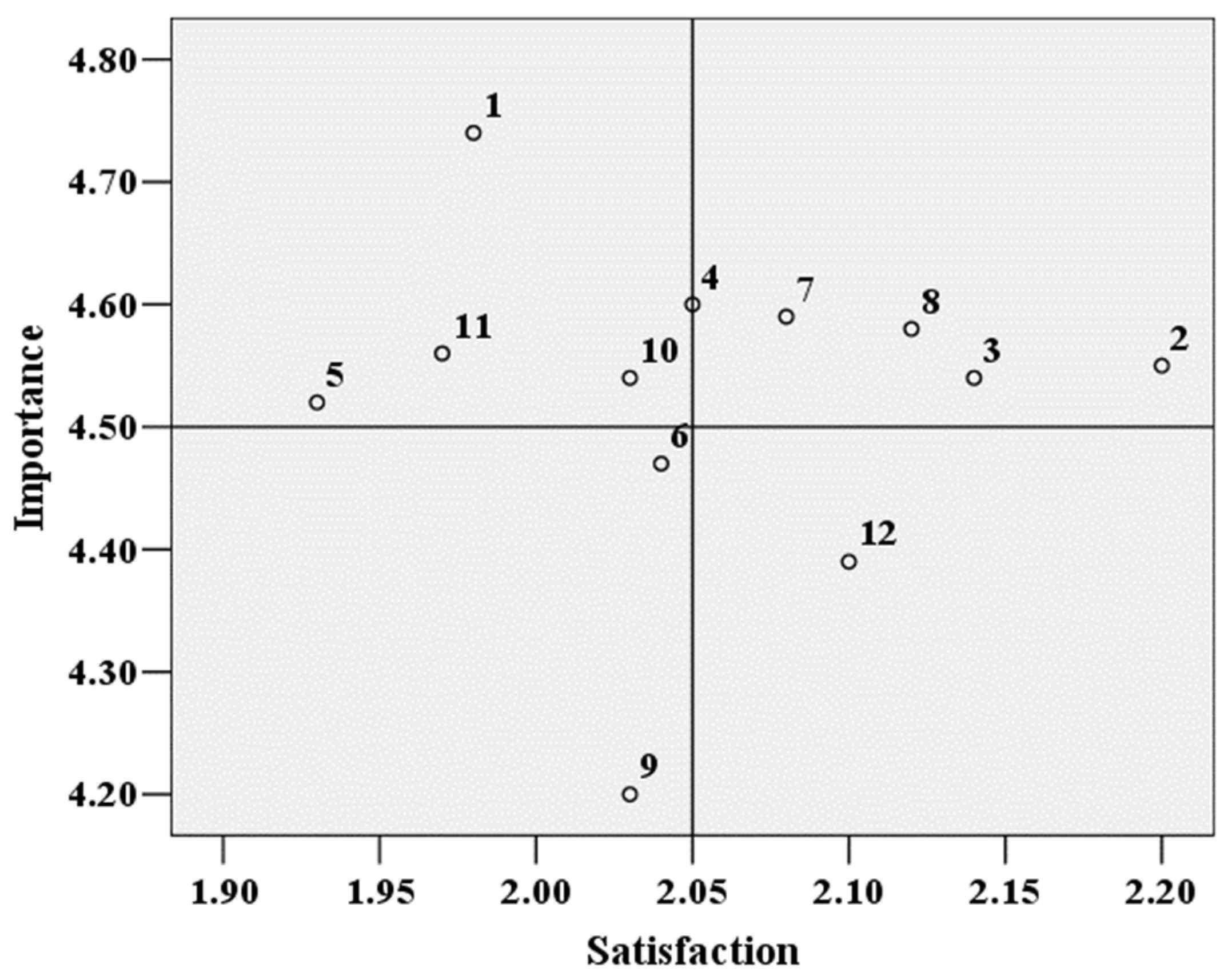
| Attributes | Importance | Satisfaction | Difference Index | IP Matrix | |
|---|---|---|---|---|---|
| Item 1 | 4.74 | 1.98 | 2.753 | 1.000 | Concentrated here |
| Item 2 | 4.55 | 2.20 | 2.350 | 0.250 | Keep up the good work |
| Item 3 | 4.54 | 2.14 | 2.403 | 0.333 | Keep up the good work |
| Item 4 | 4.60 | 2.05 | 2.550 | 0.750 | Concentrated here |
| Item 5 | 4.52 | 1.93 | 2.590 | 0.833 | Concentrated here |
| Item 6 | 4.47 | 2.04 | 2.434 | 0.417 | Low priority |
| Item 7 | 4.59 | 2.08 | 2.508 | 0.667 | Keep up the good work |
| Item 8 | 4.58 | 2.12 | 2.459 | 0.500 | Keep up the good work |
| Item 9 | 4.20 | 2.03 | 2.168 | 0.083 | Low priority |
| Item 10 | 4.54 | 2.03 | 2.506 | 0.583 | Concentrated here |
| Item 11 | 4.56 | 1.97 | 2.592 | 0.917 | Concentrated here |
| Item 12 | 4.39 | 2.10 | 2.291 | 0.167 | Possible overkill |
| Attributes | CSI | CII | Oc | Cr | Cr Ranking | |
|---|---|---|---|---|---|---|
| Item 1 | 0.73 | 1.000 | 0.73 | 0.46 | 0.97 | 1 |
| Item 2 | 0.65 | 0.250 | 0.16 | 0.26 | 0.76 | 10 |
| Item 3 | 0.59 | 0.333 | 0.20 | 0.34 | 0.84 | 9 |
| Item 4 | 0.66 | 0.750 | 0.49 | 0.37 | 0.94 | 4 |
| Item 5 | 0.66 | 0.833 | 0.55 | 0.42 | 0.96 | 2 |
| Item 6 | 0.59 | 0.417 | 0.25 | 0.28 | 0.85 | 8 |
| Item 7 | 0.67 | 0.667 | 0.45 | 0.37 | 0.94 | 5 |
| Item 8 | 0.59 | 0.500 | 0.30 | 0.31 | 0.89 | 7 |
| Item 9 | 0.50 | 0.083 | 0.04 | 0.30 | 0.16 | 12 |
| Item 10 | 0.62 | 0.583 | 0.36 | 0.37 | 0.92 | 6 |
| Item 11 | 0.64 | 0.917 | 0.59 | 0.40 | 0.96 | 3 |
| Item 12 | 0.50 | 0.167 | 0.08 | 0.25 | 0.51 | 11 |
Disclaimer/Publisher’s Note: The statements, opinions and data contained in all publications are solely those of the individual author(s) and contributor(s) and not of MDPI and/or the editor(s). MDPI and/or the editor(s) disclaim responsibility for any injury to people or property resulting from any ideas, methods, instructions or products referred to in the content. |
© 2023 by the authors. Licensee MDPI, Basel, Switzerland. This article is an open access article distributed under the terms and conditions of the Creative Commons Attribution (CC BY) license (https://creativecommons.org/licenses/by/4.0/).
Share and Cite
Hu, K.-C.; Salim, V. Combining Kano’s Model, IPA, and FMEA to Evaluate Service Quality Risk for Bus Service: Case of Bangkok Bus Service. Appl. Sci. 2023, 13, 5960. https://doi.org/10.3390/app13105960
Hu K-C, Salim V. Combining Kano’s Model, IPA, and FMEA to Evaluate Service Quality Risk for Bus Service: Case of Bangkok Bus Service. Applied Sciences. 2023; 13(10):5960. https://doi.org/10.3390/app13105960
Chicago/Turabian StyleHu, Kai-Chieh, and Vera Salim. 2023. "Combining Kano’s Model, IPA, and FMEA to Evaluate Service Quality Risk for Bus Service: Case of Bangkok Bus Service" Applied Sciences 13, no. 10: 5960. https://doi.org/10.3390/app13105960
APA StyleHu, K.-C., & Salim, V. (2023). Combining Kano’s Model, IPA, and FMEA to Evaluate Service Quality Risk for Bus Service: Case of Bangkok Bus Service. Applied Sciences, 13(10), 5960. https://doi.org/10.3390/app13105960