Article

Colour Changes of Acetal Resins (CAD-CAM) In Vivo

by
Cristina Gómez-Polo
1,*,
Ana María Martín Casado
2,
Norberto Quispe
1,
Eva Rosel Gallardo
3 and
Javier Montero
1
1
Department of Surgery, Faculty of Medicine, University of Salamanca, 37007 Salamanca, Spain
2
Department of Statistics, Faculty of Medicine, University of Salamanca, 37007 Salamanca, Spain
3
Department of Preventive and Community Dentistry, Faculty of Dentistry, University of Granada, 18011 Granada, Spain
*
Author to whom correspondence should be addressed.
Appl. Sci. 2023, 13(1), 181; https://doi.org/10.3390/app13010181
Submission received: 1 December 2022 / Revised: 15 December 2022 / Accepted: 16 December 2022 / Published: 23 December 2022
(This article belongs to the Special Issue New Techniques, Materials and Technologies in Dentistry)

Abstract

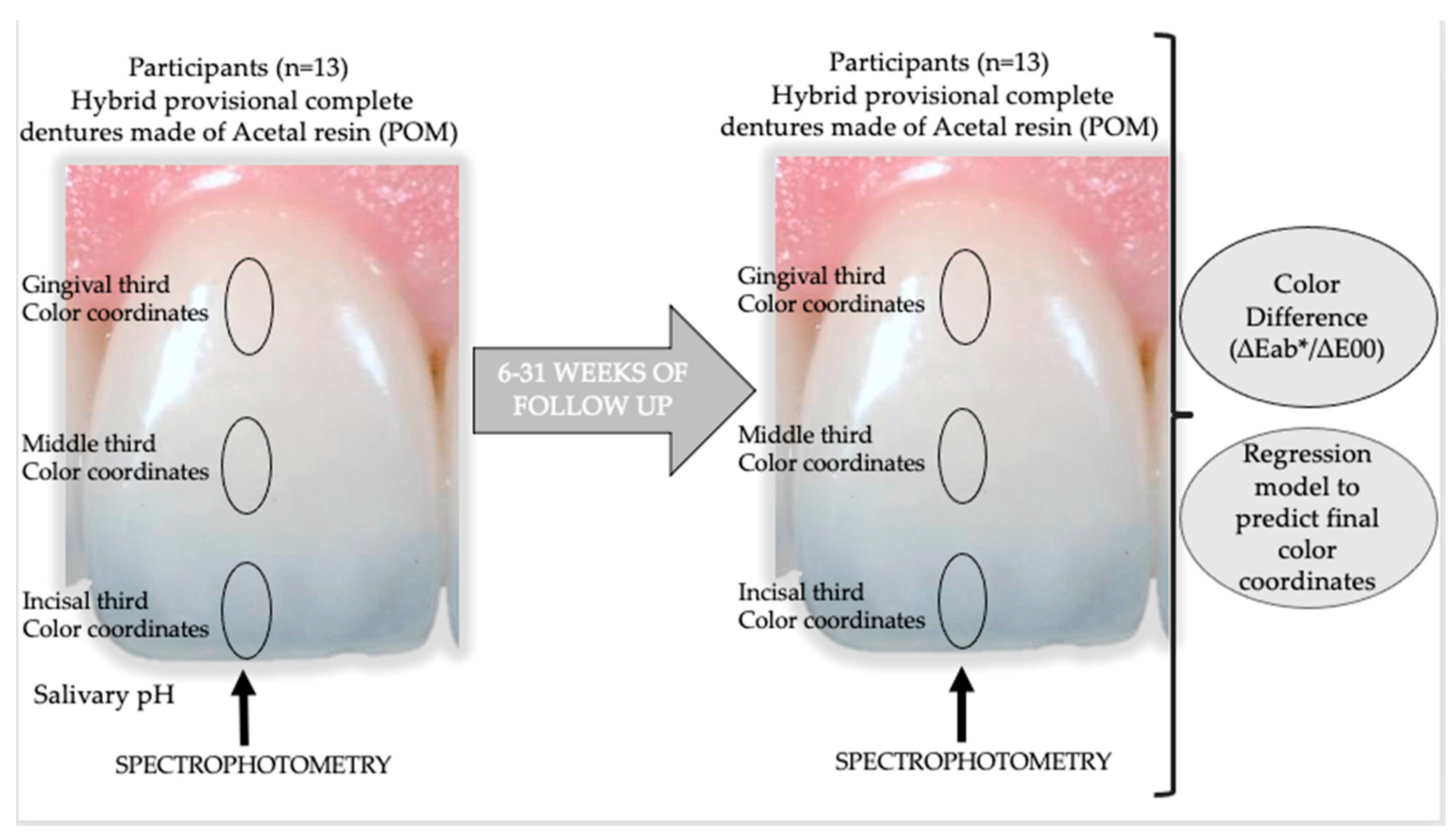
To quantify the discolouration of the temporary acetal resins in vivo, based on the weeks of follow-up and the salivary pH in the three thirds of the tooth. To find out if the final CIELAB coordinates can be predicted from the initial colour coordinates, the salivary pH, the situation (in thirds) and the weeks of follow-up. Colour coordinates (L, C, and h) were recorded by spectrophotometry in 13 participants fitted with hybrid provisional complete dentures made of acetal resin. Colour recordings were made on the day of placement and after several weeks of follow-up (6 to 31 weeks). Salivary pH was also measured as a predictor variable for colour change. The ANOVA statistical test and regression models have been used. The highest colour difference according to ∆Eab* was 27.46 units after 15 weeks of follow-up and the lowest was 7.34 units after 17 weeks of follow-up. Neither in the cervical nor in the middle third any regressor variable (initial L*, initial C*, initial h*, salivary pH and weeks of follow-up) was able to significantly predict any of the final colour coordinates (p > 0.05). The colour change of the temporary acetal resins used exceeds the threshold of clinical acceptability, and it is not acceptable to maintain satisfactory aesthetics. The weeks of follow-up and the salivary pH are not capable of satisfactorily predicting the final color coordinates of the acetal resins.
Keywords: acetal resins; spectrophotometer; CIELAB colour space; difference of colour formulae; interim dental restoration; dentistry; temporal resin acetal resins; spectrophotometer; CIELAB colour space; difference of colour formulae; interim dental restoration; dentistry; temporal resin