Article

Ultrasound Localization Microscopy in Liquid Metal Flows
1
Laboratory of Measurement and Sensor System Technniques, TU Dresden, 01069 Dresden, Germany
2
Department of Magnetohydrodynamics, Helmholtz-Zentrum Dresden-Rossendorf, 01314 Dresden, Germany
3
Institute of Applied Physics, TU Dresden, 01069 Dresden, Germany
*
Authors to whom correspondence should be addressed.
Appl. Sci. 2022, 12(9), 4517; https://doi.org/10.3390/app12094517
Submission received: 14 March 2022 / Revised: 14 April 2022 / Accepted: 21 April 2022 / Published: 29 April 2022
(This article belongs to the Special Issue Computational Ultrasound Imaging and Applications)

Abstract

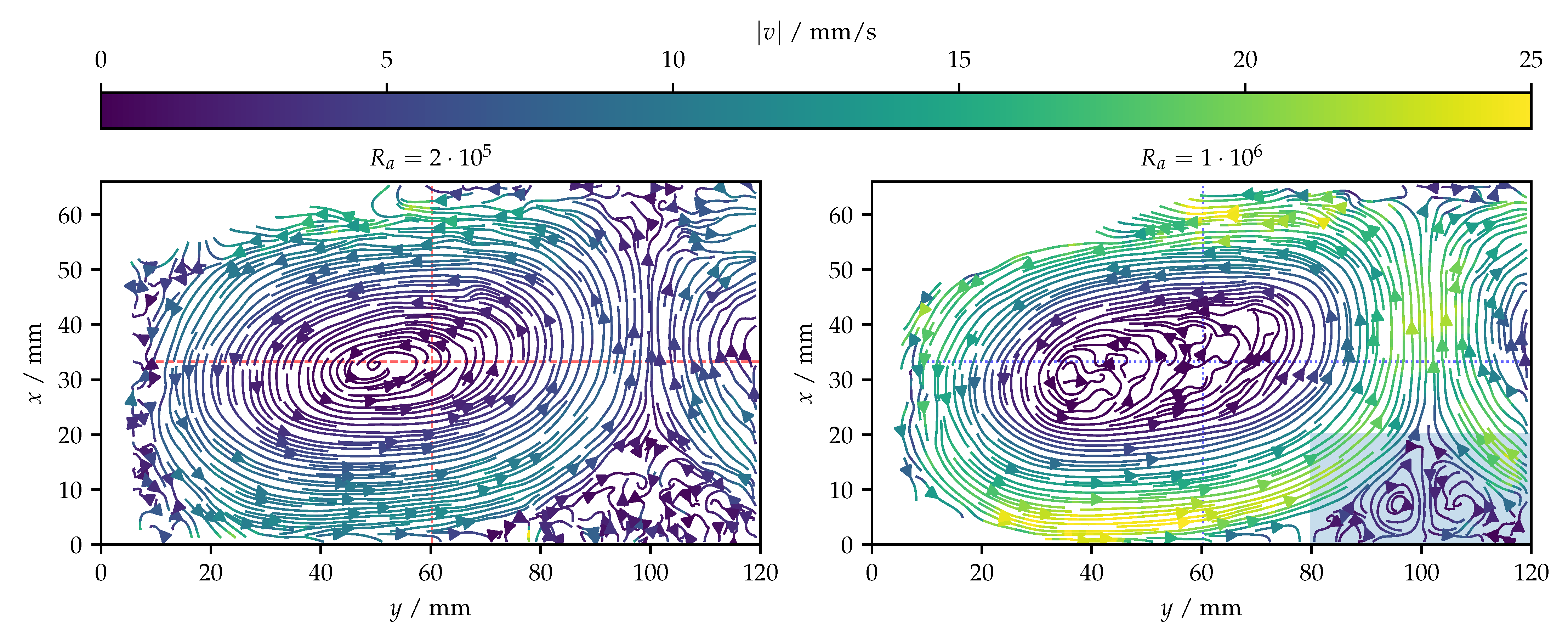
Liquid metal convection plays an important role in natural and technical processes. In experimental studies, an instrumentation with a sub-millimeter spatial resolution is required in an opaque fluid to resolve the flow field near the boundary layer. Using ultrasound methods, the trade-off between the frequency and imaging depth of typical laboratory experiments limits the spatial resolution. Therefore, the method of ultrasound localization microscopy (ULM) was introduced in liquid metal experiments for the first time in this study. To isolate the intrinsic scattering particles, an adaptive nonlinear beamformer was applied. As a result, an average spatial resolution of 188 μm could be achieved, which corresponded to a fraction of the ultrasound wavelength of 0.28. A convection experiment was measured using ULM. Due to the increased spatial resolution, the high-velocity gradients and the recirculation areas of a liquid metal convection experiment could be observed for the first time. The presented technique paves the way for in-depth flow studies of convective turbulent liquid metal flows that are close to the boundary layer.
Keywords: ultrasound imaging; ultrasound localization microscopy; sub-diffraction imaging; ultrafast imaging; adaptive beamforming; magnetohydrodynamic convection ultrasound imaging; ultrasound localization microscopy; sub-diffraction imaging; ultrafast imaging; adaptive beamforming; magnetohydrodynamic convection