Article

Clinical Mass Spectrometry in Immunosuppressant Analysis: Toward a Full Automation?
1
Clinical Chemistry Laboratory, Maggiore della Carità University Hospital, 28100 Novara, Italy
2
IRCAD & Department of Health Sciences, Amedeo Avogadro University of Eastern Piedmont, 28100 Novara, Italy
*
Author to whom correspondence should be addressed.
Appl. Sci. 2022, 12(7), 3695; https://doi.org/10.3390/app12073695
Submission received: 24 February 2022 / Revised: 4 April 2022 / Accepted: 5 April 2022 / Published: 6 April 2022
(This article belongs to the Special Issue New Mass Spectrometry Approaches for Clinical Diagnostics)

Abstract

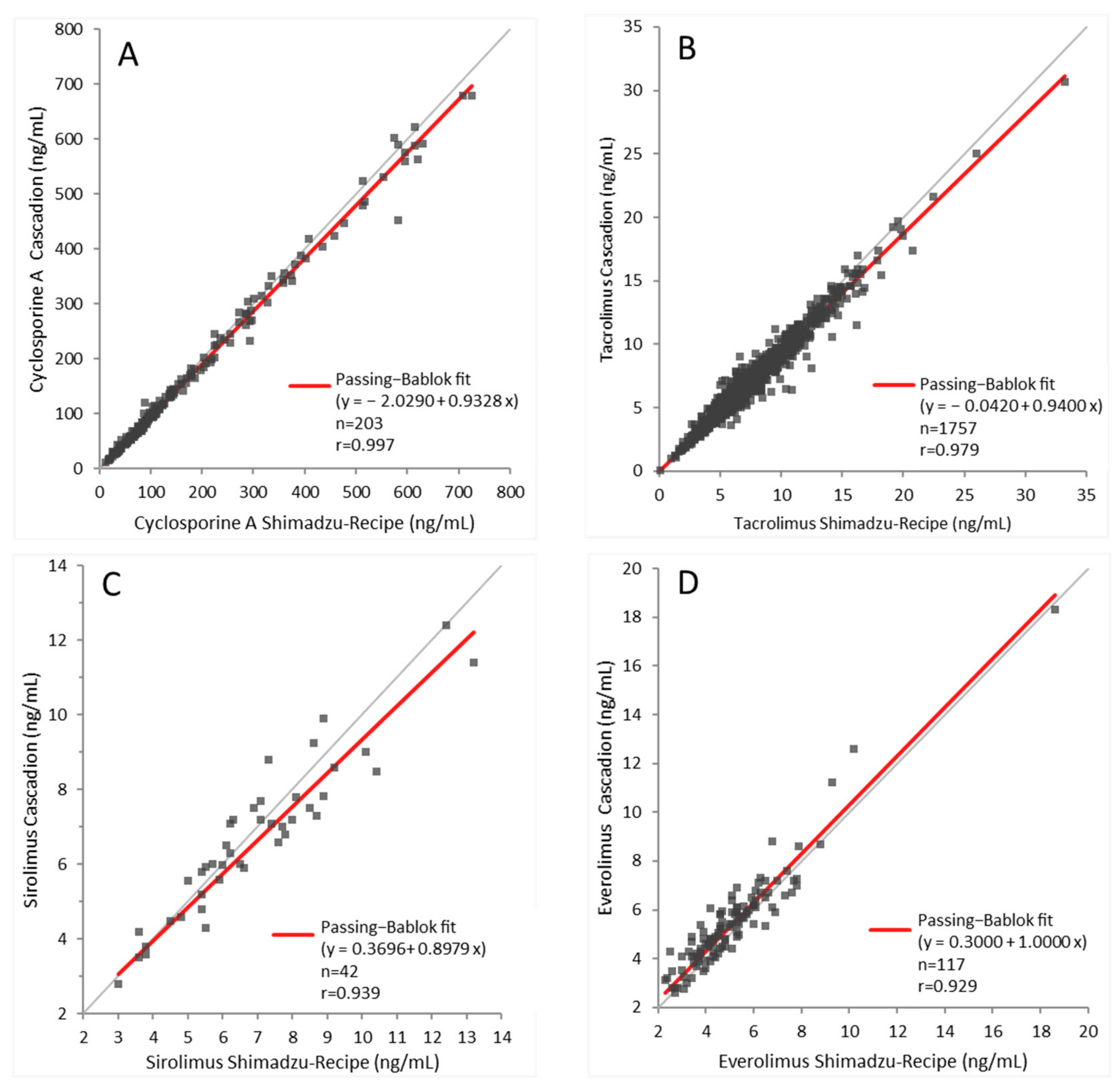
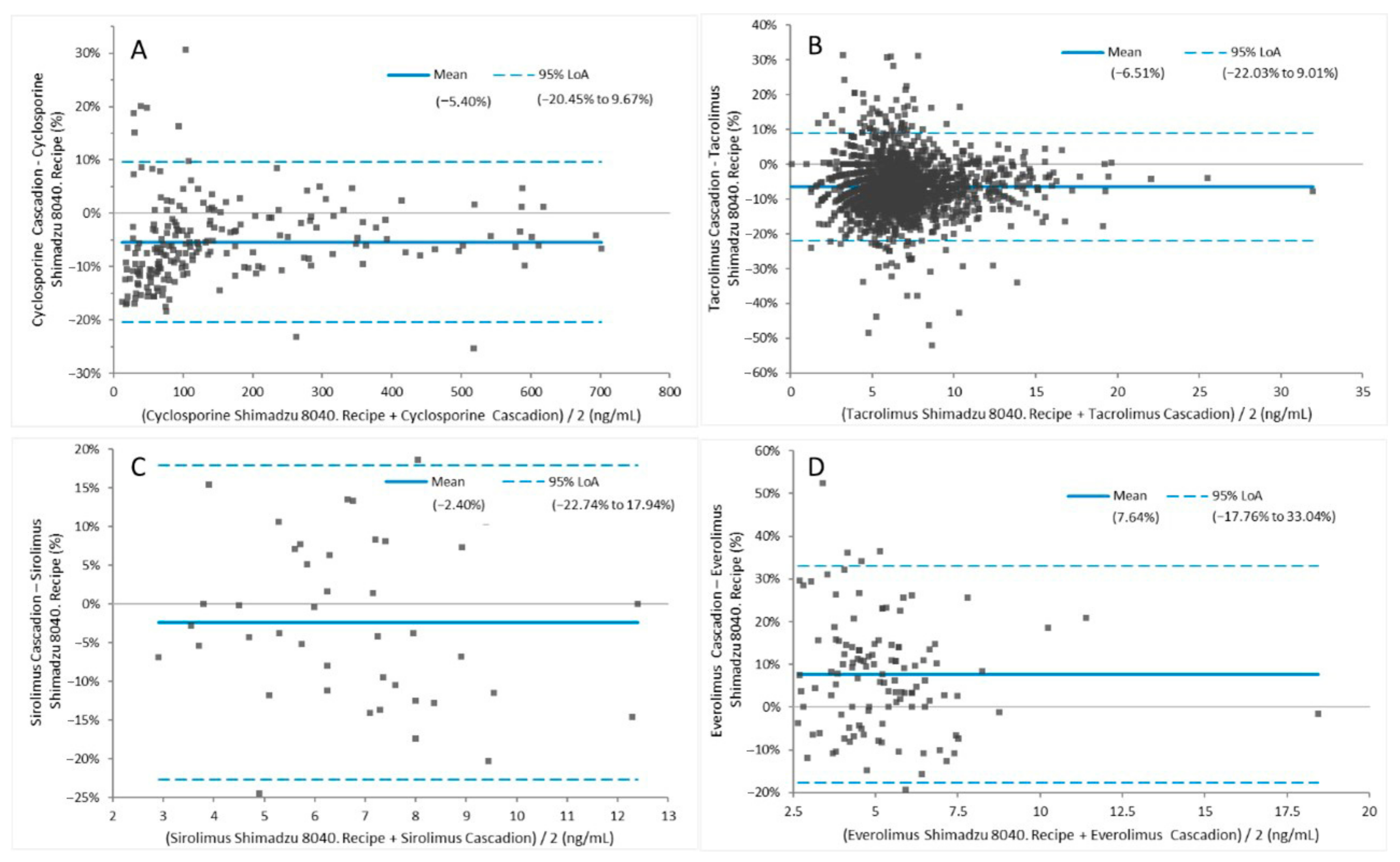
The analysis of immunosuppressive drugs allows the physician to monitor, and eventually correct, immunosuppressive therapy. The panel of molecules under evaluation includes cyclosporine A (CsA), tacrolimus, sirolimus, and everolimus. Initially, assays were performed by immunometric methods, but in the past few years this methodology has been largely superseded by a more accurate and specific technique, liquid chromatography coupled to tandem mass spectrometry (LC-MS/MS), which is now considered the “gold standard” for immunosuppressant analysis. Both LC-MS/MS and often also immunoassays require a preanalytical manual sample preparation, which involves time-consuming sequential operations whose traceability is often hampered and adds up to the probability of gross errors. The aim of this work was to compare an “open” LC-MS/MS with a fully automated system, consisting of LC instrumentation combined with a triple quadrupole MS, named Thermo ScientificTM CascadionTM SM Clinical Analyzer (Cascadion). Such automated systems suit the requirements of the reference method and are designed to completely eliminate all of the manual procedures. More than 2000 immunosuppressant samples were analyzed both with the open LC-MS/MS and with Cascadion. Statistics allowed the evaluation of linearity, intra- and inter-assay CV%, bias %, limit of detection and of quantitation, and Passing–Bablok and Bland–Altman plots. Results indicated a good correlation between the two methods. In both cases, methods confirmed their suitability for diagnostic settings. Cascadion could provide support when the presence of specialized personnel is lacking, and/or when great productivity and continuous workflow are required.
Keywords: LC-MS/MS; TDM; automation LC-MS/MS; TDM; automation