Article

The Changsha Historic Urban Area: A Study on the Changing Accessibility of the Road Network
1
School of Architecture and Art, Central South University, Changsha 410011, China
2
College of Architecture and Urban Planning, Guizhou University, Guiyang 550025, China
3
School of Civil Engineering, Central South University, Changsha 410011, China
4
School of Civil Engineering, China Jiangxi Transportation Vocational and Technical College, Nanchang 330000, China
5
School of Urban and Rural Planning and Architectural Engineering, Guiyang University, Guiyang 550025, China
6
School of Civil Engineering, Guizhou University, Guiyang 550025, China
*
Author to whom correspondence should be addressed.
Appl. Sci. 2022, 12(6), 2796; https://doi.org/10.3390/app12062796
Submission received: 6 January 2022 / Revised: 28 February 2022 / Accepted: 2 March 2022 / Published: 9 March 2022
(This article belongs to the Special Issue Slope Stability and Earth Retaining Structures)

Abstract

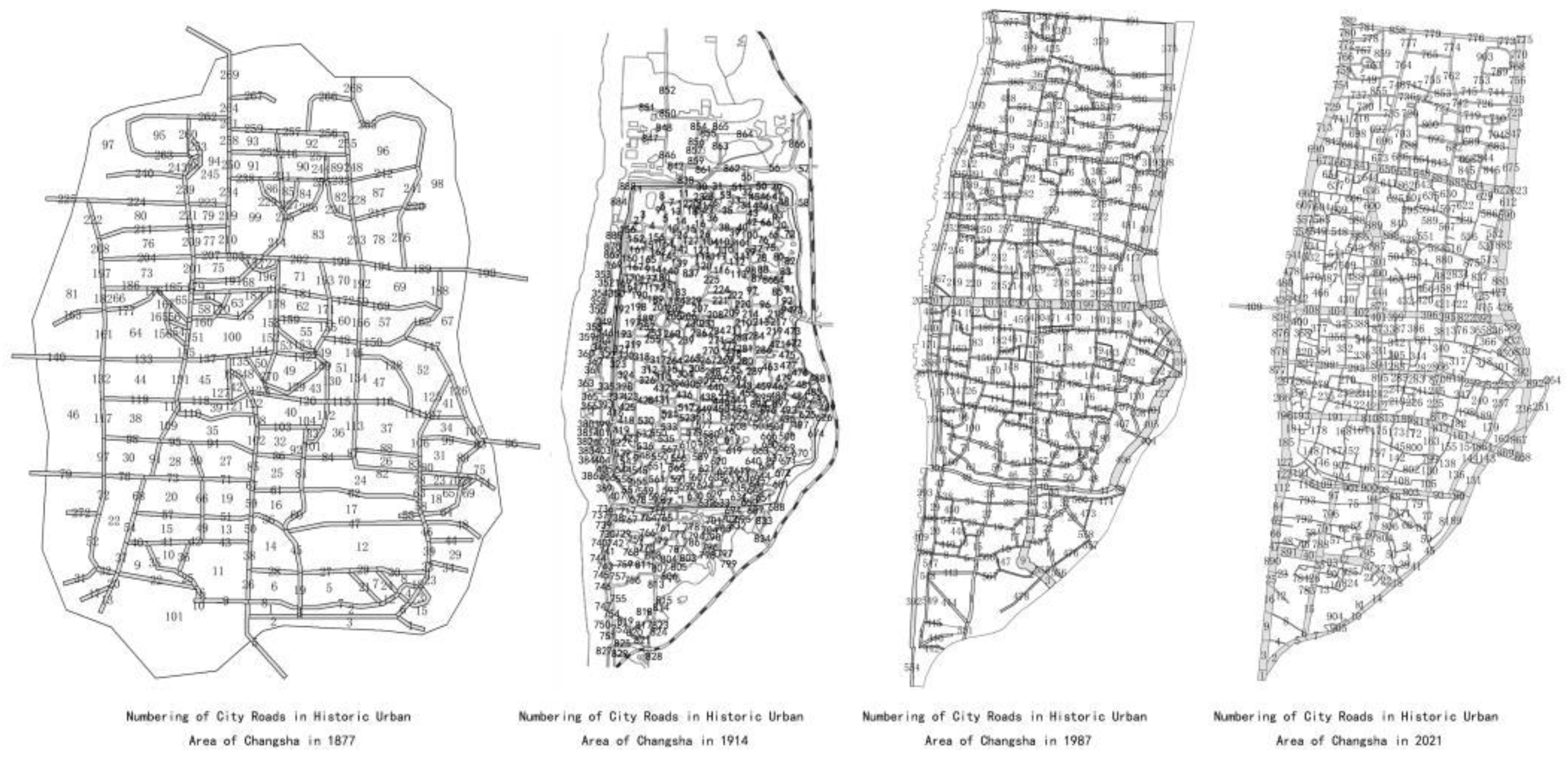
In this study, we used a complex network analysis to examine the accessibility features of changing road networks in historic urban areas. We aimed to discover the pattern of evolution after studying the accessibility of the road network in the Changsha historic urban area over four periods of time. The results were as follows: the layout of the urban road network shows repetitive cluster–parent–subsidiary development, which provides evidence of adaptive adjustment in urban road development; vulnerability has been kept low in the changing urban road network, while the spatial framework of the Changsha historic center is fixed; the evolving urban road network generally shows a deteriorating level of stability, which is largely affected by the shape of the network; the degree centrality (1877, 1.87%; 1917, 1.32%; 1987, 1.85%; 2021, 1.51%) of the urban road network shows a decreasing trend, meaning that the network is generally becoming more balanced in its evolution; and the accessibility of land plots currently used to preserve cultural relics and historic sites remains at a medium to low level, and improvements are needed for some plots. In analyzing the changing accessibility of urban roads in the historic center of Changsha city, two major problems for road renewal were identified: (1) unbalanced development of the urban space due to capital-based projects and (2) providing an appropriate increase in plot accessibility while putting equal emphasis on the protection of the spatial framework in the historic urban area. We conclude that a dynamic review of urban road network accessibility and its targeted optimization are of great significance for the protection and development of Changsha’s historic urban area.
Keywords: complex network; urban road; network structure; accessibility; Changsha historic urban area complex network; urban road; network structure; accessibility; Changsha historic urban area