


Abstract
A fractional model was developed for presenting the thermal assessment of nanoparticles in an inclined moving surface. Water was used as a base fluid, while the nanofluid utilized copper oxide and silver nanoparticles. The modification of the thermal model was further supported by mixed convection, magnetic force, and porous saturated space. Slip effects to the porous surface were also introduced. The fluctuation in temperature at different times was assumed by following the ramped thermal constraints. The fractional computations for the set of flow problems were performed with implementations of the Atangana–Baleanu (AB) and Caputo–Fabrizio (CF) analytical techniques. The integration process for such computations was achieved using the Laplace transformation. The comparative velocity and thermal analysis for the water and kerosene-oil-based nanofluid model is presented. The declining change in the velocity was observed due to the increase in the volume fraction of nanoparticles. It was observed that the increment in the temperature profile was more progressive for the kerosene oil and silver nanoparticle suspension.
1. Introduction
Because of the rapid advancement of technology in all areas of life, global energy consumption continually increases. On the other hand, the use of fossil fuels has been reduced, and alternative energy resources are still being researched in order to improve their efficiency. Furthermore, fossil fuels have contributed to environmental damage and global warming. Nanotechnology’s revolution and its distinctive qualities in comparison to the huge scale of its originality have received a lot of attention. The multiple applications of nanotechnology in numerous spheres of life, such as the medical, engineering, industrial, and agricultural sectors, fueled this rapid rise. Nanotechnology is the study of the properties of tiny materials as a scientific field. Small nanoparticles of some solid materials with strong heat conductivity, such as titanium oxide and alumina, could be used to create nanotechnology-based approaches. When these nanometer-sized particles are suspended with a poor thermal conductivity base fluid, the heat transfer characteristics of the base fluids are likely to improve. This innovative fluid is known as a nanofluid, and it has a novel heat transfer property due to nanotechnology. Saving energy is, after all, the same as reducing the size of heat transfer equipment. Nanofluids have unique features that could make them beneficial in a variety of heat transfer applications, such as domestic refrigerators, pharmaceutical processes, machining, fuel cells, engine cooling, grinding, and so on. Choi [1] was the pioneer in investigating nanofluids as coolants and cooling agents. Recently, Mahdavi et al. [2] numerically studied the impact of the Poiseuille nanofluid flow between two flat plates and concluded that Brownian motion plays a crucial role in nanoparticle migration, especially when thermophoresis is involved. Dawar et al. [3] explored the effects of radiation on the heat transfer of a 3D MHD nanofluid across a spinning disk and found out that the velocity profiles decreased as the magnetic parameter increased. Using a nonuniform dynamical model, Uddin et al. [4] investigated the convective nanofluid flow inside a square cavity. Ghasemi et al. [5] deliberated the effects of the MHD and nonlinear radiation on the nanofluid flow across a stretched surface at the stagnation point. Entropy production phenomena were numerically examined using the activation energy and s heat source/sink by Li et al. [6]. Usman et al. [7] theoretically studied the heat and mass transport phenomena in a nanofluid flow upon a radially spinning disk filled with microorganisms. Mohsenian et al. [8] addressed the convective heat transfer in an MHD nanofluid flow inside two tubes. Klazly and Bognar [9] enhanced the heat transfer in a nanofluid flow in a channel-shaped geometry. Acharya et al. [10] analyzed the time-dependent MHD flow of a nanofluid upon a spinning disk. Muthtamilselvan et al. [11] reported nanofluid properties with microorganisms. Al-Mdallal et al. [12] addressed the copper nanofluid thermal impact for the spinning of disks.
Fractional calculus is the interesting branch of mathematics for which work was initiated after 1695 for suggesting the extension of integer derivatives [13]. Fractional models often result due to the formulation of many physical and scientific problems, such as quantum physics, plasma, chemistry, biological sciences, engineering, and industrial problems. The main motivations for addressing fractional simulations are the presence of singularities and local and nonlocal kernels. Different definitions regarding the fractional framework have been suggested by researchers in fractional calculus. The Caputo and Fabrizio technique [14] is one such mathematical fractional tool that can help to access the solutions of fractional problems. The definition of a CF operator is based on the exponential decay law. The novel aspect of the CF definition is the presence of a nonsingular kernel. On other hand, the Atangana–Baleanu (AB) derivative is another useful fractional tool that was recently implemented by many researchers [15]. The expression and implementation of the AB model is based on the definition of the Mittag–Leffler hypothesis. Investigators in recent decades [16,17,18,19,20,21,22,23,24,25] have focused a number of studies on some new techniques.
After presenting the above-mentioned research survey, the aim of the current continuation is to develop a fractional mathematical model for the nanofluid problem in the presence of base fluids. Kerosene oil and water base fluids are used with suspensions of cooper oxide and silver nanoparticles. The motivations for enhancing the thermal efficiency of water and kerosene oil materials are subject to various engineering and industrial applications where such materials are comprehensively used as fuel. Kerosene oil is a distillate that is commonly used as a solvent and fuel in many industrial processes such as coal, oil shale, and petroleum refining, etc. An inclined surface was subjected to a magnetic force, and a porous medium was used for thermal inspection. The fluctuation in temperature with ramped conditions with flow time constraints is presented. The analytical simulations are presented with help of two fractional approaches: the Atangana–Baleanu (AB) and Caputo time-fractional (CF) derivatives. Both techniques are supported with recent definitions, and computations were performed via MATLAB software. The thermal dynamic the of parameters is physically addressed.
2. Problem Formulation
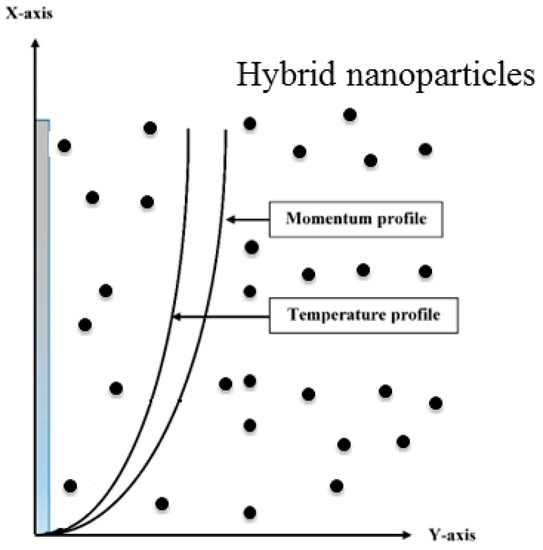
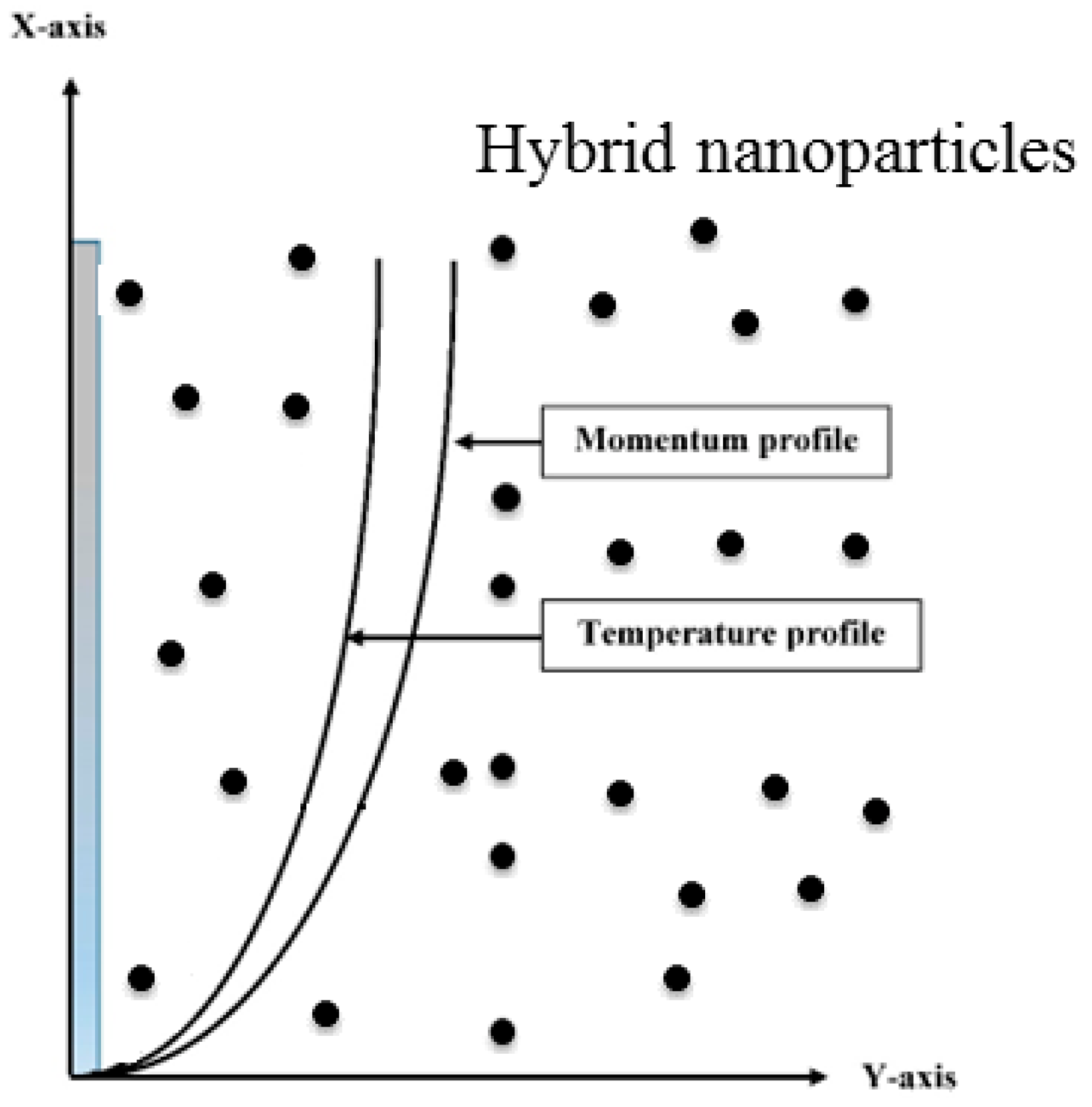
The thermal features of a nanofluid in the presence of kerosene oil and water base particles were studied. An inclined surface flow containing a uniform suspension of copper oxide and silver nanoparticles was considered. The magnetic force was normally implemented with an angle of inclination, . The impact of a porous medium was subjected to the flat surface (Figure 1). The suspension of nanoparticles and base materials with a uniform (50-50%) ratio was taken into consideration. The surface was further supported with slip constraints to control the fluid velocity. The flow in the stationary plate was induced after time . The governing model is presented in terms of the following mathematical expressions [26,27,28]:
Figure 1.
Flow configuration.
The boundary conditions for the fractional model are [26,27,28]:
The problem was entertained with following new variables [26,27,28]:
In view of the above new quantities, the problem was modified as:
with:
where:
The classical thermal features of water, kerosene oil, copper oxide, and silver particles are presented in Table 1.
Table 1.
The numerical values for water, kerosene oil, copper oxide, and silver nanoparticles.
3. Basics of Fractional Simulations
Definition 1.
The definition of Atangana–Baleanu (AB) for thefunction is presented as:
where the AB operator is . The Mittage-Leffer function, , is explained as:
Definition 2.
For Equation (13), the definition of the Laplace transform is:
and
Definition 3.
For any function the definition of the Caputo fractional (CF) is associated with the following definition:
where is the Caputo–Fabrizio operator.
Definition 4.
The Laplace transformation for CF is:
and with the Laplace-transformed variable of time for CF, we obtain:
4. Solution by Atangana–Baleanu (AB) Operator
The implementation of the AB fractional model with operator is suggested for Equation (9) as:
4.1. AB Operator for Temperature Profile
Using the Laplace transform in Equations (8) and (17) yields:
Introducing Equation (19) into Equation (18) yields:
where is the Laplace transform of function with the solution:
The solution via the AB approach for the temperature profile is:
In a more extended form, Equation (21) can be written as:
where:
Using the exponential function for determining the Laplace inverse of Equation (22), one obtains:
The solution for temperature change by following the Laplace inverse is:
where is the Heaviside function.
4.2. Velocity Field via AB-Fractional Derivative
Using the Laplace transform on Equation (7), the equation becomes:
with the conditions:
The solution is:
5. Modeling via CF Time-Fractional Derivative
In the above section, the simulations for the thermal and momentum profiles were found by utilizing CF-fractional derivatives. Now, the solution by a CF-fractional derivative can be formulated by using the CF-fractional derivative operative in Fourier’s law of thermal conductivity as follows:
5.1. Energy Field via CF-Fractional Derivative
As the thermal profile is autonomous of the momentum profile, the simulations of the thermal field can originate from Equations (8) and (26) by utilizing the Laplace transformation technique as follows:
where is the Laplace transformation of with the following conditions:
Now, presenting Equation (28) into Equation (27), we obtain:
By inputting the conditions, we yield:
Equation (29), in a more general form, can be formulated as:
where:
For the Laplace inverse of Equation (30), we use the summation form of the exponential function as follows:
By utilizing the Laplace inverse, we yield:
which is the required solution of the temperature field by the CF-fractional derivative.
5.2. Velocity Field via CF-Fractional Derivative
Taking the Laplace transform of velocity field Equation (8) and its corresponding conditions, such that:
with the succeeding transformed conditions:
the following solution of Equation (31) can be yielded by inputting the respective conditions in Equation (32):
As for the Laplace inverse, many authors have utilized different numerical schemes, so here, in this grinding stone, we also utilized the Stehfest and Tzous schemes for the solution of momentum fields attained by both the AB and CF-fractional definitions. The mathematical formulas of both algorithms can be summarized as follows [29,30,31,32]:
where is a positive integer, and
and
6. Special Cases
Because the dynamics velocity profile solutions via the AB and CF definitions in Equations (25) and (33) are more comprehensive, in order to provide some further physical understanding of the problem, we address certain exceptional situations for the momentum profile function , whose physical connotation is well-documented in the literature.
Case 1:
If we assume , the equations for the velocity field via AB and the CF derivative using Equations (25) and (33) are as follows.
and
Case 2:
Assuming is the shear stress strength), the velocity solution is:
and
Case 3:
Replacing the with the Laplace transform , the velocity determination in view of Equations (25) and (33) is:
and
Case 4:
Finally, for with Laplace the velocity solution for the AB and CF models in view of Equations (25) and (33) leads to:
and
7. Validation of Results
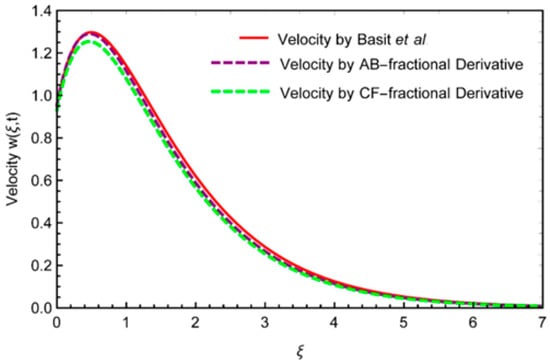
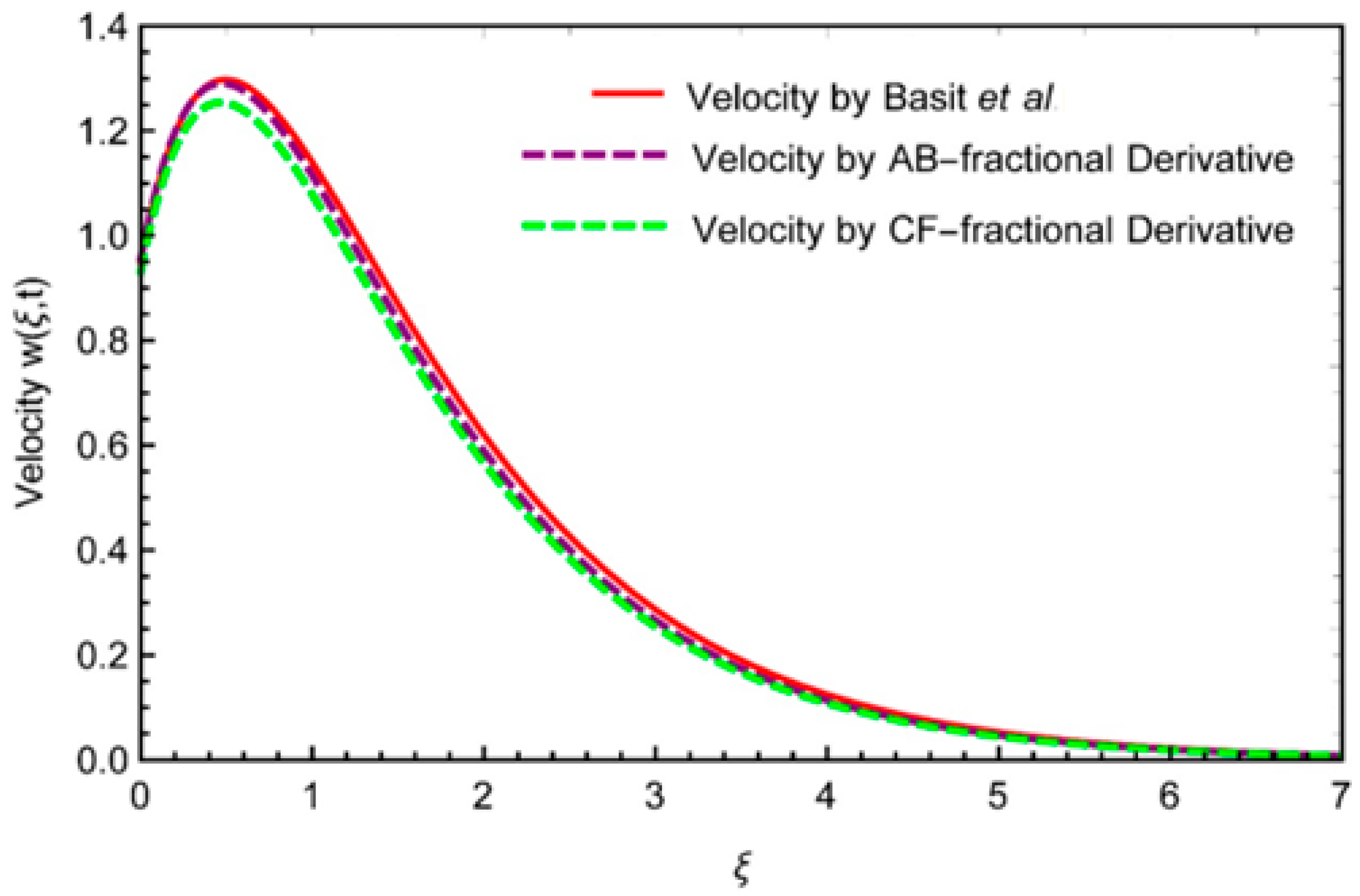
The fractional computations are verified in Figure 2 with the work of Basit et al. [30]. It is clearly noted that the obtained results show fine accuracy with these results.
Figure 2.
Comparison of the results with the work of Basit et al. [30].
8. Physical Analysis of Results
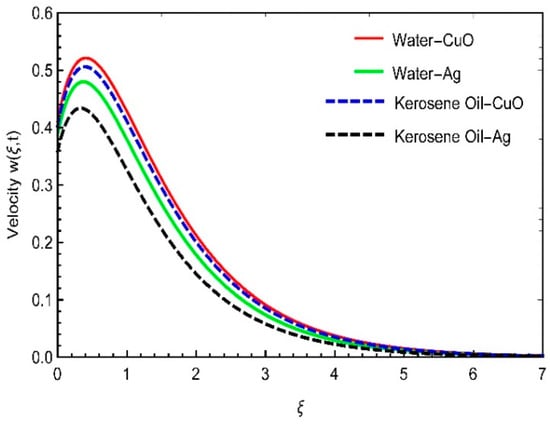
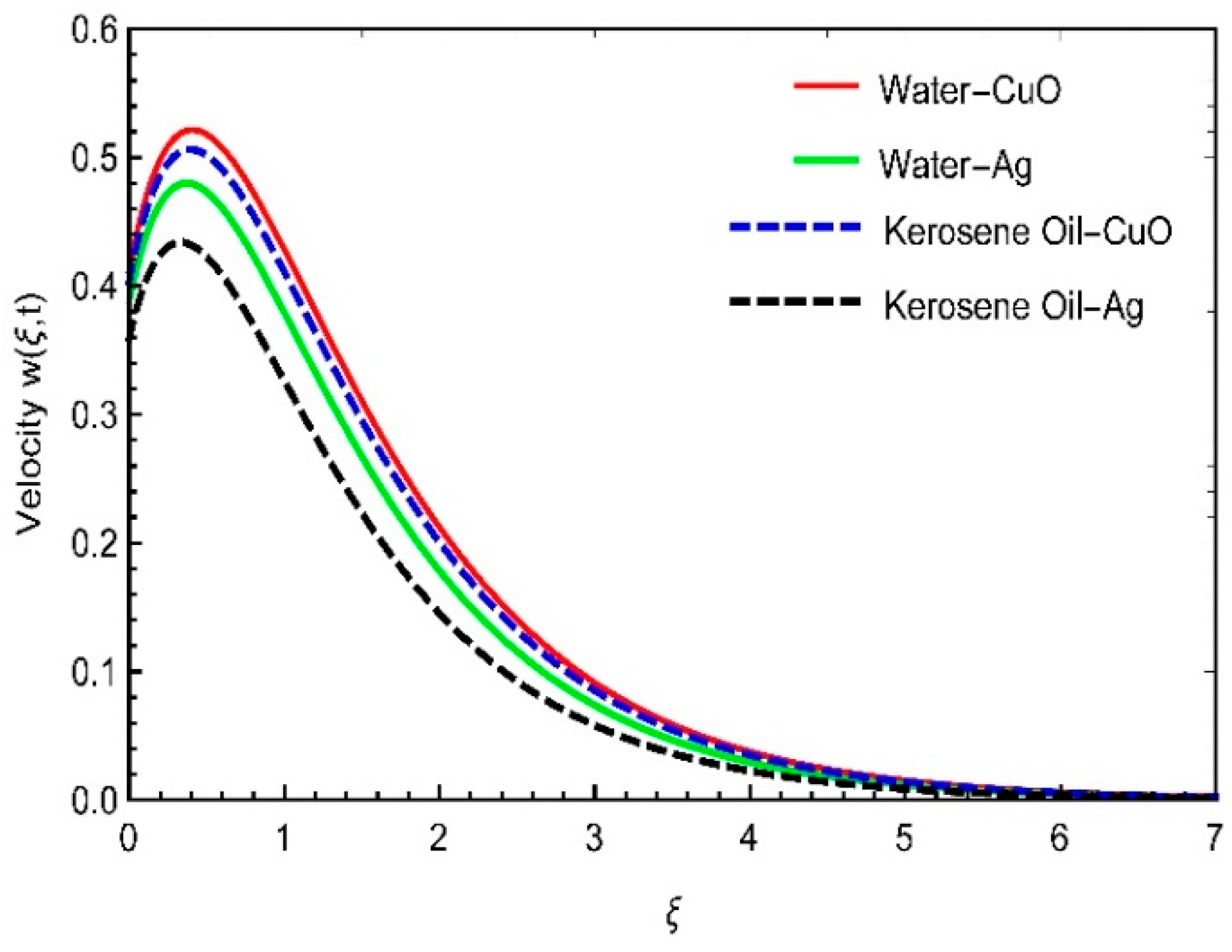
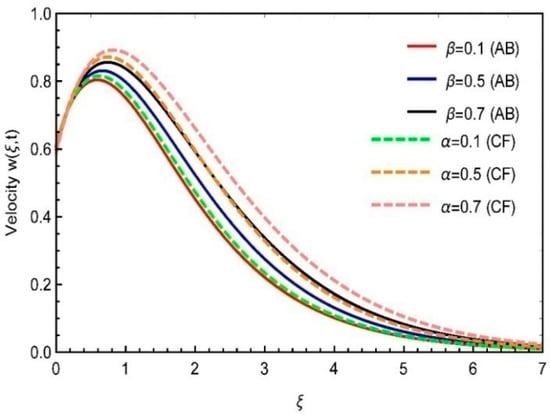
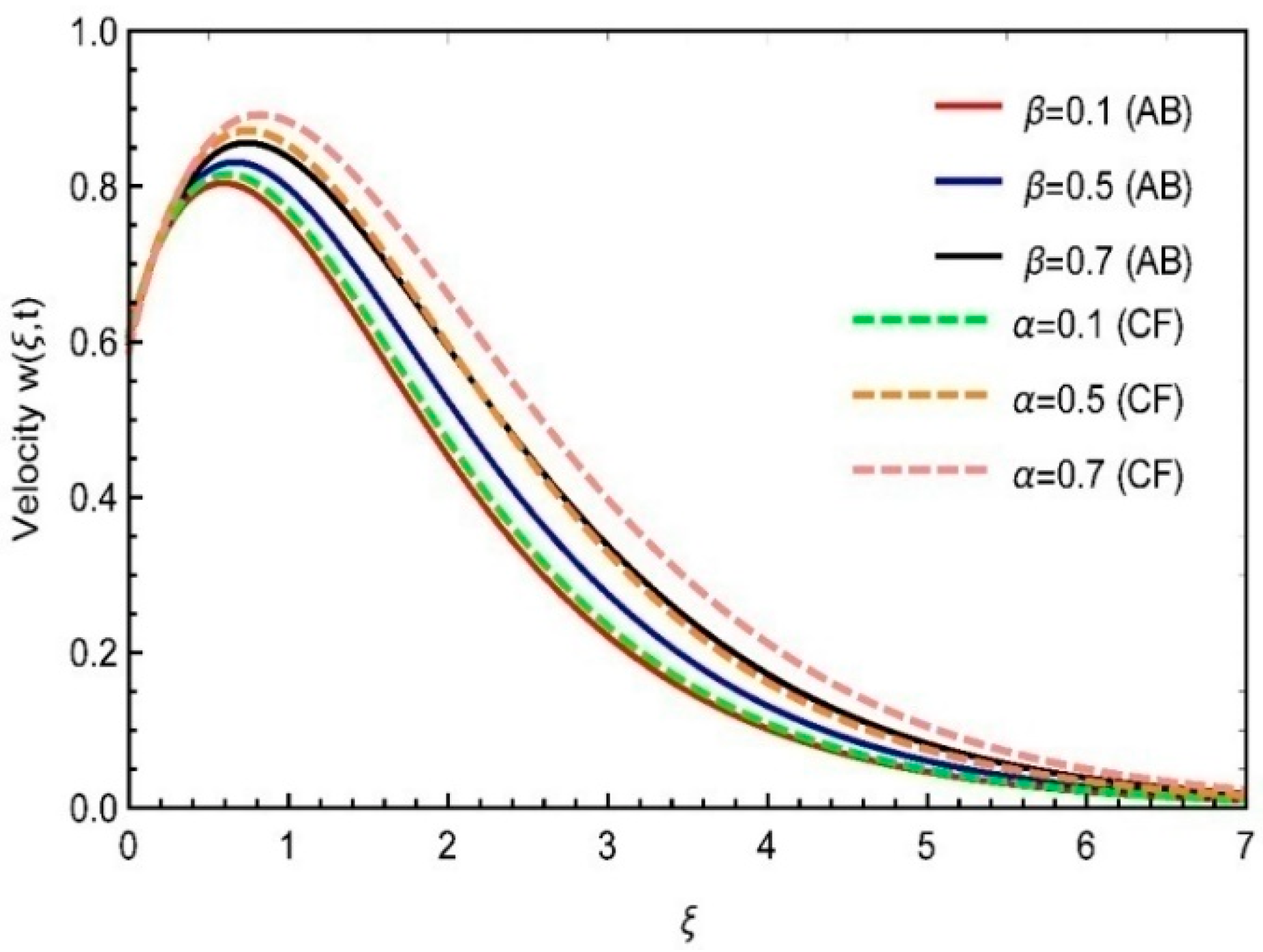
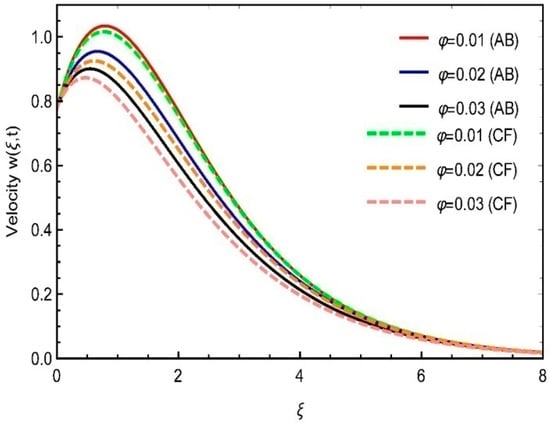
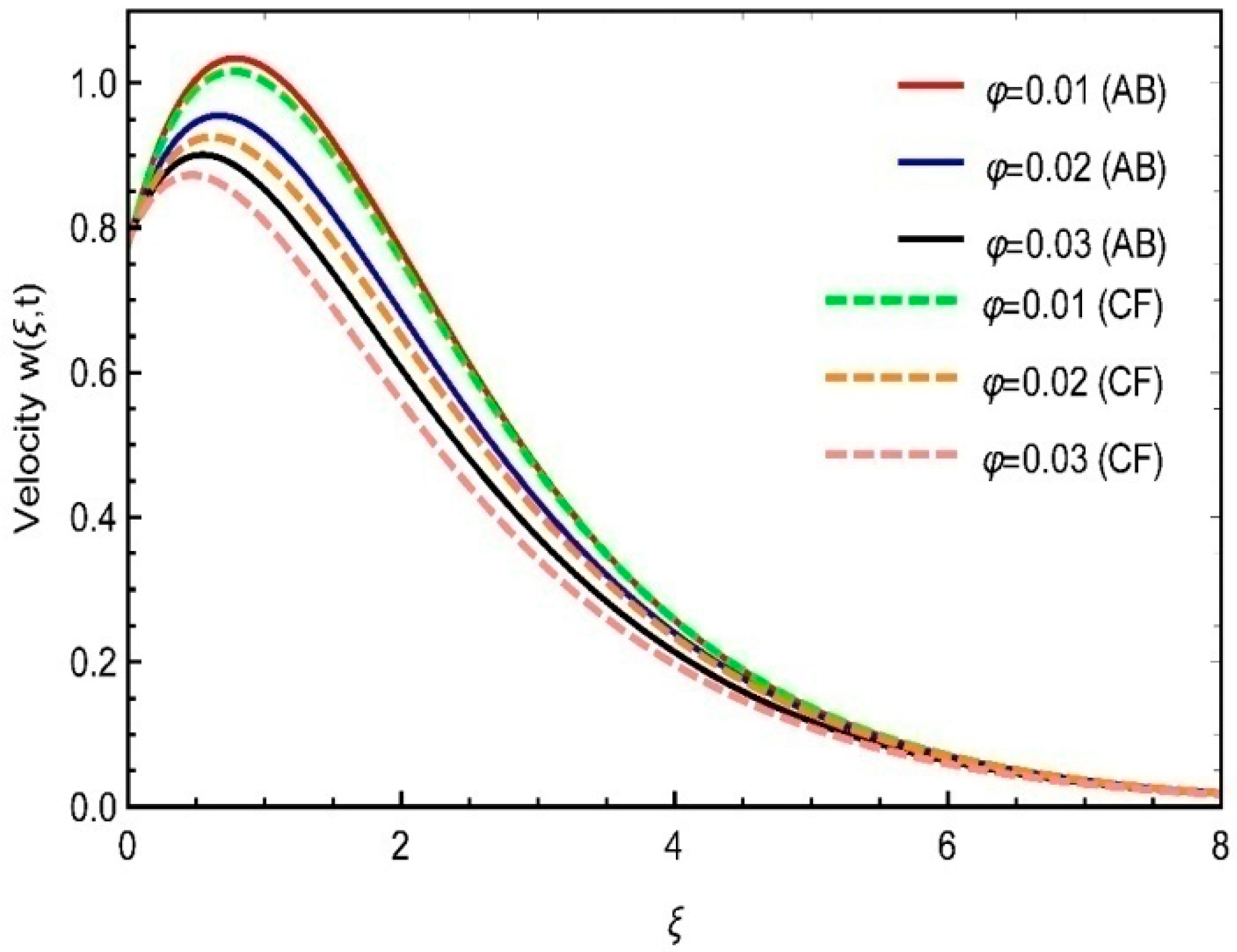
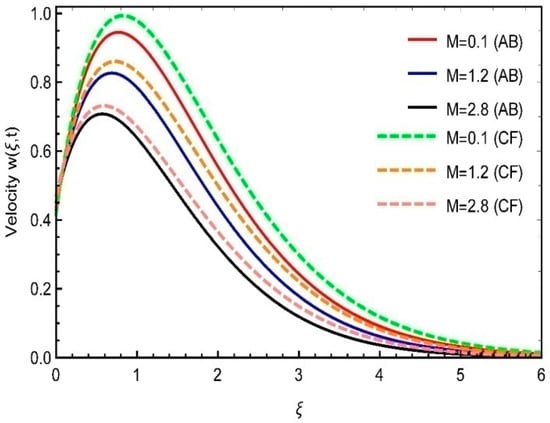
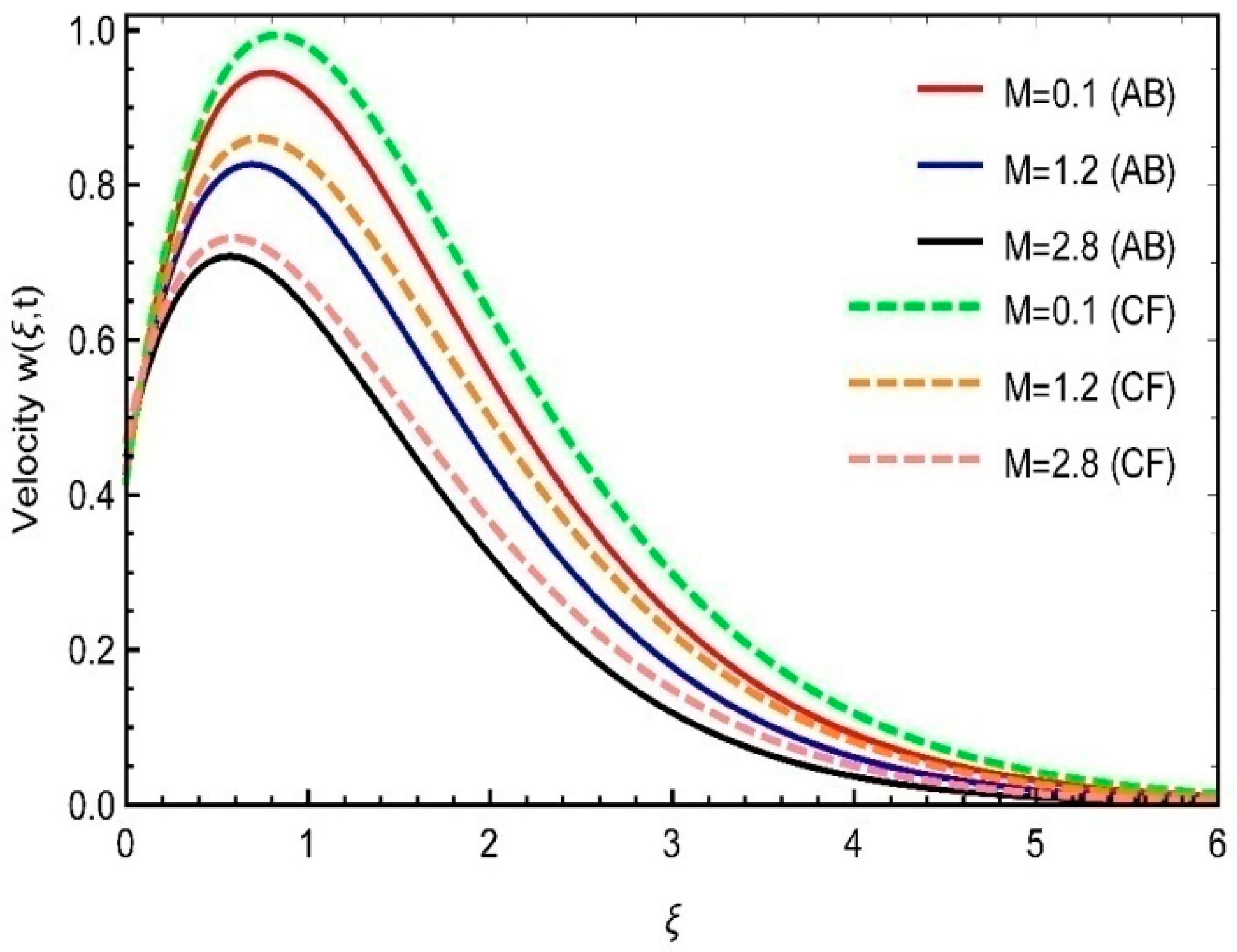
After performing the fractional simulations, the physical reflection of the parameters is presented in this section. For assessing the physical dynamic, numerical values were assigned to physical parameters, such as Figure 3, Figure 4, Figure 5, Figure 6 and Figure 7 illustrate the impacts of various parameters on the velocity and temperature field dynamics. It was remarked that, for nonlocal derivatives, we could analyze only one profile at but with the virtue of fractional-order derivative models, more than one profile of the subsequent problems could be analyzed. Moreover, the non-integer-order derivatives models could explain different layers for flowing fluid. Furthermore, due to this advantage of fractional models, the comparisons of different fluid layers could be examined individually. Figure 3 presents the comparative analysis of the velocity profile against the water and kerosene-oil base fluid with the suspension of copper oxide and silver nanoparticles. The water-based nanofluid showed more enhancement in the velocity profile compared to the kerosene-oil-based nanoparticle. Furthermore, the nanofluid mixed with copper oxide nanoparticles had a more significant impact on the velocity compared to the silver nanoparticles. Figure 4 reports the changes in velocity for and An increasing influence of velocity due to both factors was observed. The influence of the volume fraction parameter, on velocity is highlighted Figure 5. The declining velocity change was noted for increasing the volume fraction parameter. The effects of parameter on the velocity field are illustrated in Figure 6. As expected, the magnetic parameter slowed the fluid moment due to the influence of drag force, namely the Lorentz force. The Lorentz force could produce some resistance to fluid velocity due to resistive behavior.
Figure 3.
Comparative velocity profile for water- and kerosene-based nanofluids.
Figure 4.
Change in velocity for and .
Figure 5.
Change in velocity for .
Figure 6.
Change in velocity for .
Figure 7.
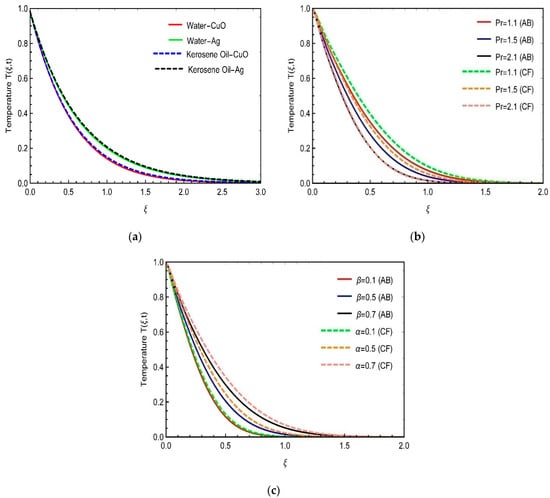
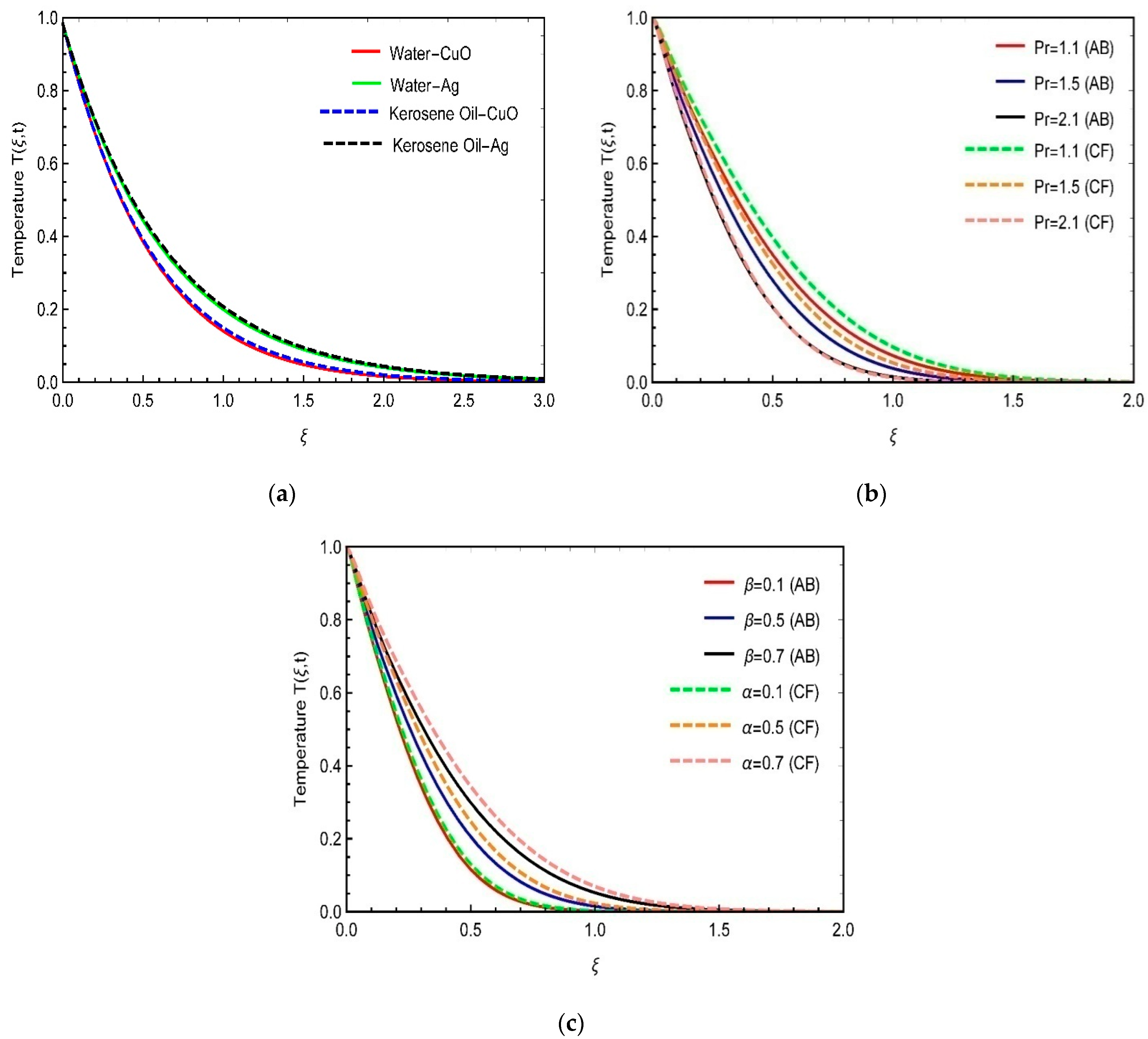
(a–c): (a) Comparative temperature profile for water- and kerosene-based nanofluids, (b) change in temperature for , and (c) change in temperature for .
The comparison of different nanofluids and nanoparticles for the thermal profile is plotted in Figure 7a. It is clear from the figure that the kerosene-oil-based nanofluid had a greater tendency to enhance the thermal conductivity than the water-based nanofluid. Figure 7b illustrates the impact of the Prandtl number, on the temperature profile. A falling behavior of the temperature profile can be seen against a larger Prandtl constant. Physically, with the increment in values, the thermal forces were weakened. Figure 7c aims to present the thermal aspect of the fractional parameters and on the temperature profile. The temperature profile rose for fractional parameters and Table 2 aims to address the numerical fluctuations in the velocity and temperature profile by using the Stehfest [31] and Tzou’s [32] integration tools. The lower temperature rate due to a larger space parameter, , was noted. However, the velocity increased for larger values using both techniques. After careful inspection, it was noted that the numerical results obtained via Tzou’s [32] technique had better relative convergence compared to Stehfest’s [31] tools. Table 3 presents the numerical values of the Nusselt number and the wall shear force. With an increment in the Nusselt number decreased, while an increasing impact of skin friction was observed.
Table 2.
The numerical outcomes for temperature and velocity profiles via Stehfest [31] and Tzou’s [32] integration tools.
Table 3.
Numerical analysis for Nusselt number and skin friction by both numerical algorithms.
9. Concluding Remarks
The fractional model for the nanofluids with kerosene oil and water base materials is presented. The thermal endorsement of the nanofluid particles was additionally impacted by slip effects, mixed convection, and magnetic forces. The computations were simulated with the Atangana–Baleanu (AB) and Caputo–Fabrizio (CF) fractional tools. The main results from current investigation are:
- ❖
- The thermal characteristics of heat transfer could be magnificently improved in the presence of copper oxide and silver nanoparticles.
- ❖
- A relatively improved profile of velocity was observed for the copper–water-based suspension compared to the kerosene-oil suspension.
- ❖
- A lower velocity rate was observed for the volume fraction and increasing values of fractional parameters.
- ❖
- The increasing thermal outcomes were predicted for the suspension of kerosene oil and silver nanoparticles compared to copper oxide and water-based material.
- ❖
- Decaying thermal outcomes were observed when the fractional parameters and Prandtl number were varied.
- ❖
- The numerical values for the temperature profile were more impressive compared to the velocity profile using Stehfest [31] and Tzou’s [32] integration techniques.
- ❖
- These results can be further extended by incorporating various thermal features such as entropy generation, exponential heat sources, activation energy, joule heating, and bioconvection and by using different non-Newtonian models.
Author Contributions
Conceptualization, O.T.B., S.U.K.; methodology, A.R.; software, A.R.; validation, M.I.K., A.N.; formal analysis, N.B.K.; investigation, S.U.K.; resources, M.I.K.; data curation, O.T.B.; writing—original draft preparation, A.R., S.U.K.; writing—review and editing, M.I.K., E.S.M.T.-E.; visualization, E.S.M.T.-E.; supervision, M.I.K.; project administration, M.I.K., S.U.K.; funding acquisition, E.S.M.T.-E. All authors have read and agreed to the published version of the manuscript.
Funding
This research received no external funding.
Institutional Review Board Statement
Not applicable.
Informed Consent Statement
Not applicable.
Data Availability Statement
All the data are clearly available in the manuscript.
Acknowledgments
The authors would like to thank the Deanship of Scientific Research at Umm Al-Qura University for supporting this work (grant code: 22UQU4340531DSR04).
Conflicts of Interest
The authors declare no conflict of interest.
Nomenclature
| Velocity | |
| Time | |
| Constant Velocity | |
| Density | |
| Temperature | |
| Thermal conductivity | |
| Prandtl number | |
| Grashof number | |
| Dynamic viscosity | |
| Density of nanoparticles | |
| Magnetic parameter | |
| Nanofluid | |
| slip parameter | |
| AB-fractional derivative operator | |
| CF-fractional derivative operator | |
| Nusselt number | |
| Skin Friction | |
| CF | Caputo–Fabrizio fractional derivative |
| Laplace variable by AB | |
| Laplace variable by CF | |
| Acceleration due to gravity | |
| AB | Atangana–Baleanu fractional derivative |
| Density of base fluid |
References
- Choi SUS 1995 Enhancing thermal conductivity of fluids with nanoparticles Proc Int Mech Eng Congress San Francisco USA ASME FED 231/MD66 99–105.
- Mahdavi, M.; Sharifpur, M.; Ahmadi, M.H.; Meyer, J.P. Nanofluid flow and shear layers between two parallel plates: A simulation approach. Eng. Appl. Comput. Fluid Mech. 2020, 14, 1536–1545. [Google Scholar] [CrossRef] [Scilit]
- Dawar, A.; Wakif, A.; Thumma, T.; Shah, N.A. Towards a new MHD non-homogeneous convective nanofluid flow model for simulating a rotating inclined thin layer of sodium alginate-based Iron oxide exposed to incident solar energy. Int. Commun. Heat Mass Transf. 2022, 130, 105800. [Google Scholar] [CrossRef] [Scilit]
- Uddin, M.J.; Rasel, S.K.; Adewole, J.K.; al Kalbani, K.S. Finite element simulation on the convective double diffusive water-based copper oxide nanofluid flow in a square cavity having vertical wavy surfaces in presence of hydro-magnetic field. Results Eng. 2022, 13, 100364. [Google Scholar] [CrossRef] [Scilit]
- Ghasemi, S.E.; Mohsenian, S.; Gouran, S.; Zolfagharian, A. A novel spectral relaxation approach for nanofluid flow past a stretching surface in presence of magnetic field and nonlinear radiation. Results Phys. 2022, 32, 105141. [Google Scholar] [CrossRef] [Scilit]
- Li, Y.M.; Al-Khaled, K.; Gouadria, S.; El-Zahar, E.R.; Usman Khan, S.U.; Khan, M.I.; Malik, M.Y. Numerical simulations for three-dimensional rotating porous disk flow of viscoelastic nanomaterial with activation energy, heat generation and Nield boundary conditions. Waves Random Complex Media 2022. [Google Scholar] [CrossRef] [Scilit]
- Usman; Bhatti, M.M.; Ghaffari, A.; Doranehgard, M.H. The role of radiation and bioconvection as an external agent to control the temperature and motion of fluid over the radially spinning circular surface: A theoretical analysis via Chebyshev spectral approach. Math. Meth. Appl. Sci. 2022, 1–18. [Google Scholar] [CrossRef] [Scilit]
- Mohsenian, S.; Gouran, S.; Ghasemi, S.E. Evaluation of weighted residual methods for thermal radiation on nanofluid flow between two tubes in presence of magnetic field. Case Stud. Therm. Eng. 2022, 32, 101867. [Google Scholar] [CrossRef] [Scilit]
- Klazly, M.; Bognar, G. Heat transfer enhancement for nanofluid flows over a microscale backward-facing step. Alex. Eng. J. 2022, 61, 8161–8176. [Google Scholar] [CrossRef] [Scilit]
- Acharya, N.; Mabood, F.; Shahzad, S.A.; Badruddin, I.A. Hydrothermal variations of radiative nanofluid flow by the influence of nanoparticles diameter and nanolayer. Int. Commun. Heat Mass Transf. 2022, 130, 105781. [Google Scholar] [CrossRef] [Scilit]
- Muthtamilselvan, M.; Suganya, S.; Al-Mdallal, Q.M. Stagnation-Point Flow of the Williamson Nanofluid Containing Gyrotactic Micro-organisms. Proc. Natl. Acad. Sci. India Sect. A Phys. Sci. 2021, 91, 633–648. [Google Scholar] [CrossRef] [Scilit]
- Al-Mdallal, Q.M.; Renuka, A.; Muthtamilselvan, M.; Abdalla, B. Ree-Eyring fluid flow of Cu-water nanofluid between infinite spinning disks with an effect of thermal radiation. Ain Shams Eng. J. 2021, 12, 2947–2956. [Google Scholar] [CrossRef] [Scilit]
- Milici, C.; Draganescu, G.; Machado, J.T. Introduction to Fractional Differential Equations; Springer Nature Switzerland AG: Cham, Switzerland, 2019. [Google Scholar]
- Caputo, M.; Fabrizio, M. A new definition of fractional derivative without singular kernel. Prog. Fract. Differ. Appl. 2015, 1, 73–85. [Google Scholar]
- Atangana, A.; Baleanu, D. New fractional derivatives with non-local and non-singular kernel: Theory and application to heat transfer model. Therm. Sci. 2016, 20, 763–769. [Google Scholar] [CrossRef] [Scilit]
- Waqas, H.; Oreijah, M.; Guedri, K.; Khan, S.U.; Yang, S.; Yasmin, S.; Khan, M.I.; Bafakeeh, O.T.; Tag-ElDin, E.S.M.; Galal, A.M. Gyrotactic motile microorganisms impact on pseudoplastic nanofluid flow over a moving Riga surface with exponential heat flux. Crystals 2022, 12, 1308. [Google Scholar] [CrossRef] [Scilit]
- Shahid, M.; Javed, H.M.A.; Ahmad, M.I.; Qureshi, A.A.; Khan, M.I.; Alnuwaiser, M.A.; Ahmed, A.; Khan, M.A.; Tag-Eldin, E.; Shahid, A.; et al. A brief assessment on recent developments in efficient electrocatalytic Nitrogen reduction with 2D non-metallic nanomaterials. Nanomaterials 2022, 12, 3413. [Google Scholar] [CrossRef] [Scilit]
- Manzoor, N.; Qasim, I.; Khan, M.I.; Ahmed, M.W.; Guedri, K.; Bafakeeh, O.T.; Tag-Eldin, E.S.M.; Galal, A.M. Antibacterial applications of low pressure plasma on degradation of multidrug resistant V. cholera. Appl. Sci. 2022, 12, 9737. [Google Scholar] [CrossRef] [Scilit]
- Mamatha, S.U.; Devi, R.L.V.R.; Ahammad, N.A.; Shah, N.A.; Rao, B.M.; Raju, C.S.K.; Khan, M.I.; Guedri, K. Multi-linear regression of triple diffusive convectively heated boundary layer flow with suction and injection: Lie group transformations. Int. J. Mod. Phys. B 2022, in press. [CrossRef] [Scilit]
- Kiranakumar, H.V.; Thejas, R.; Naveen, C.S.; Khan, M.I.; Prasanna, G.D.; Reddy, S.; Oreijah, M.; Guedri, K.; Bafakeeh, O.T.; Jameel, M. A review on electrical and gas-sensing properties of reduced graphene oxide-metal oxide nanocomposites. Biomass Convers. Biorefinery 2022, in press. [CrossRef] [Scilit]
- Abbasi, A.; Farooq, W.; Tag-ElDin, E.S.M.; Khan, S.U.; Khan, M.I.; Guedri, K.; Elattar, S.; Waqas, M.; Galal, A.M. Heat transport exploration for hybrid nanoparticle (Cu, Fe3O4)-based blood flow via tapered complex wavy curved channel with slip features. Micromachines 2022, 13, 1415. [Google Scholar] [CrossRef] [Scilit]
- Wahid, N.S.; Arifina, N.M.; Khashi’ie, N.S.; Pop, I.; Bachok, N.; Hafidzuddin, M.E.H. MHD mixed convection flow of a hybrid nanofluid past a permeable vertical flat plate with thermal radiation effect. Alex. Eng. J. 2022, 61, 3323–3333. [Google Scholar] [CrossRef] [Scilit]
- Ashorynejad, H.R.; Shahriari, A. MHD natural convection of hybrid nanofluid in an open wavy cavity. Results Phys. 2018, 9, 440–455. [Google Scholar] [CrossRef] [Scilit]
- Puneetha, V.; Khan, M.I.; Jameel, M.; Geudri, K.; Galal, A.M. The convective heat transfer analysis of the casson nanofluid jet flow under the influence of the movement of gyrotactic microorganisms. J. Indian Chem. Soc. 2022, 9, 100612. [Google Scholar] [CrossRef] [Scilit]
- Oztop, H.F.; Abu-Nada, E. Numerical study of natural convection in partially heated rectangular enclosures filled with nanofluids. Int. J. Heat Fluid Flow 2008, 29, 1326–1336. [Google Scholar] [CrossRef] [Scilit]
- Raza, A.; Ghaffari, A.; Khan, S.U.; Haq, A.U.; Khan, M.I.; Khan, M.R. Non-singular fractional computations for the radiative heat and mass transfer phenomenon subject to mixed convection and slip boundary effects. Chaos Solitons Fractals 2022, 155, 111708. [Google Scholar] [CrossRef] [Scilit]
- Raza, A.; Khan, S.U.; Al-Khaled, K.; Khan, M.I.; Haq, A.U.; Alotaibi, F.; Mousa, A.A.A.; Qayyum, S. A fractional model for the kerosene oil and water-based Casson nanofluid with inclined magnetic force. Chem. Phys. Lett. 2022, 787, 139277. [Google Scholar] [CrossRef] [Scilit]
- Raza, A.; Khan, S.U.; Khan, M.I.; Farid, S.; Muhammad, T.; Khan, M.I.; Galal, A.M. Fractional order simulations for the thermal determination of graphene oxide (GO) and molybdenum disulphide (MoS2) nanoparticles with slip effects. Case Stud. Therm. Eng. 2021, 28, 101453. [Google Scholar] [CrossRef] [Scilit]
- Guo, B.; Raza, A.; Al-Khaled, K.; Khan, S.U.; Farid, S.; Wang, Y.; IjazKhan, M.; Malik, M.Y.; Saleem, S. Fractional-order simulations for heat and mass transfer analysis confined by elliptic inclined plate with slip effects: A comparative fractional analysis. Case Stud. Therm. Eng. 2021, 28, 101359. [Google Scholar] [CrossRef] [Scilit]
- Basit, A.; Asjad, M.I.; Akgül, A. Convective flow of a fractional second grade fluid containing different nanoparticles with Prabhakar fractional derivative subject to non-uniform velocity at the boundary. Math. Methods Appl. Sci. 2021. [Google Scholar] [CrossRef] [Scilit]
- Stehfest, H. Algorithm 368: Numerical inversion of Laplace transforms [D5]. Commun. ACM 1970, 13, 47–49. [Google Scholar] [CrossRef] [Scilit]
- Tzou, D.Y. Macro-to Microscale Heat Transfer: The Lagging Behavior; John Wiley & Sons: Hoboken, NJ, USA, 2014. [Google Scholar]

Publisher’s Note: MDPI stays neutral with regard to jurisdictional claims in published maps and institutional affiliations. |
© 2022 by the authors. Licensee MDPI, Basel, Switzerland. This article is an open access article distributed under the terms and conditions of the Creative Commons Attribution (CC BY) license (https://creativecommons.org/licenses/by/4.0/).