Article

Weakly Supervised Learning with Positive and Unlabeled Data for Automatic Brain Tumor Segmentation


1
Section Experimental Radiology, Department for Diagnostic and Internventional Radiology, University Hospital Ulm, 89081 Ulm, Germany
2
Visual Computing Group, Institute of Media Informatics, Ulm University, 89081 Ulm, Germany
3
Department of Radiation Oncology, Heidelberg University Hospital, 69120 Heidelberg, Germany
4
IIIrd Radiotherapy and Chemotherapy Department, Maria Sklodowska-Curie National Research Institute of Oncology, 44-101 Gliwice, Poland
5
Radiology and Diagnostic Imaging Department, Maria Sklodowska-Curie National Research Institute of Oncology, 44-102 Gliwice, Poland
6
Department of Data Science and Engineering, The Silesian University of Technology, 44-100 Gliwice, Poland
*
Author to whom correspondence should be addressed.
Appl. Sci. 2022, 12(21), 10763; https://doi.org/10.3390/app122110763
Submission received: 5 October 2022 / Revised: 14 October 2022 / Accepted: 19 October 2022 / Published: 24 October 2022
(This article belongs to the Special Issue Applications of Artificial Intelligence in Medical Imaging)

Featured Application

The proposed solution provides a quick approach for the annotation of the necessary training data to create an application-specific machine learning model that can be used to annotate medical image studies.

Abstract

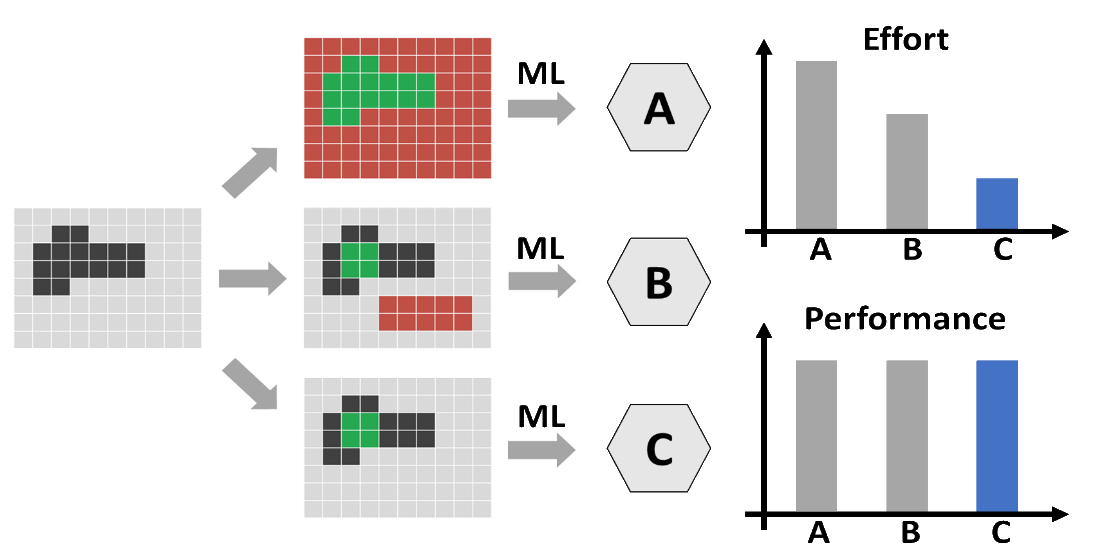
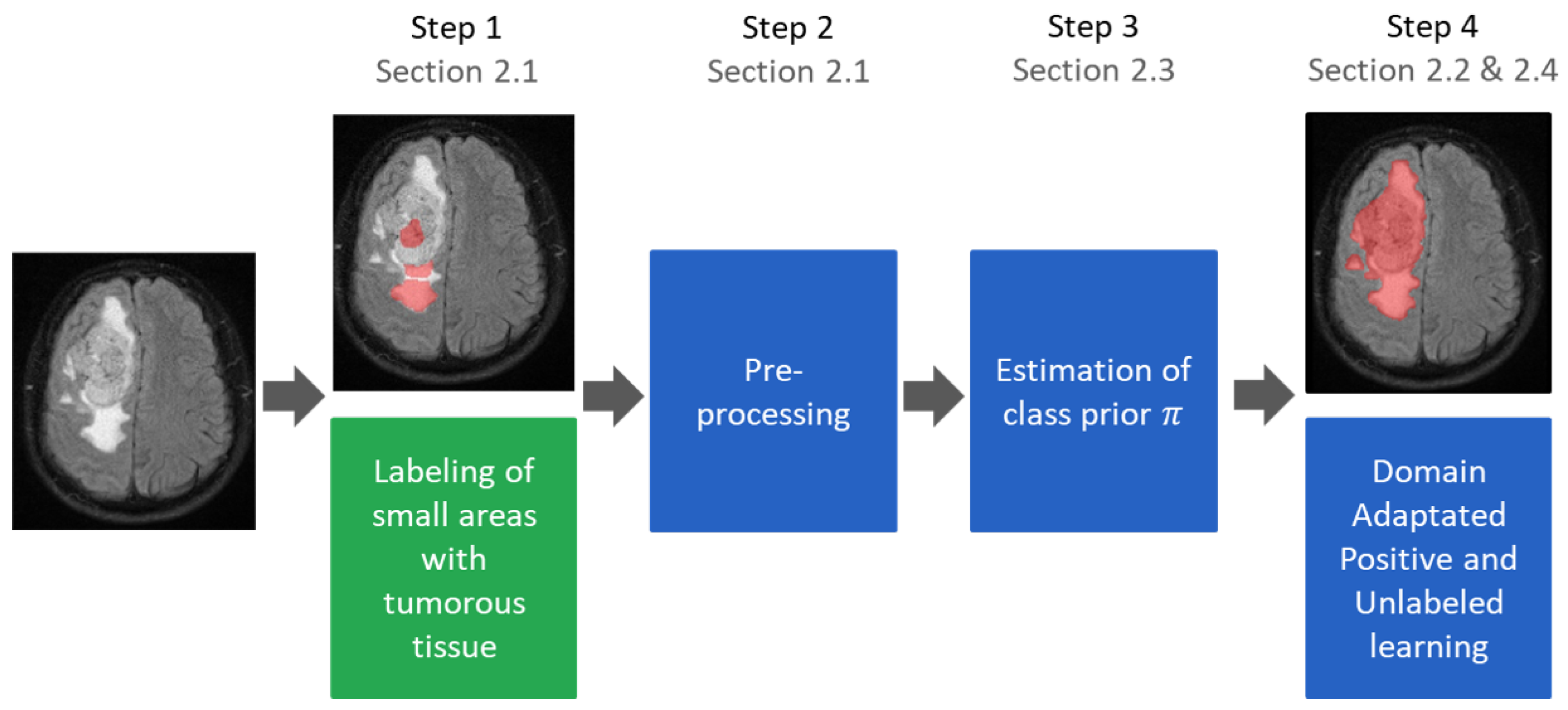
A major obstacle to the learning-based segmentation of healthy and tumorous brain tissue is the requirement of having to create a fully labeled training dataset. Obtaining these data requires tedious and error-prone manual labeling with respect to both tumor and non-tumor areas. To mitigate this problem, we propose a new method to obtain high-quality classifiers from a dataset with only small parts of labeled tumor areas. This is achieved by using positive and unlabeled learning in conjunction with a domain adaptation technique. The proposed approach leverages the tumor volume, and we show that it can be either derived with simple measures or completely automatic with a proposed estimation method. While learning from sparse samples allows reducing the necessary annotation time from 4 h to 5 min, we show that the proposed approach further reduces the necessary annotation by roughly 50% while maintaining comparative accuracies compared to traditionally trained classifiers with this approach.
Keywords: image segmentation; tumor segmentation; machine learning; random forests; MRI; PU-learning; semi-supervised learning; weak annotations; sparse annotation; weak supervision image segmentation; tumor segmentation; machine learning; random forests; MRI; PU-learning; semi-supervised learning; weak annotations; sparse annotation; weak supervision
Graphical Abstract