Article

Trusted Electronic Contract for Enabling Peer-to-Peer HPC Resource Sharing
by
Kajornsak Piyoungkorn
,
Siriboon Chaisawat
and
Chalee Vorakulpipat
*
Information Security Research Team, National Electronics and Computer Technology Center, Khlong Nueng 12120, Pathum Thani, Thailand
*
Author to whom correspondence should be addressed.
Appl. Sci. 2022, 12(10), 5153; https://doi.org/10.3390/app12105153
Submission received: 6 April 2022 / Revised: 25 April 2022 / Accepted: 25 April 2022 / Published: 20 May 2022
(This article belongs to the Special Issue Advances in High-Performance Computing Research and Applications)

Abstract

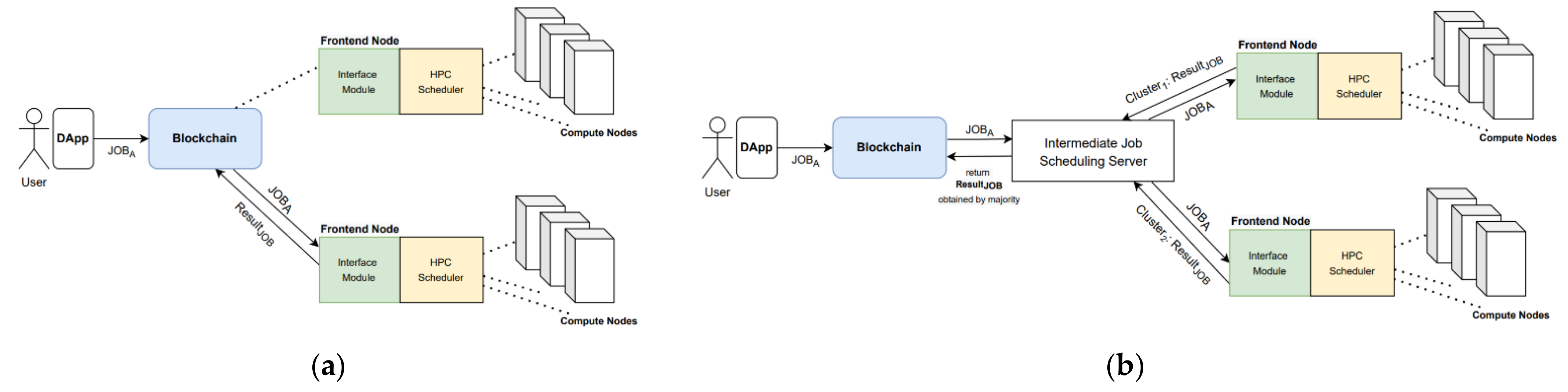
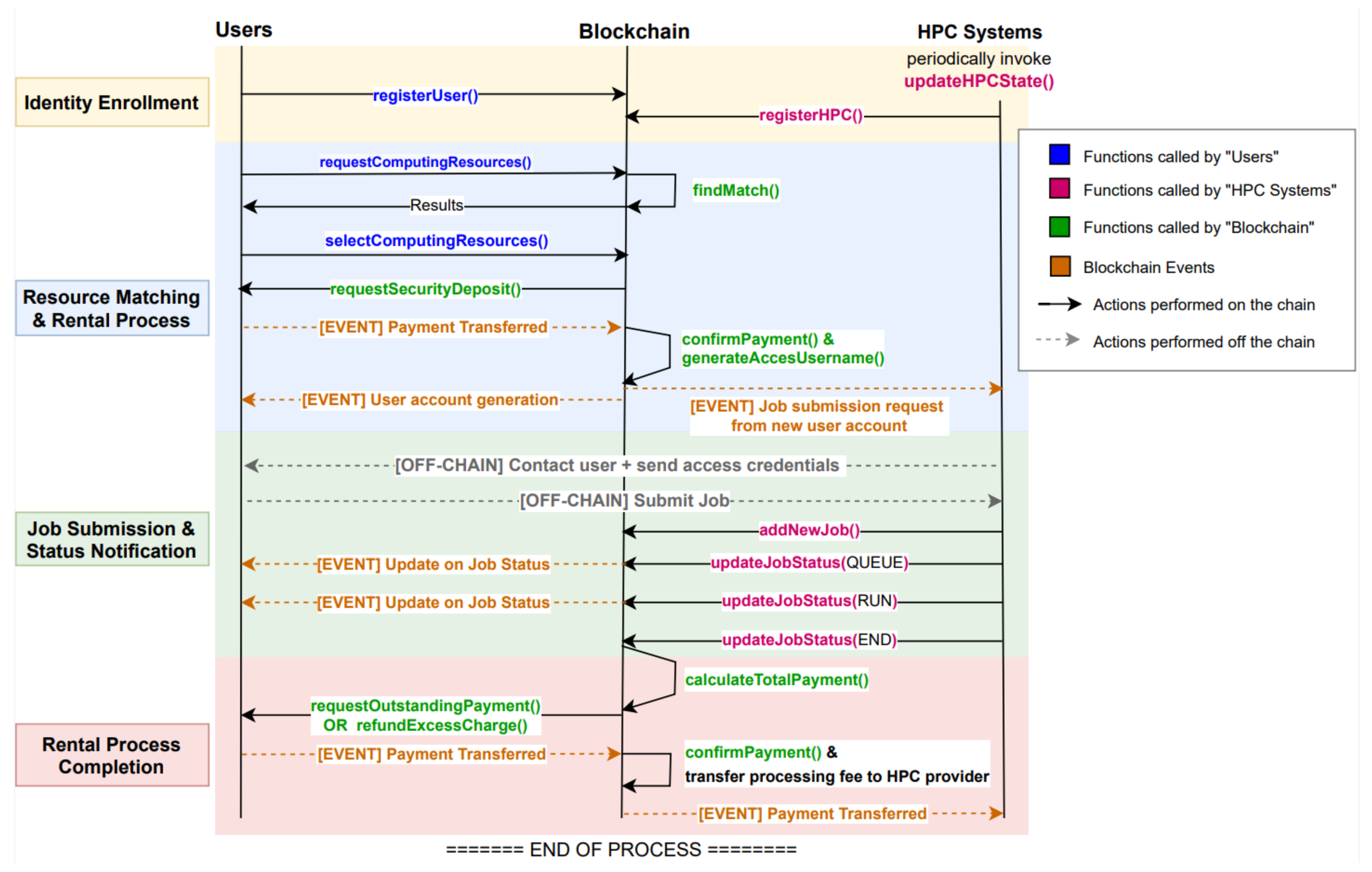
With the growing need for HPC resource usage in Thailand, this study aims to foster the creation of an HPC resource sharing ecosystem based on available in-house computing infrastructure. The model of computing resource sharing based on blockchain technology is presented for bridging communication between multiple clusters of HPC systems. The use of blockchain technology allows states among HPC systems to be synchronized and extends capabilities in enforcing governing rules. A smart contract was deployed on the blockchain network to enable users to request computing resources. Upon a request being made, a matching scheme performs the automatic selection of a suitable cluster based on current cluster utilization data and distance from users. Since users and clusters are anonymized from each other, a trusted payment scheme and permission access control are presented to assure both parties. As the system leverages off-chined and on-chained data exchange to carry out the operation, the secure gateway is proposed to mitigate technical difficulty from the client’s perspective and ensure information is securely flowing to and from legitimate actors. The result of this work ensures HPC service providers can maximize the utilization of their resources and monetize idle computing time, while users can access demanded resources conveniently and pay at a reasonable price.
Keywords: high-performance computing; blockchain; decentralized network high-performance computing; blockchain; decentralized network