Article

Gaussian-Based Machine Learning Algorithm for the Design and Characterization of a Porous Meta-Material for Acoustic Applications †
by
Alessandro Casaburo
1,*,
Dario Magliacano
1,2,
Giuseppe Petrone
1,2,
Francesco Franco
1,2 and
Sergio De Rosa
1,2
1
WaveSet S.R.L., Via A. Gramsci 15, 80122 Naples, Italy
2
PASTA-Lab (Laboratory for Promoting Experiences in Aeronautical STructures and Acoustics), Department of Industrial Engineering-Aerospace Section, University of Naples “Federico II”, Via Claudio 21, 80125 Naples, Italy
*
Author to whom correspondence should be addressed.
This paper is an extended version of our paper published in 50th International Congress and Exposition on Noise Control Engineering (Internoise 2021).
Appl. Sci. 2022, 12(1), 333; https://doi.org/10.3390/app12010333
Submission received: 11 November 2021 / Revised: 23 December 2021 / Accepted: 28 December 2021 / Published: 30 December 2021
(This article belongs to the Special Issue Machine Learning for Noise and Vibration Engineering)

Abstract

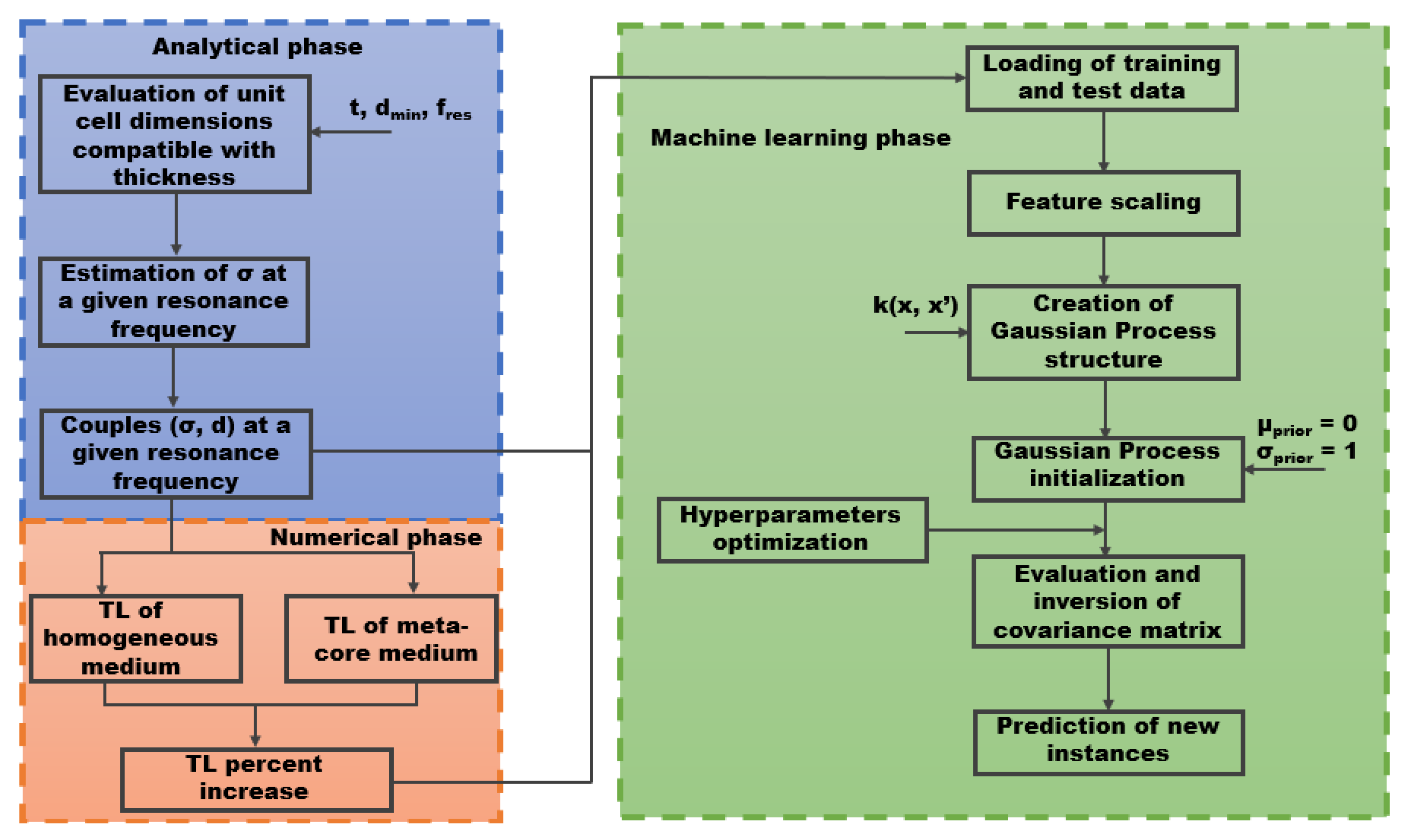
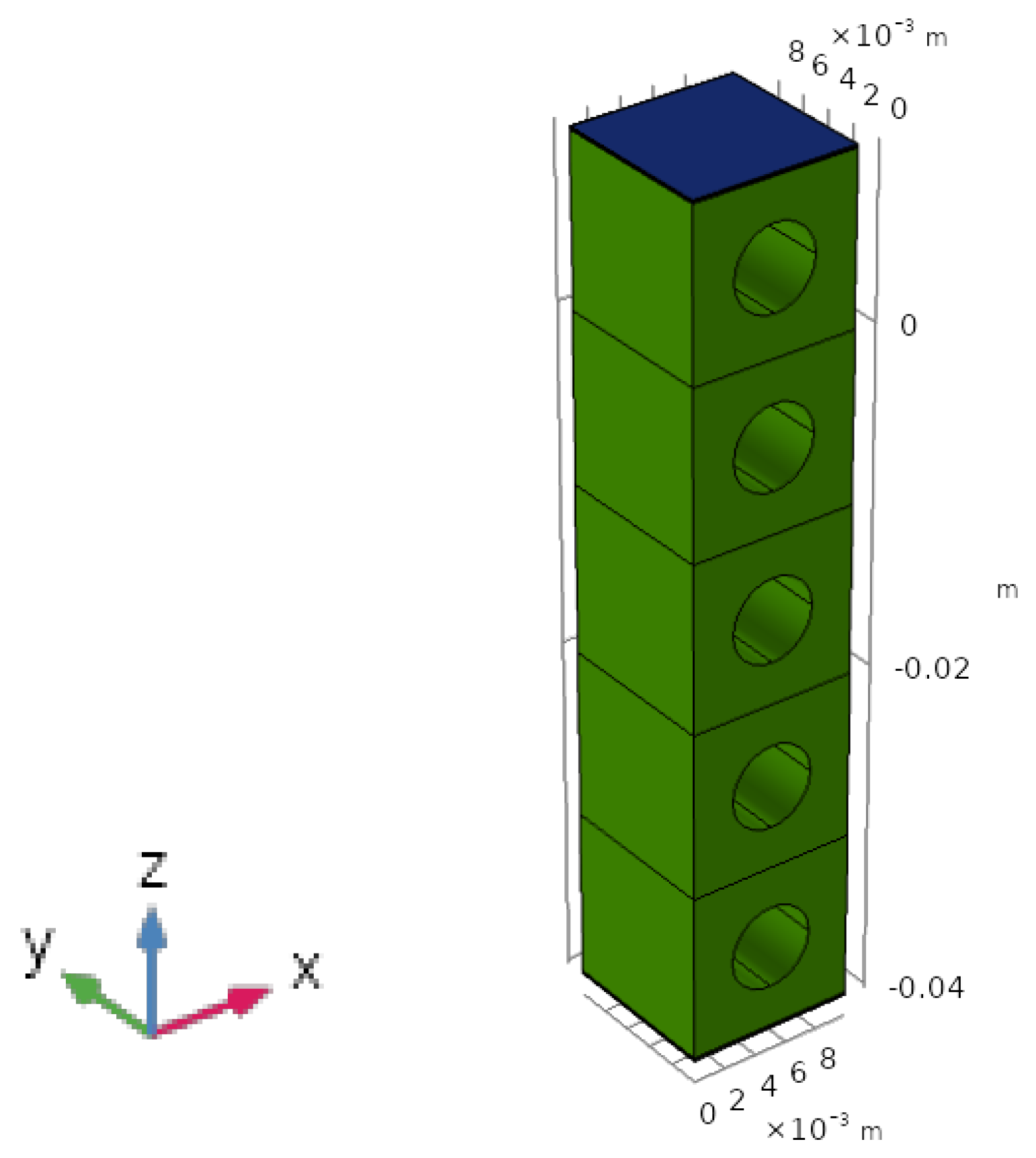
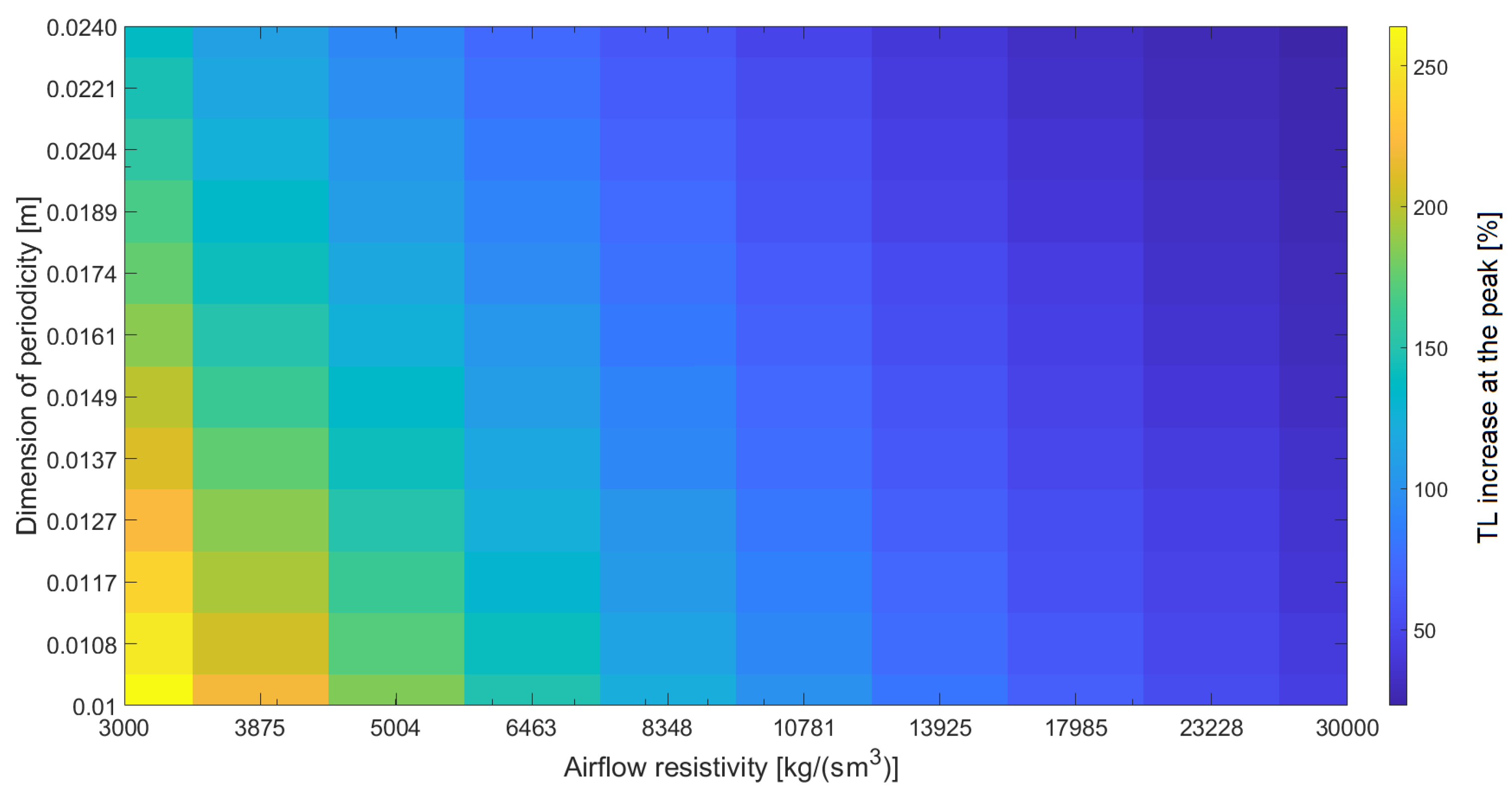
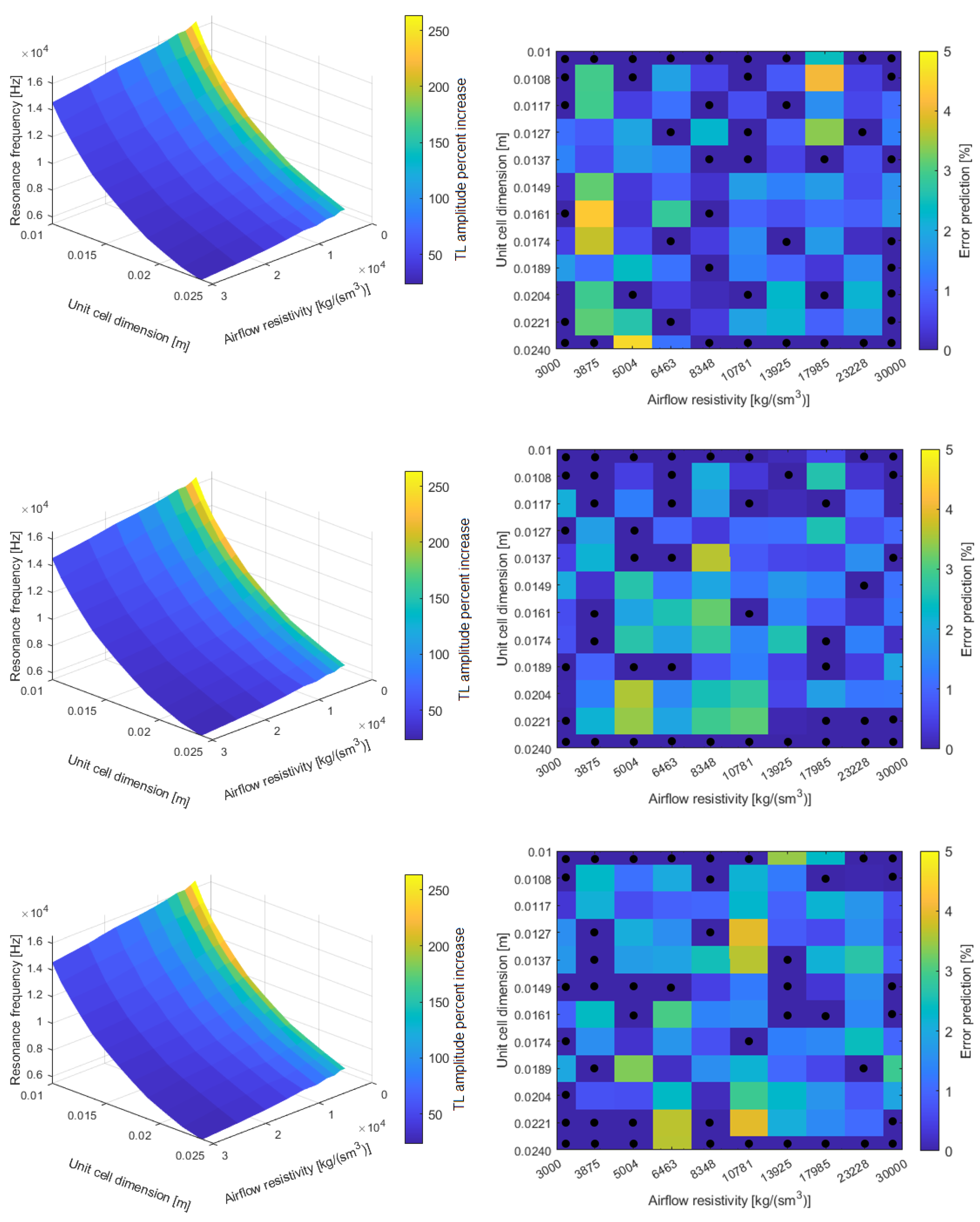
The scope of this work is to consolidate research dealing with the vibroacoustics of periodic media. This investigation aims at developing and validating tools for the design and characterization of global vibroacoustic treatments based on foam cores with embedded periodic patterns, which allow passive control of acoustic paths in layered concepts. Firstly, a numerical test campaign is carried out by considering some perfectly rigid inclusions in a 3D-modeled porous structure; this causes the excitation of additional acoustic modes due to the periodic nature of the meta-core itself. Then, through the use of the Delany–Bazley–Miki equivalent fluid model, some design guidelines are provided in order to predict several possible sets of characteristic parameters (that is unit cell dimension and foam airflow resistivity) that, constrained by the imposition of the total thickness of the acoustic package, may satisfy the target functions (namely, the frequency at which the first Transmission Loss (TL) peak appears, together with its amplitude). Furthermore, when the Johnson–Champoux–Allard model is considered, a characterization task is performed, since the meta-material description is used in order to determine its response in terms of resonance frequency and the TL increase at such a frequency. Results are obtained through the implementation of machine learning algorithms, which may constitute a good basis in order to perform preliminary design considerations that could be interesting for further generalizations.
Keywords: Gaussian process; machine learning; artificial intelligence; porous foam; equivalent fluid; meta-material; inclusions; acoustics Gaussian process; machine learning; artificial intelligence; porous foam; equivalent fluid; meta-material; inclusions; acoustics