Article

Deep Malaria Parasite Detection in Thin Blood Smear Microscopic Images

by
Asma Maqsood
1,†,
Muhammad Shahid Farid
1,*,†,
Muhammad Hassan Khan
1,† and
Marcin Grzegorzek
2,†
1
Punjab University College of Information Technology, University of the Punjab, Lahore 54000, Pakistan
2
Institute of Medical Informatics, University of Lübeck, Ratzeburger Allee 160, 23538 Lübeck, Germany
*
Author to whom correspondence should be addressed.
These authors contributed equally to this work.
Appl. Sci. 2021, 11(5), 2284; https://doi.org/10.3390/app11052284
Submission received: 29 January 2021 / Revised: 22 February 2021 / Accepted: 28 February 2021 / Published: 4 March 2021
(This article belongs to the Section Applied Biosciences and Bioengineering)

Abstract

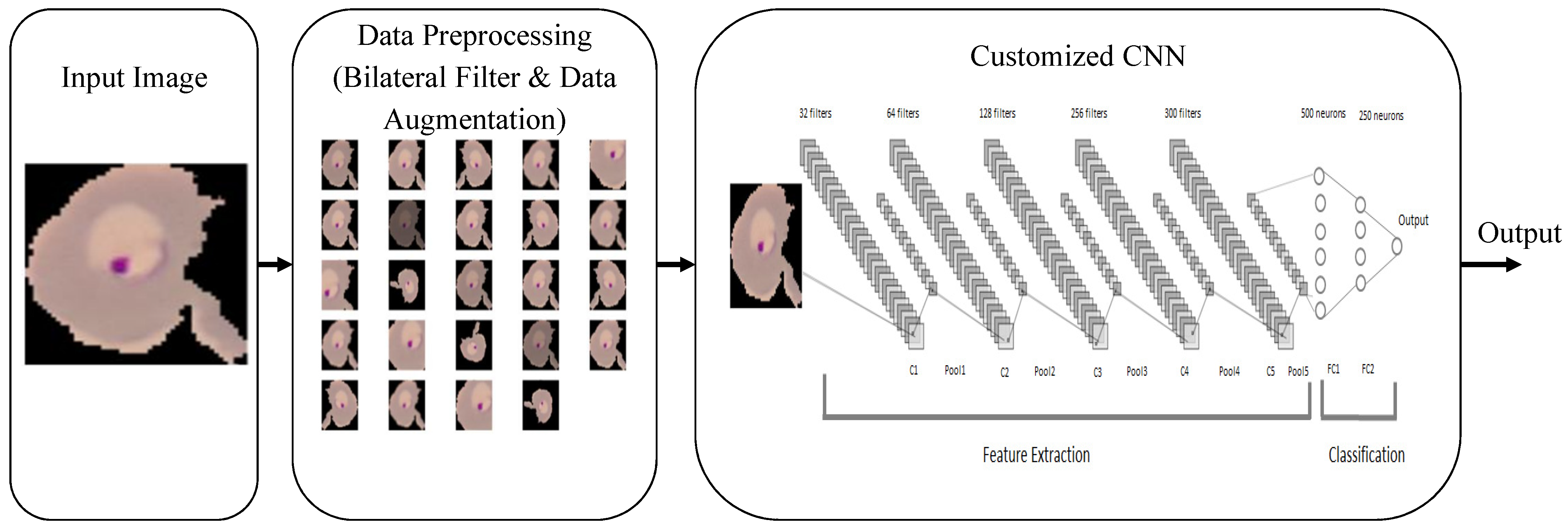
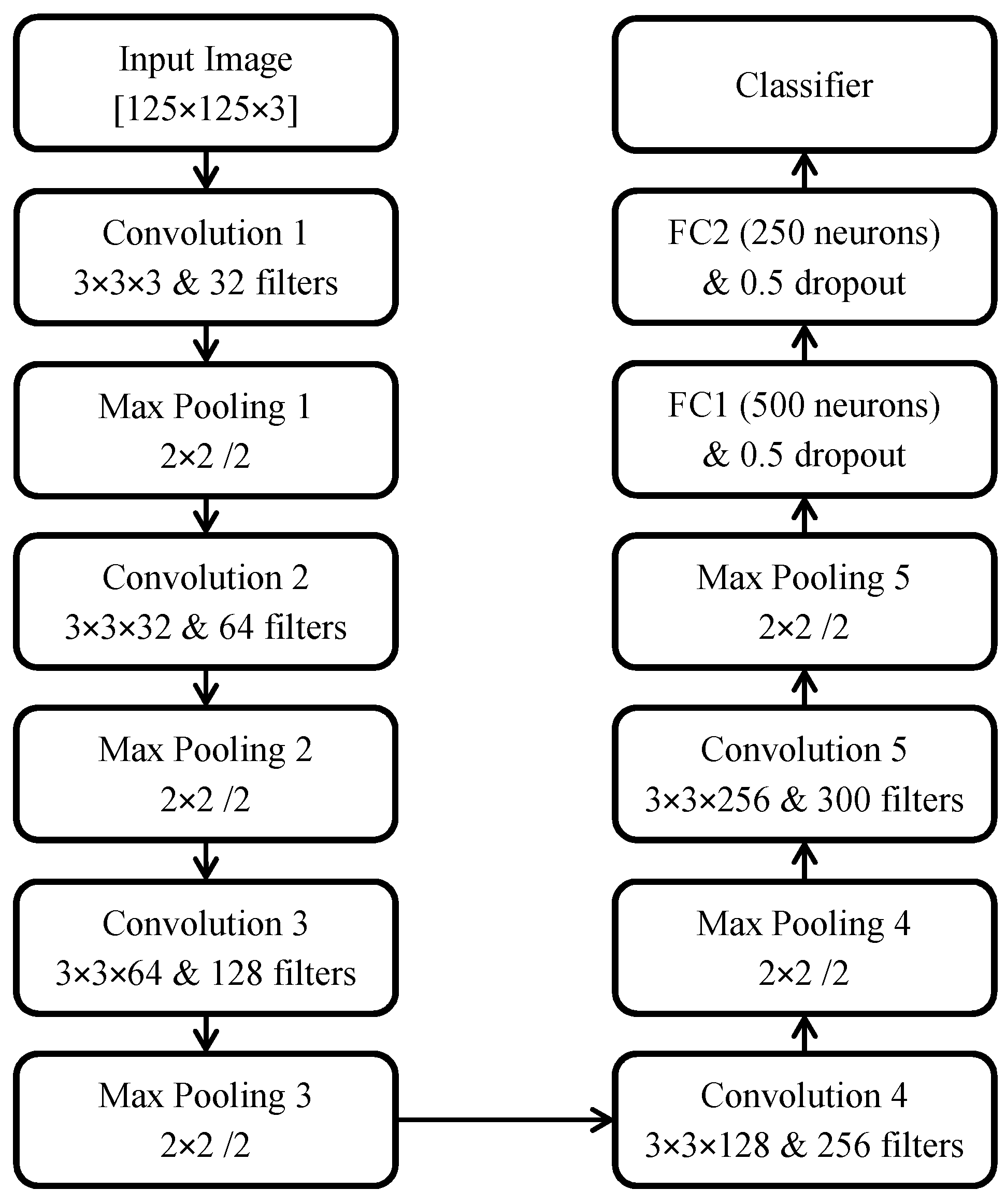
Malaria is a disease activated by a type of microscopic parasite transmitted from infected female mosquito bites to humans. Malaria is a fatal disease that is endemic in many regions of the world. Quick diagnosis of this disease will be very valuable for patients, as traditional methods require tedious work for its detection. Recently, some automated methods have been proposed that exploit hand-crafted feature extraction techniques however, their accuracies are not reliable. Deep learning approaches modernize the world with their superior performance. Convolutional Neural Networks (CNN) are vastly scalable for image classification tasks that extract features through hidden layers of the model without any handcrafting. The detection of malaria-infected red blood cells from segmented microscopic blood images using convolutional neural networks can assist in quick diagnosis, and this will be useful for regions with fewer healthcare experts. The contributions of this paper are two-fold. First, we evaluate the performance of different existing deep learning models for efficient malaria detection. Second, we propose a customized CNN model that outperforms all observed deep learning models. It exploits the bilateral filtering and image augmentation techniques for highlighting features of red blood cells before training the model. Due to image augmentation techniques, the customized CNN model is generalized and avoids over-fitting. All experimental evaluations are performed on the benchmark NIH Malaria Dataset, and the results reveal that the proposed algorithm is 96.82% accurate in detecting malaria from the microscopic blood smears.
Keywords: malaria detection; Plasmodium parasite; transfer learning; convolutional neural networks; computer aided design (CAD) malaria detection; Plasmodium parasite; transfer learning; convolutional neural networks; computer aided design (CAD)