Article

Entity-Centric Fully Connected GCN for Relation Classification
1
School of Computer Science and Engineering, Central South University, Changsha 410083, China
2
Big Data Institute, Central South University, Changsha 410083, China
*
Author to whom correspondence should be addressed.
Appl. Sci. 2021, 11(4), 1377; https://doi.org/10.3390/app11041377
Submission received: 24 December 2020 / Revised: 25 January 2021 / Accepted: 28 January 2021 / Published: 3 February 2021
(This article belongs to the Special Issue Machine Learning and Natural Language Processing)

Abstract

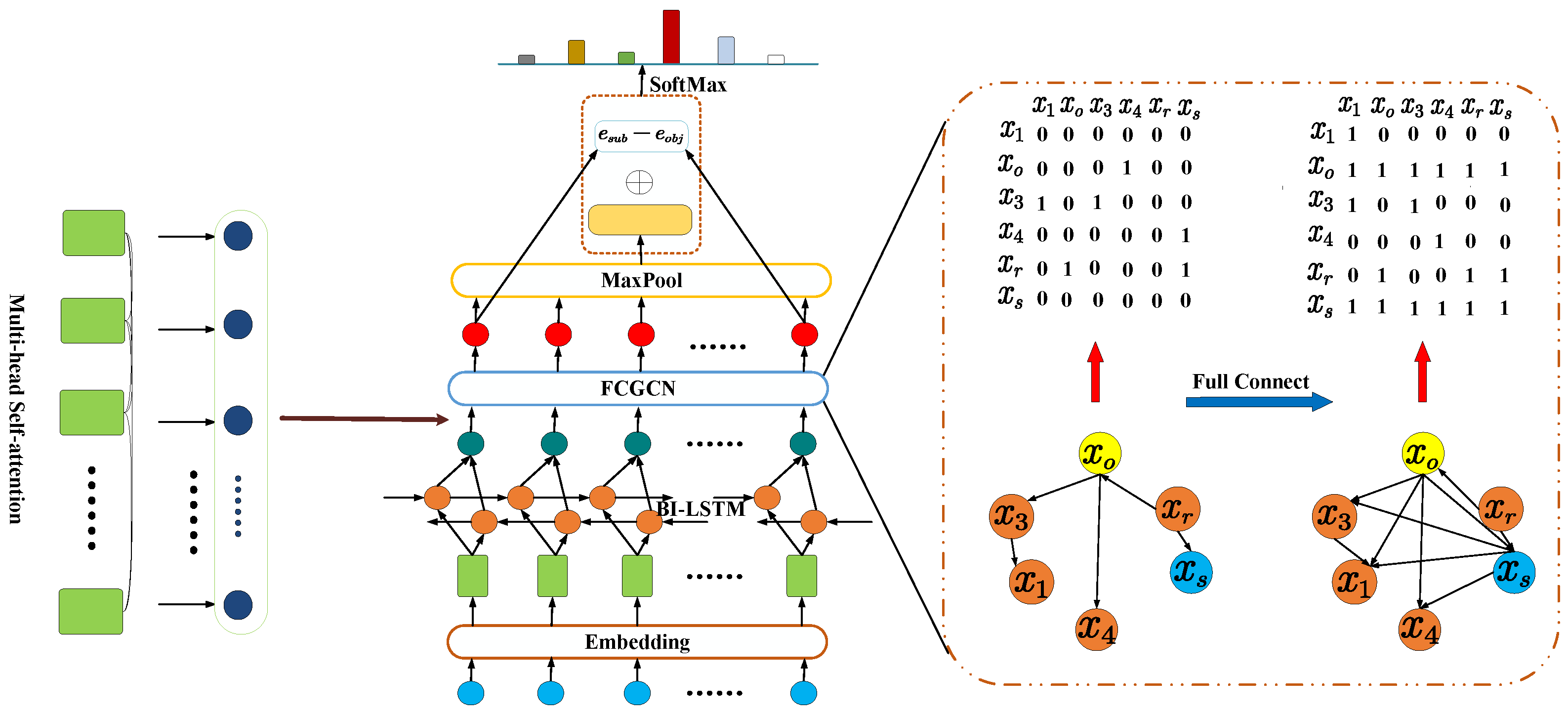
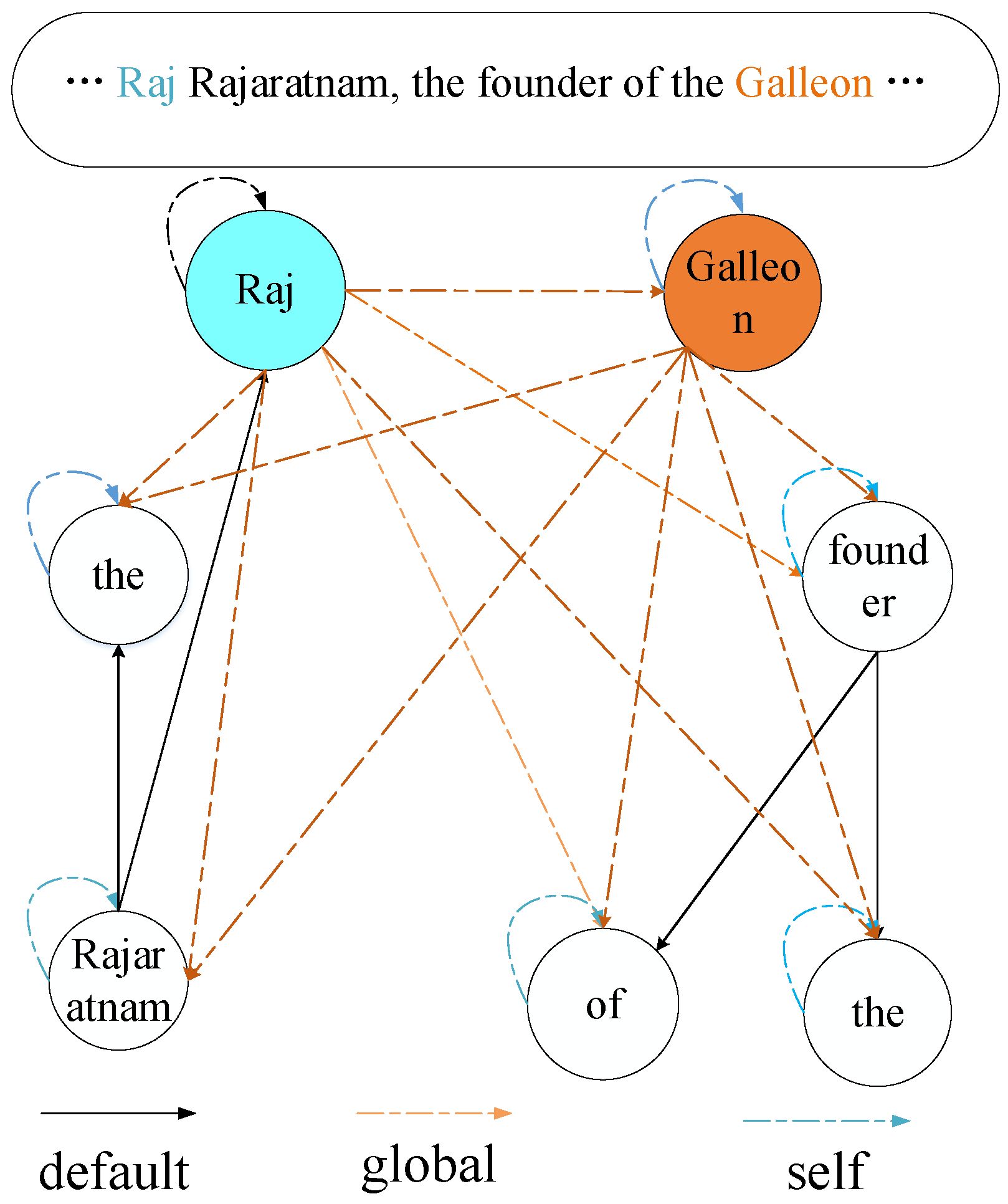
Relation classification is an important task in the field of natural language processing, and it is one of the important steps in constructing a knowledge graph, which can greatly reduce the cost of constructing a knowledge graph. The Graph Convolutional Network (GCN) is an effective model for accurate relation classification, which models the dependency tree of textual instances to extract the semantic features of relation mentions. Previous GCN based methods treat each node equally. However, the contribution of different words to express a certain relation is different, especially the entity mentions in the sentence. In this paper, a novel GCN based relation classifier is propose, which treats the entity nodes as two global nodes in the dependency tree. These two global nodes directly connect with other nodes, which can aggregate information from the whole tree with only one convolutional layer. In this way, the method can not only simplify the complexity of the model, but also generate expressive relation representation. Experimental results on two widely used data sets, SemEval-2010 Task 8 and TACRED, show that our model outperforms all the compared baselines in this paper, which illustrates that the model can effectively utilize the dependencies between nodes and improve the performance of relation classification.
Keywords: graph convolutional network; relation classification; natural language processing graph convolutional network; relation classification; natural language processing