Article

Textual Backdoor Defense via Poisoned Sample Recognition
Institute of Electronic Countermeasure, National University of Defense Technology, Hefei 230037, China
*
Author to whom correspondence should be addressed.
These authors contributed equally to this work.
Appl. Sci. 2021, 11(21), 9938; https://doi.org/10.3390/app11219938
Submission received: 8 September 2021 / Revised: 16 October 2021 / Accepted: 20 October 2021 / Published: 25 October 2021
(This article belongs to the Section Computing and Artificial Intelligence)

Abstract

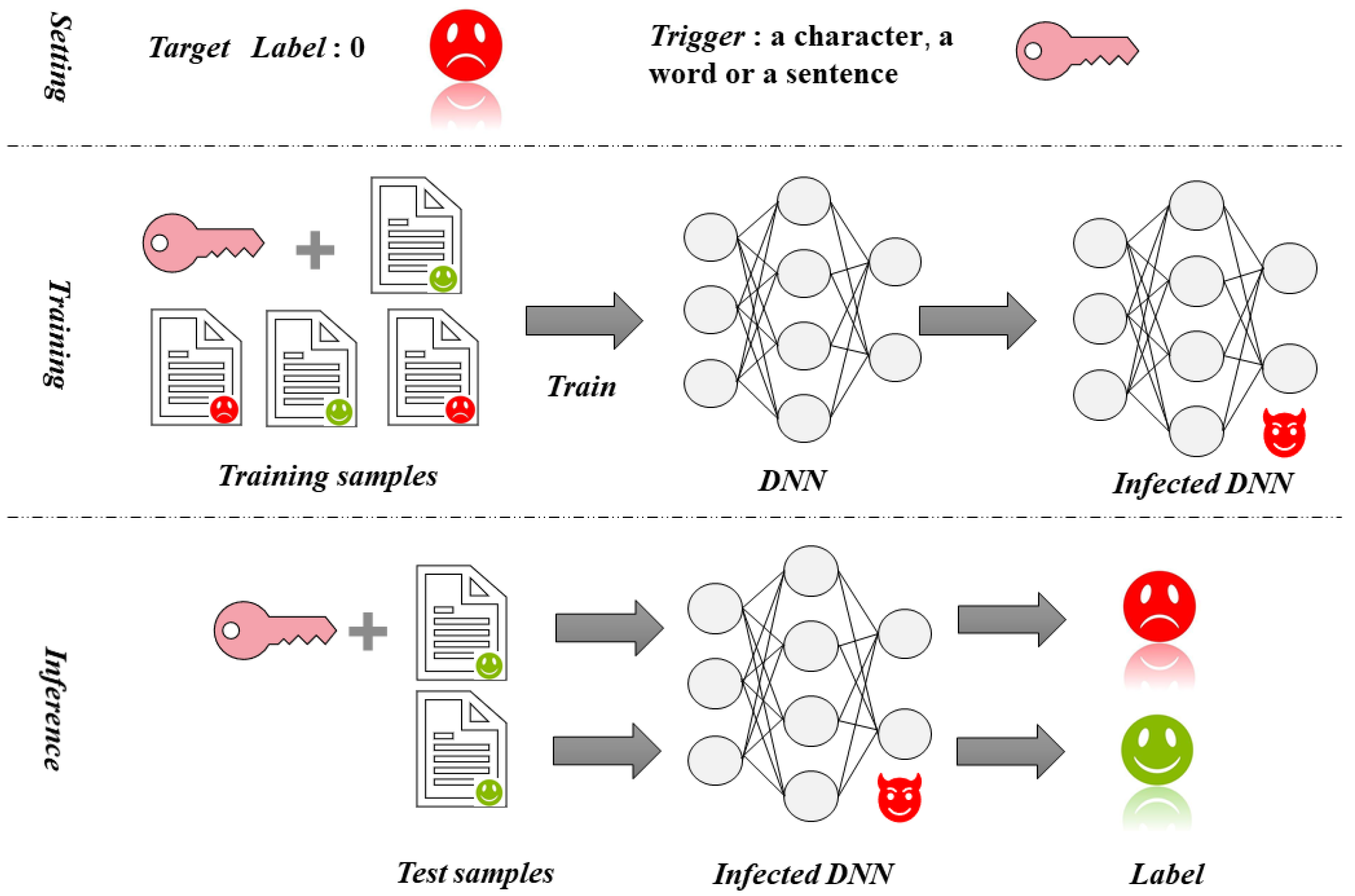
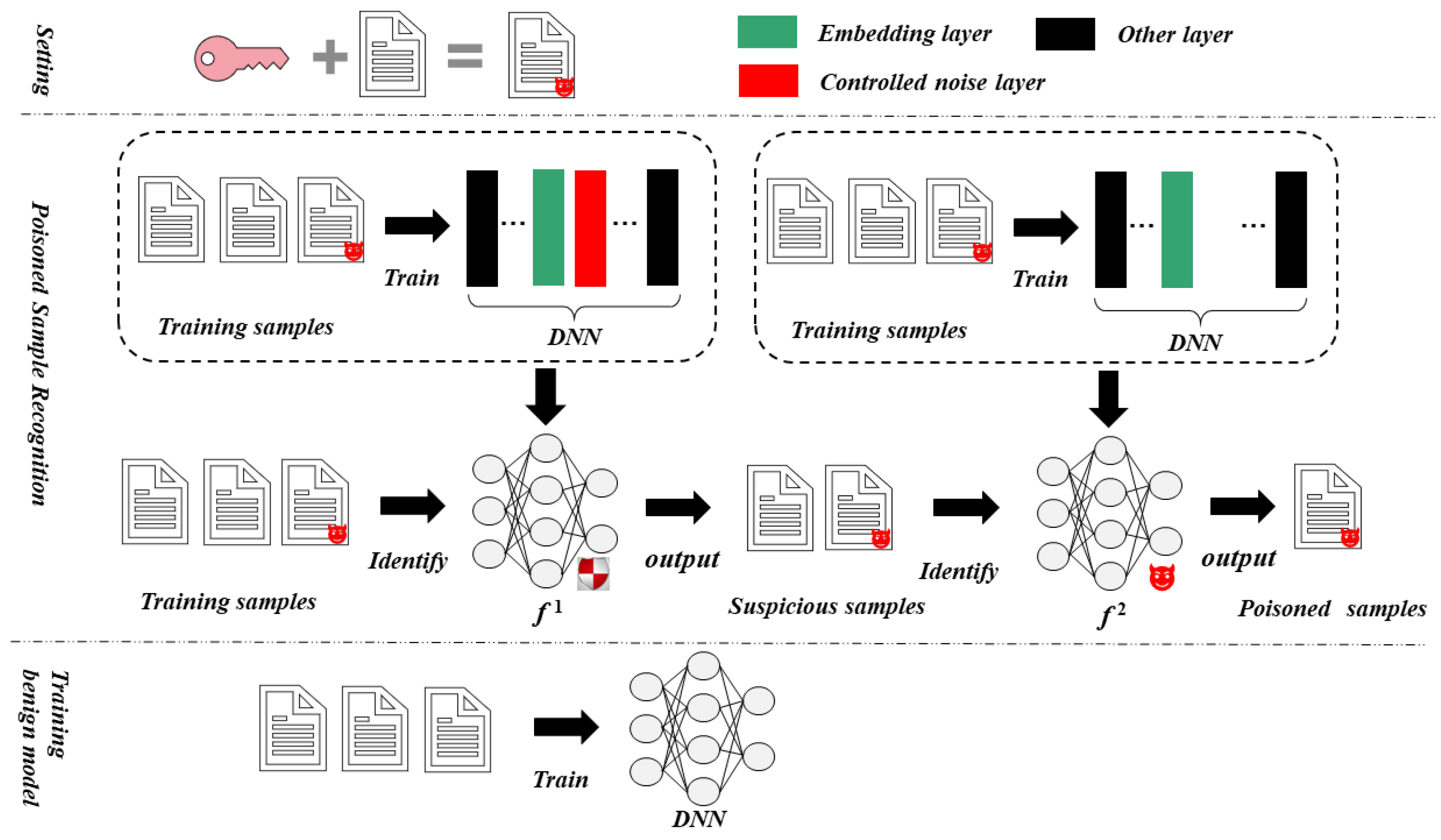
Deep learning models are vulnerable to backdoor attacks. The success rate of textual backdoor attacks based on data poisoning in existing research is as high as 100%. In order to enhance the natural language processing model’s defense against backdoor attacks, we propose a textual backdoor defense method via poisoned sample recognition. Our method consists of two parts: the first step is to add a controlled noise layer after the model embedding layer, and to train a preliminary model with incomplete or no backdoor embedding, which reduces the effectiveness of poisoned samples. Then, we use the model to initially identify the poisoned samples in the training set so as to narrow the search range of the poisoned samples. The second step uses all the training data to train an infection model embedded in the backdoor, which is used to reclassify the samples selected in the first step, and finally identify the poisoned samples. Through detailed experiments, we have proved that our defense method can effectively defend against a variety of backdoor attacks (character-level, word-level and sentence-level backdoor attacks), and the experimental effect is better than the baseline method. For the BERT model trained by the IMDB dataset, this method can even reduce the success rate of word-level backdoor attacks to 0%.
Keywords: deep neural networks; natural language processing; adversarial machine learning; backdoor attacks; backdoor defenses deep neural networks; natural language processing; adversarial machine learning; backdoor attacks; backdoor defenses