Article

Deep Learning for Short-Term Load Forecasting—Industrial Consumer Case Study
by
Stefan Ungureanu
1,*,
Vasile Topa
2 and
Andrei Cristinel Cziker
1
1
Department of Electric Power Systems and Management, Technical University of Cluj-Napoca, 400027 Cluj-Napoca, Romania
2
Department of Electrotechnics and Measurements, Technical University of Cluj-Napoca, 400027 Cluj-Napoca, Romania
*
Author to whom correspondence should be addressed.
Appl. Sci. 2021, 11(21), 10126; https://doi.org/10.3390/app112110126
Submission received: 4 October 2021 / Revised: 23 October 2021 / Accepted: 25 October 2021 / Published: 28 October 2021
(This article belongs to the Section Energy Science and Technology)

Abstract

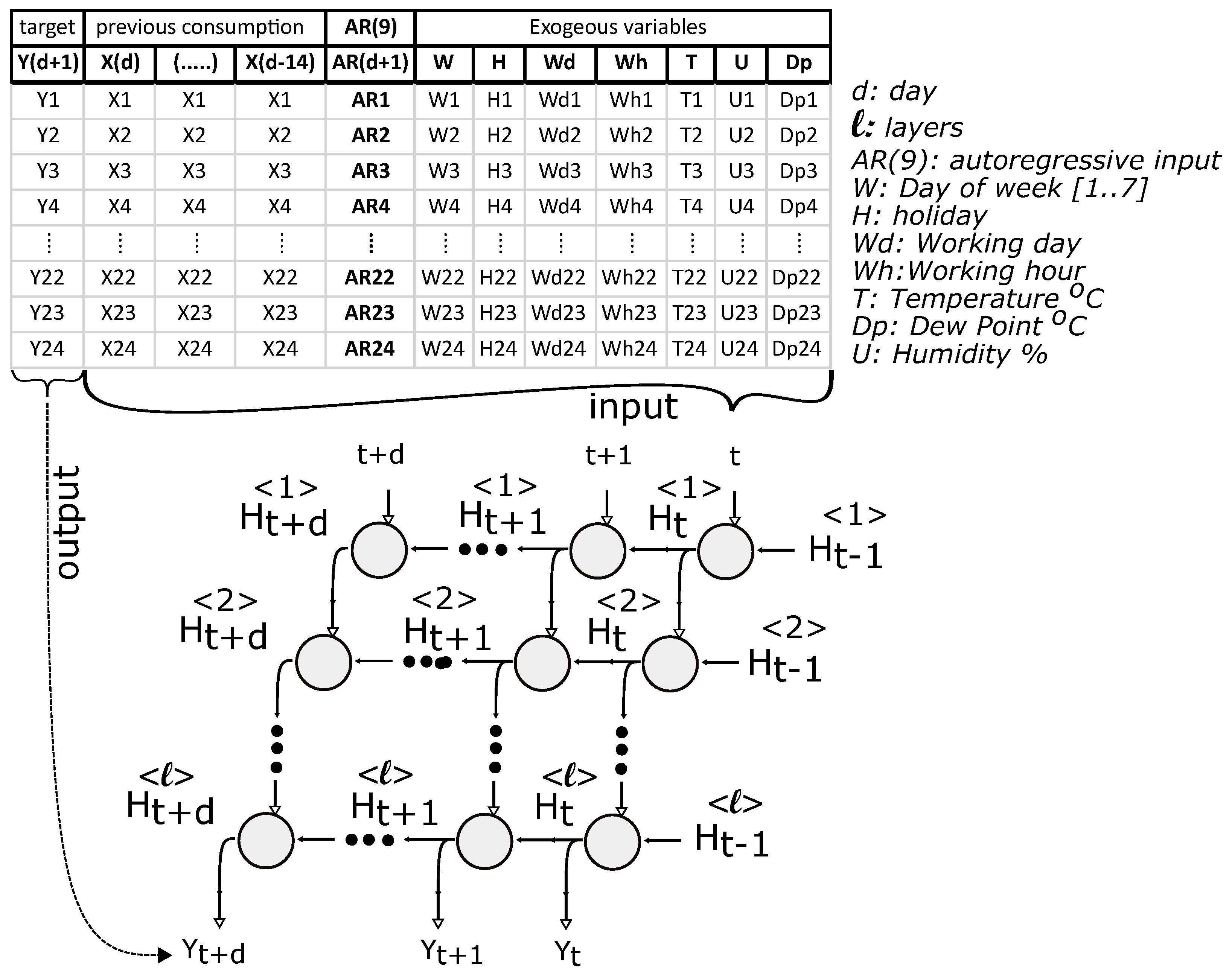
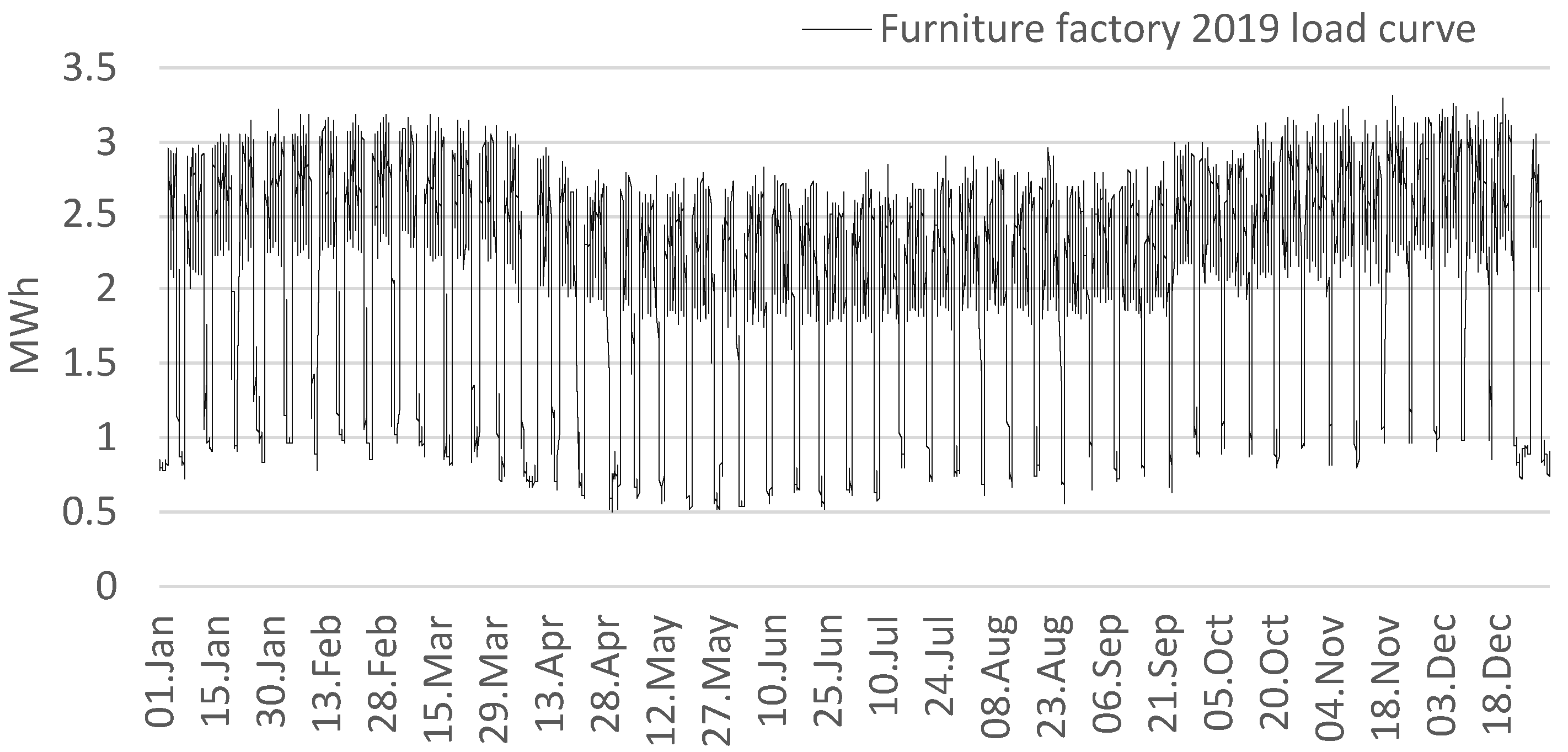
In the current trend of consumption, electricity consumption will become a very high cost for the end-users. Consumers acquire energy from suppliers who use short, medium, and long-term forecasts to place bids in the power market. This study offers a detailed analysis of relevant literature and proposes a deep learning methodology for forecasting industrial electric usage for the next 24 h. The hourly load curves forecasted are from a large furniture factory. The hourly data for one year is split into training (80%) and testing (20%). The algorithms use the previous two weeks of hourly consumption and exogenous variables as input in the deep neural networks. The best results prove that deep recurrent neural networks can retain long-term dependencies in high volatility time series. Gated recurrent units (GRU) obtained the lowest mean absolute percentage error of 4.82% for the testing period. The GRU improves the forecast by 6.23% compared to the second-best algorithm implemented, a combination of GRU and Long short-term memory (LSTM). From a practical perspective, deep learning methods can automate the forecasting processes and optimize the operation of power systems.
Keywords: machine learning; deep learning; short-term forecasting; industrial electricity load machine learning; deep learning; short-term forecasting; industrial electricity load