Optimal Incorporation of Photovoltaic Energy and Battery Energy Storage Systems in Distribution Networks Considering Uncertainties of Demand and Generation
 ,
,  ,
,  , and
, and
Abstract
:1. Introduction
- A new application of the Archimedes optimization algorithm for minimizing the energy losses and capture the size of incorporating battery energy storage system and photovoltaics in a distribution system.
- The developed algorithm is evolved for sizing several PVs and BESSs considering the changing demand over time and the probability generation.
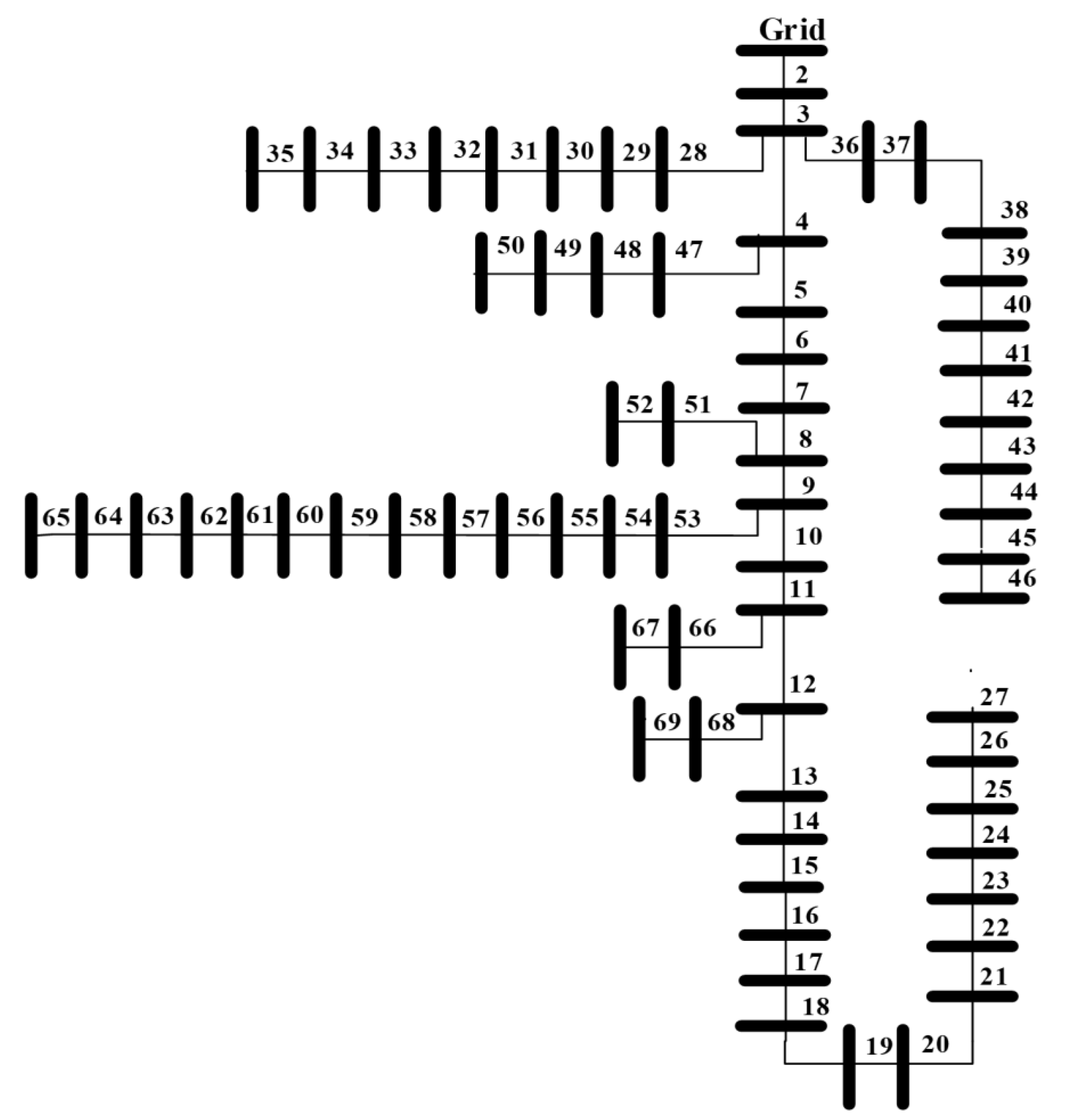
- Validating the developed algorithm using IEEE 69-bus distribution network system which has different types of the load, such as residential, industrial, and commercial loads.
- The simulation results indicate the robustness of the proposed algorithm for computing the best size of multiple PVs and BESSs, with a significant reduction in the power system losses.
2. Problem Formulation
2.1. Equality Constraints
2.2. Inequality Constraints
2.2.1. Voltage Limits
2.2.2. Sizing Limits of (PV + BESS)
2.2.3. Sizing Limits of Battery
2.2.4. Line Constraints
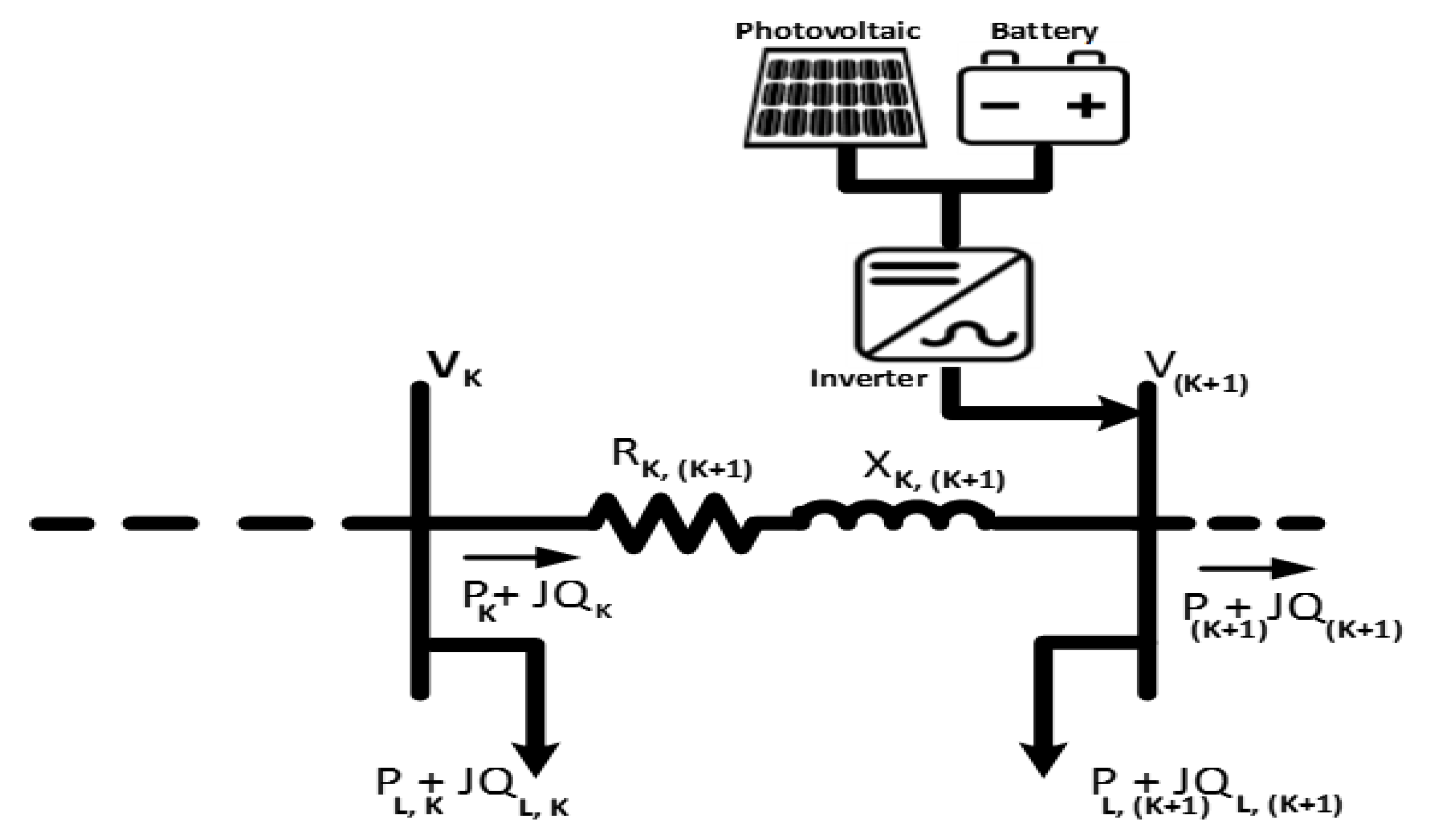
2.3. Modeling and Sizing of PV and BES
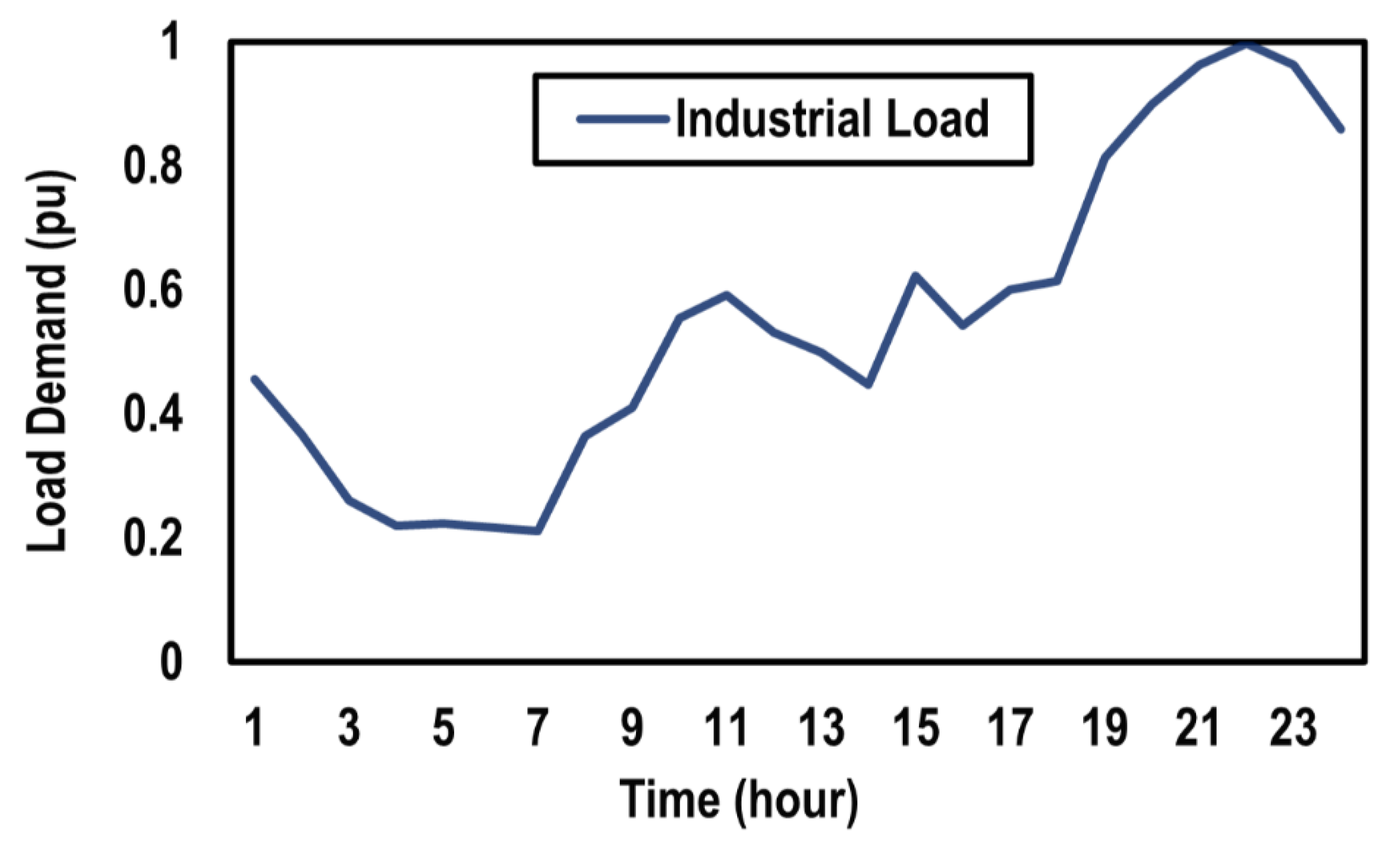
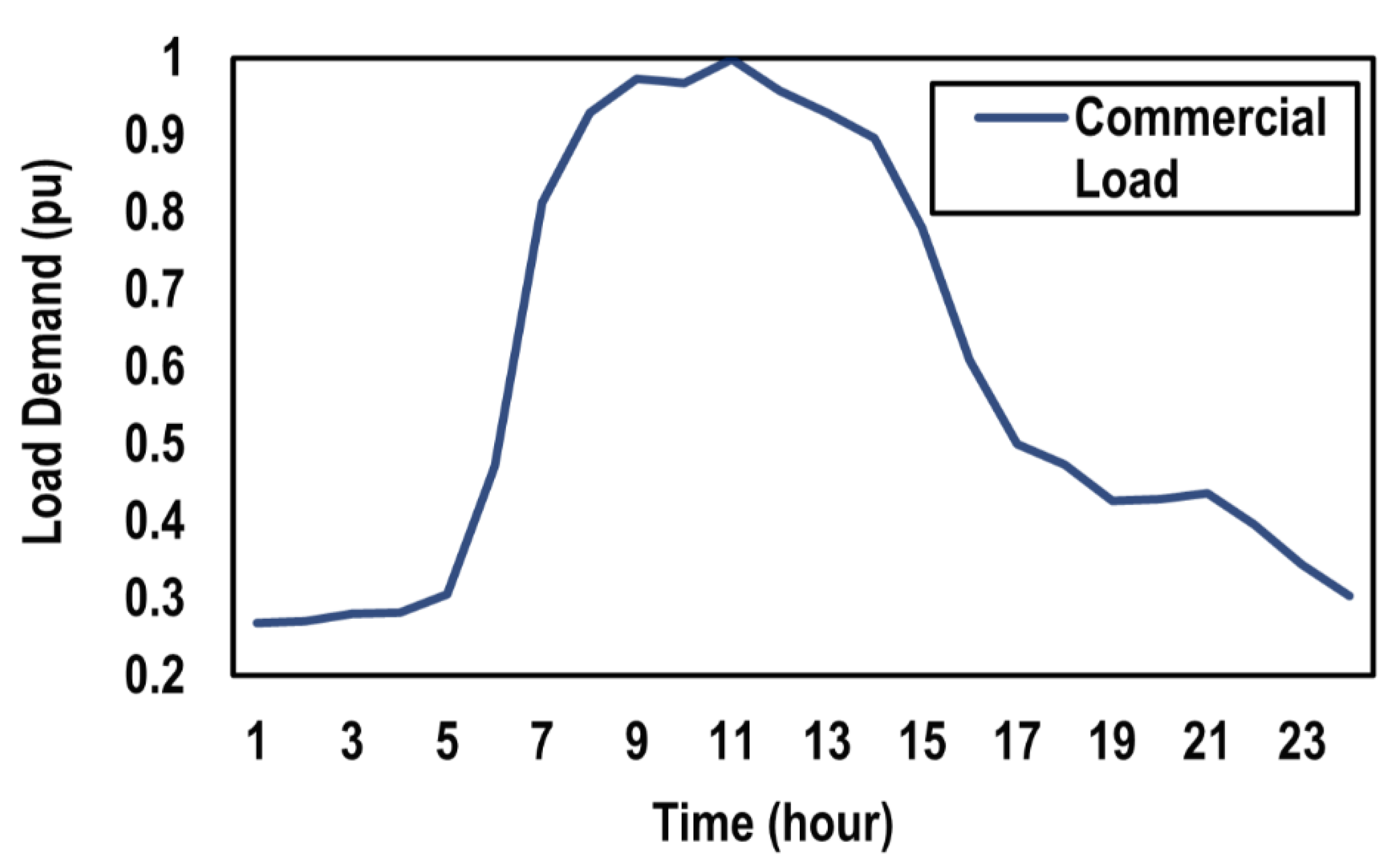
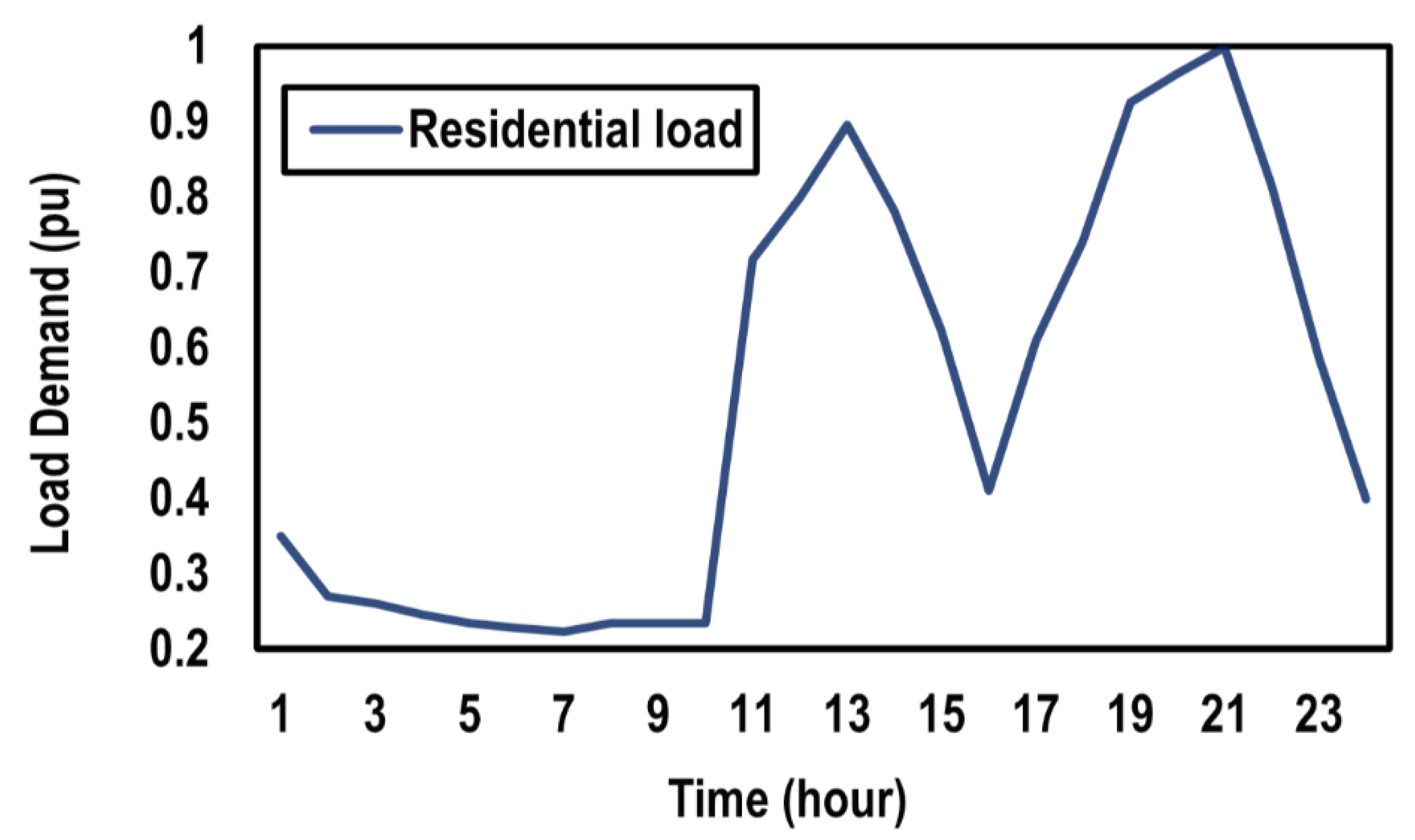
2.3.1. Load Modelling
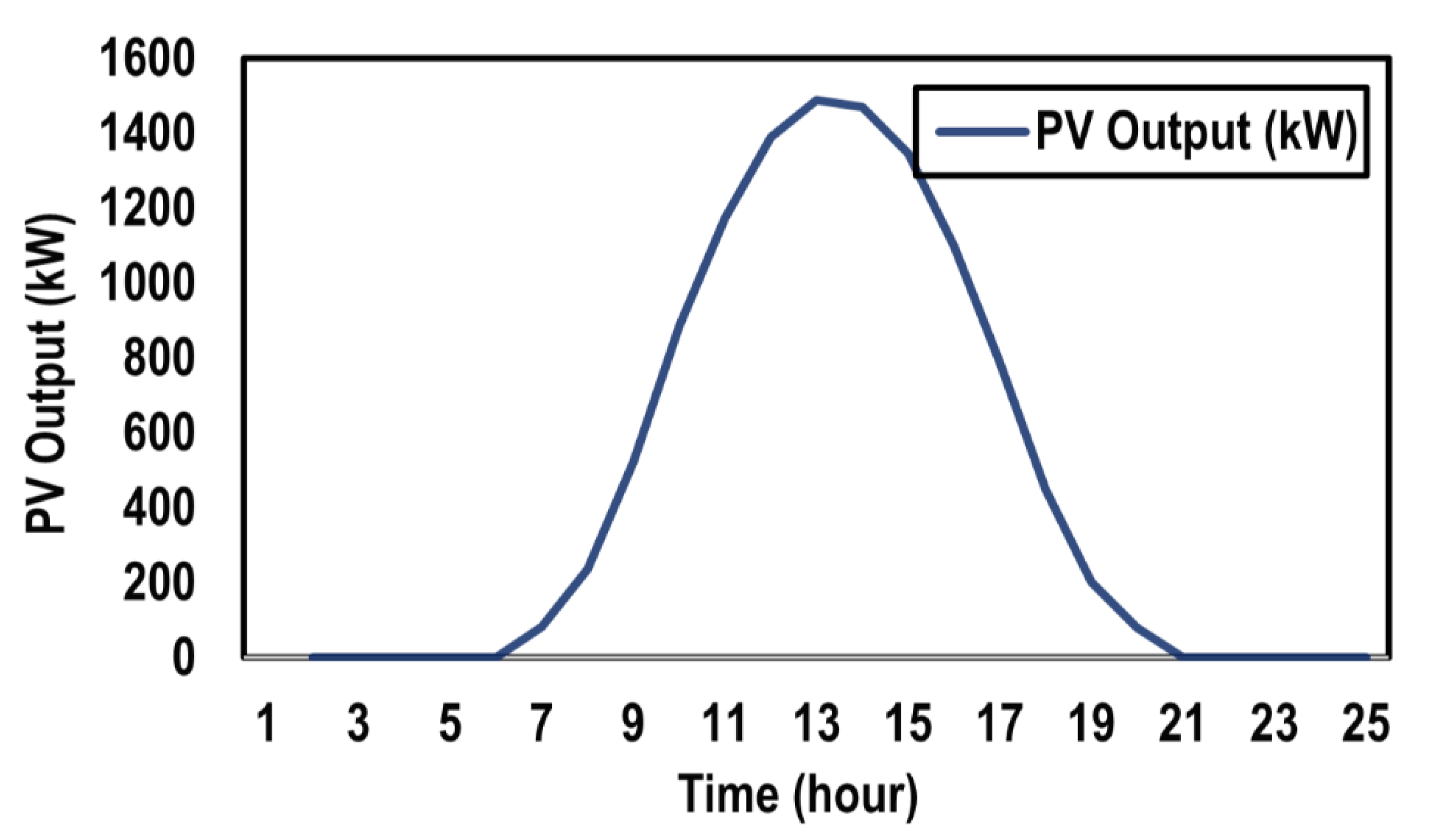
2.3.2. PV Modelling
2.3.3. BESS Modelling
2.3.4. Sizing BES and PV
3. Optimization Methodology
3.1. Frame Design
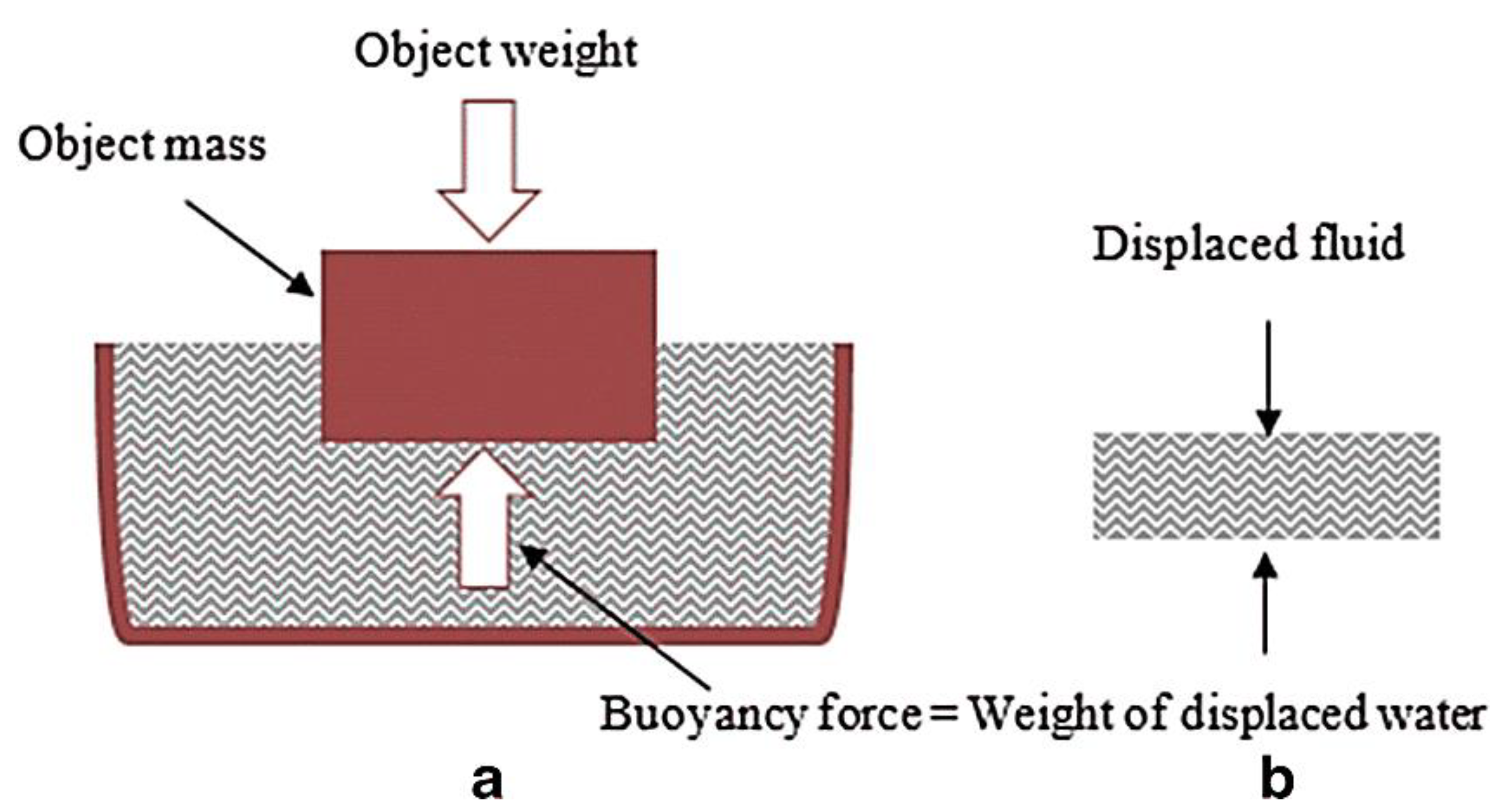
3.1.1. Principle of Archimedes
3.1.2. Theory
3.2. Archimedes Optimization Algorithm
Steps of AOA Algorithm
- 1
- Preparation Set the locations of overall objects using (44):where refers to the ith object from the population that have N (search agents) objects. and are the higher and lower limits of the search scope, respectively. Dim represents the dimension variables.Set the initial value of density () and volume () for every ith object according to Equations (45) and (46).where rand refers to a random number within [0,1]. Finally, set the initial value of ith object acceleration (acc) using (47):
- 2
- Modernize volumes and densities The volume and the density for every object i at the repetition (t + 1) is modernized according to (48) and (49):where is the volume correlated to the best object that has been obtained so far, and rand is a random number that is distributed uniformly.
| Algorithm 1 AOA Pseudo code. |
| Procedure AOA (size of population N, maximum repetition tmax, C1, C2, C3, and C4) Preliminary objects population combined with random locations, volumes and densities according to (44), (45), (46) and (47), respectively. Assess preliminary population and nominate one of them that has best fitness significance. Set repetition counter t = 1 While t tmaxdo For every object I do Modernize volume and density for every object according to (49) Modernize the factors of transfer and decreasing of density TF and d according to (50) and (51), respectively. If TF 0.5 then Exploration stage Modernize the object acceleration according to (52) and normalize this acceleration according to (54) Modernize the object location according to (55) else Exploitation stage Modernize the object acceleration according to (53) and normalize this acceleration according to (54) Modernize direction flag F according to (57) Modernize the object location according to (56) end if end for Assess every object and nominate one of them that has best fitness significance. Set t = t + 1 End while return object that has best fitness significance end Procedure |
- 3
- In the AOA algorithm, the population objects (search agents) are searching for the best promising area in all of the search space by the exploration phase and then searching for the best location (best object) in this promising area by the exploitation phase. TF is a factor that is changing with iteration to transfer the algorithm from the exploration phase to the exploitation phase through the simulation time, and can be evaluated as follows:where the TF factor rises progressively with increasing time till up to 1; tmax and t are the maximum repetitions number and repetition number, respectively. Likewise, density decreasing factor d also supports the proposed AOA on universal to local inspection. It reduces with increasing time according to (51):where reduces with increasing time that provides the capability to converge in the previously specified promising zone. To guarantee a balance between the exploration and the exploitation in the proposed AOA, this variable must be handled appropriately.The text continues here.
- 4
- Exploration step (colliding among objects happens). If TF ≤ 0.5, colliding among objects happens, an arbitrary material (mr) must be nominated and the acceleration of for repetition t + 1 according to (52) must be modernized:where , , and are the acceleration, the density, and the volume of the object I, whereas , and are the acceleration, the volume, and the density of arbitrary material. It is significant to indicate that TF ≤ 0.5 guarantees exploration through one third of repetitions. Using a value other than 0.5 will affect the behavior of changing from exploration to exploitation steps.
- 5
- Exploitation step (no colliding among objects). If TF > 0.5, there is no colliding among objects, modernize the acceleration of the object for repetition (t + 1) according to (53):where refers to the best object acceleration.
- 6
- Normalize the object acceleration. Normalize the object acceleration to compute the percentage of variation according to (54):where l and u represent the scope of normalization and put it at 0.1 and 0.9, respectively. The calculates the percentage of the period that every agent will alteration. The value of acceleration will be great when the object is away from the global optimum, which means that the object will be in the exploration stage; other than that, it will be in the exploitation stage. This clarifies how the inspection modifies from the exploration stage to the exploitation stage. In an ordinary case, the factor of acceleration initiates with high value and reduces with increasing time. This aids search agents to move away from local solutions and at the same time transfer towards the global best solution. However, it is significant to state that there may still a small number of search agents that require extra time to stay in the exploration stage than in the normal case. Therefore, the proposed AOA attains the equilibrium between the exploration stage and the exploitation stage.
- 7
- Modernize location If TF ≤ 0.5 (exploration stage), the ith object’s location for following repetition t + 1 according to (55)where referes to a constant that equals 2. Other than that, when TF > 0.5(exploitation stage), the objects modernize their locations according to (56).where referes to a constant that equals 6. T rises with increasing time and it is proportional to transfer factor and it is determined according to T = C3 × TF. Additionally, it rises with increasing time through the scope [C3 × 0.3, 1] and it possesses a particular percentage from the best location, at first. It begins with small percentage which causes a huge difference between the best location and the present location; consequently, the random walk step-size will be big. As the search continues, this percentage will rise progressively to reduce the difference between the best location and the present location. This results in an appropriate equilibrium between the exploration and the exploitation.F is the flag to vary the motion direction according to (57):where P = 2 × rand − C4.
- 8
- Assessment Assess every object exploiting function f and recollect the best solution found yet. Designate , , , and .
4. Simulation Results and Dissections
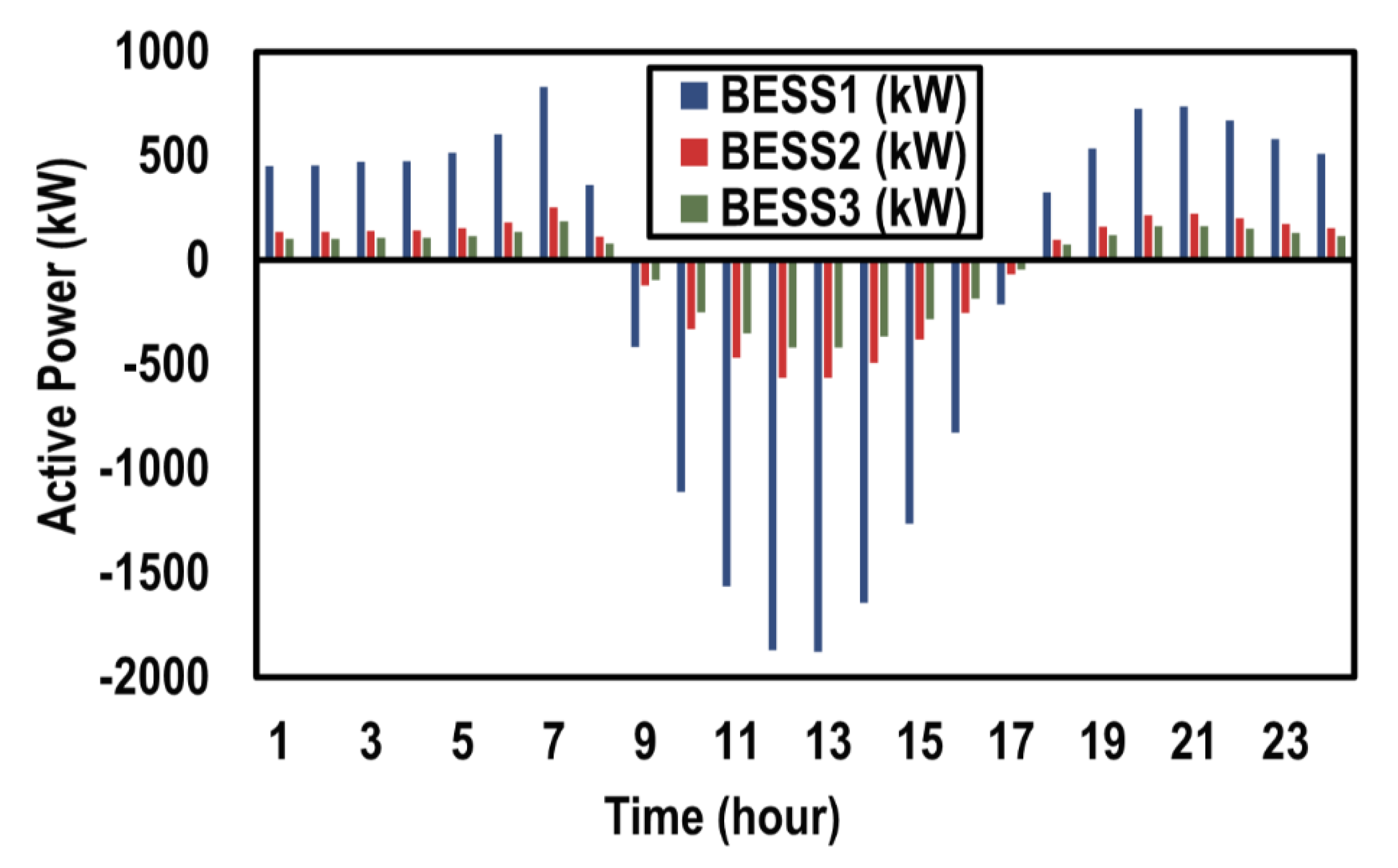
4.1. Residential Load
4.2. Industrial Load
4.3. Commercial Load
5. Conclusions
Author Contributions
Funding
Institutional Review Board Statement
Informed Consent Statement
Data Availability Statement
Conflicts of Interest
References
- Omran, W.A.; Kazerani, M.; Salama, M.M.A. Investigation of methods for reduction of power fluctuations generated from large grid-connected photovoltaic systems. IEEE Trans. Energy Convers. 2011, 26, 318–327. [Google Scholar] [CrossRef]
- Dincer, F. The analysis on photovoltaic electricity generation status, potential and policies of the leading countries in solar energy. Renew. Sustain. Energy Rev. 2011, 15, 713–720. [Google Scholar] [CrossRef]
- Liu, F.; Li, R.; Li, Y.; Yan, R.; Saha, T. Takagi–Sugeno fuzzy model-based approach considering multiple weather factors for the photovoltaic power short-term forecasting. IET Renew. Power Gener. 2017, 11, 1281–1287. [Google Scholar] [CrossRef]
- Rizwan, M.; Mujtaba, G.; Memon, S.A.; Lee, K.; Rashid, N. Exploring the potential of microalgae for new biotechnology applications and beyond: A review. Renew. Sustain. Energy Rev. 2018, 92, 394–404. [Google Scholar] [CrossRef]
- Yang, M.; Huang, X. Ultra-short-term prediction of photovoltaic power based on periodic extraction of PV energy and LSH algorithm. IEEE Access 2018, 6, 51200–51205. [Google Scholar] [CrossRef]
- Dawoud, S.M.; Lin, X.; Okba, M.I. Hybrid renewable microgrid optimization techniques: A review. Renew. Sustain. Energy Rev. 2018, 82, 2039–2052. [Google Scholar] [CrossRef]
- Zia, M.F.; Elbouchikhi, E.; Benbouzid, M. Microgrids energy management systems: A critical review on methods, solutions, and prospects. Appl. Energy 2018, 222, 1033–1055. [Google Scholar] [CrossRef]
- Siddaiah, R.; Saini, R. A review on planning, configurations, modeling and optimization techniques of hybrid renewable energy systems for off grid applications. Renew. Sustain. Energy Rev. 2016, 58, 376–396. [Google Scholar] [CrossRef]
- Niknam, T.; Taheri, S.I.; Aghaei, J.; Tabatabaei, S.; Nayeripour, M. A modified honey bee mating optimization algorithm for multiobjective placement of renewable energy resources. Appl. Energy 2011, 88, 4817–4830. [Google Scholar] [CrossRef]
- Taher, N. A new HBMO algorithm for multiobjective daily Volt/Var control in distribution systems considering distributed generators. Appl. Energy 2011, 88, 778–788. [Google Scholar]
- Bakos, G.C. Distributed power generation: A case study of small scale PV power plant in Greece. Appl. Energy 2009, 86, 1757–1766. [Google Scholar] [CrossRef]
- Wang, C.; Nehrir, M.H. Analytical approaches for optimal placement of distributed generation sources in power systems. IEEE Trans. Power Syst. 2004, 19, 2068–2076. [Google Scholar] [CrossRef]
- Acharya, N.; Mahat, P.; Mithulananthan, N. An analytical approach for DG allocation in primary distribution network. Int. J. Electr. Power Energy Syst. 2006, 28, 669–678. [Google Scholar] [CrossRef]
- Kasturi, K.; Nayak, M.R. Optimal Planning of Charging Station for EVs with PV-BES Unit in Distribution System Using WOA. In Proceedings of the 2017 IEEE 2nd International Conference on Man and Machine Interfacing (MAMI), Bhubaneswar, India, 21–23 December 2017; pp. 1–6. [Google Scholar]
- Dixit, M.; Kundu, P.; Jariwala, H.R. Optimal placement of photo-voltaic array and electric vehicles in distribution system under load uncertainty. In Proceedings of the 2017 IEEE Power & Energy Society General Meeting, Chicago, IL, USA, 16–20 July 2017; pp. 1–5. [Google Scholar]
- Yeh, H.G.; Gayme, D.F.; Low, S.H. Adaptive VAR control for distribution circuits with photovoltaic generators. IEEE Trans. Power Syst. 2012, 27, 1656–1663. [Google Scholar] [CrossRef]
- Turitsyn, K.; Sulc, P.; Backhaus, S.; Chertkov, M. Options for control of reactive power by distributed photovoltaic generators. Proc. IEEE 2011, 99, 1063–1073. [Google Scholar] [CrossRef] [Green Version]
- Sugihara, H.; Yokoyama, K.; Saeki, O.; Tsuji, K.; Funaki, T. Economic and efficient voltage management using customer-owned energy storage systems in a distribution network with high penetration of photovoltaic systems. IEEE Trans. Power Syst. 2013, 28, 102–111. [Google Scholar] [CrossRef]
- Teng, J.H.; Luan, S.W.; Lee, D.J.; Huang, Y.Q. Optimal charging/discharging scheduling of battery storage systems for distribution systems interconnected with sizeable PV generation systems. IEEE Trans. Power Syst. 2013, 28, 1425–1433. [Google Scholar] [CrossRef]
- Teleke, S.; Baran, M.E.; Bhattacharya, S.; Huang, A.Q. Rule-based control of battery energy storage for dispatching intermittent renewable sources. IEEE Trans. Sustain. Energy 2010, 1, 117–124. [Google Scholar] [CrossRef]
- Hill, C.A.; Such, M.C.; Dongmei, C.; Gonzalez, J.; Grady, W.M. Battery energy storage for enabling integration of distributed solar power generation. IEEE Trans. Smart Grid 2012, 3, 850–857. [Google Scholar] [CrossRef]
- Borowy, B.S.; Salameh, Z.M. Methodology for optimally sizing the combination of a battery bank and PV array in a wind/PV hybrid system. IEEE Trans. Energy Convers. 1996, 11, 367–375. [Google Scholar] [CrossRef]
- Ekren, O.; Ekren, B.Y. Size optimization of a PV/wind hybrid energy conversion system with battery storage using response surface methodology. Appl. Energy 2008, 85, 1086–1101. [Google Scholar] [CrossRef]
- Avril, S.; Arnaud, G.; Florentin, A.; Vinard, M. Multi-objective optimization of batteries and hydrogen storage technologies for remote photovoltaic systems. Energy 2010, 35, 5300–5308. [Google Scholar] [CrossRef]
- Castillo-Cagigal, M.; Gutiérrez, A.; Monasterio-Huelin, F.; Caamaño-Martín, E.; Masa, D.; Jiménez-Leube, J. A semi-distributed electric demand-side management system with PV generation for self-consumption enhancement. Energy Convers. Manag. 2011, 52, 2659–2666. [Google Scholar] [CrossRef] [Green Version]
- Wei-Fu, S.; Shyh-Jier, H.; Chin, E.L. Economic analysis for demand-side hybrid photovoltaic and battery energy storage system. IEEE Trans. Ind. Appl. 2001, 37, 171–177. [Google Scholar] [CrossRef]
- Nottrott, A.; Kleissl, J.; Washom, B. Energy dispatch schedule optimization and cost benefit analysis for grid-connected, photovoltaic-battery storage systems. Renew. Energy 2013, 55, 230–240. [Google Scholar] [CrossRef]
- Yu, R.; Kleissl, J.; Martinez, S. Storage size determination for grid-connected photovoltaic systems. IEEE Trans. Sustain. Energy 2013, 4, 68–81. [Google Scholar]
- Tant, J.; Geth, F.; Six, D.; Tant, P.; Driesen, J. Multiobjective battery storage to improve PV integration in residential distribution grids. IEEE Sustain. Energy 2013, 4, 182–191. [Google Scholar] [CrossRef] [Green Version]
- Alam, M.J.E.; Muttaqi, K.M.; Sutanto, D. Mitigation of rooftop solar PV impacts and evening peak support by managing available capacity of distributed energy storage systems. IEEE Trans. Power Syst. 2013, 28, 3874–3884. [Google Scholar] [CrossRef] [Green Version]
- Daud, M.Z.; Mohamed, A.; Hannan, M.A. An improved control method of battery energy storage system for hourly dispatch of photovoltaic power sources. Energy Convers. Manag. 2013, 73, 256–270. [Google Scholar] [CrossRef]
- Eminoglu, U.; Hocaoglu, M.H. Distribution systems forward/backward sweep-based power flow algorithms: A review and comparison study. Electr. Power Compon. Syst. 2008, 37, 91–110. [Google Scholar] [CrossRef]
- Abdel-mawgoud, H.; Kamel, S.; Ebeed, M.; Youssef, A.-R. Optimal allocation of renewable dg sources in distribution networks considering load growth. In Proceedings of the 2017 Nineteenth International Middle East Power Systems Conference (MEPCON), Cairo, Egypt, 19–21 December 2017; pp. 1236–1241. [Google Scholar]
- El-Fergany, A. Optimal allocation of multi-type distributed generators using backtracking search optimization algorithm. Int. J. Electr. Power Energy Syst. 2015, 64, 1197–1205. [Google Scholar] [CrossRef]
- Ali, E.; Elazim, S.A.; Abdelaziz, A. Ant lion optimization algorithm for renewable distributed generations. Energy 2016, 116, 445–458. [Google Scholar] [CrossRef]
- Abdel-Mawgoud, H.; Kamel, S.; Khasanov, M.; Khurshaid, T. A strategy for PV and BESS allocation considering uncertainty based on a modified Henry gas solubility optimizer. Electr. Power Syst. Res. 2021, 191, 106886. [Google Scholar] [CrossRef]
- Aman, M.; Jasmon, G.; Bakar, A.; Mokhlis, H. A new approach for optimum simultaneous multi-DG distributed generation Units placement and sizing based on maximization of system loadability using HPSO (hybrid particle swarm optimization) algorithm. Energy 2014, 66, 202–215. [Google Scholar] [CrossRef]
- Lopez, E.; Opazo, H.; Garcia, L.; Bastard, P. Online reconfiguration considering variability demand: Applications to real networks. IEEE Trans. Power Syst. 2004, 19, 549–553. [Google Scholar] [CrossRef]
- Hung, D.Q.; Mithulananthan, N.; Lee, K.Y. Determining PV penetration for distribution systems with time-varying load models. IEEE Trans. Power Syst. 2014, 29, 3048–3057. [Google Scholar] [CrossRef]
- Price, W.; Casper, S.G.; Nwankpa, C.O.; Bradish, R.W.; Chiang, H.-D.; Concordia, C.; Staron, J.V.; Taylor, C.W.; Vaahedi, E. Bibliography on load models for power flow and dynamic performance simulation. IEEE Power Eng. Rev. 1995, 15, 70. [Google Scholar]
- Salameh, Z.M.; Borowy, B.S.; Amin, A.R. Photovoltaic module-site matching based on the capacity factors. IEEE Trans. Energy Convers. 1995, 10, 326–332. [Google Scholar] [CrossRef]
- Hung, D.Q.; Mithulananthan, N.; Bansal, R. Integration of PV and BES units in commercial distribution systems considering energy loss and voltage stability. Appl. Energy 2014, 113, 1162–1170. [Google Scholar] [CrossRef]
- Gabash, A.; Pu, L. Active-reactive optimal power flow in distribution networks with embedded generation and battery storage. IEEE Trans. Power Syst. 2012, 27, 2026–2035. [Google Scholar] [CrossRef]
- Chen, S.; Gooi, H.B.; Wang, M. Sizing of energy storage for microgrids. IEEE Trans. Smart Grid 2011, 3, 142–151. [Google Scholar] [CrossRef]
- Hashim, F.A.; Hussain, K.; Houssein, E.H.; Mabrouk, M.S.; Al-Atabany, W. Archimedes optimization algorithm: A new metaheuristic algorithm for solving optimization problems. Appl. Intell. 2020, 51, 1531–1551. [Google Scholar] [CrossRef]
- Rorres, C. Completing book ii of archimedes’s on floating bodies. Math. Intell. 2004, 26, 32–42. [Google Scholar] [CrossRef]
- Savier, J.; Das, D. Impact of network reconfiguration on loss allocation of radial distribution systems. IEEE Trans. Power Deliv. 2007, 22, 2473–2480. [Google Scholar] [CrossRef]






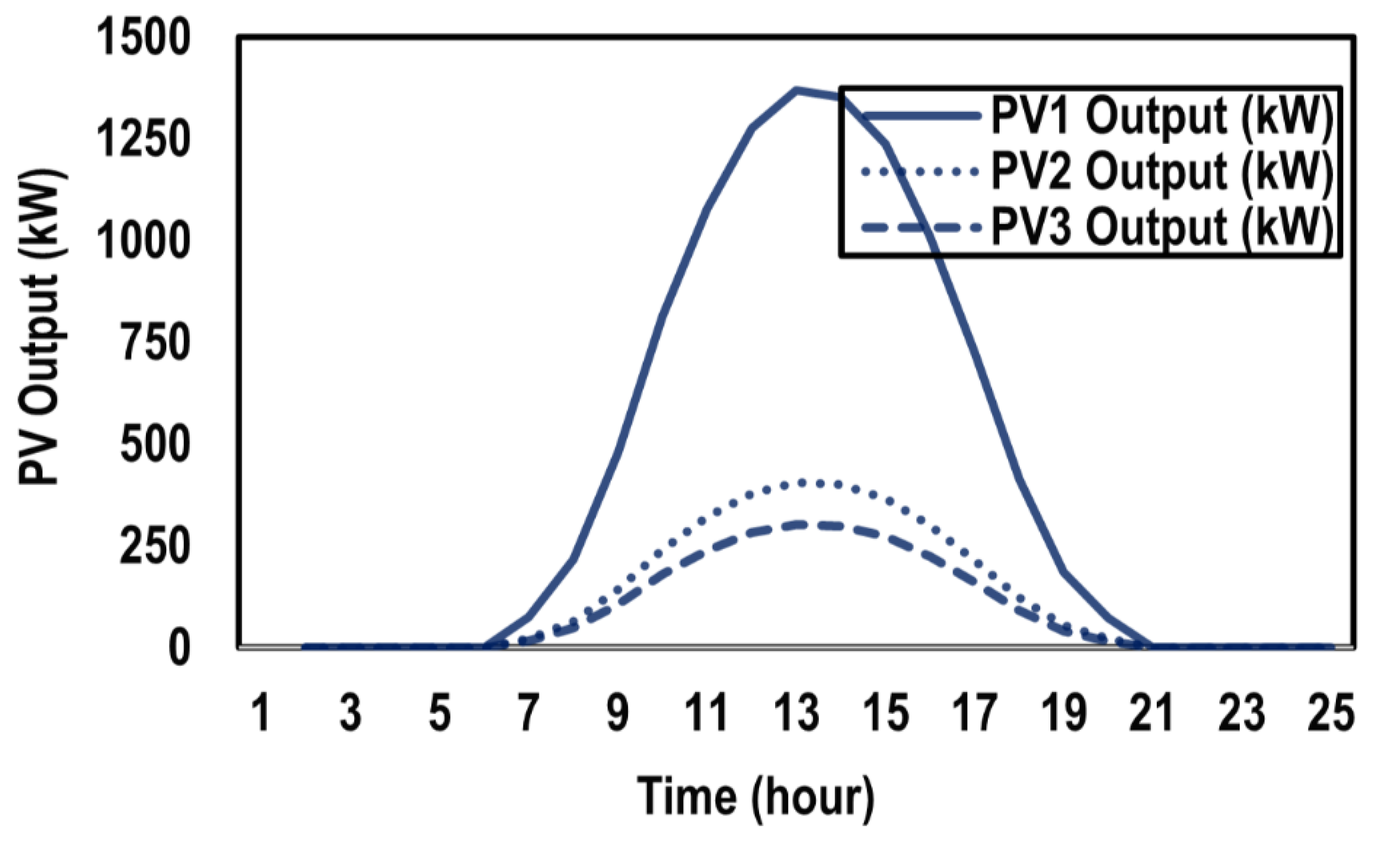


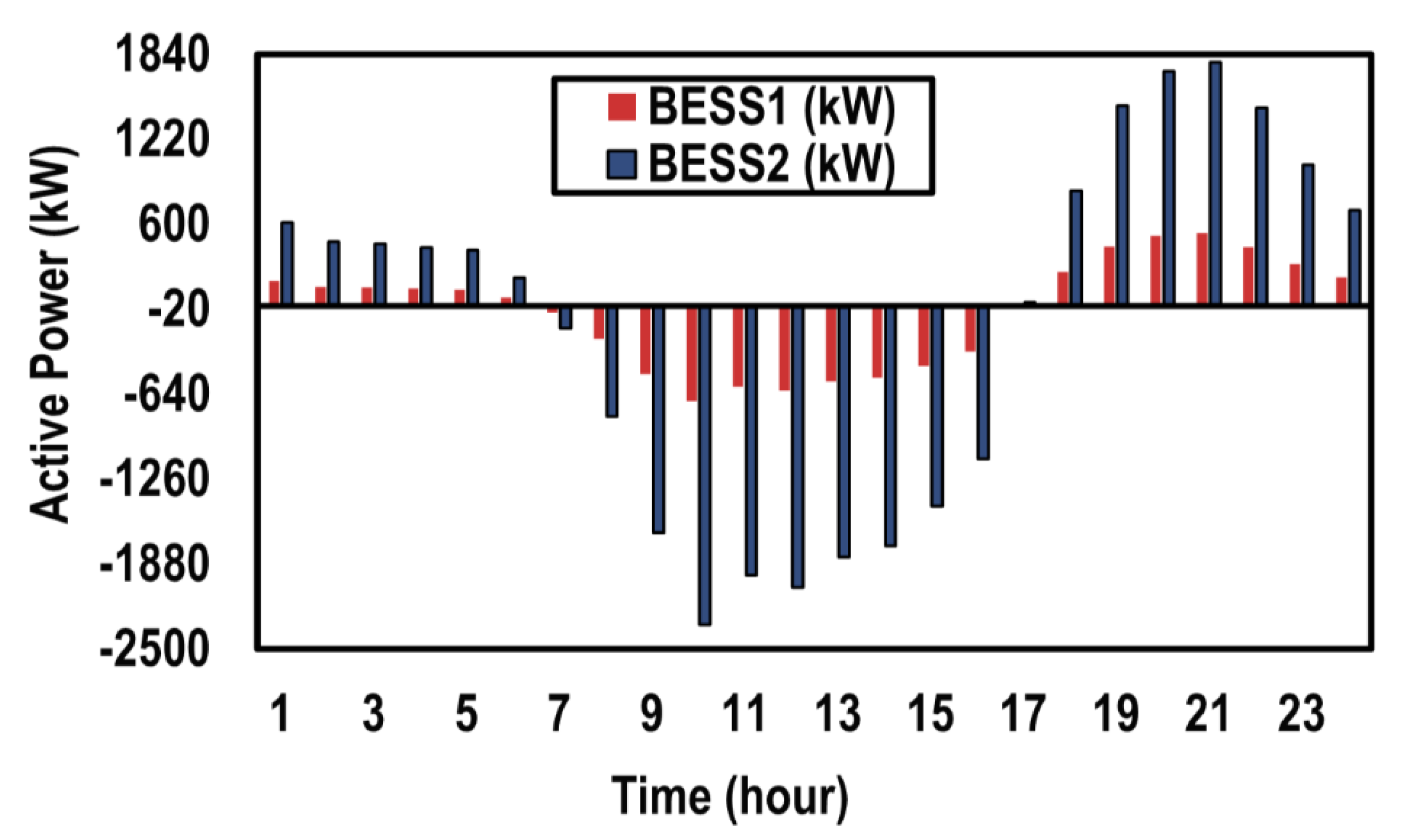


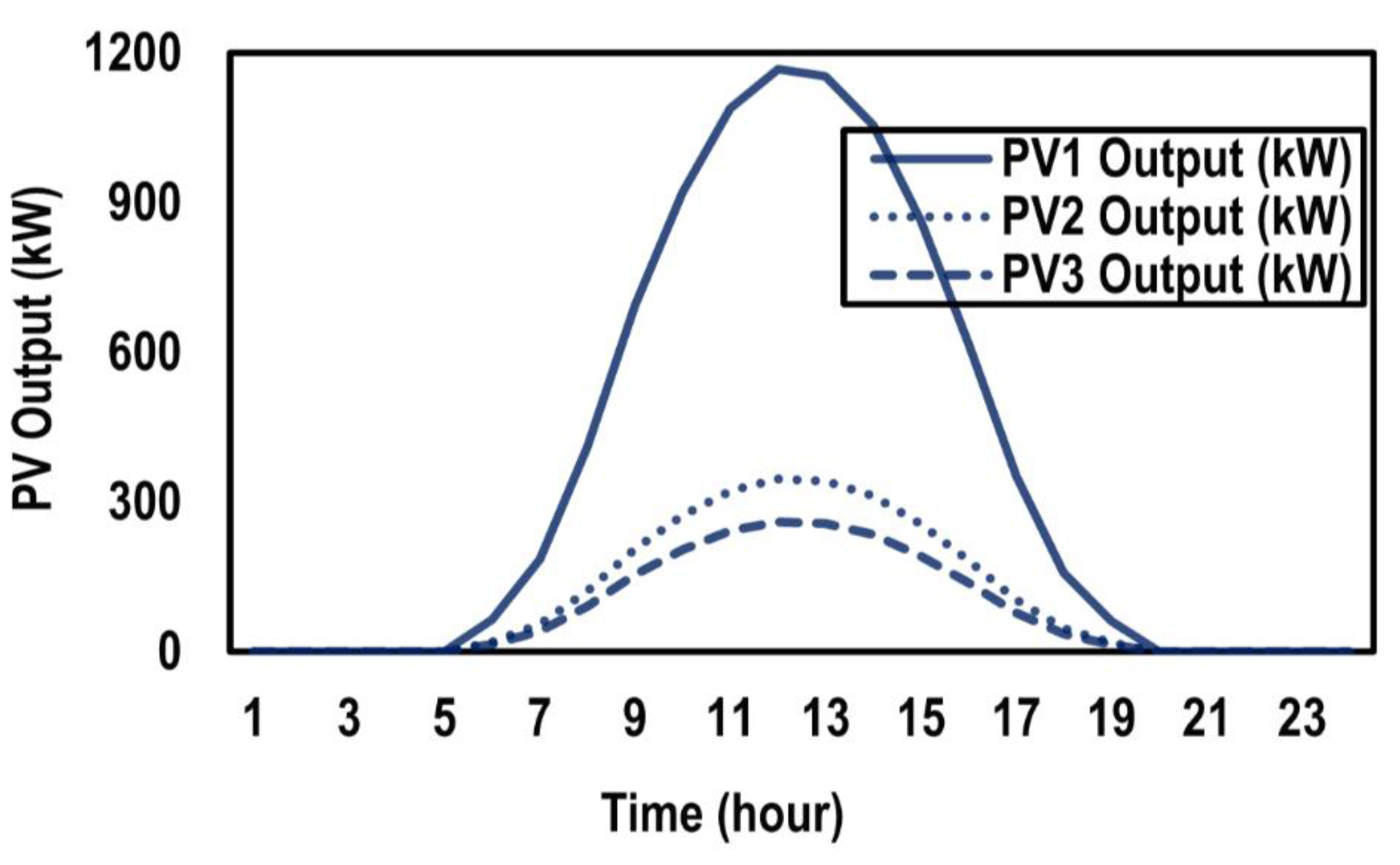

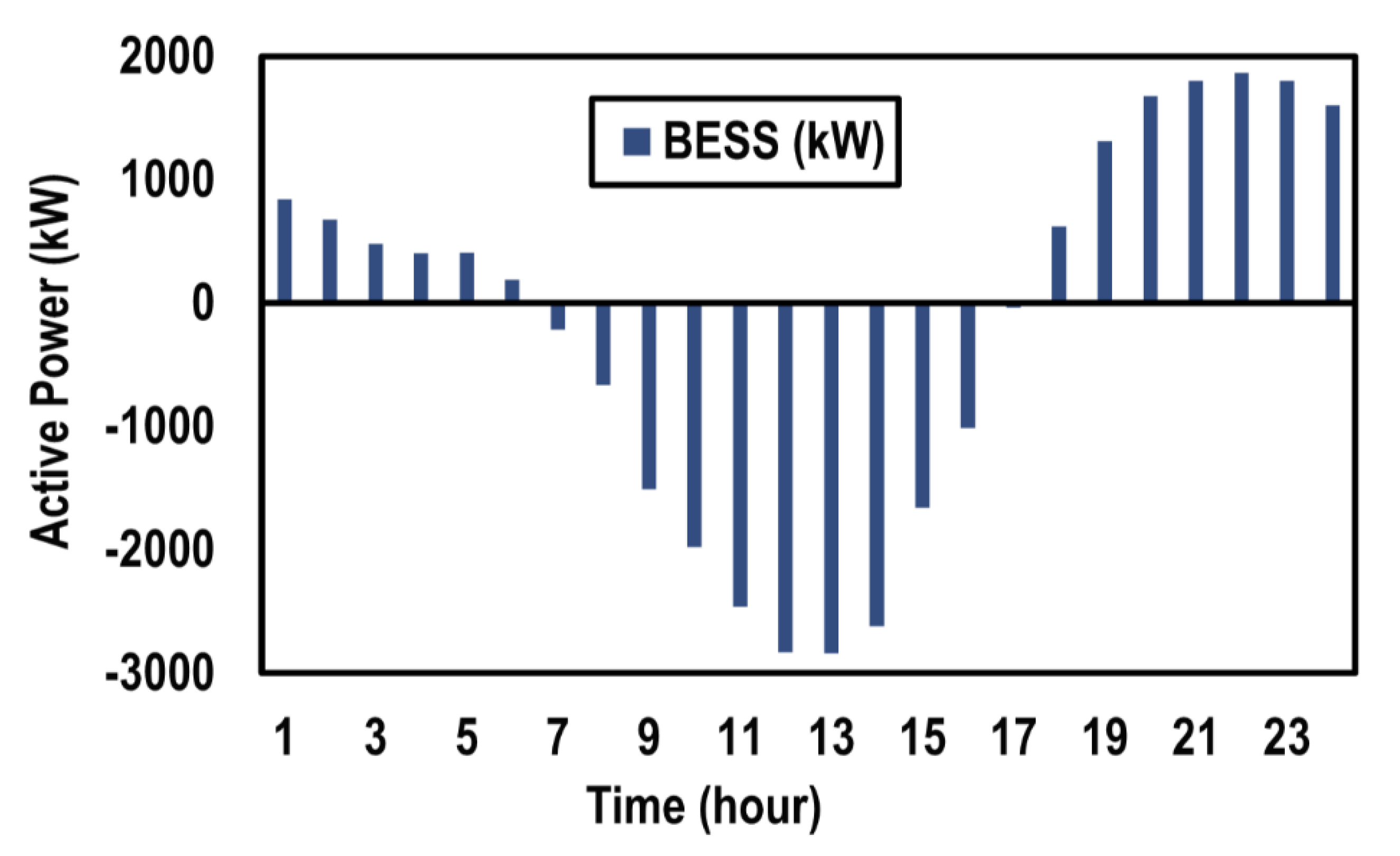
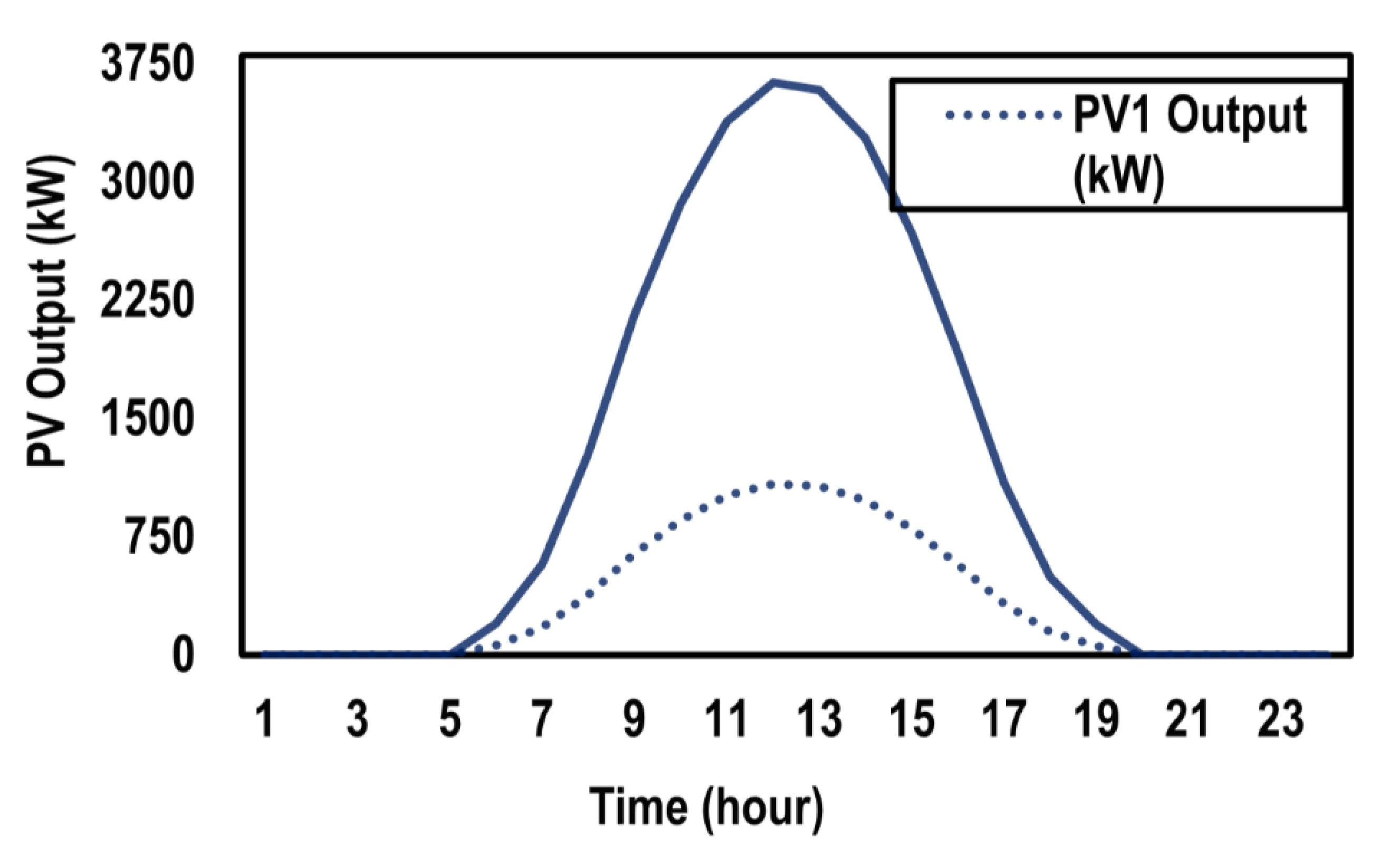

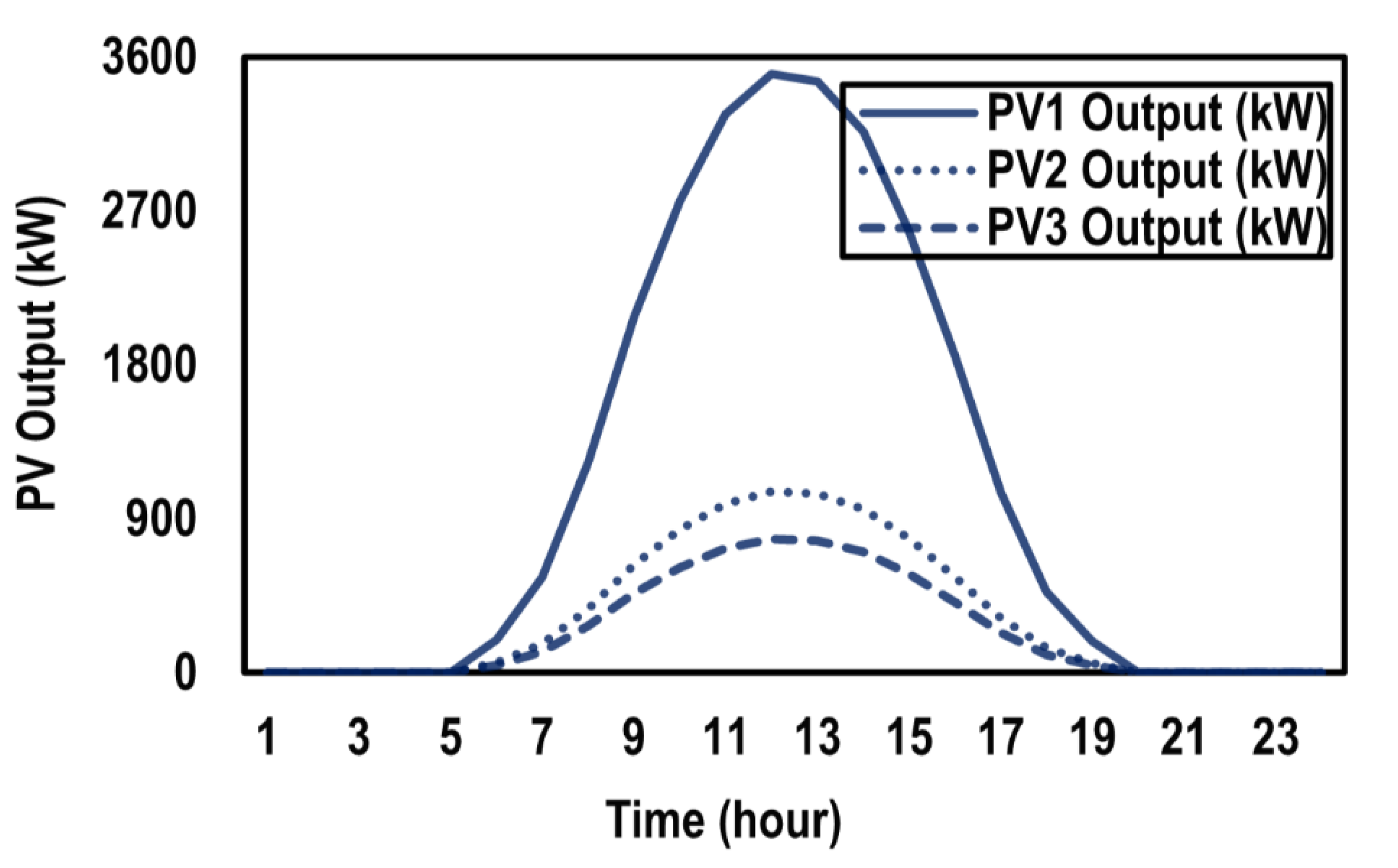


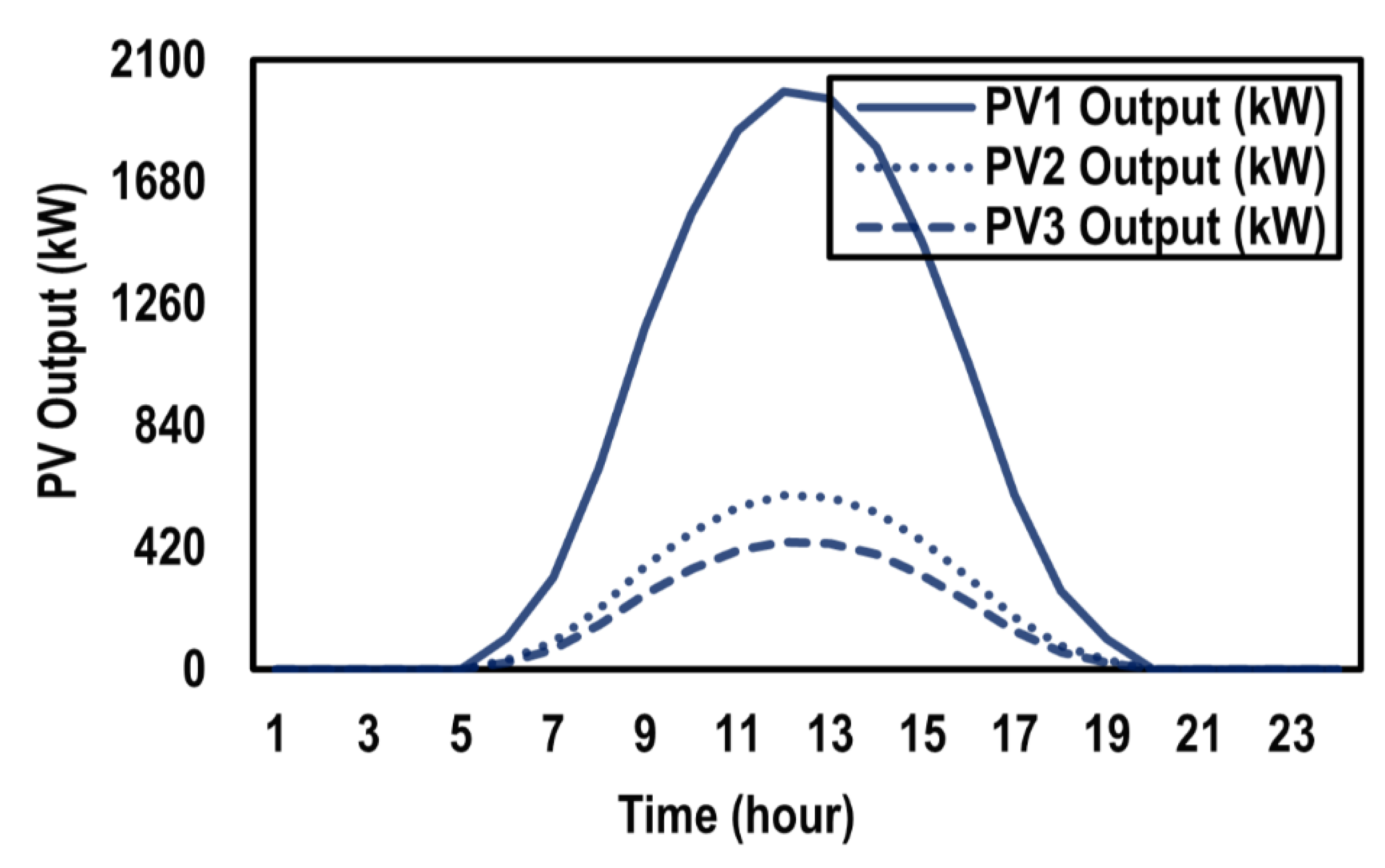

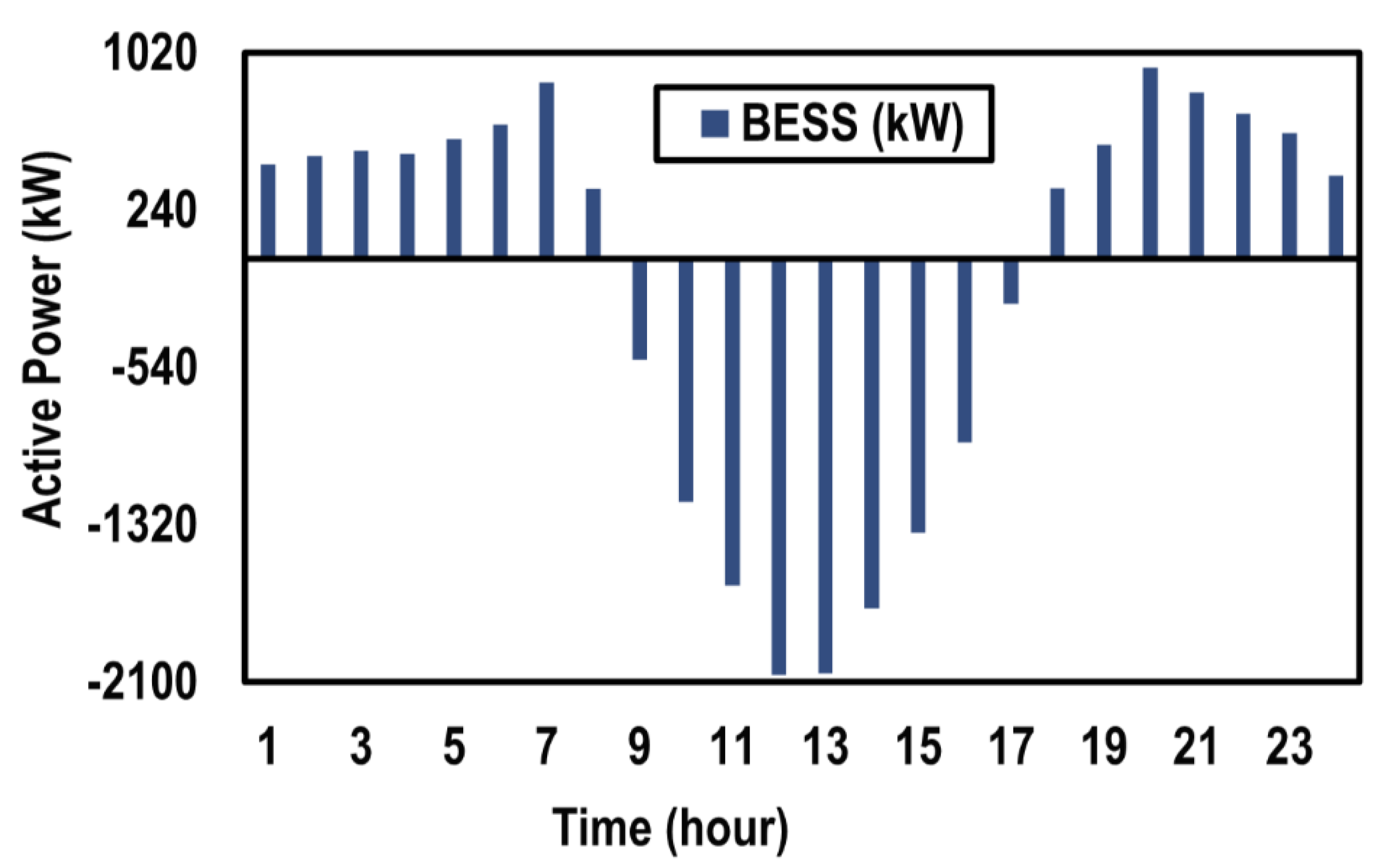




| The Used Parameters | The Proposed Value |
|---|---|
| Number of search agents | 20 |
| Maximum iteration | 2000 |
| voltage limits | |
| Limits of active output generation from PV with BESS | |
| the real load voltage indices (Np) for industrial, residential and commercial load models | 0.18, 0.92 and 1.51, respectively |
| the reactive load voltage indices (Nq) for industrial, residential and commercial load models | 6, 4.04 and 3.4, respectively |
| Item | Position (Size (kW)) | PV Energy (kWh) | Total PV Energy (kWh) | Ploss (kW) | |
|---|---|---|---|---|---|
| Residential Load | Without PV | - | - | - | 1867.977 |
| 1-PV | 61 (1489) | 61 (11,207) | 11,207 | 1389.4 | |
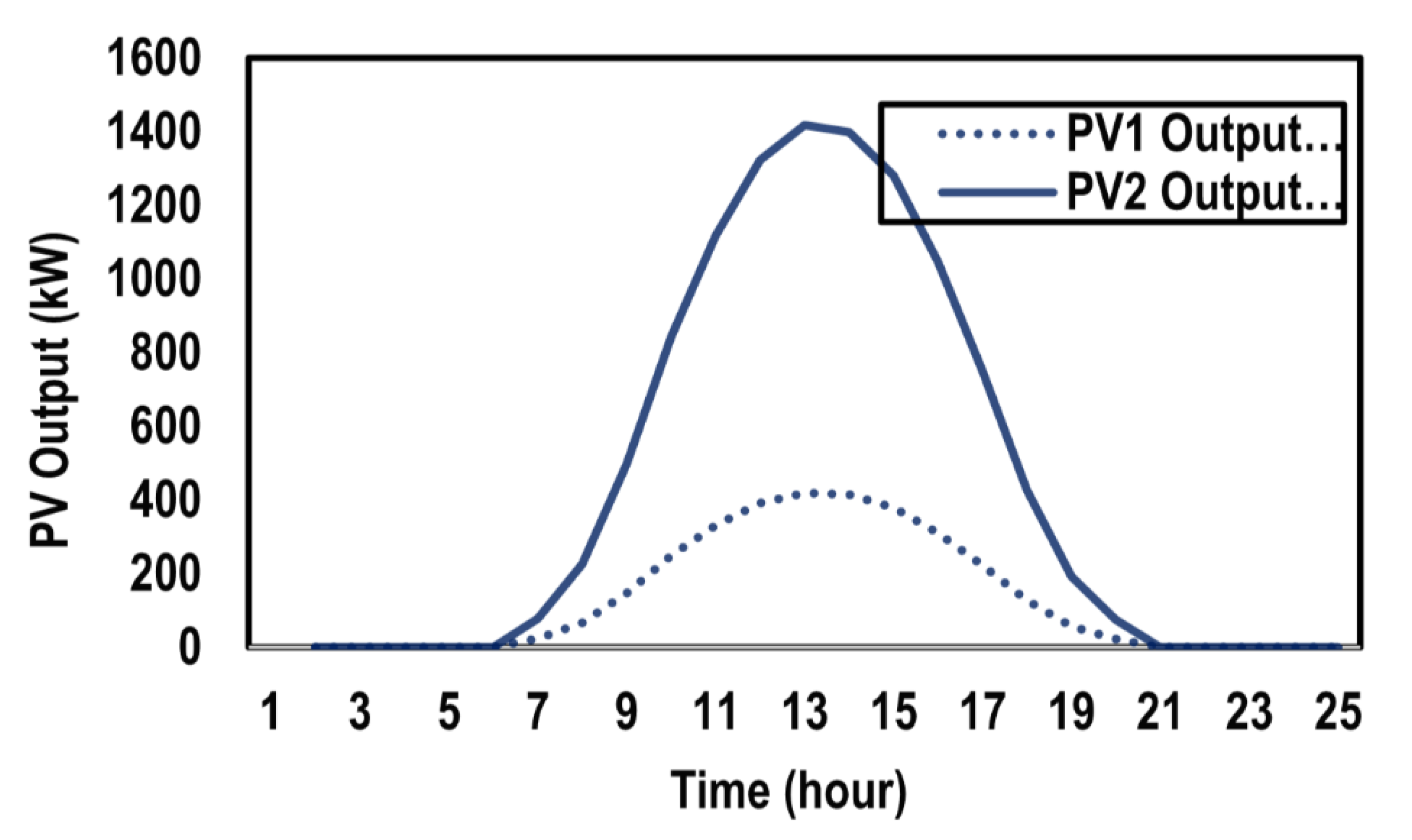
| 2-PV | 61 (1417.5) 17 (419.2) | 61 (10,668) 17 (3155.3) | 13,823.3 | 1349.2 | |
| 3-PV | 61 (1369) 18 (302.8) 11 (406.1) | 61 (10,304) 18 (2279) 11 (3056.6) | 15,639.6 | 1341.6 | |
| Item | Position (Size (kW)) | PV Energy (kWh) | EPV to grid (kWh) | Charging Energy (kWh) | Discharging Energy (kWh) | Ploss (kW) | ||
|---|---|---|---|---|---|---|---|---|
| Residential Load | Without PV and BES | - | - | - | - | - | 1867.977 | |
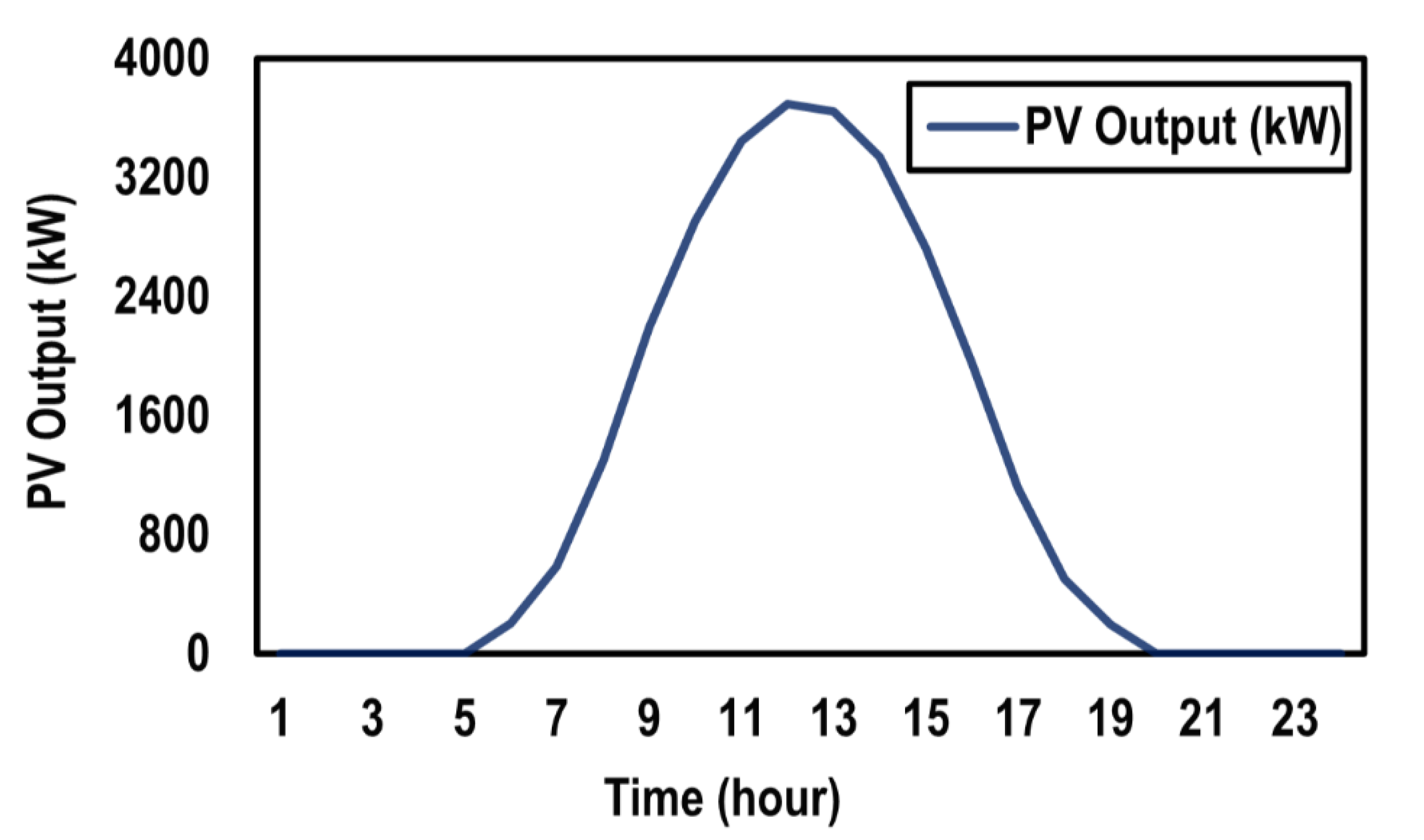
| 1 | PV | 61 (3693.2) | 27796 | 11666 | - | - | 711.9071 | |
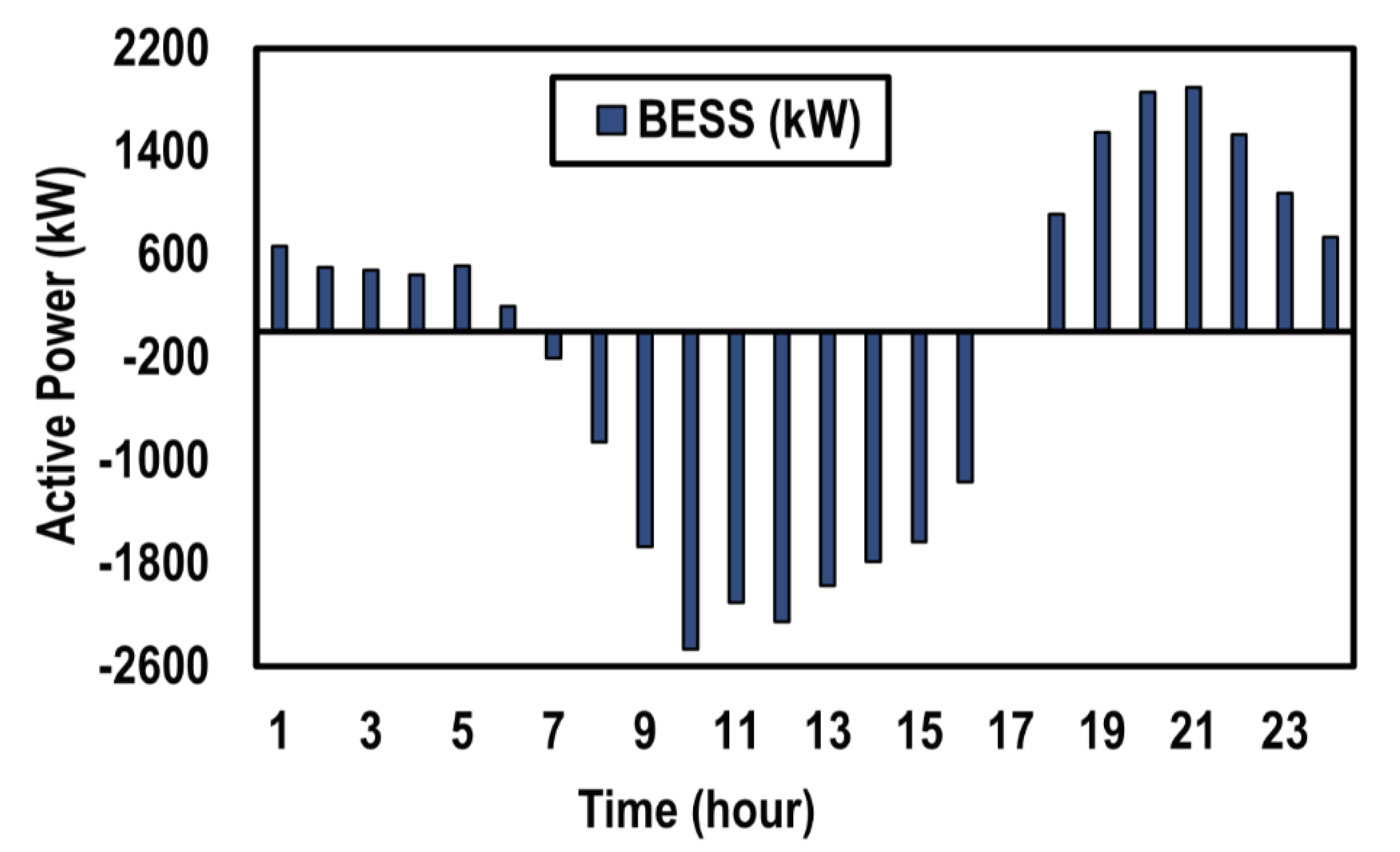
| BES | 61 (2467.5) | - | - | 16,130 | 12,358 | |||
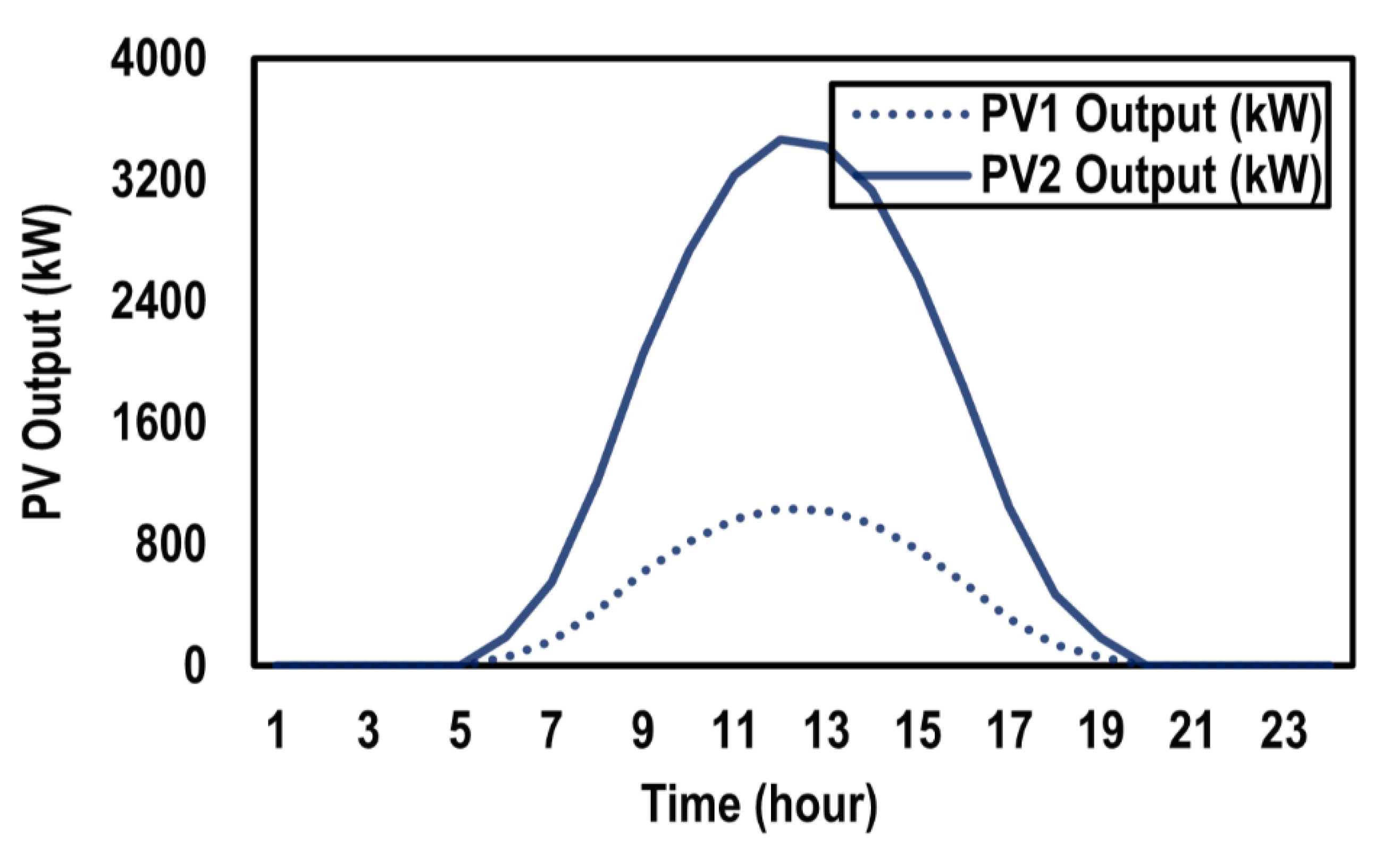
| 2 | PV | 61 (3466.1) 17 (1163.1) | 61 (26,088) 17 (7797.1) | 61 (10,971) 17 (3279.6) | - | - | 613.1804 | |
| BES | 61 (2323) 17 (693.992) | - | - | 61 (15,116) 17 (4517.5) | 61 (11,581) 17 (3460.9) | |||
| 3 | PV | 61 (3345.6) 18 (745.66) 11 (1012.7) | 61 (25,180) 18( 5612.2) 11 (7622.3) | 61 (10,589) 18 (2361.7) 11 (3202.5) | - | - | 594.447 | |
| BES | 61 (2242.17) 18 (498.78) 11 (681.1) | - | - | 61 (14,591) 18 (3250.5) 11 (4419.8) | 61 (11,178) 18 (2490.2) 11 (3386) | |||
| Item | Position (Size (kW)) | PV Energy (kWh) | Total PV Energy (kWh) | Ploss (kW) | |
|---|---|---|---|---|---|
| Industrial Load | Without PV | - | - | - | 1890.1117 |
| 1-PV | 61 (1270.7) | 61 (9563.6) | 9563.6 | 1553.5 | |
| 2-PV | 61 (1209.5) 17 (358.8) | 61 (9102.9) 17 (2700.9) | 11,803.8 | 1524.4 | |
| 3-PV | 61 (1168) 18 (259.6) 11 (345.9) | 61 (8790.6) 18 (1954.1) 11 (2603.7) | 13,348.4 | 1518.93 | |
| Item | Position (Size (kW)) | PV Energy (kWh) | EPV to grid (kWh) | Charging Energy (kWh) | Discharging Energy (kWh) | Ploss (kW) | ||
|---|---|---|---|---|---|---|---|---|
| Industrial Load | Without PV and BES | - | - | - | - | - | 1890.112 | |
| 1 | PV | 61 (3812.4) | 28,694 | 10,722 | - | - | 720.7217 | |
| BES | 61 (2841.7) | - | - | 17,972 | 13,807 | |||
| 2 | PV | 61 (3627.4) 17 (1084.2) | 61 (27,302) 17 (8160) | 61 (10,203) 17 (3051.9) | - | - | 622.0804 | |
| BES | 61 (2703.8) 17 (807.842) | - | - | 61 (17,099) 17 (5108.2) | 61 (13,137) 17 (3924.5) | |||
| 3 | PV | 61 (3501.1) 18 (780.37) 11 (1060) | 61 (26,351) 18 (5873.4) 11 (7978) | 61 (9848.4) 18 (2203.4) 11 (2964.7) | - | - | 603.1228 | |
| BES | 61 (2609.5) 18 (580.93) 11 (790.95) | - | - | 61 (16,502) 17 (3670.1) 11 (5013.3) | 61 (12,678) 17 (2819.6) 11 (3851.6) | |||
| Item | Position (Size (kW)) | PV Energy (kWh) | Total PV Energy (kWh) | Ploss (kW) | |
|---|---|---|---|---|---|
| Commercial Load | Without PV | - | - | - | 2173.851 |
| 1-PV | 61 (2168.2) | 61 (16,319) | 16,319 | 1124.5 | |
| 2-PV | 61 (2063.1) 17 (611.6) | 61 (15,527) 17 (4603) | 20,130 | 1038.2 | |
| 3-PV | 61 (1991.5) 18 (439.4) 11 (599.7) | 61 (14,989) 18 (3306.8) 11 (4513.5) | 22,809.30 | 1021.7 | |
| Item | Position (Size (kW)) | PV Energy (kWh) | EPV to grid (kWh) | Charging Energy (kWh) | Discharging Energy (kWh) | Ploss (kW) | ||
|---|---|---|---|---|---|---|---|---|
| Commercial Load | Without PV and BES | - | - | - | - | - | 2173.851 | |
| 1 | PV | 61 (3832.2) | 28,843 | 17,155 | - | - | 825.1585 | |
| BES | 61 (2064.9) | - | - | 11,688 | 8936.1 | |||
| 2 | PV | 61 (3644.3) 17 (1089.2) | 61 (27,429) 17 (8197.6) | 61 (16,253) 17 (4853.2) | - | - | 709.9147 | |
| BES | 61 (1945.8) 17 (582.223) | - | - | 61 (11,175) 17 (3344.4) | 61 (8544.5) 17 (2557.1) | |||
| 3 | PV | 61 (3517.3) 18 (783.5) 11 (1065.6) | 61 (26473) 18 (5897.1) 11 (8020.3) | 61 (15685) 18 (3483.5) 11 (4777.6) | - | - | 688.1289 | |
| BES | 61 (1878.5) 18 (420.22) 11 (564.685) | - | - | 61 (10788) 18 (2413.6) 11 (3242.7) | 61 (8248.5) 18 (1845.4) 11 (2479.4) | |||
| Item | AOA | Modified HGSO [36] | HGSO [36] |
|---|---|---|---|
| Ploss (kW) Without PV and BES | 2173.851 | 2173.851 | 2173.851 |
| Location (PV size (kW)) | 61 (3517.3) 18 (783.5) 11 (1065.6) | 61 (3517.488) 18 (784.1074) 11 (1064.323) | 61 (3187.526) 18 (860.6001) 11 (934.0223) |
| Location (BES size (kW)) | 61 (1878.5) 18 (420.22) 11 (564.685) | 61 (1878.5) 18 (420.843) 11 (563.386) | 61 (1911.138) 18 (486.4727) 11 (595.803) |
| Ploss (kW) | 688.1289 | 688.129 | 716.809 |
Publisher’s Note: MDPI stays neutral with regard to jurisdictional claims in published maps and institutional affiliations. |
© 2021 by the authors. Licensee MDPI, Basel, Switzerland. This article is an open access article distributed under the terms and conditions of the Creative Commons Attribution (CC BY) license (https://creativecommons.org/licenses/by/4.0/).
Share and Cite
Abdel-Mawgoud, H.; Kamel, S.; Tostado-Véliz, M.; Elattar, E.E.; Hussein, M.M. Optimal Incorporation of Photovoltaic Energy and Battery Energy Storage Systems in Distribution Networks Considering Uncertainties of Demand and Generation. Appl. Sci. 2021, 11, 8231. https://doi.org/10.3390/app11178231
Abdel-Mawgoud H, Kamel S, Tostado-Véliz M, Elattar EE, Hussein MM. Optimal Incorporation of Photovoltaic Energy and Battery Energy Storage Systems in Distribution Networks Considering Uncertainties of Demand and Generation. Applied Sciences. 2021; 11(17):8231. https://doi.org/10.3390/app11178231
Chicago/Turabian StyleAbdel-Mawgoud, Hussein, Salah Kamel, Marcos Tostado-Véliz, Ehab E. Elattar, and Mahmoud M. Hussein. 2021. "Optimal Incorporation of Photovoltaic Energy and Battery Energy Storage Systems in Distribution Networks Considering Uncertainties of Demand and Generation" Applied Sciences 11, no. 17: 8231. https://doi.org/10.3390/app11178231
APA StyleAbdel-Mawgoud, H., Kamel, S., Tostado-Véliz, M., Elattar, E. E., & Hussein, M. M. (2021). Optimal Incorporation of Photovoltaic Energy and Battery Energy Storage Systems in Distribution Networks Considering Uncertainties of Demand and Generation. Applied Sciences, 11(17), 8231. https://doi.org/10.3390/app11178231