Article

Multiplate® Platelet Aggregation Findings Are Dependent on Platelet Count but Can Be Corrected by Use of a Ratio


Klinik für Anästhesiologie und Intensivmedizin, Universitätsklinikum Essen, Universität Duisburg-Essen, 45122 Essen, Germany
*
Author to whom correspondence should be addressed.
Appl. Sci. 2020, 10(22), 7971; https://doi.org/10.3390/app10227971
Submission received: 4 October 2020 / Revised: 24 October 2020 / Accepted: 30 October 2020 / Published: 10 November 2020
(This article belongs to the Section Applied Biosciences and Bioengineering)

Abstract

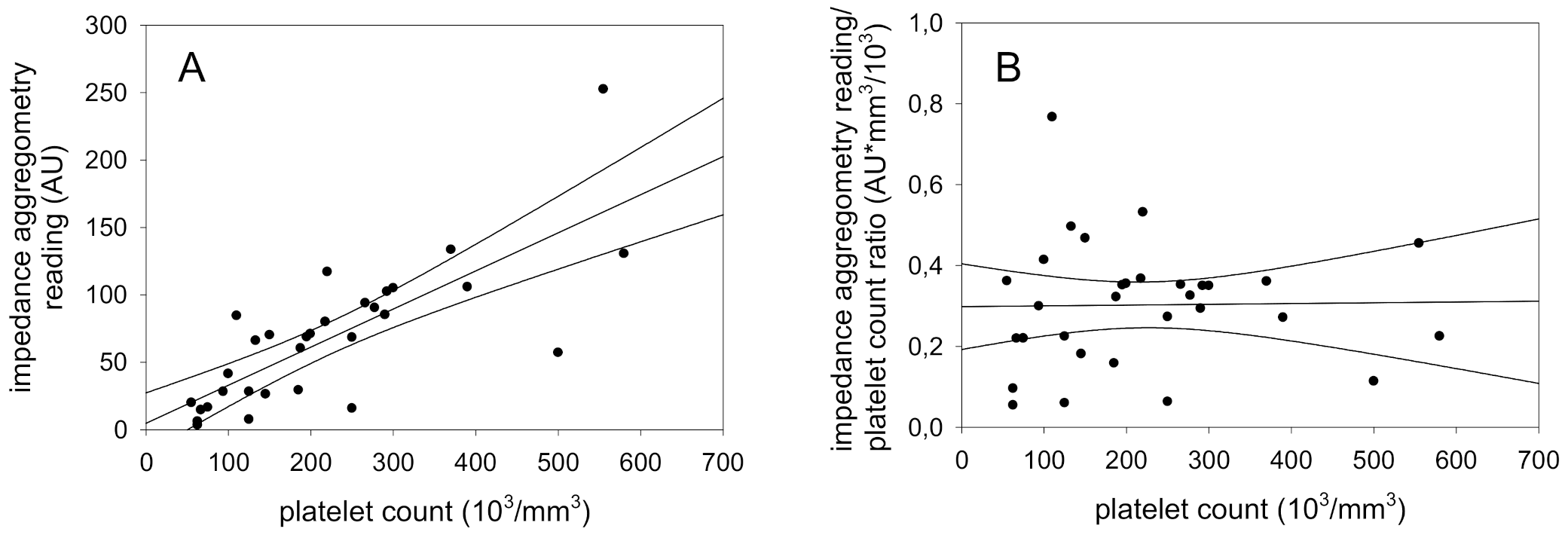
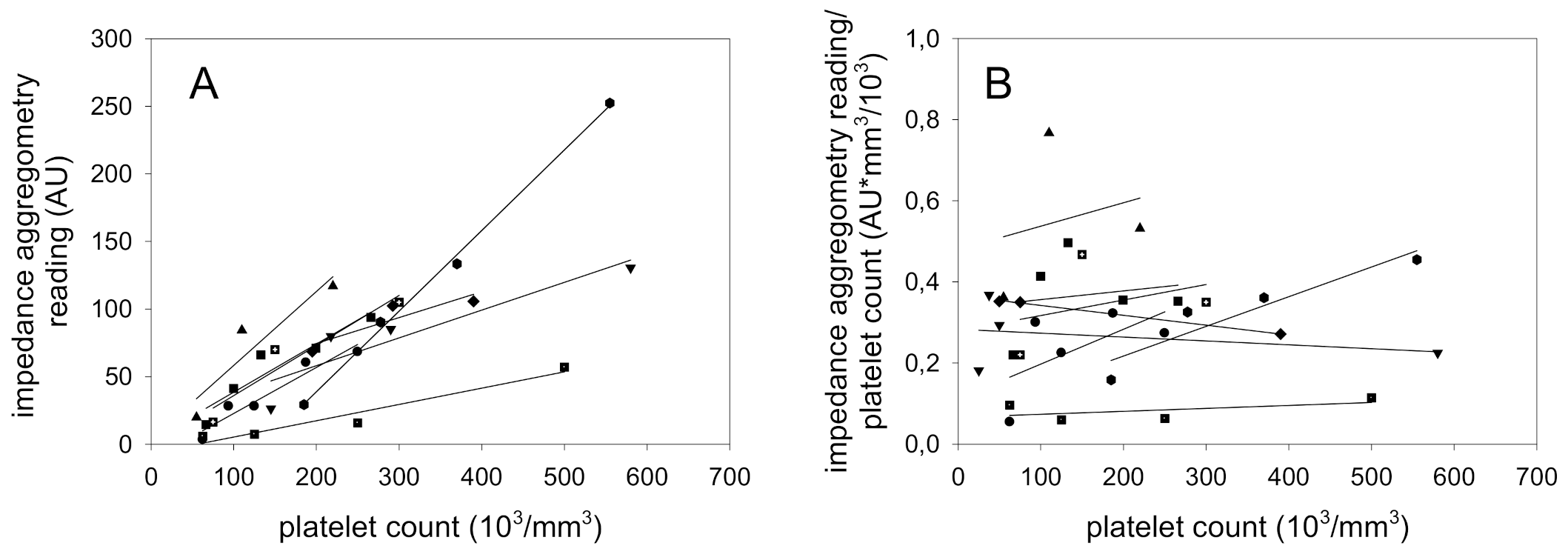
Impedance aggregometry (Multiplate®) detects the effects of platelet aggregation inhibitors and can predict thrombotic complications after coronary and cerebrovascular stent interventions. The bedside method uses whole blood samples not corrected for platelet count. It is claimed but not proved that the findings are unrelated to platelet count in the physiological range. We therefore investigated in the experimental study: (1) whether impedance aggregometry findings and platelet count are correlated and (2) whether the aggregation/platelet count ratio expresses platelet function independent of platelet count. Following ethics committee approval, platelet-rich plasma from healthy probands was diluted with platelet-poor plasma to obtain different platelet counts. Thereafter, platelet count was measured and samples were subjected to impedance aggregometry using thrombin receptor activating peptide (TRAP) for platelet activation. In all probands, impedance aggregometry findings and platelet count were highly correlated (r = 0.88 to 0.94; p < 0.05). The combination of all experiments revealed the proportionality between impedance aggregometry findings and platelet count (n = 31, r = 0.78, p = 0.0001). In contrast, the ratio of impedance aggregometry findings and platelet count was not significantly correlated with platelet count (r = 0.017; p = 0.3) and thus constitutes a specific measure for platelet function. In conclusion, impedance aggregometry findings subsequent to the activation with TRAP are dependent on both platelet function and platelet count. Normalization of impedance aggregometry findings for platelet count can be achieved by a ratio resulting in more specific results.
Keywords: multiplate-device; impedance aggregometry; platelet aggregation; platelet count multiplate-device; impedance aggregometry; platelet aggregation; platelet count