Article

Development of an AI Userbot for Engineering Design Education Using an Intent and Flow Combined Framework


Department of Technology Application and Human Resource Development, National Taiwan NormalUniversity, Taipei 06, Taiwan
*
Author to whom correspondence should be addressed.
Appl. Sci. 2020, 10(22), 7970; https://doi.org/10.3390/app10227970
Submission received: 28 September 2020 / Revised: 4 November 2020 / Accepted: 5 November 2020 / Published: 10 November 2020
(This article belongs to the Section Computing and Artificial Intelligence)

Abstract

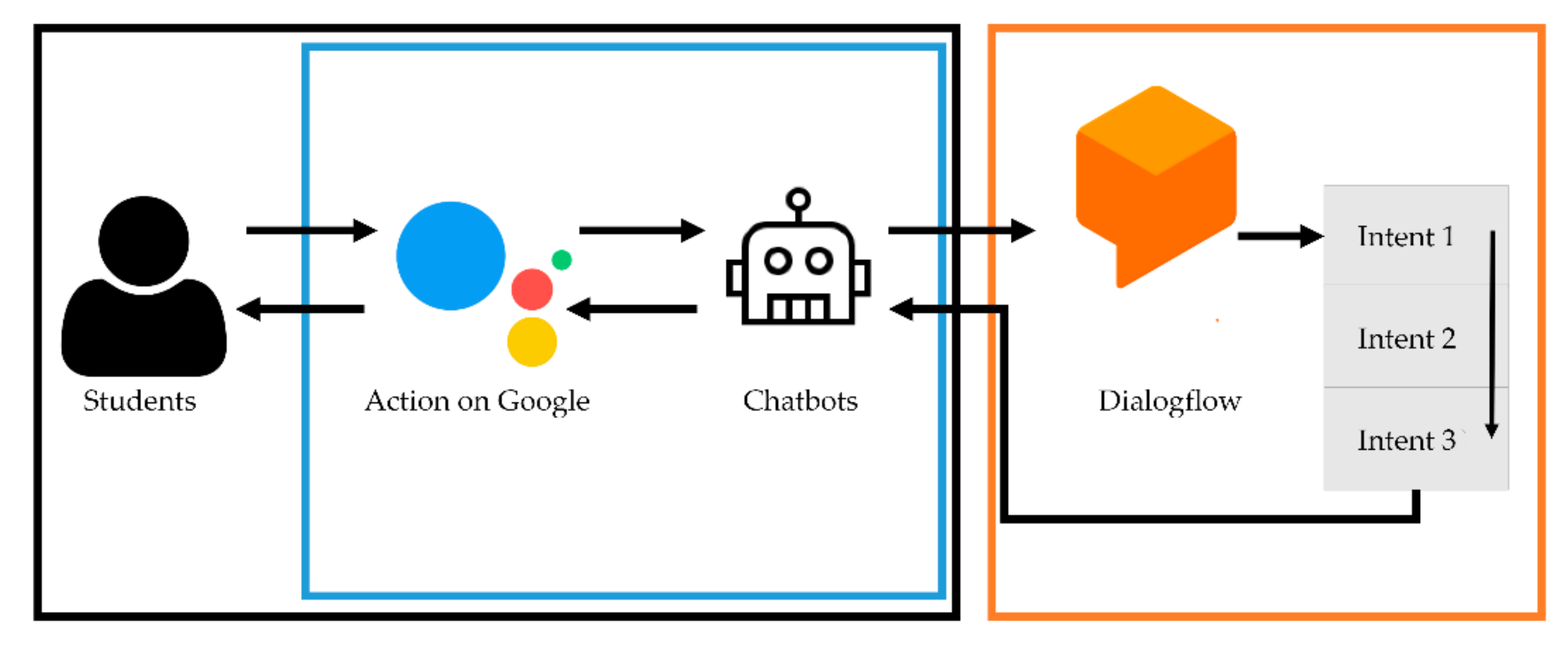
As the inclusion of users in the design process receives greater attention, designers need to not only understand users, but also further cooperate with them. Therefore, engineering design education should also follow this trend, in order to enhance students’ ability to communicate and cooperate with users in the design practice. However, it is difficult to find users on teaching sites to cooperate with students because of time and budgetary constraints. With the development of artificial intelligence (AI) technology in recent years, chatbots may be the solution to finding specific users to participate in teaching. This study used Dialogflow and Google Assistant to build a system architecture, and applied methods of persona and semi-structured interviews to develop AI virtual product users. The system has a compound dialog mode (combining intent- and flow-based dialog modes), with which multiple chatbots can cooperate with students in the form of oral dialog. After four college students interacted with AI userbots, it was proven that this system can effectively participate in student design activities in the early stage of design. In the future, more AI userbots could be developed based on this system, according to different engineering design projects for engineering design teaching.
Keywords: artificial intelligence; chatbot; participatory design; product user; userbot artificial intelligence; chatbot; participatory design; product user; userbot