Article

An Approach to Human Walking Analysis Based on Balance, Symmetry and Stability Using COG, ZMP and CP

School of Science and Technology, Keio University, Yokohama 223-8522, Kanagawa, Japan
*
Author to whom correspondence should be addressed.
Appl. Sci. 2020, 10(20), 7307; https://doi.org/10.3390/app10207307
Submission received: 6 September 2020 / Revised: 9 October 2020 / Accepted: 16 October 2020 / Published: 19 October 2020
(This article belongs to the Special Issue Biorobotics: Challenges, Technologies, and Trends)

Abstract

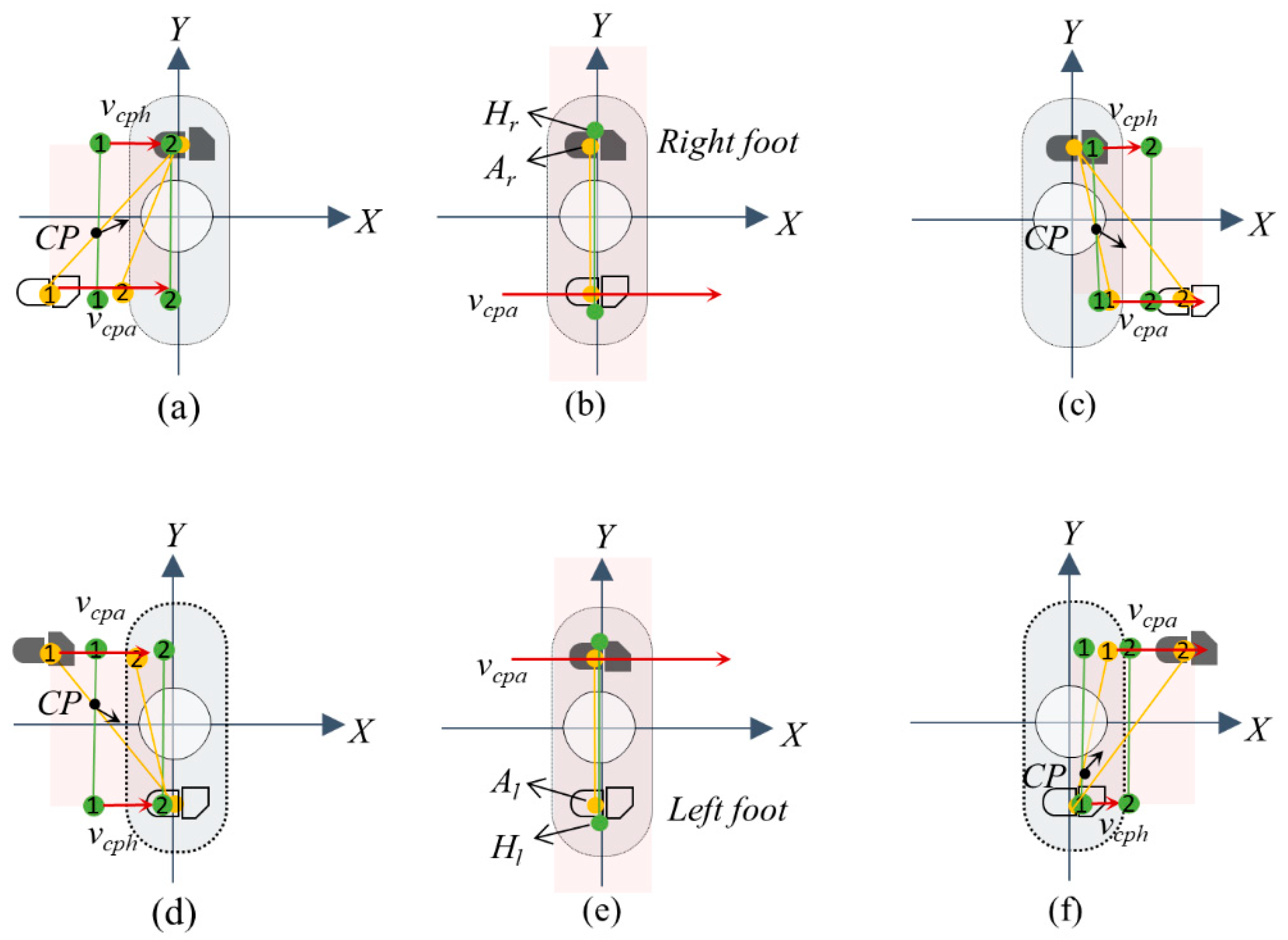
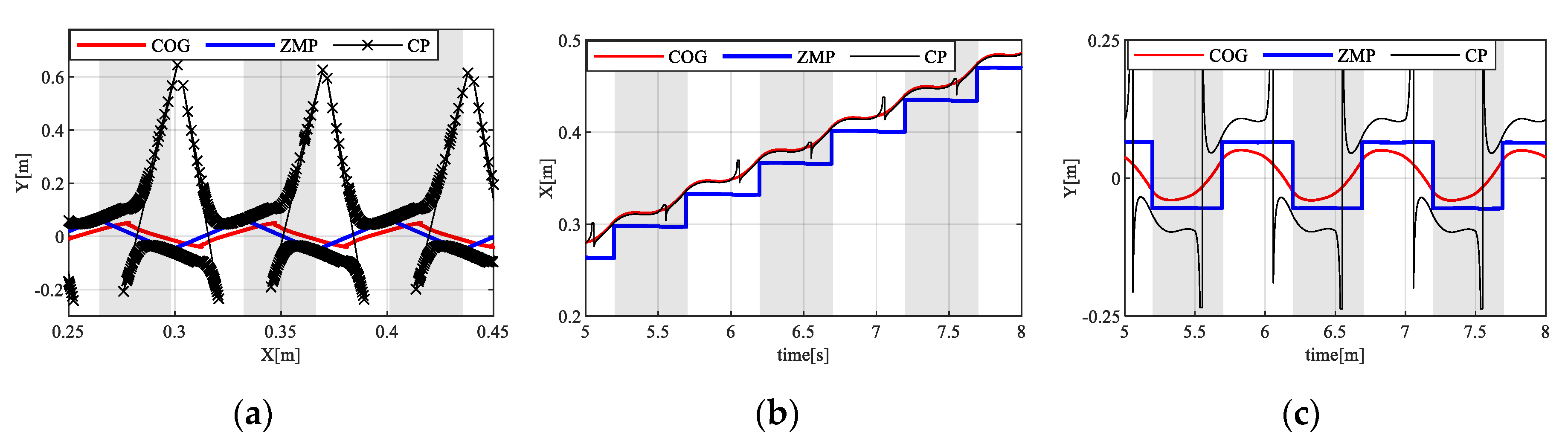
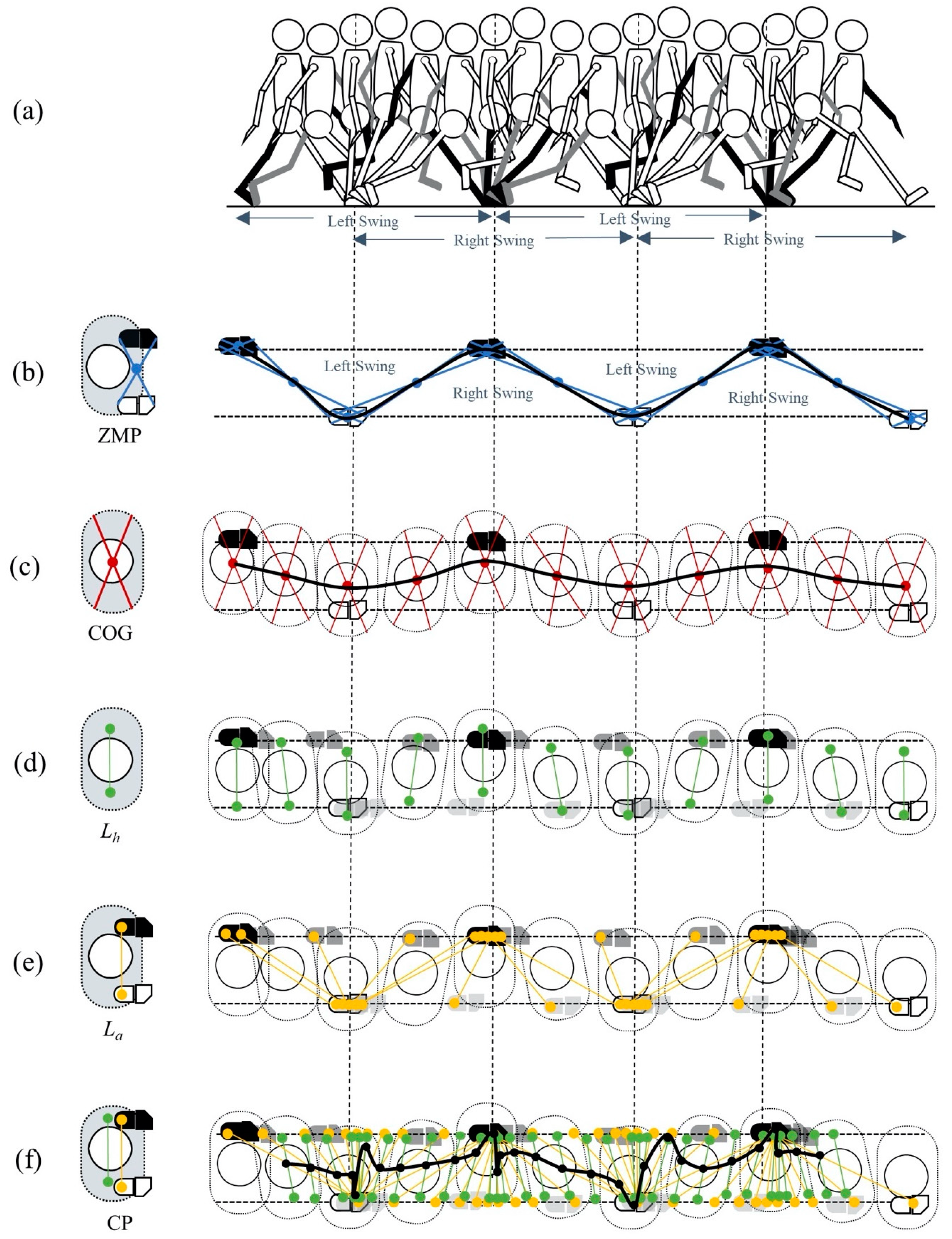
The parameters of walking have been studied from the viewpoints of joint rotation and translation of body. The balance and symmetry of walking are indispensable features to understand for healthy walking, while also being a personal characteristic. However, quantification has not been easy to carry out in the case of the conventional gait parameters COG (center of gravity) and ZMP (zero moment point). In this approach, the CP (crossing point) is proposed to quantify the concept of symmetry and balance by comparing it to the COG and ZMP. The CP is estimated based on the intersection between the hip line and the ankle line. While the hip line is fixed on the upper body where the COG is, the ankle line is altered depending on the each footfall, where the ZMP is. Therefore, the values of COG, ZMP, and CP have similar or different tendencies in terms of whether balanced walking results in symmetry or not. The validity of this is verified by carrying out a simulation with robot walking, and an experiment using human walking. Through additional experiments, it was noticed that the CP was able to improve the role of COG and ZMP in terms of not only stability, but also its relationship with the movement range of the lower limbs.
Keywords: COG; Gait recognition; human walking analysis; walking balance; walking symmetry; walking stability; ZMP COG; Gait recognition; human walking analysis; walking balance; walking symmetry; walking stability; ZMP