Article

Kalman Filter-Based Adaptive Delay Compensation for Benchmark Problem in Real-Time Hybrid Simulation


1
College of Civil Engineering, Huaqiao University, Xiamen 361021, China
2
Key Laboratory for Intelligent Infrastructure and Monitoring of Fujian Province, Huaqiao University, Xiamen 361021, China
3
School of Civil Engineering and Architecture, Wuhan University of Technology, Wuhan 430070, China
*
Author to whom correspondence should be addressed.
Appl. Sci. 2020, 10(20), 7101; https://doi.org/10.3390/app10207101
Submission received: 29 August 2020 / Revised: 5 October 2020 / Accepted: 6 October 2020 / Published: 13 October 2020
(This article belongs to the Special Issue Advances on Structural Engineering, Volume II)

Abstract

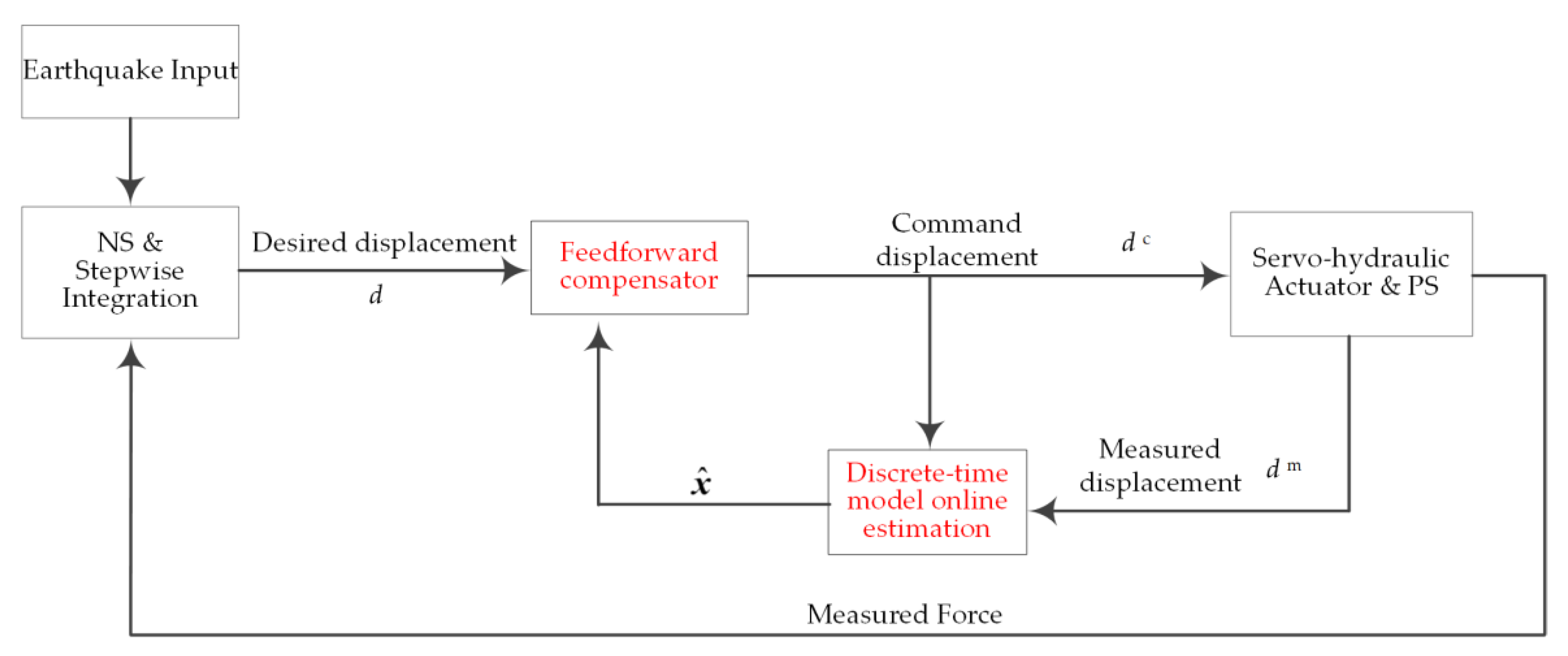
Real-time hybrid simulation (RTHS) is a versatile, effective, and promising experimental method used to evaluate the structural performance under dynamic loads. In RTHS, the emulated structure is divided into a numerically simulated substructure (NS) and a physically tested substructure (PS), and a transfer system is used to ensure the force equilibrium and deformation compatibility between the substructures. Owing to the inherent dynamics of the PS and transfer system (referred to as a control plant in this study), there is a time-delay between the displacement command and measurement. This causes de-synchronization between the boundary of the PS and NS, and affects the stability and accuracy of the RTHS. In this study, a Kalman filter-based adaptive delay compensation (KF-ADC) method is proposed to address this issue. In this novel method, the control plant is represented by a discrete-time model, whose coefficients are time-varying and are estimated online by the KF using the displacement commands and measurements. Based on this time-varying model, the delay compensator is constructed employing the desired displacements. The KF performance is investigated theoretically and numerically. To assess the performance of the proposed strategy, a series of virtual RTHSs are performed on the Benchmark problem in RTHS, which was based on an actual experimental system. Meanwhile, several promising delay-compensation strategies are employed for comparison. Results reveal that the proposed time-delay compensation method effectively enhances the accuracy, stability, and robustness of RTHS.
Keywords: real-time hybrid simulation; adaptive delay compensation; Kalman filter; feedforward; Benchmark real-time hybrid simulation; adaptive delay compensation; Kalman filter; feedforward; Benchmark