

Pedagogy over Technology: Evidence from a European Study of Generation Z Students in Entrepreneurship Education




Abstract
1. Introduction
2. Theoretical Background
2.1. What Do Young Learners Expect from Entrepreneurship Education?
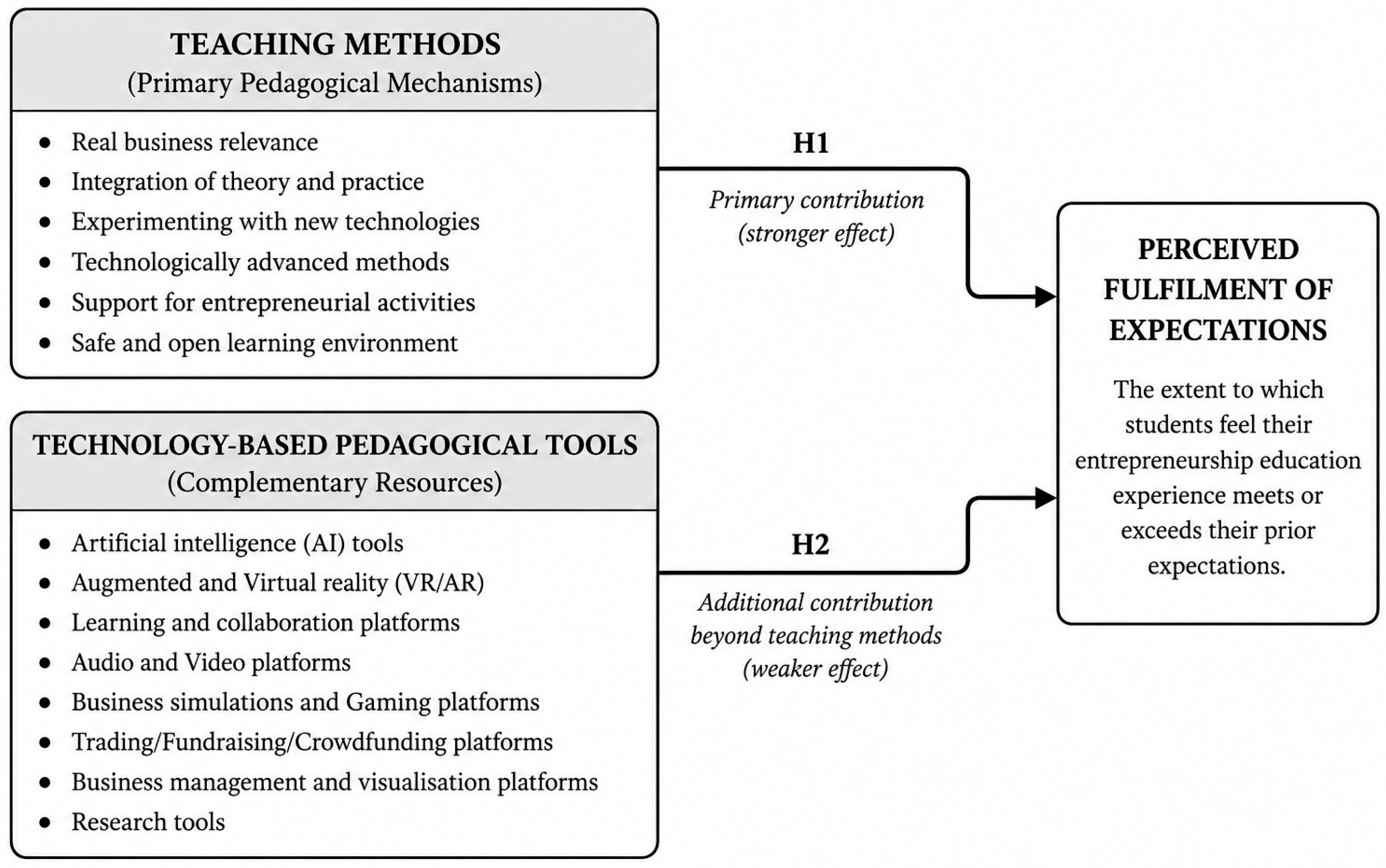
2.2. Theoretical Framework and Hypotheses
3. Materials and Methods
4. Results
4.1. Participants
4.2. Analysis and Results
5. Discussion
5.1. Theoretical Contributions
5.2. Implications for Pedagogy
6. Conclusions
Limitations and Future Research
Author Contributions
Funding
Institutional Review Board Statement
Informed Consent Statement
Data Availability Statement
Conflicts of Interest
References
- Barnes & Noble College. (2015). Getting to know Gen Z: Exploring middle and high schoolers’ expectations for higher education. Barnes & Noble College report. Barnes & Noble College. [Google Scholar]
- Biggs, J., & Tang, C. (2011). Teaching for quality learning at university (4th ed.). Open University Press. [Google Scholar]
- Block, J., & Koellinger, P. (2009). I can’t get no satisfaction—Necessity entrepreneurship and procedural utility. Kyklos, 62(2), 191–209. [Google Scholar] [CrossRef] [Scilit]
- Bower, M., & Jong, M. S.-Y. (2020). Immersive virtual reality in education. British Journal of Educational Technology, 51(6), 1981–1990. [Google Scholar] [CrossRef] [Scilit]
- Chan, C. K., & Lee, K. K. (2023). The AI generation gap: Are Gen Z students more interested in adopting generative AI such as ChatGPT in teaching and learning than their Gen X and millennial generation teachers? Smart Learning Environments, 10, 60. [Google Scholar] [CrossRef] [Scilit]
- Chardonnens, S. (2025). Adapting educational practices for Generation Z: Integrating metacognitive strategies and artificial intelligence. Frontiers in Education, 10, 1504726. [Google Scholar] [CrossRef] [Scilit]
- Chotisarn, N., & Phuthong, T. (2026). Reducing gaps in digital entrepreneurship education: A systematic review of innovative learning strategies and their institutional impact. The International Journal of Management Education, 24(1), 101283. [Google Scholar] [CrossRef] [Scilit]
- Colombelli, A., Loccisano, S., Panelli, A., Pennisi, O. A., & Serraino, F. (2022). Entrepreneurship education: The effects of challenge-based learning on the entrepreneurial mindset of university students. Administrative Sciences, 12(1), 10. [Google Scholar] [CrossRef] [Scilit]
- Council of the European Union. (2023). Council recommendation of 23 November 2023 on the key enabling factors for successful digital education and training (C/2024/1115). Official Journal of the European Union. Document 32024H01115. Available online: http://data.europa.eu/eli/C/2024/1115/oj (accessed on 20 August 2026).
- de Sousa, M. M., de Almeida, D. A. R., Mansur-Alves, M., & Huziwara, E. M. (2024). Characteristics and effects of entrepreneurship education programs: A systematic review. Trends in Psychology, 32, 682–712. [Google Scholar] [CrossRef] [Scilit] [PubMed]
- Drewery, D., Truong, M., & Fannon, A.-M. (2023). Gen Z students’ work-integrated learning experiences and work values. Higher Education, Skills and Work-Based Learning, 13, 1023–1036. [Google Scholar] [CrossRef] [Scilit]
- Eccles, J. S., & Wigfield, A. (2002). Motivational beliefs, values, and goals. Annual Review of Psychology, 53, 109–132. [Google Scholar] [CrossRef] [Scilit] [PubMed]
- European Association for Quality Assurance in Higher Education, European Students’ Union, European University Association & European Association of Institutions in Higher Education. (2015). Standards and guidelines for quality assurance in the European higher education area (ESG). EURASHE. [Google Scholar]
- European Commission. (2020). Digital education action plan 2021–2027: Resetting education and training for the digital age (COM(2020) 624 final). EUR-Lex official document. European Commission. [Google Scholar]
- European Commission. (2022). Communication from the commission to the European parliament, the council, the European economic and social committee and the committee of the regions on a European strategy for universities (COM(2022) 16 final). EUR-Lex official document. European Commission. [Google Scholar]
- European Higher Education Area. (2024, May 29–30). Tirana communiqué. Ministerial Conference, Tirana, Albania. [Google Scholar]
- Fayolle, A., & Gailly, B. (2008). From craft to science: Teaching models and learning processes in entrepreneurship education. Journal of European Industrial Training, 32(7), 569–593. [Google Scholar] [CrossRef] [Scilit]
- Fayolle, A., & Gailly, B. (2015). The impact of entrepreneurship education on entrepreneurial attitudes and intention: Hysteresis and persistence. Journal of Small Business Management, 53(1), 75–93. [Google Scholar] [CrossRef] [Scilit]
- Fyfield, M., Henderson, M., Heinrich, E., & Redmond, P. (2019). Videos in higher education: Making the most of a good thing. Australasian Journal of Educational Technology, 35(5), 1–7. [Google Scholar] [CrossRef] [Scilit]
- Gibb, A. (2002). Creating conducive environments for learning and entrepreneurship. Industry and Higher Education, 16(3), 135–148. [Google Scholar] [CrossRef] [Scilit]
- Gura, M. (2016). Make, learn, succeed: Building a culture of creativity in your school. International Society for Technology in Education. [Google Scholar]
- Habibi, F., & Zabardast, M. A. (2020). Digitalization, education and economic growth: A comparative analysis of Middle East and OECD countries. Technology in Society, 63, 101370. [Google Scholar] [CrossRef] [Scilit]
- Hair, J. F., Black, W. C., Babin, B. J., & Anderson, R. E. (2014). Multivariate data analysis. Pearson Education Limited. [Google Scholar]
- Hernández-de-Menéndez, M., Díaz, C. A. E., & Morales-Menendez, R. (2020). Educational experiences with Generation Z. International Journal on Interactive Design and Manufacturing, 14, 847–859. [Google Scholar] [CrossRef] [Scilit]
- Ibáñez, M. B., & Delgado-Kloos, C. (2018). Augmented reality for STEM learning: A systematic review. Computers & Education, 123, 109–123. [Google Scholar] [CrossRef] [Scilit]
- Jayatissa, K. A. D. U. (2023). Generation Z—A new lifeline: A systematic literature review. Sri Lanka Journal of Social Sciences and Humanities, 3(2), 179–186. [Google Scholar] [CrossRef] [Scilit]
- Kassenkhan, A., Serbin, V., Beisembekova, R., Abshukirova, A., & Mendekina, B. (2026). AI-supported gamification in e-learning: A systematic review of adaptive architectures and cognitive outcomes. Information, 17, 282. [Google Scholar] [CrossRef] [Scilit]
- Kolb, D. A. (1984). Experiential learning: Experience as the source of learning and development. Prentice-Hall. [Google Scholar]
- Krämer, W. (2025). Durbin-Watson test. In M. Lovric (Ed.), International encyclopedia of statistical science. Springer. [Google Scholar] [CrossRef] [Scilit]
- Laurillard, D. (2002). Rethinking university teaching: A conversational framework for the effective use of learning technologies (2nd ed.). RoutledgeFalmer. [Google Scholar]
- Laurillard, D. (2012). Teaching as a design science: Building pedagogical patterns for learning and technology. Routledge. [Google Scholar] [CrossRef] [Scilit]
- Leyts, M. (2023). Generation ZAlpha: Connecting with the next micro-generation. LannooCampus. [Google Scholar]
- Makransky, G., & Petersen, G. B. (2023). The theory of immersive collaborative learning (TICOL). Educational Psychology Review, 35, 103. [Google Scholar] [CrossRef] [Scilit]
- McCarthy, M. (2016). Experiential learning theory: From theory to practice. Journal of Business & Economics Research, 14(3), 91–100. [Google Scholar] [CrossRef] [Scilit]
- McCrindle, M. (2025). The future of education. McCrindle. [Google Scholar]
- McCrindle, M., & Wolfinger, E. (2011). The ABC of XYZ: Understanding the global generations (Issue October). UNSW Press. [Google Scholar]
- McKinsey & Company. (2018). ‘True Gen’: Generation Z and its implications for companies. McKinsey & Company. Available online: https://www.mckinsey.com/industries/consumer-packaged-goods/our-insights/true-gen-generation-z-and-its-implications-for-companies (accessed on 20 August 2026).
- Mohr, K. A. J., & Mohr, E. S. (2017). Understanding Generation Z students to promote a contemporary learning environment. Journal on Empowering Teaching Excellence, 1(1), 84–94. [Google Scholar] [CrossRef]
- Mujib, M., Suherman, S., & Mardiyah, M. (2026). Evaluating the impact of AI-supported inquiry-based learning on students’ creative mathematical performance, critical problem-solving skills, and attitudes toward mathematics. Journal on Efficiency and Responsibility in Education and Science, 19(2), 142–153. [Google Scholar] [CrossRef] [Scilit]
- Muukkonen, H., Oshima, J., & Damşa, C. (2026). Collaborative learning: A transactional approach to examining collaborative processes and outcomes. Journal of Computer Assisted Learning, 42, e70306. [Google Scholar] [CrossRef] [Scilit]
- Nagy, M. S. (2002). Using a single-item approach to measure facet job satisfaction. Journal of Occupational and Organizational Psychology, 75, 77–86. [Google Scholar] [CrossRef] [Scilit]
- Neck, H. M., & Greene, P. G. (2011). Entrepreneurship education: Known worlds and new frontiers. Journal of Small Business Management, 49(1), 55–70. [Google Scholar] [CrossRef] [Scilit]
- O’Brien, R. M. (2007). A caution regarding rules of thumb for variance inflation factors. Quality & Quantity, 41(5), 673–690. [Google Scholar] [CrossRef] [Scilit]
- Oliver, R. L. (1980). A cognitive model of the antecedents and consequences of satisfaction decisions. Journal of Marketing Research, 17(4), 460–469. [Google Scholar] [CrossRef] [Scilit]
- Piaget, J., & Inhelder, B. (1972). The psychology of the child. Basic Books. [Google Scholar]
- Prensky, M. (2001). Digital natives, digital immigrants part 1. On the Horizon, 9(5), 1–6. [Google Scholar] [CrossRef] [Scilit]
- Rauch, A., & Hulsink, W. (2015). Putting entrepreneurship education where the intention to act lies: An investigation into the impact of entrepreneurship education on entrepreneurial behavior. Academy of Management Learning & Education, 14(2), 187–204. [Google Scholar] [CrossRef] [Scilit]
- Redecker, C. (2017). European framework for the digital competence of educators: DigCompEdu. Publications Office of the European Union. [Google Scholar] [CrossRef]
- Rylance-Graham, R., & Ismail, N. (2026). Generation Z and digital learning: Preference or assumption? A narrative synthesis of contemporary literature. Journal of Learning Development in Higher Education, (39). [Google Scholar] [CrossRef] [Scilit]
- Saxena, M., & Mishra, D. K. (2021). Gamification and Gen Z in higher education: A systematic review of literature. International Journal of Information and Communication Technology Education, 17(4), 1–22. [Google Scholar] [CrossRef] [Scilit]
- Seemiller, C., & Grace, M. (2016). Generation Z goes to college. Jossey-Bass. Available online: https://www.wiley.com/en-us/Generation+Z+Goes+to+College-p-9781119143451 (accessed on 5 May 2026).
- Seemiller, C., & Grace, M. (2017). Generation Z: Educating and engaging the next generation of students. About Campus, 22(3), 21–26. [Google Scholar] [CrossRef] [Scilit]
- Selwyn, N. (2022). Education and technology: Key issues and debates. Bloomsbury Academic. [Google Scholar] [CrossRef] [Scilit]
- Shorey, S., Chan, V., Rajendran, P., & Ang, E. (2021). Learning styles, preferences and needs of Generation Z healthcare students: Scoping review. Nurse Education in Practice, 57, 103247. [Google Scholar] [CrossRef] [Scilit] [PubMed]
- Sousa, M. J., & Rocha, Á. (2019). Digital learning: Developing skills for digital transformation of organizations. Future Generation Computer Systems, 91, 327–334. [Google Scholar] [CrossRef] [Scilit]
- Szymkowiak, A., Melović, B., Dabić, M., Jeganathan, K., & Kundi, G. S. (2021). Information technology and Gen Z: The role of teachers, the internet, and technology in the education of young people. Technology in Society, 65, 101565. [Google Scholar] [CrossRef] [Scilit]
- Turner, A. (2015). Generation Z: Technology and social interest. The Journal of Individual Psychology, 71(2), 103–113. [Google Scholar] [CrossRef] [Scilit]
- Venkatesh, V., Thong, J. Y. L., & Xu, X. (2012). Consumer acceptance and use of information technology: Extending the unified theory of acceptance and use of technology. MIS Quarterly, 36(1), 157–178. [Google Scholar] [CrossRef] [Scilit]
- Vygotsky, L. S. (1978). Mind in society: Development of higher psychological processes (M. Cole, V. Jolm-Steiner, S. Scribner, & E. Souberman, Eds.). Harvard University Press. [Google Scholar] [CrossRef] [Scilit]
- Wang, X., Song, G., & Ghannam, R. (2024). Enhancing teamwork and collaboration: A systematic review of algorithm-supported pedagogical methods. Education Sciences, 14(6), 675. [Google Scholar] [CrossRef] [Scilit]
- Wanous, J. P., Reichers, A. E., & Hudy, M. J. (1997). Overall job satisfaction: How good are single-item measures? Journal of Applied Psychology, 82(2), 247–252. [Google Scholar] [CrossRef] [PubMed]
- Wong, H. Y. H., & Chan, C. K. Y. (2022). A systematic review on the learning outcomes in entrepreneurship education within higher education settings. Assessment & Evaluation in Higher Education, 47(8), 1213–1230. [Google Scholar] [CrossRef] [Scilit]
- World Economic Forum. (2020). Schools of the future report: Defining new models of education for the fourth industrial revolution. World Economic Forum. [Google Scholar]

| Variable | Categories | Count | Proportion |
|---|---|---|---|
| Country | Latvia | 578 | 21.7% |
| Lithuania | 534 | 20.1% | |
| Estonia | 468 | 17.6% | |
| Portugal | 125 | 4.7% | |
| Netherlands | 500 | 18.8% | |
| Italy | 302 | 11.4% | |
| Turkey | 88 | 3.3% | |
| Kosova | 20 | 0.8% | |
| Poland | 10 | 0.4% | |
| Spain | 13 | 0.5% | |
| Other | 21 | 0.8% | |
| Gender | Female | 1373 | 51.6% |
| Male | 1197 | 45.0% | |
| Prefer not to disclose | 89 | 3.3% | |
| Occupation | Only studies | 1791 | 67.4% |
| Employed full-time | 272 | 10.2% | |
| Employed part-time | 313 | 11.8% | |
| Unemployed | 274 | 10.3% | |
| Other | 9 | 0.3% | |
| Current education | High School | 222 | 8.3% |
| Vocational Education and Training (VET) | 249 | 9.4% | |
| Higher Education—College | 728 | 27.4% | |
| Higher Education—University | 573 | 21.5% | |
| Adult Education/Lifelong Learning | 102 | 3.8% | |
| Other | 785 | 29.5% | |
| Total | 2659 | 100% | |
| Model 1 | Model 2 | Model 3 | |||||||
|---|---|---|---|---|---|---|---|---|---|
| Predictor | B | SE | p | B | SE | p | B | SE | p |
| Intercept | 6.845 | 0.139 | <0.001 | 2.207 | 0.202 | <0.001 | 1.618 | 0.214 | <0.001 |
| Gender: | |||||||||
| Male–Female | −0.026 | 0.078 | 0.737 | −0.011 | 0.065 | 0.867 | −0.005 | 0.065 | 0.94 |
| Prefer not to disclose–Female | −0.842 | 0.215 | <0.001 | −0.385 | 0.181 | 0.034 | −0.430 | 0.181 | 0.018 |
| Occupation: | |||||||||
| Employed full-time–Only studies | 0.214 | 0.142 | 0.133 | 0.252 | 0.118 | 0.033 | 0.252 | 0.118 | 0.033 |
| Employed part-time–Only studies | 0.077 | 0.122 | 0.527 | 0.141 | 0.101 | 0.164 | 0.108 | 0.101 | 0.285 |
| Unemployed–Only studies | 0.207 | 0.158 | 0.192 | 0.185 | 0.132 | 0.16 | 0.169 | 0.130 | 0.195 |
| Other–Only studies | 0.384 | 0.170 | 0.024 | 0.121 | 0.141 | 0.391 | 0.141 | 0.140 | 0.314 |
| Country: | |||||||||
| Lithuania–Latvia | −0.159 | 0.562 | 0.778 | 0.626 | 0.467 | 0.181 | 0.724 | 0.461 | 0.116 |
| Estonia–Latvia | 0.365 | 0.146 | 0.012 | −0.114 | 0.124 | 0.359 | −0.032 | 0.132 | 0.806 |
| Portugal–Latvia | −0.351 | 0.153 | 0.021 | −0.088 | 0.129 | 0.497 | −0.041 | 0.133 | 0.757 |
| Netherlands–Latvia | −0.448 | 0.214 | 0.036 | −0.761 | 0.180 | <0.001 | −0.748 | 0.182 | <0.001 |
| Italy–Latvia | 0.198 | 0.144 | 0.172 | −0.002 | 0.123 | 0.986 | −0.046 | 0.127 | 0.72 |
| Turkey–Latvia | 0.413 | 0.154 | 0.007 | 0.375 | 0.137 | 0.006 | 0.504 | 0.144 | <0.001 |
| Kosova–Latvia | −0.319 | 0.213 | 0.134 | −0.620 | 0.180 | <0.001 | −0.726 | 0.185 | <0.001 |
| Poland–Latvia | 1.121 | 0.392 | 0.004 | 0.409 | 0.327 | 0.211 | 0.605 | 0.329 | 0.066 |
| Spain–Latvia | 0.350 | 0.540 | 0.517 | 0.387 | 0.449 | 0.389 | 0.381 | 0.445 | 0.392 |
| Other–Latvia | 0.506 | 0.477 | 0.289 | −0.113 | 0.397 | 0.777 | −0.096 | 0.394 | 0.807 |
| Real business relevance | 0.422 | 0.033 | <0.001 | 0.404 | 0.032 | <0.001 | |||
| Integration of theory and practice | 0.215 | 0.033 | <0.001 | 0.202 | 0.033 | <0.001 | |||
| Experimenting with new technologies | 0.012 | 0.029 | 0.674 | −0.011 | 0.029 | 0.711 | |||
| Technologically advanced methods | 0.089 | 0.029 | 0.003 | 0.037 | 0.030 | 0.219 | |||
| Support for entrepreneurial activities | 0.107 | 0.025 | <0.001 | 0.086 | 0.025 | <0.001 | |||
| Safe and open study environment | 0.097 | 0.027 | <0.001 | 0.099 | 0.028 | <0.001 | |||
| Artificial intelligence | 0.098 | 0.032 | 0.002 | ||||||
| Virtual reality | 0.005 | 0.033 | 0.881 | ||||||
| Augmented reality | 0.091 | 0.035 | 0.009 | ||||||
| Learning and collaboration platforms | 0.050 | 0.028 | 0.077 | ||||||
| Audio recordings | 0.022 | 0.035 | 0.536 | ||||||
| Video platforms | 0.109 | 0.035 | 0.002 | ||||||
| Gaming platforms | 0.046 | 0.038 | 0.231 | ||||||
| Business simulation games | 0.033 | 0.039 | 0.401 | ||||||
| Business management platforms | 0.004 | 0.038 | 0.911 | ||||||
| Trading platforms | −0.035 | 0.041 | 0.402 | ||||||
| Fundraising/crowdfunding platforms | −0.031 | 0.048 | 0.522 | ||||||
| Visualization platforms | −0.013 | 0.031 | 0.684 | ||||||
| Research Tools | 0.022 | 0.038 | 0.569 | ||||||
| Adjusted R2 | 0.039 | 0.339 | 0.358 | ||||||
| RMSE | 1.660 | 1.38 | 1.35 | ||||||
| ΔR2 | 0.299 | 0.023 | |||||||
| F Change | 147.42 | 5.47 | |||||||
| p-value F Change | <0.001 | <0.001 | |||||||
Disclaimer/Publisher’s Note: The statements, opinions and data contained in all publications are solely those of the individual author(s) and contributor(s) and not of MDPI and/or the editor(s). MDPI and/or the editor(s) disclaim responsibility for any injury to people or property resulting from any ideas, methods, instructions or products referred to in the content. |
© 2026 by the authors. Licensee MDPI, Basel, Switzerland. This article is an open access article distributed under the terms and conditions of the Creative Commons Attribution (CC BY) license.
Share and Cite
Ludviga, I.; Sluka, I.; Dombrovskis, V.; Kvelde, A.; Paraukienė, L. Pedagogy over Technology: Evidence from a European Study of Generation Z Students in Entrepreneurship Education. Adm. Sci. 2026, 16, 458. https://doi.org/10.3390/admsci16090458
Ludviga I, Sluka I, Dombrovskis V, Kvelde A, Paraukienė L. Pedagogy over Technology: Evidence from a European Study of Generation Z Students in Entrepreneurship Education. Administrative Sciences. 2026; 16(9):458. https://doi.org/10.3390/admsci16090458
Chicago/Turabian StyleLudviga, Iveta, Inese Sluka, Valerijs Dombrovskis, Anna Kvelde, and Laima Paraukienė. 2026. "Pedagogy over Technology: Evidence from a European Study of Generation Z Students in Entrepreneurship Education" Administrative Sciences 16, no. 9: 458. https://doi.org/10.3390/admsci16090458
APA StyleLudviga, I., Sluka, I., Dombrovskis, V., Kvelde, A., & Paraukienė, L. (2026). Pedagogy over Technology: Evidence from a European Study of Generation Z Students in Entrepreneurship Education. Administrative Sciences, 16(9), 458. https://doi.org/10.3390/admsci16090458

