1. Introduction
The rapid advancement of digital technologies has fundamentally transformed the tourism and hospitality industry, reshaping business operations, customer interactions, service delivery, and the ways in which hospitality organisations communicate with their markets. Increasing global competition, changing tourist expectations, and the growing demand for personalised and seamless experiences have encouraged hospitality organisations to invest in digital technologies capable of simultaneously enhancing operational efficiency and customer satisfaction (
Șchiopu et al., 2016;
Law et al., 2014;
Zsarnoczky, 2018). The transition toward Hospitality 4.0 accelerated the integration of information and communication technologies (ICTs), data analytics, automation, and interconnected digital platforms into hotel operations (
Osei et al., 2020;
Gangwar & Reddy, 2023). More recently, the emerging Hospitality 5.0 perspective has placed greater emphasis on human-centered technological transformation, in which intelligent technologies complement rather than simply replace human service provision. This development is particularly relevant to hospitality, where efficiency and automation must coexist with empathy, personalisation, interpersonal communication, and the experiential character of service encounters.
Within this transformation, Artificial Intelligence (AI) has emerged as an increasingly important technological capability across multiple stages of the hospitality customer journey. AI applications extend considerably beyond operational automation and include intelligent booking and reservation systems, virtual assistants and chatbots, recommendation engines, service robots, automated check-in and check-out technologies, predictive analytics, customer profiling, sentiment analysis, personalised service systems, and, increasingly, generative AI applications (
Dwivedi et al., 2023;
Gursoy, 2025). Recent reviews indicate that hospitality AI research encompasses both customer-facing applications and data-driven AI methods, although service robots have received particularly strong scholarly attention, and newer generative AI applications create additional opportunities for research. These technologies allow hotels to process large volumes of customer and operational data, anticipate guest needs, provide personalised recommendations, respond to customer enquiries, and support service encounters across pre-consumption, consumption, and post-consumption stages.
The growing role of AI is especially visible in hospitality marketing and customer communication. AI-enabled systems can support customer segmentation, personalised recommendations, promotional content development, conversational communication, customer relationship management, and the analysis of consumer feedback. Chatbots and virtual assistants, for example, provide continuous customer communication before and during a stay, while recommendation algorithms use customer information and behavioural patterns to personalise offers and service suggestions. Generative AI further expands these possibilities by assisting hospitality organisations in producing marketing content and supporting marketing-related creativity and performance. Recent research demonstrates the increasing strategic relevance of generative AI within international hotel marketing and highlights the organisational capabilities required to translate AI adoption into marketing innovation and performance (
Wang & Zhang, 2025). AI should therefore be understood not merely as an operational technology but also as part of the communication infrastructure through which hotels interact with, inform, persuade, and build relationships with customers.
At the same time, AI is changing the relationship between hospitality organisations and consumer generated information. Digital communication in hospitality is no longer predominantly one directional: tourists are both recipients and producers of information. They search for information, compare alternatives, interact with digital services, evaluate their experiences, recommend or criticise providers, and communicate these evaluations to other consumers through online reviews, social media, online travel agencies, and other electronic Word-Of-Mouth (eWOM) channels (
Elmedulan & Javier, 2025). Consequently, customer information sharing represents an important extension of the hospitality service experience. Online reviews can transform an individual experience into publicly accessible information capable of affecting hotel reputation, perceived service quality, trust, and subsequent consumer decisions. Research analysing large volumes of hotel reviews further shows that review sentiments, topics, scores, and other eWOM characteristics may vary across platforms, reinforcing the complexity of online information sharing environments (
Pillai & Sivathanu, 2020;
Mariani & Wirtz, 2023).
This information sharing dimension becomes particularly important when the customer experience itself is mediated by AI. Tourists may evaluate AI-enabled hospitality services according to whether they are easy to use, intelligent, useful for improving service operations, trustworthy, secure, and capable of complementing the human aspects of hospitality. Such evaluations may subsequently become part of what customers communicate to others. Evidence from online review analytics has already shown that guests explicitly discussing interactions with hospitality service robots may evaluate their experiences differently, illustrating that encounters with AI technologies can become salient components of hospitality eWOM. More recent research on generative AI similarly connects innovation characteristics and customer adoption responses with WOM in hospitality and tourism, suggesting that customer perceptions of AI may extend beyond technology acceptance to subsequent communicative behaviour (
Filieri et al., 2022;
Casaló et al., 2023).
AI also increasingly operates within the online review ecosystem itself. Hotels can use AI and natural-language-processing techniques to analyse customer sentiment, identify recurring service problems, extract competitive intelligence from large volumes of reviews, and support managerial responses to customer feedback. For example, AI-based analysis of online reviews can identify strengths and weaknesses in smart-hotel competitiveness, demonstrating the strategic value of consumer-generated information for hotel management (
Song et al., 2024). Similarly, AI-supported approaches are being developed to improve strategic managerial responses to positive and negative hotel reviews. AI-generated review summaries introduce an additional communication dimension because the source and presentation of review information can affect customer trust, information processing, and booking intentions (
Jia et al., 2025). Taking together, these developments illustrate a reciprocal relationship: AI influences customer experiences and communication, while the information customers subsequently share provides data that can itself be analysed and managed through (
C.-H. Ku et al., 2024).
Electronic word of mouth represents a particularly important behavioural outcome of AI-enabled hospitality experiences. Online reviews constitute one of the most influential forms of consumer-generated content in tourism and hospitality (
Khan et al., 2025), affecting hotel visibility, reputation, customer trust, booking decisions, and long-term competitiveness. Positive reviews can reinforce favourable perceptions, reduce uncertainty, and support customer acquisition, whereas negative reviews can signal service deficiencies and adversely influence prospective customers’ evaluations (
Varga & Albuquerque, 2024;
Chen et al., 2022). The distinction between positive and negative information sharing is especially important because favourable and unfavourable eWOM should not necessarily be assumed to arise from identical behavioural mechanisms. Recent hospitality research examining human–robot service encounters, for example, demonstrates that characteristics associated with robotic service failure can stimulate negative eWOM through customers’ perceived value and negative emotional responses. Thus, examining positive and negative review sharing separately can provide a more nuanced understanding of customers’ post consumption responses to AI-enabled services (
Ghesh et al., 2024;
Veloso & Gomez-Suarez, 2023).
Despite these developments, hospitality AI research has predominantly concentrated on technology acceptance and adoption, investigating constructs such as perceived usefulness, ease of use, trust, perceived risk, technology readiness, and behavioural intention (
Belanche et al., 2021;
Huang & Rust, 2022).
Accordingly, three interrelated research gaps motivate the present study. First, existing hospitality research has primarily examined AI acceptance and usage intentions rather than tourists’ post-consumption communication behaviour. Second, despite the strategic importance of online reviews to hospitality marketing and reputation management, relatively limited research has positioned positive and negative eWOM as distinct behavioural outcomes of tourists’ evaluations of AI-enabled hospitality experiences. Third, there remains insufficient understanding of how different dimensions of those evaluations, including perceived ease of use, operational improvement, perceived intelligence, trust, perceived risk, and need for human interaction, jointly relate to tourists’ willingness to share favourable and unfavourable experiences online. Addressing these gaps is important because AI-enabled service encounters may influence not only the individual tourist experiencing the technology but also a substantially broader audience subsequently exposed to that tourist’s online evaluation.
Therefore, the purpose of this study is to investigate the determinants of tourists’ positive and negative online review sharing behaviour following AI-enabled hospitality experiences. Specifically, the study examines how perceived ease of use, operational improvement, perceived intelligence, trust, perceived risk, and need for human interaction are associated with tourists’ willingness to share positive and negative eWOM after experiencing AI-supported hotel services. By distinguishing between these two reviews sharing outcomes, the study seeks to determine whether favourable and unfavourable post consumption communication are associated with different dimensions of the AI-enabled hospitality experience.
This study makes several contributions. First, it extends hospitality AI research beyond the conventional emphasis on technology acceptance and behavioural intention by focusing on post-consumption information sharing behaviour. Second, it connects tourists’ evaluations of AI-enabled hospitality experiences with eWOM research, thereby linking technology perceptions with an outcome of direct relevance to hospitality marketing, communication, and reputation management. Third, rather than treating online review sharing as a homogeneous behaviour, the study distinguishes between positive and negative review sharing, allowing potentially asymmetric relationships to be identified. Finally, from a managerial perspective, understanding which characteristics of AI-enabled experiences are associated with favourable and unfavourable eWOM can help hotel managers design customer-facing AI applications, coordinate AI with human service provision, monitor technology related customer feedback, and develop more effective digital communication and online reputation-management strategies.
The remainder of the paper is organised as follows.
Section 2 reviews the literature on artificial intelligence in hospitality and electronic word of mouth.
Section 3 presents the theoretical foundations and develops the conceptual framework and research hypotheses.
Section 4 describes the research design, sampling and data collection procedures, measurement approach, and statistical analysis.
Section 5 presents the empirical findings concerning positive and negative online review sharing behaviour.
Section 6 discusses the findings and their theoretical and managerial implications, while
Section 7 presents the conclusions, limitations, and directions for future research.
2. Literature Review
Artificial intelligence has become increasingly embedded in hospitality service delivery and customer interaction (
Chang et al., 2026;
Kim et al., 2025). Hotels employ AI-supported applications such as conversational agents, recommendation systems, intelligent booking technologies, automated customer support, service robots, predictive analytics, and personalised digital services to improve efficiency and enhance customer experiences (
Jabeen et al., 2022;
Doborjeh et al., 2022). These technologies operate across different stages of the customer journey and influence not only how services are delivered but also how tourists evaluate and communicate their experiences (
Samala et al., 2022;
E. C. Ku, 2026). Although hospitality research has extensively examined AI adoption and technology acceptance, less attention has been devoted to the post-consumption behavioural consequences of AI-enabled service encounters, particularly tourists’ willingness to communicate positive or negative experiences through online reviews (
C.-H. Ku et al., 2024).
AI-enabled hospitality services influence customer experience through several functional, cognitive, and relational mechanisms (
Hartatik et al., 2024). From a functional perspective, AI can simplify service interactions, accelerate responses, automate routine processes, and facilitate personalised service delivery (
Nanu, 2025;
Solanas et al., 2026). Intelligent booking systems, virtual assistants, automated check-in services, and recommendation technologies can reduce customer effort and increase convenience, while predictive systems can enable hotels to anticipate customer requirements and personalise service offerings (
Jabeen et al., 2022;
Doborjeh et al., 2022;
Knani et al., 2022). Consequently, tourists’ evaluations of AI depend not simply on the availability of the technology but on whether it generates observable improvements in the service experience (
Talukder et al., 2025).
Ease of interaction is particularly relevant in customer facing hospitality technologies. When intelligent systems are intuitive and require limited effort, customers may experience greater convenience and control over the service encounter. Conversely, complicated interfaces or poorly integrated technologies can increase cognitive effort and generate frustration. Perceived ease of use therefore represents an important evaluation of the quality of AI-enabled customer interaction rather than merely a traditional technology adoption variable.
Customers also evaluate the perceived intelligence of AI applications. Intelligent hospitality technologies are expected to provide accurate information, respond appropriately to customer needs, generate relevant recommendations, and adapt to different service situations. When AI demonstrates these capabilities, customers may perceive it as competent and capable of contributing meaningfully to their experience. In contrast, inaccurate recommendations, inappropriate responses, or an inability to interpret customer needs may weaken evaluations of service quality. Perceived intelligence consequently represents an important cognitive dimension of the AI-enabled hospitality experience.
However, technological capability alone does not determine customers’ evaluations. Hospitality remains a service environment in which interpersonal communication, empathy, reassurance, and individual attention remain important (
Kaushik et al., 2015). AI can perform routine and information-intensive tasks efficiently, but customers may still prefer human assistance when situations require emotional understanding, discretion, flexibility, or complex judgement. The emerging Hospitality 5.0 perspective is relevant in this respect because it emphasises complementarity between technological capabilities and human service rather than simple technological substitution (
Gangwar & Reddy, 2023). Thus, the need for human interaction may shape how tourists evaluate AI-mediated encounters and how they subsequently communicate those experiences.
Trust and perceived risk provide additional dimensions of this evaluation. Customers must decide whether AI-supported services are reliable, dependable, secure, and appropriate for processing personal information. Privacy concerns, information security, lack of transparency, and uncertainty about automated decision-making can reduce confidence in intelligent hospitality systems. Conversely, reliable and predictable performance can strengthen trust and improve customers’ evaluations of AI-supported service encounters. These considerations are particularly important because hospitality services often require customers to disclose personal, financial, and behavioural information.
Taken together, perceived ease of use, operational improvement, perceived intelligence, trust, perceived risk, and need for human interaction capture complementary dimensions of tourists’ AI-enabled hospitality experiences. Importantly, their consequences may extend beyond acceptance or continued use of the technology. They may also influence whether tourists choose to communicate their experiences to others.
Electronic word of mouth is a central component of contemporary hospitality communication. Online reviews enable tourists to publicly evaluate service experiences and provide information that other consumers can use when comparing hotels and making booking decisions (
Litvin et al., 2008;
Filieri, 2015;
Filieri et al., 2022). Consequently, online reviews affect hotel reputation, customer acquisition, platform visibility, trust, and competitive positioning.
The relevance of eWOM becomes particularly important when customer experiences involve AI. A guest may evaluate the convenience of an AI-supported booking process, the usefulness of a chatbot, the accuracy of an automated recommendation, the reliability of an intelligent service system, or the availability of human assistance when automation is insufficient (
Pillai & Sivathanu, 2020). These evaluations can subsequently become part of the information communicated to other consumers through online reviews.
This relationship creates a feedback mechanism between AI-enabled service delivery and digital customer communication. AI influences the customer experience, while customers transform those experiences into publicly available information through reviews. Hotels can subsequently analyse this information to identify service deficiencies, evaluate technological performance, and improve customer journeys. Online review sharing therefore represents more than a marketing outcome. It constitutes a post-consumption behavioural response through which customers participate in the evaluation of technology mediated hospitality services.
Importantly, positive and negative review sharing should not be treated as equivalent or as simple opposites. Positive eWOM may emerge when customers perceive that a service provides convenience, personalisation, efficiency, or an experience that exceeds expectations. Such communication can function as advocacy, recommendation, or recognition of satisfactory service performance (
Khan et al., 2025;
Ghesh et al., 2024). Negative eWOM, by contrast, may arise following service failure, disappointment, privacy concerns, technological frustration, or unmet expectations (
Tan et al., 2025). Customers may communicate negative experiences to warn other consumers, express dissatisfaction, seek redress, or draw managerial attention to a service problem (
Litvin et al., 2008;
Cheung & Thadani, 2012).
The distinction is particularly relevant to AI-enabled hospitality because the same technological characteristic may not produce equivalent effects on favourable and unfavourable communication. A tourist may appreciate the speed and intelligence of an automated service while simultaneously missing interpersonal interaction. Similarly, concerns about privacy or technological reliability may affect evaluations without necessarily motivating the customer to publish a negative review. Positive and negative online review sharing may reflect different combinations of cognitive, functional, and relational evaluations.
Perceived ease of use may encourage favourable information sharing when tourists experience AI applications as intuitive and effortless. Smooth interaction can reduce customer effort and contribute to a positive evaluation of the technology-mediated service encounter. Because convenience and seamless digital interactions are frequently reflected in favourable evaluations of hospitality technologies, ease of use may provide a basis for positive eWOM. At the same time, customers who interact comfortably with digital technologies may be more willing to participate in online communication generally. The relationship between ease of use and review sharing therefore merits examination beyond its traditional role in technology acceptance models.
Operational improvement concerns whether customers perceive AI as enhancing service speed, efficiency, responsiveness, or overall service delivery. When technological applications produce visible improvements in the customer journey, tourists may attribute value to the hotel’s technological capabilities and communicate favourable evaluations. Operational performance can therefore become part of the customer’s overall judgement of an AI-enabled hospitality experience.
Perceived intelligence concerns tourists’ evaluations of whether AI systems behave competently, provide relevant information, understand customer requirements, and generate appropriate responses. Intelligent and contextually appropriate interactions can strengthen perceptions of technological competence and contribute to positive customer experiences. These evaluations may subsequently encourage favourable communication and recommendations.
Trust is also relevant because online advocacy involves publicly associating oneself with an evaluation of an organisation or service. Customers who regard AI systems as reliable, credible, and dependable may be more willing to communicate favourable experiences. Conversely, insufficient trust can weaken positive evaluations and may contribute to critical communication when technological performance fails to meet expectations.
Perceived risk reflects concerns about privacy, security, reliability, and uncertainty associated with AI-supported services. Such concerns can negatively affect the customer experience and potentially motivate unfavourable communication. However, perceived risk does not necessarily lead automatically to negative review sharing. Customers may tolerate some uncertainty, avoid the technology, seek human assistance, or simply choose not to communicate the experience publicly. This distinction reinforces the need to examine negative eWOM as a separate behavioural outcome.
Finally, need for human interaction captures tourists’ preference for interpersonal contact during hospitality encounters. Customers may accept automation for routine transactions while preferring human employees when empathy, reassurance, flexibility, or complex problem solving is required (
Kaushik et al., 2015). When AI complements rather than obstructs human service, customers may evaluate the experience favourably. Conversely, excessive automation or difficulty accessing human support may contribute to dissatisfaction. The relationship between need for human interaction and review sharing is particularly relevant to hospitality, where technological efficiency must coexist with the interpersonal foundations of service.
3. Theoretical Background
Understanding tourists’ online review sharing behaviour following AI-enabled hospitality experiences requires an integrated theoretical perspective. No single theory adequately explains how technological perceptions, motivational drivers, organisational trust, and post-consumption communication jointly shape electronic word of mouth (eWOM). Accordingly, this study combines perspectives from information systems, consumer behaviour, and management research to explain both positive and negative online review sharing.
3.1. Theoretical Foundation
3.1.1. Model of PC Utilization (MPCU)
The Model of PC Utilization (MPCU) explains technology-related behaviour through factors such as job fit, complexity, long-term consequences, facilitating conditions, social influences, and affect toward use (
Thompson et al., 1991). Although originally developed for workplace computing, its underlying logic remains relevant in AI-enabled hospitality because tourists evaluate whether intelligent technologies simplify tasks, reduce effort, and improve service outcomes. Within the present study, perceived ease of use and operational improvement reflect the central MPCU proposition that technologies generating meaningful practical benefits are more likely to produce favourable behavioural responses. However, this research extends the model by proposing that these evaluations influence post-consumption online review sharing rather than technology use alone.
3.1.2. Motivational Model (MM)
The Motivational Model distinguishes intrinsic motivation from extrinsic motivation (
Igbaria et al., 1996). In hospitality, customers may share reviews because they enjoy helping others, expressing experiences, and participating in online communities, or because they wish to reward excellent service, warn future travellers, or influence organisational improvement. AI-enabled experiences can strengthen or weaken these motivations depending on whether customers perceive the interaction as innovative, trustworthy, and valuable. Consequently, motivational mechanisms provide an important explanation for why similar service experiences generate different review sharing behaviours.
3.1.3. Unified Theory of Acceptance and Use of Technology 2 (UTAUT2)
UTAUT2 extends earlier technology acceptance research by incorporating performance expectancy, effort expectancy, social influence, facilitating conditions, hedonic motivation, price value, and habit (
Venkatesh et al., 2012). While most hospitality studies apply UTAUT2 to explain adoption intentions, its constructs also provide insight into post service evaluations. Performance expectancy is reflected in operational improvement, effort expectancy aligns with perceived ease of use, and social and experiential factors influence whether customers publicly communicate their evaluations. The present study therefore adapts UTAUT2 from an adoption framework to a behavioural communication framework.
3.1.4. Electronic Word-of-Mouth Theory
Electronic word-of-mouth theory explains why consumers voluntarily create and disseminate online opinions after service consumption. Research consistently demonstrates that satisfaction, trust, perceived value, emotional intensity, service recovery, and commitment influence review generation (
Hennig-Thurau et al., 2004). Unlike technology acceptance theories, eWOM theory focuses directly on communication behaviour. This perspective is essential because the dependent variables examined in this study are positive and negative online review sharing rather than AI adoption. The theory provides the behavioural bridge linking customer evaluations of AI-enabled experiences with publicly observable communication outcomes.
3.1.5. Integrated Theoretical Framework
The proposed framework combines them into a unified explanation (
Kaushik et al., 2015). MPCU and UTAUT2 explain how customers evaluate AI-enabled services. The Motivational Model explains why customers choose to communicate their experiences; and eWOM theory explains how those evaluations become positive or negative online reviews. Organisational trust, perceived intelligence, perceived risk, and the need for human interaction operate as complementary mechanisms shaping this transition from experience evaluation to behavioural communication. This integration reflects the interdisciplinary orientation, where organisational, technological, and behavioural perspectives are examined simultaneously.
3.2. Conceptual Constructs
This subsection defines the study’s principal constructs and explains their theoretical relevance to tourists’ positive and negative online review sharing behaviour following AI-enabled hospitality experiences. Rather than treating these constructs as isolated variables, they are conceptualised as interrelated perceptions that collectively shape post-consumption electronic word of mouth (eWOM).
3.2.1. Perceived Ease of Use (PEOU)
Perceived Ease of Use (PEOU) refers to the degree to which an individual believes that using a particular technology requires minimal effort. Originating from the Technology Acceptance Model (TAM), PEOU represents a fundamental cognitive evaluation affecting users’ perceptions and subsequent behavioural responses toward technology (
Davis, 1989). Within hospitality settings, ease of use is particularly relevant because customers increasingly interact with self-service technologies, mobile applications, smart hotel systems, chatbots, and other AI-enabled interfaces. Previous research demonstrates that PEOU plays an important role in tourists’ acceptance of hotel self-service technologies (
Oh et al., 2013;
Kaushik et al., 2015), mobile hotel booking applications (
Ozturk et al., 2016), and smart hotel technologies (
Yang et al., 2021).
In AI-enabled hospitality environments, intuitive interfaces, understandable interactions, straightforward navigation, and reduced cognitive effort can facilitate more favourable customer evaluations of technology-mediated service encounters. Consequently, customers who perceive AI enabled hospitality services as easy to understand and operate may be more likely to evaluate their experiences positively and subsequently communicate these experiences through favourable online reviews. In the present study, PEOU is extended beyond its conventional role as an antecedent of technology adoption and examined as a potential determinant of positive post-consumption online review sharing behaviour.
3.2.2. Operational Improvement (OPI)
Operational Improvement captures customers’ perceptions that AI enhances the efficiency, speed, accuracy, reliability, and overall effectiveness of hospitality service delivery. This construct is conceptually related to performance expectancy and perceived usefulness, which reflect the extent to which users believe that technology improves task or service performance (
Venkatesh et al., 2012). In hospitality settings, AI-enabled technologies can contribute to faster service delivery, greater consistency, improved responsiveness, and enhanced customer value (
Wong et al., 2023). Recent research on AI service robots similarly indicates that performance expectancy contributes to customers’ perceptions of service experience quality and perceived value. Consequently, perceived operational improvements may strengthen favourable evaluations of AI-enabled hospitality experiences and stimulate positive electronic word of mouth.
3.2.3. Trust (TR)
Trust reflects confidence that AI-enabled services are reliable, transparent, secure, and aligned with customers’ interests. It encompasses confidence in both the technology and the organisation deploying it. Trust reduces uncertainty in digital interactions, facilitates customer acceptance of automated services, and increases the likelihood that positive experiences will be communicated publicly. Conversely, diminished trust may encourage criticism and discourage positive advocacy.
This construct has very strong hospitality specific literature.
Chi et al. (
2023) explicitly examine trust in customers’ acceptance of AI service robots and find trust to be an important higher order construct influencing usage intentions. Research specifically examining hotel service encounters also finds that performance and effort expectancy affect trust and that trust subsequently affects service robot acceptance.
3.2.4. Perceived Intelligence (PI)
Perceived Intelligence refers to tourists’ assessment of the apparent cognitive capabilities of AI-enabled hotel services, including their ability to understand customer requests, provide appropriate responses, process relevant information, and perform service-related tasks competently.
In hospitality encounters, perceived intelligence represents an important cognitive assessment through which customers evaluate whether AI technologies demonstrate capabilities beyond simple automation. Research on service robots indicates that perceived intelligence contributes to trust and subsequent behavioural responses during human robot interactions (
Kim et al., 2025). More recent hospitality research also identifies perceived intelligence as an important robot characteristic capable of influencing customer perceptions of value, trust, and engagement. Accordingly, customers who perceive AI-enabled hospitality technologies as intelligent and contextually responsive may be more inclined to evaluate and communicate their experiences positively.
3.2.5. Perceived Risk (PR)
Perceived Risk represents customers’ expectations of potential negative consequences associated with using AI-enabled hospitality services, including privacy breaches, misuse of personal information, technological failures, inaccurate recommendations, and uncertainty regarding automated decision-making. Such risks become particularly salient in hospitality because AI systems may collect and process substantial amounts of personal and behavioural information (
Pizam et al., 2024). Empirical research demonstrates that perceived risk can reduce customers’ willingness to use service robots, whereas information security can strengthen acceptance (
Seo & Lee, 2021). More recent hotel research similarly demonstrates the negative role of perceived risk in customers’ acceptance of service robots. Higher perceived risk may generate unfavourable post-consumption evaluations and increase customers’ propensity to communicate negative experiences through electronic word of mouth.
3.2.6. Need for Human Interaction (NHI)
Need for Human Interaction reflects customers’ preference for interpersonal contact with service employees during service encounters. The construct originates from research on technology-based self-service, which recognizes that some consumers value human contact independently of the functional advantages provided by automated technologies (
Dabholkar, 1996). In the hotel context, customers’ desire for interaction with service employees has been shown to operate as a countervailing factor in the adoption of self-service technologies (
Oh et al., 2013). This issue becomes particularly relevant with AI-enabled hospitality services because automation can improve efficiency while simultaneously reducing opportunities for empathy, interpersonal communication, and human service recovery. Consequently, customers with a stronger need for human interaction may evaluate highly automated hospitality encounters differently from customers who are more comfortable with technology mediated service.
These constructs with the corresponding citations are presented in
Table 1.
The six constructs provide complementary explanations of tourists’ post-consumption behaviour. Ease of use and operational improvement capture functional evaluations; trust and perceived intelligence represent cognitive assessments of AI capability; perceived risk reflects inhibiting perceptions and the need for human interaction recognises the enduring importance of interpersonal service in hospitality. These constructs establish the conceptual foundation for the integrated framework and the research hypotheses developed in the following subsections (
Table 2).
3.3. Conceptual Framework
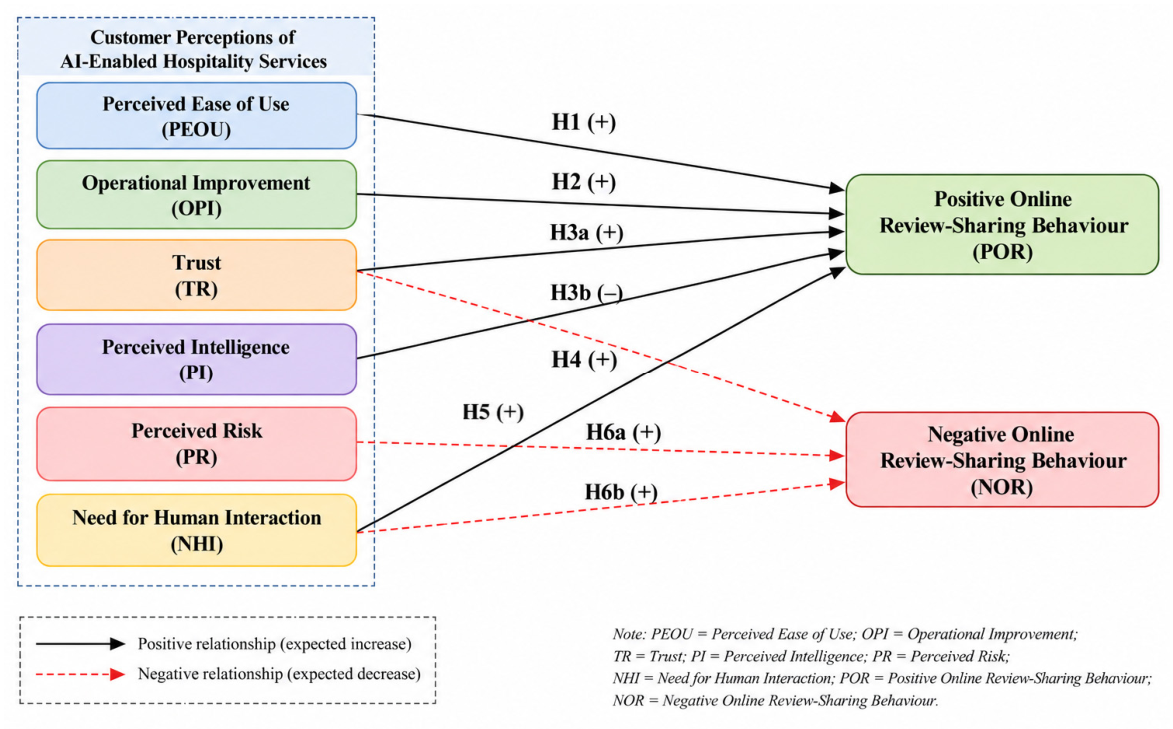
The conceptual framework integrates the theoretical perspectives and conceptual constructs discussed in the previous sections into a unified explanation of tourists’ post-consumption behaviour following AI-enabled hospitality experiences. The framework proposes that customers’ evaluations of AI-enabled services influence whether they subsequently share positive or negative online reviews. This positioning aligns the theoretical model with the empirical design of the present study and reflects the growing importance of electronic word of mouth (eWOM) as an indicator of organisational performance.
The framework adopts an interdisciplinary perspective. It combines technology acceptance theories, motivational theory, customer experience research, trust literature, and eWOM theory to explain behavioural communication. AI-enabled hospitality experiences are viewed as organisationally designed service encounters that shape customers’ functional, cognitive, and emotional evaluations. These evaluations subsequently influence publicly observable behaviours that affect organisational reputation, competitive positioning, and continuous organisational learning.
The first group of constructs, perceived ease of use and operational improvement, captures functional evaluations of AI-enabled services. They reflect the extent to which intelligent technologies simplify interactions, improve efficiency, and contribute to superior service delivery. The second group, trust and perceived intelligence, captures customers’ confidence in AI systems and the organisations deploying them. These constructs represent positive cognitive evaluations expected to encourage favourable online review sharing.
In contrast, perceived risk represents inhibiting mechanism. Customers who perceive uncertainty regarding privacy, security, service reliability, or technological complexity may be less willing to recommend AI-enabled hospitality experiences and more likely to communicate dissatisfaction. Finally, the need for human interaction recognises that hospitality remains a relational service domain in which many customers continue to value empathy, flexibility, and interpersonal communication. This construct provides an important contextual explanation for heterogeneous responses to AI-enabled services.
The framework also recognises that positive and negative online review sharing are conceptually distinct behavioural outcomes. Positive reviews represent advocacy, satisfaction, and value co-creation, whereas negative reviews frequently reflect perceived service failures, unmet expectations, risk perceptions, or emotional dissatisfaction. Consequently, the same explanatory construct may influence the two outcomes differently, justifying the use of separate empirical models rather than a single behavioural intention measure.
From a managerial perspective, the framework positions online review sharing as both an outcome and a strategic feedback mechanism. Customer-generated reviews provide hospitality organisations with actionable information regarding AI implementation, service quality, employee support, and customer expectations. By analysing these reviews, organisations can improve AI governance, redesign customer journeys, and strengthen digital transformation initiatives. Thus, behavioural communication becomes an integral component of organisational learning rather than merely a marketing metric.
3.4. Research Hypotheses
The hypotheses are derived from the integrated theoretical framework developed in the preceding subsections. Rather than explaining technology adoption, they examine how tourists’ evaluations of AI-enabled hospitality experiences influence two distinct behavioural outcomes: positive and negative online review sharing.
3.4.1. Perceived Ease of Use
Ease of use reduces cognitive effort and contributes to smoother interactions with AI-enabled services. Prior technology acceptance research consistently links user friendly technologies with favourable evaluations. In hospitality, intuitive AI interfaces are expected to encourage customers to communicate positive experiences publicly.
H1. Perceived Ease of Use influences tourists’ positive online review sharing behaviour.
3.4.2. Operational Improvement
When AI enhances speed, responsiveness, personalisation, and service reliability, customers are more likely to perceive value creation. These favourable operational evaluations are expected to stimulate positive electronic word of mouth.
H2. Operational Improvement influences tourists’ positive online review sharing behaviour.
3.4.3. Trust
Trust reduces uncertainty and strengthens confidence in both AI systems and the organisation deploying them. Trustworthy AI is expected to encourage advocacy while simultaneously discouraging criticism.
H3a. Trust influences tourists’ positive online review sharing behaviour.
H3b. Trust influences tourists’ negative online review sharing behaviour.
3.4.4. Perceived Intelligence
Customers who perceive AI as competent, adaptive, and context aware are more likely to evaluate the service positively and communicate these favourable impressions online.
H4. Perceived Intelligence influences tourists’ positive online review sharing behaviour.
3.4.5. Perceived Risk
Privacy concerns, security fears, and uncertainty regarding AI-generated decisions represent important barriers to favourable evaluations. Elevated perceived risk is therefore expected to increase negative review sharing.
H5. Perceived Risk influences tourists’ negative online review sharing behaviour.
3.4.6. Need for Human Interaction
Hospitality remains fundamentally relational. Customers who strongly prefer interpersonal communication may react less favourably when AI substitutes for human contact, particularly in emotionally sensitive situations.
H6a. A stronger Need for Human Interaction influences tourists’ positive online review sharing behaviour.
H6b. A stronger Need for Human Interaction influences tourists’ negative online review sharing behaviour.
Table 3 portrays the Proposed Research Model with the six explanatory constructs, the expected relationship, and the behavioural outcome.
Figure 1 depicts the proposed conceptual research model.
Section 3 established the theoretical foundations for examining AI-enabled hospitality experiences through the lens of post consumption behaviour. By integrating digital transformation, customer experience, responsible AI, technology acceptance, motivational theory, and electronic word of mouth, the section developed a coherent conceptual framework linking six explanatory constructs with positive and negative online review sharing behaviour. The proposed hypotheses provide the basis for the empirical analyses and align directly with the study’s logistic regression models.
4. Materials and Methods
4.1. Research Design
This study adopted a quantitative, cross-sectional, single-site survey design to investigate tourists’ perceptions of AI-enabled services and their online review sharing behaviour in a hospitality context. Quantitative research is particularly appropriate when the objective is to examine relationships among predefined constructs, test theoretically derived hypotheses, and provide empirical evidence regarding causal associations between latent variables. Moreover, survey-based research has become one of the most widely employed methodological approaches in hospitality and tourism studies investigating technology acceptance, customer behaviour, and digital service innovation because it enables the collection of standardized data from relatively large populations while facilitating robust statistical analysis. The single-site design enabled the investigation of tourists within a common hospitality environment, while its implications for the external validity and generalizability of the findings are explicitly acknowledged in the study limitations.
The present research was designed as a cross-sectional investigation, whereby data were collected from respondents at a single point in time during the summer tourist season of 2025. A cross-sectional design was considered appropriate because the study aimed to capture tourists’ contemporary perceptions, attitudes, and behavioural intentions regarding AI-enabled hospitality services rather than examining changes over time. Although longitudinal studies provide additional insights into evolving technology acceptance, cross-sectional surveys remain the dominant methodological approach for testing technology adoption models within hospitality research, particularly during the early stages of investigating emerging technologies.
In the current research the authors decided to use a single-site survey study.
The study follows a deductive research approach, whereby hypotheses were formulated based on established theories of technology adoption and recent empirical findings in artificial intelligence and hospitality management. Following the development of the conceptual framework presented in the previous section, empirical data were collected to evaluate the proposed relationships among the study constructs. This approach allows the theoretical model to be tested systematically through statistical analysis while contributing to the ongoing validation and extension of technology adoption research within AI enabled hospitality environments.
4.2. Research Context
The empirical investigation was conducted within the Greek hospitality industry, one of the country’s most significant economic sectors and among the leading tourism destinations worldwide (
Soklis et al., 2025). Tourism contributes substantially to Greece’s gross domestic product and employment, while continuous investments in digital transformation have encouraged hotels to increasingly integrate artificial intelligence into customer service, operational management, marketing activities, and guest experience personalization (
Kalantzi et al., 2023;
Nikoli & Lazakidou, 2019;
Nikolaou et al., 2023). Consequently, Greece provides an appropriate empirical setting for examining tourists’ acceptance of AI enabled hospitality services.
Data were collected from guests staying at a four-star hotel located on the well-established destination, the Greek island of Mykonos, during August and September 2025, corresponding to the peak tourist season. Selecting a four-star hotel ensured that respondents had direct exposure to a variety of digital hospitality services commonly available in contemporary hotel environments, including online reservation systems, mobile applications, automated customer support, digital concierge services, and other AI-supported technologies. Such an environment enabled respondents to evaluate AI applications based on actual or realistic service experiences rather than purely hypothetical scenarios.
The choice of a single hotel was intentional rather than incidental. Conducting the survey within one hospitality establishment ensured consistency in the technological environment experienced by participants, thereby reducing variability associated with differences in technological infrastructure across hotels. By controlling for contextual differences in service delivery, the study focused more precisely on tourists’ psychological perceptions of AI-enabled services rather than organizational differences among hospitality providers. While this design may limit the generalizability of the findings to all hotel categories, it strengthens the internal consistency of the research by providing respondents with comparable service experiences.
Furthermore, the study focuses on tourists rather than hotel managers or employees because the primary objective is to understand customer acceptance of artificial intelligence. Since tourists ultimately determine the success or failure of AI-enabled hospitality services through their willingness to use them, examining behavioural intention from the customer perspective provides valuable theoretical and managerial insights into AI adoption within hospitality settings.
4.3. Sampling Strategy and Participants
The target population comprised adult tourists staying at the selected four-star hotel during the data collection period. To participate in the study, respondents were required to be at least 18 years of age and capable of completing the questionnaire independently. Participation was entirely voluntary, and no financial or material incentives were offered.
A non-probability convenience sampling strategy was employed (
Vehovar et al., 2016). Although probability sampling techniques generally provide stronger statistical representativeness, convenience sampling remains one of the most frequently adopted approaches in hospitality and tourism research because access to tourists during their vacation is naturally constrained by time, availability, and willingness to participate. Previous hospitality studies investigating customer technology adoption have similarly relied upon convenience samples collected within hotel environments, particularly when examining emerging technologies such as artificial intelligence, service robots, and intelligent customer support systems.
Data collection resulted in 400 valid questionnaires, providing an adequate sample size for multivariate statistical analyses. The adequacy of the sample was assessed with reference to established methodological recommendations for factor analysis and structural modelling. Contemporary methodological literature generally recommends a minimum sample ranging from 200 to 400 observations for studies involving latent constructs measured through multiple indicators, while larger samples improve statistical power, parameter stability, and model reliability (
Nunnally & Bernstein, 1978). Accordingly, the final sample exceeded commonly accepted thresholds and was considered sufficient for testing the proposed conceptual framework.
Prior to the main survey, a pilot study involving 20 respondents was conducted to evaluate the clarity, comprehensibility, wording, and overall structure of the questionnaire. Pilot participants were selected from the same target population as the main survey to ensure comparable characteristics. Feedback obtained during the pilot phase resulted in minor revisions to question wording and improvements in the sequencing of several questionnaire items to enhance readability and reduce ambiguity. Since no substantial measurement problems were identified, the final questionnaire retained the same underlying construct structure while incorporating these refinements before large-scale data collection commenced.
The achieved sample represents tourists with diverse demographic characteristics, educational backgrounds, occupations, and income levels, thereby providing a heterogeneous respondent group suitable for examining behavioural intentions toward AI-enabled hospitality services across different customer segments. A detailed demographic profile of the respondents is presented in the Results section.
4.4. Questionnaire Development and Adaptation
The questionnaire was developed through a systematic multi-stage process designed to ensure theoretical consistency, content validity, and contextual relevance to AI-enabled hospitality services (
Zikmund et al., 2013). Rather than constructing entirely new measurement items, the study adopted an instrument adaptation approach by integrating validated scales from the information systems, hospitality, technology acceptance, and electronic word-of-mouth (eWOM) literature. This approach is widely recommended because it enhances construct validity, facilitates comparison with previous empirical studies, and increases the reliability of behavioural measurements.
The questionnaire development process began with an extensive review of the literature on artificial intelligence in hospitality, technology acceptance, customer experience, trust in intelligent systems, and online consumer behaviour. Attention was given to studies grounded in the Technology Acceptance Model (TAM), the Unified Theory of Acceptance and Use of Technology (UTAUT/UTAUT2), the Model of PC Utilization (MPCU), trust-based models of technology adoption, and electronic word-of-mouth theory. The conceptual synthesis presented in
Section 3 guided the selection of the latent constructs included in the empirical model and ensured that every questionnaire item corresponded directly to the theoretical framework underpinning the study.
Based on this review, six multidimensional constructs were incorporated into the questionnaire: Perceived Ease of Use, Operational Improvement, Need for Human Interaction, Perceived Risk, Perceived Intelligence, and Trust. Together, these constructs capture the functional, cognitive, and affective dimensions through which tourists evaluate AI-enabled hospitality experiences. Functional perceptions reflect the extent to which AI technologies simplify interactions and improve service delivery, cognitive evaluations represent tourists’ perceptions of the intelligence and effectiveness of AI systems, and affective dimensions encompass trust, perceived uncertainty, and preferences for interpersonal interaction. Collectively, these constructs provide a comprehensive representation of tourists’ evaluations of intelligent hospitality services and their subsequent online review sharing behaviour.
Because most validated measurement scales were originally developed in different technological and cultural contexts, several questionnaire items were carefully adapted to reflect the characteristics of AI-enabled hotel environments. Generic references to information technologies were replaced with terminology explicitly referring to AI-supported hospitality applications, including intelligent booking systems, virtual assistants, automated customer service, recommendation systems, and personalised hotel services. The adaptation process preserved the conceptual meaning of each construct while improving contextual relevance and respondent comprehension. This procedure ensured semantic equivalence between the original measurement scales and their application within contemporary hospitality settings.
To maximise content validity, the preliminary questionnaire underwent expert evaluation prior to data collection (
Rusticus, 2014). Specialists with expertise in hospitality management, information systems, and quantitative research examined the questionnaire for conceptual clarity, wording consistency, construct coverage, and overall suitability for measuring tourists’ perceptions of AI enabled hospitality services. Their feedback resulted in several minor revisions aimed at improving question clarity, reducing ambiguity, and ensuring that the questionnaire accurately reflected the theoretical definitions of the latent constructs.
A pilot study was subsequently conducted with a small respondents’ group representative of the target population. The pilot test served multiple purposes, including assessing question comprehensibility, evaluating questionnaire length, identifying ambiguous wording, and examining the overall flow of the instrument. Participants reported no major difficulties in understanding the questionnaire, although minor linguistic refinements were introduced to improve readability and ensure consistency across all measurement items. Since these modifications did not alter the conceptual meaning of the constructs, the final questionnaire retained the original theoretical structure.
The final survey instrument consisted of two main sections. The first section collected demographic information, including gender, age, occupation, educational attainment, and monthly income. These variables were included both to describe the study sample and to examine potential demographic influences on online review sharing behaviour. The second section measured respondents’ perceptions of AI-enabled hospitality services through the six latent constructs identified in the conceptual framework. This structure enabled the study to investigate how tourists’ perceptions of intelligent hospitality technologies translate into distinct forms of electronic word of mouth.
All attitudinal items were measured using a five-point Likert scale ranging from 1 (“Strongly disagree”) to 5 (“Strongly agree”), consistent with previous studies in hospitality, information systems, and consumer behaviour research. The use of a five-point response format offers several methodological advantages, including ease of comprehension, reduced respondent burden, and sufficient variability for multivariate statistical analysis. Moreover, employing a response format widely adopted in prior technology acceptance research enhances comparability with existing empirical findings.
To minimise common method bias, several procedural remedies were implemented during questionnaire design (
Podsakoff et al., 2003). Respondents were informed that participation was anonymous and voluntary and that no personally identifiable information would be collected. Instructions emphasised that there were no correct or incorrect answers and encouraged participants to provide honest evaluations based on their own experiences. In addition, the questionnaire grouped items by construct while maintaining a logical progression throughout the survey, thereby reducing respondent confusion and improving completion quality.
Because the predictor and outcome variables were collected from the same respondents using a single questionnaire, Common Method Bias (CMB) was assessed statistically in addition to the procedural remedies incorporated into the questionnaire design. Harman’s single-factor test was conducted by entering all multi-item measurement items into an unrotated exploratory factor analysis and examining the variance accounted for by the first factor (
Podsakoff et al., 2003). Common method bias would be of particular concern if a single factor emerged or if one general factor accounted for the majority of the covariance among the measures. The test was used as a diagnostic assessment alongside the procedural measures adopted to reduce common method variance.
Overall, the questionnaire development process combined theoretical rigour with practical adaptation to the hospitality context. By integrating validated measurement scales, contextualising them for AI-enabled hotel services, and refining the instrument through expert review and pilot testing, the study established a robust measurement framework capable of reliably capturing tourists’ perceptions of artificial intelligence and explaining their positive and negative online review sharing behaviour. This systematic development process provides a strong methodological foundation for the reliability and validity assessments presented in the subsequent subsection (
Cortina, 1993;
Nunnally & Bernstein, 1978).
4.5. Measurement of Constructs
The empirical model was operationalised using six latent constructs representing tourists’ perceptions of AI-enabled hospitality services. These constructs were selected based on the theoretical framework developed in
Section 3 and were designed to capture complementary dimensions of customers’ evaluations of intelligent hospitality technologies. Collectively, they represent the functional, cognitive, and affective mechanisms through which AI-enabled service experiences may influence subsequent online review sharing behaviour.
Perceived Ease of Use (PEOU) measured the extent to which respondents considered AI-enabled hospitality applications to be intuitive, user friendly, and easy to interact with during different stages of the hotel experience. This construct reflects tourists’ cognitive evaluation of the effort required to use AI-supported services such as intelligent reservation systems, virtual assistants, automated check-in procedures, and personalised digital customer support.
Operational Improvement assessed respondents’ perceptions regarding the contribution of AI technologies to improving service efficiency, operational effectiveness, response speed, and the overall quality of hotel service delivery. Rather than evaluating technical characteristics alone, this construct captures customers’ perceptions of the practical value generated through AI-enabled operational processes.
Need for Human Interaction measured tourists’ preference for interpersonal communication during hospitality service encounters despite the availability of intelligent digital technologies. The construct reflects the extent to which respondents believe that human employees continue to provide emotional support, empathy, personalised communication, and service quality that cannot be fully replicated by artificial intelligence.
Perceived Risk evaluated respondents’ concerns regarding privacy protection, information security, reliability, and potential uncertainty associated with AI-enabled hotel services. This construct captures the perceived psychological barriers that may reduce tourists’ confidence in intelligent technologies and potentially influence their post-consumption communication behaviour.
Perceived Intelligence assessed respondents’ evaluations of the apparent cognitive capabilities of AI-enabled hotel services, including their ability to understand customer requests, provide appropriate responses, process relevant information, and perform service-related tasks competently. This construct reflects tourists’ perceptions of AI competence and its ability to improve decision-making, service personalisation, and overall customer experience.
Finally, Trust measured respondents’ confidence in AI-enabled hospitality systems, focusing on perceptions of reliability, dependability, credibility, and the ability of intelligent technologies to perform consistently throughout the customer journey. Trust represents one of the central behavioural mechanisms linking technology evaluations with customer acceptance and subsequent behavioural responses.
Each construct was operationalised using multiple questionnaire items adapted from previously validated measurement scales reported in the information systems, hospitality management, and technology acceptance literature. All attitudinal items were measured using a five-point Likert scale ranging from 1 (“Strongly disagree”) to 5 (“Strongly agree”), with higher scores indicating stronger agreement with each statement. Composite construct scores were calculated by averaging the corresponding questionnaire items, allowing each latent variable to be represented by a single continuous measure in the subsequent statistical analyses.
Before hypothesis testing, the psychometric adequacy of the measurement model was evaluated through Exploratory Factor Analysis (EFA) and reliability analysis using Cronbach’s alpha coefficients (
DeVon et al., 2007). This procedure confirmed both the dimensional structure and the internal consistency of the measurement instrument, providing empirical support for the validity and reliability of the latent constructs employed in the binary logistic regression models (
Wilson et al., 2024).
Overall, the operationalisation of the constructs ensured close correspondence between the conceptual framework and the empirical analysis. By combining validated measurement scales with context specific adaptations for AI-enabled hospitality services, the study established a robust measurement framework capable of examining the determinants of tourists’ positive and negative online review sharing behaviour.
4.6. Data Collection Procedure
Data were collected through a cross-sectional survey designed to investigate tourists’ perceptions of AI-enabled hospitality services and their influence on online review sharing behaviour. A quantitative research design was selected because it enables the systematic measurement of latent behavioural constructs and facilitates the statistical examination of relationships among multiple explanatory variables within a theoretically grounded conceptual framework (
Salawu et al., 2023).
The target population consisted of adult individuals who had previous experience with hotel services incorporating artificial intelligence or intelligent digital technologies during their customer journey. Examples of such technologies included AI-assisted reservation platforms, virtual assistants, automated check-in and check-out systems, intelligent recommendation engines, personalised customer service applications, and other AI-supported hospitality solutions. Restricting participation to respondents with relevant experience ensured that participants were able to evaluate AI-enabled hospitality services based on actual interactions rather than hypothetical expectations.
Data collection was conducted using a structured self-administered questionnaire distributed electronically through online survey platforms and social media channels. Online administration was considered particularly appropriate because the study focuses on digitally active consumers who are familiar with Internet technologies and online communication platforms.
Participation in the survey was entirely voluntary. Before completing the questionnaire, respondents were informed about the academic purpose of the research, the anonymous nature of data collection, and the confidentiality of their responses. No personally identifiable information was collected at any stage of the study, and respondents were informed that they could discontinue participation at any time without consequence. These procedures were implemented to encourage honest responses and minimise potential social desirability bias.
Data collection continued until an adequate number of completed questionnaires had been obtained for multivariate statistical analysis. All submitted questionnaires were screened for completeness and internal consistency before inclusion in the final dataset. Responses containing substantial missing information, obvious response patterns, or incomplete questionnaires were excluded to improve data quality and ensure the robustness of the subsequent analyses. After data screening, the final dataset consisted of 400 respondents, providing an appropriate sample for Exploratory Factor Analysis and binary logistic regression modelling.
Following data cleaning, the dataset was coded and imported into IBM SPSS Statistics 23 for analysis. Descriptive statistics were initially calculated to summarise respondent characteristics and examine the distributions of the study variables. The reliability and validity of the measurement instrument were subsequently evaluated using Cronbach’s alpha coefficients (
Forero, 2024). Pearson correlation analysis was then performed to investigate the relationships among the latent constructs and to identify potential multicollinearity issues prior to multivariate modelling (
Cortina, 1993;
Nunnally & Bernstein, 1978).
The research hypotheses were tested using binary logistic regression, an analytical technique appropriate for modelling dichotomous dependent variables (
King, 2008). Two separate regression models were estimated: the first examined the determinants of positive online review sharing behaviour, while the second investigated the factors influencing negative online review sharing behaviour. This analytical strategy enabled the study to examine whether tourists’ perceptions of AI enabled hospitality services exert different effects on favourable and unfavourable electronic word of mouth, thereby providing a more comprehensive understanding of post-consumption behavioural communication.
Overall, the data collection procedure was designed to ensure methodological rigour, respondent anonymity, and high-quality empirical data. The combination of validated measurement scales, systematic data screening, and appropriate multivariate analytical techniques provides a robust methodological foundation for evaluating the proposed conceptual framework and addressing the research objectives of the present study.
4.7. Data Analysis
The statistical analysis was conducted using IBM SPSS Statistics following a sequential analytical strategy designed to evaluate the psychometric properties of the measurement instrument and to test the proposed conceptual framework. The analytical procedure comprised four consecutive stages: (i) descriptive statistical analysis, (ii) assessment of the measurement model, (iii) correlation analysis, and (iv) hypothesis testing through binary logistic regression. This structured approach ensured that the validity and reliability of the measurement instrument were established before examining the relationships between tourists’ perceptions of AI-enabled hospitality services and their online review sharing behaviour.
The first stage involved descriptive statistical analysis to summarise the demographic characteristics of the respondents and to examine the central tendency and variability of the study variables. Frequencies and percentages were calculated for the demographic variables, while means and standard deviations were computed for all latent constructs. These statistics provided an initial overview of respondents’ evaluations of AI-enabled hospitality experiences and facilitated the interpretation of the subsequent multivariate analyses.
The second stage focused on evaluating the psychometric adequacy of the measurement instrument. Exploratory Factor Analysis (EFA) was employed to examine the underlying dimensional structure of the questionnaire and to determine whether the measurement items clustered into the theoretically expected constructs. EFA was considered appropriate because the study sought to confirm the latent structure of an instrument adapted from multiple sources and contextualised for AI-enabled hospitality services. Internal consistency was subsequently assessed using Cronbach’s alpha coefficients, with values equal to or greater than 0.70 considered indicative of satisfactory reliability (
Cortina, 1993). Together, the factor analysis and reliability assessment provided evidence of the construct validity and internal consistency of the measurement model before proceeding to hypothesis testing (
Petkov et al., 2010).
Following the validation of the measurement instrument, Pearson’s correlation analysis was conducted to examine the relationships among the latent constructs. Correlation coefficients were used to assess the direction and strength of the associations between the independent variables and to identify potential multicollinearity issues prior to regression modelling. The observed correlation matrix also provided preliminary evidence regarding the theoretical relationships proposed in the conceptual framework and served as an initial indication of how tourists’ functional, cognitive, and affective evaluations of AI-enabled hospitality services were interrelated.
The principal stage of the empirical analysis involved binary logistic regression, which was selected because the dependent variables represented dichotomous behavioural outcomes. Unlike linear regression, binary logistic regression is specifically designed to estimate the probability of occurrence of a binary event while relaxing the assumptions of normally distributed residuals and homoscedasticity. Consequently, it provides an appropriate analytical framework for modelling tourists’ decisions to share or not share online reviews.
Two independent binary logistic regression models were estimated. The first model examined the determinants of positive online review sharing behaviour, whereas the second investigated the factors influencing negative online review sharing behaviour. In both models, the dependent variable was coded dichotomously to indicate whether respondents reported sharing the corresponding type of online review. The independent variables consisted of the validated latent constructs representing tourists’ perceptions of AI-enabled hospitality services together with the demographic control variables included in the research design.
Model adequacy was evaluated using multiple complementary indicators. Overall model significance was assessed through the Omnibus Test of Model Coefficients, while explanatory power was evaluated using the Cox and Snell and Nagelkerke pseudo-R
2 statistics (
O’Connell, 2006). The Hosmer–Lemeshow goodness-of-fit test was examined to evaluate the agreement between the predicted and observed values, with non-significant results indicating an adequate model fit (
Hosmer & Hjort, 2002). In addition, classification accuracy was reported to assess the predictive performance of each regression model (
Steyerberg et al., 2001). The contribution of each independent variable was evaluated using the estimated regression coefficients (β), Wald statistics, odds ratios (Exp(B)), corresponding 95% confidence intervals, and associated
p-values (
Nick & Campbell, 2007).
Statistical significance was evaluated at the conventional 5% significance level (α = 0.05). Variables with p-values below this threshold were considered statistically significant predictors of online review sharing behaviour. Nevertheless, statistical interpretation was not based solely on significance testing. Emphasis was also placed on the direction and magnitude of the estimated effects, allowing a more comprehensive interpretation of how tourists’ perceptions of AI-enabled hospitality services influence favourable and unfavourable electronic word of mouth.
Figure 2 depicts the work design and phases.
Overall, the adopted analytical strategy provides a robust methodological framework for addressing the research objectives of the study. By combining measurement validation procedures with multivariate regression modelling, the analysis enables a comprehensive examination of the relationships between AI-enabled hospitality experiences and tourists’ online review sharing behaviour. Moreover, estimating separate regression models for positive and negative electronic word of mouth acknowledges the possibility that favourable and unfavourable post-consumption communication are influenced by different behavioural mechanisms, thereby offering a more nuanced understanding of tourists’ interactions with intelligent hospitality technologies.
5. Results
The results of the study are described in this section.
5.1. Respondent Profile
The descriptive statistics of the final sample are portrayed in
Table 4.
The final sample comprised tourists with diverse demographic and socioeconomic characteristics, providing a broad perspective on perceptions of AI-enabled hospitality services and their influence on online review sharing behaviour. As shown in
Table 4, male respondents represented 65.0% of the sample, while female respondents accounted for 35.0%. The age distribution was concentrated among economically active individuals, with 46.0% of participants aged 26–34 years and 42.0% aged 35–44 years. Younger respondents (under 26 years) represented 9.0% of the sample, whereas participants aged 45 years and above accounted for only a small proportion. This age profile is particularly relevant because these groups are generally more familiar with digital technologies and AI-enabled services in tourism and hospitality.
The occupational composition was similarly heterogeneous. Private sector employees constituted the largest group (25.5%), followed by freelancers (23.0%) and public sector employees (16.5%). Students represented 12.5% of respondents, while household members (11.0%), workers (9.0%), farmers (1.5%), and unemployed individuals (1.0%) formed smaller segments of the sample. Such occupational diversity enhances the external validity of the findings by capturing perceptions from individuals with different professional backgrounds, levels of digital exposure, and service expectations.
Regarding educational attainment, most respondents possessed relatively high educational qualifications. Specifically, 41.0% had completed higher education and an additional 21.0% held postgraduate or doctoral degrees, whereas 34.5% had completed secondary education. Only a small percentage reported primary (1.5%) or lower secondary education (2.0%). This educational profile is appropriate for investigating AI-enabled hospitality experiences, as individuals with higher educational attainment are generally more familiar with digital platforms and more likely to engage with intelligent service technologies.
The distribution of monthly income also reflected a broad socioeconomic spectrum. Approximately one-third of respondents (34.0%) reported monthly incomes between EUR 1001 and EUR 2000, while 30.0% earned between EUR 2001 and EUR 3000. A further 18.5% reported incomes exceeding EUR 3000, whereas lower-income groups represented smaller proportions of the sample. The diversity of income levels reduces the likelihood that the findings are driven by a single socioeconomic segment and strengthens the applicability of the empirical analysis across different categories of tourists.
Overall, the demographic composition of the sample provides an appropriate basis for examining how tourists evaluate AI-enabled hospitality experiences and how these evaluations translate into positive and negative online review sharing behaviour. The predominance of working-age adults, together with relatively high educational attainment and diverse occupational backgrounds, suggests that the respondents possess sufficient familiarity with contemporary digital technologies to provide meaningful evaluations of AI applications in hospitality settings. Consequently, the sample is well suited to testing the conceptual framework and the proposed research hypotheses developed in the preceding chapter.
The test of the unidimensionality of the research factors was performed using Exploratory Factor Analysis, while each individual factor was tested for its reliability using the Cronbach Alpha statistical measure. The results obtained from all these analyses reveal that all research factors included in this study are valid and reliable.
5.2. Measurement Model Assessment
Harman’s single-factor test was performed using all measurement items included in the study. The unrotated exploratory factor analysis produced six factors with eigenvalues greater than one, while the first factor accounted for 13.992% of the total variance. Because no single factor emerged and the first factor did not account for the majority of the variance, the results provide no indication that common method variance dominates the observed relationships. Nevertheless, given the limitations of Harman’s single-factor test, the possibility of common method bias cannot be completely excluded.
Before testing the proposed hypotheses, the psychometric properties of the measurement model were evaluated to ensure that the latent constructs accurately captured tourists’ perceptions of AI-enabled hospitality experiences. Construct validity was assessed through Exploratory Factor Analysis (EFA), while internal consistency was evaluated using Cronbach’s alpha coefficients. This two-stage procedure ensured that the measurement instrument was both conceptually coherent and statistically reliable prior to the regression analyses.
The overall KMO value was 0.661, while Bartlett’s Test of Sphericity was statistically significant, x
2(276) = 5.559,846,
p < 0.001, indicating that the correlation matrix was suitable for factor analysis. Factors were extracted using Principal Component Analysis and rotated using Varimax with Kaiser Normalization. The final solution identified six factors, accounting for 66.408% of the total variance. Detailed factor loadings and variance explained are reported in
Table 5.
The exploratory factor analysis confirmed the multidimensional structure proposed in the conceptual framework. The questionnaire items loaded onto six theoretically meaningful constructs representing key dimensions of tourists’ evaluations of AI-enabled hotel services: Perceived Ease of Use (PEOU), Operational Improvement (OPI), Need for Human Interaction (NHI), Perceived Risk (PR), Perceived Intelligence (PI), and Trust (TR). The extracted factors closely correspond to the theoretical constructs discussed in
Section 3, providing empirical support for the proposed conceptual model and justifying their inclusion in the subsequent hypothesis-testing procedures.
The reliability analysis further demonstrated satisfactory internal consistency across all constructs (
Table 6). Cronbach’s alpha values ranged from 0.729 for Operational Improvement to 0.915 for Perceived Ease of Use, exceeding the widely accepted threshold of 0.70 for exploratory research. These findings indicate that the measurement scales consistently captured the intended latent dimensions and provide confidence that the observed relationships are not attributable to measurement error.
Among the examined constructs, Perceived Ease of Use exhibited the highest internal consistency (α = 0.915), suggesting that respondents evaluated the usability of AI-enabled hotel applications in a highly consistent manner. This result is theoretically consistent with technology acceptance research, where ease of use is frequently identified as one of the most stable predictors of user evaluations. The construct Perceived Intelligence also demonstrated strong reliability (α = 0.829), indicating that respondents consistently perceived AI-enabled hotel systems in terms of their competence, usefulness, and overall effectiveness. Likewise, the Need for Human Interaction (α = 0.782), Perceived Risk (α = 0.791), and Trust (α = 0.741) constructs all exhibited acceptable reliability, supporting their suitability for examining behavioural responses to AI-enabled hospitality services. Although Operational Improvement recorded the lowest reliability coefficient (α = 0.729), the value remains comfortably above the recommended threshold, indicating satisfactory internal consistency for subsequent analyses.
Following the reliability assessment, composite scores were calculated for each construct by averaging the corresponding questionnaire items. These composite variables were subsequently employed as the independent variables in the correlation analysis and the binary logistic regression models. Using aggregated construct scores rather than individual questionnaire items reduces measurement complexity while preserving the conceptual meaning of each latent variable, an approach commonly adopted in behavioural and information systems research.
Overall, the measurement assessment provides strong empirical support for the adequacy of the research instrument. The factor structure closely reflects the theoretical framework developed in
Section 3, while the reliability analysis confirms that each construct demonstrates satisfactory internal consistency. Consequently, the measurement model provides a robust foundation for examining the proposed relationships between tourists’ perceptions of AI-enabled hospitality experiences and their positive and negative online review sharing behaviour.
5.3. Descriptive Statistics and Correlation Analysis
Following the validation of the measurement model, descriptive statistics were calculated to examine respondents’ overall evaluations of the six latent constructs included in the conceptual framework. Mean scores and standard deviations provide an initial indication of tourists’ perceptions of AI-enabled hospitality services and establish the basis for the subsequent correlation and regression analyses. As presented in
Table 7, all constructs recorded mean values above the neutral midpoint of the five-point Likert scale, indicating generally favourable attitudes towards AI-enabled hotel applications among the surveyed tourists.
Values greater than three denote perspective for agreement, and values lower than three denote perspective for disagreement. It is observed that the respondents have positive perspective on all factors.
Since all factors are reliable, we create a new variable for each one of the factors, the values of which are the average of the items that constitute each factor.
Table 6 presents the average values and the corresponding standard deviations of these new variables.
The correlation analysis was subsequently performed using Pearson’s correlation coefficient to explore the relationships among the six constructs before estimating the logistic regression models (
Table 8). The observed correlations were generally weak to moderate in magnitude, indicating that although the constructs were conceptually related, they captured distinct dimensions of tourists’ perceptions. This finding reduces concerns regarding multicollinearity and supports the inclusion of all constructs in the subsequent multivariate analyses.
Several statistically significant relationships emerged from the analysis. Operational Improvement was positively associated with both Need for Human Interaction (p-value = 0.006) and Trust (p-value = 0.001). Conversely, Perceived Risk demonstrated significant negative relationships with both Need for Human Interaction (p-value < 0.001) and Perceived Intelligence (p-value < 0.001). Finally, Trust exhibited a weak but statistically significant positive association with Perceived Ease of Use (p-value = 0.041).
Furthermore, an exploration of the characteristics that differentiate tourists who, after purchasing a travel service, share their experience/evaluation online when they are satisfied with it from those that do not was conducted. As Perceived Ease of Use and Improving Operations increase, the chances of tourists to share their experience/evaluation online about a purchased travel product/service that is satisfying also increase. In addition, tourists between 26 and 44 years old have increased their chances of sharing their experience/evaluation online. Finally, there was an exploration of the characteristics that differentiate tourists who, before purchasing a tourist product, search for information about hotel room reservations from those that do not. As Improving Operations increase, the chances of searching information about hotel room reservations before purchasing a tourist product also increase.
5.4. Determinants of Positive Online Review Sharing
An attempt was then made to investigate the factors that affect the probability of a tourist sharing an experience that is either satisfying or not. It was achieved with the use of logistic regression with a dependent variable, the one that denotes if somebody shares an experience that is either satisfying or not, and possible independent variables, including the six factors described above, and the age and gender of the responders.
For sharing satisfying experiences as a dependent variable, the created statistical model has a very good adaptation to the data (x2(7) = 65.969, p-value < 0.001, Cox and Snell R2 = 15.2%, Negelkerke R2 = 24%). The predictive capacity of the model is satisfactory since it correctly classifies 25% of those that do not share their experience and correctly classifies 96.9% of those that share their experience (weighted average of correct classification is 82.5%).
The estimated model demonstrated a satisfactory overall fit to the data. The omnibus test was statistically significant (x
2(7) = 65.969,
p < 0.001), indicating that the proposed explanatory variables collectively improved prediction compared with the null model. Moreover, the model explained between 15.2% (Cox & Snell R
2) and 24.0% (Nagelkerke R
2) of the variance in positive online review sharing behaviour. Although these values indicate moderate explanatory power, they are considered acceptable for behavioural research investigating complex human decision-making processes. The classification results further demonstrated satisfactory predictive performance, correctly identifying 82.5% of all cases, including 96.9% of respondents who reported sharing positive online reviews. Collectively, these findings suggest that the proposed conceptual framework provides a meaningful explanation of tourists’ post-consumption communication behaviour in AI-enabled hospitality environments.
Table 9 portrays the Logistic Regression model — sharing their experience when satisfied with a product.
The regression results reveal that Perceived Ease of Use (PEOU) emerged as the strongest predictor of positive online review sharing (β = 0.439, OR = 1.551, p < 0.001). Specifically, a one-unit increase in perceived ease of use increased the odds of posting a positive online review by approximately 55.1%, holding all other variables constant. This finding indicates that tourists who perceive AI-enabled hotel applications as intuitive and user friendly are substantially more likely to become online advocates after a satisfactory hospitality experience. From a theoretical perspective, this result supports the proposition that effortless interactions with AI technologies enhance favourable post-consumption behavioural communication. Accordingly, Hypothesis H1 is supported.
Perceived Intelligence also exerted a statistically significant positive influence on positive online review sharing (β = 0.265, OR = 1.303, p = 0.036). Tourists who regarded AI-enabled hotel systems as intelligent, competent, and capable of supporting service delivery were more likely to publicly communicate favourable experiences. This finding suggests that customers value AI not merely for automating routine processes but for its ability to provide meaningful, personalised, and context-aware service encounters. Consequently, perceptions of intelligent AI functionality contribute directly to positive electronic word of mouth and reinforce the strategic importance of high-quality AI implementation in hospitality. These findings provide empirical support for Hypothesis H4.
An unexpected finding concerns the construct Operational Improvement, which exhibited a statistically significant negative association with positive online review sharing (β = −0.472, OR = 0.624, p = 0.001). Contrary to the initial theoretical expectation, respondents who placed greater emphasis on operational improvements were less likely to post favourable online reviews. This result suggests that tourists may perceive operational efficiency as an expected baseline characteristic rather than as a source of exceptional service deserving public recognition. Alternatively, respondents who focus strongly on operational performance may adopt more demanding evaluation standards, becoming less inclined to express positive electronic word of mouth unless service quality exceeds their expectations. Consequently, Hypothesis H2 is not supported, indicating that operational efficiency alone is insufficient to stimulate favourable online advocacy in AI-enabled hospitality contexts.
Age also emerged as an important demographic predictor. Compared with respondents younger than 26 years, tourists aged 26–34 years were approximately 4.9 times more likely to share positive online reviews (OR = 4.864, p < 0.001), while those aged 35–44 years were nearly 12 times more likely to do so (OR = 11.970, p < 0.001). No statistically significant differences were observed for older age groups. These findings indicate that working age adults represent the most active segment in generating favourable electronic word of mouth following AI-enabled hospitality experiences. Their greater familiarity with digital platforms and online review systems may explain their stronger propensity to publicly communicate positive service experiences.
Interestingly, the remaining constructs included in the conceptual framework, Trust, Perceived Risk, and Need for Human Interaction did not emerge as statistically significant predictors in the final regression model. Although these constructs were theoretically expected to influence behavioural outcomes, their effects on positive online review sharing appear to be mediated or overshadowed by the stronger influence of ease of use and perceived intelligence. This finding illustrates the complexity of tourists’ post-consumption communication behaviour and suggests that positive electronic word of mouth is driven primarily by favourable functional and cognitive evaluations of AI-enabled services rather than by concerns related to trust or perceived risk.
We explored the characteristics that differentiate tourists who, after purchasing a travel service, are sharing their experience/evaluation online if they are satisfied with the purchase of the product/service from those they do not share their experience/evaluation.
As PEOU and Perceived Intelligence increase, the chances of satisfied tourists to share their experience/evaluation online increase. As Improving Operations increase, the chances of satisfied tourists to share their experience/evaluation online decrease. Also, tourists 26 to 34 and 35 to 44 years old have increased chances of sharing their experience/evaluation online about a travel product/service that they feel satisfied about.
Concluding:
For each unit of increase of PEOU, the probability of a satisfied tourist to post his experience online increases by 55.1% (95% confidence interval (28.9%, 86.7%), p-value < 0.001).
For each unit of increase of Perceived Intelligence, the probability of a satisfied tourist to post his experience online increases by 30.3% (95% confidence interval (1.8%, 66.9%) p-value = 0.036).
For each unit of increase of Improving Operations, the probability of a satisfied tourist to post his experience online decreases by 37.6% (95% confidence interval (52.2%, 18.6%), p-value = 0.001).
Tourists 26 to 34 and 35 to 44 years old are 4.8 and 11.9 times, respectively, more likely to share an experience that feel satisfied about, than those younger than 26 years old.
Overall, the findings provide partial support for the proposed conceptual framework. Consistent with the theoretical model developed in
Section 3, favourable perceptions regarding the usability and intelligence of AI-enabled hotel applications significantly increase tourists’ willingness to share positive online reviews. However, the negative effect of Operational Improvement indicates that efficiency gains alone do not necessarily translate into online advocacy, highlighting the importance of delivering AI-enabled experiences that are not only efficient but also engaging, personalised, and memorable. From a managerial perspective, these findings suggest that hospitality organisations seeking to encourage positive electronic word of mouth should prioritise intuitive AI interfaces and intelligent customer interactions rather than focusing exclusively on operational optimisation.
Table 10 presents the summary of hypothesis testing for positive online review sharing.
5.5. Determinants of Negative Online Review Sharing
The second binary logistic regression model examined the determinants of negative online review sharing behaviour following AI enabled hospitality experiences. In contrast to the previous analysis, the dependent variable distinguished between respondents who shared negative online reviews after a dissatisfactory hotel experience and those who chose not to communicate their dissatisfaction publicly. This analysis is particularly important because negative electronic word of mouth (eWOM) has a disproportionate impact on organisational reputation, customer trust, and future booking decisions. Consequently, identifying the factors that encourage dissatisfied tourists to publish negative online evaluations provides valuable insights for both theory and hospitality management.
For sharing of satisfying experiences as a dependent variable, the created statistical model has a very good adaptation to the data (x2(2) = 11.545, p-value = 0.003, Cox and Snell R2 = 3.4%, Negelkerke R2 = 4.6%). The predictive capacity of the model is satisfactory since it correctly classifies 14.3% of those that do not share their experience and correctly classifies 91.9% of those that share their experience (weighted average of correct classification is 62%).
The regression model was statistically significant (x2(2) = 11.545, p = 0.003), indicating that the selected explanatory variables collectively contributed to predicting negative online review sharing behaviour. The model explained between 3.4% (Cox & Snell R2) and 4.6% (Nagelkerke R2) of the observed variance. Although the explanatory power was considerably lower than that observed for positive online review sharing, this outcome is not unexpected. Negative post consumption communication is often influenced by numerous situational, emotional, and contextual factors that extend beyond the technological perceptions examined in this study. Nevertheless, the classification accuracy of 62.0%, together with the correct identification of 91.9% of respondents who reported sharing negative online reviews, demonstrates that the model provides useful insights into the behavioural mechanisms underlying unfavourable electronic word of mouth.
Table 11 portrays the Logistic Regression model—sharing their experience when dissatisfied with a product.
The results indicate that Perceived Ease of Use (PEOU) remained a statistically significant predictor of online review sharing behaviour (β = 0.226, OR = 1.253, p = 0.003). Specifically, a one-unit increase in perceived ease of use increased the odds of sharing a negative online review by approximately 25.3%. At first glance, this finding appears counterintuitive because ease of use is generally associated with favourable customer evaluations. However, the result may reflect the broader role of digital literacy in facilitating online communication. Tourists who are comfortable using AI-enabled hotel applications are also likely to be more familiar with digital platforms and therefore more willing to express both positive and negative experiences online. In other words, ease of use may facilitate the act of online communication itself rather than exclusively encouraging favourable evaluations. This finding suggests that digital competence increases customers’ propensity to engage in electronic word of mouth regardless of the emotional valence of their experience.
The construct Perceived Risk exhibited a negative coefficient (β = −0.155, OR = 0.856) and approached statistical significance (p = 0.068). Although the relationship did not reach the conventional 5% significance threshold, the result suggests a tendency whereby respondents reporting lower perceptions of risk were slightly more likely to post negative online reviews. This finding contrasts with the original theoretical expectation that higher perceived risk would increase negative electronic word of mouth. One possible explanation is that tourists who perceive substantial privacy or security risks may avoid interacting with digital platforms altogether, thereby reducing their likelihood of publishing online reviews. Conversely, respondents who feel relatively secure using AI-enabled digital services may participate more actively in online review communities and therefore communicate both favourable and unfavourable experiences more readily. Because the relationship is only marginally significant, this result should be interpreted with caution. Consequently, Hypothesis H5 is not supported by the present data.
Interestingly, none of the remaining constructs, including Operational Improvement, Perceived Intelligence, Trust, and Need for Human Interaction, emerged as significant predictors of negative online review sharing behaviour. This pattern differs from the results obtained for positive online reviews and suggests that dissatisfied tourists may rely less on evaluations of AI functionality when deciding whether to communicate their experiences publicly. Instead, negative electronic word of mouth may be influenced more strongly by contextual service failures, unmet expectations, emotional responses, or recovery experiences that were not directly measured in the present study. These findings highlight the multidimensional nature of online complaint behaviour and indicate that AI-related perceptions alone cannot fully explain tourists’ decisions to publish negative reviews.
We explored the characteristics that differentiate tourists who, after purchasing a travel service, share their experience/evaluation online when they are dissatisfied with the purchase of a product/service from those they do not share their experience/evaluation.
As PEOU increases, the chances of dissatisfied tourists to share their experience/evaluation online also increase. As Perceived Risk increases, the chances of dissatisfied tourists sharing their experience/evaluation online decrease.
Concluding:
For each unit of increase of PEOU, the probability of a dissatisfied tourist posting his/her experience online increases by 25.3% (95% confidence interval (8%, 45.3%), p-value = 0.003).
For each unit of increase of Perceived Risk, the probability of a dissatisfied tourist to post his/her experience online decreases by 14.4% (p-value = 0.068 − indicatively significant).
In summary, the probability of the satisfied tourist posting his/her experience online is positively affected by the PEOU and Perceived Intelligence factors and negatively by the Improving Operations factor. At the same time, the probability is increased for tourists aged 26 to 44, compared to those younger than 26. The probability of the dissatisfied tourist posting his/her experience is positively affected by the PEOU factor and negatively by the Perceived Risk factor.
These findings are explainable since the good ease of use and the applicable Perceived Intelligence make better the life of the tourist during his/her holidays. On the other hand, if an improvement of the offered operations is necessary, there is a dissatisfaction that the tourist feels the need to post. Younger than 26 years old, possibly treat their posting experience as a secondary activity during their holidays and neglect to share this information. The perceived risk is one of the main fears for a tourist during his/her holidays. If the tourist does not feel safe and secure, s/he feels the need to share it with other tourists so that they would avoid a similar risky experience.
From the perspective of the proposed conceptual framework, the results provide limited support for the hypothesized determinants of negative online review sharing. While Perceived Ease of Use remained statistically significant, its positive relationship with negative review sharing suggests that ease of interacting with AI-enabled systems may increase customers’ overall willingness to participate in online communication rather than influencing only favourable behavioural outcomes. Likewise, the absence of significant effects for Trust, Perceived Intelligence, and Need for Human Interaction indicates that these constructs may play a more important role in shaping positive advocacy than online criticism. The comparatively weak explanatory power of the regression model further suggests that negative electronic word of mouth is influenced by additional psychological and situational variables beyond those incorporated into the present conceptual framework. Future research should therefore consider integrating constructs such as service recovery, customer dissatisfaction, emotional intensity, perceived justice, and complaint behaviour to obtain a more comprehensive explanation of negative online review sharing behaviour.
From a managerial perspective, these findings underline an important implication for AI-enabled hospitality services. Organisations should not assume that improving AI usability will exclusively increase positive customer advocacy. The same digital competencies that facilitate favourable online engagement also enable dissatisfied customers to communicate service failures rapidly through online review platforms. Consequently, investments in user-friendly AI technologies should be accompanied by effective service recovery mechanisms, transparent communication, and prompt responses to customer complaints. By combining intuitive AI-enabled service delivery with proactive complaint management, hospitality organisations can maximise the benefits of positive electronic word of mouth while mitigating potential reputational damage arising from negative online reviews.
Table 12 presents the summary of hypothesis testing for negative online review sharing.
6. Discussion
The study examined how tourists’ evaluations of AI-enabled hospitality experiences are associated with positive and negative electronic word of mouth (eWOM). Rather than focusing exclusively on technology acceptance or intentions to use AI, the analysis considered online review sharing as a post-consumption behavioural outcome. An important finding is that positive and negative review sharing were associated with different patterns of predictors. This distinction supports the treatment of favourable and unfavourable eWOM as separate behavioural outcomes rather than as opposite ends of a single continuum.
The binary logistic regression model for positive online review sharing identified three statistically significant predictors: perceived ease of use, operational improvement, and perceived intelligence. Perceived ease of use was positively associated with positive review sharing. A one-unit increase in perceived ease of use was associated with 55.1% higher odds of sharing a positive online review (OR = 1.551, 95% CI = 1.289–1.867, p < 0.001). This finding is consistent with the broader technology acceptance literature, which emphasises the importance of effortless and intuitive interaction with digital technologies. In the hospitality context, the result suggests that tourists who perceive AI-enabled services as easier to use are also more likely to communicate favourable experiences online. The finding extends the relevance of perceived ease of use beyond technology acceptance by associating it with a post-consumption communication outcome.
Perceived intelligence was also positively associated with positive online review sharing. A one-unit increase in perceived intelligence was associated with 30.3% higher odds of positive review sharing (OR = 1.303, 95% CI = 1.018–1.669, p = 0.036). This result suggests that tourists’ evaluations of the capabilities of AI-enabled services are relevant not only to their immediate interaction with the technology but also to their subsequent online communication. When AI-supported hospitality services are perceived favourably in terms of their intelligent capabilities, tourists may be more inclined to communicate a positive evaluation of their experience. This result is compatible with the transition toward more customer-oriented forms of smart hospitality, in which technological value depends not simply on automation but on the capacity of intelligent systems to contribute meaningfully to the customer experience.
A particularly noteworthy finding concerns operational improvement. Contrary to the theoretically expected positive relationship, operational improvement was significantly and negatively associated with positive online review sharing (OR = 0.624, 95% CI = 0.478–0.814, p = 0.001). Thus, a one-unit increase in perceived operational improvement was associated with approximately 37.6% lower odds of positive review sharing, holding the other variables in the model constant.
This finding suggests that tourists may distinguish between the functional value of AI-enabled hotel services and the experiential value that motivates them to communicate positively about their stay. In other words, perceiving AI as improving speed, efficiency, accuracy, or service processes does not necessarily make the AI-enabled experience sufficiently distinctive or emotionally meaningful to stimulate positive electronic word of mouth.
This result can be interpreted through the distinction between utilitarian service performance and experiential hospitality value. Technology acceptance perspectives generally assume that performance-related benefits encourage favourable behavioural responses because customers value technologies that improve task accomplishment and service efficiency (
Venkatesh et al., 2012). In hospitality, however, service evaluation extends beyond instrumental efficiency. The hospitality experience incorporates interpersonal interaction, emotional engagement, personalization, and a sense of being cared for. Consequently, operationally efficient AI may be appreciated as a functional service mechanism without becoming a salient component of the guest experience that tourists consider worth communicating to others. This distinction is particularly relevant in hospitality because technological efficiency and human service are not necessarily interchangeable sources of customer value (
Huang & Rust, 2022;
Nanu, 2025).
A second possible interpretation concerns expectation normalization. Operational improvements such as faster transactions, reduced waiting time, greater accuracy, and streamlined service processes may increasingly be perceived as baseline expectations rather than exceptional service attributes. When AI performs these functions effectively, customers may simply regard the hotel as meeting expected service standards. Such improvements may therefore have limited capacity to generate the surprise, emotional activation, or perceived distinctiveness that encourages customers to voluntarily share positive experiences online. This interpretation is compatible with eWOM research emphasizing that online review sharing is not merely a direct reflection of functional satisfaction; it can also be driven by the perceived relevance, distinctiveness, and communicative value of the consumption experience (
Hennig-Thurau et al., 2004;
Filieri, 2015).
A third explanation may relate to the technology–human service trade-off. Operational improvements achieved through automation may simultaneously reduce opportunities for interpersonal contact. In a hospitality environment, tourists may recognize the efficiency benefits of AI while perceiving highly automated service delivery as less relational or less personalized. Prior research on self-service technologies and service robots indicates that customers differ in their preference for technology-mediated versus employee-mediated service and that the need for human interaction remains relevant in technology-intensive hospitality environments (
Dabholkar, 1996;
Oh et al., 2013;
Choi et al., 2020). Thus, greater perceived operational efficiency may coexist with a weaker interpersonal experience, potentially reducing the motivational basis for positive online advocacy.
Importantly, the negative coefficient should not be interpreted as evidence that operational improvement is detrimental to tourists or that hotels should avoid AI-driven efficiency. The regression identifies a negative conditional association with positive review-sharing behaviour after accounting for the other variables in the model. Given the correlations among perceptions of AI, this coefficient may reflect the unique contribution of Operational Improvement once ease of use, trust, perceived intelligence, perceived risk, and need for human interaction are considered simultaneously. The finding therefore warrants cautious interpretation and replication across hotels, destinations, and AI applications.
Theoretically, this result contributes to the literature by challenging the assumption that the operational benefits of AI necessarily translate into favourable post-consumption communication. It suggests a distinction between AI adoption value, operational value, and advocacy value. An AI application may be useful and operationally effective without necessarily producing an experience that customers wish to endorse publicly. For hospitality theory, this reinforces the importance of considering AI as part of a broader service system in which technological efficiency and human-centered experiential value jointly shape customer responses. Future research could explicitly test whether satisfaction, perceived novelty, emotional engagement, personalization, or reduced human contact mediate or moderate the relationship between perceived operational improvement and eWOM.
The findings for negative online review sharing reveal a substantially different pattern. The negative review model had relatively limited explanatory strength, with Cox and Snell R2 of 0.034 and Nagelkerke R2 of 0.046. These pseudo-R2 statistics indicate that the variables included in the final model accounted for only a modest component of the differentiation in negative review sharing behaviour. The model’s overall classification accuracy should also be interpreted cautiously because it correctly classified 91.9% of sharers but only 14.3% of non-sharers. Consequently, overall classification accuracy alone should not be interpreted as evidence of strong predictive performance.
Perceived ease of use was positively associated with negative online review sharing (OR = 1.253, 95% CI = 1.080–1.453, p = 0.003). Each one-unit increase in perceived ease of use was associated with 25.3% higher odds of reporting negative review sharing. At first sight, this finding may appear inconsistent with its positive association with favourable eWOM. However, the two findings together suggest a more nuanced interpretation. Ease of use may be associated with tourists’ propensity to communicate their experiences online rather than exclusively with the valence of that communication. Tourists who experience AI-enabled services as easy to use may be more willing to engage with the broader digital environment in which experiences are subsequently communicated. This explanation remains tentative because general digital engagement or digital literacy was not directly measured in the study.
Perceived risk exhibited a negative coefficient in the negative review model (OR = 0.856, 95% CI = 0.725–1.011), but the relationship did not reach the conventional 5% threshold for statistical significance (p = 0.068). Accordingly, the study does not provide sufficient statistical evidence to support the hypothesised relationship between perceived risk and negative online review sharing. The direction of the coefficient should therefore not be interpreted as demonstrating that perceived risk either increases or decreases negative eWOM. Future research could examine whether different dimensions of risk, including privacy, security, performance, and psychological risk, have distinct relationships with tourists’ post-consumption communication.
Trust and need for human interaction were not supported as significant determinants of the hypothesised review sharing outcomes in the final regression models. This is theoretically informative. These constructs may remain important to tourists’ broader evaluations of AI-enabled hospitality services without necessarily translating directly into the specific act of posting a positive or negative online review. The absence of statistically supported relationships also suggests that determinants established in technology acceptance research should not automatically be assumed to predict post-consumption eWOM.
The comparison between the two models provides one of the study’s main theoretical insights. Positive and negative online review sharing were not characterised by mirror image relationships. Positive review sharing was associated with perceived ease of use and perceived intelligence in a positive direction and with operational improvement in an unexpected negative direction. Negative review sharing, by contrast, was significantly associated only with perceived ease of use among the focal constructs retained in the final model, while perceived risk did not reach statistical significance. These differences support the conceptual treatment of positive and negative eWOM as distinct post-consumption behaviours.
This asymmetry also extends hospitality AI research beyond the conventional question of whether tourists accept or intend to use intelligent technologies. A construct that facilitates technology acceptance does not necessarily produce favourable advocacy, nor does the absence of a favourable evaluation necessarily generate negative eWOM. Online review sharing represents an additional behavioural stage in which tourists decide whether an experience is sufficiently relevant to communicate publicly and whether that communication will be favourable or unfavourable. The relatively weak explanatory strength of the negative review model further suggests that negative eWOM may depend on factors not represented in the present framework, potentially including specific service failures, emotional reactions, dissatisfaction, complaint motivation, expectations, and service recovery experiences. These possibilities require direct empirical examination before firm conclusions can be drawn.
From a theoretical perspective, the results therefore provide only partial support for the proposed framework. Perceived ease of use remains relevant beyond initial technology acceptance, but its positive association with both review outcomes indicates that its role in post-consumption communication may be more complex than originally anticipated. Perceived intelligence was associated specifically with positive review sharing, while operational improvement produced a relationship opposite to the expected direction. Trust, perceived risk, and need for human interaction did not provide statistically supported evidence for their respective hypothesised relationships. Taken together, the results suggest that established technology-related perceptions alone are insufficient to explain the full complexity of post-consumption communication in AI-enabled hospitality settings.
The findings also have managerial implications. Hotel managers should pay particular attention to the usability of customer facing AI applications because perceived ease of use was associated with both forms of online review sharing. Intuitive AI interfaces may facilitate positive engagement, but managers should also recognise that customers who interact comfortably with AI-enabled services may communicate unfavourable experiences as well. Ease of use should therefore be accompanied by systematic monitoring of customer feedback and effective service recovery procedures.
The positive association between perceived intelligence and favourable review sharing further suggests that hotels should focus on the quality and relevance of AI-supported customer interactions rather than on technological novelty alone. At the same time, the unexpected negative association between operational improvement and positive review sharing cautions against if greater efficiency will automatically translate into stronger online advocacy. Operational benefits remain valuable to hotel management, but generating favourable eWOM may require experiences that customers perceive as personally meaningful and worth communicating. Nevertheless, these managerial interpretations should be regarded as implications of statistical associations rather than evidence of causal effects.
Finally, the lack of statistically supported effects for trust, perceived risk, and need for human interaction should not be interpreted as evidence that these considerations are unimportant to hospitality management. Rather, the present results indicate that they did not significantly explain the specific review sharing outcomes examined under the conditions of this study. Issues of transparency, data protection, human assistance, and responsible AI remain relevant aspects of service design, but additional research is required to establish how and under what conditions they translate into online advocacy or negative eWOM.
7. Conclusions
This study investigated how tourists’ evaluations of AI-enabled hospitality services are associated with positive and negative online review sharing behaviour. Using data from 400 tourists and two binary logistic regression models, the study extends the analysis of hospitality AI beyond technology acceptance by examining post-consumption eWOM as a behavioural outcome. The findings demonstrate that positive and negative online review sharing should be examined separately because the two outcomes were characterised by different patterns of statistical relationships.
For positive online review sharing, perceived ease of use and perceived intelligence were significant positive predictors, whereas operational improvement exhibited a significant relationship in the opposite direction to that originally expected. Trust and need for human interaction were not supported as significant predictors of positive review sharing. For negative review sharing, perceived ease of use was positively and significantly associated with the outcome, whereas perceived risk did not reach statistical significance at the 5% level. Trust and need for human interaction were likewise not supported as significant predictors of negative review sharing.
These findings refine the study’s theoretical contribution. They indicate that constructs traditionally associated with technology acceptance do not necessarily operate in the same manner when the outcome is post-consumption communication. Perceived ease of use was positively associated with both positive and negative review sharing, suggesting that usability may be related to online communicative engagement without necessarily determining the valence of that communication. The positive association between perceived intelligence and favourable eWOM indicates that tourists’ evaluations of AI capabilities may be particularly relevant to positive advocacy. Conversely, the unexpected negative relationship between operational improvement and positive review sharing demonstrates that perceptions of greater operational efficiency should not automatically be equated with stronger customer advocacy.
Therefore, the study contributes to hospitality and AI research by positioning positive and negative eWOM as distinct outcomes of AI-enabled customer experiences. This distinction is important because favourable and unfavourable communication were not explained by equivalent sets of predictors. The comparatively limited explanatory strength of the negative review model further indicates that negative eWOM may depend on additional factors beyond the AI-related perceptions incorporated into the present framework. Future theoretical development should therefore integrate technology-related evaluations with service failure, emotional, complaint-behaviour, service-recovery, and customer experience perspectives.
From a managerial perspective, the findings suggest that hotel managers should prioritise intuitive and appropriately designed AI-supported customer interactions while recognising that ease of use is associated with both favourable and unfavourable online communication. The significant relationship between perceived intelligence and positive review sharing also supports attention to the relevance and quality of AI-generated recommendations and interactions. However, the negative relationship between operational improvement and positive eWOM cautions managers against if efficiency improvements alone will generate online advocacy. Hotels should combine technological efficiency with customer-focused service design, active feedback monitoring, and effective service recovery. These recommendations should be interpreted as managerial implications of observed associations rather than as causal effects established by the present research.
Some limitations should be acknowledged. First, data were collected from a single four-star hotel on a Greek island, which restricts the generalisability of the findings to other hospitality settings. Second, data collection occurred during the summer of 2025, and therefore the findings may reflect seasonal characteristics of the tourist population and hotel experience. Third, non-probability convenience sampling limits the representativeness of the sample. Fourth, the cross-sectional and self-reported nature of the data do not permit causal inference and may be affected by common method and response biases.
An additional methodological limitation concerns the analytical strategy. The explanatory constructs were operationalised through multi-item measures whose psychometric properties were assessed before composite scores were calculated and entered the binary logistic regression models. This approach was selected because the focal dependent variables were observed dichotomous behaviours and allowed their associations with the predictors to be expressed directly in terms of odds ratios. However, unlike a latent variable modelling approach, the use of composite scores does not explicitly model measurement error at the item level or estimate the measurement and structural components simultaneously. Consequently, future research could complement the present approach by applying generalized structural equation modelling or structural equation modelling with estimators appropriate for categorical endogenous variables. Such analyses would make it possible to assess the robustness of the proposed relationships while explicitly accounting for measurement error.
Future research should also validate the framework across different destinations, hotel categories, cultural contexts, and tourist populations using larger and, where feasible, probability-based samples. Future research should employ multi-site and longitudinal survey designs encompassing different hotel categories, destinations, geographical regions, and travel seasons. The longitudinal and experimental designs could provide stronger evidence concerning temporal ordering and causal mechanisms. Future studies could additionally examine whether service failures, satisfaction, emotional responses, complaint motivations, service recovery, and characteristics of online platforms explain the substantial portion of negative review sharing behaviour that was not captured by the present model. Finally, comparisons among generative AI, conversational agents, recommendation systems, service robots, and other AI-enabled hospitality applications could determine whether the relationships observed in this study vary according to the type and intensity of customer interaction with AI.