1. Introduction
The strategic integration of sustainability and corporate social responsibility (CSR) has become an important issue in organisational theory and management research. Although CSR and environmental, social, and governance (ESG) frameworks are increasingly prominent in organisational discourse, an important challenge concerns how broad sustainability commitments are translated into strategy and day-to-day management practices. Previous research suggests that this challenge involves the alignment of organisational functions, management levels, control systems, and operational activities (
Beusch et al., 2022;
Risi et al., 2023). This challenge is also relevant to public higher education institutions, where sustainability objectives interact with institutional governance, resource constraints, and administrative operations. Sustainability in higher education extends beyond education, research, and environmental initiatives to the organisation and management of institutional activities. Existing research emphasises that sustainability objectives become operational practices when strategic planning is connected across hierarchical levels and educational, research, social, and administrative functions (
Sanches et al., 2023;
Serafini et al., 2022). Within this broader context, the present study focuses specifically on workload and capacity management in university administration. Rather than examining sustainability integration across the institution as a whole, it considers workload governance as one operational domain in which management-control information can support decisions with implications for social sustainability. The study examines how formal workload and capacity modelling can make operational constraints visible, how these constraints are experienced by administrative employees, and how this information can support management-control decisions in a public higher education setting.
1.1. The CSR–Strategy Integration Gap
Over the past two decades, CSR, ESG frameworks, and sustainability strategies have become increasingly important elements of organisational management. Research has examined their relationships with competitive advantage, reputation, stakeholder value creation, and long-term organisational performance (
Aguinis & Glavas, 2012;
Friede et al., 2015;
Rodrigues & Franco, 2019). At the same time, the literature identifies a continuing challenge in connecting broad sustainability commitments with organisational structures and everyday management practices.
Aguinis and Glavas (
2012) highlight the fragmentation of CSR research across strategic, organisational, financial, and social dimensions, while
Rodrigues and Franco (
2019) identify a recurring gap between the formulation of sustainability strategies and their operational implementation. This distinction is important because the existence of sustainability objectives does not necessarily mean that they influence functional activities or resource-allocation decisions. Operational integration requires coordination among organisational units and adaptation to local operating conditions (
Risi et al., 2023). Similarly, sustainability-oriented control systems may remain peripheral when they are separated from an organisation’s core activities and traditional management controls (
Beusch et al., 2022). The relevant question is therefore not only whether organisations formulate sustainability commitments, but also how management processes and information systems connect broader objectives with operational decisions. This issue is particularly relevant in the public sector, where the production of performance information does not necessarily ensure its consistent use across organisational levels. Effective implementation also depends on coordination among functions and on the incorporation of information into organisational routines (
Deslatte et al., 2022;
Grøn & Kristiansen, 2022). From this perspective, workload and capacity information represents one specific form of operational information that can support managerial decisions concerning the organisation and allocation of administrative resources.
1.2. Governance and Management Control as Implementation Mechanisms
Governance and management control provide an important connection between strategic objectives and operational management. Strategic commitment alone does not determine how resources are allocated or how operational problems are identified and addressed. Formal planning tools, measurement systems, performance indicators, and decision-support mechanisms can help translate broader organisational objectives into information that can be used in operational decision-making (
Maccarrone & Contri, 2021;
Beusch et al., 2022). Management control is particularly relevant because it connects organisational objectives with measurement, resource allocation, risk identification, and managerial decision-making. Sustainability-oriented management control extends this logic by considering how sustainability-related concerns can be incorporated into established management processes rather than managed through isolated systems.
Beusch et al. (
2022) emphasise the importance of connecting sustainability control with traditional management control, while
Maccarrone and Contri (
2021) highlight the role of structured planning and measurement mechanisms in operationalising sustainability considerations. In public organisations, however, the availability of formal information does not automatically determine how that information will be used. Its use may differ across senior, middle, and operational management levels (
Grøn & Kristiansen, 2022), while coordination across organisational units can facilitate the integration of sustainability planning and performance management (
Deslatte et al., 2022). Public organisations must also reconcile resource constraints, accountability requirements, stakeholder expectations, and operational continuity (
Magliacani, 2023). Management control can therefore provide an important governance mechanism through which operational information is interpreted and incorporated into resource and capacity decisions. In the present study, formal workload and capacity modelling is considered from this perspective. The model is not treated as a management control system in isolation; rather, it generates structured information concerning workload, processing requirements, available capacity, and process constraints that can support management-control decisions. This distinction shifts attention from the modelling tool itself to the managerial use of the information it provides.
1.3. Workload and Capacity as Social Sustainability Risks
Workload and capacity provide a concrete operational setting in which management-control and social sustainability concerns intersect. Administrative systems frequently operate under fixed deadlines, fluctuating demand, and limited human resources. When workload approaches or exceeds available capacity, the resulting pressure can affect both process performance and the conditions under which employees perform their work. Research on workload indicates that both underload and overload can affect work-related attitudes and employee well-being through different mechanisms (
Pindek et al., 2023). Persistent excessive workload has also been associated with emotional exhaustion, depersonalisation, and intentions to leave (
Park et al., 2021). These relationships are not necessarily linear or determined by workload alone. Their effects may depend on the resources, autonomy, coordination capabilities, and organisational support available to employees and teams (
Leicht-Deobald et al., 2022). Workload should therefore be understood in relation to the capacity and organisational resources available to respond to it. From a social sustainability perspective, persistent workload pressure is relevant because employee well-being and the long-term viability of administrative operations depend partly on how organisations manage workload and resources. However, operational capacity indicators should not be interpreted as direct measures of employee well-being. A capacity shortfall identifies an operational condition, whereas experiences such as workload pressure, stress, satisfaction, additional working time, or perceived burnout risk require separate employee evidence. This distinction is central to the present study, which combines formal workload and capacity analysis with qualitative evidence from administrators. Workload and capacity constraints also have broader administrative implications. Performance information must be incorporated into planning and decision-making if it is to influence organisational practices (
Grøn & Kristiansen, 2022), while formal coordination can facilitate the organisational use of such information (
Deslatte et al., 2022). In public organisations, the management of resources is additionally connected with accountability, organisational learning, and service continuity (
Magliacani, 2023). These concerns are particularly relevant to publicly funded higher education institutions, where sustainability initiatives must be connected across institutional levels and operational functions (
Sanches et al., 2023;
Serafini et al., 2022). Workload governance can consequently be understood as an operational management issue with relevance to social sustainability. Formal capacity information can identify where demand creates pressure on available resources, while employee evidence can provide insight into how such conditions are experienced in practice. Management control provides the organisational context in which these different forms of information can inform decisions concerning staffing, workload distribution, capacity planning, scheduling, and process improvement.
1.4. Research Gap
Despite the growing literature on CSR and sustainability integration, relatively limited attention has been paid to how sustainability-related considerations connect with workload and capacity management in public-sector administrative systems. Existing research has examined strategic sustainability integration and management control, while public-sector research has addressed performance information, accountability, and the institutionalisation of sustainability planning (
Beusch et al., 2022;
Deslatte et al., 2022;
Grøn & Kristiansen, 2022;
Magliacani, 2023). However, the connection between these broader governance concerns and the operational management of administrative workload remains less developed. This issue is also relevant in higher education. Sustainability must be integrated across multiple areas of institutional activity, but implementation may be affected by barriers between strategic planning, organisational levels, and operational functions (
Serafini et al., 2022). Participatory approaches have been developed to support sustainability-oriented strategic planning in higher education, although these primarily concern the formulation of goals, actions, and participatory processes rather than the formal analysis of administrative workload and capacity (
Sanches et al., 2023). A related gap concerns the connection between workload research and social sustainability. Research in work and organisational psychology and human resource management has examined relationships among workload, well-being, burnout, intentions to leave, team resources, and performance (
Leicht-Deobald et al., 2022;
Park et al., 2021;
Pindek et al., 2023). These findings provide an important basis for understanding employee-related workload risks, but workload and capacity management has received less attention as an operational management issue connecting employee experience with sustainability-oriented management control. Finally, research increasingly recognises the importance of formal tools, management control, performance information, and coordination in sustainability implementation (
Beusch et al., 2022;
Deslatte et al., 2022;
Grøn & Kristiansen, 2022;
Maccarrone & Contri, 2021). This creates an opportunity to examine how mathematically structured workload and capacity information can contribute to managerial decision-making without assuming that the modelling tool itself constitutes or measures sustainability performance. The present study addresses these intersecting gaps through an illustrative case of a university enrolment process. It combines formal workload and capacity modelling with qualitative evidence from administrative employees to examine operational capacity conditions, employees’ experiences of workload and rework, and the potential contribution of formal capacity information to management-control decisions relevant to workload governance and social sustainability.
1.5. Research Questions
Building on these research gaps, the study examines workload and capacity governance as a specific operational domain within the broader relationship between sustainability and management control. The analysis distinguishes among three related but analytically separate elements: the operational conditions identified through workload and capacity modelling, administrators’ reported experiences of these conditions, and the use of formal workload and capacity information for management-control purposes. This distinction allows the sustainability implications of workload governance to be examined without treating operational performance indicators as direct measures of social sustainability.
Accordingly, the study addresses the following research questions:
RQ1: How does the administrative enrolment process perform under different workload conditions relative to available capacity?
RQ2: How are workload and capacity constraints reflected in administrators’ reported experiences of workload pressure, rework, and employee well-being?
RQ3: How can formal workload and capacity modelling support management-control decisions relevant to workload governance and social sustainability?
To address these questions, the study combines quantitative process and capacity analysis with qualitative evidence from administrative staff. The quantitative component examines how the enrolment process performs under different levels of demand relative to available capacity, while the qualitative component provides evidence concerning workload concentration, rework, additional working time, and employee experiences associated with workload pressure. The two forms of evidence are brought together at the interpretation stage to examine how formal workload and capacity information can support management-control decisions.
The study contributes to the intersection of sustainability, administrative sciences, and management control in three ways. First, it connects the broader discussion of sustainability-oriented management control with the operational problem of administrative workload and capacity. Second, it illustrates how formal workload and capacity modelling can provide structured information for capacity planning and workload governance. Third, by combining modelled operational conditions with administrators’ reported experiences, it connects workload management with the social dimension of sustainability while maintaining a distinction between operational performance and employee-related evidence. The resulting framework is intended as an illustrative, case-derived analytical approach to understanding these relationships in public higher education administration.
2. Theoretical Background
This section develops the theoretical foundation for examining workload and capacity governance within the broader context of sustainability-oriented management control. CSR and ESG provide the strategic context, while governance and management control explain how broader organisational priorities can be connected with operational information and decision-making. The discussion then focuses on social sustainability and workload governance as the specific operational domain examined in this study. Finally, these perspectives are integrated into an analytical framework linking workload and capacity conditions, employee experiences, and management-control decision support. The theoretical argument therefore proceeds from the broad to the specific. Sustainability integration establishes the strategic context; governance and accountability establish the organisational context; management control provides the connection with operational decision-making; and workload and capacity management represent the specific administrative problem examined empirically. Formal modelling is positioned within this framework as a source of structured decision-relevant information rather than as a direct measure of sustainability performance.
2.1. CSR and Sustainability as Strategic Capabilities
CSR and sustainability have increasingly moved from peripheral responsibility initiatives toward strategic organisational concerns. Their relevance extends beyond ethical and reputational considerations to questions of long-term organisational performance, resilience, and stakeholder relationships. At the same time, the literature emphasises that the organisational effects of sustainability depend on the depth and quality of its integration into strategy and management systems (
Aguinis & Glavas, 2019;
T. Hahn et al., 2015).
Rodrigues and Franco (
2019) similarly argue that sustainability becomes strategically meaningful when it is connected with organisational goals, governance, and decision-making rather than treated as an isolated programme. This strategic perspective is also reflected in research connecting sustainability with organisational performance and formal management systems (
Friede et al., 2015;
Velte, 2017). Sustainability-oriented management can contribute to organisational legitimacy, stakeholder trust, and the management of institutional risks (
Bitektine & Haack, 2015;
Crilly et al., 2012). These relationships are particularly relevant in multi-stakeholder environments, including public-sector institutions, where organisational performance is evaluated not only through efficiency but also through accountability, service continuity, and the responsible management of resources. Sustainability has also been linked to organisational resilience. In volatile and resource-constrained environments, resilience concerns an organisation’s capacity to respond to uncertainty, adapt to changing conditions, and maintain operational viability (
Duchek, 2020;
Ortiz-de-Mandojana & Bansal, 2016). From this perspective, sustainability can be understood partly as an organisational capability that depends on how strategic priorities are translated into the management of resources and operational risks. For the present study, this literature provides the broader strategic context rather than a direct empirical measure. The analysis does not attempt to evaluate the institution’s overall CSR or ESG performance. Instead, it focuses on one operational domain—administrative workload and capacity—and considers how its management may be relevant to the social dimension of sustainability and organisational resilience.
2.2. Governance, Accountability and Risk Management
The translation of sustainability objectives into organisational practice depends partly on governance structures and accountability mechanisms. Governance provides the institutional and decision-making arrangements through which strategic priorities are connected with management responsibilities, resource use, and organisational control. Sustainability integration is therefore more credible when sustainability-related considerations are reflected in management structures and decision-making processes rather than remaining separate from core organisational activities (
Jamali et al., 2017;
Michelon et al., 2015). Accountability is closely related to this process because organisational objectives become managerially relevant when information about their implementation can be generated, evaluated, and used. Accountability includes external dimensions, such as regulatory and stakeholder scrutiny, as well as internal mechanisms through which organisations monitor and evaluate their activities (
Bebbington et al., 2017;
R. Hahn & Kühnen, 2013). A potential problem is decoupling, whereby formally adopted sustainability principles remain disconnected from everyday organisational practices (
Crilly et al., 2012;
Haack et al., 2012). For the present study, the relevance of this literature lies primarily in the importance of connecting organisational priorities with operational information and resource-allocation decisions. Governance is also connected with risk management. Sustainability-related risks may include operational as well as reputational and financial dimensions (
Linnenluecke et al., 2018). Organisational resilience similarly depends on the capacity to identify constraints, respond to uncertainty, and maintain operational viability (
Duchek, 2020;
Ortiz-de-Mandojana & Bansal, 2016). Capacity constraints and persistent workload pressure can be considered within this broader risk-management perspective because they may threaten the continuity and stability of administrative operations. Accordingly, the governance perspective adopted in this study does not assume that workload constraints are themselves measures of sustainability performance. Rather, governance concerns whether relevant workload and capacity information becomes visible and usable in organisational decision-making. This leads directly to the role of management control, through which operational information can be connected with planning, resource allocation, and managerial responses.
2.3. Management Control Systems and Formal Decision-Support Tools
Management control provides a more direct theoretical connection between strategic priorities and operational decision-making. Management control extends beyond performance measurement and includes the mechanisms through which organisations influence resource allocation, planning, decision-making priorities, and risk management (
Merchant & Van der Stede, 2017). From a sustainability perspective, formal control mechanisms such as objectives, performance indicators, planning systems, and monitoring arrangements can help connect sustainability-related priorities with organisational decision processes (
Arjaliès & Mundy, 2013;
Gond et al., 2016). The development of sustainability-oriented control also involves organisational learning and adaptation because new priorities must be incorporated into established management processes rather than simply added as separate reporting requirements (
Lueg & Radlach, 2016;
Maas et al., 2016). This is particularly important when sustainability concerns relate to operational resource decisions. In such situations, managers require information that makes constraints, trade-offs, and potential risks visible. Formal modelling and decision-support tools can contribute to this informational function. Such tools can represent resource constraints, capacity limits, processing requirements, and performance criteria within a structured analytical environment. When their outputs are incorporated into planning and managerial deliberation, decision-support models can complement management control by providing information relevant to resource allocation and operational decision-making (
Lueg et al., 2021). This distinction is important for the role of P-Graph in the present study. The P-Graph model is used to formalise the administrative process and analyse workload relative to available capacity. Its operational objective is to maximise completed cases subject to process and capacity constraints. The model therefore does not incorporate CSR or social sustainability as an independent optimisation criterion. Instead, it produces structured information concerning workload, capacity limitations, process bottlenecks, and case completion that can be interpreted within a management-control framework. Its contribution to sustainability-oriented management is consequently realised through the potential managerial use of this information in capacity planning, workload distribution, resource allocation, and process improvement.
2.4. Social Sustainability and Workload Governance in Administrative Systems
Social sustainability provides the specific sustainability dimension most directly relevant to the present study. Within organisations, social sustainability concerns not only external community relationships but also employee well-being, workplace conditions, and the long-term sustainability of human resources (
Kramar, 2014;
Ehnert et al., 2016). Workload and capacity management are relevant to this perspective because persistent mismatches between demand and available human resources can affect the conditions under which employees perform their work. Workload governance refers here to the structured consideration of workload and capacity in planning, resource allocation, priority setting, and operational management. This perspective recognises that workload is not solely an individual employee or human-resource issue. Chronic overload has been associated with burnout, turnover, and absenteeism, with potential consequences for knowledge retention and operational stability (
Bakker & Demerouti, 2017;
Montani et al., 2020). Organisational resilience also depends partly on the ability to manage resource scarcity and operational uncertainty (
Duchek, 2020). Administrative workload may be intensified not only by the number of incoming cases but also by the characteristics of the process itself. Incomplete or incorrect information can require cases to be revisited, corrected, and processed again, thereby consuming capacity that would otherwise be available for new cases. Fixed deadlines can further concentrate workload within short periods. Consequently, the relationship between workload and capacity is important both for process performance and for understanding the working conditions experienced by administrative employees. These dimensions nevertheless require different forms of evidence. Formal workload and capacity analysis can identify demand levels, processing requirements, bottlenecks, rework conditions, and the number of cases that can be completed within available capacity. Employee experiences such as workload pressure, additional working time, satisfaction, stress, and perceived burnout risk cannot be derived directly from those model outputs. They require complementary evidence from employees themselves. In the present study, these experiences are therefore examined through semi-structured interviews and interpreted alongside, rather than calculated from, the capacity model. This distinction provides the basis for connecting workload governance with social sustainability without treating the two concepts as equivalent. Workload and capacity information can support management decisions that influence working conditions, while employee evidence provides insight into the human consequences associated with those conditions. Management control provides the mechanism through which these forms of information can inform organisational responses.
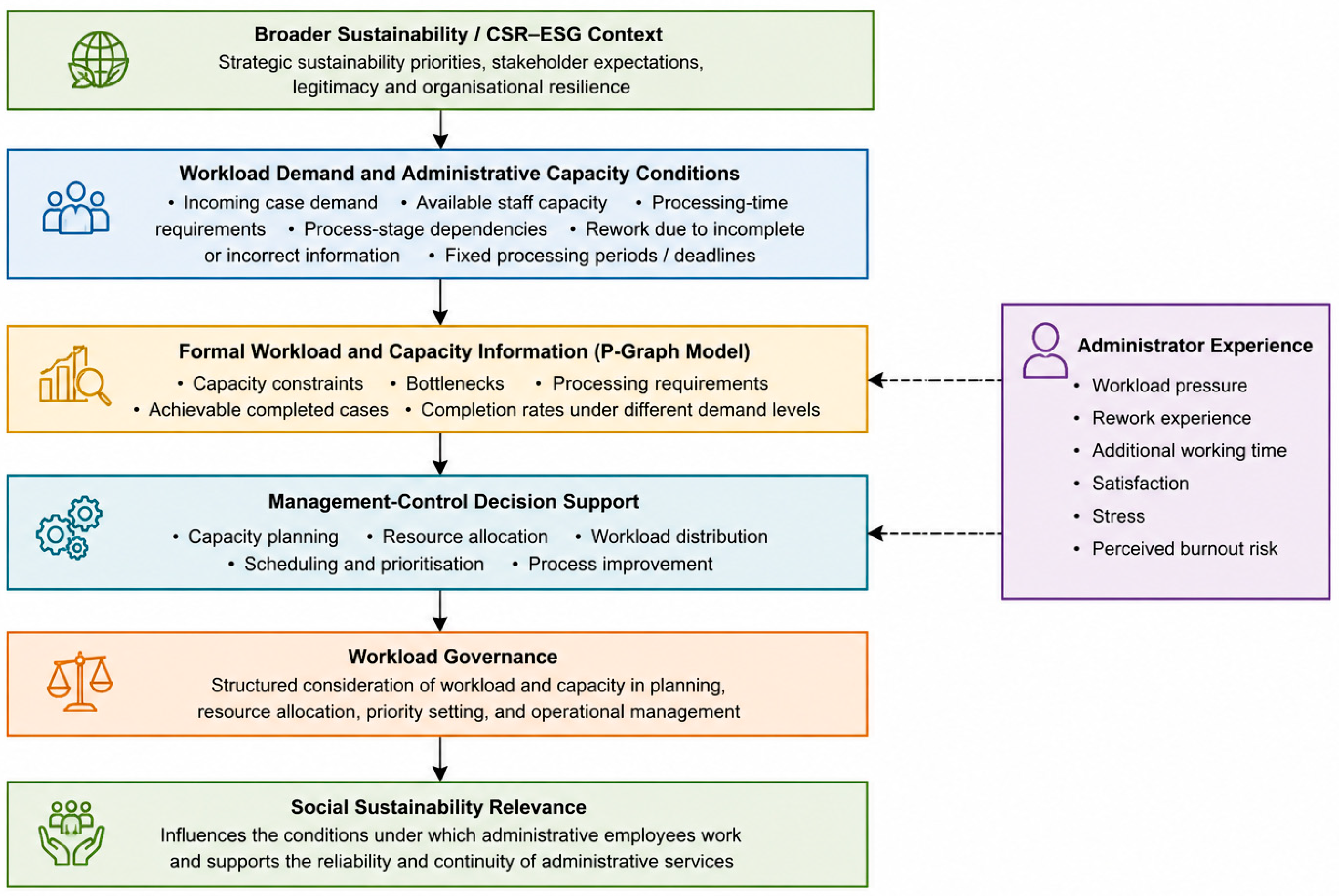
2.5. Analytical Framework: Workload Governance and Sustainability-Oriented Management Control
Based on the preceding literature, this study adopts an analytical framework that connects sustainability-oriented management control with the operational problem of workload and capacity governance. The framework does not assume a direct relationship between a formal modelling tool and sustainability performance. Instead, it distinguishes among operational conditions, employee experiences, management-control information, and the broader social sustainability relevance of workload governance. At the operational level, administrative demand interacts with available staff capacity, processing-time requirements, process-stage dependencies, and the need to revisit cases containing incomplete or incorrect information. These conditions determine the extent to which the administrative process can accommodate workload within the available processing period. Formal workload and capacity modelling makes these relationships visible by identifying capacity constraints, bottlenecks, and achievable case completion under different levels of demand. At the employee level, workload and capacity conditions are experienced through the organisation of administrative work. Workload concentration, repeated processing, additional working time, satisfaction, stress, and perceived burnout risk represent employee-related dimensions that cannot be inferred solely from operational completion rates. Qualitative evidence is therefore used to complement the model by providing information about how administrators experience workload and capacity pressure. The management-control level connects these two forms of evidence with organisational decision-making. Formal workload and capacity information can support decisions concerning resource allocation, capacity planning, workload distribution, scheduling, and potential process improvement. Employee evidence can complement this information by identifying workload-related concerns that are not captured by process-performance indicators. Management control is therefore understood as the organisational context in which operational and employee information can be interpreted and used. Social sustainability provides the broader interpretive domain of the framework. Decisions concerning workload and capacity can influence the conditions under which administrative employees work and the organisation’s ability to maintain reliable administrative operations. Workload governance is therefore treated as an operational issue relevant to social sustainability, rather than as a direct measure of sustainability performance. The relationships among these elements are summarised in the analytical framework presented in
Figure 1.
The resulting analytical logic can be summarised as follows: workload demand relative to available capacity creates operational capacity conditions; formal modelling makes these conditions visible; employee evidence provides complementary information on experienced workload pressure; and management control provides the organisational mechanism through which this information can support workload-governance decisions relevant to social sustainability. The framework is used as an illustrative, case-derived structure for interpreting the empirical analysis rather than as a causal model intended for statistical generalisation.
3. Materials and Methods
This study adopts an illustrative mixed-method case-study design to examine workload and capacity governance in the administrative enrolment process of a public higher education institution. The research combines direct process observation and time tracking, Business Process Modelling (BPM), semi-structured interviews with administrative staff, and P-Graph-based workload and capacity modelling. The quantitative component identifies processing requirements, available administrative capacity, process-stage constraints, and achievable case completion under different workload conditions. The qualitative component provides complementary evidence concerning administrators’ experiences of workload concentration, rework, additional working time, and employee well-being. The analytical design distinguishes between operational conditions and employee experiences. P-Graph modelling is used to analyse workload and capacity relationships and to identify capacity constraints under different demand levels, whereas the interview evidence is used to contextualise how workload and rework are experienced by administrative staff. These two evidence sources are integrated at the interpretation stage to consider how formal workload and capacity information can support management-control decisions relevant to workload governance and social sustainability. Generative artificial intelligence tools were used solely for language refinement and editorial support during manuscript preparation. All conceptual development, data collection, modelling, analysis, interpretation of results, and final content validation were performed by the authors.
3.1. Research Setting: Public Higher Education as an Administrative Context
The empirical setting is the student enrolment process of a publicly funded higher education institution. Administrative enrolment represents a suitable case for workload and capacity analysis because a large number of student cases must be processed within fixed time periods using a limited number of administrative staff, while administrative process management also has broader sustainability implications (
Buics & Eisinger, 2024). The process also involves interactions between digital and paper-based activities and requires administrators to revisit cases when student information or documentation is incomplete or incorrect.
The institution enrols approximately 4000–6000 new students annually and has a total student population of approximately 14,000. Although annual student volume is relatively stable, administrative workload is concentrated around specific enrolment periods. The principal capacity challenge therefore concerns the concentration of case-processing demand within fixed time windows rather than annual student volume alone.
The administrative context is additionally characterised by staff-retention and experience-related challenges. Approximately 20% of administrative staff leave the organisation within two years, while effective performance in the administrative role requires approximately one to two years of experience. Loss of experienced staff can therefore reduce available organisational knowledge and place additional pressure on remaining employees during high-workload periods.
The enrolment process affects several stakeholder groups, including students, administrative staff, faculty, and the institution itself. From the perspective adopted in this study, however, workload and capacity are analysed primarily as administrative management conditions. Their broader governance and social sustainability relevance is considered through their implications for resource planning, employee workload, and service continuity.
3.2. Data Collection and Workload Assessment
Data collection combined quantitative process information with qualitative evidence from administrative staff. Quantitative data were used to parameterise the workload and capacity analysis, while qualitative evidence was used to contextualise workload-related problems and employee experiences. BPM was additionally used to map the sequence and dependencies of the enrolment process before its formal representation in P-Graph.
Direct observation and time tracking were conducted during the enrolment process to identify the principal administrative activities and their processing requirements. Observed activities included document verification, data processing, handling incomplete or incorrect student information, and correction and reprocessing activities. These observations were used to establish the structure of the process and the average processing times applied in the capacity model. The enrolment process consists of two principal processing stages. The first stage involves digital verification of student data and documentation and requires an average of approximately 30 min (0.50 staff-hours) per student case. The second stage involves paper-based processing and verification and requires approximately 45 min (0.75 staff-hours) per case. Three weeks are available for the first stage and two weeks for the second stage. Cases containing incomplete or incorrect information can require additional administrative handling before processing can continue. Based on the empirical assessment of the process, the model incorporates an error/revisit uncertainty range of 10–20%, representing the proportion of cases that may require revisiting or reprocessing. This range is treated as a model constraint/uncertainty parameter rather than as a separate workload scenario.
The quantitative process analysis was supplemented by semi-structured interviews with administrative staff directly involved in the enrolment process. Participants were informed about the purpose of the research before participation. The interviews addressed the organisation and distribution of enrolment-related tasks; workload and capacity constraints during peak periods; additional work generated by incomplete or incorrect student data; correction and reprocessing activities; additional working time; and employee experiences associated with workload pressure, including satisfaction, stress, and perceived burnout risk. Participants were also asked about existing practices used to manage workload and capacity constraints. A total of nine administrative staff participated in the interviews. The interviews were documented through contemporaneous research notes rather than audio-recorded and transcribed. The qualitative material was reviewed and organised around recurring issues concerning workload concentration, rework, capacity pressure, additional working time, and employee well-being. The qualitative evidence was used as a complementary source of evidence to contextualise the quantitative workload and capacity analysis. It was not converted into quantitative measures or incorporated directly into the P-Graph completion-rate calculations.
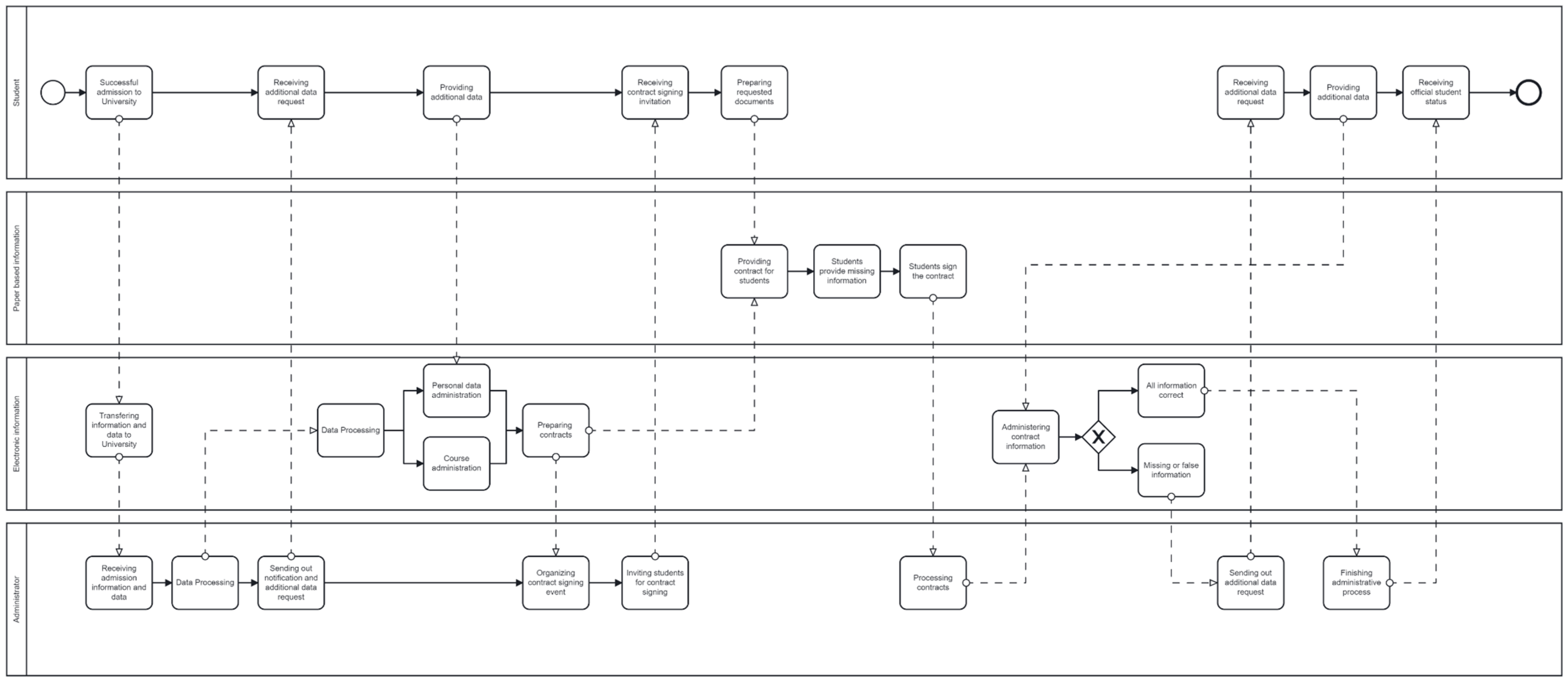
BPM was used to map the existing enrolment process before the P-Graph model was constructed (
Figure 2). The process map identified the sequence of administrative activities, task dependencies, decision points, and the interaction between digital and paper-based processing. The first stage consists primarily of digital verification of student data and documentation, while the second stage includes paper-based document processing and subsequent administrative completion. Cases containing incomplete or incorrect information can return to the relevant processing activity for correction and further handling. The BPM representation therefore provided the structural basis for identifying the activities, dependencies, and revisit paths subsequently represented in the P-Graph model.
3.3. P-Graph Model Formulation and Capacity Constraints
P-Graph is a mathematically grounded process-modelling and optimisation framework that represents relationships among process activities, resources, and outputs (
Friedler et al., 1992;
Tan et al., 2018). In the present study, P-Graph was used to formalise the two-stage enrolment process and examine the number of student cases that can be completed under different workload conditions subject to available administrative capacity, processing-time requirements, process-stage dependencies, and revisit requirements.
The operational objective of the model is to maximise the number of completed student cases. Let
denote the number of cases completed after Stage 2 under workload scenario
s. The objective can therefore be expressed as:
where
represents completed enrolment cases under scenario
s.
The basic process-flow constraints require the number of cases entering Stage 1 not to exceed scenario demand and the number of cases completed in Stage 2 not to exceed the number processed through Stage 1:
where
denotes the number of student cases under scenario
s,
represents cases processed through Stage 1, and
represents completed cases after Stage 2. Case quantities are constrained to non-negative integer values.
Administrative capacity was calculated separately for the two stages. The administrative unit consisted of 21 administrators working eight hours per day and five days per week. Three weeks were available for Stage 1 and two weeks for Stage 2. Gross staff-time capacity was calculated based on
Eisinger and Buics (
2024) as:
where
denotes gross staff-time capacity in stage n,
is the number of administrators,
is working hours per day,
is working days per week, and
is the number of weeks available for the respective processing stage. Gross capacity is therefore A
1 = 2520 staff-hours and A
2 = 1680 staff-hours.
Because administrators also perform other institutional duties during the enrolment period, not all gross working time is available for enrolment-related processing. Based on staff estimates and institutional workload records, the model assumed that 55% of gross working time was available for enrolment-related activities. The 55% value is therefore treated as a workload-allocation assumption used to estimate effective enrolment-processing capacity rather than as a directly observed proportion of working time. Effective enrolment-processing capacity was calculated as:
This resulted in E1 = 1386 staff-hours and E2 = 924 staff-hours.
Average processing time was 0.50 staff-hours per case in Stage 1 and 0.75 staff-hours per case in Stage 2. The theoretical case-processing capacity of each stage was calculated as:
where
denotes theoretical case-processing capacity, and
denotes average processing time per case. Accordingly,
= 2772 cases and
= 1232 cases.
These values represent theoretical case-processing capacities rather than staff-hours or predicted model throughput. The P-Graph analysis additionally accounts for process-stage dependencies and the capacity consumed when cases require revisiting or reprocessing.
The process model also accounts for cases that must be revisited because student data or documentation is incomplete or incorrect. The empirically established revisit proportion was represented as an uncertainty range:
where
r denotes the proportion of cases requiring revisit or reprocessing. Revisited cases re-enter the relevant processing activity and consequently consume administrative capacity that would otherwise be available for new cases. The 10–20% range is retained across the workload analysis and is not used to define the low-, medium-, and high-workload scenarios.
3.4. Workload and Capacity Scenario Design
To examine the sensitivity of the administrative process to changes in workload, the P-Graph model was evaluated under three workload scenarios representing different levels of student demand relative to available administrative capacity. The scenarios retained the same underlying process structure, processing requirements, administrative resources, and revisit uncertainty range. They therefore represent alternative workload conditions rather than alternative technological or process configurations. The high-workload scenario consisted of 4400 student cases, the medium-workload scenario of 2200 cases, and the low-workload scenario of 1460 cases. For each scenario, the model evaluated the number of cases that could be processed through Stage 1 and Stage 2 within available administrative capacity. Scenario performance was assessed using both the number of completed cases and the corresponding completion rate. For stage
n and scenario
s, the completion rate was calculated as:
where
denotes cases completed at stage n, and
denotes scenario demand.
The purpose of the scenario analysis was therefore to identify how the existing administrative process performs as workload changes relative to available capacity, including the emergence of capacity constraints and bottlenecks.
3.5. Operational and Qualitative Evidence Used in the Analysis
The study distinguishes among indicators generated directly by the P-Graph workload and capacity analysis, empirically observed process conditions, qualitative employee evidence, and the management-control interpretation of these evidence sources. This distinction enables the analysis to retain the broader governance and social sustainability dimensions of workload management while identifying clearly how each indicator is evidenced. The principal quantitative outputs of the P-Graph analysis are the number of cases completed at each processing stage, completion rates relative to scenario demand, and the capacity constraints affecting process performance. Revisit and rework requirements are represented as process conditions that consume administrative capacity. These indicators provide information about the ability of the existing administrative process to accommodate workload within the available processing period. Other dimensions are informed by observational and qualitative evidence rather than generated directly by the optimisation model. Workload concentration and rework were identified through the process assessment and discussed by administrative staff, while additional working time, satisfaction, stress, and perceived burnout risk were examined through the interviews. These dimensions provide complementary evidence concerning how workload and capacity conditions are experienced by employees.
Table 1 integrates these evidence sources within the analytical framework of the study. Operational indicators describe process and capacity performance, while qualitative evidence provides information concerning workload experience and employee-related implications. At the interpretation stage, these findings are considered together to identify implications for management-control decisions concerning capacity planning, resource allocation, workload distribution, scheduling, and process improvement. Their relevance to governance and social sustainability is therefore established through this integrated interpretation rather than through relabelling operational completion rates as direct sustainability measures.
4. Results
The results are presented in four stages. First, qualitative evidence from the administrative staff interviews is used to describe how workload concentration, rework, capacity pressure, and employee well-being are experienced within the enrolment process. Second, the operational structure and theoretical capacity of the two processing stages are examined. Third, the P-Graph representation is used to identify the principal workload and capacity relationships within the process. Finally, model results are compared across the three workload scenarios to examine how changes in student demand affect achievable case completion within the available administrative capacity.
4.1. Qualitative Evidence on Workload and Capacity Pressure
The interviews with nine administrative staff complemented the workload and capacity analysis by providing evidence concerning how workload-related conditions were experienced within the enrolment process. Review of the contemporaneous interview notes identified recurring issues concerning workload concentration, rework generated by incomplete or incorrect student information, capacity pressure and additional working time, and employee well-being. A recurring issue concerned the concentration of administrative workload within relatively short enrolment periods. Participants described peak periods as particularly demanding because large numbers of student cases had to be processed within fixed administrative deadlines. The workload problem was therefore associated not only with the overall number of cases but also with the concentration of processing requirements within limited time windows. Rework was another recurring source of administrative burden. Incomplete or incorrect student information required administrators to revisit cases, identify missing or inconsistent information, undertake corrective actions, and subsequently continue processing. Such repeated handling increased the amount of administrative work associated with individual cases and consumed capacity that could otherwise have been used for processing additional cases. The interview material also indicated that periods of high workload and capacity pressure were associated with additional working time. Participants described overtime or work beyond normal working periods as a practical response when administrative demand became difficult to accommodate within the available processing period. Additional working time is therefore treated here as qualitative evidence of how administrators responded to workload pressure rather than as a quantitative output of the P-Graph model. Finally, participants associated sustained workload pressure with employee well-being concerns, including stress, reduced satisfaction, and concerns about burnout. These findings represent reported employee experiences rather than psychometric or clinical measurements. Nevertheless, they indicate that the workload and capacity problem has an employee-related dimension in addition to its effect on administrative processing performance. Taken together, the qualitative findings identify workload concentration, rework, additional working time, and employee well-being as recurring dimensions of the administrative workload problem. These findings provide the employee-level context for interpreting the quantitative capacity analysis presented in the following subsections.
4.2. Process Structure and Administrative Capacity
The enrolment process consists of two consecutive administrative stages with different processing requirements. Stage 1 involves digital verification of student data and documentation. Administrators review the information submitted by students and identify missing or incorrect data that must be addressed before the case can proceed. The average processing requirement for this stage is approximately 30 min, or 0.50 staff-hours, per case. Stage 2 involves paper-based document processing and administrative completion. This stage requires approximately 45 min, or 0.75 staff-hours, per case. The coexistence of digital and paper-based activities creates dependencies between the two stages, while incomplete or inconsistent information can require cases to return to the relevant processing activity. The process operates within fixed processing periods. Three weeks are available for Stage 1 and two weeks for Stage 2. With 21 administrators working eight hours per day and five days per week, gross staff-time capacity is 2520 staff-hours in Stage 1 and 1680 staff-hours in Stage 2. Applying the 55% workload-allocation assumption described in
Section 3.3 results in effective enrolment-processing capacities of 1386 staff-hours and 924 staff-hours, respectively. Given average processing requirements of 0.50 staff-hours per case in Stage 1 and 0.75 staff-hours per case in Stage 2, the corresponding theoretical case-processing capacities are 2772 cases for Stage 1 and 1232 cases for Stage 2. These figures represent upper-bound case capacities under the stated workload-allocation and processing-time assumptions. They do not represent predicted P-Graph throughput because the process model additionally accounts for stage dependencies and capacity consumed by revisited cases. The comparison between the two stages reveals an important structural constraint. Although Stage 2 has a shorter processing window than Stage 1, it also requires more processing time per case. Its theoretical case capacity is therefore substantially lower. This makes the second, paper-based processing stage a particularly important capacity constraint within the existing enrolment process. The administrative capacity parameters of the two processing stages are summarised in
Table 2.
4.3. P-Graph Representation of Workload and Capacity Constraints
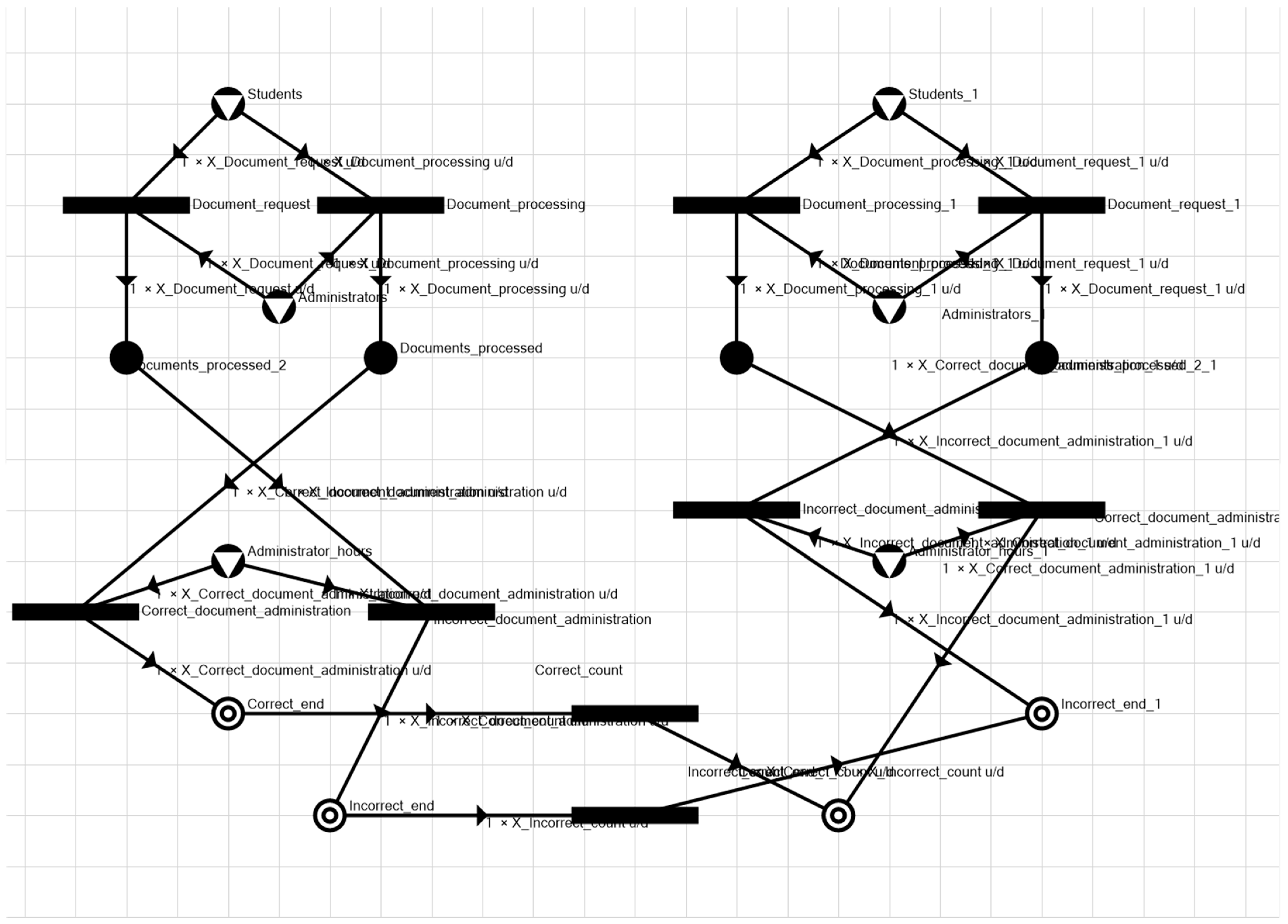
Figure 3 presents a representation of the enrolment process as formalised for the P-Graph analysis. The model represents the relationships among incoming student cases, administrative processing activities, available staff capacity, the two sequential processing stages, and the possibility that cases containing incomplete or incorrect information require revisiting. Student cases first enter the digital verification stage, where submitted data and documentation are reviewed. Cases requiring correction or additional information return to the relevant processing activity before they can proceed. Verified cases subsequently enter the paper-based second stage, where further administrative processing is completed. Administrative staff capacity constitutes a constrained resource for both stages. This representation allows the workload imposed by student demand to be evaluated against available processing capacity. The model objective is to maximise the number of cases completed after Stage 2 subject to the capacity, processing-time, process-dependency, and revisit conditions specified in
Section 3.3. The resulting model outputs therefore represent achievable process completion under the stated constraints rather than an independently optimised sustainability configuration. The model structure also helps identify where capacity limitations become operationally important. In particular, the lower theoretical capacity of Stage 2, together with the sequential relationship between the two stages and capacity consumed by revisited cases, constrains the number of cases that can reach final completion as workload increases.
4.4. Workload and Capacity Scenario Analysis
The P-Graph model was evaluated under three workload scenarios while retaining the same process structure, administrative resources, processing requirements, and revisit uncertainty range. The high-workload scenario contained 4400 student cases, the medium-workload scenario 2200 cases, and the low-workload scenario 1460 cases. The results therefore show how the existing process responds to different levels of demand rather than comparing alternative process designs. Under the high-workload scenario of 4400 cases, the model processed 2203 cases through Stage 1 and 915 cases through Stage 2. Relative to scenario demand, these values correspond to completion rates of 50.1% and 20.8%, respectively. The results indicate a substantial capacity shortfall under high workload, particularly at the second stage. Under the medium-workload scenario of 2200 cases, 2034 cases were processed through Stage 1 and 1066 through Stage 2. The corresponding completion rates were 92.5% and 48.5%. Stage 1 therefore accommodated most of the incoming workload, whereas Stage 2 remained substantially capacity-constrained. Under the low-workload scenario of 1460 cases, Stage 1 processed 1402 cases and Stage 2 completed 1174 cases. The corresponding completion rates were 96.0% and 80.4%. Although completion performance was substantially higher under this workload condition, the difference between Stage 1 and Stage 2 remained visible, consistent with the lower processing capacity of the second stage. The modelled completion results for the three workload scenarios are summarised in
Table 3.
Across the three scenarios, completion rates increased as workload demand decreased. The strongest constraint consistently occurred in Stage 2. Stage 1 completion increased from 50.1% under high workload to 96.0% under low workload, while Stage 2 completion increased from 20.8% to 80.4%. The scenario comparison therefore demonstrates the sensitivity of the existing administrative process to workload relative to available capacity.
These results provide direct evidence of operational capacity constraints rather than direct measures of governance quality or social sustainability. Their broader significance becomes clearer when considered together with the qualitative findings reported in
Section 4.1. The model identifies the structural conditions under which workload becomes difficult to accommodate within available capacity, while the interview evidence indicates that workload concentration, rework, additional working time, and employee well-being concerns are experienced within the administrative process. The combined evidence provides the basis for the management-control and social sustainability interpretation developed in the Discussion.
5. Discussion
This study examined administrative workload and capacity as an operational management problem situated within the broader context of sustainability-oriented management control. By combining P-Graph-based workload and capacity modelling with qualitative evidence from administrative staff, the analysis distinguishes between operational capacity conditions, employees’ experiences of workload pressure, and the managerial interpretation of these forms of information. The findings provide an illustrative account of how formal workload and capacity information can support management-control decisions relevant to workload governance and social sustainability in public higher education. Three findings are particularly important. First, the ability of the enrolment process to accommodate demand varies substantially with workload relative to available capacity, with the second, paper-based processing stage representing the strongest constraint. Second, the interview evidence indicates that workload concentration and rework are experienced by administrators as sources of additional workload and are associated with additional working time and employee well-being concerns. Third, formal modelling makes workload and capacity relationships visible in a structured form that can support managerial decisions concerning capacity planning, workload distribution, resource allocation, scheduling, and potential process improvement. These findings are discussed below in relation to the three research questions and the broader sustainability literature.
5.1. Workload, Capacity, and Administrative Process Performance
The first research question asked how the administrative enrolment process performs under different workload conditions relative to available capacity. The scenario analysis demonstrates a clear relationship between workload demand and achievable case completion. Under the high-workload scenario of 4400 student cases, Stage 1 achieved a completion rate of 50.1%, while only 20.8% of scenario demand was completed through Stage 2. Under the medium-workload scenario of 2200 cases, the corresponding rates increased to 92.5% and 48.5%, while under the low-workload scenario of 1460 cases, they reached 96.0% and 80.4%. These results indicate that the administrative process is particularly sensitive to workload at the second processing stage. This finding is consistent with the underlying capacity structure identified in
Section 4.2. Stage 2 combines a shorter processing period with a higher average processing requirement per case, producing a theoretical capacity of 1232 cases compared with 2772 cases in Stage 1. The sequential structure of the process and capacity consumed by revisited cases further constrain final case completion. The results therefore suggest that administrative workload should be assessed in relation to available capacity and process structure rather than through case volume alone. A given volume of administrative demand can have different operational implications depending on processing times, available staff-time, deadlines, process dependencies, and the extent to which cases require repeated handling. Formal capacity analysis makes these relationships explicit and can identify where the existing process is particularly vulnerable to workload pressure. From a management-control perspective, this finding is relevant because resource planning requires information about the relationship between demand and the capacity of specific process stages. The model does not prescribe a particular managerial intervention, but it identifies where capacity constraints are located and how process completion changes as workload varies. This provides a structured informational basis for evaluating possible responses such as changes in staffing allocation, scheduling, workload distribution, or process organisation.
5.2. Employee Experience, Rework, and Social Sustainability
The second research question concerned how workload and capacity constraints are reflected in administrators’ reported experiences of workload pressure, rework, and employee well-being. The qualitative findings complement the model by showing that the operational workload problem has an employee-related dimension. Across the interview material, recurring issues included the concentration of workload within fixed enrolment periods, additional work generated by incomplete or incorrect student information, additional working time during demanding periods, and concerns relating to stress, satisfaction, and burnout. Rework is particularly important in connecting the quantitative and qualitative components of the study. From an operational perspective, revisited cases consume administrative capacity that would otherwise be available for new cases. From the employee perspective, however, rework also represents repeated administrative effort: incomplete or inconsistent information must be identified, corrected, followed up, and subsequently processed again. The same phenomenon can therefore be understood simultaneously as a capacity requirement and as an experienced source of workload. The interview evidence further indicates that additional working time can function as an organisational response when workload becomes difficult to accommodate within normal working periods. This finding is relevant to workload governance because overtime may temporarily increase the amount of labour available to the process without addressing the underlying relationship between demand, processing requirements, and normal administrative capacity. Persistent reliance on such responses may therefore warrant managerial attention even when immediate processing requirements can eventually be met. These findings connect the administrative workload problem with the social dimension of sustainability. Social sustainability within organisations concerns, among other issues, the conditions under which human resources can be maintained over time. The present findings suggest that workload governance is relevant to this issue because decisions concerning capacity, workload distribution, process organisation, and rework influence the conditions under which administrative employees perform their work. The interview evidence provides the empirical basis for this connection by identifying reported employee experiences associated with workload pressure. The findings should nevertheless be interpreted at the level supported by the research design. Stress, satisfaction, and burnout were not assessed using psychometric instruments, and the interview evidence therefore represents employee perceptions and experiences rather than measured psychological outcomes. Within this boundary, the qualitative findings complement the capacity analysis and support the interpretation of workload governance as an operational issue relevant to social sustainability.
5.3. Formal Modelling as Management-Control Decision Support
The third research question asked how formal workload and capacity modelling can support management-control decisions relevant to workload governance and social sustainability. The findings suggest that the principal contribution of formal modelling lies in its ability to transform operational characteristics into structured information that can be used in managerial decision-making. In the present case, the P-Graph representation makes explicit the relationships among student demand, processing requirements, available administrative capacity, sequential process stages, and revisit requirements. This informational role is consistent with the management-control perspective developed in
Section 2. Management control connects organisational objectives with planning, measurement, resource allocation, and managerial action. A workload and capacity model can contribute to this process by identifying capacity limits, bottlenecks, and the consequences of alternative levels of demand. Managers can use such information when considering staffing requirements, workload distribution, scheduling, resource allocation, or potential process changes. The P-Graph model should therefore be understood as a formal decision-support component within a broader management-control process. The model itself does not determine governance arrangements or sustainability outcomes. Its contribution lies in making operational constraints and trade-offs visible in a form that can inform managerial deliberation. The management-control function emerges when this information is interpreted and used alongside other organisational evidence, including employee experiences. This distinction also clarifies the connection with sustainability-oriented management control. Sustainability considerations do not need to appear as a separate mathematical objective for operational information to be relevant to sustainability-oriented decisions. In the present case, information concerning workload and capacity can inform managerial choices that affect both administrative performance and working conditions. When such information is considered together with employee evidence concerning workload pressure, rework, additional working time, and well-being, it provides a broader informational basis for workload governance. The study therefore extends the management-control discussion by illustrating how a formal operations model can contribute decision-relevant information within a sustainability-oriented management context. Its contribution is not the automatic translation of CSR or ESG principles into an optimal process configuration, but the provision of structured operational information that managers can use when addressing a workload-governance problem with social sustainability implications.
5.4. CSR/ESG Integration and the Operationalisation of Sustainability
The findings also contribute to the broader discussion concerning the operationalisation of CSR, ESG, and sustainability commitments. A recurring issue in this literature is the difficulty of translating broad organisational objectives into the routines, information systems, and decision processes through which resources are actually managed. The present case illustrates one specific operational domain in which this translation can occur: the governance of administrative workload and capacity. The relationship should be understood as a sequence rather than as a direct effect of the modelling technique. CSR and ESG frameworks provide a broader strategic context in which employee-related and organisational sustainability concerns become relevant. Management control provides mechanisms through which such priorities can enter planning and decision-making. Workload and capacity information then provides operational evidence that managers can use when considering resource requirements and working conditions. In this sense, formal modelling can contribute to sustainability integration by strengthening the informational basis of operational management. This interpretation also broadens the meaning of sustainability implementation beyond dedicated sustainability programmes or reporting systems. Operational decisions concerning staffing, capacity, workload distribution, deadlines, and process organisation may have sustainability implications even when they are made within conventional administrative management systems. Connecting such decisions with reliable operational and employee information can therefore represent one practical pathway through which sustainability considerations become relevant to everyday management. For public higher education institutions, this perspective is particularly pertinent because sustainability must coexist with resource constraints, accountability requirements, service expectations, and the need to maintain institutional operations. Workload governance provides a concrete example of how broader sustainability principles can be connected with routine administrative management without requiring sustainability to be treated as a separate operational system.
5.5. Avoiding Symbolic Sustainability
The distinction between symbolic and substantive sustainability remains relevant to the interpretation of the findings. Sustainability commitments become operationally meaningful when they influence the information considered in organisational decisions and the way resources and operational risks are managed. Formal workload and capacity information can contribute to this process by making resource constraints visible and enabling managers to consider them systematically rather than responding only after workload pressure becomes acute. At the same time, the availability of formal information does not by itself guarantee substantive sustainability integration. The organisational significance of a capacity model depends on whether its outputs are incorporated into planning, resource allocation, workload management, and subsequent managerial action. In this respect, the present study locates the contribution of formal modelling within the broader management-control process rather than attributing sustainability outcomes directly to the modelling tool. This interpretation is consistent with the broader CSR and sustainability literature concerning the potential gap between formal organisational commitments and operational implementation. The case illustrates how workload and capacity information can provide one practical input into reducing this gap by connecting broad employee- and sustainability-related concerns with concrete administrative resource decisions.
5.6. An Illustrative Framework for Workload Governance and Social Sustainability
Taken together, the findings support the analytical framework developed in
Section 2.5. At the operational level, workload demand interacts with administrative capacity, processing requirements, process-stage dependencies, and revisit requirements. The P-Graph analysis makes these relationships visible and demonstrates how achievable case completion changes as demand varies. At the employee level, the interview evidence identifies workload concentration, rework, additional working time, and well-being concerns as recurring experiences associated with the administrative process. Management control provides the organisational connection between these evidence sources and managerial action. Capacity information can inform decisions concerning staffing, workload distribution, scheduling, and process organisation, while employee evidence can identify workload-related consequences that are not represented by process-performance indicators. Considering these sources together provides a more complete basis for workload governance than either operational modelling or employee evidence alone. Within this framework, social sustainability represents the broader organisational relevance of workload governance. Sustainable administrative operations require attention not only to the number of cases processed but also to the human resources through which those services are delivered. Workload governance therefore provides a concrete operational domain through which management-control decisions can address both capacity requirements and employee-related concerns. The resulting framework should be interpreted as an illustrative, case-derived analytical framework rather than as a universally generalisable causal model. The single-institution case demonstrates how the relationships among workload, capacity, employee experience, management-control information, and social sustainability can be examined together. Further research is required to determine how these relationships operate across different institutions, administrative processes, and organisational contexts.
6. Managerial and Policy Implications
The findings have practical implications for managers responsible for administrative capacity, workload allocation, and process planning, as well as broader implications for institutional governance and sustainability strategy. The case demonstrates the value of distinguishing between workload demand, available processing capacity, and employees’ experiences of workload pressure. Formal workload and capacity information can support managerial decisions by making resource constraints and process bottlenecks visible before decisions concerning staffing, scheduling, workload distribution, or process improvement are made. At the institutional level, these decisions are also relevant to social sustainability because they influence the conditions under which administrative services are delivered and employees perform their work.
6.1. Implications for Organisational Leaders
For organisational leaders, the findings highlight the importance of evaluating administrative workload relative to available capacity rather than relying on overall case volume alone. In the enrolment process examined here, capacity differs substantially between the two processing stages because of differences in available processing periods and average processing requirements. The second, paper-based stage represents a particularly important constraint. Formal workload and capacity analysis can help managers identify such bottlenecks and evaluate whether existing resources are sufficient for expected levels of demand. The findings also demonstrate the managerial importance of rework. Incomplete or incorrect student information does not merely create a quality problem; it consumes administrative capacity through repeated handling of cases. Managers should therefore consider both incoming workload and the additional capacity requirements generated by revisits when planning administrative resources. Measures that improve information quality, clarify submission requirements, or reduce unnecessary repeated processing may consequently have workload-management benefits, although the effects of specific process interventions were not tested in the present study. Workload planning should also consider the temporal concentration of administrative demand. The interviews indicate that workload pressure is particularly relevant when large numbers of cases must be processed within fixed periods and that additional working time can be used as a practical response to such pressure. Rather than treating overtime as a routine capacity mechanism, managers can use workload and capacity information to evaluate staffing allocation, scheduling, task distribution, and the timing of administrative activities before peak periods occur. Employee evidence should complement these quantitative indicators. Completion rates and capacity utilisation provide information about process performance, but they do not capture how workload is experienced by administrative staff. Regular consideration of employee feedback concerning rework, workload concentration, additional working time, stress, and satisfaction can therefore provide information that is not visible in process-performance measures alone. Combining operational and employee information offers managers a broader basis for workload-governance decisions. P-Graph and comparable formal modelling approaches can support this process by allowing managers to examine workload and capacity relationships systematically. Their managerial value lies not in automatically selecting a sustainable organisational configuration, but in providing structured information that can inform resource-allocation and process-management decisions.
6.2. Implications for Governance and Sustainability Strategy
At the institutional level, the findings suggest that workload and capacity governance can form part of a broader sustainability-oriented management approach. Sustainability in public higher education is not limited to environmental performance; its social dimension also concerns the conditions under which employees work and the organisation’s capacity to maintain reliable services over time. Administrative workload management is therefore relevant to sustainability when resource and process decisions affect employee working conditions and operational continuity. From a governance perspective, the practical implication is the need to connect operational information with institutional planning and accountability processes. Workload and capacity indicators can provide decision-makers with evidence concerning where demand exceeds or approaches available resources, while employee evidence can identify workload-related concerns that are not captured by operational indicators. Integrating these sources into regular management-control processes can support more transparent consideration of capacity requirements and workload-related risks. This approach also provides a practical connection between broader CSR/ESG commitments and operational management. Rather than attempting to represent CSR or sustainability directly as an optimisation variable, institutions can identify operational domains in which organisational decisions have employee- and sustainability-related implications. Workload and capacity governance represents one such domain. Formal analysis can provide the operational evidence, while institutional governance determines how that evidence is incorporated into planning, resource allocation, and managerial action. For higher education policy and institutional governance, the findings also suggest that administrative capacity should be considered alongside service expectations and regulatory requirements. Fixed deadlines or administrative requirements can create concentrated processing demands that may be difficult to accommodate with existing human resources. Where institutions are expected to maintain reliable student services within constrained resource environments, systematic assessment of administrative capacity can contribute to more informed decisions concerning staffing, process requirements, and service organisation. The implications extend beyond the specific enrolment process examined here, but should be treated as propositions for application and further investigation rather than as generalised empirical findings. Other administrative environments characterised by fixed deadlines, repeated case handling, limited human resources, and fluctuating demand may similarly benefit from formal workload and capacity assessment. The applicability and effects of such approaches, however, depend on the characteristics of the particular organisational context.
7. Limitations and Future Research
This study has several limitations that define the scope within which its findings should be interpreted and provide directions for future research. First, the empirical analysis is based on the enrolment process of a single public higher education institution. The case-study design enabled detailed examination of the process structure, workload requirements, administrative capacity, and employee experiences within a specific organisational setting, but it does not support statistical generalisation to other institutions or administrative environments. The analytical framework developed from the case should therefore be regarded as illustrative and case-derived. Comparative research across multiple higher education institutions and other administrative settings would be valuable for examining the extent to which similar workload and capacity relationships occur in different organisational contexts. Second, the institutional and public-sector context may influence the observed workload and capacity conditions. Higher education administration operates within specific regulatory requirements, academic calendars, fixed administrative deadlines, and resource-allocation arrangements. These characteristics may differ from those of private-sector organisations or other public services. Future studies could apply the workload-governance framework to different organisational settings to examine how regulatory conditions, resource flexibility, process structure, and demand variability affect capacity management. Third, several parameters of the workload and capacity model are based on empirically informed assumptions rather than continuous measurement of staff activity. In particular, the assumption that 55% of gross administrative working time is available for enrolment-related activities was informed by staff estimates and institutional workload records. Similarly, the model represents the proportion of cases requiring revisit or reprocessing through a 10–20% uncertainty range. These assumptions enable structured workload and capacity analysis but introduce parameter uncertainty into the resulting capacity estimates. Future research could strengthen parameter estimation through more extensive time-tracking data, longitudinal workload records, or sensitivity analysis across alternative capacity-allocation and revisit assumptions. Fourth, the qualitative component was based on interviews with nine administrative staff documented through contemporaneous research notes rather than audio-recorded verbatim transcripts. The material was reviewed and organised around recurring workload-related issues, but the qualitative component was intended primarily to contextualise the workload and capacity analysis rather than to provide an independently comprehensive qualitative investigation of employee well-being. Future research could extend this component through larger interview samples, verbatim transcription, systematic qualitative coding, and longitudinal investigation of employee experiences across different workload periods. Fifth, employee well-being outcomes were not measured using validated psychometric instruments. References to stress, satisfaction, and burnout in this study therefore reflect administrators’ reported experiences and concerns rather than independently measured psychological outcomes. Future studies could combine workload and capacity modelling with validated measures of occupational stress, job satisfaction, burnout, or related employee outcomes. Such research would allow the relationship between operational workload conditions and employee well-being to be examined more directly. Sixth, the scenario analysis varies the level of student demand while retaining the same underlying process structure and administrative resource assumptions. The high-, medium-, and low-workload scenarios should therefore be interpreted as workload and capacity conditions rather than as alternative process configurations. The present analysis does not empirically compare baseline, optimised, or digitised process designs. Future research could extend the model by explicitly constructing and comparing alternative interventions, including changes in staffing, workload allocation, processing periods, process sequencing, information-quality controls, or the degree of digitalisation. Such analyses could evaluate whether particular interventions improve achievable case completion or reduce capacity pressure relative to the existing process. Finally, the study focuses on workload and capacity governance as one operational domain relevant to social sustainability. It does not provide a comprehensive assessment of institutional CSR, ESG, or sustainability performance. Future research could examine how workload and capacity information interacts with broader sustainability-oriented management-control systems, including human-resource indicators, employee feedback mechanisms, service-performance measures, and institutional sustainability objectives. Further research could also explore the use of predictive analytics and AI-supported decision tools for forecasting workload and supporting capacity planning while evaluating their organisational and employee implications. These limitations define the contribution of the study as an illustrative examination of how formal workload and capacity information can be combined with employee evidence within a sustainability-oriented management-control perspective. Replication across institutions, improved parameter measurement, stronger qualitative and employee-level measurement, and explicit testing of alternative process configurations would provide important opportunities for evaluating and extending the framework.
8. Conclusions
This study examined workload and capacity governance as an operational domain through which sustainability considerations can inform management-control decisions in public higher education. Using the enrolment process of a single higher education institution as an illustrative case, the study combined process observation and time tracking, Business Process Modelling, semi-structured interviews with nine administrative staff, and P-Graph-based workload and capacity modelling. This mixed-method design enabled operational capacity conditions to be examined alongside administrators’ experiences of workload pressure and rework. The findings provide three principal conclusions. First, the performance of the enrolment process is strongly influenced by workload relative to available administrative capacity. Completion rates declined as student demand increased, with the second, paper-based processing stage representing the most persistent capacity constraint. The results demonstrate the importance of considering processing requirements, available staff-time, process dependencies, and revisited cases when assessing administrative capacity. Second, the qualitative evidence shows that workload and capacity constraints have an employee-related dimension. Administrators identified workload concentration, repeated handling of incomplete or incorrect cases, additional working time, stress, reduced satisfaction, and concerns about burnout as recurring issues associated with demanding enrolment periods. These findings complement the capacity analysis by showing how operational workload conditions are experienced by the employees responsible for delivering administrative services. Third, the study illustrates how formal workload and capacity modelling can contribute to management-control decision support. By making workload demand, capacity constraints, bottlenecks, and achievable case completion visible, formal modelling can provide information relevant to capacity planning, resource allocation, workload distribution, scheduling, and process improvement. When considered together with employee evidence, this information can provide a broader basis for workload-governance decisions relevant to social sustainability. The contribution of the study therefore lies in connecting an operational workload and capacity problem with the broader literature on sustainability-oriented management control. CSR and ESG provide the wider strategic context, while management control provides the organisational mechanism through which operational and employee information can inform decision-making. Social sustainability provides the broader relevance of workload governance because the management of administrative capacity influences the conditions under which employees work and the organisation’s ability to maintain reliable administrative operations. The resulting framework should be understood as an illustrative, case-derived analytical approach rather than as a generalisable causal model. The study demonstrates the value of making workload and capacity conditions visible and considering them alongside employee experience, while further research is required to test alternative process configurations and examine these relationships across institutions and organisational settings. In this way, workload and capacity governance represents a concrete operational area through which broader sustainability commitments can become relevant to everyday management decisions.
Author Contributions
Conceptualization, B.E.B. and L.B.; methodology, L.B.; software, L.B.; validation, B.E.B. and L.B.; formal analysis, L.B.; resources, B.E.B. and L.B.; data curation, L.B.; writing—original draft preparation, B.E.B.; writing—review and editing, L.B.; visualization B.E.B. and L.B.; supervision, B.E.B.; project administration, L.B. All authors have read and agreed to the published version of the manuscript.
Funding
This research received no external funding.
Institutional Review Board Statement
This study did not require ethical review because, in accordance with Article 4(1) of the General Data Protection Regulation (EU 2016/679), the present study collected no personal data, and all responses were fully anonymous and voluntary. The study posed no physical or psychological risk to participants. Furthermore, in Hungary, there is no national legislation requiring Ethics Committee approval for anonymous, non-invasive social science research involving adult participants and no sensitive or personal data.
Informed Consent Statement
Informed consent was obtained from all subjects involved in the study.
Data Availability Statement
The data presented in this study are available on request from the corresponding author.
Conflicts of Interest
The authors declare no conflicts of interest.
References
- Aguinis, H., & Glavas, A. (2012). What we know and don’t know about corporate social responsibility: A review and research agenda. Journal of Management, 38(4), 932–968. [Google Scholar] [CrossRef] [Scilit]
- Aguinis, H., & Glavas, A. (2019). On corporate social responsibility, sensemaking, and the search for meaningfulness through work. Journal of Management, 45(3), 1057–1086. [Google Scholar] [CrossRef] [Scilit]
- Arjaliès, D. L., & Mundy, J. (2013). The use of management control systems to manage CSR strategy: A levers of control perspective. Management Accounting Research, 24(4), 284–300. [Google Scholar] [CrossRef] [Scilit]
- Bakker, A. B., & Demerouti, E. (2017). Job demands–resources theory: Taking stock and looking forward. Journal of Occupational Health Psychology, 22(3), 273–285. [Google Scholar] [CrossRef] [Scilit] [PubMed]
- Bebbington, J., Unerman, J., & O’Dwyer, B. (2017). Sustainability accounting and accountability (2nd ed.). Routledge. [Google Scholar]
- Beusch, P., Frisk, J. E., Rosén, M., & Dilla, W. (2022). Management control for sustainability: Towards integrated systems. Management Accounting Research, 54, 100777. [Google Scholar] [CrossRef] [Scilit]
- Bitektine, A., & Haack, P. (2015). The “macro” and the “micro” of legitimacy: Toward a multilevel theory of the legitimacy process. Academy of Management Review, 40(1), 49–75. [Google Scholar] [CrossRef] [Scilit]
- Buics, L., & Eisinger, B. (2024). Sustainability aspects of administrative process management: A case study analysis. Chemical Engineering Transactions, 114, 481–486. [Google Scholar] [CrossRef]
- Crilly, D., Zollo, M., & Hansen, M. T. (2012). Faking it or muddling through? Understanding decoupling in response to stakeholder pressures. Academy of Management Journal, 55(6), 1429–1448. [Google Scholar] [CrossRef] [Scilit]
- Deslatte, A., Krause, R. M., & Hawkins, C. V. (2022). The road to routinization: A functional collective action approach for local sustainability planning and performance management. State and Local Government Review, 54(4), 310–327. [Google Scholar] [CrossRef] [Scilit]
- Duchek, S. (2020). Organizational resilience: A capability-based conceptualization. Business Research, 13, 215–246. [Google Scholar] [CrossRef] [Scilit]
- Ehnert, I., Parsa, S., Roper, I., Wagner, M., & Muller-Camen, M. (2016). Reporting on sustainability and HRM: A comparative study of sustainability reporting practices by the world’s largest companies. The International Journal of Human Resource Management, 27(1), 88–108. [Google Scholar] [CrossRef] [Scilit]
- Eisinger, B., & Buics, L. (2024). Transforming public services management: A P-graph methodology case study and scenario analysis. Chemical Engineering Transactions, 114, 475–480. [Google Scholar] [CrossRef]
- Friede, G., Busch, T., & Bassen, A. (2015). ESG and financial performance: Aggregated evidence from more than 2000 empirical studies. Journal of Sustainable Finance & Investment, 5(4), 210–233. [Google Scholar] [CrossRef] [Scilit]
- Friedler, F., Tarjan, K., Huang, Y. W., & Fan, L. T. (1992). Graph-theoretic approach to process synthesis: Axioms and theorems. Chemical Engineering Science, 47(8), 1973–1988. [Google Scholar] [CrossRef] [Scilit]
- Gond, J. P., Grubnic, S., Herzig, C., & Moon, J. (2016). Configuring management control systems: Theorizing the integration of strategy and sustainability. Management Accounting Research, 28, 1–15. [Google Scholar] [CrossRef] [Scilit]
- Grøn, C. H., & Kristiansen, M. B. (2022). What gets measured gets managed? The use of performance information across organizational echelons in the public sector. Public Performance & Management Review, 45(2), 448–472. [Google Scholar] [CrossRef] [Scilit]
- Haack, P., Schoeneborn, D., & Wickert, C. (2012). Talking the talk, moral entrapment, creeping commitment? Exploring narrative dynamics in corporate responsibility standardization. Organization Studies, 33(5–6), 815–845. [Google Scholar] [CrossRef] [Scilit]
- Hahn, R., & Kühnen, M. (2013). Determinants of sustainability reporting: A review of results, trends, theory, and opportunities in an expanding field of research. Journal of Cleaner Production, 59, 5–21. [Google Scholar] [CrossRef] [Scilit]
- Hahn, T., Pinkse, J., Preuss, L., & Figge, F. (2015). Tensions in corporate sustainability: Towards an integrative framework. Journal of Business Ethics, 127(2), 297–316. [Google Scholar] [CrossRef] [Scilit]
- Jamali, D., Karam, C., Yin, J., & Soundararajan, V. (2017). CSR logics in developing countries: Translation, adaptation and stalled development. Journal of World Business, 52(3), 343–359. [Google Scholar] [CrossRef] [Scilit]
- Kramar, R. (2014). Beyond strategic human resource management: Is sustainable human resource management the next approach? International Journal of Human Resource Management, 25(8), 1069–1089. [Google Scholar] [CrossRef] [Scilit]
- Leicht-Deobald, U., Lam, C. F., Bruch, H., Kunze, F., & Wu, W. (2022). Team boundary work and team workload demands: Their interactive effect on team vigor and team effectiveness. Human Resource Management, 61(4), 465–488. [Google Scholar] [CrossRef] [Scilit]
- Linnenluecke, M. K., Griffiths, A., & Winn, M. (2018). Firm and industry adaptation to climate change: A review of climate adaptation studies in the business and management field. Wiley Interdisciplinary Reviews: Climate Change, 9(3), e527. [Google Scholar] [CrossRef] [Scilit]
- Lueg, R., Krastev, B., & Lueg, K. (2021). Bidirectional effects between sustainability disclosure and risk. Journal of Cleaner Production, 290, 125776. [Google Scholar] [CrossRef] [Scilit]
- Lueg, R., & Radlach, R. (2016). Managing sustainable development with management control systems: A literature review. European Management Journal, 34(2), 158–171. [Google Scholar] [CrossRef] [Scilit]
- Maas, K., Schaltegger, S., & Crutzen, N. (2016). Integrating corporate sustainability assessment, management accounting, control, and reporting. Journal of Cleaner Production, 136, 237–248. [Google Scholar] [CrossRef] [Scilit]
- Maccarrone, P., & Contri, A. M. (2021). Integrating corporate social responsibility into corporate strategy: The role of formal tools. Sustainability, 13(22), 12551. [Google Scholar] [CrossRef] [Scilit]
- Magliacani, M. (2023). How the sustainable development goals challenge public management: Action research on the cultural heritage of an Italian smart city. Journal of Management and Governance, 27, 987–1015. [Google Scholar] [CrossRef] [Scilit]
- Merchant, K. A., & Van der Stede, W. A. (2017). Management control systems: Performance measurement, evaluation and incentives (4th ed.). Pearson Education. [Google Scholar]
- Michelon, G., Pilonato, S., & Ricceri, F. (2015). CSR reporting practices and the quality of disclosure: An empirical analysis. Critical Perspectives on Accounting, 33, 59–78. [Google Scholar] [CrossRef] [Scilit]
- Montani, F., Vandenberghe, C., Khedhaouria, A., & Courcy, F. (2020). Examining the inverted U-shaped relationship between workload and innovative work behavior: The role of work engagement and mindfulness. Human Relations, 73(1), 59–93. [Google Scholar] [CrossRef] [Scilit]
- Ortiz-de-Mandojana, N., & Bansal, P. (2016). The long-term benefits of organizational resilience through sustainable business practices. Strategic Management Journal, 37(8), 1615–1631. [Google Scholar] [CrossRef] [Scilit]
- Park, S. K., Rhee, M.-K., & Lee, S. W. (2021). The effects of job demands and resources on turnover intention: The mediating roles of emotional exhaustion and depersonalization. Work, 70(1), 301–309. [Google Scholar] [CrossRef] [Scilit] [PubMed]
- Pindek, S., Shen, W., Gray, C. E., & Spector, P. E. (2023). Clarifying the inconsistently observed curvilinear relationship between workload and employee attitudes and mental well-being. Work & Stress, 37(2), 195–221. [Google Scholar] [CrossRef] [Scilit]
- Risi, D., Wickert, C., & Ramus, T. (2023). Coordinated enactment: How organizational departments work together to implement CSR. Business & Society, 62(4), 745–786. [Google Scholar] [CrossRef] [Scilit]
- Rodrigues, M., & Franco, M. (2019). The corporate sustainability strategy in organisations: A systematic review and future directions. Sustainability, 11(22), 6214. [Google Scholar] [CrossRef] [Scilit]
- Sanches, F. E. F., de Souza Junior, M. A. A., Massaro Junior, F. R., Povedano, R., & Gaio, L. E. (2023). Developing a method for incorporating sustainability into the strategic planning of higher education institutions. International Journal of Sustainability in Higher Education, 24(4), 812–839. [Google Scholar] [CrossRef] [Scilit]
- Serafini, P. G., de Moura, J. M., de Almeida, M. R., & de Rezende, J. F. D. (2022). Sustainable Development Goals in higher education institutions: A systematic literature review. Journal of Cleaner Production, 370, 133473. [Google Scholar] [CrossRef] [Scilit]
- Tan, R. R., Aviso, K. B., Promentilla, M. A. B., Yu, K. D. S., & Santos, J. R. (2018). Future research prospects for input–output models. In Input-output models for sustainable industrial systems: Implementation using LINGO (pp. 139–143). Springer. [Google Scholar]
- Velte, P. (2017). Does ESG performance have an impact on financial performance? Evidence from Germany. Journal of Global Responsibility, 8(2), 169–178. [Google Scholar] [CrossRef] [Scilit]
| Disclaimer/Publisher’s Note: The statements, opinions and data contained in all publications are solely those of the individual author(s) and contributor(s) and not of MDPI and/or the editor(s). MDPI and/or the editor(s) disclaim responsibility for any injury to people or property resulting from any ideas, methods, instructions or products referred to in the content. |