

Adaptive Architectures Under Macroenvironmental Turbulence: A Comparative Study of Apple, Amazon, and McDonald’s


Abstract
1. Introduction
Research Questions
- RQ1:
- How do firms translate macroenvironmental volatility into strategic reconfiguration processes?
- RQ2:
- How do adaptive mechanisms differ across business models and sectors under shared environmental pressures?
- RQ3:
- What dynamic capabilities enable firms to convert environmental constraints into competitive advantages?
2. Literature Review and Theoretical Framework
2.1. Research Gap and Theoretical Positioning
2.2. PESTEL Analysis: The Macroenvironment as Strategic Participant
2.3. Contingency Theory: Structural Fit Under Conditions of Permanent Turbulence
2.4. Dynamic Capabilities: Sensing, Seizing, and Transforming
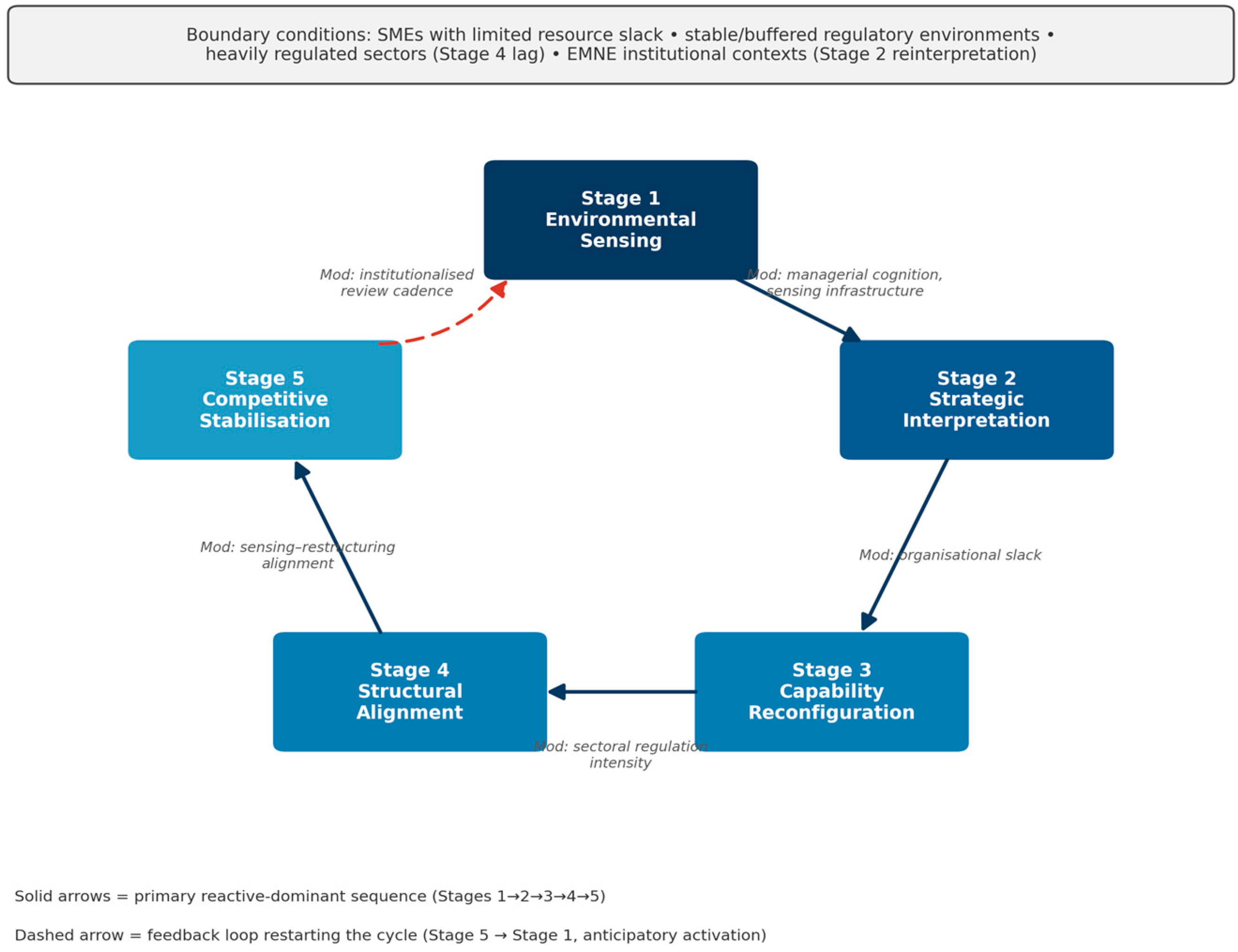
2.5. The ARC Framework: An Integrative Theoretical Contribution
- Stage 1—Environmental Sensing: Systematic identification of PESTEL-triggered volatility signals.
- Stage 2—Strategic Interpretation: Managerial framing of signals into actionable strategic priorities, filtering noise from structurally significant shifts.
- Stage 3—Capability Reconfiguration: Deployment of dynamic capabilities (sensing, seizing, transforming) to realign resources with interpreted environmental demands.
- Stage 4—Structural Alignment: Contingency fit adjustment: organisational structure, governance, and operational systems are reconfigured to match the new environmental configuration.
- Stage 5—Competitive Stabilisation: Achievement of provisional strategic equilibrium. New sensing processes restart the cycle immediately, shown in Figure 1 as the dashed feedback arrow from Stage 5 back to Stage 1.
2.6. Theoretical Propositions, Mapped onto the Five ARC Stages
3. Methodology
3.1. Research Design and Philosophical Positioning
3.2. Case Selection Rationale
3.3. Data Collection

| Source Category | Type | N (Approx.) | Analytical Purpose |
|---|---|---|---|
| Annual reports | Primary corporate documents | 18 | Strategic actions, resource allocation, forward-looking statements |
| ESG/sustainability reports | Corporate disclosures | 12 | Sustainability adaptation, ESG commitment trajectories |
| Regulatory filings & proceedings | Institutional sources | 10 | Compliance pressures, legal exposure, regulatory sanctions |
| Financial and business press | Secondary triangulation | 22 | Independent verification of corporate claims; alternative framings |
| Peer-reviewed academic studies | Theoretical triangulation | 16 | Interpretive support; theoretical grounding and cross-validation |
| Total | 78 |
3.4. Analytical Process
- 1
- Open coding: Strategic responses and adaptive actions were identified inductively within each firm’s documentary record, without imposing prior theoretical categories. In total, 187 initial codes were generated across the three cases.
- 2
- Axial coding: Initial codes were organised around PESTEL dimensions, establishing which environmental triggers corresponded to which adaptive responses within and across firms.
- 3
- Thematic aggregation: Axial codes were synthesised into higher-order analytical constructs (e.g., ‘anticipatory architecture’, ‘compliance-as-moat’, ‘franchise flexibility’) representing the second- and aggregate-dimension levels of the data structure.
- 4
- Cross-case comparison: Constructs were applied simultaneously across all three firms, identifying shared mechanisms and sector-specific divergences.
- 5
- Pattern matching: Findings were tested against the ARC Framework’s five-stage logic, refining the framework iteratively where empirical evidence indicated adjustment.
3.5. Data Structure: First-Order Concepts, Second-Order Themes, and Aggregate Dimensions
| First-Order Concepts (Inductive) | Second-Order Themes (Interpretive) | Aggregate Dimensions (Theoretical) |
|---|---|---|
| Apple’s shift of iPhone assembly from China to India/Vietnam (2020–2023) | Anticipatory geopolitical derisking | Environmental Sensing & Strategic Interpretation (ARC Stages 1–2) |
| Apple’s GDPR compliance repositioned as ‘privacy as a human right’ in marketing | Regulatory pressure converted into brand differentiator | Environmental Sensing & Strategic Interpretation (ARC Stages 1–2) |
| Amazon’s EU antitrust fine (EUR 746 m, 2021) followed by marketplace policy restructure | Regulatory sanction triggering structural reconfiguration | Capability Reconfiguration & Structural Alignment (ARC Stages 3–4) |
| Amazon’s deployment of over 750,000 warehouse robots (2022–2024) | Automation as competitive moat construction | Capability Reconfiguration & Structural Alignment (ARC Stages 3–4) |
| McDonald’s exit from Russian operations (March 2022, 847 restaurants) | Franchise structure enabling rapid geopolitical disengagement | Structural Alignment & Competitive Stabilisation (ARC Stages 4–5) |
| McDonald’s MyMcDonald’s Rewards digital loyalty programme (launched 2021, 50 M users by 2023) | Digital infrastructure as retention and data asset | Structural Alignment & Competitive Stabilisation (ARC Stages 4–5) |
| Shared: all three firms publish annual carbon neutrality targets with quantified milestones | ESG as environmental legitimacy requirement | Convergence as Baseline Reconfiguration |
| Shared: all three firms accelerated digital ordering/customer-facing AI integration post-2020 | Digitalisation as entry requirement, not differentiator | Convergence as Baseline Reconfiguration |
4. Results: PESTEL Analysis and Adaptive Mechanisms
4.1. Apple: Stage-by-Stage Evidence
4.2. Amazon: Stage-by-Stage Evidence
4.3. McDonald’s: Stage-by-Stage Evidence
4.4. Convergence as Baseline Reconfiguration
5. Discussion
5.1. Answering the Research Questions
5.2. Environmental Volatility and Reconfiguration Mechanisms (Proposition 1)
5.3. Anticipatory vs. Reactive Adaptation Architectures (Proposition 2)
5.4. Sensing–Restructuring Alignment and Adaptive Lag (Proposition 3)
5.5. Convergence as Environmental Baseline, Divergence as Competitive Logic
5.6. Alternative Explanations and Interpretive Caution
5.7. Theoretical Contribution of the ARC Framework
5.8. Boundary Conditions, Limitations, and Future Research
| Boundary Condition | Mechanism Affected | Implication for Framework |
|---|---|---|
| Small and medium enterprises (SMEs) with limited resource slack | Stages 1–2 (sensing infrastructure) and Stage 3 (reconfiguration scale) | SMEs lack the capital and institutional capacity to sustain dedicated environmental sensing units. Stage 1 operates through informal managerial cognition rather than structured intelligence functions. ARC cycle speed is constrained by restructuring capacity, not sensing. |
| Firms in stable or highly buffered national regulatory environments | Stage 1 (perceived volatility intensity) | Regulatory buffering reduces effective PESTEL volatility, dampening Stage 1 activation. Proposition 1’s volatility–reconfiguration relationship may not hold in contexts of persistent regulatory stability (e.g., certain Gulf Cooperation Council markets, domestic monopolies). |
| Firms in heavily regulated sectors (healthcare, financial services, defence) | Stage 4 (restructuring pace) | Mandatory compliance timelines impose structural lag between Stages 3 and 4 regardless of sensing capability advancement. Proposition 3’s alignment logic is systematically disrupted by external pace-setters beyond managerial control; the Amazon case in Section 5.4 shows a related but distinct compliance-driven lag outside this sector-defined boundary. |
| Emerging economy multinationals (EMNEs) with non-Western institutional contexts | Stage 2 (strategic interpretation logic) | Institutional environments shape how environmental signals are interpreted and prioritised. Political signals that generate defensive reconfiguration in Western multinationals may generate opportunity-sensing responses in EMNEs with closer state relationships. The framework requires contextual adaptation for non-OECD institutional environments. |
5.9. Managerial Implications
6. Conclusions
Supplementary Materials
Funding
Institutional Review Board Statement
Informed Consent Statement
Data Availability Statement
Conflicts of Interest
Appendix A. Document Corpus: Inventory and Classification
| Source | Firm/Type | Year | PESTEL Dimension & Key Evidence |
|---|---|---|---|
| Apple Annual Report (Form 10-K) | Apple/Primary | 2020–2023 | Political/Economic: Explicit disclosure of supply chain geographic diversification strategy; India and Vietnam manufacturing ramp-up cited. |
| Apple Privacy White Paper (‘A Day in the Life of Your Data’) | Apple/Primary | 2021 | Legal/Social: ATT framework rationale; ‘privacy as a human right’ positioning formalised as brand strategy. |
| Amazon Annual Report (Form 10-K) | Amazon/Primary | 2019–2023 | Economic/Technological: AWS revenue trajectory; robotics deployment figures; logistics infrastructure capital expenditure. |
| Amazon The Climate Pledge Commitment Document | Amazon/Primary | 2019–2022 | Environmental: Net-zero 2040 targets; electric vehicle fleet commitments; Shipment Zero programme milestones. |
| Luxembourg Data Protection Authority (CNPD) Decision—Amazon | Amazon/Regulatory | 2021 | Legal: EUR 746 m GDPR fine; grounds for sanction; Amazon’s subsequent marketplace policy restructuring. |
| McDonald’s Annual Report | McDonald’s/Primary | 2019–2023 | Political/Economic: Russia exit financial impact; franchise model resilience metrics; digital loyalty user growth. |
| McDonald’s Scale for Good ESG Report | McDonald’s/Primary | 2020–2023 | Environmental/Social: Packaging transition targets; menu localisation data; supplier sustainability standards. |
| Financial Times: ‘Apple’s Great Decoupling’ | Apple/Press | 2023 | Political: Independent verification of manufacturing shift timeline and scale; analyst commentary on supply chain reconfiguration costs. |
| The Economist: ‘Amazon’s Antitrust Tightrope’ | Amazon/Press | 2023 | Legal: DMA compliance burden; institutional engagement strategy; structural adjustment to EU marketplace rules. |
| Reuters: ‘McDonald’s Russia Exit: Speed and Scale’ | McDonald’s/Press | 2022 | Political: Operational timeline of 847-restaurant transfer; franchise model’s role in enabling rapid disengagement. |
| Zhao, W.: ‘Strategic innovations in Apple’s supply chain management’ | Apple/Academic | 2024 | Political/Technological: Independent scholarly account of Apple’s post-2019 supply-chain repositioning, corroborating the primary-document timeline. |
References
- Abdullahi, U., Mohamed, A. M., & Senasi, V. (2024). Digital orientation and organizational resilience: The contingent effect of dynamic capabilities. Sustainable and Resilient Infrastructure, 10(4), 295–312. [Google Scholar] [CrossRef] [Scilit]
- Almeida, F. (2026). From vulnerability to resilience: Dynamic capabilities as a moderating mechanism under environmental turbulence in developing economies. Business Strategy and the Environment. [Google Scholar] [CrossRef] [Scilit]
- Amhalhal, A., Anchor, J., Tipi, N., & Elgazzar, S. H. (2022). The impact of contingency fit on organisational performance: An empirical study. International Journal of Productivity and Performance Management, 71(6), 2214–2234. [Google Scholar] [CrossRef] [Scilit]
- Çitilci, T., & Akbalık, M. (2020). The importance of PESTEL analysis for environmental scanning process. In H. Dinçer, & S. Yüksel (Eds.), Handbook of research on decision-making techniques in financial marketing (pp. 336–357). IGI Global. [Google Scholar] [CrossRef] [Scilit]
- Eccles, R. G., & Klimenko, S. (2019). The investor revolution. Harvard Business Review, 97(3), 106–116. [Google Scholar]
- Fainshmidt, S., Wenger, L., Pezeshkan, A., & Mallol, M. (2022). When do dynamic capabilities lead to competitive advantage? The importance of strategic fit. Journal of Management Studies, 59(4), 986–1018. [Google Scholar]
- Gioia, D. A., Corley, K. G., & Hamilton, A. L. (2013). Seeking qualitative rigor in inductive research: Notes on the Gioia methodology. Organizational Research Methods, 16(1), 15–31. [Google Scholar]
- Helfat, C. E. (2022). Strategic organization, dynamic capabilities, and the external environment. Strategic Organization, 20(4), 733–747. [Google Scholar] [CrossRef] [Scilit]
- Jiang, Y., Ritchie, B. W., & Verreynne, M. L. (2023). Building dynamic capabilities in tourism organisations for disaster management: Enablers and barriers. Journal of Sustainable Tourism, 31(4), 971–996. [Google Scholar] [CrossRef] [Scilit]
- Karadzhov, V., & Patarchanova, E. (2025). How to create the best PESTEL analysis. International Journal of Digital Research, 1(3), 8–20. [Google Scholar] [CrossRef] [Scilit]
- Klimczak, K. M., & Shachmurove, Y. (2025). Managing strategic change in times of global volatility: An introduction. In K. M. Klimczak, & Y. Shachmurove (Eds.), Strategic response to turbulence (pp. 1–12). Edward Elgar Publishing. [Google Scholar] [CrossRef] [Scilit]
- Radic, M., Herrmann, P., Haberland, P., & Riese, C. R. (2022). Development of a business model resilience framework for managers and strategic decision-makers. Schmalenbach Journal of Business Research, 74(4), 575–601. [Google Scholar] [CrossRef] [Scilit] [PubMed]
- Verbeke, A. (2020). Will the COVID-19 pandemic really change the governance of global value chains? British Journal of Management, 31(3), 444–446. [Google Scholar] [CrossRef] [Scilit]
- Warner, K. S. R., & Wäger, M. (2019). Building dynamic capabilities for digital transformation: An ongoing process of strategic renewal. Long Range Planning, 52(3), 326–349. [Google Scholar] [CrossRef] [Scilit]
- Wenzel, M., Stanske, S., & Lieberman, M. B. (2020). Strategic responses to crisis. Strategic Management Journal, 41, V7–V18. [Google Scholar] [CrossRef] [Scilit]
- Witschel, D., Baumann, D., & Voigt, K.-I. (2022). How manufacturing firms navigate through stormy waters of digitalization: The role of dynamic capabilities, organizational factors and environmental turbulence for business model innovation. Journal of Management & Organization, 28(3), 681–714. [Google Scholar] [CrossRef] [Scilit]
- Yin, R. K. (2018). Case study research and applications: Design and methods (6th ed.). Sage Publications. [Google Scholar]
- Zhao, W. (2024). Strategic innovations in Apple’s supply chain management. Advances in Economics, Management and Political Sciences, 113, 9–16. [Google Scholar] [CrossRef] [Scilit]
| Study | Theory | Context | Method | Key Limitation |
|---|---|---|---|---|
| Warner and Wäger (2019) | Digital dynamic capabilities | Established firms | Longitudinal | Single sector; limited cross-industry scope |
| Fainshmidt et al. (2022) | Strategic resilience | Multi-sector | Meta-analytic | Does not specify reconfiguration mechanisms |
| Abdullahi et al. (2024) | Contingency/resilience | Global firms | Empirical | Limited integration with capability reconfiguration logic |
| Amhalhal et al. (2022) | Contingency fit | Manufacturing firms | Empirical, cross-sectional | Tests fit–performance link; does not theorise external trigger structures |
| Witschel et al. (2022) | Dynamic capabilities/digitalisation | German manufacturing | Survey, cross-sectional | Single country and sector; turbulence treated as antecedent only |
| Karadzhov and Patarchanova (2025) | PESTEL/environmental scanning | Multi-sector | Conceptual review | Descriptive; limited theorisation of internal translation mechanisms |
| Klimczak and Shachmurove (2025) | Strategic change under volatility | Global firms | Conceptual synthesis | Integrative overview; does not propose a staged reconfiguration model |
| Almeida (2026) | Dynamic capabilities as moderator | SMEs, developing economy | Quantitative, cross-sectional | Single-country, survey-based; not comparative across sectors |
| This study | Integrated ARC Framework | Cross-sector global firms | Comparative multi-case, longitudinal | Integrates external trigger structures with internal reconfiguration across three sectors; includes boundary conditions and explicit theory-building status |
| Dimension | Apple | Amazon | McDonald’s |
|---|---|---|---|
| Political | Geographic supply chain diversification initiated before US–China tariff escalation: assembly partner expansion into India and Vietnam (2020–2023); reduction of China-based manufacturing from ~95% to ~80% of iPhone production [Apple 10-K, 2020–2023; Financial Times, 2023; Zhao (2024)]. | Proactive withdrawal from Russian consumer operations (March 2022); ongoing adjustments to EU digital market regulations; institutional engagement with DMA compliance requirements [Amazon 10-K, 2019–2023; The Economist, 2023]. | Exit from 847 Russian restaurants (March 2022) within weeks of invasion; prioritisation of long-term reputational integrity over short-term revenue [McDonald’s Annual Report, 2019–2023; Reuters, 2022]. |
| Economic | Expansion of Apple Services (App Store, Apple TV+, Apple Music) to reduce dependence on hardware revenue cycles; Services revenue grew from 18% (2019) to 26% of total revenue (2023) [Apple 10-K, 2019, 2023]. | AWS revenue growth from $35 bn (2019) to $91 bn (2023) providing structural macroeconomic buffer; advertising segment expanded as third revenue pillar [Amazon 10-K, 2019–2023]. | Franchise model reduces direct financial risk exposure: franchisees bear capital costs of ~95% of restaurant operations; systemic resilience to macroeconomic shocks [McDonald’s Annual Report, 2019–2023]. |
| Social | Supply chain labour condition audits expanded under ethical scrutiny; ‘privacy as a human right’ positioning activated as premium brand differentiator following GDPR and App Tracking Transparency (ATT) rollout [Apple Privacy White Paper, 2021]. | Climate Pledge commitment (net zero by 2040) and deployment of 100,000 electric delivery vehicles in response to reputational and investor pressure [Amazon Climate Pledge Commitment Document, 2019–2022]. | Menu adaptation to health trends in 50+ markets; plant-based options introduced across Europe (2020–2022); social responsibility embedded in franchise standards [McDonald’s Scale for Good ESG Report, 2020–2023]. |
| Technological | Apple Silicon (M-series) chip transition (2020–2022) internalising processor production; Vision Pro spatial computing platform anticipating next-cycle technology shift [Apple 10-K, 2020–2023]. | Deployment of 750,000+ warehouse robots (2022–2024); AWS AI and machine learning services expanded to capture enterprise AI demand [Amazon 10-K, 2022–2024]. | MyMcDonald’s Rewards digital loyalty platform (50 M users by 2023); AI-enabled Dynamic Yield kiosk personalisation in 8000+ restaurants [McDonald’s Annual Report, 2021–2023]. |
| Environmental | Carbon neutrality target for entire supply chain by 2030; product packaging transition to recycled materials; Apple Watch recycled aluminium integration [Apple corporate ESG disclosures, 2020–2023]. | Absolute emissions continue to rise with operational scale despite 20% reduction in emissions intensity per unit shipped (2021–2023) [Amazon Climate Pledge Commitment Document, 2021–2023]. | Transition to biodegradable and recycled packaging in 85% of markets by 2024; restaurant energy efficiency programmes targeting 20% reduction [McDonald’s Scale for Good ESG Report, 2020–2023]. |
| Legal | App Tracking Transparency (ATT) framework (2021): GDPR compliance converted into competitive tool against advertising competitors; Digital Markets Act (DMA) compliance underway [Apple Privacy White Paper, 2021]. | EUR 746 m GDPR fine (Luxembourg, 2021); EUR 1.1 bn antitrust investigation (EU, 2023); substantial legal infrastructure investment to manage cross-jurisdictional complexity [Luxembourg CNPD Decision, 2021; The Economist, 2023]. | Multi-jurisdictional regulatory compliance across 100+ countries; minimum wage increases in US and EU accelerating kitchen automation investment [McDonald’s Annual Report, 2019–2023]. |
| Firm | Convergence (Baseline) | Divergence (Mechanism) | Dominant ARC Stage |
|---|---|---|---|
| Apple | Digitalisation, ESG commitments, regulatory compliance | Anticipatory vertical integration; chip internalisation; privacy-as-differentiator; sensing-led reconfiguration | Stages 1–2: Environmental sensing and strategic interpretation |
| Amazon | Digitalisation, ESG commitments, regulatory compliance | Operational scale as structural barrier; regulatory complexity converted into competitive moats; automation compounding | Stages 3–4: Capability reconfiguration and structural alignment |
| McDonald’s | Digitalisation, ESG commitments, regulatory compliance | Franchise flexibility for rapid geopolitical disengagement; local adaptation without brand erosion; digital loyalty infrastructure | Stages 4–5: Structural alignment and competitive stabilisation |
Disclaimer/Publisher’s Note: The statements, opinions and data contained in all publications are solely those of the individual author(s) and contributor(s) and not of MDPI and/or the editor(s). MDPI and/or the editor(s) disclaim responsibility for any injury to people or property resulting from any ideas, methods, instructions or products referred to in the content. |
© 2026 by the author. Licensee MDPI, Basel, Switzerland. This article is an open access article distributed under the terms and conditions of the Creative Commons Attribution (CC BY) license.
Share and Cite
El Ghali Ghorafi, F. Adaptive Architectures Under Macroenvironmental Turbulence: A Comparative Study of Apple, Amazon, and McDonald’s. Adm. Sci. 2026, 16, 431. https://doi.org/10.3390/admsci16090431
El Ghali Ghorafi F. Adaptive Architectures Under Macroenvironmental Turbulence: A Comparative Study of Apple, Amazon, and McDonald’s. Administrative Sciences. 2026; 16(9):431. https://doi.org/10.3390/admsci16090431
Chicago/Turabian StyleEl Ghali Ghorafi, Fatine. 2026. "Adaptive Architectures Under Macroenvironmental Turbulence: A Comparative Study of Apple, Amazon, and McDonald’s" Administrative Sciences 16, no. 9: 431. https://doi.org/10.3390/admsci16090431
APA StyleEl Ghali Ghorafi, F. (2026). Adaptive Architectures Under Macroenvironmental Turbulence: A Comparative Study of Apple, Amazon, and McDonald’s. Administrative Sciences, 16(9), 431. https://doi.org/10.3390/admsci16090431

