

Article

Adaptive Architectures Under Macroenvironmental Turbulence: A Comparative Study of Apple, Amazon, and McDonald’s


by
Fatine El Ghali Ghorafi
Department of Economics and Business, Universidad de Almería, 04120 Almería, Spain
Adm. Sci. 2026, 16(9), 431; https://doi.org/10.3390/admsci16090431
Submission received: 4 August 2026 / Revised: 3 September 2026 / Accepted: 4 September 2026 / Published: 8 September 2026

Abstract

Purpose: This study examines how large multinational corporations translate sustained macroenvironmental volatility into deliberate strategic reconfiguration processes, and how adaptive mechanisms differ across business models and sectors under shared environmental pressures. Design/Methodology: The study employs a qualitative comparative multiple-case design with abductive logic and a longitudinal perspective covering 2019–2024. Apple, Amazon, and McDonald’s were selected through theoretical sampling for their sector heterogeneity, their shared global regulatory and operational exposure, and their contrasting adaptive architectures—vertical integration, platform diversification, and franchising, respectively—rather than a uniform majority-international-revenue criterion. A corpus of 78 primary and secondary documents was analysed through open coding, axial coding, thematic aggregation, cross-case comparison, and pattern matching. Findings: All three firms converge around digitalisation, regulatory compliance, and sustainability as environmental legitimacy requirements rather than differentiating strategic choices. Divergence emerges in execution mechanisms: Apple deploys anticipatory vertical integration; Amazon converts operational complexity into structural barriers; McDonald’s exploits franchise flexibility for local adaptation while preserving brand coherence. The analysis yields an original Adaptive Reconfiguration Cycle (ARC Framework) comprising five iterative stages, evidenced for each firm across the full cycle rather than only its dominant stage. Theoretical Contribution: The study develops an integrated macroenvironment–capability reconfiguration framework that bridges PESTEL analysis, dynamic capabilities theory, and contingency theory, addressing an under-explored integration gap in each tradition. Three theory-building propositions, generated inductively from the three comparative cases and not presented as empirically established relationships, are advanced together with their moderating conditions. Practical Implications: Firms must institutionalise environmental sensing as a permanent strategic function, treat compliance capabilities as competitive assets, and build adaptive capacity as a standing organisational competency. Originality/Value: This study is among the few comparative analyses to integrate PESTEL trigger structures with dynamic capabilities reconfiguration logic across heterogeneous sectors using longitudinal evidence. The ARC Framework is offered as an analytically transferable, theory-generating model with explicit boundary conditions and testable propositions, rather than as a broadly generalisable one.

1. Introduction

Between 2019 and 2024, multinational corporations absorbed a sequence of overlapping shocks—a global pandemic, an inflationary cycle, a major European war and its energy and supply-chain consequences, and an accelerating wave of digital and AI-related regulation—that together redefined what “normal” operating conditions mean for firms of global scale. Recent work on strategic management under global volatility frames this period not as a temporary disturbance but as a structural shift in the baseline operating environment for large firms (Klimczak & Shachmurove, 2025). Geopolitical fault lines have widened, regulatory regimes have intensified and grown less predictable, technological disruption has accelerated at rates that outpace most institutional adaptation cycles, and sustainability pressures have restructured the expectations of regulators, investors, and consumers simultaneously rather than sequentially.
A growing body of post-2019 research documents how firms actually behaved under these conditions, and this evidence motivates the present study’s problem statement. In the immediate crisis phase, firms were shown to select among a limited repertoire of strategic responses—retrenchment, persevering, innovating, or exit—rather than improvising without pattern (Wenzel et al., 2020). International business scholars debated, in real time, whether the pandemic would permanently reshape the governance of global value chains, with early evidence suggesting reconfiguration in specific dimensions (supply diversification, relational governance) rather than wholesale deglobalisation (Verbeke, 2020). At the level of the business model itself, a parallel stream showed that resilience is not a single trait but a composite of factors that managers can deliberately design for, including redundancy, diversification, and modularity (Radic et al., 2022). Sector-specific evidence outside the present study’s three cases reinforces the same pattern: tourism organisations facing disaster-scale disruption were found to build dynamic capabilities unevenly, with clear enablers and barriers depending on organisational scale (Jiang et al., 2023), and manufacturing firms undergoing digitalisation showed that environmental turbulence functions as an antecedent that activates dynamic capabilities rather than merely moderating their effect on outcomes (Witschel et al., 2022).
This environment shifts the central question for strategic analysis. It is no longer sufficient to ask whether a firm adjusts to environmental change. Recent evidence on dynamic capabilities under turbulent conditions indicates that the analytically consequential question is whether a firm’s adaptive capacity is structurally embedded deeply enough—through sensing, seizing, and reconfiguration mechanisms that are institutionalised rather than improvised—to maintain competitive relevance as conditions continue to shift (Almeida, 2026). Work specifically on the boundary between firms and their environments extends this point further, arguing that dynamic capabilities can also act outward, shaping the external environment itself rather than only adapting to it (Helfat, 2022).
This study examines Apple, Amazon, and McDonald’s across 2019–2024 using PESTEL analysis as the diagnostic framework and dynamic capabilities theory and contingency theory as the interpretive lenses. These three firms, rather than any other set of large multinationals, are selected for four reasons developed fully in Section 3.2: (1) sector heterogeneity—technology hardware and services, e-commerce and cloud infrastructure, and global food service, respectively; (2) shared global regulatory and operational exposure, verified against each firm’s own disclosures rather than assumed uniformly (Section 3.2); (3) sharply contrasting adaptive architectures—vertical integration, platform diversification, and franchising—which allows the study to observe how the same class of environmental pressure is processed through structurally different organisational designs; and (4) documented strategic reconfiguration during the study period, evidenced in primary corporate documents and independent analyses, including sector-specific accounts such as Zhao’s (2024) analysis of Apple’s supply-chain repositioning. All three navigated exceptional disruption and maintained or strengthened their competitive positions. The question this study pursues is: what explains that outcome, and through what mechanisms was it achieved?

Research Questions

RQ1:
How do firms translate macroenvironmental volatility into strategic reconfiguration processes?
RQ2:
How do adaptive mechanisms differ across business models and sectors under shared environmental pressures?
RQ3:
What dynamic capabilities enable firms to convert environmental constraints into competitive advantages?
The contribution runs in two directions. Empirically, the study provides longitudinal comparative evidence on how firms of distinct organisational architectures respond to shared macroenvironmental pressure, extending single-crisis or single-sector accounts (Wenzel et al., 2020; Jiang et al., 2023; Radic et al., 2022) to a cross-sector, multi-shock design. Theoretically, it develops an Adaptive Reconfiguration Cycle (ARC Framework) that integrates PESTEL trigger structures, contingency theory’s fit logic, and dynamic capabilities’ reconfiguration mechanisms, presented as a theory-building rather than a fully established explanatory model (see Section 2.5). This integration extends the conversation between traditions that have largely developed in parallel, and responds directly to recent calls to connect volatility diagnosis with capability reconfiguration under conditions of permanent turbulence (Klimczak & Shachmurove, 2025; Almeida, 2026; Helfat, 2022).

2. Literature Review and Theoretical Framework

2.1. Research Gap and Theoretical Positioning

Three theoretical streams inform the study of corporate adaptation under environmental turbulence. Each presents significant contributions and specific structural limitations that this study seeks to address.
PESTEL-based literature provides systematic diagnostic coverage of external environmental complexity but remains primarily descriptive: it maps the sources of environmental pressure effectively but offers limited theorisation of how those pressures translate into internal strategic transformation (Karadzhov & Patarchanova, 2025; Çitilci & Akbalık, 2020). Dynamic capabilities literature provides strong theorisation of internal adaptation mechanisms—sensing, seizing, and transforming—but underspecifies the macroenvironmental trigger structures that activate those mechanisms (Almeida, 2026; Helfat, 2022). Contingency theory establishes the fit principle as foundational—organisational effectiveness depends on alignment between structure and environment—but its fit-oriented assumptions are insufficient to explain continuous reconfiguration under conditions of permanent turbulence (Abdullahi et al., 2024; Amhalhal et al., 2022).
The integration gap this study addresses is the absence of a framework connecting external volatility trigger structures with the reconfiguration mechanisms through which firms convert those triggers into adaptive strategic architectures under continuously shifting fit conditions. Table 1 summarises this positioning: recent contributions have each advanced one or two elements of this chain—Warner and Wäger (2019) extend dynamic capability theorising to digital transformation but within a single sector; Fainshmidt et al. (2022) meta-analyse strategic resilience without specifying reconfiguration mechanisms; Abdullahi et al. (2024) advance a dynamic reading of contingency fit without linking it to capability reconfiguration logic; Amhalhal et al. (2022) provide empirical evidence for contingency-fit effects on performance but do not theorise the external trigger structures that necessitate re-fit; Witschel et al. (2022) show that environmental turbulence functions as an antecedent to dynamic capabilities in a single-sector, single-country survey; and Almeida (2026) tests dynamic capabilities as a moderator of environmental forces on firm outcomes, but in a single-country, survey-based design rather than a cross-sector comparative one. None combines all three elements—external trigger structure, internal reconfiguration mechanism, and structural fit outcome—across heterogeneous sectors using comparative, longitudinal evidence. This is the gap the ARC Framework, introduced in Section 2.5, is built to close.

2.2. PESTEL Analysis: The Macroenvironment as Strategic Participant

PESTEL’s environmental-scanning logic, when applied critically rather than descriptively, identifies which environmental dimensions generate the most systemic pressure on a given firm, how those dimensions interact, and what adaptive responses they require (Karadzhov & Patarchanova, 2025). Consistent with broader treatments of the framework as an early-warning mechanism for strategic planning (Çitilci & Akbalık, 2020), the framework’s principal limitation is its categorical structure: it organises external forces into discrete analytical columns that do not reflect the nonlinear interdependencies through which those forces operate. A geopolitical shift carries technological implications; regulatory change reflects social pressure and creates economic consequences. Section 3.1 returns to this limitation directly when justifying PESTEL’s use in this study relative to alternative diagnostic tools.

2.3. Contingency Theory: Structural Fit Under Conditions of Permanent Turbulence

Contingency theory’s foundational insight—that organisational performance depends on the fit between internal structure and environmental conditions—remains widely used, but its classical formulation implicitly treats fit as an achievable and maintainable state. Under conditions of permanent turbulence, the objective cannot be to achieve fit and maintain it; it must be to build reconfiguration capacity that continuously regenerates fit as conditions change. Recent work by Abdullahi et al. (2024) develops this dynamic reading of fit directly, and empirical evidence from Amhalhal et al. (2022) confirms that the strength of the contingency–performance relationship depends on how well measurement and structural choices are aligned with contingent conditions in the first place—though the integration with specific reconfiguration mechanisms remains underspecified in both accounts. This is the gap this study’s Stage 4 (Structural Alignment) is built to address.

2.4. Dynamic Capabilities: Sensing, Seizing, and Transforming

Dynamic capabilities theory explains sustained competitive advantage under environmental change through three core capability clusters: sensing environmental shifts before they become evident to competitors; seizing opportunities through well-timed asset redeployment; and transforming internal processes to prevent organisational calcification. Warner and Wäger (2019) extended this logic to digital transformation contexts, and Almeida (2026) provides recent quantitative evidence that sensing-and-seizing and learning-and-reconfiguring capabilities moderate the effect of environmental forces on firm outcomes. Witschel et al. (2022) refine this picture further, showing in a manufacturing context that environmental turbulence is better modelled as an antecedent condition that activates dynamic capabilities and business-model innovation jointly, rather than as a variable that only moderates an existing capability–outcome relationship. Helfat (2022) extends the tradition in a complementary direction, introducing the concept of external-facing dynamic capabilities through which firms not only adapt to their environment but actively reshape it. The tradition’s principal gap, addressed by ARC Stages 1–2, is the underspecification of external trigger structures that activate these capabilities: dynamic capabilities theory is strong on internal mechanics but relatively silent on which macroenvironmental conditions, in what configurations, generate the greatest pressure for reconfiguration.

2.5. The ARC Framework: An Integrative Theoretical Contribution

This study proposes the Adaptive Reconfiguration Cycle (ARC Framework) as its central theoretical contribution. As shown in Figure 1, the framework integrates the three traditions reviewed above into a model with five sequential but iterative stages:
  • Stage 1—Environmental Sensing: Systematic identification of PESTEL-triggered volatility signals.
  • Stage 2—Strategic Interpretation: Managerial framing of signals into actionable strategic priorities, filtering noise from structurally significant shifts.
  • Stage 3—Capability Reconfiguration: Deployment of dynamic capabilities (sensing, seizing, transforming) to realign resources with interpreted environmental demands.
  • Stage 4—Structural Alignment: Contingency fit adjustment: organisational structure, governance, and operational systems are reconfigured to match the new environmental configuration.
  • Stage 5—Competitive Stabilisation: Achievement of provisional strategic equilibrium. New sensing processes restart the cycle immediately, shown in Figure 1 as the dashed feedback arrow from Stage 5 back to Stage 1.
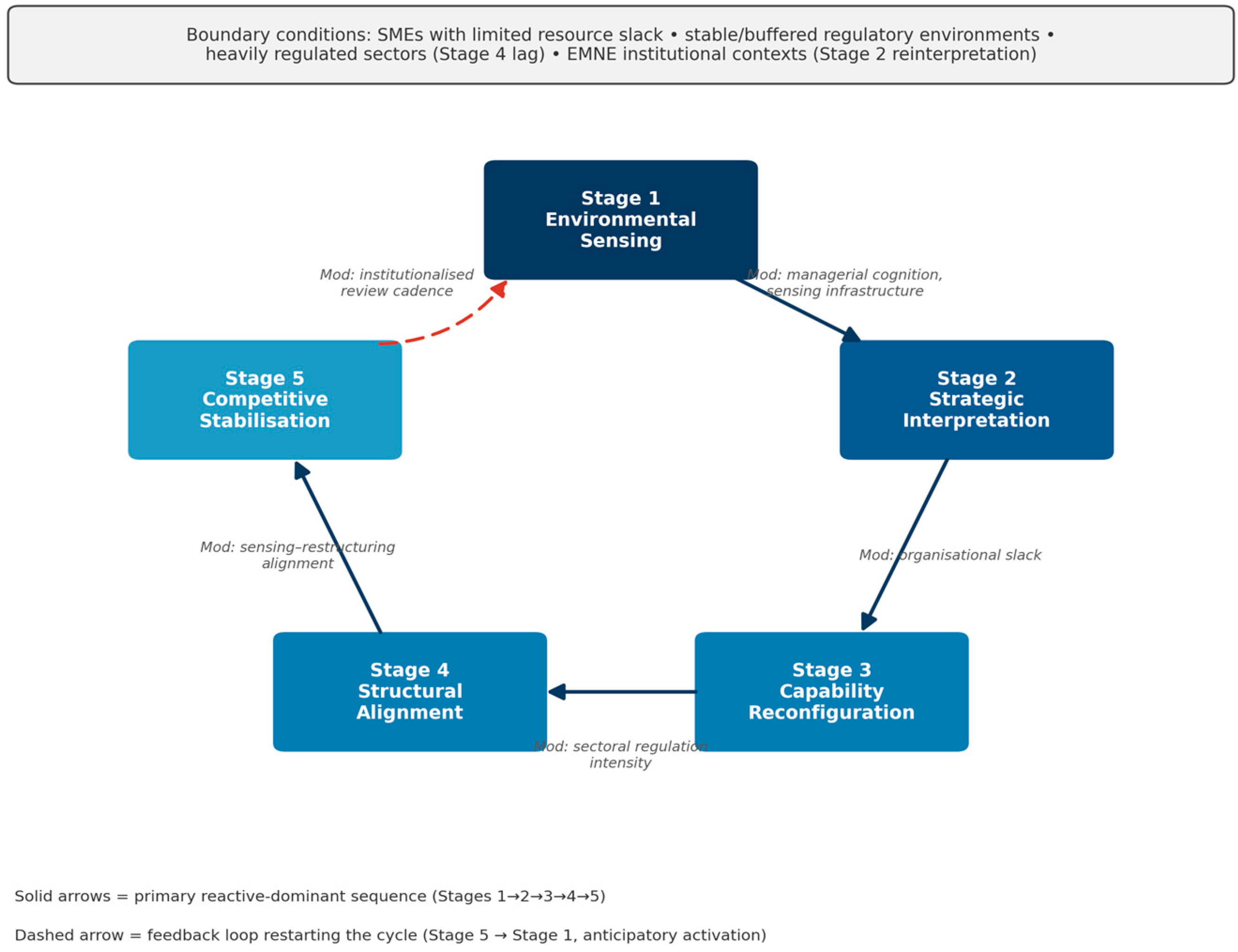
The ARC Framework explains not only that firms adapt, but through what mechanisms and in what sequence. Section 2.6 below states the three theory-building propositions and ties each proposition explicitly to the stage transition(s) it concerns, so that Figure 1 and the propositions read as a single integrated model rather than as separate elements.
Figure 1. The Adaptive Reconfiguration Cycle (ARC Framework): five-stage model showing the primary reactive-dominant sequence (solid arrows, Stages 1→2→3→4→5), the anticipatory feedback loop from Stage 5 back to Stage 1 (dashed arrow), the moderating condition associated with each stage transition, and the boundary conditions constraining the framework’s applicability (see Section 5.8).
Admsci 16 00431 g001
Individually, PESTEL analysis, dynamic capabilities theory, and contingency theory are well established, and a reasonable question is what the ARC Framework contributes beyond re-labelling their components. Three points clarify the intended contribution. First, none of the three traditions specifies which external trigger structure (PESTEL dimension) maps onto which internal reconfiguration mechanism (sensing, seizing, transforming) under which structural-fit outcome; the ARC Framework’s contribution is this explicit five-stage sequencing, together with the empirical demonstration—across three structurally distinct firms—that an identical external trigger can activate different stages depending on organisational architecture (see Section 5.1). Second, contingency theory’s static fit logic is here reframed as a recurring cycle in which Stage 5 feeds back into Stage 1; this is consistent with recent calls for a dynamic reading of fit (Abdullahi et al., 2024) and with evidence that dynamic capabilities can act on the environment as well as respond to it (Helfat, 2022), but has not, to the authors’ knowledge, been operationalised with paired PESTEL/dynamic-capability stage evidence in a comparative, multi-sector design. Third, the explicit boundary conditions and propositions (Section 2.6) are intended to render the framework falsifiable in subsequent quantitative work, rather than to serve only as a redescriptive label for existing constructs. Accordingly, the ARC Framework is presented as an integrative, theory-building device that organises and sequences existing mechanisms rather than as a claim to a new causal mechanism independent of its three parent traditions.

2.6. Theoretical Propositions, Mapped onto the Five ARC Stages

The three propositions below are theory-building propositions generated inductively from the comparative analysis of three cases. They are not presented as empirically established relationships: they summarise patterns observed within this sample, are stated with explicit moderating and boundary conditions, and are offered as a basis for future testing on larger, probability-based samples rather than as generalised claims. Each proposition is stated together with the specific ARC stage transition it concerns, so that Figure 1’s five stages and this section’s propositions form one integrated model rather than two separate elements.
Proposition 1 (theory-building)—concerns the Stage 1→3 relationship: The greater the intensity of macroenvironmental volatility across PESTEL dimensions, the greater the reliance on dynamic capability reconfiguration mechanisms at Stage 3. This relationship is moderated by organisational slack: firms with higher resource slack activate Stage 3 more rapidly and extensively than resource-constrained firms facing equivalent pressure. The proposition does not hold for firms in highly regulated and stable national markets, where regulatory buffering reduces effective volatility intensity (see Section 5.8, boundary condition 2).
Proposition 2 (theory-building)—concerns Stage 1–2 dominance versus Stage 3–5 dominance: Firms operating under high cross-border regulatory and geopolitical exposure develop anticipatory adaptation architectures (Stages 1–2 dominant) rather than reactive systems (Stages 3–5 dominant). This relationship is moderated by managerial cognition and sensing infrastructure: firms with institutionalised environmental scanning units (dedicated geopolitical risk functions, regulatory intelligence units) exhibit stronger Stage 1–2 dominance than firms relying on ad hoc executive judgment. The proposition is framed around cross-border regulatory and geopolitical exposure rather than revenue share alone (see Section 3.2); its generalisability to SMEs or domestically oriented firms requires separate empirical examination (see Section 5.8, boundary condition 1).
Proposition 3 (theory-building)—concerns the Stage 1↔Stage 4 alignment: Strategic adaptation effectiveness depends on the alignment between environmental sensing capability (Stage 1) and organisational restructuring capacity (Stage 4); misalignment is associated with adaptive lag. This relationship is moderated by sectoral regulation intensity: in heavily regulated sectors (financial services, healthcare, energy), restructuring capacity is often constrained by compliance timelines, which can generate structural lag even when sensing is advanced. The proposition may not hold for firms in sectors with low regulatory friction, where restructuring can proceed at the pace of sensing (see Section 5.8, boundary condition 3).

3. Methodology

3.1. Research Design and Philosophical Positioning

The study adopts a qualitative comparative multiple-case design, informed by abductive logic and a theory-building orientation (Yin, 2018; Gioia et al., 2013). Abductive reasoning is appropriate for this purpose because the study moves beyond documentation of strategic actions toward theoretical explanation of the mechanisms that generate them. The longitudinal scope (2019–2024) captures a strategically consequential period encompassing multiple distinct and overlapping environmental disruptions, enabling temporal pattern analysis that cross-sectional designs cannot provide.
A multiple-case comparative design is selected because it permits replication logic: findings that hold across three structurally distinct firms and sectors are more theoretically generalisable than findings from a single case. The design also allows identification of both cross-case shared mechanisms and firm-specific divergences, which is central to addressing RQ2. Consistent with the theory-building framing adopted throughout this study, “generalisable” here refers to analytic generalisation to theory (Yin, 2018), not to statistical generalisation to a wider population of firms.
PESTEL was selected over three alternative diagnostic tools for reasons specific to this study’s aim of linking macroenvironmental triggers to internal reconfiguration mechanisms. SWOT analysis was not used as the primary diagnostic instrument because it collapses external and internal factors into a single four-quadrant structure organised around firm-level valence (strength/weakness, opportunity/threat) rather than around the dimensional structure of the environment itself; it is well suited to summarising a firm’s position at a point in time but does not decompose external volatility into the political, economic, social, technological, environmental, and legal channels that this study needs to trace against each firm’s coded strategic responses. Porter’s Five Forces was not used because it is an industry-structure framework calibrated to competitive rivalry and bargaining power within a defined market; it explains why an industry is attractive but not how a firm senses and interprets cross-jurisdictional regulatory, geopolitical, or social volatility that originates outside the immediate competitive arena—the trigger structure this study’s Stage 1 is built to capture. Scenario planning was considered as a forward-looking alternative but was set aside for the historical, evidence-tracing design adopted here: scenario methods are constructed for anticipating multiple future states, whereas this study’s abductive, document-based design reconstructs how three firms actually processed volatility that had already occurred, which requires a categorical scanning framework applied retrospectively to a documentary corpus rather than a prospective scenario-generation method. PESTEL was therefore retained as the diagnostic instrument because its six-dimension structure maps directly onto the coding scheme described in Section 3.4 and the cross-firm comparison developed in Section 4, and because, consistent with its established use as a structured environmental-scanning device (Çitilci & Akbalık, 2020), it provides the categorical consistency the coding scheme in Section 3.4 requires; its acknowledged limitation—treating the six dimensions as separable when they interact (Section 2.2)—is addressed analytically in this study by triangulating each PESTEL-coded episode across multiple document types (see Section 3.3) and by discussing cross-dimensional interaction explicitly in Section 5, rather than by abandoning the categorical structure altogether.

3.2. Case Selection Rationale

Case selection followed a theoretical sampling logic designed to maximise analytic heterogeneity while maintaining shared exposure to the environmental conditions under study, consistent with the rationale previewed in Section 1. International revenue exposure was verified against each firm’s most recent 10-K/annual report disclosures rather than assumed uniformly across the three cases, since international revenue share varies substantially by firm, as detailed below.
Apple: FY2023 net sales outside the Americas segment (Europe, Greater China, Japan, Rest of Asia Pacific combined) represent approximately 57–58% of total net sales (Apple, Form 10-K, FY2023), supporting a majority-international-revenue characterisation.
McDonald’s: The large majority of restaurants and system-wide sales are generated outside the United States through franchised operations in over 100 countries (McDonald’s Annual Report, 2019–2023), also supporting a majority-international characterisation.
Amazon: Amazon’s revenue is, by contrast, majority North American: the International segment has represented approximately one-fifth to one-quarter of total net sales in the 2019–2023 period (Amazon, Form 10-K, FY2023), with North America and AWS together generating the majority of net sales. On a strict revenue-share reading, Amazon therefore does not meet a majority-international-revenue criterion.
Amazon is retained in the sample, but not on a majority-international-revenue basis. Its inclusion rests instead on multi-jurisdictional regulatory and geopolitical exposure—EU antitrust and data-protection proceedings, cross-border logistics, tax and competition regimes spanning dozens of jurisdictions—documented directly in Section 4 (Legal dimension) and Appendix A. The four selection criteria are as follows:
Sector heterogeneity: technology hardware and services (Apple); e-commerce and cloud infrastructure (Amazon); global food service (McDonald’s).
Global regulatory and operational exposure: all three firms face multi-jurisdictional regulatory, geopolitical, and social pressures simultaneously. Two of the three (Apple, McDonald’s) additionally generate a majority of revenue from outside their home market; Amazon’s cross-border exposure is concentrated in regulatory and operational terms rather than revenue share, as documented above.
Variation in adaptive architecture: vertical integration model (Apple); platform and diversification model (Amazon); franchise model (McDonald’s).
Documented strategic reconfiguration: all three firms exhibited substantive strategic repositioning during the 2019–2024 period, as evidenced in primary corporate documents and independent analyses, including Zhao’s (2024) account of Apple’s supply-chain diversification.
This combination allows the study to distinguish between firm-specific adaptive mechanisms and cross-sector patterns. Cases were confirmed against exclusion criteria: firms with materially lower global regulatory exposure than the three selected cases, firms that did not undergo documented strategic restructuring during the period, and firms operating in a single-country regulatory environment were excluded as primary cases.

3.3. Data Collection

A corpus of 78 documents was assembled across five source categories (see Table 2). Document selection followed purposive criteria: documents had to fall within the 2019–2024 temporal boundary, address strategic decisions related to at least one PESTEL dimension, and be accessible through public repositories, institutional databases (Factiva, LexisNexis, company investor relations portals), or peer-reviewed journals. Documents were logged with source type, date, firm, and PESTEL dimension tags in a structured data register.
Data availability: The complete 78-document register (source, date, firm, document type, and PESTEL dimension tag for every document, not only the illustrative subset in Appendix A) is provided as Supplementary Materials, Table S1, alongside this submission.
Table 2. Data Corpus: Source Categories and Analytical Purpose.
Source CategoryTypeN (Approx.)Analytical Purpose
Annual reportsPrimary corporate documents18Strategic actions, resource allocation, forward-looking statements
ESG/sustainability reportsCorporate disclosures12Sustainability adaptation, ESG commitment trajectories
Regulatory filings & proceedingsInstitutional sources10Compliance pressures, legal exposure, regulatory sanctions
Financial and business pressSecondary triangulation22Independent verification of corporate claims; alternative framings
Peer-reviewed academic studiesTheoretical triangulation16Interpretive support; theoretical grounding and cross-validation
Total 78
Corporate documents were treated as strategic artifacts rather than neutral accounts. Annual reports and sustainability communications are carefully constructed narratives with strong incentives for favourable self-presentation. Triangulation across independent press coverage and regulatory proceedings was used throughout to maintain analytical distance from official corporate framings and to distinguish genuine strategic reconfiguration from rhetorical positioning.

3.4. Analytical Process

Data analysis proceeded through five sequenced stages, following the Gioia et al. (2013) approach to qualitative rigour in theory-building research:
1
Open coding: Strategic responses and adaptive actions were identified inductively within each firm’s documentary record, without imposing prior theoretical categories. In total, 187 initial codes were generated across the three cases.
2
Axial coding: Initial codes were organised around PESTEL dimensions, establishing which environmental triggers corresponded to which adaptive responses within and across firms.
3
Thematic aggregation: Axial codes were synthesised into higher-order analytical constructs (e.g., ‘anticipatory architecture’, ‘compliance-as-moat’, ‘franchise flexibility’) representing the second- and aggregate-dimension levels of the data structure.
4
Cross-case comparison: Constructs were applied simultaneously across all three firms, identifying shared mechanisms and sector-specific divergences.
5
Pattern matching: Findings were tested against the ARC Framework’s five-stage logic, refining the framework iteratively where empirical evidence indicated adjustment.
The distinction between anticipatory and reactive reconfiguration—whether observed strategic responses preceded or followed the peak of environmental pressure—was applied systematically at each coding stage. This temporal distinction is central to distinguishing dynamic capability deployment from reactive accommodation.
Open coding, axial coding, thematic aggregation, cross-case comparison, and pattern matching were conducted by the lead author, who holds primary responsibility for the qualitative analysis reported here. A single-coder design was adopted given the scope of the study; accordingly, no second coder was used and no formal inter-coder reliability statistic was calculated. To support the transparency and traceability of coding decisions in the absence of a second coder, every first-order concept was linked directly to its supporting document(s), and the resulting audit trail—tracing each concept from document excerpt through first-order concept, second-order theme, and aggregate dimension to its ARC stage assignment—is provided in full as Supplementary Materials, Table S2. This supports the traceability of the coding decisions underlying the data structure presented in Section 3.5. The single-coder design and its implications for coding reliability are acknowledged as a limitation in Section 5.8.

3.5. Data Structure: First-Order Concepts, Second-Order Themes, and Aggregate Dimensions

Table 3 presents the data structure developed through this process, following the Gioia et al. (2013) three-level format. The structure maps first-order concepts (inductively derived from documents) through second-order themes (theoretically informed) to aggregate dimensions (framework-level constructs). Representative source excerpts anchoring each first-order concept are provided in Appendix A; the complete document-to-concept mapping for all 78 documents is provided in Supplementary Materials, Table S2, so that the connection between individual empirical observations and theoretical constructs can be traced document-by-document.
Table 3. Data Structure: From First-Order Concepts to Aggregate Dimensions.
First-Order Concepts (Inductive)Second-Order
Themes (Interpretive)
Aggregate Dimensions
(Theoretical)
Apple’s shift of iPhone assembly from China to India/Vietnam (2020–2023)Anticipatory geopolitical deriskingEnvironmental Sensing & Strategic Interpretation (ARC Stages 1–2)
Apple’s GDPR compliance repositioned as ‘privacy as a human right’ in marketingRegulatory pressure converted into brand differentiatorEnvironmental Sensing & Strategic Interpretation (ARC Stages 1–2)
Amazon’s EU antitrust fine (EUR 746 m, 2021) followed by marketplace policy restructureRegulatory sanction triggering structural reconfigurationCapability Reconfiguration & Structural Alignment (ARC Stages 3–4)
Amazon’s deployment of over 750,000 warehouse robots (2022–2024)Automation as competitive moat constructionCapability Reconfiguration & Structural Alignment (ARC Stages 3–4)
McDonald’s exit from Russian operations (March 2022, 847 restaurants)Franchise structure enabling rapid geopolitical disengagementStructural Alignment & Competitive Stabilisation (ARC Stages 4–5)
McDonald’s MyMcDonald’s Rewards digital loyalty programme (launched 2021, 50 M users by 2023)Digital infrastructure as retention and data assetStructural Alignment & Competitive Stabilisation (ARC Stages 4–5)
Shared: all three firms publish annual carbon neutrality targets with quantified milestonesESG as environmental legitimacy requirementConvergence as Baseline Reconfiguration
Shared: all three firms accelerated digital ordering/customer-facing AI integration post-2020Digitalisation as entry requirement, not differentiatorConvergence as Baseline Reconfiguration

4. Results: PESTEL Analysis and Adaptive Mechanisms

This section reports the comparative PESTEL findings in two forms. Table 4 and Table 5 summarise the evidence; the prose in Section 4.1, Section 4.2, Section 4.3 and Section 4.4 then walks through each firm’s evidence stage by stage against the ARC Framework, rather than reporting only each firm’s single dominant stage, so that the full reconfiguration cycle—not just its most visible phase—is described for every case.

4.1. Apple: Stage-by-Stage Evidence

Stage 1 (Environmental Sensing): Apple’s documentary record shows formal, recurring supply-chain risk assessment tied to geopolitical monitoring; the earliest India/Vietnam assembly partner agreements predate the 2022–2023 peak of US–China tariff escalation, indicating an active sensing function rather than a reactive one [Apple 10-K, 2020–2023; (Zhao, 2024)]. Stage 2 (Strategic Interpretation): the same GDPR and App Tracking Transparency requirements that other firms treated purely as compliance costs were reframed internally as a brand asset—“privacy as a human right”—evidencing a distinct interpretive filter applied to an identical external signal [Apple Privacy White Paper, 2021]. Stage 3 (Capability Reconfiguration): the Apple Silicon (M-series) transition (2020–2022) internalised a previously outsourced technological capability, redeploying resources from external processor sourcing to in-house chip design [Apple 10-K, 2020–2023]. Stage 4 (Structural Alignment): manufacturing capacity was structurally reallocated away from single-country concentration, reducing China-based manufacturing from roughly 95% to roughly 80% of iPhone production over the period—a shift documented in independent industry analysis as well as in Apple’s own disclosures [Financial Times, 2023; (Zhao, 2024)]. Stage 5 (Competitive Stabilisation): Services revenue grew from 18% to 26% of total revenue over 2019–2023, evidencing a more diversified and less cyclically exposed revenue base that stabilises the firm against future hardware-cycle shocks, before Stage 1 sensing resumes with the Vision Pro platform anticipating the next technology cycle [Apple 10-K, 2019, 2023]. Apple’s profile is Stage 1–2 dominant: the evidentiary weight of the corpus sits earliest in the cycle, consistent with Proposition 2’s anticipatory-architecture pattern.

4.2. Amazon: Stage-by-Stage Evidence

Stage 1–2: Amazon’s environmental sensing around EU regulatory exposure is documented, but the interpretive response is comparatively reactive rather than anticipatory: marketplace policy change follows, rather than precedes, formal regulatory sanction [Luxembourg CNPD Decision, 2021]. Stage 3 (Capability Reconfiguration): following the EUR 746 m GDPR fine (2021) and the EUR 1.1 bn antitrust investigation (2023), Amazon restructured its marketplace policies and expanded legal and compliance infrastructure at scale [The Economist, 2023]; in parallel, warehouse automation deployment exceeded 750,000 robots by 2022–2024, redeploying capital toward operational capability [Amazon 10-K, 2022–2024]. Stage 4 (Structural Alignment): the compliance and automation investments produced durable structural barriers—cross-jurisdictional legal capacity and logistics infrastructure—that are difficult for lower-capacity competitors to replicate, converting a regulatory cost into an operating moat. Stage 5 (Competitive Stabilisation): AWS revenue growth from $35 bn (2019) to $91 bn (2023) provided a macroeconomic buffer that stabilised the firm’s overall revenue base against retail-segment volatility, while the advertising segment’s expansion added a third revenue pillar [Amazon 10-K, 2019–2023]. Amazon’s profile is Stage 3–4 dominant: its adaptive signature is reconfiguration at scale following, rather than pre-empting, external pressure—the reactive pattern that Proposition 2 distinguishes from Apple’s anticipatory one, and the resource-intensive pattern that Proposition 1 associates with high organisational slack.

4.3. McDonald’s: Stage-by-Stage Evidence

Stage 1–2: McDonald’s sensing and interpretive function is embedded largely at the corporate level, with adaptive execution delegated structurally to franchisees; the interpretive response to social and regulatory signals shows up as menu and format localisation across 50+ markets rather than centralised strategic repositioning [McDonald’s Scale for Good ESG Report, 2020–2023]. Stage 3 (Capability Reconfiguration): the MyMcDonald’s Rewards digital loyalty programme, launched in 2021 and reaching 50 million users by 2023, represents a centrally deployed technological capability layered onto the franchise network [McDonald’s Annual Report, 2021–2023]. Stage 4 (Structural Alignment): the clearest evidence in the entire corpus for rapid structural realignment is McDonald’s Russia exit—847 restaurants transferred to a local operator within weeks of the February 2022 invasion—a speed of disengagement that appears structurally enabled by the franchise architecture itself rather than achieved through ad hoc crisis management [Reuters, 2022]. Stage 5 (Competitive Stabilisation): the combination of franchise-model capital-risk transfer (franchisees bear roughly 95% of restaurant operating costs) and the loyalty platform’s data and retention value stabilised the brand’s competitive position through the disruption period [McDonald’s Annual Report, 2019–2023]. McDonald’s profile is Stage 4–5 dominant: its adaptive signature is structural-architecture-enabled speed of realignment and stabilisation, rather than early sensing (Apple) or resource-intensive reconfiguration (Amazon).

4.4. Convergence as Baseline Reconfiguration

Across all three firms, digitalisation, ESG commitment, and regulatory compliance appear at every stage of the cycle rather than distinguishing one firm’s profile from another’s: all three publish quantified carbon-neutrality targets, and all three accelerated digital, customer-facing, or AI-enabled infrastructure after 2020. This shared pattern is treated in Section 5.5 as evidence of environmental legitimacy requirements rather than of competitive strategy, since it does not vary systematically with the dominant ARC stage identified for each firm.

5. Discussion

5.1. Answering the Research Questions

RQ1—How do firms translate macroenvironmental volatility into strategic reconfiguration processes? The evidence across all three cases supports a common answer at the mechanism level, even though its timing and starting point differ by firm: volatility is translated into reconfiguration through the five-stage ARC sequence described in Section 4, moving from sensing through interpretation, capability reconfiguration, and structural alignment, to a provisional stabilisation that restarts sensing. What differs across firms is not whether this sequence occurs but where in the cycle each firm’s adaptive signature concentrates—a finding developed fully under RQ2 below.
RQ2—How do adaptive mechanisms differ across business models and sectors under shared environmental pressures? The three cases occupy three distinct positions on the same five-stage cycle: Apple is Stage 1–2 dominant (anticipatory sensing and interpretation, enabled by balance-sheet strength and vertical integration); Amazon is Stage 3–4 dominant (reactive but resource-intensive reconfiguration and structural realignment, enabled by scale); McDonald’s is Stage 4–5 dominant (rapid structural realignment and stabilisation, enabled by the franchise architecture’s built-in flexibility). This divergence is not inconsistency in the framework; it is the framework’s central finding, evidenced in Table 5 and Section 4.1, Section 4.2 and Section 4.3: identical categories of PESTEL pressure (regulatory, geopolitical) are processed through structurally different organisational architectures into structurally different points of maximum adaptive activity.
RQ3—What dynamic capabilities enable firms to convert environmental constraints into competitive advantages? Sensing capability, evidenced by Apple’s pre-emptive supply-chain diversification, converts anticipated constraint into first-mover repositioning. Seizing and reconfiguration capability at scale, evidenced by Amazon’s compliance-infrastructure and automation investment following regulatory sanction, converts a cost burden into a structural barrier that competitors with lower reconfiguration capacity cannot easily match. Transforming capability embedded in organisational architecture itself, evidenced by McDonald’s rapid Russia exit, converts geopolitical constraint into demonstrated reputational and operational resilience. Section 5.6 below qualifies this reading against two alternative explanations that do not depend on dynamic capability sophistication.

5.2. Environmental Volatility and Reconfiguration Mechanisms (Proposition 1)

The findings offer support for Proposition 1 across all three cases. During 2020–2022, when political, economic, and social disruptions reached peak simultaneity, each firm exhibited its most significant structural repositioning: Apple accelerated manufacturing geographic diversification; Amazon deepened logistics automation at scale; McDonald’s executed the Russia exit and activated digital loyalty infrastructure simultaneously. This pattern is consistent with broader evidence that firms facing crisis-level disruption select among a limited set of strategic responses—retrenchment, persevering, innovating, or exit—rather than improvising without pattern, and that the response chosen tracks the resources available to the firm (Wenzel et al., 2020); it is also consistent with contemporaneous debate over whether such shocks would durably reconfigure global value chains, in which the more supported reading was selective reconfiguration (supply diversification, relational governance) rather than wholesale restructuring (Verbeke, 2020)—a reading that matches the selective, firm-specific reconfiguration observed here rather than a uniform response across the three cases.
The chronological sequencing summarised here—assembly diversification following 2020, the Russia exit dated to March 2022, the EUR 746 m fine preceding Amazon’s marketplace policy changes—is drawn directly from the primary and press record in Appendix A/Supplementary Table S1. The characterisation of these sequences as reflecting a particular ARC stage, and the attribution of divergent responses to “strategic interpretation” rather than incidental variation, is the authors’ interpretation of that record, offered as the most parsimonious reading rather than as an independently verified causal claim.
The data structure in Table 3 shows that the same external PESTEL pressures are followed by structurally different reconfiguration responses depending on the firm’s adaptive architecture. The EU antitrust environment, for example, is followed by compliance restructuring in Amazon (Stage 3 activation: marketplace policy reform) and by brand-level differentiation in Apple (Stage 2 activation: privacy positioning). This divergence is not inconsistency; it is consistent with the Stage 2 mechanism—strategic interpretation—filtering identical environmental signals through different organisational logics, a pattern associated with divergent capability activations rather than a demonstrated causal relationship.
The moderating role of organisational slack is evident in the comparison between Apple and McDonald’s. Apple’s balance sheet strength (>$150 bn cash and equivalents, 2019–2022) is associated with proactive manufacturing reconfiguration that required multi-year capital commitments before the strategic payoff was certain. McDonald’s, operating on thinner direct capital exposure through the franchise model, achieved comparable geopolitical flexibility through structural design rather than capital deployment.

5.3. Anticipatory vs. Reactive Adaptation Architectures (Proposition 2)

Proposition 2 is most clearly supported by the Apple case. Apple’s supply chain geographic diversification was initiated in 2020–2021, before US–China trade tensions reached their 2022–2023 peak (Zhao, 2024). The ATT privacy framework was developed and deployed in 2021, before the regulatory pressure it addressed had been formulated into mandatory requirements in most jurisdictions. This chronological evidence, grounded in the primary document record, is consistent with the proposition that firms with institutionalised environmental sensing (Stage 1 dominance) begin reconfiguration before competitors face the same imperative as mandatory; the sensing-infrastructure mechanism itself is inferred from public disclosures rather than from direct observation of internal processes, and should be read accordingly.
Amazon’s adaptive pattern differs in important ways. Amazon’s reconfiguration of marketplace policies followed the EUR 746 m fine (2021) rather than preceding it—a reactive rather than anticipatory Stage 3 activation. However, the scale and depth of that reconfiguration subsequently constructed structural barriers (compliance infrastructure, legal capacity, cross-jurisdictional operational protocols) that competitors with lower organisational depth cannot easily match. Amazon’s competitive advantage in this reading derives less from sensing priority and more from reconfiguration capacity at scale—an interpretation consistent with, but not proof of, the underlying mechanism.
McDonald’s Russia exit—completed within weeks of the February 2022 invasion, with 847 restaurants transferred to local operators—illustrates Stage 4–5 dominance: structural alignment and competitive stabilisation executed rapidly through pre-existing franchise architecture. The speed of this disengagement appears structurally enabled by the franchise model rather than strategically improvised, though the study’s document-based design cannot fully rule out unobserved improvisation.

5.4. Sensing–Restructuring Alignment and Adaptive Lag (Proposition 3)

Proposition 3 concerns the Stage 1↔Stage 4 relationship: whether a firm’s environmental sensing capability and its organisational restructuring capacity move together, and what happens when they do not. The three cases give this proposition direct, if uneven, support.
Apple shows the closest alignment between sensing and restructuring in the sample. The same 2020–2021 window in which supply-chain risk was being sensed is also the window in which assembly partner agreements in India and Vietnam were being signed, so that the roughly 95% to 80% shift in China-based manufacturing share tracks the sensing timeline rather than lagging behind it by several years (Zhao, 2024). Under Proposition 3, this tight coupling is consistent with the absence of a heavily regulated, compliance-timeline-bound restructuring process in Apple’s core hardware business, which allowed capital reallocation to proceed at close to the pace of sensing.
Amazon illustrates the misalignment side of Proposition 3, though the lag is regulatory rather than sectoral in the strict sense used in Section 5.8. Environmental sensing around EU data-protection and antitrust exposure long preceded the EUR 746 m GDPR fine (2021), yet marketplace policy restructuring (Stage 4) only followed the sanction rather than anticipating it. Because Amazon’s core retail and logistics operations sit outside the heavily regulated sectors named in Section 5.8 (financial services, healthcare, energy), the lag is better read as an instance of the general Stage 1↔Stage 4 misalignment that Proposition 3 predicts under conditions of high compliance uncertainty, rather than as evidence for the sector-specific boundary condition itself; the compliance and automation investment that followed did, eventually, close the gap and convert the initial lag into a durable structural barrier (Section 4.2), consistent with alignment being restored at Stage 4 even when Stage 1→Stage 3 activation was delayed.
McDonald’s presents the case in which alignment is achieved through structural design rather than through sensing speed. The franchise architecture keeps restructuring capacity largely decoupled from centralised sensing: local franchisees can act on local signals directly, and the corporate centre can act on centrally sensed signals (such as the Russia exit) without the compliance-timeline drag that constrains more heavily regulated organisations. This is consistent with the boundary condition in Section 5.8 concerning heavily regulated sectors: McDonald’s own restructuring pace is not slowed by sector-level compliance timelines, so its Stage 1↔Stage 4 alignment stays close even though its sensing function is less centralised than Apple’s. Read together, the three cases support Proposition 3’s core claim—that adaptive lag tracks misalignment between sensing and restructuring capacity—while also showing that the source of alignment (organisational slack for Apple, structural decentralisation for McDonald’s) differs across adaptive architectures, and that the misalignment observed for Amazon is closer to a compliance-driven lag than to the sector-level lag the boundary condition in Section 5.8 was framed around; this refinement is discussed further under boundary condition 3 in Section 5.8.

5.5. Convergence as Environmental Baseline, Divergence as Competitive Logic

The convergence of all three firms around digitalisation, ESG commitments, and regulatory compliance (Table 5) carries a precise theoretical implication: these orientations have largely ceased to function as competitive differentiators in this sample. They instead resemble environmental legitimacy requirements—conditions for continued operation at this scale—rather than sources of advantage. This reading aligns with recent work characterising ESG as a regulatory baseline rather than a strategic choice (Fainshmidt et al., 2022), and is consistent with a broader shift documented in the investor-relations literature, in which large investors moved from treating ESG disclosure as optional reputational signalling to treating it as a baseline expectation of ownership itself (Eccles & Klimenko, 2019). Read against that shift, the ESG convergence observed across Apple, Amazon, and McDonald’s looks less like three firms independently choosing sustainability as a strategy and more like three firms responding to the same external legitimacy floor that Eccles and Klimenko describe from the investor side.
Competitive distinction operates at the level of execution mechanisms. Apple’s privacy-as-differentiator strategy, Amazon’s compliance-as-moat logic, and McDonald’s brand-coherent local adaptation represent three structurally distinct expressions of the same environmental response—shaped, in the authors’ interpretation, by each firm’s specific adaptive architecture, capability profile, and sector logic.

5.6. Alternative Explanations and Interpretive Caution

Before attributing the adaptive success observed across these three cases primarily to dynamic capability deployment, two alternative explanations merit serious consideration.
The first is resource abundance. Apple, Amazon, and McDonald’s are among the best-capitalised organisations in the global economy. A plausible reading of the evidence is that their adaptive agility reflects the sheer scale of resources available for parallel investment rather than the sophistication of their sensing and reconfiguration mechanisms. On this interpretation, what appears as strategic foresight may be better characterised as resource-enabled optionality: the capacity to pursue multiple strategic paths simultaneously until one proves viable, a luxury unavailable to less capitalised competitors. Evidence from smaller-firm settings is instructive here: tourism organisations facing disaster-scale disruption showed markedly uneven capability development, with enabling and limiting conditions tied closely to organisational scale and resource access rather than to managerial insight alone (Jiang et al., 2023), which is consistent with a resource-based reading of the present findings.
The second alternative concerns market power and institutional dominance. All three firms occupy structurally entrenched positions in their respective sectors. Their ability to convert regulatory pressure into competitive moats—rather than absorbing it as a cost burden—may reflect the negotiating leverage and institutional relationships that accompany dominant market positions rather than any inherent adaptive capability advantage. Firms without comparable structural leverage face the same regulatory environments but without equivalent conversion capacity.
These alternative framings are integrated into the analytical reading above (Section 5.2, Section 5.3 and Section 5.4) rather than treated only as a closing caveat: wherever a reconfiguration episode is attributed to dynamic capability deployment, the possibility that resource abundance or market power alone could account for the same episode is noted in-line. These alternative framings do not invalidate the dynamic capability interpretation advanced here, but they counsel interpretive restraint. The ARC Framework is likely to capture part of the adaptive story; resource abundance and structural power likely explain another part. Disentangling these mechanisms empirically remains a priority for future research incorporating variation in firm size, market position, and resource endowment—for example, extending the ARC Framework to a matched sample of smaller or less dominant firms facing comparable PESTEL pressure.

5.7. Theoretical Contribution of the ARC Framework

The ARC Framework’s primary contribution is its integration across three previously siloed traditions, as set out in Section 2.5. PESTEL analysis provides the trigger structure (Stages 1–2); dynamic capabilities theory specifies the reconfiguration mechanisms (Stage 3); contingency theory provides the fit logic governing structural alignment (Stage 4) and stabilisation (Stage 5). Few existing frameworks combine all three with this degree of specificity or with explicit boundary conditions.
The framework also extends the longstanding debate between inside-out and outside-in perspectives on competitive advantage. Neither tradition alone is sufficient to explain the adaptive patterns observed across these three cases. What the evidence suggests is an iterative dynamic between external sensing and internal reconfiguration—a bidirectional relationship that the ARC cycle formalises and that neither PESTEL analysis nor dynamic capabilities theory alone captures as directly. This finding extends Warner and Wäger’s (2019) account of dynamic capability building as an ongoing renewal process by specifying the external trigger structure that initiates each renewal cycle, is consistent with Almeida’s (2026) recent evidence that reconfiguration capabilities moderate, rather than substitute for, firms’ exposure to environmental forces, and resonates with Helfat’s (2022) argument that dynamic capabilities can act on the external environment as well as respond to it—a possibility visible, for instance, in the way Apple’s privacy positioning appears to have shaped subsequent industry-wide expectations around data practices rather than merely conforming to them. It is also consistent with Witschel et al.’s (2022) finding that environmental turbulence functions as an antecedent condition for capability activation: in the present sample, the intensity of PESTEL pressure during 2020–2022 precedes, rather than merely accompanies, each firm’s most significant Stage 3 activity.

5.8. Boundary Conditions, Limitations, and Future Research

Theoretical frameworks require explicit specification of the conditions under which they do not hold or hold differently. Four boundary conditions constrain the ARC Framework’s applicability, summarised in Table 6. These boundary conditions are read here as evidence that the framework should be positioned as analytically transferable and theory-generating rather than broadly generalisable (Section 6).
Table 6. ARC Framework: Boundary Conditions.
Boundary ConditionMechanism AffectedImplication for Framework
Small and medium enterprises (SMEs) with limited resource slackStages 1–2 (sensing infrastructure) and Stage 3 (reconfiguration scale)SMEs lack the capital and institutional capacity to sustain dedicated environmental sensing units. Stage 1 operates through informal managerial cognition rather than structured intelligence functions. ARC cycle speed is constrained by restructuring capacity, not sensing.
Firms in stable or highly buffered national regulatory environmentsStage 1 (perceived volatility intensity)Regulatory buffering reduces effective PESTEL volatility, dampening Stage 1 activation. Proposition 1’s volatility–reconfiguration relationship may not hold in contexts of persistent regulatory stability (e.g., certain Gulf Cooperation Council markets, domestic monopolies).
Firms in heavily regulated sectors (healthcare, financial services, defence)Stage 4 (restructuring pace)Mandatory compliance timelines impose structural lag between Stages 3 and 4 regardless of sensing capability advancement. Proposition 3’s alignment logic is systematically disrupted by external pace-setters beyond managerial control; the Amazon case in Section 5.4 shows a related but distinct compliance-driven lag outside this sector-defined boundary.
Emerging economy multinationals (EMNEs) with non-Western institutional contextsStage 2 (strategic interpretation logic)Institutional environments shape how environmental signals are interpreted and prioritised. Political signals that generate defensive reconfiguration in Western multinationals may generate opportunity-sensing responses in EMNEs with closer state relationships. The framework requires contextual adaptation for non-OECD institutional environments.
Several further limitations warrant explicit acknowledgement. The qualitative comparative design yields theoretical depth but cannot establish causal relationships between specific PESTEL dimensions and financial outcomes; language throughout Section 4 and Section 5 avoids causal verbs (“produce”, “generate”, “enable”) where the underlying design supports only association or sequencing. Future research combining econometric methods with case-based evidence—longitudinal panel designs, regression discontinuity approaches applied to regulatory change events—would enable more precise causal attribution.
The 2019–2024 temporal window is insufficient for assessing whether adaptive strategies produce durable competitive advantage across a full competitive cycle. Longitudinal extensions tracking these firms through 2028–2030 would allow assessment of whether ARC cycle execution patterns persist, evolve, or degrade over time.
Survivorship bias is the most fundamental limitation. This study analyses three organisations that emerged from disruption in strengthened competitive positions. Firms that pursued comparable strategies and failed remain outside the analytical frame. Understanding when the ARC Framework produces maladaptive outcomes requires designs incorporating strategic failures alongside successes.
Coding was conducted by a single coder (the lead author; Section 3.4), without a second coder or a formal inter-coder reliability statistic. While the full audit trail (Supplementary Table S2) allows every coding decision to be traced back to its supporting document, single-coder qualitative analysis is inherently more exposed to individual interpretive bias than double-coded designs. Future replications of this analysis, or extensions of the ARC Framework to new cases, would benefit from independent double coding and a reported reliability statistic.
The document corpus, while triangulated and now fully available as Supplementary Materials, relies on publicly accessible sources and does not include primary interview data. Future research incorporating executive interviews or internal strategy documents would strengthen the process tracing evidence and reduce dependence on interpretive inference from public documents.
Finally, PESTEL’s categorical structure imposes analytical tidiness that obscures nonlinear cross-dimensional interdependencies (Section 2.2 and Section 3.1). Systems dynamics modelling and AI-enabled scenario planning are better equipped to represent these interactions. Future applications of the ARC Framework should consider coupling its sequential stage logic with computational methods capable of modelling feedback loops between PESTEL dimensions, and with the kind of cross-sector, resilience-factor frameworks proposed for business models more generally (Radic et al., 2022), which could help operationalise organisational slack as a measurable moderator of Proposition 1.

5.9. Managerial Implications

The findings carry four direct implications for strategic practice, read as practical suggestions consistent with the patterns observed in this sample rather than as causally established prescriptions:
Environmental sensing should be institutionalised as a permanent strategic function with dedicated resources and accountability. Relying on it only reactively appears, in this sample, to forgo the anticipatory adaptation advantage demonstrated by Apple. This means establishing formal geopolitical risk, regulatory intelligence, and technology horizon-scanning units—rather than relying solely on ad hoc executive judgment.
Compliance capabilities should be resourced as strategic assets rather than regulatory cost centres. Amazon’s conversion of antitrust and data compliance exposure into operational barriers illustrates that legal complexity, managed at sufficient scale and depth, can be associated with structural competitive moats. Compliance investment should be evaluated on its strategic return, not merely its cost.
Adaptive capacity should be embedded as a permanent organisational competency with dedicated resources, accountability structures, and performance metrics. Firms that treat adaptation as a crisis-response protocol rather than a standing capability appear, in this sample, more likely to experience adaptive lag, consistent with the retrenchment-versus-persevering distinction documented in the broader crisis-response literature (Wenzel et al., 2020).
Strategic flexibility appears, in these cases, to matter alongside operational efficiency rather than being subordinate to it. Firms that have achieved high efficiency in fixed configurations may face greater structural risk in turbulent environments than firms that have traded some efficiency for reconfiguration capacity. The franchise model’s structural flexibility advantage in McDonald’s case offers one transferable design principle, bounded by the sector-specific conditions noted in Table 6.

6. Conclusions

This study demonstrates that strategic adaptation under sustained macroenvironmental volatility is, in this sample, a deliberate, continuous process of capability reconfiguration that must maintain pace with conditions that are themselves continuously shifting. Apple, Amazon, and McDonald’s—across three structurally distinct competitive contexts, and selected for that heterogeneity rather than for scale alone (Section 1 and Section 3.2)—each illustrate what this looks like in practice: firms that have institutionalised the capacity to read external pressure and convert it into competitive repositioning, at different points on the same five-stage cycle (Section 5.1).
The Adaptive Reconfiguration Cycle (ARC Framework) offers an integrative theoretical account of these patterns, understood as a theory-building contribution rather than an empirically established one (Section 2.6). By connecting PESTEL trigger structures with dynamic capabilities reconfiguration logic and contingency theory’s fit principle, the framework extends the conversation between traditions that have largely developed in parallel. The three theory-building propositions advanced here, mapped explicitly onto the five ARC stages, with their moderating conditions and boundary specifications, provide a foundation for future empirical testing across larger samples and additional sectoral contexts.
The convergence of all three firms around digitalisation, ESG, and regulatory compliance should be read not as evidence of shared strategic vision but as evidence of environmental baseline reconfiguration: these orientations appear, in this sample, to function as entry requirements for institutional legitimacy at this scale of operation, consistent with the broader shift in investor expectations documented by Eccles and Klimenko (2019). Competitive differentiation operates at the level of execution mechanisms—how each firm operationalises common orientations given its specific sector logic, adaptive architecture, and organisational identity.
Consistent with the boundary conditions in Table 6, the ARC Framework is best understood as analytically transferable and theory-generating rather than broadly generalisable; its applicability to SMEs, stable-regulatory contexts, heavily regulated sectors, and EMNE institutional settings requires dedicated empirical testing rather than assumed extension. The broader implication is a reframing of what corporate viability may require under permanent turbulence. Scale provides resources but not, on its own, protection. What appears to sustain competitive relevance in this sample is the institutionalised capacity to sense, interpret, reconfigure, align, and stabilise—continuously and, ideally, faster than environmental pressure accumulates. Organisations that have built this capacity as a permanent architectural feature are, in these three cases, those best positioned to convert disruption into competitive opportunity.

Supplementary Materials

The following supporting information can be downloaded at: https://www.mdpi.com/article/10.3390/admsci16090431/s1, Table S1: Complete document corpus register (78 documents): source, date, firm, document type, and PESTEL dimension; Table S2: Coding audit trail: document excerpt → first-order concept → second-order theme → aggregate dimension → ARC stage.

Funding

This research received no external funding.

Institutional Review Board Statement

Not applicable.

Informed Consent Statement

Not applicable.

Data Availability Statement

The document corpus analysed in this study consists of publicly available annual reports, ESG/sustainability disclosures, regulatory filings, and press sources, cited throughout the manuscript and catalogued in Appendix A. The full structured corpus register is available from the corresponding author upon reasonable request.

Conflicts of Interest

The author declares no conflicts of interest.

Appendix A. Document Corpus: Inventory and Classification

Table A1 presents a representative sample of the primary and secondary documents included in the analytical corpus, classified by source type, firm, year, and PESTEL dimension addressed. The complete 78-document corpus, including source, date, firm, document type, and PESTEL-dimension tag for every document, is provided as Supplementary Materials, Table S1, and the complete coding-to-document audit trail is provided as Supplementary Materials, Table S2 (see Section 3.4 and Section 3.5).
Table A1. Representative Document Inventory (Selected from 78-document corpus).
SourceFirm/TypeYearPESTEL Dimension & Key Evidence
Apple Annual Report (Form 10-K)Apple/Primary2020–2023Political/Economic: Explicit disclosure of supply chain geographic diversification strategy; India and Vietnam manufacturing ramp-up cited.
Apple Privacy White Paper (‘A Day in the Life of Your Data’)Apple/Primary2021Legal/Social: ATT framework rationale; ‘privacy as a human right’ positioning formalised as brand strategy.
Amazon Annual Report (Form 10-K)Amazon/Primary2019–2023Economic/Technological: AWS revenue trajectory; robotics deployment figures; logistics infrastructure capital expenditure.
Amazon The Climate Pledge Commitment DocumentAmazon/Primary2019–2022Environmental: Net-zero 2040 targets; electric vehicle fleet commitments; Shipment Zero programme milestones.
Luxembourg Data Protection Authority (CNPD) Decision—AmazonAmazon/Regulatory2021Legal: EUR 746 m GDPR fine; grounds for sanction; Amazon’s subsequent marketplace policy restructuring.
McDonald’s Annual ReportMcDonald’s/Primary2019–2023Political/Economic: Russia exit financial impact; franchise model resilience metrics; digital loyalty user growth.
McDonald’s Scale for Good ESG ReportMcDonald’s/Primary2020–2023Environmental/Social: Packaging transition targets; menu localisation data; supplier sustainability standards.
Financial Times: ‘Apple’s Great Decoupling’Apple/Press2023Political: Independent verification of manufacturing shift timeline and scale; analyst commentary on supply chain reconfiguration costs.
The Economist: ‘Amazon’s Antitrust Tightrope’Amazon/Press2023Legal: DMA compliance burden; institutional engagement strategy; structural adjustment to EU marketplace rules.
Reuters: ‘McDonald’s Russia Exit: Speed and Scale’McDonald’s/Press2022Political: Operational timeline of 847-restaurant transfer; franchise model’s role in enabling rapid disengagement.
Zhao, W.: ‘Strategic innovations in Apple’s supply chain management’Apple/Academic2024Political/Technological: Independent scholarly account of Apple’s post-2019 supply-chain repositioning, corroborating the primary-document timeline.

References

  1. Abdullahi, U., Mohamed, A. M., & Senasi, V. (2024). Digital orientation and organizational resilience: The contingent effect of dynamic capabilities. Sustainable and Resilient Infrastructure, 10(4), 295–312. [Google Scholar] [CrossRef] [Scilit]
  2. Almeida, F. (2026). From vulnerability to resilience: Dynamic capabilities as a moderating mechanism under environmental turbulence in developing economies. Business Strategy and the Environment. [Google Scholar] [CrossRef] [Scilit]
  3. Amhalhal, A., Anchor, J., Tipi, N., & Elgazzar, S. H. (2022). The impact of contingency fit on organisational performance: An empirical study. International Journal of Productivity and Performance Management, 71(6), 2214–2234. [Google Scholar] [CrossRef] [Scilit]
  4. Çitilci, T., & Akbalık, M. (2020). The importance of PESTEL analysis for environmental scanning process. In H. Dinçer, & S. Yüksel (Eds.), Handbook of research on decision-making techniques in financial marketing (pp. 336–357). IGI Global. [Google Scholar] [CrossRef] [Scilit]
  5. Eccles, R. G., & Klimenko, S. (2019). The investor revolution. Harvard Business Review, 97(3), 106–116. [Google Scholar]
  6. Fainshmidt, S., Wenger, L., Pezeshkan, A., & Mallol, M. (2022). When do dynamic capabilities lead to competitive advantage? The importance of strategic fit. Journal of Management Studies, 59(4), 986–1018. [Google Scholar]
  7. Gioia, D. A., Corley, K. G., & Hamilton, A. L. (2013). Seeking qualitative rigor in inductive research: Notes on the Gioia methodology. Organizational Research Methods, 16(1), 15–31. [Google Scholar]
  8. Helfat, C. E. (2022). Strategic organization, dynamic capabilities, and the external environment. Strategic Organization, 20(4), 733–747. [Google Scholar] [CrossRef] [Scilit]
  9. Jiang, Y., Ritchie, B. W., & Verreynne, M. L. (2023). Building dynamic capabilities in tourism organisations for disaster management: Enablers and barriers. Journal of Sustainable Tourism, 31(4), 971–996. [Google Scholar] [CrossRef] [Scilit]
  10. Karadzhov, V., & Patarchanova, E. (2025). How to create the best PESTEL analysis. International Journal of Digital Research, 1(3), 8–20. [Google Scholar] [CrossRef] [Scilit]
  11. Klimczak, K. M., & Shachmurove, Y. (2025). Managing strategic change in times of global volatility: An introduction. In K. M. Klimczak, & Y. Shachmurove (Eds.), Strategic response to turbulence (pp. 1–12). Edward Elgar Publishing. [Google Scholar] [CrossRef] [Scilit]
  12. Radic, M., Herrmann, P., Haberland, P., & Riese, C. R. (2022). Development of a business model resilience framework for managers and strategic decision-makers. Schmalenbach Journal of Business Research, 74(4), 575–601. [Google Scholar] [CrossRef] [Scilit] [PubMed]
  13. Verbeke, A. (2020). Will the COVID-19 pandemic really change the governance of global value chains? British Journal of Management, 31(3), 444–446. [Google Scholar] [CrossRef] [Scilit]
  14. Warner, K. S. R., & Wäger, M. (2019). Building dynamic capabilities for digital transformation: An ongoing process of strategic renewal. Long Range Planning, 52(3), 326–349. [Google Scholar] [CrossRef] [Scilit]
  15. Wenzel, M., Stanske, S., & Lieberman, M. B. (2020). Strategic responses to crisis. Strategic Management Journal, 41, V7–V18. [Google Scholar] [CrossRef] [Scilit]
  16. Witschel, D., Baumann, D., & Voigt, K.-I. (2022). How manufacturing firms navigate through stormy waters of digitalization: The role of dynamic capabilities, organizational factors and environmental turbulence for business model innovation. Journal of Management & Organization, 28(3), 681–714. [Google Scholar] [CrossRef] [Scilit]
  17. Yin, R. K. (2018). Case study research and applications: Design and methods (6th ed.). Sage Publications. [Google Scholar]
  18. Zhao, W. (2024). Strategic innovations in Apple’s supply chain management. Advances in Economics, Management and Political Sciences, 113, 9–16. [Google Scholar] [CrossRef] [Scilit]
Table 1. Literature Review: Contributions, Limitations, and Positioning of This Study.
StudyTheoryContextMethodKey Limitation
Warner and Wäger (2019)Digital dynamic capabilitiesEstablished firmsLongitudinalSingle sector; limited cross-industry scope
Fainshmidt et al. (2022)Strategic resilienceMulti-sectorMeta-analyticDoes not specify reconfiguration mechanisms
Abdullahi et al. (2024)Contingency/resilienceGlobal firmsEmpiricalLimited integration with capability reconfiguration logic
Amhalhal et al. (2022)Contingency fitManufacturing firmsEmpirical, cross-sectionalTests fit–performance link; does not theorise external trigger structures
Witschel et al. (2022)Dynamic capabilities/digitalisationGerman manufacturingSurvey, cross-sectionalSingle country and sector; turbulence treated as antecedent only
Karadzhov and Patarchanova (2025)PESTEL/environmental scanningMulti-sectorConceptual reviewDescriptive; limited theorisation of internal translation mechanisms
Klimczak and Shachmurove (2025)Strategic change under volatilityGlobal firmsConceptual synthesisIntegrative overview; does not propose a staged reconfiguration model
Almeida (2026)Dynamic capabilities as moderatorSMEs, developing economyQuantitative, cross-sectionalSingle-country, survey-based; not comparative across sectors
This studyIntegrated ARC FrameworkCross-sector global firmsComparative multi-case, longitudinalIntegrates external trigger structures with internal reconfiguration across three sectors; includes boundary conditions and explicit theory-building status
Table 4. Comparative PESTEL Analysis: Apple, Amazon, and McDonald’s (2019–2024).
DimensionAppleAmazonMcDonald’s
PoliticalGeographic supply chain diversification initiated before US–China tariff escalation: assembly partner expansion into India and Vietnam (2020–2023); reduction of China-based manufacturing from ~95% to ~80% of iPhone production [Apple 10-K, 2020–2023; Financial Times, 2023; Zhao (2024)].Proactive withdrawal from Russian consumer operations (March 2022); ongoing adjustments to EU digital market regulations; institutional engagement with DMA compliance requirements [Amazon 10-K, 2019–2023; The Economist, 2023].Exit from 847 Russian restaurants (March 2022) within weeks of invasion; prioritisation of long-term reputational integrity over short-term revenue [McDonald’s Annual Report, 2019–2023; Reuters, 2022].
EconomicExpansion of Apple Services (App Store, Apple TV+, Apple Music) to reduce dependence on hardware revenue cycles; Services revenue grew from 18% (2019) to 26% of total revenue (2023) [Apple 10-K, 2019, 2023].AWS revenue growth from $35 bn (2019) to $91 bn (2023) providing structural macroeconomic buffer; advertising segment expanded as third revenue pillar [Amazon 10-K, 2019–2023].Franchise model reduces direct financial risk exposure: franchisees bear capital costs of ~95% of restaurant operations; systemic resilience to macroeconomic shocks [McDonald’s Annual Report, 2019–2023].
SocialSupply chain labour condition audits expanded under ethical scrutiny; ‘privacy as a human right’ positioning activated as premium brand differentiator following GDPR and App Tracking Transparency (ATT) rollout [Apple Privacy White Paper, 2021].Climate Pledge commitment (net zero by 2040) and deployment of 100,000 electric delivery vehicles in response to reputational and investor pressure [Amazon Climate Pledge Commitment Document, 2019–2022].Menu adaptation to health trends in 50+ markets; plant-based options introduced across Europe (2020–2022); social responsibility embedded in franchise standards [McDonald’s Scale for Good ESG Report, 2020–2023].
TechnologicalApple Silicon (M-series) chip transition (2020–2022) internalising processor production; Vision Pro spatial computing platform anticipating next-cycle technology shift [Apple 10-K, 2020–2023].Deployment of 750,000+ warehouse robots (2022–2024); AWS AI and machine learning services expanded to capture enterprise AI demand [Amazon 10-K, 2022–2024].MyMcDonald’s Rewards digital loyalty platform (50 M users by 2023); AI-enabled Dynamic Yield kiosk personalisation in 8000+ restaurants [McDonald’s Annual Report, 2021–2023].
EnvironmentalCarbon neutrality target for entire supply chain by 2030; product packaging transition to recycled materials; Apple Watch recycled aluminium integration [Apple corporate ESG disclosures, 2020–2023].Absolute emissions continue to rise with operational scale despite 20% reduction in emissions intensity per unit shipped (2021–2023) [Amazon Climate Pledge Commitment Document, 2021–2023].Transition to biodegradable and recycled packaging in 85% of markets by 2024; restaurant energy efficiency programmes targeting 20% reduction [McDonald’s Scale for Good ESG Report, 2020–2023].
LegalApp Tracking Transparency (ATT) framework (2021): GDPR compliance converted into competitive tool against advertising competitors; Digital Markets Act (DMA) compliance underway [Apple Privacy White Paper, 2021].EUR 746 m GDPR fine (Luxembourg, 2021); EUR 1.1 bn antitrust investigation (EU, 2023); substantial legal infrastructure investment to manage cross-jurisdictional complexity [Luxembourg CNPD Decision, 2021; The Economist, 2023].Multi-jurisdictional regulatory compliance across 100+ countries; minimum wage increases in US and EU accelerating kitchen automation investment [McDonald’s Annual Report, 2019–2023].
Note: bracketed citations in this table refer to primary and secondary source documents included in the study’s document corpus (Appendix A; Supplementary Table S1), not to the scholarly reference list.
Table 5. Adaptive Strategy Comparison: Convergences, Divergences, and ARC Stage Profile.
FirmConvergence (Baseline)Divergence (Mechanism)Dominant ARC Stage
AppleDigitalisation, ESG commitments, regulatory complianceAnticipatory vertical integration; chip internalisation; privacy-as-differentiator; sensing-led reconfigurationStages 1–2: Environmental sensing and strategic interpretation
AmazonDigitalisation, ESG commitments, regulatory complianceOperational scale as structural barrier; regulatory complexity converted into competitive moats; automation compoundingStages 3–4: Capability reconfiguration and structural alignment
McDonald’sDigitalisation, ESG commitments, regulatory complianceFranchise flexibility for rapid geopolitical disengagement; local adaptation without brand erosion; digital loyalty infrastructureStages 4–5: Structural alignment and competitive stabilisation
Disclaimer/Publisher’s Note: The statements, opinions and data contained in all publications are solely those of the individual author(s) and contributor(s) and not of MDPI and/or the editor(s). MDPI and/or the editor(s) disclaim responsibility for any injury to people or property resulting from any ideas, methods, instructions or products referred to in the content.


