Article

When Persistence Becomes Unsustainable: Entrepreneurial Addiction, Burnout, and Exit Intention


by
Jaruwan Supachaiwat
1,
Atthaphon Mumi
2,
Achariya Issarapaibool
1 and
Anupong Sukprasert
3,*
1
Department of Management, Mahasarakham Business School, Mahasarakham University, Mahasarakham 44150, Thailand
2
NIDA Business School, National Institute of Development Administration, Bangkok 10240, Thailand
3
Department of Business Computer, Mahasarakham Business School, Mahasarakham University, Mahasarakham 44150, Thailand
*
Author to whom correspondence should be addressed.
Adm. Sci. 2026, 16(7), 331; https://doi.org/10.3390/admsci16070331
Submission received: 10 June 2026 / Revised: 2 July 2026 / Accepted: 6 July 2026 / Published: 9 July 2026

Abstract

Entrepreneurial exit intention represents an important yet underexplored stage of the entrepreneurial process. Prior research has identified several antecedents of entrepreneurial exit intention, but it has largely overlooked entrepreneurial addiction and its underlying psychological mechanisms. Drawing on self-regulation theory, this study examines the relationships among entrepreneurial addiction, entrepreneurial burnout, career adaptability, locus of control, well-being, and entrepreneurial exit intention. Data were collected from 250 entrepreneurs in Thailand’s digital services, software, and food and beverage industries and analyzed using partial least squares structural equation modeling (PLS-SEM). The findings indicate that entrepreneurial addiction is positively associated with entrepreneurial exit intention both directly and indirectly through entrepreneurial burnout. Internal locus of control weakens the relationship between entrepreneurial addiction and burnout, whereas career adaptability and well-being unexpectedly strengthen the hypothesized relationships. The study contributes to the entrepreneurial exit literature by identifying entrepreneurial addiction and burnout as important self-regulatory antecedents of entrepreneurial exit intention. The findings also provide evidence compatible with self-regulation theory and suggest that psychological resources may not consistently function as protective resources under conditions of excessive entrepreneurial engagement.

1. Introduction

Entrepreneurship is essential for promoting economic development, encouraging in-novation, and creating jobs within economies (Audretsch, 2007; Shane & Venkataraman, 2000). However, entrepreneurial activities are carried out in an environment where there are uncertainties, competition, financial uncertainty, and continuous emotional pressures (Sarma et al., 2024; Khanin et al., 2022). Although the study of entrepreneurship has focused on persistence, growth, and successful venture, growing academic interest has been devoted to the exit of entrepreneurs rather than their failure (Dong et al., 2022; Widz & Kammerlander, 2023). Entrepreneurial exit is increasingly recognized as an adaptive mechanism that enables entrepreneurs to conserve their resources, maintain their psychological health, and exploit other opportunities (Widz & Kammerlander, 2023; Van Heghe et al., 2024).
Recent entrepreneurial exit research has advanced understanding of why entrepreneurs leave their ventures by distinguishing different exit routes and exit strategies and by emphasizing that exit is not synonymous with failure but may also represent a deliberate and value-creating entrepreneurial decision (Wennberg et al., 2010; DeTienne et al., 2015). However, despite these advances, existing studies have primarily explained entrepreneurial exit through economic performance, opportunity evaluation, venture characteristics, and strategic considerations, leaving the psychological mechanisms underlying entrepreneurs’ decisions to exit comparatively underdeveloped. Specifically, whereas prior entrepreneurial exit studies have primarily explained why entrepreneurs exit by emphasizing exit routes, strategic choices, and venture-level determinants, the present study advances entrepreneurial exit theory by explaining the dynamic psychological self-regulatory mechanism through which persistent entrepreneurial engagement progressively evolves into entrepreneurial exit intention.
Entrepreneurial activities often require sustained effort, long working hours, and continuous psychological investment, which may gradually undermine entrepreneurs’ well-being (Torrès & Thurik, 2019; Stephan et al., 2023). Recent reviews on entrepreneurial burnout and work addiction suggest that excessive and compulsive work engagement represents an important yet underexplored pathway through which entrepreneurial involvement becomes psychologically unsustainable (Delladio & Caputo, 2024; Towch et al., 2024). These findings suggest that excessive entrepreneurial engagement may impose substantial psychological costs, highlighting entrepreneurial addiction as a potentially important mechanism through which persistent venture involvement contributes to burnout and, ultimately, entrepreneurial exit intention (Spivack & McKelvie, 2021).
In spite of the increasing interest in entrepreneurial exit, the literature does not shed much light on the psychological factors that lead to entrepreneurial exit intention (DeTienne & Cardon, 2012; Krueger, 2017). Current academic knowledge about entrepreneurial exit has mainly centered on economic or opportunity-related antecedents like venture performance, market circumstances, and opportunity identification (Hessels et al., 2018). While previous studies have associated burnout with entrepreneurial exit, significantly fewer studies have looked at the relationship between maladaptive entrepreneurial engagement, burnout, and exit intention (Shir et al., 2019; Zhao et al., 2023a). Entrepreneurial addiction, in particular, is perceived as a compulsive pattern of entrepreneurial engagement characterized by persistent venture involvement despite accumulating personal and psychological costs, rather than merely another manifestation of stress or burnout (Spivack et al., 2014; Spivack & McKelvie, 2021). Unlike burnout, which reflects the outcome of prolonged psychological resource depletion, entrepreneurial addiction represents a distinct maladaptive self-regulatory process that progressively intensifies entrepreneurs’ commitment to their ventures even when continued engagement becomes psychologically harmful (Spivack & McKelvie, 2021; Carver & Scheier, 1998). More importantly, entrepreneurial addiction functions as the initiating self-regulatory mechanism that drives persistent overinvestment in entrepreneurial activities, whereas burnout represents the subsequent psychological consequence of prolonged self-regulatory depletion. By introducing entrepreneurial addiction as a unique psychological mechanism, this study extends entrepreneurial exit research beyond traditional economic and strain-based explanations and contributes to a deeper theoretical understanding of how maladaptive entrepreneurial engagement shapes entrepreneurs’ intentions to disengage from their ventures.
Although psychological resources—including career adaptability as a psychosocial resource, together with locus of control and well-being as psychological resources—are generally regarded as protective factors that facilitate effective coping and entrepreneurial persistence, emerging research on entrepreneurship suggests that their influence may become more complex under prolonged entrepreneurial strain (Bandura, 1997; Ryan & Deci, 2017; Obschonka et al., 2023). In highly uncertain entrepreneurial environments, these resources may not only enhance entrepreneurs’ capacity to persist but may also increase self-awareness, opportunity evaluation, and strategic reassessment of continued venture involvement (Savickas, 2005; Savickas & Porfeli, 2012; Van Heghe et al., 2024). Consequently, entrepreneurs who possess stronger self-regulatory capabilities may become more capable of recognizing when entrepreneurial engagement has become unsustainable and deliberately disengaging from their ventures. This observation highlights an important theoretical gap in the entrepreneurial exit literature. While prior studies have substantially advanced our understanding of entrepreneurial exit routes, exit strategies, and economic antecedents of exit (Wennberg et al., 2010; DeTienne et al., 2015), comparatively less attention has been devoted to explaining the dynamic self-regulatory process through which entrepreneurs regulate their behavioral investment over time and ultimately decide to disengage.
Addressing this unresolved problem requires a theoretical perspective capable of explaining not only why psychological strain develops but also how entrepreneurs continuously regulate their behavioral investment and ultimately decide whether continued entrepreneurial engagement remains worthwhile. Consequently, the central research problem concerns the dynamic self-regulatory process underlying entrepreneurial disengagement rather than psychological strain alone, thereby directly guiding the choice of the theoretical framework adopted in this study. This problematization shifts attention from explaining the existence of psychological strain to explaining the behavioral process through which entrepreneurs continuously regulate their investment and eventually decide whether to persist or disengage, thereby providing the conceptual foundation for selecting Self-Regulation Theory as the primary theoretical lens for explaining entrepreneurial disengagement as a dynamic self-regulatory process.
Furthermore, existing literature normally assumes that psychological resources such as adaptability, locus of control, and well-being act as protective mechanisms that reduce stress and increase perseverance (Bandura, 1997; Ryan & Deci, 2017; Obschonka et al., 2023). Nonetheless, emerging evidence suggests that these resources may not always function in the same manner and may instead facilitate entrepreneurs’ adaptive disengagement from psychologically unhealthy entrepreneurial situations (Van Heghe et al., 2024; Widz & Kammerlander, 2023). Therefore, an important question remains whether these resources primarily buffer the adverse effects of entrepreneurial strain or instead enhance entrepreneurs’ propensity to disengage from unsustainable entrepreneurial involvement. Collectively, these observations indicate that existing entrepreneurial exit theory has primarily explained entrepreneurial exit through economic, strategic, and behavioral perspectives, while offering a comparatively limited understanding of the dynamic self-regulatory processes that underlie entrepreneurs’ decisions to disengage from their ventures (Wennberg et al., 2010; DeTienne et al., 2015; Hessels et al., 2018).
Although several theoretical perspectives, such as Conservation of Resources Theory (COR) and Job Demands–Resources (JD-R) Theory, have been widely used to explain entrepreneurial stress and burnout, these perspectives primarily emphasize resource loss and work demands as antecedents of psychological strain (Hobfoll, 1989, 2001; Bakker & Demerouti, 2007, 2017; Torrès & Thurik, 2019; Stephan et al., 2023). They provide a comparatively limited explanation of how entrepreneurs continuously regulate goal-directed behavior and ultimately decide to disengage from entrepreneurial activities (Carver & Scheier, 1998). Because the central research problem addressed in this study concerns how entrepreneurs progressively regulate their behavioral investment before deciding to exit, Self-Regulation Theory provides a more appropriate theoretical lens than resource-based perspectives alone. Self-Regulation Theory explicitly explains how individuals monitor discrepancies between current and desired states, regulate their behavioral investment, and adjust or discontinue goal pursuit when continued investment becomes psychologically unsustainable (Bandura, 1991; Carver & Scheier, 1998; Lord et al., 2010). Rather than replacing COR or JD-R Theory, Self-Regulation Theory complements these perspectives by explaining the dynamic behavioral mechanism linking entrepreneurial addiction, psychological resource depletion, burnout, and entrepreneurial exit intention. This theoretical focus directly aligns with the central objective of the present study, namely explaining why excessive entrepreneurial persistence ultimately culminates in adaptive entrepreneurial disengagement. Accordingly, Self-Regulation Theory is particularly well suited to the present study because it captures the sequential behavioral regulation process linking entrepreneurial addiction, psychological resource depletion, burnout, and entrepreneurial exit intention, whereas COR and JD-R Theory primarily explain the antecedents of resource depletion and psychological strain rather than entrepreneurs’ adaptive disengagement decisions.
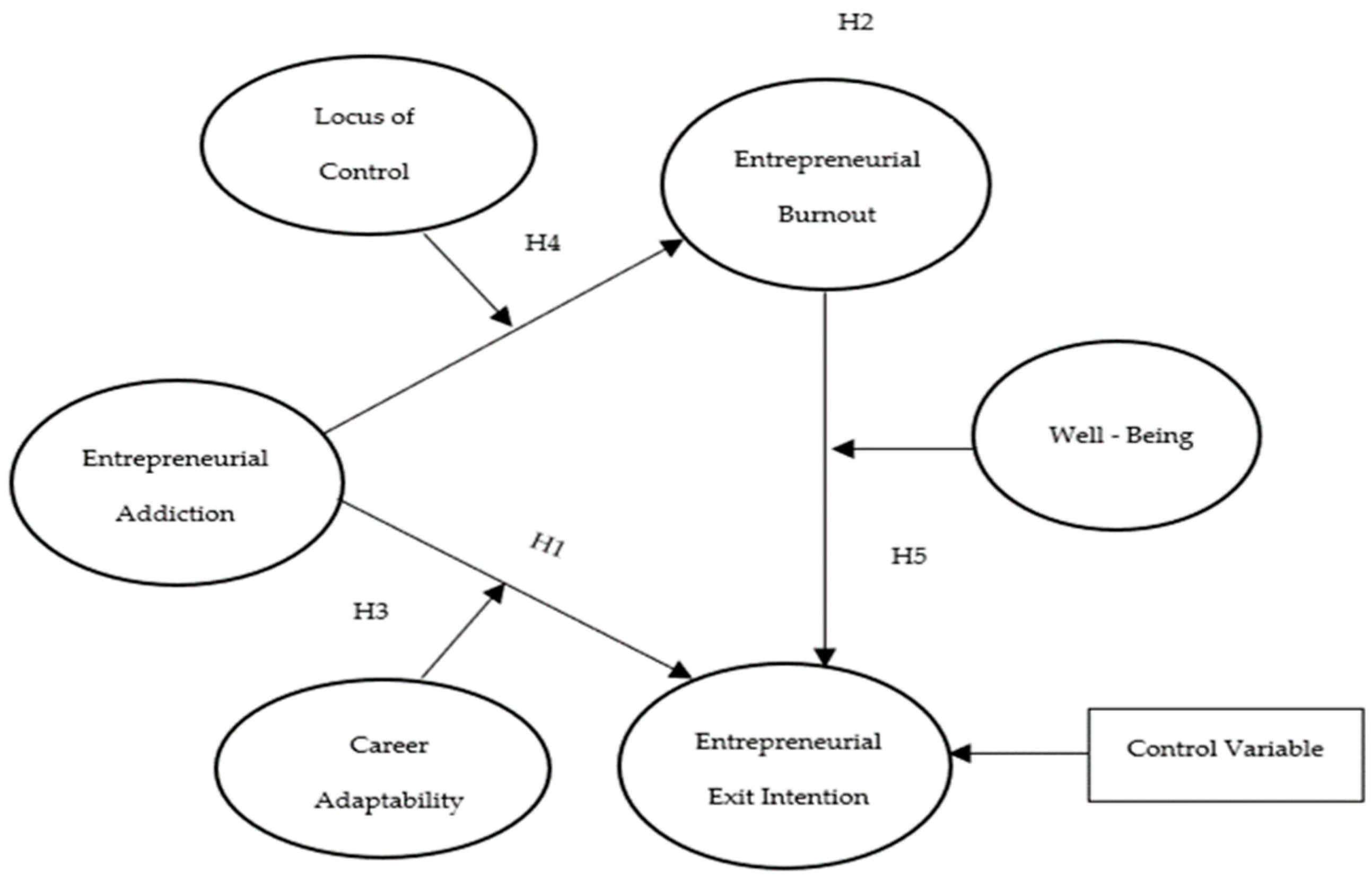
In light of these limitations, the present study draws primarily on self-regulation theory (SRT) (Carver & Scheier, 1998), which explains that individuals rely on limited self-regulatory resources to regulate their emotions, behaviors, and goal-directed actions (Hohen & Schweizer, 2021). When these resources are used up through sustained efforts and self-control demands, individuals may disengage from demanding activities to restore psychological equilibrium (Patzelt & Shepherd, 2011). Within this perspective, entrepreneurial addiction is conceptualized as a maladaptive pattern of persistent goal pursuit in which entrepreneurs continue investing self-regulatory resources despite accumulating personal costs (Spivack & McKelvie, 2021). From this perspective, entrepreneurial addiction is proposed to initiate a progressive self-regulatory depletion process in which persistent overinvestment of self-regulatory resources leads to burnout and, ultimately, entrepreneurial exit intention (Carver & Scheier, 1998). The process of burnout might thus serve as a self-regulatory “stop signal,” indicating that continued entrepreneurial involvement is no longer psychologically sustainable (Torrès et al., 2022; Towch et al., 2024). Accordingly, entrepreneurial exit intention is conceptualized in this study not as an indicator of entrepreneurial failure but as an adaptive self-regulatory response that enables entrepreneurs to restore depleted psychological resources and maintain long-term well-being. Furthermore, Career Construction Theory (CCT) (Savickas, 2005) is utilized to examine the contribution of career adaptability as a psychosocial resource to how entrepreneurs react to the challenging entrepreneurial situation. In order to test the objectives of this research, five hypotheses are developed. Accordingly, the proposed research model examines the direct effect of entrepreneurial addiction on entrepreneurial exit intention, the mediating role of entrepreneurial burnout, and the moderating effects of career adaptability, locus of control, and well-being on these relationships.
Empirically, the research is concerned with entrepreneurs working in Thailand within the digital services, software, and food and beverage industries. These sectors are typified by dynamic environments, uncertainties, emotional labor, and high-performance demands, thereby serving as appropriate settings to investigate entrepreneurial burnout and entrepreneurial exit intentions. Moreover, Thailand serves as an interesting emerging economy setting in which small- and medium-sized enterprises contribute to economic growth but also experience a great deal of competition and psychological pressure (Palmer et al., 2021; Delladio & Caputo, 2024). By integrating entrepreneurial addiction, entrepreneurial burnout, psychological resources, and entrepreneurial exit intention into a unified theoretical framework, the present study provides a more comprehensive explanation of the psychological processes underlying entrepreneurial exit. Through PLS-SEM, an integrated model of entrepreneurial addiction, burnout, psychological resources, and entrepreneurial exit intention is developed and empirically tested. By integrating Self-Regulation Theory and Career Construction Theory, the proposed model provides a more comprehensive understanding of the psychological mechanisms through which excessive entrepreneurial engagement contributes to entrepreneurial exit intention. First, it reframes entrepreneurial exit intentions as a self-regulatory process that is adaptive and sustainable and not a form of entrepreneurial failure. Secondly, it recognizes that entrepreneurial burnout serves as a mediating mechanism between entrepreneurial addiction and entrepreneurial exit intentions. Thirdly, it refines the prevailing view of psychological resources by demonstrating that career adaptability and well-being may foster adaptive disengagement. Collectively, these contributions extend entrepreneurial exit theory beyond existing explanations centered on exit routes, exit strategies, and economic decision-making by introducing entrepreneurial addiction as a distinct self-regulatory mechanism that explains how excessive entrepreneurial engagement progressively evolves into entrepreneurial burnout and ultimately entrepreneurial exit intention. In doing so, the study repositions entrepreneurial exit as a dynamic self-regulatory process through which entrepreneurs adaptively disengage from unsustainable entrepreneurial involvement rather than merely as a consequence of venture failure or economic evaluation.

2. Literature Review and Hypotheses Development

This research uses Self-Regulation Theory (Bandura, 1991; Carver & Scheier, 1998) to provide an explanation about why entrepreneurial addiction drains self-regulatory resources, thus resulting in entrepreneurial burnout and eventually entrepreneurial exit intention. Self-Regulation Theory further posits that self-regulatory resources affect people’s ability to handle stress and self-regulate their behavior. Moreover, Career Construction Theory (Savickas, 2005) is used to explain the moderating role of career adaptability, which is a psychosocial resource that enables individuals to cope with career-related challenges and uncertainty.

2.1. Entrepreneurial Exit Intention and Addiction

Entrepreneurial exit intention refers to entrepreneurs’ conscious consideration of discontinuing their business activities (DeTienne, 2010). Entrepreneurial exit has traditionally been associated with venture failure; however, recent studies increasingly conceptualize it as an adaptive response to unsustainable working conditions and prolonged psychological strain (Esfandiar et al., 2019; Morris et al., 2020). Accordingly, entrepreneurial exit is now viewed not merely as the end of entrepreneurial activity but as a self-directed decision in which entrepreneurs reassess whether continued engagement in the venture aligns with their long-term personal and professional goals.
Despite this shift in the entrepreneurial exit literature, existing studies have predominantly explained entrepreneurial exit intention in terms of venture performance, opportunity evaluation, and environmental conditions (DeTienne, 2010; Hessels et al., 2018; Widz & Kammerlander, 2023). While these studies have substantially advanced the understanding of entrepreneurial exit, comparatively less attention has been devoted to the internal psychological mechanisms through which highly committed entrepreneurs develop entrepreneurial exit intentions. This gap raises an important theoretical question: why might entrepreneurs who demonstrate exceptional persistence ultimately develop entrepreneurial exit intentions?
According to self-regulation theory, entrepreneurs possess limited self-regulatory resources to regulate their emotions, behaviors, and goal-directed activities under demanding circumstances (Bandura, 1991; Carver & Scheier, 1998). Entrepreneurial addiction refers to persistent and compulsive engagement in entrepreneurship despite its accumulating negative consequences for entrepreneurs’ personal lives (Spivack, 2020; Spivack & McKelvie, 2018). Maintaining such excessive involvement requires sustained self-regulatory effort, which may gradually weaken entrepreneurs’ regulatory capacity (Williamson et al., 2021; Torrès et al., 2022), thereby making it increasingly difficult to balance venture demands with personal needs and long-term goals. This creates an important theoretical paradox. Entrepreneurs are generally expected to persist because persistence has long been regarded as a defining characteristic of entrepreneurial success (Shane & Venkataraman, 2000). However, self-regulation theory suggests that persistent goal pursuit may become maladaptive once self-regulatory resources are progressively depleted, thereby creating a theoretical tension between continued entrepreneurial persistence and adaptive entrepreneurial disengagement. Although entrepreneurs with entrepreneurial addiction remain intensely committed to their ventures, prolonged over-engagement may gradually impair their regulatory capacity. Consequently, continued persistence may eventually become psychologically unsustainable, prompting entrepreneurs to reconsider whether remaining in entrepreneurship still serves their long-term goals.
From a self-regulation perspective, entrepreneurial addiction may therefore increase entrepreneurs’ awareness of the growing mismatch between continued entrepreneurial effort and desired personal outcomes. As personal sacrifices accumulate, entrepreneurs may increasingly perceive that maintaining intensive venture involvement comes at the expense of their psychological well-being. Rather than reflecting failure, entrepreneurial exit may consequently become a proactive means of restoring psychological equilibrium and achieving a more sustainable balance between work and personal life (Ryan & Deci, 2017). Previous research similarly demonstrates that excessive work engagement and compulsive persistence are associated with greater psychological strain and stronger withdrawal intentions (Kleine et al., 2024; Sardeshmukh et al., 2021). Taken together, these findings suggest that entrepreneurial exit intention may emerge not only from deteriorating venture conditions but also from entrepreneurs’ adaptive self-regulatory reassessment of whether continued entrepreneurial persistence remains psychologically sustainable. Entrepreneurial addiction therefore represents a distinct self-regulatory mechanism through which entrepreneurs may voluntarily consider entrepreneurial exit despite their strong commitment to the venture.
Although entrepreneurial burnout is expected to mediate the relationship between entrepreneurial addiction and entrepreneurial exit intention, Self-Regulation Theory also suggests that entrepreneurs may begin reconsidering their continued involvement before burnout is fully developed. When entrepreneurial activities increasingly conflict with personal goals and psychological well-being, entrepreneurs may proactively evaluate entrepreneurial exit as an adaptive self-regulatory response. Therefore, based on Self-Regulation Theory, entrepreneurial addiction is expected to directly increase entrepreneurial exit intention even before entrepreneurial burnout fully develops, because compulsive entrepreneurial involvement progressively undermines entrepreneurs’ ability to maintain a sustainable balance between venture demands and personal well-being. Therefore, we hypothesized that,
Hypothesis 1.
Entrepreneurial addiction positively influences entrepreneurial exit intention.

2.2. Entrepreneurial Burnout as a Mediator

Entrepreneurial addiction is characterized by persistent overinvestment of cognitive, emotional, and behavioral resources in venture-related activities and continued engagement despite accumulating adverse personal consequences (Spivack, 2020). According to Self-Regulation Theory, sustaining prolonged goal-directed behavior requires continuous self-regulatory effort. When entrepreneurs repeatedly invest psychological resources without sufficient recovery, their capacity to regulate behavior, emotions, and goal pursuit gradually deteriorates, increasing their vulnerability to psychological exhaustion and burnout (Bandura, 1991; Carver & Scheier, 1998; Williamson et al., 2021; Torrès et al., 2022; Torrès & Thurik, 2019; Towch et al., 2024; Delladio & Caputo, 2024; Stephan et al., 2023).
Previous research on entrepreneurial exit has demonstrated that work stressors, emotional exhaustion, and psychological strain contribute to entrepreneurial exit intentions (Sardeshmukh et al., 2021; Shahid & Kundi, 2022). However, these studies primarily conceptualize burnout as a consequence of external work demands and offer limited explanation for why some entrepreneurs continue to invest excessive time, effort, and personal identity in their ventures despite escalating psychological costs. In contrast, entrepreneurial addiction represents a distinct maladaptive self-regulatory process characterized by compulsive venture engagement despite adverse consequences (Spivack, 2020). Whereas entrepreneurial addiction reflects excessive persistence in goal-directed behavior, burnout represents the psychological consequence of prolonged self-regulatory failure (Spivack, 2020; Towch et al., 2024). Accordingly, the present study argues that entrepreneurial addiction functions as an upstream maladaptive self-regulatory mechanism that progressively depletes entrepreneurs’ psychological resources, leading to entrepreneurial burnout before entrepreneurial exit intention develops. This perspective extends existing burnout–exit models by explaining how burnout develops rather than treating burnout as the initial antecedent of entrepreneurial exit.
Entrepreneurial burnout is characterized by emotional exhaustion, diminished motivation, and impaired psychological functioning (Zhao et al., 2023b; Delladio & Caputo, 2024). Within self-regulation theory, burnout reflects entrepreneurs’ diminished capacity to sustain goal-directed effort following prolonged self-regulatory resource depletion (Bandura, 1991; Carver & Scheier, 1998). As burnout intensifies, entrepreneurs are increasingly likely to reassess whether continued venture engagement remains psychologically sustainable and may view entrepreneurial exit as an adaptive strategy to preserve their remaining psychological resources (DeTienne, 2010; Esfandiar et al., 2019; Morris et al., 2020; Widz & Kammerlander, 2023). Consistent with prior evidence linking burnout to withdrawal cognitions and entrepreneurial exit intentions (Sardeshmukh et al., 2021; Shahid & Kundi, 2022), entrepreneurial burnout serves as the proximal mediating psychological mechanism through which entrepreneurial addiction translates into entrepreneurial exit intention. Therefore, we hypothesized that,
Hypothesis 2.
Entrepreneurial burnout mediates the relationship between entrepreneurial addiction and entrepreneurial exit intention.

2.3. Moderating Role of Career Adaptability

Career adaptability refers to individuals’ psychosocial resources for managing current and anticipated career-related tasks, transitions, and challenges (Savickas, 2005; Savickas & Porfeli, 2012). According to career construction theory (CCT), career adaptability enables individuals to cope effectively with uncertainty, adapt to changing environments, and maintain adaptive functioning throughout their careers. Within entrepreneurial settings, these psychosocial resources promote flexibility, proactive problem solving, and effective responses to the dynamic demands of venture creation and development. From the perspective of self-regulation theory, career adaptability also enhances entrepreneurs’ capacity to regulate goal-directed behavior and flexibly adjust their behavioral investment in response to changing circumstances. Accordingly, entrepreneurs with higher career adaptability are expected to regulate their behavioral investment more effectively, thereby reducing the likelihood that prolonged entrepreneurial engagement develops into psychological exhaustion, whereas those experiencing entrepreneurial addiction may continue pursuing venture goals despite increasing psychological costs.
Previous research consistently identifies career adaptability as a protective psychological resource. Entrepreneurs with higher career adaptability are better able to reframe stressful situations, explore alternative solutions, and modify their strategies in response to changing business environments (Hou et al., 2012; Ross et al., 2021). These adaptive capabilities help preserve psychological resources and reduce the adverse consequences of demanding entrepreneurial conditions. Empirical evidence further indicates that career adaptability is associated with lower levels of stress, anxiety, and entrepreneurial burnout, as well as greater psychological resilience and well-being (Williamson et al., 2021; Torrès et al., 2022; Doğanülkü et al., 2025; Nakra & Kashyap, 2023; Van Heghe et al., 2024; Obschonka et al., 2023). Consistent with Career Construction Theory, these psychosocial resources should enable entrepreneurs to better regulate the strain associated with entrepreneurial addiction, thereby reducing the likelihood that excessive entrepreneurial engagement develops into burnout.
However, entrepreneurship presents a more complex context in which career adaptability may also produce resource-consuming consequences. Unlike employees in conventional organizational settings, entrepreneurs often adapt by pursuing new opportunities, experimenting with alternative business models, and continuously adjusting business strategies, all of which require additional cognitive, emotional, and behavioral resource investment. From the perspective of self-regulation theory, entrepreneurs experiencing entrepreneurial addiction may persist in investing self-regulatory effort to pursue venture goals despite mounting psychological costs. This pattern is consistent with the conservation of resources perspective, which suggests that sustained resource investment without sufficient recovery may trigger a resource loss spiral, accelerating psychological resource depletion and entrepreneurial burnout (Zhao et al., 2023a). Likewise, entrepreneurial exit research suggests that entrepreneurs often remain committed to their ventures because exit decisions are shaped by personal, family, and contextual considerations rather than immediate withdrawal (Hsu et al., 2016; Widz & Kammerlander, 2023). Consequently, career adaptability may not only facilitate adaptive coping but also encourage continued entrepreneurial engagement, thereby intensifying entrepreneurial burnout under conditions of entrepreneurial addiction.
Despite this alternative theoretical possibility, Career Construction Theory explicitly conceptualizes career adaptability as a psychosocial resource that promotes adaptive career adjustment, psychological resilience, and effective coping with career-related challenges (Savickas, 2005; Savickas & Porfeli, 2012). Although entrepreneurial contexts may occasionally encourage continued resource investment, the dominant theoretical perspective continues to conceptualize career adaptability as a protective psychosocial resource. Accordingly, the present study follows this theoretical prediction and proposes that career adaptability weakens the positive relationship between entrepreneurial addiction and entrepreneurial burnout. Therefore, we hypothesize that,
Hypothesis 3.
Career adaptability negatively moderates the relationship between entrepreneurial addiction and entrepreneurial burnout.

2.4. Moderating Role of Locus of Control

Locus of control (LOC) is a term used to describe the level of belief about the extent to which people consider outcomes to be controlled through their behavior or the environment (Rotter, 1966). According to the theories of self-regulation, perceived control is an important psychological resource for regulating behavior, overcoming difficulties and maintaining goal-directed behavior in challenging environments. Individuals with a stronger internal locus of control are more likely to perceive challenging situations as manageable, adopt proactive coping strategies, and effectively regulate their behavior (Bandura, 1991; Carver & Scheier, 1998). Within an entrepreneurial context, entrepreneurs vary in the extent to which they believe business outcomes to be controllable through their behavior. Entrepreneurs who have an internal locus of control usually consider themselves to have more influence on outcomes while those with external locus of control believe outcomes are influenced more by external factors (Rotter, 1975).
Entrepreneurs with a stronger internal locus of control are more likely to engage in proactive coping, effective problem-solving, and adaptive responses to entrepreneurial challenges. Consequently, entrepreneurs with a stronger internal locus of control are better able to cope with work-related demands and psychological stress, thereby reducing their vulnerability to entrepreneurial burnout (Eren et al., 2023). Prior research further indicates that an internal locus of control is associated with greater entrepreneurial well-being and more constructive responses to adversity (Stephan et al., 2023). Therefore, we hypothesized that,
Hypothesis 4.
Locus of control negatively moderates the relationship between entrepreneurial addiction and entrepreneurial burnout.

2.5. Moderating Role of Well-Being

Well-being refers to a positive psychological state characterized by emotional balance, life satisfaction, and effective psychological functioning (Ryan & Deci, 2017; Topp et al., 2015; Shir et al., 2019). According to self-regulation theory, individuals continuously monitor and regulate their emotions, motivation, and behaviors to pursue valued goals. Successful self-regulation depends on the availability of sufficient psychological resources that enable individuals to cope with stress, restore psychological balance, and sustain adaptive goal-directed behavior (Bandura, 1991; Carver & Scheier, 1998). As an important psychological resource, well-being enhances entrepreneurs’ capacity to recover from strain and maintain effective functioning under demanding entrepreneurial conditions (Wiklund et al., 2019).
Entrepreneurial exit research has increasingly recognized that entrepreneurs’ psychological functioning influences entrepreneurial exit decisions beyond traditional economic and venture performance explanations. Rather than viewing exit solely as a consequence of venture failure, recent studies suggest that entrepreneurs’ psychological well-being influences whether continued venture engagement remains personally sustainable (Hsu et al., 2016; Hessels et al., 2018). Furthermore, Dong et al. (2022) demonstrated that work-related well-being constitutes an important psychological mechanism underlying entrepreneurial exit intention, highlighting that entrepreneurs’ internal psychological experiences, rather than external venture conditions alone, contribute to decisions to exit.
From a self-regulation theory perspective, entrepreneurs with higher levels of well-being possess greater psychological resources to regulate the emotional consequences of entrepreneurial burnout. Consequently, they are better able to recover from psychological strain, maintain commitment to their ventures, and reduce the likelihood that burnout translates into entrepreneurial exit intention. Previous studies similarly indicate that entrepreneurs with higher well-being demonstrate greater psychological resilience, more effective stress management, and lower withdrawal tendencies (Obschonka et al., 2023; Stephan et al., 2023; Kleine et al., 2024; Torrès et al., 2022). Although emerging entrepreneurial exit research suggests that well-being may also facilitate entrepreneurs’ evaluation of whether continued venture engagement remains psychologically sustainable (Dong et al., 2022; Van Heghe et al., 2024), Self-Regulation Theory predominantly conceptualizes well-being as a protective psychological resource. Accordingly, the present study proposes that well-being weakens the positive relationship between entrepreneurial burnout and entrepreneurial exit intention. Therefore, we hypothesize that,
Hypothesis 5.
Well-being negatively moderates the relationship between entrepreneurial burnout and entrepreneurial exit intention.
Collectively, these hypotheses provide an integrated theoretical explanation of how entrepreneurial addiction, entrepreneurial burnout, career adaptability, locus of control, and well-being jointly influence entrepreneurial exit intention. The proposed conceptual model summarizing these hypothesized relationships is presented in Figure 1.

3. Materials and Methods

3.1. Research Design

This study employed a cross-sectional survey design to collect data from entrepreneurs operating in two high-pressure industries in Thailand: the digital services and software industry and the food and beverage (F&B) industry. These industries were selected because they expose entrepreneurs to sustained work intensity, environmental uncertainty, and elevated risks of burnout, entrepreneurial addiction, and exit intention. Entrepreneurs in the digital services and software industry experience rapid technological change, continuous innovation demands, and intensive workloads (Palmer et al., 2021; Delladio & Caputo, 2024). Similarly, F&B entrepreneurs face demanding operational workloads, emotional labor, and income volatility, thereby increasing the risk of burnout and entrepreneurial exit intention.
The sampling frame was obtained from the Department of Business Development (DBD), Ministry of Commerce, Thailand. As of 2 May 2025, the database contained 7500 legally registered SMEs in the digital services and software and F&B industries, which constituted the target population. Eligible firms were first identified from the DBD database based on industry classification. Potential participants were then contacted by telephone to verify eligibility, explain the study, and obtain voluntary agreement to participate before questionnaire distribution. Purposive sampling was used to recruit respondents directly responsible for strategic decision-making and business operations. Eligible participants were founders, business owners, chief executive officers (CEOs), or owner-managers who were actively involved in the strategic and operational management of their businesses. Firms that were no longer operating or whose respondents did not satisfy these eligibility criteria were excluded from the study. The demographic characteristics, such as gender, age, education, working experience, and working position, describe the respondent characteristics (see Table A1). The respondent profile characteristics of businesses include business owner type, business type, industry type, and the period of time operating the company (see Table A2). Following participant screening, data were collected between 24 July and 24 August 2025 using two modes: (1) an online questionnaire administered through Google Forms (Google LLC, Mountain View, CA, USA) and email and (2) a paper-based questionnaire distributed by mail. Identical questionnaire items, instructions, and response scales were used across both modes to ensure procedural consistency. Because identical questionnaires, response scales, and standardized administration procedures were applied across both survey modes, no formal mode-effect analysis was conducted. To prevent duplicate responses, only one questionnaire was accepted from each entrepreneur and firm. Google Forms restricted online submissions to one response per participant, while company names, email addresses, and telephone numbers were cross-checked during data screening to identify and remove duplicate submissions. Participation was voluntary. All respondents received a participant information sheet and provided informed consent before completing the questionnaire. Participant anonymity and confidentiality were strictly maintained, and all analyses were conducted using aggregated data. Ethical approval was granted by the Institutional Review Board (IRB) of Mahasarakham University (approval date: 23 July 2025).
A total of 1570 questionnaires were distributed, comprising 1370 online invitations and 200 mailed questionnaires. After excluding undelivered invitations, 1042 online and 102 mailed questionnaires were successfully delivered. The online survey returned 286 questionnaires, of which 86 were incomplete or unusable, leaving 200 usable responses (19.19%). All 50 mailed questionnaires were complete, corresponding to a usable response rate of 49.01%. The final sample comprised 250 valid responses, exceeding the minimum sample size recommended for PLS-SEM (Hair et al., 2014). Prior to hypothesis testing, the dataset was screened for missing values, outliers, normality, multicollinearity, and non-response bias. Cases with substantial missing values were excluded, and the remaining dataset contained less than 5% missing data (Hair et al., 2017). Potential outliers were assessed using standardized Z-scores (±3.29) (Tabachnick & Fidell, 2013; Grove et al., 2013; Polit, 2010). No influential outliers requiring removal were identified. Although PLS-SEM does not require multivariate normality, skewness, kurtosis, and the Kolmogorov–Smirnov test indicated acceptable distributional properties (West et al., 1995; Chakravarti et al., 1967).
Multicollinearity was assessed using variance inflation factor (VIF) and tolerance values. All VIF values were below 5 and tolerance values exceeded 0.20, indicating that multicollinearity was not a concern (Hair et al., 2011, 2017). Non-response bias was evaluated by comparing early and late respondents using independent-samples t-tests following Armstrong and Overton (1977). Although statistically significant differences were observed for a small number of individual variables, no systematic pattern was found across the study constructs, suggesting that non-response bias was unlikely to materially affect the findings.

3.2. Measurement

The entrepreneurial exit intention was measured using five items adopted from Crossley et al. (2007) and reworded to reflect withdrawal from entrepreneurial activities rather than organizational turnover. Entrepreneurial addiction was conceptualized as a second-order reflective construct comprising six first-order dimensions (obsessive thoughts, self-worth, engagement, tolerance, negative outcomes, and neglect), consistent with the original conceptualization proposed by Spivack et al. (2014). The higher-order specification captures the multidimensional nature of entrepreneurial addiction while allowing the overall construct to represent compulsive entrepreneurial engagement.
Entrepreneurs’ burnout was measured using five items adopted from Rohland et al. (2004). Career adaptability was measured using the scale developed by Hou et al. (2012), including concern, control, curiosity, and confidence. Locus of control was measured using the ten-item scale developed by Mueller and Thomas (2001). The well-being construct was measured using the World Health Organization Five Well-Being Index (WHO, 1998). To assess common method bias, a theoretically unrelated marker variable (travel behavior) was included following the marker variable approach recommended by Lindell and Whitney (2001). The travel-behavior items were adapted from Chansuk et al. (2022).
All measurement items were translated from English into Thai and back-translated into English to ensure semantic equivalence. The translation and back-translation were conducted by the research advisors, who possess expertise in entrepreneurship theory and research methodology, and the translated questionnaire was further reviewed by the Language Institute of Khon Kaen University. The translated and back-translated versions were compared with the original questionnaire, and discrepancies were resolved through discussion until conceptual equivalence was achieved. Minor wording modifications were made across all constructs to improve clarity and contextual appropriateness for Thai entrepreneurs while preserving the original theoretical meaning. Before the main survey, the questionnaire was trialed with 30 entrepreneurs operating three- to five-star hotel and accommodation businesses to evaluate clarity, comprehensibility, and contextual appropriateness. Feedback from the pilot test was incorporated into the final questionnaire. Consistent with prior entrepreneurship research, six control variables were included: gender, age, work experience, position, business type, and industry (Robinson et al., 1991; Wiklund et al., 2019).

3.3. Statistical Techniques

The proposed research model was analyzed using Partial Least Squares Structural Equation Modeling (PLS-SEM) with SmartPLS version 4.1.1.8 (SmartPLS GmbH, Oststeinbek, Germany) to examine the relationships among the study constructs and evaluate the model’s predictive capability. PLS-SEM was selected because the primary objective of this study was to explain and predict entrepreneurial exit intention by examining the combined effects of entrepreneurial addiction, entrepreneurial burnout, and multiple psychological resources, rather than to confirm an established covariance structure (Hair et al., 2021a). The proposed model incorporates direct, mediating, moderating, and control relationships, making PLS-SEM well suited for simultaneously estimating these relationships within a unified analytical framework (Hair et al., 2021b). This analytical capability aligns with the study’s research question, which seeks to explain and predict entrepreneurial exit intention by simultaneously examining the direct, mediating, and moderating relationships among entrepreneurial addiction, burnout, and psychological resources. Furthermore, PLS-SEM is particularly suitable for entrepreneurship research that emphasizes prediction and theory development, as it enables researchers to evaluate the predictive capability of behavioral models without requiring multivariate normality (Hair et al., 2019; Sarstedt et al., 2022). Accordingly, given the cross-sectional survey design and the study’s prediction-oriented objective, PLS-SEM was considered the most appropriate analytical approach for estimating the proposed relationships and evaluating the model’s predictive capability.

4. Results

4.1. Testing the Assumptions of the Structural Equation Model

Before estimating the structural model, multicollinearity was assessed using variance inflation factors (VIFs) and tolerance values (Hair et al., 2017). Indicator VIF values ranged from 2.471 to 4.843, while tolerance values ranged from 0.206 to 0.405, indicating that multicollinearity was not a concern (Hair et al., 2021b).
Given that the study relied on cross-sectional self-reported survey data, common method variance (CMV) was assessed using the marker-variable technique (Lindell & Whitney, 2001; Malhotra et al., 2006), which provides a more robust assessment than Harman’s single-factor test (Podsakoff et al., 2003; Fuller et al., 2016). Travel Behavior (Chansuk et al., 2022) was selected as the marker construct because it is theoretically unrelated to Self-Regulation Theory and the substantive constructs examined in this study while being measured using the same survey instrument, thereby meeting the recommended criteria for marker-variable selection (Lindell & Whitney, 2001).
To assess CMV, two PLS-SEM models were estimated: (1) a baseline model excluding the marker construct and (2) a marker-included model in which Travel Behavior was specified as an exogenous construct predicting all endogenous constructs. Following Fuller et al. (2016) and Podsakoff et al. (2003, 2012), standardized path coefficients (β) and significance levels (p-values) were compared before and after including the marker construct (see Table A2). The standardized path coefficients changed only marginally, ranging from −2.12% to +1.38%. The largest change was observed for the interaction effect between entrepreneurial burnout and well-being on entrepreneurial exit intention (−2.12%), whereas the statistical significance of all hypothesized relationships remained unchanged (see Table A3). Collectively, these findings suggest that common method variance is unlikely to have materially influenced the observed relationships.

4.2. Measurement Model

Pearson’s correlation coefficient was used to examine the relationships among the study variables and identify unusually high correlations. The results presented in Table 1 showed that none of the correlation coefficients exceeded the 0.80 threshold (Hair et al., 2021b), indicating no multicollinearity. High levels of entrepreneurial addiction were significantly related to high levels of entrepreneurial exit intention (r = 0.451, p < 0.01), and entrepreneurial burnout was also significantly related to entrepreneurial exit intention (r = 0.380, p < 0.01). The results further revealed relationships among locus of control, career adaptability, entrepreneurial addiction, and entrepreneurial burnout. Furthermore, well-being was significantly related to entrepreneurial burnout and entrepreneurial exit intention (p < 0.01).
To assess discriminant validity, the Fornell–Larcker criterion and the heterotrait–monotrait ratio (HTMT) were used, as shown in Table 1 and Table 2. The results indicated that the square root of the AVE for each construct exceeded its correlations with the other constructs, while all HTMT values remained below the recommended threshold of 0.90 (Henseler et al., 2015; Hair et al., 2021b), indicating satisfactory discriminant validity. Confirmatory factor analysis was then conducted to evaluate the measurement structure of the first-order and second-order constructs. Despite the low loadings of several indicators, they were retained to preserve the theoretical comprehensiveness of the constructs (Hair et al., 2017). Overall, the measurement model demonstrated satisfactory psychometric properties and met the recommended evaluation criteria, as shown in Table A4 and Table A5. (Costello & Osborne, 2005; Stevens, 1992). Indicators with factor loadings below the recommended threshold were removed only when their exclusion improved construct validity without compromising the theoretical meaning or conceptual coverage of the corresponding construct.
Moreover, composite reliability (CR) was calculated for all constructs. All CR values exceeded the recommended threshold of 0.70, indicating satisfactory internal consistency (Nunnally & Bernstein, 1994; Hair et al., 2021b). Convergent validity was assessed using the Average Variance Extracted (AVE), with values of 0.50 or higher generally considered desirable (Hair, 2009; Hair et al., 2021b). Although the AVE values for Entrepreneurial Addiction (0.476) and Entrepreneurial Burnout (0.469) were slightly below the recommended threshold, both constructs demonstrated satisfactory composite reliability, consistent with Fornell and Larcker’s (1981) recommendation. Nevertheless, these findings should be interpreted with caution, as AVE values below 0.50 indicate that the evidence for convergent validity of these two constructs is weaker than desirable. In addition, although several indicators were removed during the measurement model assessment based on established measurement criteria, this item deletion may have reduced the breadth of the construct’s representation. Therefore, while the overall measurement model demonstrated acceptable reliability and discriminant validity, the convergent validity of Entrepreneurial Addiction and Entrepreneurial Burnout should be interpreted with appropriate caution. Future research is encouraged to further refine and validate these measurement scales across different entrepreneurial contexts.

4.3. Evaluation of the Structural Model

After validating the measurement model. The structural model was evaluated using the Bollen and Stine (1992) and Streukens and Leroi-Werelds (2016) bootstrapped approach with 5000 resamples, where three indicators were evaluated. The results from model fit indices revealed an appropriate fit, since the SRMR values were within the recommended levels and the dULS and dG values did not indicate any major issues related to misspecification of the model (Hair et al., 2021b; Maydeu-Olivares & Shi, 2017). It is therefore safe to conclude that the structural model was adequate (refer to Table 3). The coefficient of determination (R2) was used in determining the explanatory power of the structural model (Hair et al., 2021b). The structural model accounted for 66.6% of the variation in entrepreneurial burnout (R2 = 0.666; adjusted R2 = 0.659) and 62.9% of the variance in entrepreneurial exit intention (R2 = 0.629; adjusted R2 = 0.623). These figures denote a considerable explanatory power of the two endogenous variables. The results from the effect size test demonstrate that entrepreneurial addiction has a higher impact on entrepreneurial burnout (f2 = 0.338) than entrepreneurial exit intention (f2 = 0.115).
According to the results, the entrepreneurial burnout (EB) has a medium impact on entrepreneurial exit intention (EEI) (f2 = 0.178), which is in line with existing effect sizes criteria (Cohen, 1988; Hair et al., 2021b). The analysis of predictive power of the structural model was performed using the PLS Predict procedure. All Q2 scores were positive, which indicated that the predictive validity of the endogenous variables was achieved (Geisser, 1974; Shmueli et al., 2016). To test the predictive performance of the model, we examined whether RMSE and MAE were lower than those in the case of the linear model (LM) benchmark. As it is shown in Table 4, for some EEI indicators (for example, EEI1 and EEI5), RMSE and MAE were equal to or even larger than in the case of the benchmark for LM, which means that the predictive performance was poor or moderate (Hair et al., 2021b).
Although the SRMR value of 0.092 slightly exceeds the commonly suggested threshold of 0.08, this result should be interpreted with caution in the context of PLS-SEM. Model fit assessment in PLS-SEM remains subject to considerable debate, and SRMR should not be treated as a strict cut-off criterion for model acceptance or rejection. Rather, it should be considered as one diagnostic indicator alongside other measurement and structural model assessment criteria. In this study, the measurement model demonstrated acceptable reliability, convergent validity, and discriminant validity, while the structural model showed theoretically consistent and statistically significant relationships. Therefore, the SRMR value indicates a marginal but acceptable model fit, and the overall evidence supports the adequacy of the proposed model.

4.4. Results from PLS-SEM

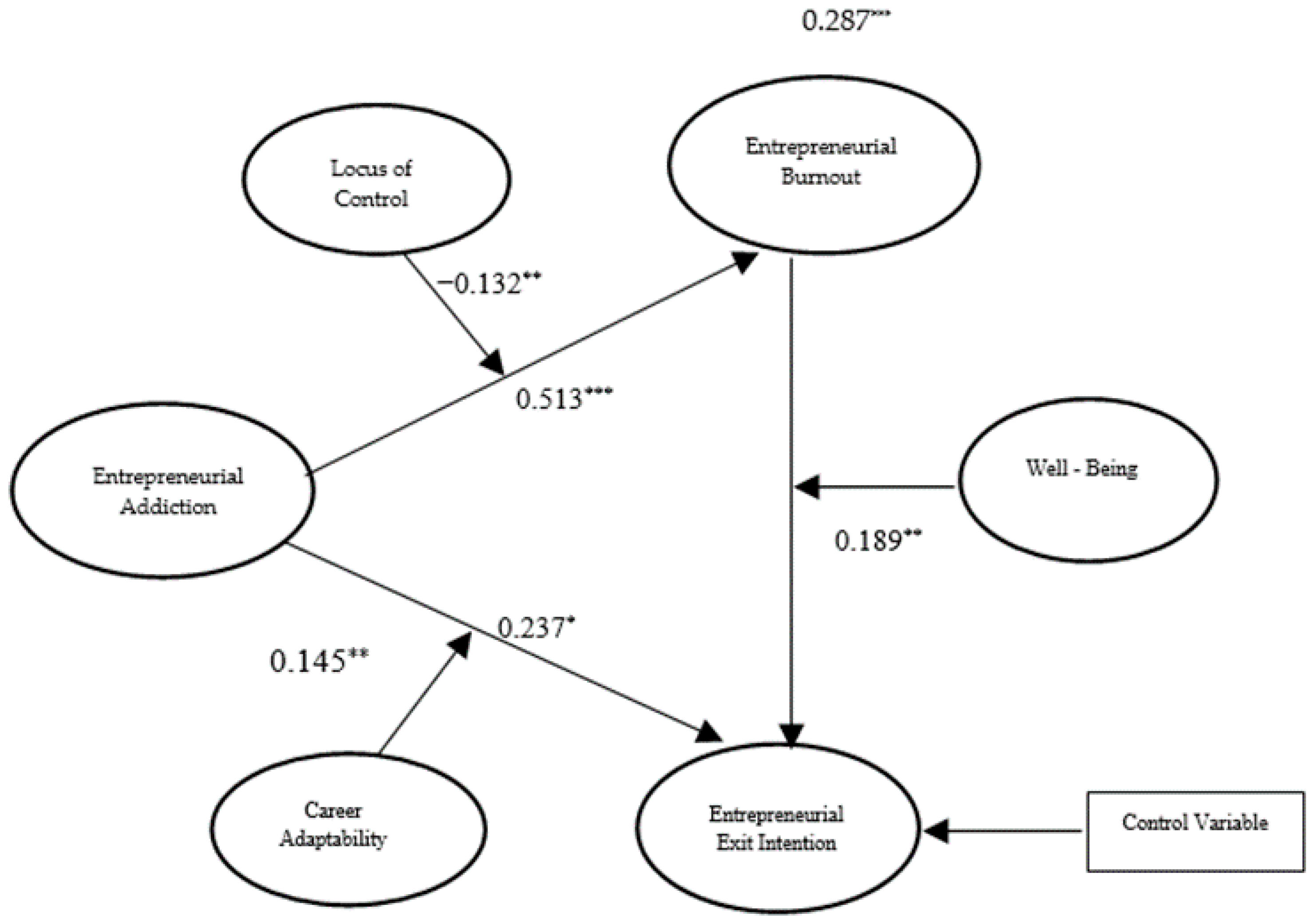
The results for PLS-SEM obtained from Figure 2 and Table 5 show the direct, mediating, moderating, and control effects. First of all, the analysis of Hypothesis 1 suggests that entrepreneurial addiction has a positive effect on the entrepreneurs’ intentions to leave their businesses (β = 0.237, p < 0.10). The results prove that Hypothesis 1 is correct since entrepreneurial addiction positively influences entrepreneurs’ intentions to leave the business when there is strong commitment and a negative impact on their personal lives. Secondly, entrepreneurial burnout acts as a mediator between entrepreneurial addiction and exit intention in Hypothesis 2. According to the results provided in Table 5, entrepreneurial addiction has a positive influence on entrepreneurial burnout (β = 0.513, p < 0.01) that positively affects entrepreneurial exit intention (β = 0.560, p < 0.01). The indirect effects were examined using boot-strapping with 5000 resamples (Bollen & Stine, 1992; Streukens & Leroi-Werelds, 2016).
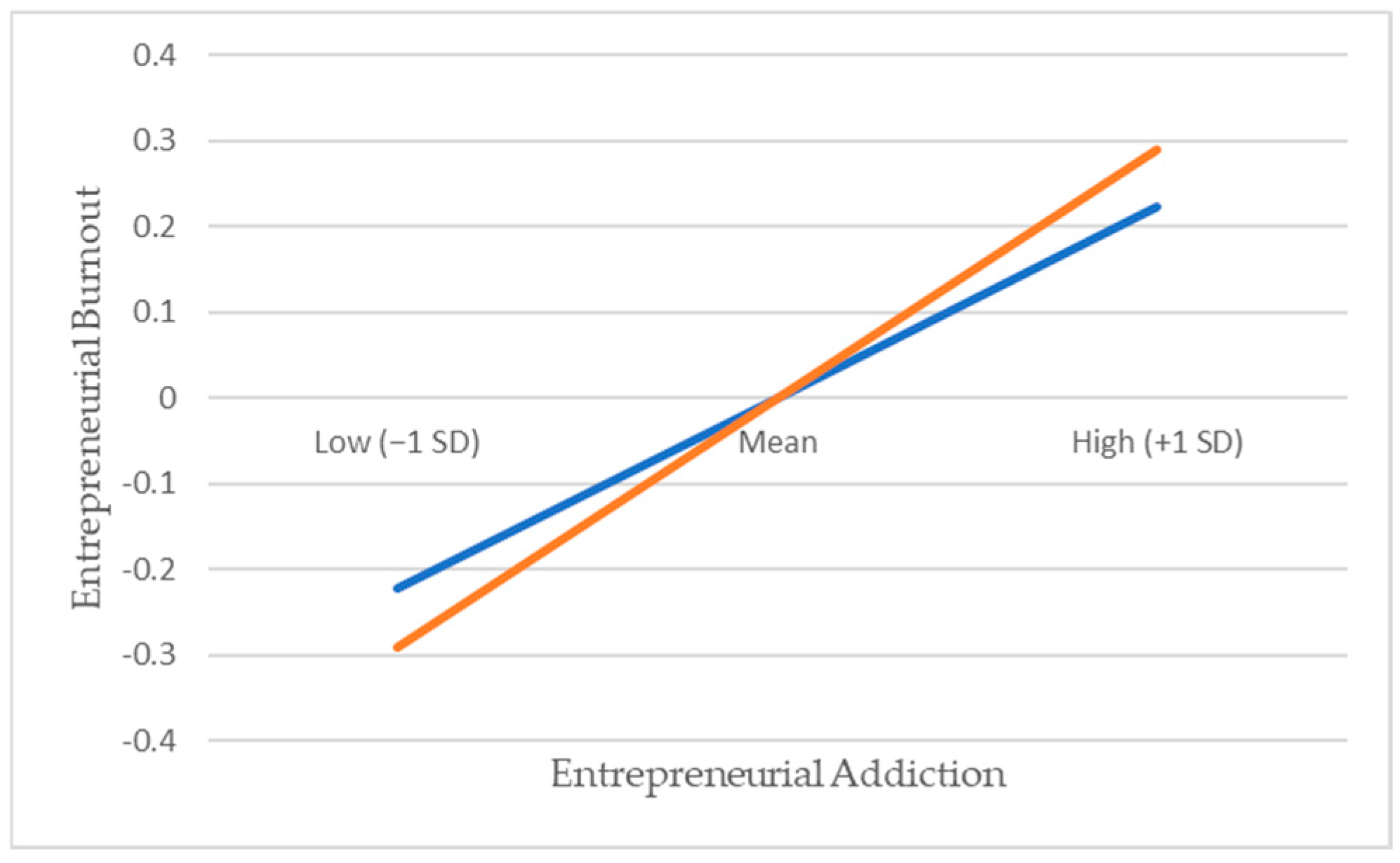
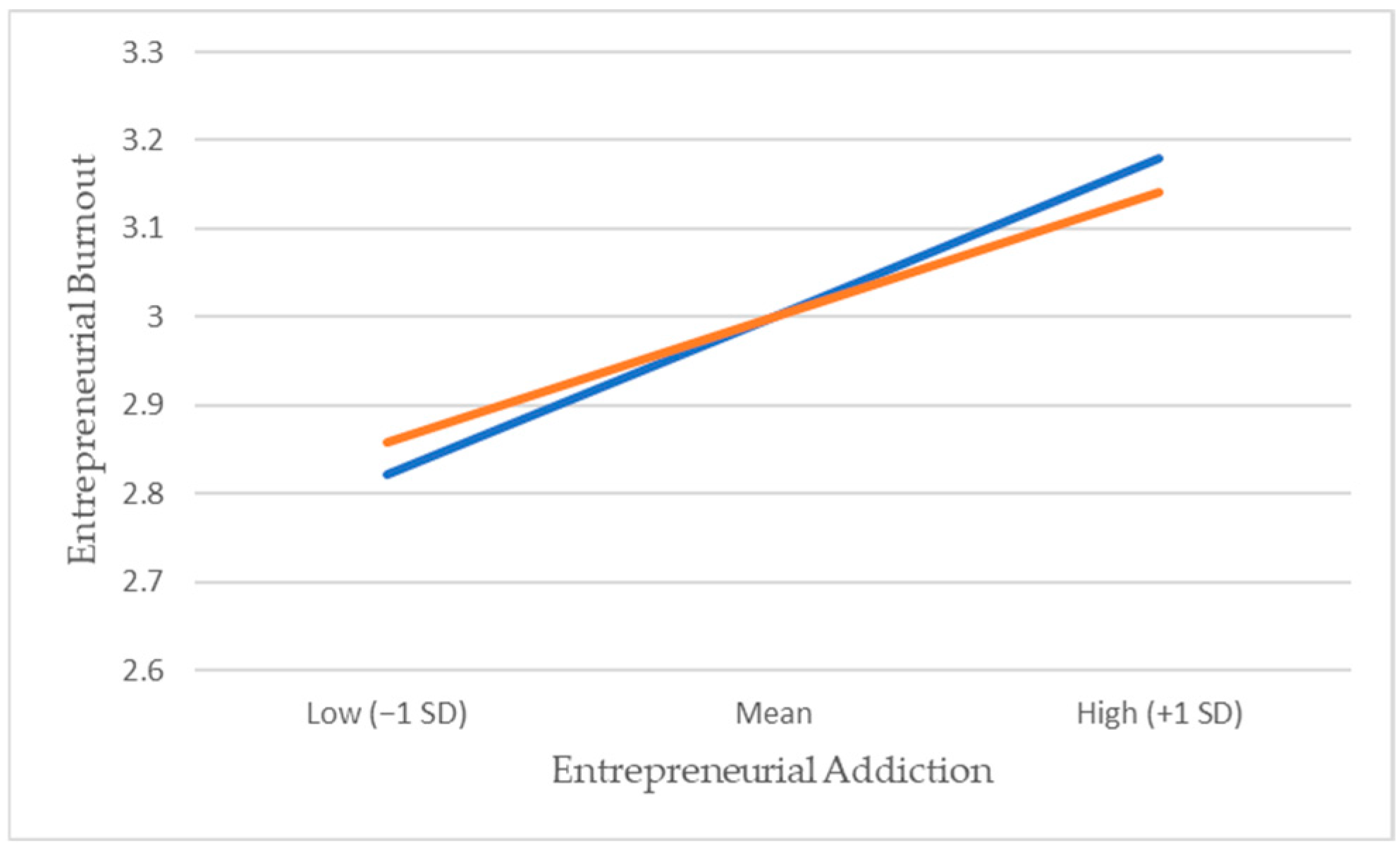
In fact, there exists an important indirect impact of entrepreneurial addiction on entrepreneurial exit intention via entrepreneurial burnout (β = 0.287, p < 0.01), which indicates the mediator proposed by Hypothesis 2. However, while Hypothesis 3 suggests that career adaptability will have a negative interaction effect on the relationship between entrepreneurial addiction and burnout, the empirical results indicate a positive significant interaction effect of entrepreneurial addiction and career adaptability (β = 0.145, p < 0.05). (See Figure A1). Therefore, Hypothesis 3 is not supported because career adaptability positively moderates the influence of entrepreneurial addiction on entrepreneurial burn out. On the contrary, Hypothesis 4 assumes locus of control to be a negative moderator. The result shows that the negative interaction of entrepreneurial addiction and locus of control is significantly important (β = −0.132, p < 0.05), indicating that internal locus of control can moderate the influence of entrepreneurial addiction on entrepreneurial burn out (See Figure A2).
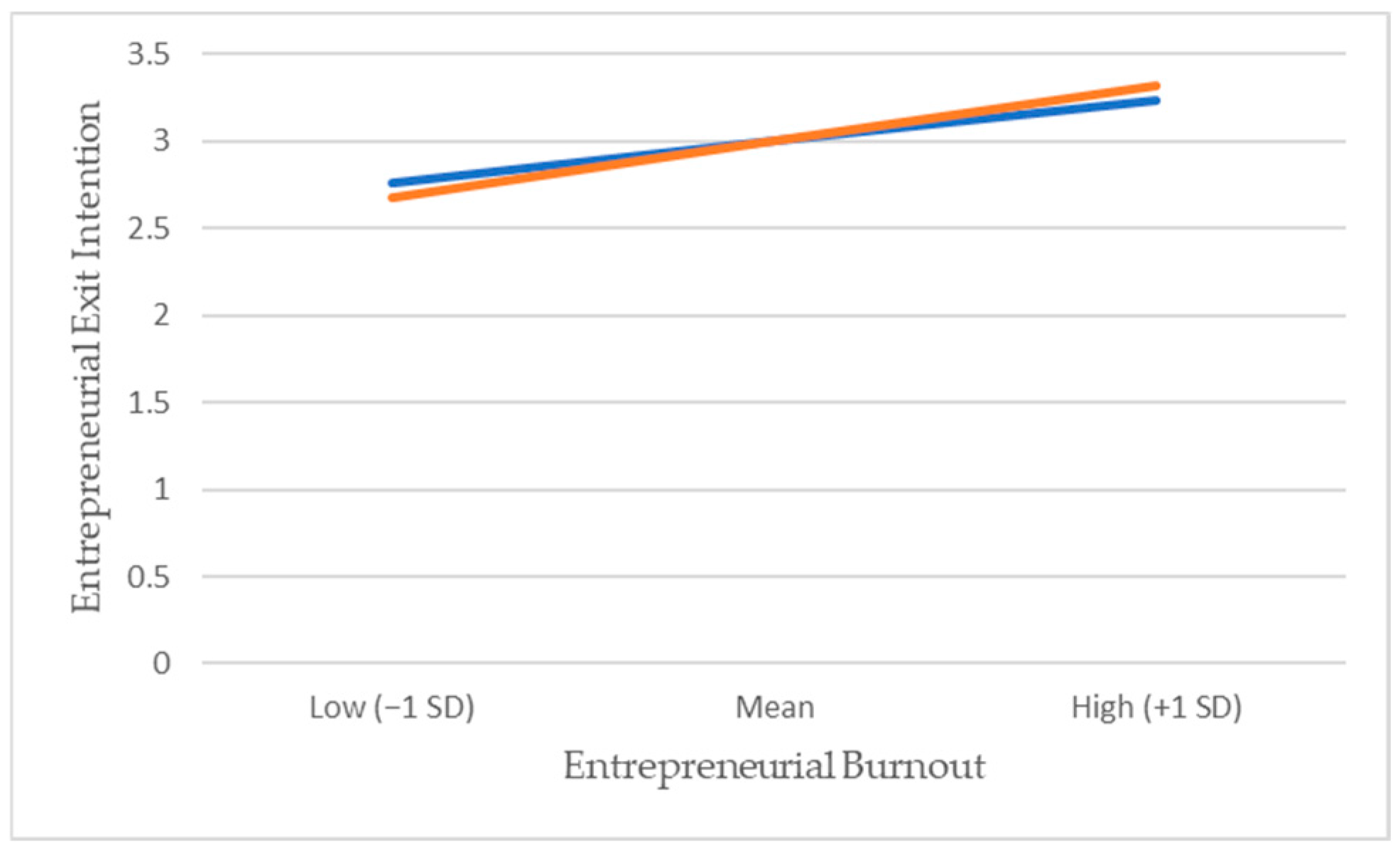
Hypothesis 5 proposed that well-being would negatively moderate the relationship between entrepreneurial burnout and entrepreneurial exit intention. Entrepreneurial burnout and well-being interact positively in a statistically significant manner (β = 0.189, p < 0.01), implying that Hypothesis 5 does not hold, because the relationship between entrepreneurial burnout and exit intention is strengthened by well-being (See Figure A3). The control variables show that there is a positive and statistically significant association between the level of work experience and entrepreneurial exit intention (β = 0.316, p < 0.01). In other words, more experienced entrepreneurs tend to have a higher intention to exit from entrepreneurship. Entrepreneurship ownership structure affects exit intention as well. Entrepreneurs running businesses as limited partnerships (Type 1) show a positive association with entrepreneurial exit intention (β = 0.583, p < 0.05). Limited company owners (Type 2) are found to have a relatively stronger association with entrepreneurial exit intention (β = 0.677, p < 0.01) compared to sole proprietorships and public companies. Business types are found to be significant determinants of entrepreneurial exit intention (β = 0.422, p < 0.05). Entrepreneurs working in the digital and software industries have a higher intention of exiting the entrepreneurial venture than those in food and beverage sectors.

5. Discussion

Entrepreneurial exit has increasingly been recognized as a multidimensional process rather than merely an indicator of venture failure. While previous entrepreneurial exit research has primarily examined exit routes, exit strategies, and the outcomes of entrepreneurial disengagement (Wennberg et al., 2010; DeTienne et al., 2015), comparatively less attention has been devoted to understanding why entrepreneurs develop entrepreneurial exit intentions, particularly from a psychological perspective (Dong et al., 2022). The present study addresses this gap by examining the associations among entrepreneurial addiction, entrepreneurial burnout, psychological resources, and entrepreneurial exit intention within a self-regulation theory framework.
The findings provide evidence consistent with self-regulation theory by suggesting that entrepreneurial addiction is positively associated with entrepreneurial exit intention in high-pressure entrepreneurial environments. Consistent with the propositions of self-regulation theory (Bandura, 1991; Carver & Scheier, 1998), greater entrepreneurial addiction was associated with stronger entrepreneurial exit intention when continued entrepreneurial engagement increasingly conflicted with personal well-being, life balance, and long-term goals. Entrepreneurial addiction is characterized by compulsive and excessive engagement despite negative personal consequences (Spivack, 2020). Such persistent engagement may increase psychological strain associated with continued venture involvement, contributing to stronger entrepreneurial exit intention when entrepreneurial demands become increasingly difficult to sustain.
These findings complement the entrepreneurial exit literature by suggesting that entrepreneurial exit intention may emerge not only from venture-level or economic considerations but also from maladaptive patterns of entrepreneurial engagement. Rather than viewing entrepreneurial exit solely because of venture failure, the findings support the growing perspective that entrepreneurs may report stronger entrepreneurial exit intention when continued entrepreneurial engagement becomes psychologically unsustainable (Wennberg et al., 2010; DeTienne et al., 2015).
Beyond this direct relationship, entrepreneurial burnout emerged as a significant mediator linking entrepreneurial addiction and entrepreneurial exit intention. The findings suggest that excessive entrepreneurial engagement is associated with greater emotional exhaustion and psychological strain. Consistent with the propositions of self-regulation theory (Bandura, 1991; Carver & Scheier, 1998), entrepreneurial burnout was positively associated with stronger entrepreneurial exit intentions under conditions of prolonged entrepreneurial engagement, consistent with previous studies linking burnout to withdrawal cognitions and entrepreneurial disengagement (Roczniewska & Bakker, 2021; Van Heghe et al., 2024; Torrès et al., 2022; Stephan et al., 2023).
These findings extend the entrepreneurial exit literature by identifying entrepreneurial burnout as an important mediator linking entrepreneurial addiction and entrepreneurial exit intention. While previous entrepreneurial exit research has primarily emphasized venture performance, economic considerations, and contextual influences (Wennberg et al., 2010; DeTienne et al., 2015), the present findings suggest that entrepreneurial burnout represents an additional psychological pathway associated with entrepreneurial exit intention.
While entrepreneurship literature has traditionally emphasized persistence and commitment as desirable entrepreneurial qualities, the present study suggests that excessive persistence may become maladaptive when entrepreneurs are unable to disengage from escalating demands and declining psychological functioning (Barthauer et al., 2020; Towch et al., 2024). Accordingly, entrepreneurial exit intention should not be interpreted solely as an indicator of entrepreneurial failure but may also reflect entrepreneurs’ reported intention to disengage under conditions of prolonged entrepreneurial strain. Importantly, the present findings contribute to explaining why entrepreneurs develop entrepreneurial exit intentions rather than how they ultimately exit their ventures, thereby complementing existing research on entrepreneurial exit processes and strategies (Wennberg et al., 2010; DeTienne et al., 2015).
An important result relates to the moderating role of career adaptability. Contrary to Hypothesis 3 and the dominant assumptions of Career Construction Theory, career adaptability strengthened rather than weakened the relationship between entrepreneurial addiction and burnout (Hirschi & Koen, 2021; Ross et al., 2021). The result indicates that career adaptability may not consistently serve as a protective factor in entrepreneurial contexts. Career Construction Theory generally assumes that adaptable individuals are better able to manage uncertainty, adjust goals, and navigate career-related challenges (Savickas, 2005).
However, the present findings suggest that this protective role becomes less effective when entrepreneurs experience high levels of entrepreneurial addiction. Under these conditions, career adaptability might be insufficient to weaken the positive association between entrepreneurial addiction and entrepreneurial burnout, suggesting that it may not consistently function as a protective psychological resource in high-pressure entrepreneurial environments (Ross et al., 2021).
Because the present study did not directly examine the psychological or behavioral processes underlying this moderating effect, the mechanisms through which career adaptability strengthened the relationship between entrepreneurial addiction and entrepreneurial burnout cannot be conclusively determined. Future research should therefore investigate how career adaptability influences entrepreneurial burnout and the subsequent development of entrepreneurial exit intention.
These findings extend the application of career construction theory in entrepreneurship research by suggesting that the effectiveness of career adaptability depends on the broader psychological context in which entrepreneurs operate. Rather than assuming that career adaptability uniformly reduces entrepreneurial burnout (Savickas, 2005; Ross et al., 2021), the present findings indicate that its moderating role varies according to entrepreneurs’ level of entrepreneurial addiction. Consequently, this study identifies an important boundary condition under which career adaptability may not effectively reduce entrepreneurial burnout or prevent the development of entrepreneurial exit intention.
The significant moderating role of locus of control suggests that entrepreneurs’ perceptions of personal control may influence how strongly entrepreneurial addiction translates into burnout. Entrepreneurs with a stronger internal locus of control experienced weaker effects of entrepreneurial addiction on burnout, indicating that perceived behavioral control enhances adaptive coping and emotional regulation under high-pressure entrepreneurial conditions (These findings reinforce prior research suggesting that entrepreneurs who perceive greater personal control are more likely to adopt proactive coping strategies, regulate excessive work engagement, and manage stress before emotional exhaustion intensifies (Eren et al., 2023; Nisula & Olander, 2025).
Consistent with the propositions of self-regulation theory (Bandura, 1991; Carver & Scheier, 1998), the findings suggest that an internal locus of control functions as an important psychological resource associated with a weaker relationship between entrepreneurial addiction and entrepreneurial burnout. Consequently, entrepreneurs with a stronger internal locus of control may be less likely to report entrepreneurial exit intentions because entrepreneurial addiction is less strongly associated with entrepreneurial burnout at higher levels of internal locus of control.
These findings complement the entrepreneurial exit literature by suggesting that psychological resources may influence relationships associated with the development of an entrepreneurial exit intention. Rather than directly determining whether entrepreneurs ultimately exit their ventures (Wennberg et al., 2010; DeTienne et al., 2015), an internal locus of control weakens the positive association between entrepreneurial addiction and entrepreneurial burnout, thereby weakening one relationship associated with entrepreneurial exit intentions. Accordingly, the present findings extend entrepreneurial exit research by highlighting the importance of individual psychological resources in explaining why entrepreneurs develop entrepreneurial exit intention, complementing existing explanations that have traditionally emphasized venture-level and contextual determinants of entrepreneurial exit (Wennberg et al., 2010; DeTienne et al., 2015).
The unexpected moderating effect of well-being gives further insight into the relationship between entrepreneurial burnout and entrepreneurial exit intentions. Contrary to conventional assumptions that well-being buffers the negative consequences of burnout (Ryan & Deci, 2017; Stephan et al., 2023), the findings indicate that well-being strengthened the positive relationship between entrepreneurial burnout and entrepreneurial exit intention. Contrary to the proposed hypothesis, entrepreneurs with higher levels of well-being demonstrated a stronger positive association between entrepreneurial burnout and entrepreneurial exit intention. This finding suggests that well-being may not uniformly buffer the consequences of entrepreneurial burnout, indicating that its role in entrepreneurial contexts may be more complex than traditionally assumed.
Because the present study did not directly examine the psychological or behavioral processes underlying this moderating effect, the mechanisms through which well-being strengthened the relationship between entrepreneurial burnout and entrepreneurial exit intention cannot be conclusively determined. Accordingly, interpretations regarding cognitive evaluations, self-awareness, opportunity pursuit, or decision-making processes extend beyond the evidence provided by the present study and should be examined in future research. Nevertheless, the findings suggest that well-being may influence the relationship between entrepreneurial burnout and entrepreneurial exit intention rather than functioning solely as a stress-buffering psychological resource (Ryan & Deci, 2017; Williamson et al., 2021). Future research is needed to clarify the psychological and behavioral processes through which well-being moderates this relationship.
From the perspective of the entrepreneurial exit literature, the findings suggest that psychological resources do not necessarily operate uniformly in developing an entrepreneurial exit intention. While previous entrepreneurial exit studies have largely emphasized venture characteristics, economic factors, and exit routes (Wennberg et al., 2010; DeTienne et al., 2015), the present findings indicate that individual psychological resources may also contribute to entrepreneurial exit intention, although the mechanisms underlying this relationship require further investigation.
Beyond the hypothesized relationships, the significant control variables provide additional insights into entrepreneurial exit intentions. First, entrepreneurs with greater work experience reported a higher entrepreneurial exit intention. This finding suggests that accumulated entrepreneurial experience may influence how entrepreneurs respond to prolonged entrepreneurial demands. Rather than implying entrepreneurial failure, greater entrepreneurial experience may be associated with a greater likelihood of reporting entrepreneurial exit intention when continued venture engagement becomes increasingly difficult to sustain, consistent with the entrepreneurial exit literature (Wennberg et al., 2010; DeTienne et al., 2015).
The findings further indicate that ownership structure is associated with entrepreneurial exit intention. Entrepreneurs operating limited partnerships and limited companies reported a higher entrepreneurial exit intention than those operating sole proprietorships and public companies. One possible explanation is that more formal ownership structures involve greater managerial responsibilities and organizational complexity, increasing the psychological demands associated with venture management. Because the present study did not directly examine these potential organizational mechanisms, this interpretation should be considered tentative and warrants further investigation.
Finally, entrepreneurs operating in the digital services and software industry demonstrated a higher entrepreneurial exit intention than those in the food and beverage sector. This finding may reflect differences in industry characteristics, as digital ventures typically operate under conditions of rapid technological change, continuous innovation pressure, and heightened competitive intensity, all of which may increase entrepreneurs’ psychological demands (Palmer et al., 2021; Delladio & Caputo, 2024). Taken together, these findings reinforce the main results by suggesting that entrepreneurial exit intention is associated not only with entrepreneurial addiction, entrepreneurial burnout, and psychological resources but also with entrepreneurs’ accumulated experience and venture context. Accordingly, the significant control variables provide important contextual support for understanding entrepreneurial exit intention under different entrepreneurial conditions.
Overall, the present results add to the entrepreneurial exit literature by suggesting that entrepreneurial exit intention is associated with the combined influence of individual psychological factors and entrepreneurial context. Consistent with the propositions of self-regulation theory (Bandura, 1991; Carver & Scheier, 1998), entrepreneurial addiction was positively associated with entrepreneurial burnout, which in turn was associated with stronger entrepreneurial exit intention, whereas psychological resources moderated the strength of these relationships.
At the same time, the significant effects of work experience, ownership structure, and industry context indicate that entrepreneurial exit intention cannot be explained solely by individual psychological factors. Collectively, the findings provide a more comprehensive explanation of entrepreneurial exit intention by suggesting that both psychological factors and entrepreneurial context should be considered when illustrating why entrepreneurs develop entrepreneurial exit intention. Although only selected control variables were significantly associated with entrepreneurial exit intention, including these variables increased the robustness of the structural model by demonstrating that the observed relationships among entrepreneurial addiction, entrepreneurial burnout, psychological resources, and entrepreneurial exit intention remained stable after accounting for individual and business characteristics.

6. Theoretical Contributions

The present study contributes to the entrepreneurship and entrepreneurial exit literature in four key ways.
First, this study contributes to the entrepreneurial exit literature by identifying entrepreneurial addiction and entrepreneurial burnout as important self-regulatory antecedents of entrepreneurial exit intention. Previous entrepreneurial exit research has primarily explained entrepreneurial exit through exit routes, exit strategies, venture performance, and contextual determinants (Wennberg et al., 2010; DeTienne et al., 2015). The present findings complement this literature by explaining the dynamic self-regulatory process through which prolonged entrepreneurial addiction contributes to entrepreneurial burnout and ultimately entrepreneurial exit intention. Because the study examined entrepreneurial exit intention rather than actual entrepreneurial exit or post-exit outcomes, the findings should be interpreted as explaining stronger entrepreneurial exit intention rather than providing evidence regarding entrepreneurial exit itself, post-exit outcomes, resource recovery, entrepreneurial re-entry, or the long-term consequences of entrepreneurial exit.
Second, the findings provide evidence compatible with the application of self-regulation theory in entrepreneurship research. Specifically, the findings suggest that prolonged entrepreneurial engagement is associated with greater entrepreneurial burnout, which in turn is associated with stronger entrepreneurial exit intention. Nonetheless, as the study did not directly assess self-regulation, self-monitoring, goal discrepancy, or regulatory adjustment processes, these findings should be regarded as supportive evidence rather than a direct empirical validation of the mechanisms posited by self-regulation theory.
Third, the findings refine the application of career construction theory by suggesting that career adaptability does not necessarily function as a protective psychological resource in entrepreneurial contexts. Contrary to the proposed hypothesis, career adaptability strengthened the relationship between entrepreneurial addiction and entrepreneurial burnout, indicating that its influence may depend on the broader psychological context in which entrepreneurial demands are experienced. Accordingly, the findings identify an important boundary condition for applying career construction theory in entrepreneurship research. Because the present study did not directly examine the behavioral processes underlying this relationship, future research should investigate the mechanisms through which career adaptability influences entrepreneurial exit intention.
Finally, the findings highlight that psychological resources play distinct rather than uniform roles in entrepreneurial exit intention. An internal locus of control weakened the relationship between entrepreneurial addiction and entrepreneurial burnout, while well-being strengthened the relationship between entrepreneurial burnout and entrepreneurial exit intention. Collectively, these findings suggest that psychological resources operate in context-dependent rather than uniformly protective ways, emphasizing the necessity of considering their different roles in understanding entrepreneurial exit intention.
Beyond the hypothesized relationships, the significant effects of work experience, ownership structure, and industry context further suggest that entrepreneurial exit intention cannot be explained solely by individual psychological factors, complementing previous entrepreneurial exit research that has emphasized the role of contextual influences (Wennberg et al., 2010; DeTienne et al., 2015). These findings indicate that entrepreneurial exit intention is associated with individual psychological factors, entrepreneurial context, and the dynamic self-regulatory process. Collectively, these factors should all be considered when explaining why entrepreneurs develop entrepreneurial exit intention.

7. Practical Implications

The findings of this study provide several practical implications for entrepreneurs, entrepreneurial support organizations, and policymakers. The primary practical implication emerging from the findings is the importance of preventing entrepreneurial burnout rather than encouraging entrepreneurial exit. Interventions should focus on reducing the psychological conditions that contribute to entrepreneurial burnout, as the findings indicate that entrepreneurial addiction is positively associated with burnout, which in turn increases the intention to exit among entrepreneurs.
For entrepreneurs, the findings highlight the importance of recognizing prolonged entrepreneurial over-engagement as a potential psychological risk. Entrepreneurs, particularly those operating in highly competitive and innovation-intensive industries, should establish healthy work boundaries, regularly monitor symptoms of entrepreneurial burnout, manage excessive workloads, and adopt recovery practices that support long-term psychological well-being and sustainable entrepreneurial engagement. For entrepreneurial support organizations, including incubators, accelerators, and business advisory services, the findings suggest that entrepreneurship development programs should extend beyond business growth and venture performance by incorporating psychological sustainability into existing support systems. Practical initiatives may include regular burnout monitoring, mental health support services, entrepreneurial coaching, resilience training, peer-support networks, and workload management programs to help entrepreneurs recognize and manage psychological strain before burnout intensifies (Stephan et al., 2023; Torrès et al., 2022).
The findings also have implications for policymakers responsible for SME development and entrepreneurial support. Entrepreneurship policies should integrate psychological well-being and burnout prevention into existing startup and SME support initiatives rather than focusing exclusively on business growth and innovation. For example, public entrepreneurship support agencies could incorporate psychological well-being assessments, burnout prevention resources, coaching services, and resilience-building programs into incubator, accelerator, and SME development initiatives to promote more sustainable entrepreneurial engagement.
Finally, because the present study examined entrepreneurial exit intention rather than actual entrepreneurial exit or post-exit outcomes, the findings should not be interpreted as recommending entrepreneurial exit as a desirable or adaptive response to entrepreneurial burnout. Instead, the practical implications primarily support the early identification of entrepreneurial addiction and burnout, together with preventive interventions that promote sustainable entrepreneurial engagement and reduce the likelihood that entrepreneurs will develop entrepreneurial exit intention.

8. Research Limitations and Future Research Perspectives

Several limitations should be considered when interpreting the findings of this study. First, the cross-sectional research design does not permit conclusions regarding the temporal ordering of entrepreneurial addiction, entrepreneurial burnout, and entrepreneurial exit intention. Although the observed relationships were statistically significant, future longitudinal studies are needed to examine how entrepreneurial addiction develops into entrepreneurial burnout and how these processes influence entrepreneurial exit intention over time. Such designs would provide stronger evidence regarding the temporal dynamics underlying entrepreneurial exit.
Second, all constructs were measured using self-reported data, which may increase the risk of common method variance despite the procedural and statistical remedies implemented in this study (Podsakoff & Organ, 1986; Podsakoff et al., 2003, 2012). Future research could strengthen the evidence by employing longitudinal, multi-source, or mixed-method designs that capture entrepreneurs’ psychological experiences from multiple perspectives. Third, the findings were derived from entrepreneurs operating in Thailand’s digital services, software, and food and beverage industries. Future studies should investigate whether different industries, countries, and institutional environments replicate the observed relationships. Comparative research across entrepreneurial ecosystems would improve understanding of how cultural and institutional contexts shape entrepreneurial addiction, burnout, and entrepreneurial exit intention.
Finally, the present findings generate several opportunities for future entrepreneurial exit research. Future studies should examine actual entrepreneurial exit behavior rather than entrepreneurial exit intention, distinguish between voluntary and involuntary entrepreneurial exit, investigate different entrepreneurial exit pathways and strategies, and explore post-exit outcomes, including entrepreneurial re-entry. Such studies would help determine whether, if at all, and under what conditions entrepreneurial exit functions as an adaptive response to entrepreneurial addiction and burnout, or whether alternative post-exit trajectories emerge under different entrepreneurial conditions. These unexpected findings suggest that additional psychological mechanisms may underlie the relationships observed in the present study. Because the present study did not directly measure the psychological or behavioral mechanisms underlying these relationships, future studies should directly examine the self-regulatory processes proposed by self-regulation theory, together with the cognitive and behavioral mechanisms through which career adaptability and well-being influence entrepreneurial burnout and entrepreneurial exit intention. Such research would help clarify the theoretical mechanisms underlying the unexpected findings reported in this study.

9. Conclusions

This study examined entrepreneurial exit intention by investigating the relationships among entrepreneurial addiction, entrepreneurial burnout, career adaptability, locus of control, and well-being within a self-regulation theory framework.
The findings indicate that entrepreneurial addiction is positively associated with entrepreneurial exit intention both directly and indirectly through entrepreneurial burnout, identifying entrepreneurial burnout as an important mediator linking entrepreneurial addiction and entrepreneurial exit intention. Specifically, entrepreneurial burnout mediated the relationship between entrepreneurial addiction and entrepreneurial exit intention. In addition, an internal locus of control weakened the positive relationship between entrepreneurial addiction and entrepreneurial burnout, while career adaptability strengthened this relationship. Finally, well-being unexpectedly strengthened the positive relationship between entrepreneurial burnout and entrepreneurial exit intention.
Overall, the findings provide evidence consistent with the propositions of self-regulation theory by suggesting that entrepreneurial addiction contributes to entrepreneurial burnout, which in turn is associated with stronger entrepreneurial exit intention. Collectively, the findings suggest that entrepreneurial exit intention develops through a dynamic self-regulatory process rather than being explained solely by venture performance or economic considerations. The findings further indicate that career adaptability and well-being may not consistently operate as protective psychological resources under conditions of excessive entrepreneurial engagement. Because the present study examined entrepreneurial exit intention rather than actual entrepreneurial exit or post-exit outcomes, the findings should not be interpreted as demonstrating that entrepreneurial exit itself is adaptive. Instead, the study contributes to a better understanding of the dynamic self-regulatory conditions under which entrepreneurs develop entrepreneurial exit intention.

Author Contributions

Conceptualization, J.S.; methodology, J.S.; software, J.S.; validation, A.S., A.M. and A.I.; formal analysis, J.S.; investigation, J.S.; resources, J.S.; data curation, J.S.; writing—original draft preparation, J.S.; writing—review and editing, A.S., A.M. and A.I.; visualization, J.S.; supervision, A.S., A.M. and A.I.; project administration, A.S.; funding acquisition, A.S. All authors have read and agreed to the published version of the manuscript.

Funding

This research was conducted with institutional support from Mahasarakham University. No grant number is applicable.

Institutional Review Board Statement

The authors declare that the work described has been carried out in accordance with the Declaration of Helsinki of the World Medical Association, revised in 2013 for experiments involving humans as well as in accordance with the EU Directive 2010/63/EU for animal experiments. This study was approved by the Institutional Review Board of Mahasarakham University (IRB Approval Number: 479-432/2568; Date: 23 July 2025).

Informed Consent Statement

The authors declare that they obtained a written informed consent from the patients and/or volunteers included in the article and that this report does not contain any personal information that could lead to their identification.

Data Availability Statement

The data sets created and/or analyzed during this study are available from the corresponding author upon reasonable request.

Acknowledgments

The authors of this article wish to thank Mahasarakham University, Thailand, for providing research funding specifically for publication in an international journal.

Conflicts of Interest

The authors declare the following financial interests/personal relationships which may be considered as potential competing interests: Anupong Sukprasert reports article publishing charges was provided by Mahasarakham University. The authors declare that they have no known competing financial interests or personal relationships that could have appeared to influence the work reported in this paper.

Abbreviations

The following abbreviations are used in this manuscript:
SRTSelf-Regulation Theory
CCTCareer Construction Theory
EEI Entrepreneurial Exit Intentions
EA Entrepreneurial Addiction
EB Entrepreneurial Burnout
LCLocus of Control
CA Career Adaptability
WB Well-being

Appendix A

Table A1. Demographic Profile of Respondents.
VariableScaleTotalPercent
GenderMale9638.4
Female14056.0
LGBTQIA+145.6
AgeLess than 30 years old114.4
30–40 years old12951.6
41–50 years old9839.2
More than 50 years old124.8
Education levelHigh vocational certificate14.0
Bachelor’s degree16365.2
Master’s degree8333.2
Doctoral degree31.2
Working experience1–5 years5722.8
6–10 years9839.2
More than 10 years8538.0
Working positionBusiness owners 22288.8
CEO2811.2
Table A2. Characteristic Profile of Businesses.
VariableScaleTotalPercent
Business Owner TypeSingle Proprietorship2710.8
Limited Partnership2811.2
Limited Company18373.2
Public Company124.8
Business TypeDigital Services and Software20883.2
Food and Beverage4216.8
Industry TypeE-transaction72.8
E-retail12750.8
E-content83.2
e-Logistics10.4
Software as a Service31.2
Software consultancy4718.8
IT and computer service156.0
Restaurants228.8
Non-alcoholic beverage store208.0
The period of time in
operating company
Less than 3 years62.4
3–5 years239.2
6–10 years8634.4
11–15 years5421.6
16–20 years2610.4
More than 20 years5522.0
Table A3. Test of Common Method Bias—Marker Variable Technique (Travel Behavior—5 items).
Pathβp-Value
Model 1 (Baseline)Model 2
(Marker Included)
% ChangeModel 1
(Baseline)
Model 2 (Marker Included)Result
EA -> EEI0.2370.235−0.84%0.063 *0.056 *not biased
EA -> EB0.5130.512−0.19%0.000 ***0.000 ***not biased
EB -> EEI0.5600.557−0.54%0.000 ***0.000 ***not biased
EA -> EB -> EEI0.2870.285−0.70%0.007 ***0.006 ***not biased
CA × EA -> EB0.1450.147+1.38%0.038 **0.037 **not biased
LC × EA -> EB−0.132−0.134−1.52%0.032 **0.029 **not biased
WB × EB -> EEI0.1890.185−2.12%0.002 ***0.001 ***not biased
Notes: * p < 0.1, ** p < 0.05, *** p < 0.01. Model 1 Measurement model with no loadings from substantive indicators of hypothesized constructs to marker variable. Model 2 Measurement model with unequal loadings from substantive indicators of hypothesized constructs to marker variable constrained to be equal.
Table A4. Confirmatory Factor Analysis with Factor Loadings, Composite Reliability, and Variance Extracted (First-order constructs).
ItemsFactor Loading (λ)CRAVE
Entrepreneurial Exit IntentionsEEI10.7460.8850.659
EEI20.858
EEI30.809
EEI4Excluded
EEI50.831
Entrepreneurial BurnoutEB1Excluded0.7780.469
EB20.788
EB30.643
EB40.638
EB50.660
Locus of controlLC1Excluded0.8840.656
LC20.736
LC30.766
LC4Excluded
LC5Excluded
LC6Excluded
LC7Excluded
LC80.846
LC9Excluded
LC100.884
Well-beingWB10.7990.8090.679
WB2Excluded
WB3Excluded
WB40.849
WB5Excluded
Note: Excluded = factor loading < 0.50, which factor loading should be higher than the 0.50 cut–off (Costello & Osborne, 2005; Stevens, 1992).
Table A5. Confirmatory Factor Analysis with Factor Loadings, Composite Reliability, and Variance Extracted (Second-order constructs).
ItemsFactor Loading (λ)CRAVE
Entrepreneurial AddictionObsessive Thoughts0.4580.8560.476
Self-worth0.831
Engagement0.717
Tolerance0.498
Negative Outcomes0.718
Neglect0.824
Obsessive ThoughtsOT1Excluded0.7310.577
OT20.746
OT3Excluded
OT40.772
OT5Excluded
Self-worthSW10.6300.7780.541
ExcludedExcluded
SW30.769
SW40.796
EngagementEG10.7530.8110.683
EG20.894
EG3Excluded
ToleranceTL1Excluded0.7260.573
TL20.831
TL30.675
Negative OutcomesNGO1Excluded0.8150.688
NGO20.827
NGO30.832
NeglectNG10.8090.7830.548
NG2Excluded
NG3Excluded
NG40.661
NG50.744
Career AdaptabilityConcern0.6240.8370.531
Control0.782
Curiosity0.812
Confidence0.681
ConcernCC1Excluded0.9560.879
CC2Excluded
CC30.943
CC40.943
CC50.926
CC6Excluded
ControlCT1Excluded0.7710.529
CT20.719
CT3Excluded
CT40.675
CT50.784
CT6Excluded
CuriosityCU1Excluded0.7460.496
CU2Excluded
CU30.634
CU40.786
CU50.685
CU6Excluded
ConfidenceCD1Excluded0.7640.618
CD2Excluded
CD30.830
CD40.740
CD5Excluded
CD6Excluded
Note: Excluded = factor loading < 0.50, which factor loading should be higher than the 0.50 cut–off (Costello & Osborne, 2005; Stevens, 1992).

Appendix B

Figure A1. Moderating Career Adaptability.
Admsci 16 00331 g0a1
Figure A2. Moderating Locus of Control.
Admsci 16 00331 g0a2
Figure A3. Moderating Well-being.
Admsci 16 00331 g0a3

References

  1. Armstrong, J., & Overton, T. (1977). Estimating nonresponse bias in mail survey. Journal of Marketing Research, 14, 396–402. [Google Scholar] [CrossRef]
  2. Audretsch, D. B. (2007). Entrepreneurship capital and economic growth. Oxford Review of Economic Policy, 23, 63–78. [Google Scholar] [CrossRef]
  3. Bakker, A. B., & Demerouti, E. (2007). The job demands-resources model: State of the art. Journal of Managerial Psychology, 22, 309–328. [Google Scholar] [CrossRef]
  4. Bakker, A. B., & Demerouti, E. (2017). Job demands-resources theory: Taking stock and looking foward. Journal of Occupational Health Psychology, 22, 273–285. [Google Scholar] [CrossRef] [PubMed]
  5. Bandura, A. (1991). Social cognitive theory of self-regulation. Organizational Behavior and Human Decision Processes, 50(2), 248–287. [Google Scholar] [CrossRef]
  6. Bandura, A. (1997). Self-efficacy: The exercise of control. W. H. Freeman. [Google Scholar]
  7. Barthauer, L., Kaucher, P., Spurk, D., & Kauffeld, S. (2020). Burnout and career (un)sustainability: Looking into the black box of burnout triggered career turnover intentions. Journal of Vocational Behavior, 117, 103334. [Google Scholar] [CrossRef]
  8. Bollen, K., & Stine, R. (1992). Bootstrapping goodness-of-fit measures in structural equation models. Sociological Methods & Research, 21, 205–229. [Google Scholar] [CrossRef]
  9. Carver, C. S., & Scheier, M. F. (1998). On the self-regulation of behavior. Cambridge University Press. [Google Scholar] [CrossRef]
  10. Chakravarti, I. M., Laha, R. G., & Roy, J. (1967). Handbook of methods of applied statistics (Vol. I, pp. 392–394). John Wiley and Sons. [Google Scholar]
  11. Chansuk, C., Arreeras, T., Chiangboon, C., Phonmakham, K., Chotikool, N., Buddee, R., Pumjampa, S., Yanasoi, T., & Arreeras, S. (2022). Using factor analyses to understand the post-pandemic travel behavior in domestic tourism through a questionnaire survey. Transportation Research Interdisciplinary Perspectives, 16, 100691. [Google Scholar] [CrossRef]
  12. Cohen, J. (1988). Statistical power analysis for the behavioral sciences (2nd ed.). Routledge. [Google Scholar] [CrossRef]
  13. Costello, A. B., & Osborne, J. (2005). Best practices in exploratory factor analysis: Four recommendations for getting the most from your analysis. Practical Assessment, Research & Evaluation, 10(7), 1–9. [Google Scholar]
  14. Crossley, C. D., Bennett, R. J., Jex, S. M., & Burnfield, J. L. (2007). Development of a global measure of job embeddedness and integration into a traditional model of voluntary turnove. Journal of Applied Psychology, 92(4), 1031–1042. [Google Scholar] [CrossRef] [PubMed]
  15. Delladio, S., & Caputo, A. (2024). When the tank is empty: Reviewing burnout in entrepreneurship. Journal of Small Business Management, 63(5), 2320–2356. [Google Scholar] [CrossRef]
  16. DeTienne, D. R. (2010). Entrepreneurial exit as a critical component of the entrepreneurial process: Theoretical development. Journal of Business Venturing, 25(2), 203–215. [Google Scholar] [CrossRef]
  17. DeTienne, D. R., & Cardon, M. S. (2012). Impact of founder experience on exit intentions. Small Business Economics, 38(4), 351–374. [Google Scholar] [CrossRef]
  18. DeTienne, D. R., McKelvie, A., & Chandler, G. N. (2015). Making sense of entrepreneurial exit strategies: A typology and test. Journal of Business Venturing, 30(2), 255–272. [Google Scholar] [CrossRef]
  19. Doğanülkü, H. A., Çok, R., & Güneşlice, A. (2025). The moderating role of career decision regret in the relationship between counselors’ career adaptability and effective counselor characteristics. Dokuz Eylül Üniversitesi Buca Eğitim Fakültesi Dergisi, 63, 282–300. [Google Scholar] [CrossRef]
  20. Dong, J., Wang, X., Cao, X., & Higgins, D. (2022). More prosocial, more ephemeral? Exploring the formation of a social entrepreneur’s exit intention via life satisfaction. International Journal of Environmental Research and Public Health, 19(12), 6966. [Google Scholar] [CrossRef] [PubMed]
  21. Eren, F., Kousignian, I., Wallez, S., Melchior, M., & Mary-Krause, M. (2023). Association between individuals’ locus of control and mental health during the COVID-19 pandemic. Journal of Affective Disorders Reports, 14, 100678. [Google Scholar] [CrossRef]
  22. Esfandiar, K., Sharifi-Tehrani, M., Pratt, S., & Altinay, L. (2019). Understanding entrepreneurial intentions: A developed integrated structural model approach. Journal of Business Research, 94, 172–182. [Google Scholar] [CrossRef]
  23. Fornell, C., & Larcker, D. F. (1981). Structural equation models with unobservable variables and measurement error: Algebra and statistics. Journal of Marketing Research, 18(3), 382–388. [Google Scholar] [CrossRef]
  24. Fuller, C. M., Simmering, M. J., Atinc, G., Atinc, Y., & Babin, B. J. (2016). Common methods variance detection in business research. Journal of Business Research, 69(8), 3192–3198. [Google Scholar] [CrossRef]
  25. Geisser, S. (1974). A predictive approach to the random effect model. Biometrika, 61, 101–107. [Google Scholar] [CrossRef]
  26. Grove, S. K., Burns, N., & Gray, J. (2013). The practice of nursing research: Appraisal, synthesis, and generation of evidence. Elsevier Health Sciences. [Google Scholar]
  27. Hair, J. F. (2009). Multivariate data analysis. Exploratory factor analysis. Annabel Ainscow. [Google Scholar]
  28. Hair, J. F., Hult, T. G. M., Ringle, C. M., & Sarstedt, M. (2021a). A primer on partial least squares structural equation modeling (PLS-SEM) (3rd ed.). SAGE Publications, Inc. [Google Scholar]
  29. Hair, J. F., Hult, T. G. M., Ringle, C. M., Sarstedt, M., Danks, N. P., & Ray, S. (2021b). Partial least squares structural equation modeling (PLS-SEM) using R. Springer. [Google Scholar] [CrossRef]
  30. Hair, J. F., Matthews, L. M., Matthews, R. L., & Sarstedt, M. (2017). PLS-SEM or CB-SEM: Updated guidelines on which method to Use. International Journal of Multivariate Data Analysis, 1(2), 107–123. [Google Scholar] [CrossRef]
  31. Hair, J. F., Ringle, C., & Sarstedt, M. (2011). PLS-SEM: Indeed a silver bullet. Journal of Marketing Theory and Practice, 19, 139–151. [Google Scholar] [CrossRef]
  32. Hair, J. F., Risher, J. J., Sarstedt, M., & Ringle, C. M. (2019). When to use and how to report the results of PLS-SEM. European Business Review, 31(1), 2–24. [Google Scholar] [CrossRef]
  33. Hair, J. F., Jr., Sarstedt, M., Hopkins, L., & Kuppelwieser, V. G. (2014). Partial least squares structural equation modeling (PLS-SEM): An emerging tool in business research. European Business Review, 26, 106–121. [Google Scholar] [CrossRef]
  34. Henseler, J., Ringle, C. M., & Sarstedt, M. (2015). A new criterion for assessing discriminant validity in variance-based structural equation modeling. Journal of the Academy of Marketing Science, 43(1), 115–135. [Google Scholar] [CrossRef]
  35. Hessels, J., Rietveld, C. A., Thurik, A. R., & Van der Zwan, P. (2018). Depression and entrepreneurial exit. Academy of Management Perspectives, 32(3), 323–339. [Google Scholar] [CrossRef]
  36. Hirschi, A., & Koen, J. (2021). Contemporary career orientations and career selfmanagement: A review and integration. Journal of Vocational Behavior, 126, 103505. [Google Scholar] [CrossRef]
  37. Hobfoll, S. E. (1989). Conservation of resources: A new attempt at conceptualizing stress. American Psychologist, 44(3), 513–524. [Google Scholar] [CrossRef] [PubMed]
  38. Hobfoll, S. E. (2001). The influence of culture, community, and the nested-self in the stress process: Advancing conservation of resources theory. Applied Psychology, 50, 337–421. [Google Scholar] [CrossRef]
  39. Hohen, S., & Schweizer, L. (2021). Entrepreneurs’ exit strategy intentions and their final exit paths. Schmalenbach Journal of Business Research, 73, 443–477. [Google Scholar] [CrossRef]
  40. Hou, Z.-J., Leung, S. A., Li, X., Li, X., & Xu, H. (2012). Career adapt-abilities scale—China form: Construction and initial validation. Journal of Vocational Behavior, 80(3), 686–691. [Google Scholar] [CrossRef]
  41. Hsu, D. K., Wiklund, J., Anderson, S. E., & Coffey, B. S. (2016). Entrepreneurial exit intentions and the business–family interface. Journal of Business Venturing, 31(6), 613–627. [Google Scholar] [CrossRef]
  42. Khanin, D., Rosenfield, R., Mahto, R. V., & Singhal, C. (2022). Barriers to entrepreneurship: Opportunity recognition vs. opportunity pursuit. Review of Managerial Science, 16, 1147–1167. [Google Scholar] [CrossRef]
  43. Kleine, A.-K., Schmitt, A., & Wisse, B. M. (2024). Financial stress and quit intention: The mediating role of entrepreneurs’ affective commitment. International Entrepreneurship and Management Journal, 20(2), 1487–1510. [Google Scholar] [CrossRef]
  44. Krueger, N. (2017). Entrepreneurial intentions are dead: Long live entrepreneurial intentions, revisiting the entrepreneurial mind (pp. 13–34). Springer International Publishing. [Google Scholar]
  45. Lindell, M. K., & Whitney, D. J. (2001). Accounting for common method variance in cross-sectional research designs. Journal of Applied Psychology, 86(1), 114–121. [Google Scholar] [CrossRef] [PubMed]
  46. Lord, R. G., Diefendorff, J. M., Schmidt, A. M., & Hall, R. J. (2010). Self-regulation at work. Annual Review Psychology, 61, 543–568. [Google Scholar] [CrossRef] [PubMed]
  47. Malhotra, N. K., Kim, S. S., & Patil, A. (2006). Common method variance in IS research: A comparison of alternative approaches and a reanalysis of past research. Management Science, 52(12), 1865–1883. [Google Scholar] [CrossRef]
  48. Maydeu-Olivares, A., & Shi, D. (2017). Effect sizes of model misfit in structural equation models: Standardized residual covariances and residual correlations. Methodology European Journal of Research Methods for the Behavioral and Social Sciences, 13(1), 23–30. [Google Scholar] [CrossRef]
  49. Morris, M. H., Soleimanof, S., & White, R. J. (2020). Retirement of entrepreneurs: Implications for entrepreneurial exit. Journal of Small Business Management, 58(6), 1089–1120. [Google Scholar] [CrossRef]
  50. Mueller, S. L., & Thomas, A. S. (2001). Culture and entrepreneurial potential: A nine country study of locus of control and innovativeness. Journal of Business Venturing, 16(1), 51–75. [Google Scholar] [CrossRef]
  51. Nakra, N., & Kashyap, V. (2023). Linking career adaptability and psychological well-being: A test of moderated mediation model among Indian employees. Journal of Career Development, 50(6), 1139–1154. [Google Scholar] [CrossRef]
  52. Nisula, A.-M., & Olander, H. (2025). The role of internal locus of control and social competence in knowledge worker innovativeness. European Journal of Innovation Management, 28(11), 131–153. [Google Scholar] [CrossRef]
  53. Nunnally, J. C., & Bernstein, I. H. (1994). Psychometric theory (3rd ed.). McGraw-Hill. [Google Scholar]
  54. Obschonka, M., Pavez, I., Kautonen, T., Kibler, E., Salmela-Aro, K., & Wincent, J. (2023). Job burnout and work engagement in entrepreneurs: How the psychological utility of entrepreneurship drives healthy engagement. Journal of Business Venturing, 38(2), 106272. [Google Scholar] [CrossRef]
  55. Palmer, C., Kraus, S., Kailer, N., Huber, L., & Öner, Z. H. (2021). Entrepreneurial burnout: A systematic review and research map. International Journal of Entrepreneurship and Small Business, 43(3), 438–461. [Google Scholar] [CrossRef]
  56. Patzelt, H., & Shepherd, D. (2011). Negative emotions of an entrepreneurial career: Self-employment and regulatory coping behaviors. Journal of Business Venturing, 26, 226–238. [Google Scholar] [CrossRef]
  57. Podsakoff, P. M., MacKenzie, S. B., Lee, J.-Y., & Podsakoff, N. P. (2003). Common method biases in behavioral research: A critical review of the literature and recommended remedies. Journal of Applied Psychology, 88, 879–903. [Google Scholar] [CrossRef] [PubMed]
  58. Podsakoff, P. M., MacKenzie, S. B., & Podsakoff, N. P. (2012). Sources of method bias in social science research and recommendations on how to control it. Annual Review of Psychology, 63, 539–569. [Google Scholar] [CrossRef] [PubMed]
  59. Podsakoff, P. M., & Organ, D. W. (1986). Self-report in organizational research. Journal of Management, 12, 531–544. [Google Scholar] [CrossRef]
  60. Polit, D. F. (2010). Statistics and data analysis for nursing research (2nd ed.). Pearson. [Google Scholar]
  61. Robinson, P. B., Stimpson, D. V., Huefner, J. C., & Hunt, H. K. (1991). An attitude approach to the prediction of entrepreneurship. Entrepreneurship Theory and Practice, 15(4), 13–31. [Google Scholar] [CrossRef]
  62. Roczniewska, M., & Bakker, A. B. (2021). Burnout and self-regulation failure: A diary study of self-undermining and job crafting among nurses. Journal of Advanced Nursing, 77(8), 3424–3435. [Google Scholar] [CrossRef] [PubMed]
  63. Rohland, B. M., Kruse, G. R., & Rohrer, J. E. (2004). Validation of a single-item measure of burnout against the Maslach burnout inventory among physicians. Stress and Health: Journal of the International Society for the Investigation of Stress, 20(2), 75–79. [Google Scholar] [CrossRef]
  64. Ross, J., Strevel, H., & Javadizadeh, B. (2021). Don’t stop believin’: The journey to entrepreneurial burnout and back again. Journal of Small Business & Entrepreneurship, 33(5), 559–582. [Google Scholar] [CrossRef]
  65. Rotter, J. B. (1966). Generalized expectancies for internal versus external control of reinforcement. Psychological Monographs: General and Applied, 80(1), 1–28. [Google Scholar] [CrossRef]
  66. Rotter, J. B. (1975). Some problems and misconceptions related to the construct of internal versus external control of reinforcement. Journal of Consulting and Clinical Psychology, 43(1), 56–67. [Google Scholar] [CrossRef]
  67. Ryan, R. M., & Deci, E. L. (2017). Self-determination theory: Basic psychological needs in motivation, development, and wellness. The Guilford Press, 38(3), 231. [Google Scholar] [CrossRef]
  68. Sardeshmukh, S. R., Goldsby, M., & Smith, R. M. (2021). Are work stressors and emotional exhaustion driving exit intentions among business owners? Journal of Small Business Management, 59(4), 544–574. [Google Scholar] [CrossRef]
  69. Sarma, S., Attaran, S., & Attaran, M. (2024). Sustainable entrepreneurship: Factors influencing opportunity recognition and exploitation. The International Journal of Entrepreneurship and Innovation, 25(1), 56–69. [Google Scholar] [CrossRef]
  70. Sarstedt, M., Hair, J. F., Pick, M., Liengaard, B. D., Radomir, L., & Ringle, C. M. (2022). Progress in partial least squares structural equation modeling use in marketing research in the last decade. Psychology & Marketing, 39(5), 1035–1064. [Google Scholar] [CrossRef]
  71. Savickas, M. L. (2005). The theory and practice of career construction. In S. D. Brown, & R. W. Lent (Eds.), Career development and counseling: Putting theory and research to work (pp. 42–70). John Wiley. [Google Scholar]
  72. Savickas, M. L., & Porfeli, E. J. (2012). Career adapt-abilities scale: Construction, reliability, and measurement equivalence across 13 countries. Journal of Vocational Behavior, 80(3), 661–673. [Google Scholar] [CrossRef]
  73. Shahid, S., & Kundi, Y. M. (2022). Feel dragged out: A recovery perspective in the relationship between emotional exhaustion and entrepreneurial exit. Journal of Small Business and Enterprise Development, 29(2), 203–220. [Google Scholar] [CrossRef]
  74. Shane, S., & Venkataraman, S. (2000). The promise of entrepreneurship as a field of research. Academy of Management Review, 25, 217–226. [Google Scholar] [CrossRef]
  75. Shir, N., Nikolaev, B. N., & Wincent, J. (2019). Entrepreneurship and well-being: The role of psychological autonomy, competence, and relatedness. Journal of Business Venturing, 34(5), 105875. [Google Scholar] [CrossRef]
  76. Shmueli, G., Ray, S., Velasquez Estrada, J. M., & Chatla, S. B. (2016). The elephant in the room: Predictive performance of PLS models. Journal of Business Research, 69(10), 4552–4564. [Google Scholar] [CrossRef]
  77. Spivack, A. J. (2020). Entrepreneurship addiction and the negative mental health consequences of entrepreneurial engagement among some entrepreneurs. In A. Örtenblad (Ed.), Against entrepreneurship (pp. 217–232). Palgrave Macmillan. [Google Scholar] [CrossRef]
  78. Spivack, A. J., & McKelvie, A. (2018). Entrepreneurship addiction: Shedding light on the manifestation of the “dark side” in work-behavior patterns. Academy of Management Perspectives, 32(3), 358–378. [Google Scholar] [CrossRef]
  79. Spivack, A. J., & McKelvie, A. (2021). Measuring addiction to entrepreneurship. Journal of Business Venturing Insights, 15, e00212. [Google Scholar] [CrossRef]
  80. Spivack, A. J., McKelvie, A., & Haynie, J. M. (2014). Habitual entrepreneurs: Possible cases of entrepreneurship addiction? Journal of Business Venturing, 29(5), 651–667. [Google Scholar] [CrossRef]
  81. Stephan, U., Zbierowski, P., Pérez-Luño, A., Wach, D., Wiklund, J., Alba Cabañas, M., Barki, E., Benzari, A., Bernhard-Oettel, C., & Boekhorst, J. A. (2023). Act or wait-and-see? adversity, agility, and entrepreneur wellbeing across countries during the COVID-19 pandemic. Entrepreneurship Theory and Practice, 47(3), 682–723. [Google Scholar] [CrossRef]
  82. Stevens, J. (1992). Applied multivariate statistics for the social sciences. Erlbaum. [Google Scholar]
  83. Streukens, S., & Leroi-Werelds, S. (2016). Bootstrapping and PLS-SEM: A step-by-step guide to get more out of your bootstrap results. European Management Journal, 34(6), 618–632. [Google Scholar] [CrossRef]
  84. Tabachnick, B. G., & Fidell, L. S. (2013). Using multivariate statistics (6th ed.). Pearson. [Google Scholar]
  85. Topp, C. W., Østergaard, S. D., Søndergaard, S., & Bech, P. (2015). The WHO-5 well-being index: A systematic review of the literature. Psychotherapy and Psychosomatics, 84(3), 167–176. [Google Scholar] [CrossRef] [PubMed]
  86. Torrès, O., Benzari, A., Fisch, C., Mukerjee, J., Swalhi, A., & Thurik, R. (2022). Risk of burnout in French entrepreneurs during the COVID-19 crisis. Small Business Economics, 58(2), 717–739. [Google Scholar] [CrossRef] [PubMed]
  87. Torrès, O., & Thurik, R. (2019). Small business owners and health. Small Business Economics, 53(2), 311–321. [Google Scholar] [CrossRef]
  88. Towch, S. V., Atroszko, P. A., & Pontes, H. M. (2024). Exploring the relationship between work addiction and burnout. International Journal of Mental Health and Addiction, 24(1), 44–65. [Google Scholar] [CrossRef]
  89. Van Heghe, Y., Knockaert, M., Patzelt, H., & Wiklund, J. (2024). The significance of entrepreneurs’ physical health for venture distress and exit. Journal of Business Venturing Insights, 22, e00502. [Google Scholar] [CrossRef]
  90. Wennberg, K., Wiklund, J., DeTienne, D. R., & Cardon, M. S. (2010). Reconceptualizing entrepreneurial exit: Divergent exit routes and their drivers. Journal of Business Venturing, 25(4), 361–375. [Google Scholar] [CrossRef]
  91. West, S. G., Finch, J. F., & Curran, P. J. (1995). Structural equation models with nonnormal variables: Problems and remedies. In R. H. Hoyle (Ed.), Structural equation modeling: Concepts, issues, and applications (pp. 56–75). Sage Publications. [Google Scholar]
  92. Widz, M., & Kammerlander, N. (2023). Entrepreneurial exit intentions in emerging economies: A neoinstitutional perspective. Small Business Economics, 60(2), 615–638. [Google Scholar] [CrossRef]
  93. Wiklund, J., Nikolaev, B., Shir, N., Foo, M.-D., & Bradley, S. (2019). Entrepreneurship and well-being: Past, present, and future. Journal of Business Venturing, 34(4), 579–588. [Google Scholar] [CrossRef]
  94. Williamson, A. J., Gish, J. J., & Stephan, U. (2021). Let’s focus on solutions to entrepreneurial ill-being! Recovery interventions to enhance entrepreneurial well-being. Entrepreneurship Theory and Practice, 45(6), 1307–1338. [Google Scholar] [CrossRef]
  95. World Health Organization Regional Office for Europe. (1998). Wellbeing measures in primary health care/the DepCareProject: Report on a WHO meeting: Stockholm, Sweden, 12–13 February 1998. World Health Organization Regional Office for Europe. [Google Scholar]
  96. Zhao, H., Li, J., Gao, W., & Weng, Q. (2023a). Why and when does person-entrepreneurship misfit promote entrepreneurial exit intention? A conservation of resources perspective. Current Psychology, 42(23), 19752–19766. [Google Scholar] [CrossRef]
  97. Zhao, H., Weng, Q., Li, J., & Gao, W. (2023b). Linking career adaptability to entrepreneurial burnout: A moderated mediation model. Journal of Career Development, 50(4), 785–802. [Google Scholar] [CrossRef]
Figure 1. Conceptual Model.
Admsci 16 00331 g001
Figure 2. Results of the conceptual model. Notes: * p < 0.1, ** p < 0.05, *** p < 0.01.
Admsci 16 00331 g002
Table 1. Pearson’s correlation matrix and Fornell–Larcker Criterion.
VariableEEIEAEBCALCWB
Mean5.844.044.164.155.904.19
S.D.0.840.420.420.330.740.54
EEI0.812 a
EA0.451 **0.531 a
EB0.380 **0.415 **0.630 a
CA0.376 **0.442 **0.363 **0.523 a
LC0.319 **0.359 **0.341 **0.424 **0.810 a
WB0.376 **0.327 **0.222 **0.409 **0.254 **0.824 a
Note: N = 250 ** Correlation is significant at the 0.01 level (2-tailed). a The square root of AVE was shown as bold numbers on the diagonals.
Table 2. Heterotrait–monotrait ratio (HTMT).
VariableEEIEAEBCALCWB
EEI
EA0.794
EB0.6640.562
CA0.3390.5490.521
LC0.5400.5430.6820.518
WB0.6780.8630.8190.8380.441
Note: N = 250; The HTMT ratio should not exceed 0.9.
Table 3. The Standardized Root Mean Squared Residual (SRMR).
Saturate ModelEstimate Model
SRMR0.0920.092
dULS4.7204.720
dG1.1401.140
Table 4. PLSpredict assessment.
ConstructItemPLSLM
Q2_predictRMSE_
PLS-SEM
MAE_
PLS-SEM
LM_RMSELM_MAE
CCCC30.2610.5020.4120.5850.497
CC40.4530.4810.3830.6510.481
CC50.2530.5320.4390.6160.529
CDCD30.3320.5580.4490.6830.500
CD40.2280.5630.4310.6410.458
CTCT20.3050.5720.4610.6860.508
CT40.2710.5610.4340.6570.468
CT50.3740.5270.4220.6800.466
CUCU30.2650.5630.4350.6480.449
CU40.4230.5170.4050.7090.511
CU50.2650.5550.4410.6910.555
EBEB20.3790.5590.4620.7090.511
EB30.2560.5960.5240.6910.555
EB40.2160.6140.4230.6930.422
EB50.1860.5870.4210.6500.426
EEIEEI10.2071.1120.6881.0120.745
EEI20.1071.0430.5840.9910.580
EEI30.3460.8960.5981.1070.682
EEI50.0291.0690.6241.0850.673
EGEG10.1920.7080.5210.7880.489
EG20.4670.5240.3900.7180.420
NGNG10.4450.5590.4460.7510.525
NG40.2720.6350.4900.7440.529
NG50.3890.5570.4480.7130.497
NGONGO20.3410.5930.4430.7300.432
NGO30.3470.5470.3920.6770.394
OTOT20.0540.6070.4690.6250.467
OT40.0850.6600.5440.6900.546
SWSW10.2810.5370.4000.6330.417
SW30.3810.5940.4580.7550.486
SW40.4310.5760.4360.7650.461
TLTL20.1680.5840.4560.6400.472
TL30.0880.6530.4920.6840.501
Table 5. The results of PLS-SEM analyses.
RelationshipβS.D.t-Valuep-ValueResults
EA -> EEI0.287 *0.1271.8660.063Supported (H1)
EA -> EB0.513 ***0.1264.0550.000Supported (H2)
EB -> EEI0.560 ***0.1124.9980.000
EA -> EB -> EEI0.287 ***0.1062.7130.007
CA × EA -> EB0.145 **0.0702.0800.038Not Supported (H3)
LC × EA -> EB−0.132 **0.0612.1600.032Supported (H4)
WB × EB -> EEI0.189 ***0.0613.0730.002Not Supported (H5)
Gender 1 -> EEI0.0320.2750.1170.907
Gender 2 -> EEI0.1280.2720.4710.638
Work Exp.1 -> EEI0.0990.1080.9190.359
Work Exp.2 -> EEI0.316 ***0.1142.7830.006
Working position-> EEI0.1170.0981.1940.233
Business Owner Type 1 -> EEI0.583 **0.2812.0770.039
Business Owner Type 2 -> EEI0.677 ***0.2332.9020.004
Business Owner Type 3 -> EEI0.3420.2251.5220.129
Business Type -> EEI0.422 **0.1732.4430.015
Notes: * p < 0.1, ** p < 0.05, *** p < 0.01. EEI = Entrepreneurial Exit Intention, EA = Entrepreneurial Addiction, EB = Entrepreneurial burnout, CA = Career Adaptability, LC = Locus of Control, WB = Well-being, Work Exp.1 = Between 1 year and 5 years, Work Exp.2 = More than 10 years, Business Owner Type 1 = Limited Partnership), Business Owner Type 2 = Limited Company, Business Type 3 = Digital and Software.
Disclaimer/Publisher’s Note: The statements, opinions and data contained in all publications are solely those of the individual author(s) and contributor(s) and not of MDPI and/or the editor(s). MDPI and/or the editor(s) disclaim responsibility for any injury to people or property resulting from any ideas, methods, instructions or products referred to in the content.