Article

Family Firms’ Tax Behavior: The Effect of Brazil’s New Transfer Pricing Rules


1
Department of Economics, Management, Industrial Engineering and Tourism, University of Aveiro, 3810-193 Aveiro, Portugal
2
Higher Institute of Accounting and Administration, University of Aveiro, 3810-193 Aveiro, Portugal
3
Research Centre on Accounting and Taxation (CICF), School of Management, Polytechnic University of Cávado and Ave, 4750-821 Barcelos, Portugal
*
Author to whom correspondence should be addressed.
Adm. Sci. 2026, 16(7), 330; https://doi.org/10.3390/admsci16070330
Submission received: 14 May 2026 / Revised: 2 July 2026 / Accepted: 7 July 2026 / Published: 8 July 2026
(This article belongs to the Special Issue Entrepreneurship in Emerging Markets: Opportunities and Challenges)

Abstract

This study investigates how family firms adjusted their tax strategies following Brazil’s 2023 alignment with the OECD transfer pricing guidelines, using nonfamily firms as a benchmark. The analysis adopts a blended socioemotional wealth (SEW) and implicit theory perspective, which explains family firms’ behavioral responses to institutional change by linking SEW intensity to owners’ cognitive orientations. The sample comprises 1239 firm-year observations from 177 nonfinancial companies listed on Brazil’s stock exchange between 2018 and 2024. Before the transfer pricing reform, family firms displayed a more aggressive approach to corporate income tax (CIT) minimization than their nonfamily counterparts. After the reform, only nonfamily firms, typically more internationalized, intensified their CIT minimization, indicating greater responsiveness to the new OECD-aligned rules. Family firms, by contrast, exhibited no significant change. Exploiting the new rules requires cross-border operations, which family firms tend to limit to preserve family control. With little such exposure, they were not positioned to benefit from the reform and their tax behavior remained unchanged. This inertia is consistent with an entity-oriented mindset, indirectly inferable from the firms’ muted tax response to the reform. The study contributes to family business and international taxation research by revealing that ownership structure conditions firms’ responses to regulatory change, extending the SEW–implicit theory framework to explain heterogeneous tax behavior, and offering policy insights that standardized enforcement may yield uneven outcomes across ownership types.

1. Introduction

Multinational enterprises (MNEs) often engage in corporate income tax (CIT) minimization1 through transfer pricing2 strategies (Gauß et al., 2024; Gregorio, 2018; Rathke et al., 2021). As such practices are closely tied to the regulatory environment in which firms operate, Brazil’s adoption of OECD-aligned transfer pricing rules in 2023 represented a structural shift with potential implications for corporate tax behavior. However, firms are unlikely to respond uniformly to this institutional change: differences in ownership, especially the presence of controlling families, can imprint distinct priorities and risk postures on CIT minimization strategies (Chakroun & Ben Amar, 2025; S. Chen et al., 2010; Skorodziyevskiy et al., 2024). Answering Arregle et al.’s (2024) call to bridge family-business and international-business research, we examine whether family firms, given their governance, risk preferences, and socioemotional wealth (SEW) priorities, respond differently from nonfamily firms to Brazil’s new transfer pricing framework. Central to this distinction is the notion of SEW, which denotes the nonfinancial endowments families derive from owning and controlling firms, including identity, family control and influence, and the perpetuation of the family dynasty (Berrone et al., 2012; Gómez-Mejía et al., 2007; Lohe et al., 2021; Viana et al., 2026a). Building on this perspective, we adopt the blended SEW–implicit theory framework of Gómez-Mejía et al. (2026) as an interpretive lens. In that framework, four SEW-related antecedents—the salience of family versus business identities, founder imprinting, generational stage, and favorable path dependence—are theorized to shape owners’ implicit orientations (entity vs. incremental). An entity orientation emphasizes preserving the status quo—maintaining stability, tradition, and established practices—whereas an incremental orientation is associated with adaptability and greater openness to risk.
In our empirical models, however, we do not operationalize these antecedents, which encapsulate critical dimensions of SEW (FIBER; Berrone et al., 2012). Instead—despite SEW’s multidimensionality (Swab et al., 2020)—we treat SEW intensity as a latent construct and proceed abductively: observed behavioral patterns are used to infer the underlying SEW priorities, while cognitive orientation is inferred indirectly, through firms’ tax-behavior responses to the 2023 reform.
This indirect inference rests on a specific rationale. An entity orientation may already shape family firms’ decisions independently of the reform. This is reflected, for instance, in the conservative internationalization through which control-focused families limit the cross-border exposure that could dilute their control (Arregle et al., 2012; Avrichir et al., 2016; Claver et al., 2009). Yet the orientation becomes inferable, for tax purposes, only once the reform makes cross-border engagement newly advantageous—so that firms’ failure to exploit that advantage reveals it. This inferential logic builds on the framework’s premise that implicit orientations manifest in consequential, risk-relevant strategic choices (Gómez-Mejía et al., 2026); we treat the reform as the first such choice in our observation window—novel and uncertain—which is what renders the orientation observable in our design. By contrast, the pre-reform period offers no comparable test. Tax minimization then rested on established practices within a stable, formula-based regime (Gregorio, 2018); as such, it signals no particular cognitive orientation, reflecting a stable socioemotional priority rather than a response to a newly posed strategic choice.
Anchored in this blended SEW–implicit-theory lens, we ask whether family firms changed their tax behavior as much as nonfamily firms’. We test this by analyzing 1239 firm-year observations from B3-listed nonfinancial companies (2018–2024) and comparing effective tax rates (ETR) between the pre- and post-reform periods. Our findings show that, prior to the reform, family firms had significantly lower ETR than nonfamily firms, indicating a higher level of CIT minimization, a finding consistent with earlier studies (Martinez & Ramalho, 2014; Viana et al., 2026b). This behavior reflects the family’s socioemotional priorities—preserving resources under family control—in an institutional setting where tax aggressiveness carried negligible reputational cost (Martinez & Ramalho, 2014), in line with a restricted SEW orientation (Bauweraerts et al., 2024; Viana et al., 2026b). Following the introduction of the OECD-aligned rules, only nonfamily firms significantly reduced their ETR, a response consistent with their broader international exposure (Arregle et al., 2012; Avrichir et al., 2016), which positioned them to exploit the planning opportunities afforded by the new principles-based regime. Family firms, by contrast, maintained their pre-reform behavior, a pattern consistent with the limited international exposure that leaves them outside the scope of the cross-border transactions the reform governs (Avrichir et al., 2016; Carney et al., 2017; Claver et al., 2009; Pinelli et al., 2025; Zona et al., 2022). This inertia, in turn, indirectly reveals the entity orientation that had shaped their conservative internationalization in the first place: an orientation emphasizing status quo preservation, strategic rigidity, and a preference for predictability over the cross-border engagement that adapting to the reform would require (Gómez-Mejía et al., 2026).
The importance of this question extends beyond academic debate: Brazil is the most prominent case of a major emerging economy abandoning a unilateral, formula-based transfer pricing system in favor of the OECD standard, and the reform’s declared purpose was to curb profit shifting and protect the domestic tax base (Ministry of the Economy, 2022). Yet, while prior research has examined transfer pricing and family firms’ tax behavior separately, how family firms respond to such a reform remains largely unexamined. To address this gap, we analyze the differentiated impact of international transfer pricing standards on family firms relative to nonfamily firms, contributing to debates on corporate tax compliance and regulatory effectiveness. Theoretically, it extends the SEW perspective by showing how noneconomic family priorities shape firms’ responses to an institutional change in the tax environment, while allowing an underlying entity orientation to be inferred indirectly from family firms’ muted tax response to the reform. It also offers practical insights for policymakers and tax administrations by highlighting how ownership-related behavioral patterns shape firm responses to tax reforms. Moreover, the findings support the development of tailored strategies that can foster greater international business engagement by family firms, enabling more effective tax planning structures and enhancing their competitiveness and long-term sustainability.
The remainder of this paper is organized as follows: Section 2 presents the literature review and the hypotheses development; Section 3 describes the methodology used in the study; Section 4 presents the results of the analysis; Section 5 provides the discussion; and Section 6 concludes the paper.

2. Literature Review and Hypotheses Development

2.1. Transfer Pricing and Corporate Tax Behavior

In international taxation, profit shifting through transfer pricing strategies persists as a major challenge: the arm’s length principle, while intended to ensure fair and consistent taxation of related-party cross-border transactions, contains a degree of flexibility that MNEs can exploit to strategically relocate profits (OECD, 2022; Rathke et al., 2021). Under the OECD standard, adherence to this principle rests on a comparability analysis that benchmarks intra-group transactions against those between unrelated parties (Godoi & Furman, 2025). In practice, MNEs can minimize tax liabilities by setting intra-firm prices in ways that shift profits from high-tax to low-tax jurisdictions (Rathke et al., 2021). Transfer pricing is widely regarded as one of the main instruments used in corporate tax avoidance, particularly when combined with tax havens and complex international arrangements that facilitate profit shifting (Taylor & Richardson, 2012). MNEs intensify these practices by exploiting the mobility of intangible assets and the flexibility of global organizational structures (Richardson et al., 2013). Indeed, the mispricing of intra-group imports and exports is one of the most common profit-shifting channels through which multinationals concentrate global profits in low-tax affiliates (Rathke & Lima e Alves, 2025). Importantly, profit shifting does not depend solely on tax rate differentials; it can also occur in jurisdictions with similar rates due to asymmetries in tax enforcement, where weaker oversight increases the likelihood of tax evasion (Baumann & Friehe, 2013). At the same time, the wide variation in the rigor and clarity of transfer pricing rules across countries heightens the tax risk faced by MNEs (Gauß et al., 2024; Mescall & Klassen, 2018). In this context, transfer pricing may function not only as a mechanism for resource allocation and tax avoidance but also as a practice with broader consequences for income distribution, wealth concentration, risk exposure, and overall quality of life, highlighting the need for a more socially responsible approach to its regulation (Sikka & Willmott, 2010).

2.2. The Brazilian Transfer Pricing Reform

In the Brazilian context, the former transfer pricing model, while offering administrative simplicity and legal certainty, failed to prevent profit shifting and tax base erosion due to its combination of predetermined margins and the free choice of methods, an approach that had been described as opening avenues for aggressive tax planning (Gregorio, 2018). Because these predetermined margins were applied regardless of the specific economic circumstances of each transaction, the former regime lacked the comparability analysis and departed from the arm’s length principle that anchor the OECD standard (Godoi & Furman, 2025). Rathke (2021) found strong evidence of profit shifting under this previous regime, driven by Brazil’s high corporate income tax rate, complex tax structure, and unique regulatory framework. Rathke et al. (2021) argue that such shifting was, in part, enabled by regulatory asymmetry: while Brazil relied on its own formula-based rules, many of its trading partners applied OECD-aligned, principles-based standards. According to these authors, this mismatch allowed MNEs to exploit the greater flexibility of those foreign regimes, particularly those grounded in the arm’s length principle, to shift profits out of Brazil. Reinforcing the magnitude of these incentives, Rathke and Lima e Alves (2025) find that Brazilian firms used mispriced intra-group sales and internal debt as complementary channels applied simultaneously, with internal sales serving as the primary channel and their combined use conditional on the strength of firms’ profit-shifting incentives.
In response, and building on the recognition of structural vulnerabilities in the former regime, Brazil implemented new OECD-aligned transfer pricing rules in 2023. The Brazilian government emphasized that these rules, introduced as part of an effort to harmonize the national framework with international standards, are intended to align with the arm’s length principle and to help curb tax base erosion and profit shifting (Ministry of the Economy, 2022). In doing so, the reform introduced the comparability analysis that the previous regime lacked (Godoi & Furman, 2025).

2.3. Family Firms’ Tax Behavior in Emerging Markets

Evidence on whether family ownership intensifies or restrains tax-minimizing behavior (as defined in note 1) in emerging markets is decidedly mixed, and the direction of the relationship appears to depend on the institutional context and the mechanisms at play. A systematic review of this literature finds that, while family firms tend to be less tax aggressive than nonfamily firms in several developed economies, the association turns positive in others and, frequently, in developing settings such as Brazil, India, and Malaysia (Khelil & Khlif, 2023). The Brazilian classification in that review rests on Martinez and Ramalho (2014), who find that listed family firms are more tax aggressive than their nonfamily counterparts on both effective-tax-rate and book-tax-difference measures, a result they explicitly contrast with the lower aggressiveness documented for U.S. family firms by S. Chen et al. (2010). More recent Brazilian evidence concurs, with family firms adopting more aggressive tax strategies than nonfamily ones (Viana et al., 2026b). This cross-country contrast suggests that how family ownership translates into tax behavior is shaped by the surrounding institutional environment rather than a fixed property of the organizational form.
One strand of this literature links family ownership to greater tax aggressiveness through a principal–principal agency logic, in which controlling families extract private benefits at the expense of minority shareholders. Tax-saving positions provide a vehicle for such rent extraction, an interpretation supported by evidence from Tunisia (Gaaya et al., 2017), Jordan (Almaharmeh et al., 2024), Indonesia (Kartadjumena & Nuryaman, 2024), and Turkey (Özbay et al., 2023), and reinforced by Chinese evidence that the involvement of the founder’s in-laws in management—heightening agency conflict—increases tax avoidance (Shi et al., 2023). Across these studies, the effect is typically conditional on the strength of external monitoring: higher audit quality (Gaaya et al., 2017; Kartadjumena & Nuryaman, 2024), larger and more active audit committees (Almaharmeh et al., 2024), and stronger tax enforcement and social trust (Shi et al., 2023) all attenuate it.
A second strand documents the opposite pattern, attributing greater tax conservatism to the preservation of SEW and to the perception that aggressive tax positions are risky and potentially value-destructive. Evidence from China shows that, within family-controlled firms, those led by family chairmen engage in less tax avoidance than those led by nonfamily chairmen, an effect attributed to SEW preservation and family reputational concerns (Cao et al., 2023). In Taiwan, family firms became less inclined than nonfamily firms to engage in tax avoidance after the 2018 tax reform, particularly when control-enhancing mechanisms were stronger (Kuo, 2022). In Mexico, governance reforms and higher levels of firm-level governance were associated with lower tax avoidance, an effect concentrated in family-owned firms (Kerr et al., 2024). In Korea, heterogeneity among controlling shareholders is associated with lower tax avoidance, because related parties counterbalance the largest shareholder’s incentives by exerting a monitoring role when their interests diverge (S.-A. Cho et al., 2025). The Indian evidence is more nuanced: family firms engage in less tax avoidance overall, especially when descendants serve as chairpersons or CEOs, but the relationship with family ownership is U-shaped, with tax avoidance declining at moderate ownership levels and rising again at higher ones (Ajmal et al., 2026). Pakistani evidence further shows that this restraining effect is tied specifically to family founders and owners and disappears under a nonfamily CEO, who is instead associated with higher tax avoidance (Amin et al., 2025), underscoring that who exercises control conditions the direction of the effect.
Taken together, these contradictory findings point not to an indeterminate relationship but to a conditional one, in which the direction of family firms’ tax behavior turns on governance arrangements, the configuration of the controlling family, and the broader institutional setting. Corporate opacity can reverse an otherwise negative association, as evidenced in Taiwan, where higher levels of opacity make family firms more likely to engage in tax avoidance (Lee & Bose, 2021); firm performance can flip the sign, as the mixed-gamble evidence from India shows family identity discouraging tax evasion when performance is high but encouraging it when performance is low (Eddleston & Mulki, 2021); and generational control matters, with descendant-led Taiwanese family firms more tax aggressive than founder-led ones (M.-C. Chen & Li, 2026). Non-economic and cultural factors operate in the same conditional manner, with the personal values of family executives and the prevailing tax culture shaping compliance among Moroccan family firms (Belahouaoui & Attak, 2024). Notably, the expected differential effect of family ownership need not materialize under a major reform: in Korea, concentrated family ownership did not produce a distinct response to the BEPS-driven disclosure reform (H. Cho, 2020).
The evidence reviewed here indicates that family firms’ tax behavior is best understood as conditional rather than fixed, varying with governance, family configuration, and institutional context. Brazil’s 2023 transfer pricing reform offers a particularly informative setting for examining this conditionality, since its cross-border reach applies directly to the related-party transactions associated with family firms’ international exposure, the channel we turn to next.

2.4. Family Firms’ Internationalization

Beyond the potential implications of the new transfer pricing rules for overall tax behavior, their impact may also differ between family and nonfamily firms, given the distinctive decision-making patterns and strategic priorities of family firms. While the preceding subsections examined transfer pricing and the Brazilian reform (Section 2.1 and Section 2.2) and the tax behavior of family firms in emerging markets (Section 2.3), research at their intersection—family firms’ behavior specifically within the transfer pricing domain—remains virtually absent. To bridge this gap, we draw on family-firm internationalization literature. This literature addresses the cross-border related-party transactions that lie at the core of transfer pricing rules, offering insight into how SEW priorities and risk preferences shape family firms’ tax incentives under such rules.
Family firms often exhibit a conservative approach to internationalization, driven by a strong orientation toward preserving SEW—particularly the control dimension (Arregle et al., 2012; Avrichir et al., 2016; Gómez-Mejía et al., 2007, 2010). This tendency leads to a preference for low-risk forms of international expansion, such as exporting, while avoiding more complex and resource-intensive strategies like establishing foreign subsidiaries, consistent with evidence that family firms are more risk-averse and less willing to adopt high-commitment entry modes (Avrichir et al., 2016; Claver et al., 2009). Furthermore, Carney et al. (2017) find that a higher prevalence of family firms strengthens exports, with generally null effects on outward foreign direct investment; conceptually, their cost efficiency, agility, and localized capabilities align with participation in international production networks via exporting. In the same vein, recent research shows that family firms tend to maintain more persistent export relationships than their nonfamily counterparts, reinforcing their role as stable and reliable participants in global value chains (Aragon-Amonarriz et al., 2025). Beyond influencing the choice of entry mode, internationalization also transforms the internal dynamics linking family involvement and performance. For instance, Cano-Rubio et al. (2021) show that internationalization itself reshapes how family involvement translates into growth: economic motives fully mediate the involvement–growth link in non-international firms, but only partially in internationalized firms. Relatedly, Zona et al. (2022) show that, for family firms, foreign direct investment can promote domestic growth that yields SEW-consistent benefits—stronger local stakeholder ties and eased financing pressures that help sustain family control. Notably, Diaz-Moriana et al. (2025) demonstrate that for family firms, internationalization is not merely an economic strategy but also a way to strengthen and preserve SEW—via legacy building and long-term legitimacy—supporting transgenerational continuity. Consistent with this view, D’Allura et al. (2025) find that family firms with stronger family involvement favor greenfield investments to maintain control, ensure long-term orientation, and preserve SEW. Nonetheless, Lohe et al. (2021) show that such behavior is not uniform: family firms’ internationalization decisions follow a mixed-gamble logic that balances SEW preservation with financial objectives, with heterogeneity shaped by contextual pressures and the moderating influence of nonfamily managers.

2.5. Hypotheses Development

At the level of the firm population as a whole, the expected effect of the reform is theoretically indeterminate—not because firms are unaffected, but because their responses are expected to diverge by ownership structure. Based on the theoretical arguments advanced in this study, internationally exposed nonfamily firms are positioned to respond to the reform, whereas control-oriented family firms are expected to remain inert. When the response of nonfamily firms is aggregated with the unchanged behavior of family firms across the full sample, the former is diluted, masking the heterogeneous behavior that ownership-based disaggregation reveals. This offsetting logic is consistent with evidence that pooling family and nonfamily firms can conceal effects that emerge only once the two groups are analyzed separately (Viana et al., 2026b). Accordingly, in the absence of a distinction between family and nonfamily firms, we do not expect the reform to produce a discernible aggregate effect on CIT minimization:
H0-1. 
The transfer pricing reform has no effect on CIT minimization among firms.
Family firms prioritize the control dimension of SEW—the preservation of family authority over the firm and the avoidance of dependence on external actors (Gómez-Mejía et al., 2007, 2010). Under the blended SEW–implicit theory framework (Gómez-Mejía et al., 2026), this control-centered priority is associated with an entity orientation, which emphasizes status quo preservation, strategic rigidity, and predictability over adaptation. This orientation operates well before any reform, expressing itself in a conservative approach to internationalization through which family firms limit the cross-border exposure that would dilute their control (Arregle et al., 2012; Avrichir et al., 2016; Claver et al., 2009). Because transfer pricing rules govern related-party cross-border transactions, the limited international exposure that follows from this prior, control-driven choice leaves family firms outside the scope of the activity the reform makes newly advantageous. As a result, the reform offers them little occasion to alter established tax behavior in the short window following its adoption. We therefore expect the tax behavior of family firms to remain unchanged across the reform:
H0-2. 
The transfer pricing reform has no effect on CIT minimization among family firms.
Nonfamily firms typically pursue internationalization more extensively than family firms, adopting higher-commitment entry modes and maintaining broader cross-border operations (Arregle et al., 2012; Avrichir et al., 2016). This greater international exposure places them squarely within the scope of transfer pricing rules and endows them with the technical capacity to respond strategically to changes in those rules. Although Brazil’s reform was designed to curb profit shifting and protect the tax base (Ministry of the Economy, 2022), its behavioral effect need not be uniform across firms. The reform replaced the former system of fixed statutory margins with a principles-based regime grounded in the arm’s length standard and comparability analysis (Godoi & Furman, 2025). The inherent flexibility of this regime had already enabled the foreign counterparts of Brazilian affiliates to shift profits out of Brazil under the OECD-aligned rules applied in their jurisdictions (Rathke et al., 2021). For internationally exposed nonfamily firms with the sophistication to navigate the new standard, this flexibility can be turned to their advantage, enabling more efficient tax structuring of cross-border transactions. Accordingly, and consistent with the internationalization-based reasoning that distinguishes nonfamily from family firms, we expect the reform to be associated with greater CIT minimization (reflected in lower ETR) among nonfamily firms:
Ha-3. 
The transfer pricing reform increases CIT minimization among nonfamily firms.

3. Methodology

This section describes the sample selection, the variables, the regression models, and the complementary nonparametric analysis. The dataset, estimation code, and output files supporting these analyses are provided as Supplementary Materials.

3.1. Sample Selection

Initially, financial data from the consolidated financial statements of all 375 companies listed on Brazil’s official stock exchange (B3), covering the period from 2017 to 2024, were collected from the Economatica® database. Additional information was collected from management reports and financial statement notes, obtained from the website of the Brazilian Securities and Exchange Commission (CVM) and other public sources, primarily company websites. Exclusions were made as shown in Table 1, resulting in a final sample of 1239 firm-year observations from 177 nonfinancial companies, spanning from 2018 to 2024, of which 609 year-observations (87 firms) correspond to family firms and 630 year-observations (90 firms) correspond to nonfamily firms. Data from 2017 were used exclusively to obtain lagged total assets.

3.2. Variables and Measurement

3.2.1. Dependent Variables

This study uses CIT minimization as the dependent variable in the econometric models. To capture the level of CIT minimization, we use ETR, defined as the ratio of total tax expenses (current and deferred) to pretax book income (Bauweraerts et al., 2020, 2024; Benkraiem et al., 2024; Brune et al., 2019; Chakroun & Ben Amar, 2025; S. Chen et al., 2010; Gaaya et al., 2017; López-González et al., 2019; Martinez & Ramalho, 2014; Mafrolla & D’Amico, 2016; Sánchez-Marín et al., 2016; Steijvers & Niskanen, 2014). This proxy prevents the influence of tax deferral strategies on the measure of CIT (Hanlon & Heitzman, 2010). ETR values were winsorized at the 5th and 95th percentiles, to reduce the effect of outliers.
To ensure the robustness of the findings, an additional proxy is employed: book–tax differences (BTD), calculated as pretax book income minus estimated taxable income, scaled by lagged total assets (Bauweraerts et al., 2020; Martinez & Ramalho, 2014; Souguir et al., 2024). Estimated taxable income is calculated by dividing the current tax expense by Brazil’s statutory tax rate of 34%. BTD values were also winsorized at the 5th and 95th percentiles.
Both proxies capture nonconforming CIT minimization but do not account for conforming CIT minimization (Hanlon & Heitzman, 2010). However, this limitation is not expected to significantly impact the results, as conforming CIT minimization is uncommon among public companies due to accounting constraints, external audits, and market oversight.

3.2.2. Family Firm Variable (FAMILY)

Given the conceptual heterogeneity in defining family firms—spanning ownership, managerial involvement, and affective dimensions such as emotional attachment, transgenerational intent, and social capital (Arregle et al., 2021)—we define family firms as companies in which the founders or their relatives hold a significant ownership stake and concurrently occupy top management positions, such as chairperson or chief executive officer (CEO). To reflect substantial family influence, Martinez and Ramalho (2014) employed a 5% ownership threshold, which is also common in other studies (e.g., S. Chen et al., 2010; Özbay et al., 2023), while Santos and Silva (2018) and Amin et al. (2024) adopted more restrictive criteria, requiring family ownership above 15% and 20% of ordinary shares, respectively. Our study applies a 10% cutoff to capture meaningful family control in the Brazilian context, following de Oliveira et al. (2022) and Gómez-Mejía et al. (2010). Moreover, within our sample, this value represents the minimum level of family ownership observed when managerial involvement is present. Accordingly, the variable FAMILY is a dummy equal to 1 for family firms and 0 otherwise.

3.2.3. Transfer Pricing Reform Variable (TPREFORM)

TPREFORM is the key independent variable capturing the introduction of Brazil’s OECD-aligned transfer pricing rules. It is a dummy variable equal to 1 for firm-year observations in the post-reform period (2023–2024), when the new regime was in force, and 0 for observations in the pre-reform period (2018–2022), governed by the former fixed-margin regime. The cutoff reflects the entry into force of the new rules under Law No. 14596/2023 (Brazil, 2023), which made the new regime optional for 2023 and mandatory from 2024 onward. By contrasting firms’ tax behavior before and after this regulatory change, TPREFORM identifies the reform’s effect on CIT minimization; its interaction with the family-firm indicator (FAMILY × TPREFORM) captures whether that effect differs between family and nonfamily firms.

3.2.4. Control Variables

To account for other factors that may affect the relationship between the dependent variables related to CIT minimization and the independent variables associated with firm ownership structure (familial or nonfamilial) and TPREFORM, the following additional variables are incorporated into the models:
  • Return on Asset (ROA): net result scaled by total assets.
  • Leverage (LEV): long-term debts divided by total assets.
  • Proportion of plant, property, and equipment (PPE) (PPPE): proportion of PPE in total assets.
  • Proportion of intangible assets (PINT): proportion of intangibles in total assets.
  • Natural logarithm of total assets (NLTAS): natural logarithm of total assets.

3.2.5. Theoretical Regression Models

To empirically assess whether Brazil’s 2023 TPREFORM influenced CIT minimization (measured by ETR) we estimate two panel regression models using Prais–Winsten estimation with panel-corrected standard errors (PCSE; Beck & Katz, 1995). Model 1 tests the overall effect of the reform on ETR without accounting for ownership structure. Model 2 introduces a dummy variable for family firms (FAMILY) and an interaction term between FAMILY and TPREFORM to examine whether the reform’s impact differs between family and nonfamily firms. The formal model specifications are presented below:
ETRi,t = α + β1TPREFORMt + γ1ROAi,t + γ2LEVi,t + γ3PPPEi,t + γ4PINTi,t + γ5NLTASi,t + εi,t
ETRi,t = α + β1FAMILYi + β2TPREFORMt + β3(FAMILYi × TPREFORMt)
+ γ1ROAi,t + γ2LEVi,t + γ3PPPEi,t + γ4PINTi,t + γ5NLTASi,t + εi,t

3.2.6. Analysis of International Transaction Volumes

To complement the regression analyses and gain further insights into differences in cross-border tax-related practices between family and nonfamily firms, we conducted a nonparametric test using the volume of international transactions at the firm-year level. This variable captures the monetary value (in millions of BRL) of payments to and receipts from abroad or from nonresidents as reported in firm-level operations. The data were extracted from a confidential corporate tax reporting system under authorization from the Brazilian tax authority, as one of the authors serves as a tax auditor at the institution. Given the highly skewed distribution and the presence of extreme values, we employed the Wilcoxon–Mann–Whitney test (rank-sum test), which is robust to violations of normality and heteroscedasticity. This procedure compares the distribution of international transaction volumes between family and nonfamily firms across all firm-year observations.

4. Data Analysis and Interpretation of Results

4.1. Descriptive Statistics

Table 2 presents the descriptive statistics, revealing that firms exhibit consistently lower ETR following the transfer pricing reform. The average ETR declines from 21% in the pre-reform period to 18% post-reform. This downward shift is evident across the distribution: at the 25th percentile, ETR drops from 11% to 8%; at the median, from 22% to 20%; and at the 75th percentile, from 31% to 29%.

4.2. Empirical Results

4.2.1. Assumption Checks

Before estimating the regression models, we examined the pairwise associations among the independent variables to assess potential multicollinearity. Table 3 reports the Pearson correlation matrix. Most correlations among the variables are statistically significant but modest in magnitude. The strongest association is the negative correlation between ROA and LEV (r = −0.440, p < 0.01), indicating that more profitable firms tend to be less leveraged. FAMILY is negatively correlated with PINT (r = −0.265, p < 0.01) and NLTAS (r = −0.215, p < 0.01), suggesting that family firms in the sample tend to hold proportionally fewer intangibles and to be somewhat smaller. Notably, TPREFORM exhibits no significant correlation with FAMILY (r = 0.000) or with the majority of firm characteristics, with the sole exception of a weak positive association with firm size (NLTAS; r = 0.107, p < 0.01); this indicates that the pre- and post-reform split is largely orthogonal to ownership structure and firm attributes. Overall, all correlations are well below the |0.80| threshold commonly associated with multicollinearity concerns.
To corroborate this assessment, we computed variance inflation factors (VIF) for the independent variables. As shown in Table 4, all VIF values are well below the recommended threshold of 5, the highest being 1.28 and the mean 1.18. Together with the correlation coefficients reported above, these diagnostics indicate that the independent variables are not excessively correlated, and that the regression estimates are unlikely to be biased due to collinearity.
Furthermore, in line with the methodological guidelines proposed by Beck and Katz (1995), this study employs the PCSE estimator with panel-specific first-order autoregressive processes and pairwise-complete observations. The structure of the dataset—comprising 177 firms observed over a seven-year period (T = 7; N = 177)—features a relatively small time dimension compared to the number of cross-sectional units. As noted by Beck and Katz (1995), this configuration demands particular attention to standard error estimation, since conventional methods may underestimate variability and produce misleading inference. The PCSE estimators are specifically designed to produce more reliable standard errors in such contexts, correcting for panel heteroskedasticity, contemporaneous correlation across units, and serial correlation within units, in a manner that remains robust when the time dimension is limited.

4.2.2. Regression Analysis

The PCSE regression results for Model 1, which estimates the overall effect of TPREFORM on ETR without distinguishing between family and nonfamily firms, and for Model 2, which incorporates an interaction between FAMILY and TPREFORM to assess whether the 2023 reform had a differential impact on ETR across ownership types, are presented in Table 5. The negative and statistically insignificant coefficient for TPREFORM (β = −0.0225, p > 0.10) in Model 1 indicates that the 2023 reform did not significantly affect firms’ overall ETR. This result is consistent with H0-1: in the aggregate, the significant response of nonfamily firms is diluted by the unchanged behavior of family firms, so that no discernible effect emerges in the full sample. Among the control variables, ROA (β = −0.0019, p < 0.01) and NLTAS (β = −0.0069, p < 0.01) are both negative and statistically significant, suggesting that more profitable and larger firms tend to report lower ETR. PINT shows a positive and significant effect (β = 0.1305, p < 0.01), indicating that a higher proportion of intangible assets is associated with higher ETR. The other variables, LEV and PPPE, are not statistically significant in this specification. In Model 2, the coefficient for family firms pre-reform period (FAMILY = 1, TPREFORM = 0) is negative and statistically significant (β = −0.0415, p < 0.01), indicating that, prior to the transfer pricing reform, family firms exhibited lower ETR compared to nonfamily firms. This finding is consistent with a previous study (Martinez & Ramalho, 2014). The coefficient for nonfamily firms post-reform period (FAMILY = 0; TPREFORM = 1) is also negative and statistically significant (β = −0.0421, p < 0.01), showing that nonfamily firms experienced a reduction in ETR following the implementation of the new transfer pricing rules. This result supports Ha-3, indicating that the reform fostered greater CIT minimization among nonfamily firms. In contrast, the interaction term FAMILY × TPREFORM (β = 0.0418, p < 0.10) shows that the post-reform effect for family firms is essentially offset. When adding this interaction to the main TPREFORM coefficient (−0.0421), the net impact of the reform on the ETR of family firms is approximately −0.0003, a magnitude that is economically negligible and statistically significant only at the 10% level, which provides weak evidence of any effect. This evidence indicates that, unlike nonfamily firms, family firms did not experience a meaningful change in their ETRs following the transfer pricing reform, indicating that H0-2 cannot be rejected.
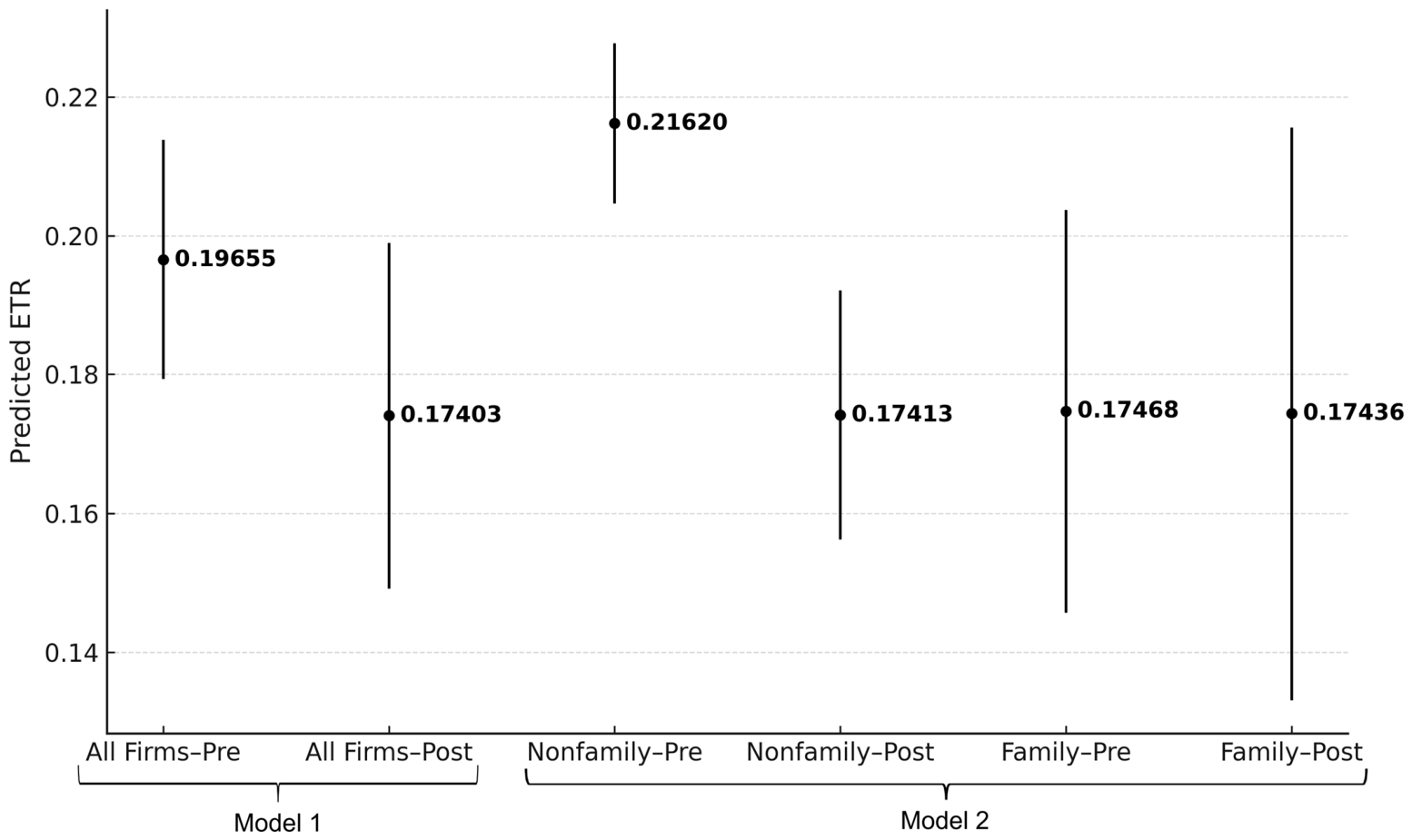
Table 6 reports the estimated predictive margins of ETR derived from the PCSE regressions, capturing the average fitted values across both the overall sample (Model 1) and subgroups defined by family ownership and the transfer pricing reform (Model 2). For Model 1, the average predicted ETR decreased from 19.66% in the pre-reform period to 17.40% post-reform. While this descriptive reduction appears meaningful, the associated coefficient for post-reform period (TPREFORM = 1) in the regression is not statistically significant (see Table 5), indicating that there is no conclusive evidence that the reform caused a change in the overall ETR. For Model 2, the margins reveal that, prior to the reform, nonfamily firms had a higher predicted ETR (21.62%) than family firms (17.47%). After the reform, the ETR for nonfamily firms dropped to 17.41%, while the ETR for family firms remained virtually unchanged at 17.44%. These margins are adjusted predictions holding covariates constant and confirm that the reduction in ETR was concentrated among nonfamily firms, while family firms exhibited behavioral rigidity in response to the reform.
Figure 1 illustrates the estimated predictive margins of ETR for both Model 1 (all firms, pre- vs. post-reform) and Model 2 (disaggregated by family vs. nonfamily firms and reform period), based on the results reported in Table 6.

4.2.3. Robustness Checks

Alternative dependent variable (BTD). As shown in Table 7, when BTD is employed as the dependent variable, the robustness tests for Models 1 and 2 provide weaker support for the patterns identified with ETR (Table 5). It is important to note that higher BTD reflects greater divergence between accounting and taxable income, which implies an opposite directional interpretation compared to ETR when assessing CIT minimization.
In the robustness test for Model 1, the coefficient for the post-reform period (TPREFORM = 1) is small and statistically insignificant (β = 0.0009, p > 0.10), indicating no meaningful effect of the reform on BTD across all firms, consistent with the nonsignificant result for TPREFORM in Model 1 using ETR. In contrast, the robustness test for Model 2 reveals that the coefficients for family firms in the pre-reform period (FAMILY = 1, TPREFORM = 0; β = 0.0054, p > 0.10) and nonfamily firms in the post-reform period (FAMILY = 0, TPREFORM = 1; β = 0.0029, p > 0.10) are statistically insignificant, thereby contradicting the significant reductions in ETR reported in Table 5. The coefficient for the interaction term (FAMILY × TPREFORM; β = −0.0042, p > 0.10) is also insignificant, which aligns with the ETR-based model, where the interaction was not significant at the 5% level. Regarding the control variables, the robustness tests largely confirm the patterns observed with ETR. These results underscore that the evidence of tax minimization effects depends on the proxy employed: while ETR reveals significant reductions associated with the transfer pricing reform—particularly among nonfamily firms—such patterns do not hold when BTD is used, highlighting the sensitivity of the findings to alternative measures of corporate tax behavior.
Robustness to the COVID-19 pandemic. Because the sample period (2018–2024) encompasses the COVID-19 pandemic, we re-estimated the main model including a dummy variable equal to one for the pandemic years (2020–2022) and zero otherwise. As shown in Table 8, the pandemic dummy is statistically insignificant (β = −0.013, p > 0.10), and the main findings remain stable: the coefficients for FAMILY, for the FAMILY × TPREFORM interaction, and for all control variables retain their sign, magnitude, and significance, and the model’s explanatory power is essentially unchanged. Linear combination tests confirm that the contrasts underlying our hypotheses are unchanged under the COVID-19 control: family firms exhibit significantly lower ETR than nonfamily firms before the reform (β = −0.041, p < 0.01) but not after (β = 0.001, p = 0.97); family firms show no significant pre–post change (β = −0.010, p = 0.69); and nonfamily firms significantly reduce their ETR following the reform (β = −0.052, p < 0.01). We note that, because the pandemic years fall entirely within the pre-reform period, the COVID-19 dummy captures within-period heterogeneity in the pre-reform era rather than an effect that can be cleanly separated from the reform indicator; it should therefore be interpreted as a control rather than as an estimate of the pandemic’s causal impact on tax behavior. Overall, these results indicate that our findings are not driven by the pandemic.

4.2.4. Nonparametric Evidence on International Transaction Volumes

The nonparametric analysis (Table 9) shows that nonfamily firms engage in significantly higher volumes of international transactions (z = 6.67; p < 0.001), reflecting their broader cross-border exposure.
This pattern helps explain the regression results (Table 5), where the post-reform reduction in ETR is observed only among nonfamily firms. The findings suggest that the stronger tax response of nonfamily firms to the transfer pricing reform is plausibly linked to their broader cross-border activity, consistent with financially driven incentives to minimize CIT.

5. Discussion

The findings reveal clear differences in the tax behavior of family and nonfamily firms prior to the implementation of Brazil’s new transfer pricing rules. During the pre-reform period (2018–2022), family firms consistently reported lower ETRs than their nonfamily counterparts, indicating a greater propensity toward aggressive CIT minimization, a pattern that echoes prior Brazilian evidence (Martinez & Ramalho, 2014; Viana et al., 2026b). Viewed through the lens of SEW (Berrone et al., 2012; Gómez-Mejía et al., 2007), this pre-reform behavior reflects a stable socioemotional priority—preserving resources and decision authority under family control—pursued through familiar practices whose reputational and enforcement costs were negligible in the Brazilian setting (Martinez & Ramalho, 2014). As an established practice rather than a consequential, novel strategic choice, it provides no basis, in our setting, for inferring an implicit orientation.
Following the reform (2023–2024), only nonfamily firms exhibited a significant reduction in ETR, a response that reflects their broader international exposure and the technical sophistication to exploit the planning opportunities afforded by the new principles-based regime. Typically more internationalized (Richardson et al., 2013; Carney et al., 2017), these firms operate extensively in the related-party cross-border transactions that transfer pricing rules govern, and thus stood to benefit from the regulatory shift toward alignment with the OECD’s arm’s length principle. By contrast, family firms showed no economically meaningful change in their ETRs after the reform, indicating a more inert stance. This inertia stems primarily from a structural feature: the limited international exposure that leaves family firms largely outside the scope of the cross-border activity the reform makes newly advantageous. That limited exposure is itself rooted in the desire to preserve SEW, especially in its control dimension (Arregle et al., 2012; Avrichir et al., 2016; Carney et al., 2017; Claver et al., 2009; Gómez-Mejía et al., 2007; Pinelli et al., 2025; Zona et al., 2022). As noted by Gómez-Mejía et al. (2010), international expansion often entails external financing and professionalization, both of which may dilute the family’s authority and introduce outside influence into strategic decisions. Pinelli et al. (2025) further argue that the degree of internationalization depends on the specific socioemotional priorities upheld: while legacy preservation and long-term orientation may support global growth, a strong emphasis on control—reflected in concentrated ownership, family-dominated governance, and resistance to external advisors—tends to constrain it. In sum, the same control-driven priority that historically limited family firms’ internationalization now leaves them structurally unprepared to capitalize on the reform.
Taken together, our evidence is consistent with a single, stable preference—the preservation of family control—producing different behaviors across the two regulatory regimes. Before the reform, domestic CIT minimization served control at negligible cost; after it, further minimization runs through deeper cross-border engagement, which family owners tend to perceive as diluting control (Gómez-Mejía et al., 2010; Pinelli et al., 2025). The regime change altered which behavior serves the family’s dominant priority, not the priority itself. It is only this post-reform choice—declining an available adaptation whose price is internationalization—that we interpret as consistent with an entity-based implicit theory orientation among high-SEW family owners (Gómez-Mejía et al., 2026).
The nonparametric analysis of international transaction volumes provides additional evidence for the post-reform pattern. Nonfamily firms conducted significantly more cross-border operations, reflecting broader international exposure and stronger incentives to adjust transfer pricing strategies. While this measure does not capture all facets of internationalization, it serves as a reliable proxy for exposure to complex, tax-sensitive foreign activities. The comparatively lower participation of family firms provides direct evidence of the limited international exposure that underlies their inertia, an exposure constrained by the control-centered SEW priority discussed above, and consistent with the entity orientation we infer from their post-reform behavior.
Importantly, the differentiated effects of the reform only became evident once the analysis accounted for ownership structure. When examining the full sample of firms without distinguishing between family and nonfamily firms, the results did not reveal a meaningful impact of the reform on CIT minimization. It was only through the ownership-based split that the distinct behavioral responses to the reform emerged: nonfamily firms exhibited a significant increase in CIT minimization, whereas family firms maintained pre-reform behavior. This finding underscores the analytical value of disaggregating firms based on ownership and control structure—specifically, whether they are family or nonfamily businesses—given the well-documented behavioral differences between these groups in the academic literature. Without this separation, the heterogeneous responses to regulatory change would remain concealed, limiting the explanatory power and policy relevance of the analysis.
The robustness analysis using BTD, however, presents a contrasting outcome. Although the same PCSE specification was applied, the model with BTD as the dependent variable did not produce statistically significant results for the key explanatory variables, diverging from the findings based on ETR. This difference is both conceptually and empirically grounded. ETR is a directly observed measure of the firm’s actual tax burden and tends to reflect current tax planning actions, especially those involving the timing of tax recognition (Hanlon & Heitzman, 2010). In contrast, BTD captures the difference between financial and taxable income, an indirect construct that is more vulnerable to measurement error, discretionary reporting choices, and temporary differences (Hanlon & Heitzman, 2010). These elements reinforce the view that BTD-based estimates should serve as complementary robustness checks, rather than replications of the primary ETR-based analysis.

6. Conclusions and Implications

The objective of this article is to analyze whether Brazil’s 2023 transfer pricing reform has affected the CIT minimization behavior of family and nonfamily firms. Grounded in the blended perspective of SEW and implicit theories (Gómez-Mejía et al., 2026), we propose that ownership structure may condition firms’ tax responses to institutional change. Specifically, we test whether the reform produced distinct effects on CIT minimization for family versus nonfamily firms, based on the premise that family firms exhibit distinct socioemotional priorities, decision-making logics, and risk preferences (Berrone et al., 2012; Gómez-Mejía et al., 2007, 2026).
Utilizing a sample of 1239 firm-year observations from 177 nonfinancial Brazilian companies listed on B3 between 2018 and 2024, we employed PCSE regression models to test whether Brazil’s 2023 transfer pricing reform affected CIT minimization behavior differently in family firms compared with nonfamily firms. The results show that, following the reform, nonfamily firms significantly reduced their ETR, evidencing increased CIT minimization in this group under the OECD-aligned rules, as hypothesized for the more internationally exposed group. In contrast, family firms exhibited no significant change in ETR, in line with our prediction that their control-centered priorities would leave their tax behavior unchanged. At the aggregate level, no significant effect emerged for the full sample, consistent with our expectation that the response of nonfamily firms would be diluted by the unchanged behavior of family firms when ownership structure is not taken into account.
Overall, these findings indicate that, following the 2023 transfer pricing reform, nonfamily firms responded more proactively to the new regulatory environment, lowering their effective tax burden. This outcome challenges the Brazilian government’s expectation that the new OECD-aligned rules would effectively curb profit shifting and safeguard the domestic tax base (Ministry of the Economy, 2022). In contrast, family firms exhibited more rigid behavior, with no significant changes in their tax behavior. This pattern appears to reflect not only structural factors, such as lower international exposure, but also an entity-oriented cognitive frame among family firms, inferred from the refusal of an available adaptation whose route—deeper cross-border engagement—threatens the control they most value. Within this blended SEW–implicit theory perspective (Gómez-Mejía et al., 2026), adapting to the reform would require the very cross-border engagement that family owners associate with a loss of control, so preserving the status quo, rather than pursuing the available tax advantage, becomes the behavior that protects their dominant priority.
This study makes both theoretical and practical contributions. Theoretically, it extends the blended SEW–implicit theory framework (Gómez-Mejía et al., 2026) to the setting of a tax reform, showing how the control-centered socioemotional priorities of family firms, expressed in limited internationalization, condition their tax response to institutional change, and how an entity orientation can be inferred indirectly from that response. Practically, the findings carry implications for both policymakers and firms. For policymakers and tax administrations, the findings indicate that standardized enforcement may yield uneven outcomes across ownership types, highlighting the need for differentiated policy approaches. For family firms themselves, the results show that a control-driven reluctance to internationalize now carries a tangible tax cost, as nonfamily competitors exploit the new regime to lower their effective tax burden; recognizing this trade-off may help family owners weigh the long-term competitive implications of preserving control against the benefits of broader cross-border engagement. Tailored strategies can help reconcile the two, addressing the structural and strategic particularities of family firms to foster international engagement while safeguarding the control that underpins their long-term competitiveness.
A few limitations should nonetheless be acknowledged. First, the post-reform window is short, covering only 2023 and 2024, a period during which the new regime was optional in its first year and mandatory thereafter; this restricts our ability to capture longer-term adjustments to the reform. Second, our central mechanism—international exposure—is captured indirectly, through a nonparametric analysis of cross-border transaction volumes rather than through measures integrated into the regression models. Third, the cognitive orientation central to our interpretive framework is not measured directly but inferred indirectly from firms’ tax-behavior responses; we therefore interpret it as consistent with, rather than as direct evidence of, an entity orientation. Finally, the focus on Brazilian nonfinancial listed firms limits generalizability to private, financial, or other institutional contexts.
Future research could deepen the understanding of the mechanisms driving family firms’ differentiated responses to transfer pricing reforms by incorporating indicators of internationalization directly into the regression analysis, such as the presence of international subsidiaries and the volume of cross-border intragroup transactions. These metrics could help assess how varying levels of global exposure shape firms’ ability to engage with complex tax frameworks.
Building on Gómez-Mejía et al. (2026), future studies could also explore how internal heterogeneity among Brazilian family firms—particularly in ownership concentration, generational stage, and governance professionalization—interacts with implicit cognitive orientations. For instance, firms with more professionalized management and lower salience of family control concerns may be more likely to adopt an incremental mindset, fostering openness to institutional change and more strategic exploitation of OECD-aligned transfer pricing rules.
Moreover, longitudinal designs could examine whether the behavioral rigidity observed here persists or erodes over time. As nonfamily firms exploit the new regime more effectively, family firms may face growing competitive pressure that gradually offsets their reluctance to expand cross-border operations. Should they respond by building the internationalization capabilities required to navigate the OECD-aligned rules, a resource-based view of the firm could offer a complementary lens for understanding such an evolution, including whether family firms eventually come to engage with the reform as actively as their nonfamily counterparts.

Supplementary Materials

The following supporting information can be downloaded at: https://www.mdpi.com/article/10.3390/admsci16070330/s1. Supplementary File: replication package (compressed archive containing the panel dataset, the Stata do-files for the regression analyses, the output files for all models, and a README.txt file describing the contents). The do-file and the underlying international transaction data for the complementary nonparametric analysis are not included, as they rely on a confidential corporate tax reporting system.

Author Contributions

Conceptualization, C.V., S.C. and A.D.; methodology, C.V.; validation, C.V.; formal analysis, C.V.; investigation, C.V.; resources, C.V.; data curation, C.V.; writing—original draft preparation, C.V.; writing—review and editing, C.V., S.C. and A.D.; visualization, C.V.; supervision, S.C. and A.D.; project administration, S.C. and A.D. All authors have read and agreed to the published version of the manuscript.

Funding

This research received no external funding.

Institutional Review Board Statement

Not applicable.

Informed Consent Statement

Not applicable.

Data Availability Statement

The dataset, estimation code, and output files supporting the main results are provided as Supplementary Materials. The confidential international transaction data used in the nonparametric analysis cannot be shared (see Section 3).

Conflicts of Interest

The authors declare no conflicts of interest.

Notes

1
The term CIT minimization refers to corporate income tax behaviors such as tax planning, tax avoidance, tax aggressiveness, tax evasion, and other strategies aimed at reducing tax liabilities (Anesa et al., 2019).
2
Within the Brazilian setting, transfer pricing refers to the pricing of goods, services, and intangibles exchanged between related entities located in different countries (Gauß et al., 2024; Hanlon & Heitzman, 2010; OECD, 2022). These prices must comply with the arm’s length principle, which requires that entities belonging to the same corporate group set their transactions as if they were independent, so that intra-group amounts mirror those charged in comparable transactions between unrelated parties (Devereux & Vella, 2014; Gauß et al., 2024; OECD, 2022).

References

  1. Ajmal, T. K., Singhal, A., Kumar, V., & Atawnah, N. (2026). Family firms and tax avoidance preferences: Evidence from India. Emerging Markets Review, 70, 101410. [Google Scholar] [CrossRef] [Scilit]
  2. Almaharmeh, M. I., Shehadeh, A., Alkayed, H., Aladwan, M., & Iskandrani, M. (2024). Family ownership, corporate governance quality and tax avoidance: Evidence from an emerging market—The case of Jordan. Journal of Risk and Financial Management, 17(2), 86. [Google Scholar] [CrossRef] [Scilit]
  3. Amin, A., Ali, R., Rehman, R. U., & Elamer, A. (2025). The role of family owners, family founders, and non-family CEOs in shaping tax avoidance behavior. Journal of Sustainable Finance and Accounting, 8, 100027. [Google Scholar] [CrossRef] [Scilit]
  4. Amin, A., Ali, R., Rehman, R. U., & Hasan, M. (2024). Family ownership, control, and firm performance: Does gender diversity matter? Eurasian Business Review, 14, 501–525. [Google Scholar] [CrossRef] [Scilit]
  5. Anesa, M., Gillespie, N., Spee, A. P., & Sadiq, K. (2019). The legitimation of corporate tax minimization. Accounting, Organizations and Society, 75, 17–39. [Google Scholar] [CrossRef] [Scilit]
  6. Aragon-Amonarriz, C., Iturrioz-Landart, C., Mínguez, R., Minondo, A., & Requena, F. (2025). Are family firms’ export relationships more persistent? Journal of Family Business Strategy, 16(1), 100649. [Google Scholar] [CrossRef] [Scilit]
  7. Arregle, J.-L., Calabrò, A., Hitt, M. A., Kano, L., & Schwens, C. (2024). Family business and international business: Breaking silos and establishing a rigorous way forward. Journal of World Business, 59(3), 101532. [Google Scholar] [CrossRef] [Scilit]
  8. Arregle, J.-L., Chirico, F., Kano, L., Kundu, S. K., Majocchi, A., & Schulze, W. S. (2021). Family firm internationalization: Past research and an agenda for the future. Journal of International Business Studies, 52, 1159–1198. [Google Scholar] [CrossRef] [Scilit]
  9. Arregle, J.-L., Naldi, L., Nordqvist, M., & Hitt, M. A. (2012). Internationalization of family-controlled firms: A study of the effects of external involvement in governance. Entrepreneurship Theory and Practice, 36(6), 1115–1143. [Google Scholar] [CrossRef] [Scilit]
  10. Avrichir, I., Meneses, R., & dos Santos, A. A. (2016). Do family-managed and non-family-managed firms internationalize differently? Journal of Family Business Management, 6(3), 330–349. [Google Scholar] [CrossRef] [Scilit]
  11. Baumann, F., & Friehe, T. (2013). Profit shifting despite symmetric tax rates? A note on the role of tax enforcement. International Economic Journal, 27(1), 97–108. [Google Scholar] [CrossRef] [Scilit]
  12. Bauweraerts, J., Cirillo, A., & Sciascia, S. (2024). Socioemotional wealth and tax aggressiveness in private family firms: The role of the CEO’s characteristics. Family Business Review, 37(3), 370–395. [Google Scholar] [CrossRef] [Scilit]
  13. Bauweraerts, J., Vandernoot, J., & Buchet, A. (2020). Family firm heterogeneity and tax aggressiveness: A mixed gamble approach. Canadian Journal of Administrative Sciences, 37(2), 149–163. [Google Scholar] [CrossRef] [Scilit]
  14. Beck, N., & Katz, J. N. (1995). What to do (and not to do) with time-series cross-section data. American Political Science Review, 89(3), 634–647. [Google Scholar] [CrossRef] [Scilit]
  15. Belahouaoui, R., & Attak, E. H. (2024). Analysis of tax compliance behavior of family businesses: Combining social and psychology norms and legitimacy determinants. International Journal of Sociology and Social Policy, 44(7–8), 672–688. [Google Scholar] [CrossRef] [Scilit]
  16. Benkraiem, R., Lakhal, F., & Slama, A. (2024). How does the heterogeneity of institutional investors influence corporate tax avoidance? The moderating role of family ownership. International Journal of Managerial Finance, 20(5), 1144–1169. [Google Scholar] [CrossRef] [Scilit]
  17. Berrone, P., Cruz, C., & Gomez-Mejia, L. R. (2012). Socioemotional wealth in family firms: Theoretical dimensions, assessment approaches, and agenda for future research. Family Business Review, 25(3), 258–279. [Google Scholar] [CrossRef] [Scilit]
  18. Brazil. (2023). Law No. 14,596, of June 14, 2023 [Provides for transfer pricing rules relating to the Corporate Income Tax (IRPJ) and the Social Contribution on Net Profit (CSLL)]. Diário Oficial da União. Available online: https://www.planalto.gov.br/ccivil_03/_ato2023-2026/2023/lei/l14596.htm (accessed on 14 May 2026).
  19. Brune, A., Thomsen, M., & Watrin, C. (2019). Family firm heterogeneity and tax avoidance: The role of the founder. Family Business Review, 32(3), 296–317. [Google Scholar] [CrossRef] [Scilit]
  20. Cano-Rubio, M., Fuentes-Lombardo, G., & Sanchez-Famoso, V. (2021). Family involvement as influencer on family firm’s growth. Journal of International Entrepreneurship, 19, 510–537. [Google Scholar] [CrossRef] [Scilit]
  21. Cao, F., Li, S., Dai, M., & Li, J. (2023). Your heart is where your treasure is: Family chairman and tax avoidance in family-controlled firms. Journal of Business Research, 154, 113298. [Google Scholar] [CrossRef] [Scilit]
  22. Carney, M., Duran, P., van Essen, M., & Shapiro, D. (2017). Family firms, internationalization, and national competitiveness: Does family firm prevalence matter? Journal of Family Business Strategy, 8(3), 123–136. [Google Scholar] [CrossRef] [Scilit]
  23. Chakroun, S., & Ben Amar, A. (2025). The IFRS adoption, corporate tax avoidance and the moderating effect of family ownership. International Journal of Law and Management, 67(1), 16–36. [Google Scholar] [CrossRef] [Scilit]
  24. Chen, M.-C., & Li, H.-Y. (2026). Are Taiwanese descendant family firms more aggressive in tax avoidance? Asia-Pacific Journal of Accounting & Economics, 33(2), 321–338. [Google Scholar] [CrossRef] [Scilit]
  25. Chen, S., Chen, X., Cheng, Q., & Shevlin, T. (2010). Are family firms more tax aggressive than non-family firms? Journal of Financial Economics, 95(1), 41–61. [Google Scholar] [CrossRef] [Scilit]
  26. Cho, H. (2020). Sustainable tax behavior of MNEs: Effect of international tax law reform. Sustainability, 12(18), 7738. [Google Scholar] [CrossRef] [Scilit]
  27. Cho, S.-A., Kim, S., & Choi, W.-W. (2025). Unified or divided? Conflicting interests of controlling shareholders in corporate tax avoidance. Emerging Markets Review, 68, 101339. [Google Scholar] [CrossRef] [Scilit]
  28. Claver, E., Rienda, L., & Quer, D. (2009). Family firms’ international commitment: The influence of family-related factors. Family Business Review, 22(2), 125–135. [Google Scholar] [CrossRef] [Scilit]
  29. D’Allura, G. M., Calabrò, A., Bannò, M., & Pisano, V. (2025). Family firms’ equity entry modes: Bridging family business and international business. Journal of Management & Organization, 31(3), 1580–1600. [Google Scholar] [CrossRef] [Scilit]
  30. de Oliveira, R. M., Pimenta, D. P., Ferreira, M. P., & Ribeiro, A. M. (2022). Analysis of corporate acquisition on executive compensation: A study between Brazilian family and non-family firms. Enfoque: Reflexão Contábil, 41(1), 131–146. [Google Scholar] [CrossRef] [Scilit]
  31. Devereux, M. P., & Vella, J. (2014). Are we heading towards a corporate tax system fit for the 21st century? Fiscal Studies, 35(4), 449–475. [Google Scholar] [CrossRef] [Scilit]
  32. Diaz-Moriana, V., Moreno-Menendez, A. M., Casillas, J. C., & Arzubiaga, U. (2025). Family firms’ internationalization: A pathway to long-term legitimacy. Review of International Business and Strategy, 35(2–3), 165–189. [Google Scholar] [CrossRef] [Scilit]
  33. Eddleston, K. A., & Mulki, J. P. (2021). Differences in family-owned SMEs’ ethical behavior: A mixed gamble perspective of family firm tax evasion. Entrepreneurship: Theory and Practice, 45(4), 767–791. [Google Scholar] [CrossRef] [Scilit]
  34. Gaaya, S., Lakhal, N., & Lakhal, F. (2017). Does family ownership reduce corporate tax avoidance? The moderating effect of audit quality. Managerial Auditing Journal, 32(7), 731–744. [Google Scholar] [CrossRef] [Scilit]
  35. Gauß, P., Kortenhaus, M., Riedel, N., & Simmler, M. (2024). Leveling the playing field: Constraints on multinational profit shifting and the performance of national firms. Journal of Public Economics, 234, 105116. [Google Scholar] [CrossRef] [Scilit]
  36. Godoi, M., & Furman, M. (2025). The Brazilian reform of transfer pricing rules: Complying with the OECD’s standards. Acta Universitatis Lodziensis. Folia Iuridica, 110, 97–107. [Google Scholar] [CrossRef] [Scilit]
  37. Gómez-Mejía, L. R., Chirico, F., Withers, M. C., Martin, G. P., & Wiseman, R. M. (2026). Are family owners willing to risk “rocking the boat”? A blended socioemotional wealth–implicit theory framework. Journal of Management, 52(4), 1602–1630. [Google Scholar] [CrossRef] [Scilit]
  38. Gómez-Mejía, L. R., Haynes, K. T., Núñez-Nickel, M., Jacobson, K. J. L., & Moyano-Fuentes, J. (2007). Socioemotional wealth and business risks in family-controlled firms: Evidence from Spanish olive oil mills. Administrative Science Quarterly, 52(1), 106–137. [Google Scholar] [CrossRef] [Scilit]
  39. Gómez-Mejía, L. R., Makri, M., & Kintana, M. L. (2010). Diversification decisions in family-controlled firms. Journal of Management Studies, 47(2), 223–252. [Google Scholar] [CrossRef] [Scilit]
  40. Gregorio, R. M. (2018). Country note: Brazilian transfer pricing rules: An analysis of effectiveness. Intertax, 46(11), 914–929. [Google Scholar] [CrossRef] [Scilit]
  41. Hanlon, M., & Heitzman, S. (2010). A review of tax research. Journal of Accounting and Economics, 50(2–3), 127–178. [Google Scholar] [CrossRef] [Scilit]
  42. Kartadjumena, E., & Nuryaman, N. (2024). Ownership structures, executive compensation and tax aggressiveness in Indonesia mining and plantation companies: The moderating effect of audit quality. International Journal of Economics and Financial Issues, 14(3), 23–32. [Google Scholar] [CrossRef] [Scilit]
  43. Kerr, J. N., Price, R., Román, F. J., & Romney, M. A. (2024). Corporate governance and tax avoidance: Evidence from governance reform. Journal of Accounting and Public Policy, 47, 107232. [Google Scholar] [CrossRef] [Scilit]
  44. Khelil, I., & Khlif, H. (2023). Tax avoidance in family firms: A literature review. Journal of Financial Crime, 30(4), 1021–1035. [Google Scholar] [CrossRef] [Scilit]
  45. Kuo, C.-S. (2022). Family firms, tax avoidance, and socioemotional wealth: Evidence from tax reform in Taiwan. Review of Quantitative Finance and Accounting, 58(4), 1535–1572. [Google Scholar] [CrossRef] [Scilit]
  46. Lee, C.-H., & Bose, S. (2021). Do family firms engage in less tax avoidance than non-family firms? The corporate opacity perspective. Journal of Contemporary Accounting and Economics, 17(2), 100263. [Google Scholar] [CrossRef] [Scilit]
  47. Lohe, F.-W., Calabrò, A., & Torchia, M. (2021). Disentangling the drivers of family firms’ internationalization through the lens of socioemotional wealth. Journal of International Entrepreneurship, 19, 479–509. [Google Scholar] [CrossRef] [Scilit]
  48. López-González, E., Martínez-Ferrero, J., & García-Meca, E. (2019). Does corporate social responsibility affect tax avoidance: Evidence from family firms. Corporate Social Responsibility and Environmental Management, 26(4), 819–831. [Google Scholar] [CrossRef] [Scilit]
  49. Mafrolla, E., & D’Amico, E. (2016). Tax aggressiveness in family firms and the non-linear entrenchment effect. Journal of Family Business Strategy, 7(3), 178–184. [Google Scholar] [CrossRef] [Scilit]
  50. Martinez, A. L., & Ramalho, G. C. (2014). Family firms and tax aggressiveness in Brazil. International Business Research, 7(3), 129–136. [Google Scholar] [CrossRef] [Scilit]
  51. Mescall, D., & Klassen, K. J. (2018). How does transfer pricing risk affect premiums in cross-border mergers and acquisitions? Contemporary Accounting Research, 35(2), 830–865. [Google Scholar] [CrossRef] [Scilit]
  52. Ministry of the Economy. (2022). Explanatory statement No. 448/2022—Provisional measure No. 1152 of December 28, 2022. Available online: https://www.planalto.gov.br/ccivil_03/_Ato2019-2022/2022/Exm/Exm-Mpv-1152-22.pdf (accessed on 14 May 2026).
  53. OECD. (2022). OECD transfer pricing guidelines for multinational enterprises and tax administrations 2022. OECD Publishing. [Google Scholar] [CrossRef] [Scilit]
  54. Özbay, D., Adıgüzel, H., & Karahan Gökmen, M. (2023). Corporate social responsibility and tax avoidance: Channeling effect of family firms. Journal of Corporate Accounting & Finance, 34(3), 11–30. [Google Scholar] [CrossRef] [Scilit]
  55. Pinelli, M., Debellis, F., Caputo, M., & Moscato, M. T. (2025). Decomposing socioemotional wealth: The effect of restricted and extended socioemotional priorities on family firms’ internationalization. Review of International Business and Strategy, 35(2/3), 144–164. [Google Scholar] [CrossRef] [Scilit]
  56. Rathke, A. A. T. (2021). Profit shifting in Brazil and the impact of tax havens. Revista Contabilidade & Finanças, 32(85), 95–108. [Google Scholar] [CrossRef] [Scilit]
  57. Rathke, A. A. T., & Lima e Alves, D. (2025). Investigating the substitution across profit shifting channels: A study in Brazil. International Journal of the Economics of Business, 32(2), 275–293. [Google Scholar] [CrossRef] [Scilit]
  58. Rathke, A. A. T., Rezende, A. J., & Watrin, C. (2021). The impact of countries’ transfer pricing rules on profit shifting. Journal of Applied Accounting Research, 22(1), 22–49. [Google Scholar] [CrossRef] [Scilit]
  59. Richardson, G., Taylor, G., & Lanis, R. (2013). Determinants of transfer pricing aggressiveness: Empirical evidence from Australian firms. Journal of Contemporary Accounting & Economics, 9(2), 136–150. [Google Scholar] [CrossRef] [Scilit]
  60. Santos, T. R., & Silva, J. O. (2018). Does the influence of the family have any effect? Analysis of the remuneration of executives of family and nonfamily companies. Revista de Contabilidade e Organizações, 12, e148149. [Google Scholar] [CrossRef] [Scilit]
  61. Sánchez-Marín, G., Portillo-Navarro, M.-J., & Clavel, J. G. (2016). The influence of family involvement on tax aggressiveness of family firms. Journal of Family Business Management, 6(2), 143–168. [Google Scholar] [CrossRef] [Scilit]
  62. Shi, X., Hou, J., & Gu, Q. (2023). In-laws’ involvement in management and tax avoidance: Evidence from family firms in China. Finance Research Letters, 53, 103646. [Google Scholar] [CrossRef] [Scilit]
  63. Sikka, P., & Willmott, H. (2010). The dark side of transfer pricing: Its role in tax avoidance and wealth retentiveness. Critical Perspectives on Accounting, 21(4), 342–356. [Google Scholar] [CrossRef] [Scilit]
  64. Skorodziyevskiy, V., Sherlock, C., Su, E., Chrisman, J. J., & Dibrell, C. (2024). Strategic change in family firms: A review from an institutional environment and firm size perspective. Family Business Review, 37(1), 130–160. [Google Scholar] [CrossRef] [Scilit]
  65. Souguir, Z., Lassoued, N., & Bouzgarrou, H. (2024). CEO overconfidence and tax avoidance: Role of institutional and family ownership. International Journal of Managerial Finance, 20(3), 768–793. [Google Scholar] [CrossRef] [Scilit]
  66. Steijvers, T., & Niskanen, M. (2014). Tax aggressiveness in private family firms: An agency perspective. Journal of Family Business Strategy, 5(4), 347–357. [Google Scholar] [CrossRef] [Scilit]
  67. Swab, R. G., Sherlock, C., Markin, E., & Dibrell, C. (2020). “SEW” What do we know and where do we go? A review of socioemotional wealth and a way forward. Family Business Review, 33(4), 424–445. [Google Scholar] [CrossRef] [Scilit]
  68. Taylor, G., & Richardson, G. (2012). International corporate tax avoidance practices: Evidence from Australian firms. The International Journal of Accounting, 47(4), 469–496. [Google Scholar] [CrossRef] [Scilit]
  69. Viana, C., Cruz, S., & Dinis, A. (2026a). Bridging theoretical assumptions and empirical evidence on family firms’ tax behavior: A systematic review. Journal of Risk and Financial Management, 19(2), 125. [Google Scholar] [CrossRef] [Scilit]
  70. Viana, C., Cruz, S., & Dinis, A. (2026b). Family firms’ tax behavior: The role of real earnings management. Revista Contabilidade & Finanças. Advance online publication. [Google Scholar] [CrossRef] [Scilit]
  71. Zona, F., Bannò, M., & Coller, G. (2022). International expansion and firm growth in domestic markets: Family versus non-family firms. Family Business Review, 35(2), 159–183. [Google Scholar] [CrossRef] [Scilit]
Figure 1. Estimated predictive margins of ETR.
Admsci 16 00330 g001
Table 1. Step-by-step exclusion process of companies for analysis.
StepsExclusion CriteriaExcludedRemaining
Initial sample 375
Exclusion 1Financial companies were excluded30345
Exclusion 2Companies with missing current tax data in any year from 2018 to 2024 were excluded67278
Exclusion 3Companies with both current tax and deferred tax equal to zero in any year from 2018 to 2024 were excluded22256
Exclusion 4Companies with a positive total tax (current + deferred) and negative pretax income in the same year, in any year from 2018 to 2024, were excluded74182
Exclusion 5Companies undergoing judicial recovery in any year from 2018 to 2022 were excluded5177
Table 2. Descriptive statistics.
95% Confidence
Interval
Percentiles
TPREFORMNMeanLower
Limit
Upper
Limit
SDMinMax25th50th75th
ETR08850.210.190.220.17−0.360.680.110.220.31
13540.180.160.200.22−0.480.690.080.200.29
ROA08856.696.107.278.90−73.94107.672.865.759.67
13545.945.236.656.79−39.4530.062.795.539.82
LEV08850.360.330.380.340.004.440.170.320.47
13540.360.320.390.350.004.330.190.330.47
PPPE08850.230.220.250.210.000.890.040.200.37
13540.230.210.250.210.000.850.030.190.35
PINT08850.140.120.150.180.000.820.010.050.20
13540.130.120.150.170.000.760.010.060.18
NLTAS088522.0921.9722.221.9116.9827.6220.8022.1123.31
135422.5422.3522.741.8817.9427.7521.1922.4923.76
Notes: The dataset includes 630 year-observations for nonfamily firms and 609 for family firms. ETR stands for total effective tax rate; ROA, for return on assets; LEV, for Leverage; PPPE, for proportion of plant, property, and equipment; PINT, for proportion of intangibles; NLTAS, for natural logarithm of total assets.
Table 3. Pearson correlation matrix for independent variables.
ROALEVPINTPPPEFAMILYNLTASTPREFORM
ROA1.000
LEV−0.440 ***1.000
PINT−0.056 **0.0161.000
PPPE−0.113 ***0.117 ***−0.304 ***1.000
FAMILY−0.092 ***−0.002−0.265 ***−0.0011.000
NLTAS−0.064 **0.117 ***0.154 ***0.130 ***−0.215 ***1.000
TPREFORM−0.0400.000−0.005−0.0020.0000.107 ***1.000
Notes: ** p < 0.05; *** p < 0.01 (two-tailed). N = 1239 firm-year observations. ROA stands for return on assets; LEV, for leverage; PINT, for proportion of intangibles; PPPE, for proportion of plant, property, and equipment; FAMILY, for family firms; NLTAS, for natural logarithm of total assets; TPREFORM, for Brazilian transfer pricing reform.
Table 4. Variance inflation factors (VIF).
VIF1/VIF
ROA1.280.782
LEV1.260.794
PINT1.240.805
PPPE1.170.852
FAMILY1.140.880
NLTAS1.120.894
TPREFORM1.020.985
Mean VIF1.18
Notes: ROA stands for return on assets; LEV, for leverage; PINT, for proportion of intangibles; PPPE, for proportion of plant, property, and equipment; FAMILY, for family firms; NLTAS, for natural logarithm of total assets; TPREFORM, for Brazilian transfer pricing reform. Mean VIF is the arithmetic mean of the individual VIF values reported in the table; 1/VIF denotes the tolerance (the reciprocal of each VIF).
Table 5. PCSE regressions on ETR.
VariableModel 1Model 2
Intercept0.3434 ***0.4043 ***
Post-reform period (TPREFORM = 1)−0.0225
Family firms pre-reform period (FAMILY = 1, TPREFORM = 0) −0.0415 ***
Nonfamily firms post-reform period (FAMILY = 0, TPREFORM = 1) −0.0421 ***
Reform’s additional effect on family firms (FAMILY × TPREFORM) 0.0418 *
Return on assets (ROA)−0.0019 ***−0.0021 ***
Leverage (LEV)−0.0266−0.0312
Proportion of plant, property, and equipment (PPPE)0.04520.0368
Proportion of intangibles (PINT)0.1305 ***0.1103 ***
Natural logarithm of total assets (NLTAS)−0.0069 ***−0.0084 ***
Observations12391239
Nr. of groups177177
Balanced panelyesyes
R-squared0.250.27
Wald chi2113.30 ***127.78 ***
Notes: All models were estimated using Prais–Winsten regression with panel-corrected standard errors (PCSE), accounting for panel-specific AR(1) autocorrelation and cross-sectional correlation. The panel is balanced, with each group observed over the same number of periods. Standard errors are robust to heteroskedasticity and contemporaneous correlation. * p < 0.10; *** p < 0.01.
Table 6. Estimated predictive margins of ETR.
95% Confidence Interval
MarginSEzp > |z|Lower LimitUpper Limit
TPREFORM (Model 1)
00.1965510.00880422.320.00000.1792950.213808
10.1740350.01272713.670.00000.1490910.198978
FAMILY × TPREFORM (Model 2)
0 × 00.2161990.00589236.690.00000.2046500.227747
0 × 10.1741260.00911619.100.00000.1562590.191994
1 × 00.1746760.01481511.790.00000.1456400.203713
1 × 10.1743590.0210408.290.00000.1331210.215596
Table 7. PCSE regressions on BTD.
VariableRobustness Test for Model 1Robustness Test for Model 2
Intercept−0.0307−0.0384 *
Post-reform period (TPREFORM = 1)0.0009
Family firms pre-reform period (FAMILY = 1, TPREFORM = 0) 0.0054
Nonfamily firms post-reform period (FAMILY = 0, TPREFORM = 1) 0.0029
Reform’s additional effect on family firms (FAMILY × TPREFORM) −0.0042
Return on assets (ROA)0.0031 ***0.0031 ***
Leverage (LEV)−0.0012−0.0010
Proportion of plant, property, and equipment (PPPE)−0.0166−0.0155
Proportion of intangibles (PINT)−0.0391 ***−0.0358 ***
Natural logarithm of total assets (NLTAS)0.0025 ***0.0027 ***
Observations12391239
Nr. of groups177177
Balanced panelyesyes
R-squared0.350.34
Wald chi2151.95 ***158.19 ***
Notes: All models were estimated using Prais–Winsten regression with panel-corrected standard errors (PCSE), accounting for panel-specific AR(1) autocorrelation and cross-sectional correlation. The panel is balanced, with each group observed over the same number of periods. Standard errors are robust to heteroskedasticity and contemporaneous correlation. * p < 0.10; *** p < 0.01.
Table 8. PCSE regressions on ETR.
VariableBaseline ModelModel with COVID-19 Control
Intercept0.4043 ***0.3966 ***
Family firms pre-reform period (FAMILY = 1, TPREFORM = 0)−0.0415 ***−0.0408 ***
Nonfamily firms post-reform period (FAMILY = 0, TPREFORM = 1)−0.0421 ***−0.0518 ***
Reform’s additional effect on family firms (FAMILY × TPREFORM)0.0418 *0.0416 *
Return on assets (ROA)−0.0021 ***−0.0021 ***
Leverage (LEV)−0.0312−0.0325
Proportion of plant, property, and equipment (PPPE)0.03680.0325
Proportion of intangibles (PINT)0.1103 ***0.1089 ***
Natural logarithm of total assets (NLTAS)−0.0084 ***−0.0077 ***
COVID-19 pandemic period (COVID = 1, 2020–2022) −0.0131
Observations12391239
Nr. of groups177177
Balanced panelyesyes
R-squared0.270.27
Wald chi2127.78 ***189.31 ***
Notes: All models were estimated using Prais–Winsten regression with panel-corrected standard errors (PCSE), accounting for panel-specific AR(1) autocorrelation and cross-sectional correlation. The panel is balanced, with each group observed over the same number of periods. Standard errors are robust to heteroskedasticity and contemporaneous correlation. * p < 0.10; *** p < 0.01.
Table 9. Wilcoxon–Mann–Whitney test: International transaction volumes (BRL million)—family vs. nonfamily firms.
Firm-Year ObservationsRank SumExpected
Nonfamily630431,956.0390,600.0
Family609336,224.0377,580.0
Combined1239768,180.0768,180.0
Notes: Results indicate a statistically significant difference (z = 6.67; p < 0.001). Variance: unadjusted = 39,645,900; adjustment for ties = −1,198,791.8; adjusted = 38,447,108.
Disclaimer/Publisher’s Note: The statements, opinions and data contained in all publications are solely those of the individual author(s) and contributor(s) and not of MDPI and/or the editor(s). MDPI and/or the editor(s) disclaim responsibility for any injury to people or property resulting from any ideas, methods, instructions or products referred to in the content.