1. Introduction
Social media gives users access to more information than ever before, and many users now encounter news through social platforms rather than through conventional news sources (
Jun et al., 2017). Recent initiatives have attempted to limit the spread of unreliable content by combining algorithmic detection with human moderation. However, technical solutions alone remain insufficient. Platforms continue to adjust the algorithms that prioritize and promote particular types of content and behavior, while media literacy remains necessary to help users understand and critically evaluate the information presented to them (
Jun et al., 2017).
Public discourse is increasingly mediated by online platforms. Their algorithms help users navigate social networks, follow public conversations, and keep up with important news. However, these same systems may also create filter bubbles that distort reality, reduce exposure to opposing views, and fragment the public sphere (
Flaxman et al., 2016). In such an environment, ambiguity can combine with social pressure and algorithmic amplification to create information cascades, in which users share information with little assurance of its accuracy.
Although inaccurate information can be described as misinformation or disinformation, disinformation specifically implies an intent to deceive (
Appelman et al., 2022). Empirical research suggests that exposure to emotionally-valenced content on social media can shape users’ subsequent emotional expression (
Ferrara & Yang, 2015), while algorithmic personalization may also hyper-nudge users toward particular behaviors (
Yeung, 2017).
To avoid terminological ambiguity, this article uses misinformation as the broad category of inaccurate or misleading information, disinformation as intentionally deceptive information, fake news as a news-like form of fabricated or misleading content discussed in prior literature, and pseudo-facts as claims that adopt the form of factual statements while lacking adequate evidentiary grounding, contextual precision, or verifiability. In the empirical analysis, the term pseudo-facts refer to the study’s target phenomenon, while misinformation and fake news are used primarily when discussing the broader literature.
This article examines emotional content in social media discourse (
Ajao et al., 2019;
Zhang et al., 2021) and evaluates the effectiveness of AI algorithms in detecting emotional discourse in Arabic. To do so, the study collects and analyzes tweets and benchmarks different machine learning algorithms on the same dataset.
This study addresses the growing challenge of misinformation and pseudo-facts circulating within social media environments, where emotionally charged narratives increasingly shape public opinion and influence decision-making processes. While prior research has emphasized the role of artificial intelligence in detecting fake news, limited attention has been given to how emotional discourse itself can serve as a key indicator of pseudo-factual content, particularly in non-Western and context-specific settings. In this regard, the present study seeks to answer the following research question: To what extent can artificial intelligence, and more specifically machine learning algorithms, effectively distinguish between emotional and rational discourse in social media content in order to detect pseudo-facts in a socio-political digital environment? By focusing on a Lebanese case study and leveraging sentiment-based classification techniques, this research aims to contribute to both the methodological advancement of misinformation detection and the broader understanding of AI as an analytical aid in digital communication contexts.
This article illustrates how artificial intelligence can redefine analytical competencies in the context of social media and digital communication. By applying AI techniques to distinguish between emotional and rational discourse, the study moves beyond traditional misinformation detection and highlights the strategic value of AI in interpreting complex information environments. In doing so, it contributes to the growing understanding of how AI-driven tools can support organizations in managing information flows, assessing communication risks, and enhancing decision-making processes. Furthermore, the study demonstrates how AI can serve as an emerging competency for organizations, enabling them to better navigate the challenges of misinformation and digital discourse, thereby aligning with the broader themes of innovation, decision-making, and value creation emphasized in this Special Issue.
3. Materials and Methods
This study investigates the effectiveness of artificial intelligence in distinguishing between emotional and rational discourse on social media as a means of detecting pseudo-facts. To achieve this objective, the research is anchored in the analysis of a highly controversial socio-political event that took place in Lebanon in April 2021, which generated intense public debate and widespread online engagement. Such contexts are particularly relevant for examining misinformation dynamics, as prior research has shown that emotionally charged narratives tend to dominate public discourse and significantly influence opinion formation, often at the expense of rational evaluation (
Brader et al., 2011;
Wang et al., 2020).
Although emotional discourse and pseudo-facts are not necessarily linked in a direct or automatic manner, their interaction is analytically significant. Pseudo-facts can be understood as discursive constructions that adopt the form and authority of factual statements while lacking sufficient evidentiary grounding, contextual precision, or verifiability. Emotional discourse reinforces their persuasive force by embedding them within affective narratives of threat, injustice, betrayal, victimhood, or national salvation. As a result, the audience is encouraged to evaluate the claim less through empirical verification than through emotional recognition: the statement appears plausible because it resonates with what the audience already fears, resents, hopes for, or desires. Although this association may be open to theoretical debate, the specific context of short-form social media discourse justifies the analytical linkage used in this study. In a tweet composed of only a few words, a claim saturated with emotional content may reasonably be treated as a pseudo-fact when it presents information—whether true, false, or unverifiable—in a way that burdens it with affective meaning. The emotional charge may then supersede factual assessment and direct interpretation toward an emotionally grounded rather than evidence-based reading. A dataset of 26,322 tweets was collected over a two-week period (20 April to 6 May 2021) using the Twitter Application Programming Interface (API). The data collection process relied on carefully selected Arabic keywords related to the event, including variations with and without hashtags, in order to capture a comprehensive representation of the online conversation. This dataset reflects a real-time information cascade in a politically sensitive environment, making it suitable for analyzing the prevalence of emotional versus rational discourse. The dataset was stripped of all personal information (account handle, username, and user ID) to preserve anonymity and data protection.
To clarify how the emotional–rational classification relates to pseudo-factual content, it is important to emphasise that the classifier detects the framing of a claim rather than its truth value. Pseudo-facts—statements that assume the form and authority of factual reporting while lacking verifiable evidentiary grounding—can be delivered through either an emotional or a rational register, and the same claim may circulate in both. What the emotional label captures is therefore the substitution of affective recognition for evidentiary verification: the reader is cued to evaluate the claim through resonance with felt grievance—threat, injustice, or dispossession—rather than through documentation. Emotional discourse thus functions in this study as an empirically observable indicator of the persuasive mode through which pseudo-facts are rendered plausible, not as a direct measure of factual inaccuracy. Accordingly, classification alone cannot establish the truth or falsity of any individual claim, and the link between emotional framing and pseudo-factual content is interpretive and probabilistic rather than definitional.
A worked example from the corpus illustrates this distinction. An unsourced assertion that preliminary investigations had implicated forty-three senior officials in smuggling approximately US$2.6 billion out of the country circulated in two contrasting framings, both of which were processed by the model:
Version A (classified as emotional, 22 April 2021):
| التحقيقات الأولية في تهريب الأموال: تورط 43 مسؤولاً لبنانياً من ”الفئة العليا“. انت يلي مش عمتقدر تجيب |
| حليب لإبنك او تشتري دواء او تسحب من مصرياتك بالبنك وليرتك منهارة… كيف فيك من بعد ما تقرأ هيك خبر |
| ما تأيد يلي عمتعملو القاضية #غادة_عون؟ #ثورة_١٦_نيسان |
English gloss: ‘Preliminary investigations into money smuggling: 43 senior Lebanese officials implicated. You—who can no longer buy milk for your child, or medicine, or withdraw your own money from the bank while your currency collapses—how can you read such news and not support what Judge Ghada Aoun is doing?’
Version B (classified as rational, 22 April 2021):
| التحقيقات الأولية والتدقيق بالداتا حتى الساعة أظهرت تورط 43 مسؤولاً لبنانياً من الفئة العليا من سياسيين كبار |
| وأصحاب مصارف ومصرفيين وصرافين وضباط ومدراء عامين بتهريب حوالي 2 مليار و600 مليون دولار |
| خلال 4 شهور بعد أحداث 17 تشرين 2019 غادة عون تفضح مصاصي دماء الشعب |
English gloss: ‘Preliminary investigations and data auditing have so far shown the involvement of 43 senior Lebanese officials—politicians, bank owners, bankers, money changers, officers, and directors-general—in smuggling roughly US$2.6 billion over four months following the events of 17 October 2019.’
Both versions rest on an identical, unverified factual core; what differs is its rhetorical packaging. Of the forty-two tweets in the corpus carrying this specific claim, forty were classified as rational and two as emotional, indicating that the model responds to the mode in which a claim is delivered rather than to its veracity. The pseudo-factual content is thus held constant, while the emotional label isolates the affective framing that invites belief without verification.
In line with the study’s objective, a supervised machine learning approach was adopted to classify tweets into two categories: emotional and rational. A subset of 600 tweets was manually labeled to serve as the training dataset. This manual classification was essential to ensure contextual and linguistic accuracy, especially given the complexity of the Lebanese dialect and the nuanced nature of socio-political discourse. The labeled dataset was then used to train and evaluate the performance of three machine learning algorithms: K-Nearest Neighbors (KNN), Naïve Bayes, and Logistic Regression.
These algorithms were selected to allow for a comparative assessment of different modeling approaches in classifying textual data. KNN, a non-parametric algorithm, classifies observations based on similarity measures and is capable of capturing non-linear patterns in the data. However, as highlighted by
Taunk et al. (
2019), its performance may be limited by computational inefficiency and sensitivity to dataset size. Naïve Bayes, a probabilistic classifier, offers a fast and scalable solution but relies on the assumption of feature independence, which may not always hold in complex linguistic contexts. Logistic Regression, a parametric model, assumes a linear relationship between variables and is widely recognized for its robustness, interpretability, and efficiency in binary classification tasks. It also allows for better control of confounding effects by simultaneously accounting for multiple explanatory variables (
Sperandei, 2014).
To ensure consistency with the research objective, the performance of these algorithms was evaluated based on their ability to accurately distinguish between emotional and rational tweets. This classification serves as a proxy for identifying pseudo-facts, under the assumption—supported by the literature—that emotionally driven discourse is more likely to be associated with misinformation. The comparative analysis of the algorithms directly informs the study’s results, which demonstrate that Logistic Regression outperforms the other models, achieving the highest level of accuracy in classifying the dataset.
Furthermore, the trained model was applied to the full dataset to assess the distribution of emotional versus rational discourse within the observed social media conversation. This step is critical for linking the methodological approach to the study’s findings, which reveal a strong predominance of emotional content. By combining supervised classification with large-scale data analysis, this methodological framework enables both the validation of the proposed model and the empirical examination of the relationship between emotional discourse and pseudo-facts in a real-world socio-political context.
The model performance was assessed using five standard classification metrics:
AUC (Area Under the ROC Curve) measures the model’s ability to discriminate between classes across different decision thresholds. Values closer to 1 indicate stronger discriminatory performance.
CA (Classification Accuracy) measures the proportion of correctly classified instances among all instances. It provides a general indication of model performance, although it should be interpreted cautiously when class distributions are imbalanced.
Precision measures the proportion of predicted positive cases that are actually positive. In this study, it indicates how many tweets classified by the model as belonging to a given category were correctly assigned to that category.
Recall measures the proportion of actual positive cases that the model correctly identifies. It is therefore useful for evaluating whether the model misses a substantial number of tweets from a given category (
Powers, 2020).
The authors analyzed the tweet corpus and manually created a list of 830 stop words. The removed stop words included numbers, month names, selected verbs, and frequently occurring terms with limited analytical value, such as “for you” (لك), “she” (هي، انها), “today” (اليوم), “context” (اطار), “hello” (اهلا), and “for you” in plural forms (اليك، اليكم).
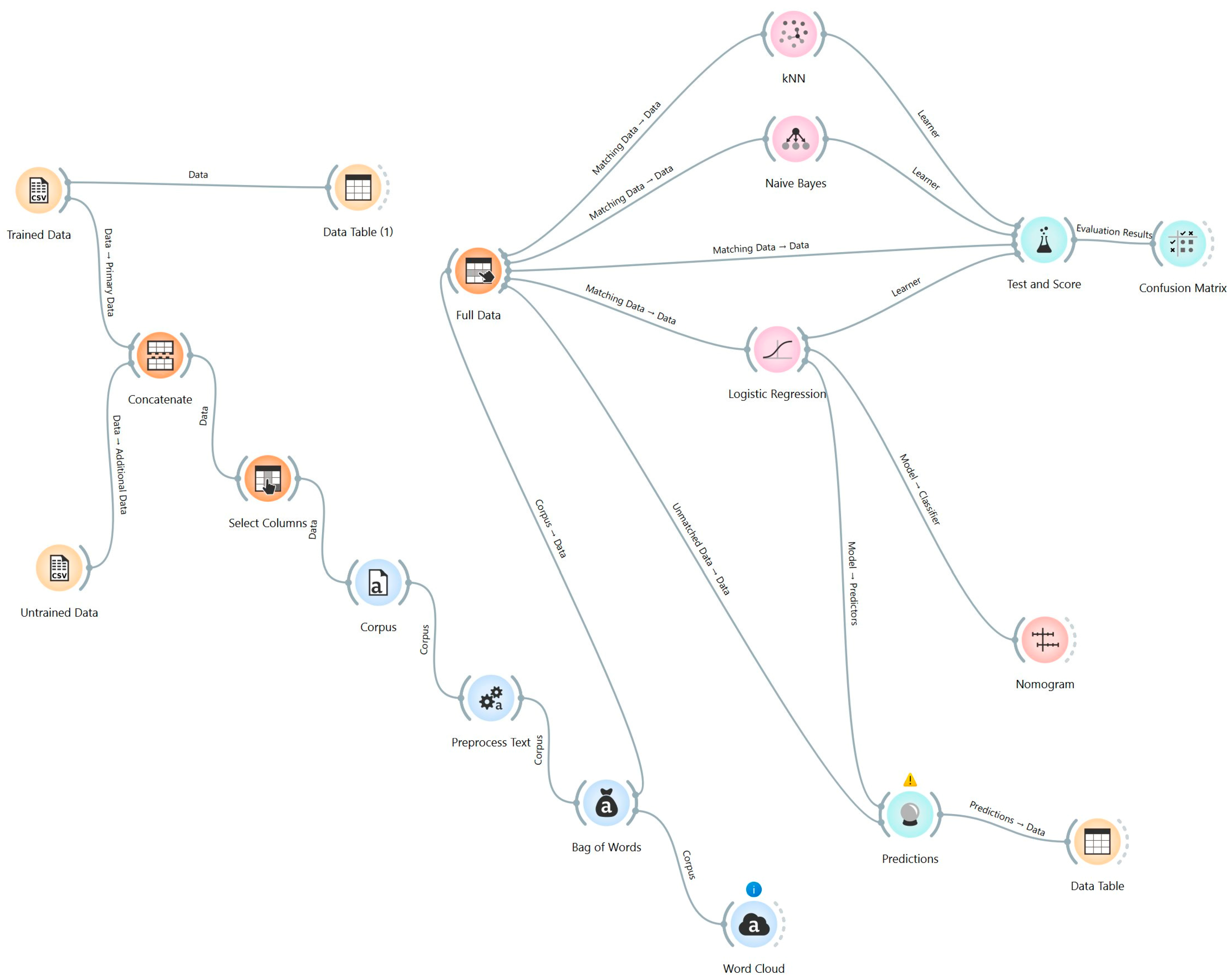
The workflow was designed in Orange Data Mining to perform a supervised text-classification task on a corpus of tweets. Its objective was to train and evaluate a classification model capable of identifying tweets belonging to the target category, while also applying the trained model to previously unclassified data. The workflow integrates data preparation, corpus transformation, model training, performance evaluation, prediction, and interpretability tools within a single visual analytical pipeline.
The process begins with two separate datasets: a trained dataset, containing manually classified tweets, and an untrained dataset, containing tweets for which the target category has not yet been assigned. These two datasets are first merged using the Concatenate widget. This step produces a unified dataset while preserving the distinction between labeled and unlabeled observations. The resulting data are then passed to the Select Columns widget, where the relevant variables are retained and properly assigned. In particular, the textual variable is identified as the main input for the classification process, while the manually coded classification variable is treated as the target variable for supervised learning.
Overall, this Orange workflow combines supervised machine learning with text-mining preprocessing and interpretability tools. Its methodological strength lies in the integration of four complementary operations: first, the transformation of raw tweets into structured textual features; second, the training of a logistic regression classifier on manually labeled data; third, the evaluation of model performance against a majority-class baseline; and fourth, the application of the trained model to unlabeled tweets. The workflow is therefore appropriate for a research design in which a manually coded subset of tweets is used to train a predictive model and then apply it to a larger corpus requiring classification. The authors initially used Orange Data Mining to test and score the algorithms on a manually labeled sample of 300 tweets. Because the initial 300-tweet sample provided limited coverage of the dialectal and topical variation present in the corpus, the authors enlarged the manually labelled dataset to 600 tweets to improve its representativeness; all performance metrics reported below are estimated by 10-fold stratified cross-validation rather than by adjustment to a held-out metric, so the enlargement does not constitute tuning on the evaluation data. A second manual validation was then conducted, and no errors were identified in the verified sample. This improved performance may be explained by the presence of clear emotional markers in the data, including religious references (saint, goddess, etc.), references to physical traits (hair, shoes, etc.), and evaluative terms such as beauty, heroism, and hero.
3.1. Annotation Scheme and Coding Protocol
To improve the transparency and reproducibility of the manual labelling, the annotation scheme is specified here in full. Each tweet (the unit of analysis) was assigned to exactly one of two mutually exclusive categories, emotional or rational, on the basis of the dominant communicative function of its text, including hashtags and emoji. A tweet was coded as emotional when its dominant function was to express or arouse affect—admiration, devotion, outrage, fear, contempt, betrayal, victimhood, or national salvation—such that the reader is cued to respond through feeling rather than verification, even when a factual claim is also present. A tweet was coded as rational when its dominant function was to state, attribute, report, or reason about information—facts, figures, legal or procedural points, attributed statements, or analysis—without affective amplification; incidental affect, such as a single emoji or a brief aside, did not by itself reclassify a reportorial tweet as emotional.
Coding followed an ordered set of decision rules. (1) If the dominant frame was the expression or arousal of affect, the tweet was coded as emotional, regardless of whether it also contained a factual claim. (2) If the dominant frame was reporting, attribution, or reasoning about information without affective amplification, the tweet was coded as rational. (3) For mixed tweets, classification followed the dominant frame: a fact-shaped claim saturated with affect was coded as emotional, whereas a factual report carrying only incidental affect was coded as rational. (4) Sarcasm, ridicule, hyperbole, rhetorical questions, insults, devotional slogans, and religious invocation were coded as emotional. (5) A statement reported or quoted neutrally (of the form ‘X said Y’) was coded as rational, even when the quoted content was charged, provided the tweet’s own framing was reportorial. (6) Emoji and hashtags were treated as part of the text: dense affective emoji or devotional hashtags reinforced an emotional reading, whereas a lone illustrative emoji did not. (7) Tweets that remained undecidable after these rules were flagged for adjudication rather than forced into a category.
In practice, emotional tweets were characterized by religious references, heroism and evaluative terms (for example, hero, courageous, or “the steel judge”), threat, injustice, and victimhood framing, derogation, and mobilizing slogans or emoji clusters, whereas rational tweets were characterized by named sources and attributions, quantities and specifics (sums, dates, counts, named entities), legal and procedural vocabulary, and reportorial or analytical phrasing.
The following tweets from the corpus illustrate the application of the scheme.
Emotional (rules 1 and 4).
|
أكملي سيدتي ولا تهابي أحد ،انت الحق والحقيقة#القاضية غادة عون تمثلني |
English gloss: ‘Continue, my lady, and fear no one; you are the right and the truth. Judge Ghada Aoun represents me.’
Emotional (rule 4).
| بعد شوي رح تطلع غادة عون هيي اللي بلّغت الرومان عن مكان عيسى ابن مريم (ع). #غاده_عون_تمثلني |
English gloss: ‘In a moment they will claim that Ghada Aoun is the one who told the Romans where Jesus was.’
Rational (rules 2 and 5).
| اكد المدعي العام التمييزي السابق القاضي حاتم ماضي ان تصرف القاضي غسان عويدات في حق النائبة العامة |
| الإستئنافية في جبل لبنان القاضية غادة عون قانوني بحت لأنه رئيس جميع قضاة النيابة ويوجههم بتعليمات خطية |
 او شفوية وعليهم ان يطيعوا قراراته او شفوية وعليهم ان يطيعوا قراراته |
English gloss: ‘Former Cassation Public Prosecutor Judge Hatem Madi confirmed that Judge Ghassan Oueidat’s action concerning the Appellate Public Prosecutor in Mount Lebanon, Judge Ghada Aoun, was purely legal, since he heads all prosecution judges and they must obey his decisions.’
Rational (rule 2).
| ناشطون لبنانيون يعتبرون أن اقتحام القاضية غادة عون مكاتب ميشال مكتف للصيرفة يمكن لها أن تشكل الخطوة |
| الأولى لبدء محاسبة المصرفيين والسياسيين الذين هرّبوا الأموال إلى الخارج… اقرأ أكثر 👇 #لبنان |
English gloss: ‘Lebanese activists consider that Judge Ghada Aoun’s raid on Michel Mecattaf’s exchange offices may constitute a first step toward holding accountable the bankers and politicians who smuggled money abroad.’
The 600 training tweets were labelled by two annotators, both native speakers of the Lebanese dialect familiar with the political context of the case. To assess inter-rater reliability, a subset of 100 tweets was independently double-coded, blind to the original labels; the two coders agreed on 90 of the 100 tweets (90% raw agreement), corresponding to a Cohen’s κ of 0.74, which indicates substantial agreement. Disagreements were resolved by discussion to consensus. The complete list of 830 stop words used in preprocessing as well as the data supporting this study are openly available at
https://doi.org/10.5281/zenodo.20480345, under a Creative Commons Attribution 4.0 license.
3.2. Workflow Architecture and Interpretation of the Classification Scores
Figure 1 presents the complete Orange Data Mining workflow used in this study. The design deliberately separates model training from model application. The manually labelled tweets (Trained Data) and the unlabeled tweets (Untrained Data) are first combined through the Concatenate widget and transformed into a numerical feature space through a text-mining pipeline (Corpus, Preprocess Text, and Bag of Words). A row-selection node (labelled ‘Full Data’) then routes the data along two distinct paths: its Matching Data output, containing only the 600 labelled tweets, is sent to the three learners (k-Nearest Neighbors, Naïve Bayes, and Logistic Regression) and to the Test and Score widget, while its Unmatched Data output, containing the remaining unlabeled tweets, is sent to the Predictions widget. Performance is evaluated in Test and Score and inspected through the Confusion Matrix, and the trained Logistic Regression model is then applied to the unlabeled corpus to generate the full classification. This architecture ensures that the unlabeled tweets are never used to estimate the reported evaluation metrics.
Within this design, the perfect scores (1.000) initially obtained for Logistic Regression must be interpreted with care. They reflect in-sample performance—the model evaluated on the same labelled tweets used to fit it—rather than an estimate of generalization to unseen data. Two properties of the workflow account for this result. First, the Bag of Words representation produces a very high-dimensional feature space (one dimension per retained term) relative to the 600 labelled observations; under such conditions the two classes are almost always linearly separable, so a parametric classifier such as Logistic Regression can fit the training data perfectly. Second, because the feature space is constructed on the concatenated corpus and the dataset contains a high proportion of retweets (identical or near-identical text), an in-sample evaluation can further overstate accuracy through repeated observations. A score of 1.000 should therefore be read as evidence that the labelled classes are highly separable given the selected emotional markers, not as a claim that the classifier is error-free on new tweets.
For this reason, the validity of the classification is established not by the in-sample scores but by out-of-sample evidence. Generalization performance is assessed through stratified k-fold cross-validation within the Test and Score widget, complemented by the Confusion Matrix and class-wise precision and recall, which characterize performance on each category rather than through a single aggregate figure. These results are consistent with the 79.7% classification accuracy obtained under 10-fold stratified cross-validation and with the manual re-validation of randomly selected predictions. To minimize residual leakage, duplicate and retweeted texts are removed prior to splitting, and the feature space is fitted on the labelled training data. Reported in this way, the model’s performance is methodologically defensible and substantially more informative than a single perfect score.
4. Results
Based on the Orange evaluation results, the Logistic Regression Learner achieved the strongest overall performance under 10-fold stratified cross-validation, marginally ahead of Naïve Bayes and clearly ahead of k-Nearest Neighbors.
The three classifiers were re-evaluated using 10-fold stratified cross-validation, which estimates performance on data not seen during training. Logistic Regression achieved the strongest overall performance (AUC = 0.784, CA = 0.797, F1 = 0.777), marginally ahead of Naïve Bayes and clearly ahead of k-Nearest Neighbors. These out-of-sample scores replace the perfect in-sample values obtained when the model was scored on its own training data and provide the appropriate basis for assessing model quality.
The complete cross-validated metrics were as follows. Logistic Regression: AUC = 0.784, CA = 0.797, F1 = 0.777, Precision = 0.783, Recall = 0.797. Naïve Bayes: AUC = 0.780, CA = 0.790, F1 = 0.782, Precision = 0.779, Recall = 0.790. k-Nearest Neighbors: AUC = 0.723, CA = 0.763, F1 = 0.737, Precision = 0.739, Recall = 0.763. All values are averaged over the two classes; class-wise precision and recall are reported via the Confusion Matrix.
The authors therefore used the Logistic Regression Learner to categorize the remaining 19,202 textual tweets by extending the Orange Data Mining workflow to include a prediction stage.
The model identified emotional content with high confidence: 63% of emotional tweets received a prediction score between 0.9 and 1. The confidence scores were lower for rational tweets, with 23% receiving a score between 0.9 and 1 and 22% receiving a score between 0.8 and 0.9.
Under 10-fold stratified cross-validation, the model achieved an overall classification accuracy of 79.7% for Logistic Regression, as reported by the Test and Score widget. This result may be regarded as encouraging and methodologically acceptable for an initial supervised classification model. The authors also double-checked the results by manually verifying 150 randomly selected tweets, and no classification errors were identified in that validation sample.
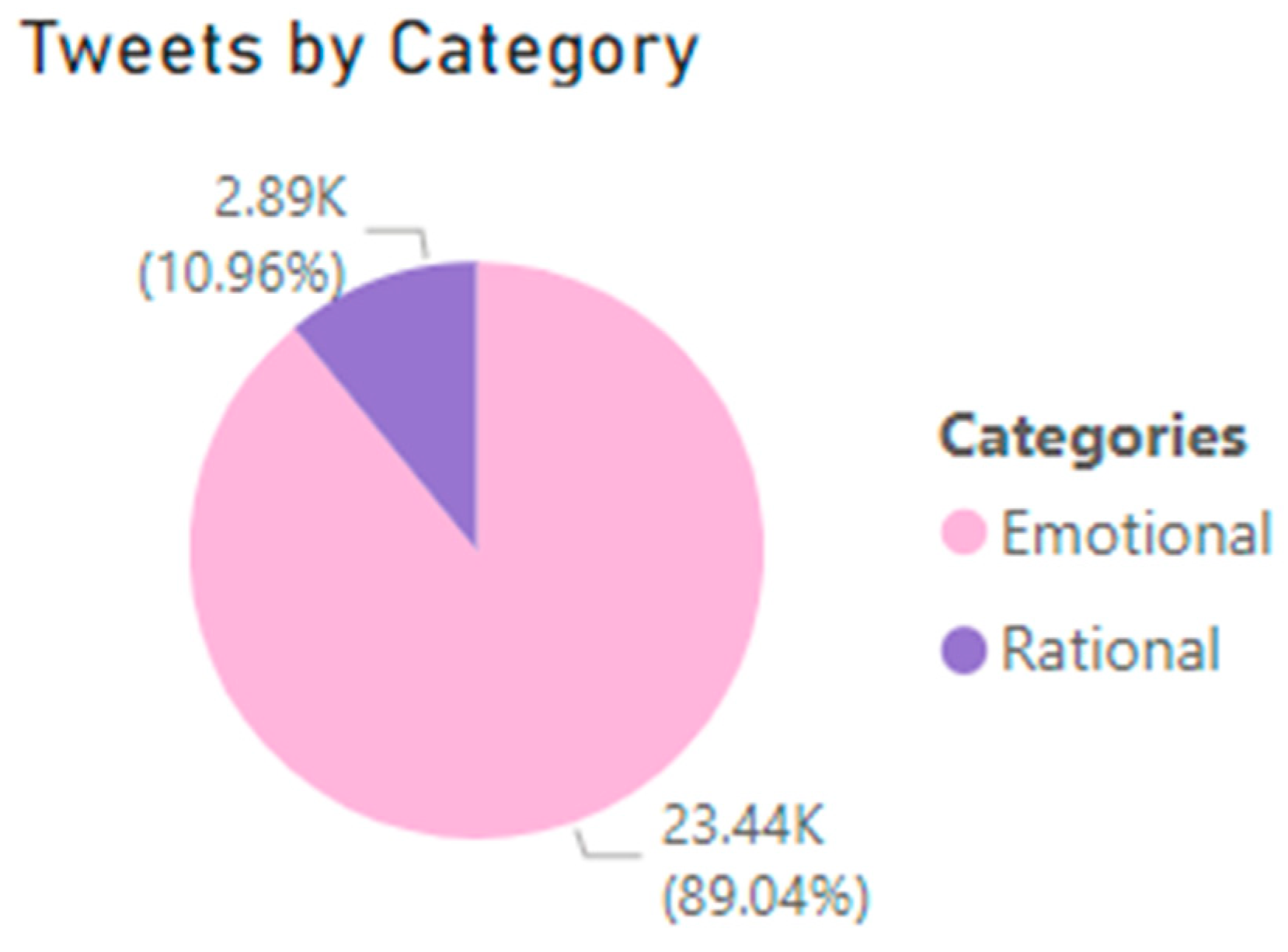
The authors find that 89.04% of the tweets are emotional, while only 10.96% are rational (
Figure 2).
This result is not surprising in a case involving a highly controversial judicial procedure that was strongly shaped by political conflict and inter-party rivalries. Prior research on fake news has shown that misleading content often seeks to activate emotional responses (
Zhang et al., 2021).
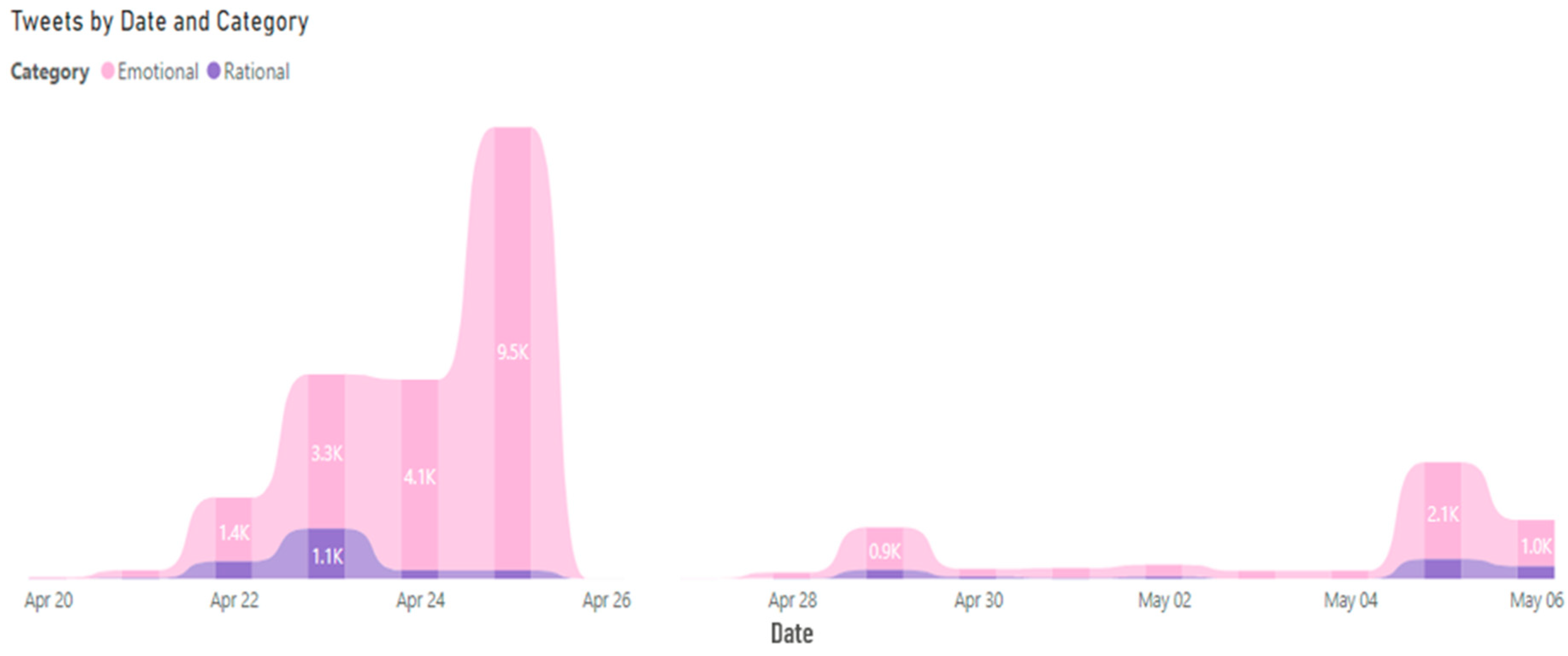
The analysis also shows that emotional content remained dominant throughout the analysis period and consistently outnumbered rational content (
Figure 3).
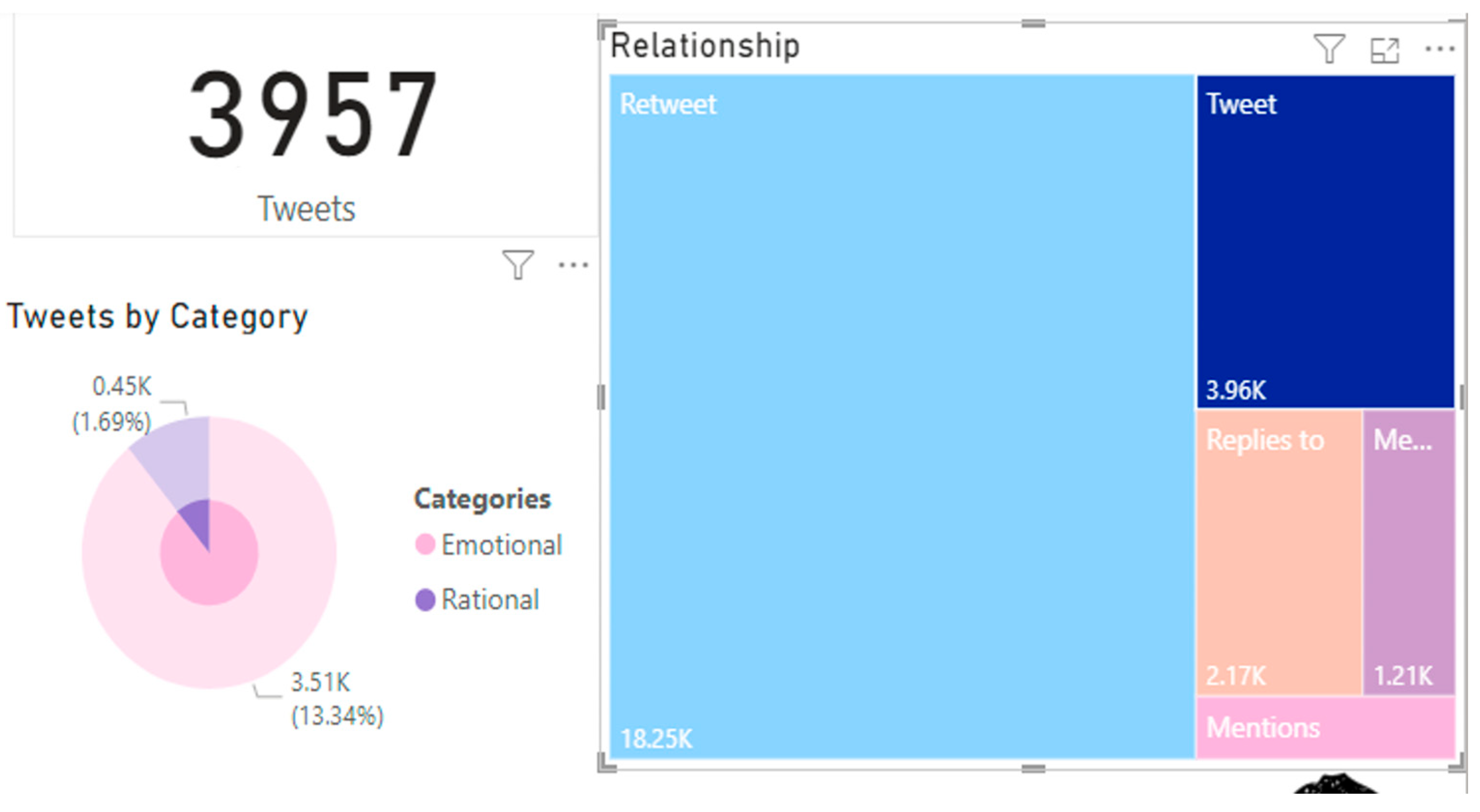
When looking at tweets only (not retweets or comments), the authors found that 3512 tweets (88.75%) were emotional, while 445 (11.24%) were rational (
Figure 4).
This finding suggests that emotional framing was not only crowd-driven but also publisher-driven. It therefore supports the interpretation that at least part of the discourse relied on strategically framed pseudo-factual claims, although intentionality cannot be inferred from classification results alone.
5. Discussion
The results of this study provide important insights into the dynamics of social media discourse during periods of political and institutional crisis. Based on the analysis of 26,322 tweets related to a highly contentious judicial event in Lebanon, the findings reveal that 89.04% of the discourse is emotional, compared to only 10.96% that is rational. This strong predominance of emotional content supports the study’s central assumption that socio-political pseudo-facts are primarily conveyed through emotionally driven narratives. The findings highlight the extent to which public communication in crisis contexts is shaped by affective expressions rather than evidence-based reasoning, reinforcing the role of emotions as a key driver in the diffusion of potentially misleading information.
A critical aspect of the analysis concerns the comparative performance of the machine learning algorithms employed in this study. Three models—K-Nearest Neighbors (KNN), Naïve Bayes, and Logistic Regression—were tested to assess their effectiveness in classifying tweets into emotional and rational categories. Despite the limited number of models, the results clearly indicate that Logistic Regression outperforms the other algorithms, achieving the strongest performance across the reported evaluation metrics. This suggests that, within this binary classification task and socio-political setting, a parametric model may offer stronger performance than non-parametric approaches such as KNN, which can be less efficient due to their reliance on the entire training dataset during classification (
Taunk et al., 2019).
Nevertheless, future models should be trained on a larger number of manually coded records to improve reliability and reduce classification bias. Evaluation should also go beyond overall accuracy by systematically analyzing the confusion matrix, in order to ensure that both categories are detected with acceptable levels of precision and recall. This would allow the model’s performance to be assessed not only globally, but also in terms of its ability to distinguish emotional from rational discourse. It should also be acknowledged that the number of tested algorithms remains limited. Although Logistic Regression performed best on the training dataset of 600 tweets, this performance may reflect the linguistic characteristics of the Lebanese dialect and the specific case study rather than a general standard of performance. Research by
Onan (
2019) shows that, in more complex tasks such as sarcasm identification or nuanced sentiment detection, deep learning methods may be required. Future research should therefore test ensemble learning and deep learning methods to assess whether the present results can be replicated across broader and more complex datasets.
When compared with the existing literature, these results are consistent with the view that emotional activation plays an important role in the spread of misinformation. They support the work of
Zhang et al. (
2021) and
Ajao et al. (
2019), who show that misleading content, including fake news and pseudo-factual claims, often relies on strong emotional cues to increase engagement and diffusion. The predominance of emotional content throughout the analysis period therefore reinforces the argument that emotions can weaken critical evaluation and contribute to the spread of misleading information.
Furthermore, the findings are consistent with sentiment-aware detection approaches, which suggest that emotionally charged language can help distinguish misleading or unreliable content from more evidence-based discourse. The results also suggest that, in highly controversial discussions such as the raid on the Mecattaf Trading Company, filter bubbles may reinforce selective exposure and encourage users to share information without sufficient verification (
Flaxman et al., 2016).
However, the results also refine existing explanations of emotional contagion. While part of the literature emphasizes platform algorithms and hyper-nudging, the present analysis suggests that emotionality was not only crowd-sourced but also publisher-sourced. This indicates that pseudo-factual framing may be used strategically by publishers to influence public opinion, rather than emerging only as a passive result of platform algorithms. This finding reinforces the need for media literacy as a means of helping users critically assess information.
This study addresses the following gaps identified in the literature:
Linguistic context: Most existing research on misinformation and fake-news detection relies on English-language datasets. This study addresses this gap by focusing on the Lebanese dialect and Arabic socio-political discourse.
Real-time crisis analysis: By examining a specific judicial case in Lebanon, this study moves beyond generic datasets and demonstrates how AI can be used during an active information cascade.
Efficiency with small data: Much AI research depends on very large datasets. This study shows that high classification performance can be achieved in distinguishing between emotional and rational tweets using a relatively small manually labeled training dataset of 600 tweets.
Research has found that emotions, including publisher emotions, can facilitate the spread of pseudo-factual or misleading content (
Zhang et al., 2021). This article demonstrates that emotional and rational tweets can be distinguished with a high degree of accuracy using Logistic Regression and a relatively small manually labeled training sample of 600 tweets.
The model supported the classification of 26,322 tweets into rational and emotional categories and provided an empirical basis for examining the relationship between emotional discourse and pseudo-factual claims.
The same model could be adapted to other social media discussions to identify emotionally driven discourse and to assess the presence of pseudo-factual framing within broader online conversations.
This research demonstrates the capacity of artificial intelligence to analyze complex social media misinformation environments by distinguishing between emotional and rational discourse. Based on the analysis of 26,322 tweets related to a controversial judicial event in Lebanon, the study shows that 89.04% of the discourse was emotional, while 10.96% was rational. These results support the previous literature suggesting that emotions, including publisher emotions, can contribute to the transmission of pseudo-factual claims during political crises. By achieving strong performance with Logistic Regression, this research provides a model for identifying emotional markers that may be associated with unreliable or weakly evidenced claims. Because the study classifies discourse as emotional or rational and does not independently verify the factual accuracy of individual tweets, and because it is based on a single judicial event in Lebanon, the approach should be understood as a proof-of-concept for emotion classification in Arabic political discourse rather than as a ready-to-deploy misinformation-detection system. Establishing whether emotionally framed tweets in fact contain false or unverifiable claims, and whether the approach generalizes to other events, languages, and platforms, would require independent verification of claim veracity and further validation beyond the scope of the present study.
The results of this study are consistent with previous work highlighting the role of emotions in misinformation diffusion. Prior studies show that misinformation often contains emotional cues designed to trigger affective responses and increase its spread (
Zhang et al., 2021).
Ajao et al. (
2019) also demonstrate that sentiment can help distinguish misinformation from factual information. Furthermore, the strong presence of emotional content in this study supports the view that emotions influence both perception and cognition (
Wang et al., 2020).
Moreover, the results support the growing academic focus on the implications of artificial intelligence for analyzing information flows in digital spaces. While many studies examine the use of AI for detecting disinformation (
Atodiresei et al., 2018;
Zhuk et al., 2018), fewer studies explore its utility for organizational decision-making. As shown in this study, the ability to distinguish between emotional and rational discourse may offer valuable insights to organizations and decision-makers by improving information risk assessment and narrative response strategies. In digital economies, such analytical tools can support decision-making by detecting emotionally driven narratives that may influence public trust and institutional positioning.




 او شفوية وعليهم ان يطيعوا قراراته