


Abstract
This study investigates the impact of logistics performance on international trade by comparing Lithuania and Turkey within a gravity model framework. Using a bilateral panel dataset of 984 observations covering trade with 26 European Union member states over the period 2007–2025, the study incorporates the six sub-indicators of the World Bank’s Logistics Performance Index (LPI) as explanatory variables. The results confirm that logistics performance significantly influences bilateral trade, but through markedly different channels for the two economies. For Lithuania, the quality and competence of logistics services emerges as the dominant trade-enhancing factor (4.726, p < 0.01), reflecting its position as a small open EU economy. For Turkey, infrastructure quality is the primary driver of trade (2.782, p < 0.01), consistent with its status as a large emerging economy. The Turkey dummy variable becomes statistically insignificant when LPI variables are included, indicating that logistics performance substantially explains the trade differential between the two countries. Export–import disaggregation reveals that imports are more sensitive to logistics dimensions such as timeliness and service quality than exports. Robustness checks using pooled OLS, random effects, and fixed effects estimations, along with the Hausman test, broadly support the baseline findings. The study provides differentiated policy recommendations: Lithuania should prioritize logistics service quality, while Turkey should focus on infrastructure development and customs reform.
1. Introduction
The current global economy uses international trade as one of its main elements, which determines how countries compete with each other and their economic development (Martí et al., 2012; Mann, 2012). Globalization creates stronger market connections that make organizations need better logistics management systems to maintain their international trading operations while decreasing their border-related costs (Cheung et al., 2020; Martí et al., 2014). The logistics performance system enables trade facilitation by connecting production networks and decreasing supply chain obstacles that establish international trade patterns (De & Saha, 2013; Bensassi et al., 2015).
The disruptions that affected global supply chains during recent years have made logistics operations more vital for international trade. Recent events have exposed the fragility of global supply chains. The COVID-19 pandemic, the Russia–Ukraine conflict, and the rerouting of maritime traffic around the Cape of Good Hope after Red Sea security threats each disrupted trade flows (UNCTAD, 2025). These disruptions raised freight rates, increased operational costs, and caused congestion at key ports. Together, they underscored the need for logistics systems that are both efficient and resilient. The Global Supply Chain Pressure Index, developed by the Federal Reserve Bank of New York, captures the economic weight of these pressures. Supply chain shocks feed directly into inflation and generate volatility in trade flows (Ginn & Saadaoui, 2025). The academic community and policymakers need to understand how logistics performance affects international trade because this knowledge has become essential for their work.
Since its introduction, the World Bank’s Logistics Performance Index has been the primary tool for assessing national logistics capabilities. It measures six dimensions: customs efficiency, infrastructure quality, ease of arranging international shipments, logistics service quality, tracking and tracing, and delivery punctuality (Arvis et al., 2018). Launched in 2025–2026, the LPI 2.0 framework introduces a new approach to measuring supply chain performance. Rather than relying on perception-based surveys, it draws on actual supply chain tracking data (Arvis et al., 2025, 2026). The current research uses the established LPI framework for its study because it creates consistency with existing research, but the study treats this method development as vital information for future investigations.
Researchers have conducted extensive studies that show better logistics operations lead to higher international trade activity (Celebi, 2017; Puertas et al., 2014; Tang & Abosedra, 2019; Bugarcic & Kleinert, 2024). The existing body of research still contains multiple fundamental deficiencies. First, existing research studies maintain a macro-level approach that studies complete trade patterns between multiple nations, but fails to recognize how different countries will experience logistics performance changes. Second, several country-specific studies examine major trading economies, such as South Korea (Song & Lee, 2022), China (Zhang, 2022), and the ECOWAS nations (Kareem, 2025). However, none compares structurally different economies within a single, unified framework. Third, the majority of research studies only analyze data until 2020, preventing them from understanding how recent supply chain interruptions have changed the relationship between logistics operations and international trade.
The current study resolves existing research deficiencies through its assessment of logistical efficiency and international trade patterns between Lithuania and Turkey from 2007 to 2025. The selection of these two economies is motivated by their fundamentally different structural characteristics and strategic positions within European trade architecture. Lithuania is a small open economy and has been an EU member since 2004, having joined the Eurozone in 2015. It serves as a strategic logistics gateway for the Baltic region. The Kowalski and Bates (2025) report shows that Lithuania’s GDP depends on imports for approximately 40% of its value, while the country possesses trading advantages through high infrastructure standards and its compliance with EU regulations. Turkey is a major emerging economy that connects European and Asian trade routes through its Customs Union with the EU (in place since 1996) and its ongoing pursuit of EU candidate status. Turkey aims to become a regional logistics center under its 2053 Transport and Logistics Master Plan, which targets annual exports of one trillion dollars (Republic of Türkiye Ministry of Transport and Infrastructure, 2023). The Kowalski and Bates (2025) identifies customs reform and infrastructure investment as the key levers for strengthening Turkey’s logistics sector. Methodologically, this pairing follows a most-different-systems logic: the two economies share strong EU trade ties (the constant) but differ sharply in size, integration status, and geographic position (the variables of interest). This design isolates how structural characteristics, rather than idiosyncratic factors, condition the logistics–trade relationship.
The study compares two economies through a gravity model that uses LPI sub-indicators to find answers to two main research questions. The first research question examines how logistics performance impacts bilateral trade between EU partners in economies that have different fundamental structural characteristics. The second research question investigates which dimensions of logistics performance most effectively drive trade in small open EU economies and large emerging economies that hold EU candidate status.
Beyond confirming that logistics performance promotes trade, this study advances a structural-contingency perspective: it shows that the same logistics dimensions operate through different channels depending on a country’s size, EU-integration status, and geographic position. This shifts the question from “does logistics matter?” to “which dimensions matter, for whom, and why”. The study therefore extends existing knowledge beyond contextual replication: rather than re-confirming that logistics matters for trade, it identifies which logistics dimensions drive trade in structurally distinct economies and why these channels differ. The study makes three significant theoretical contributions to existing academic knowledge. It presents the first systematic assessment that compares how logistics activities impact trade between an EU member state and an EU candidate country because EU integration status determines trade patterns to emerge from their logistics performance. The study extends its research period until 2025 to demonstrate how recent supply chain interruptions, geopolitical conflicts and post-pandemic recovery processes affect their results. The research shows how logistics performance affects trade for different types of economies because it uses both country-specific gravity models and panel data estimation methods. The study also extends the traditional gravity specification with contemporary control variables—the Global Supply Chain Pressure Index (GSCPI) and Global Economic Policy Uncertainty (GEPU). These capture how external shocks evolved during the 2020s.
The remainder of this paper is structured as follows. Section 2 provides a comprehensive review of the literature on logistics performance and international trade. Section 3 presents the empirical model together with its gravity equation specifications. Section 4 describes the data sources and presents descriptive statistics. Section 5 reports and discusses the estimation results with country-specific analyses and robustness checks. Section 6 discusses the findings, and Section 7 concludes with policy implications and directions for future research.
2. Literature Review
2.1. Theoretical Foundations: How Logistics Performance Shapes Trade
The theoretical foundation linking logistics performance to international trade rests on the recognition that efficient logistics systems reduce trade costs, improve market access and enable national economies to join global supply chains (Christopher, 2016; Grant et al., 2017). Logistics refers to the activities involved in moving and storing goods along the supply chain. Across economic sectors, it is widely used as an indicator of development performance (Arvis et al., 2018). Global supply chain research shows that international trade suffers more from logistics obstacles than from conventional tariff and non-tariff restrictions, which makes logistics efficiency a crucial factor for trade competitive advantage (Celebi, 2017).
The empirical literature has shown that better logistics performance leads to higher trade volumes. Bugarcic and Kleinert (2024) studied 166 countries using several gravity-model techniques, including fixed-effects OLS, Poisson estimation, and the Helpman–Melitz–Rubinstein two-stage procedure. They found that logistics performance positively affects trade across all methods. Balbaa (2026) used OLS regression analysis to study 2023 data from 153 countries and found that LPI positively impacts trade integration with statistical significance, while price instability functions as a primary barrier that hampers trade competitiveness. Tang and Abosedra (2019) conducted an analysis of 23 Asian economies to demonstrate that export-led growth hypothesis exists, and they found that logistics performance plays an essential role in creating this growth pattern.
2.2. The LPI and the Gravity Model: Measurement and Method
Empirical studies of the logistics–trade relationship rely heavily on two building blocks: a standardized measure of logistics performance and a tractable model of bilateral trade. The most widely used measure is the World Bank’s Logistics Performance Index (LPI), which evaluates six operational dimensions on a five-point scale: customs efficiency, infrastructure quality, ease of arranging international shipments, logistics service quality, tracking and tracing, and timeliness (Arvis et al., 2018). Although the index is survey-based—and therefore subject to respondent bias and uneven country coverage—it remains the dominant indicator in the field (Çemberci et al., 2015; Civelek et al., 2015; Kabak et al., 2020).
The gravity model has become the leading research method used to study how logistics performance affects trade volume. The model that Tinbergen developed in 1962 to study bilateral trade relationships shows that two countries will trade based on their economic sizes and the distance that separates them. The extended gravity equation system lets researchers estimate how logistics improvements will impact trade by including both logistics factors and standard trade determinants.
The research of Song and Lee (2022) investigates how LPI components affect South Korean trade with 161 countries through their analysis of SITC commodity groups. The study results show that different commodity groups have different LPI component importance, which drives trade operations according to different needs for infrastructure and shipment systems in machinery and transport equipment, whereas the tracking and timing needs of operations explain the trade for miscellaneous manufactured articles. Steinhauser and Khúlová (2025) apply Poisson pseudo-maximum-likelihood estimation to bilateral trade flows across SITC product groups. They find that stronger tracking systems and customs operations raise export volumes. Trade also increases when two countries have similar logistics capabilities—an application of Linder’s hypothesis to logistics.
The academic literature shows particular interest in studying European experiences. The research by Puertas et al. (2014) proves that logistics performance serves as a more essential factor for determining export success in EU countries than for their importing partners, because customs efficiency and transportation systems reduce operational expenses in international trade. Bensassi et al. (2015) used data from 19 Spanish regions to demonstrate that logistics infrastructure serves as an essential factor for improving regional export capabilities while infrastructure investments help businesses overcome the trade hindrances caused by their remote geographical locations. European research demonstrates that logistics performance functions as a vital factor for international trade because it affects both export and import operations in different ways.
The research discovered critical findings through country-specific studies which extended beyond European borders. Zhang (2022) investigates how logistics performance in RCEP member countries affects China’s export trade, identifying infrastructure and customs efficiency in South Asian members as the primary constraints on regional performance. Suroso (2022) examines palm oil exports from Indonesia and Malaysia, revealing that the critical logistics dimensions differ even between countries exporting similar commodities: timeliness and tracking for Indonesia versus logistics competence and service quality for Malaysia. Kareem (2025) demonstrates that a one percent increase in customs efficiency or transport quality leads to a 1.25 percent rise in manufacturing exports to ECOWAS countries, which demonstrates the economic benefits of trade facilitation for developing regions.
2.3. Maritime Connectivity and Supply Chain Pressures in a Changing Trade Environment
The traditional LPI framework shows that maritime connectivity serves as a basic trade cost element which affects the volume of trade between two countries. The research by Fugazza and Hoffmann (2017) shows that direct maritime connections between two countries lead to higher trade volumes, while each transshipment results in a 40 percent decrease in export values. Their analysis shows that the Liner Shipping Connectivity Index (LSCI) is a stronger determinant of trade costs than geographic distance alone. This highlights the need to include maritime connectivity in gravity-model specifications.
Geopolitical risks and supply chain disruptions create current trade difficulties because they have changed worldwide logistics operations from their typical operations. The Geopolitical Risk Index, which Caldara and Iacoviello (2022) established, shows that international political conflicts decrease overall trade activities, but intermediate goods trade shows less decline because businesses maintain tight links with international production networks. The UNCTAD Review of Maritime Transport (UNCTAD, 2025) reports that global seaborne trade grew by 2.2 percent in 2024, while the distance traveled by ships rose by 5.9 percent due to major rerouting. This rerouting increased operating costs and port congestion. Businesses now face a new reality where they must assess logistics performance through two criteria, which are their ability to maintain efficient operations and their capability to handle unexpected external challenges.
The Global Supply Chain Pressure Index (GSCPI) developed by the Federal Reserve Bank of New York serves as an effective instrument for measuring supply chain disruptions. Ginn and Saadaoui (2025) demonstrate that GSCPI shocks explain a significant portion of headline inflation and create substantial volatility in global trade flows, particularly during crises such as the Russia–Ukraine conflict. The study adopts a new methodological approach through its integration of modern indicators with traditional gravity model variables.
2.4. Institutional Perspectives and Policy Frameworks
International organizations now understand that effective logistics operations serve as essential elements for both establishing competitive trade advantages and achieving sustainable development goals. The World Trade Report 2025 (WTO, 2025) argues that artificial intelligence could transform international trade. Through productivity gains, AI may raise trade volumes by almost 40 percent by 2040—provided that countries close their digital divides and maintain open trade agreements. The International Transport Forum projects that global freight demand will double by 2050 to create demand for major infrastructure development that requires 1.7 percent of global GDP to be spent each year and for the decarbonization of long-distance maritime and aviation transport systems.
The World Economic Forum (2025) identifies specific strategies for sustainable logistics in emerging markets. The organization proposes systemic levers that include green fuel production and digital operational enhancements to improve competitiveness while maintaining environmental sustainability. The institutional perspectives demonstrate that technological innovation and sustainability requirements and changing worldwide governance systems are transforming the relationship between logistics and trade.
Different methods of developing logistics systems become clear through the examination of country-specific policy frameworks. The Turkish government’s 2023 Transport and Logistics Master Plan establishes a thirty-year schedule to develop the country as a major logistical center. The plan intends to enhance railway freight transportation to 22 percent while achieving complete net-zero transportation emissions by 2053. The OECD case study on Turkey 2025 shows that modernizing infrastructure and streamlining customs processes will help decrease logistics expenses. The Kowalski and Bates (2025) report on Lithuania describes the country as a strategic Baltic entrance point that benefits from EU rules but also faces restrictions when EU regulations match its national standards, while infrastructure conditions are vital for sustaining trade operations during international political crises.
2.5. Research Gaps and the Contribution of the Present Study
Taken together, the reviewed literature establishes that logistics performance is a robust determinant of trade, yet it leaves three issues underexplored, as outlined in the Introduction: the lack of structured comparisons across economies with different size, EU status, and geographic position; the limited temporal coverage that mostly predates the major post-2020 supply-chain disruptions; and the absence of contemporary pressure indicators such as the GSCPI within gravity specifications.
This study addresses these issues by comparing Lithuania and Turkey—two economies with distinct structural profiles but strong EU trade ties—within a single gravity framework that incorporates all six LPI sub-indicators and contemporary control variables. Extending the sample to 2025 allows the analysis to capture recent global disruptions, while the combined, disaggregated, and country-specific estimations provide a basis for economy-specific policy recommendations.
3. Empirical Model
The study examines how logistics performance reaches international trade through its comparison of Lithuania and Turkey for their different structural economic systems and European Union trade patterns. The study uses the gravity model as its primary research method to analyze how logistics performance factors impact trade between countries. The gravity model has gained recognition as the main research framework for studying international trade, which developed from the work of Tinbergen (1962) and Head and Mayer (2014).
The gravity model states that two countries will trade more when their economic strength increases while their physical distance decreases which follows the principles of Newtonian gravitational law. The basic form of the gravity equation establishes that two countries will trade more when their combined income increases and their physical distance decreases while using additional factors to measure trade tendencies between shared languages, common borders and regional trade partnerships (Fracasso, 2014; Alexander & Merkert, 2020).
Researchers have confirmed the gravity model through multiple tests that demonstrate its ability to predict international trade patterns between two countries. The model has been successfully used in multiple studies that explore how logistics performance affects international trade activities (Bensassi et al., 2015; Wang et al., 2018; Puertas et al., 2014). The research investigates the traditional gravity model according to the Song and Lee (2022) approach by using World Bank Logistics Performance Index (LPI) sub-indicators as additional explanation factors.
The World Bank’s LPI is an interactive benchmarking tool that assesses national trade-logistics performance across six criteria: (1) the efficiency of customs and border clearance (Customs); (2) the quality of trade- and transport-related infrastructure (Infrastructure); (3) the ease of arranging competitively priced international shipments (International Shipments); (4) the competence and quality of logistics services (Logistics Quality); (5) the ability to track and trace consignments (Tracking and Tracing); and (6) the frequency with which shipments reach consignees on schedule (Timeliness). Each indicator is evaluated on a five-point scale.
The current research presents its unique aspect through a study that compares Lithuania with Turkey. The research study uses Lithuania, which acts as a small open EU economy that functions as a Baltic Region logistics hub, to compare with Turkey, which serves as a large emerging economy that connects both European and Asian trade routes while remaining an EU candidate country. The research uses Turkey_D as a country dummy variable to demonstrate how the two economies differ in their trade-logistics connections.
Based on the theoretical framework described above, the gravity equation model is specified as follows. Equation (1) represents the baseline empirical model for evaluating the impact of LPI on international trade:
ln(Tradeijt) = β0 + β1 ln(DISTij) + β2 ln(GDPit·GDPjt) + β3 ln(LPICit + LPICjt) + β4 ln(LPIIit + LPIIjt) + β5
ln(LPISit + LPISjt) + β6 ln(LPIQit + LPIQjt) + β7 ln(LPITTit + LPITTjt) + β8 ln(LPITit + LPITjt) + β9Turkey_D +
Controls + uijt
ln(LPISit + LPISjt) + β6 ln(LPIQit + LPIQjt) + β7 ln(LPITTit + LPITTjt) + β8 ln(LPITit + LPITjt) + β9Turkey_D +
Controls + uijt
The equation uses the natural logarithm of bilateral trade between Lithuania or Turkey and their EU partner in year t as ln(Tradeijt), which serves as its representation. The model uses GDP as gross domestic product measured in current U.S. dollars and DIST as the distance that separates two capital cities, which the system measures in kilometers, and LPI as its system of logistics performance sub-indicators. The LPI variables function through the aggregation of LPI scores that country i and its trading partner j possess according to the methodology established by Song and Lee (2022). The binary dummy variable Turkey_D equals 1 for Turkey and 0 for Lithuania. It captures the structural economic differences between the two countries. The study uses regional trade agreements (RTA), contiguity (CONTIG), common language (COMLANG), Liner Shipping Connectivity Index (LSCI), Global Economic Policy Uncertainty (GEPU), and Global Supply Chain Pressure Index (GSCPI) as its control variables. The term uijt represents the error term.
To investigate the differential effects of logistics performance on exports and imports, Equation (1) is further disaggregated into export and import models:
ln(EXijt) = β0 + β1ln(DIST) + β2ln(GDP) + ∑βkln(LPIk) + β9Turkey_D + Controls + uijt
ln(IMijt) = β0 + β1ln(DIST) + β2ln(GDP) + ∑βkln(LPIk) + β9Turkey_D + Controls + uijt
The researchers estimate Equations (2) and (3) separately for Lithuania and Turkey to understand the effects of each country and to find the LPI components that matter most to different economies. The method enables researchers to compare how various aspects of logistics performance lead to differences in trade patterns between a small EU economy and a large EU candidate emerging market. The research team uses extra panel data estimation methods to confirm that their findings are trustworthy.
The complete dataset is analyzed using pooled ordinary least squares (OLS), random effects (RE) and time-fixed effects (FE) models. The researchers use the Hausman specification test to choose between fixed and random effects models, which helps them confirm their main findings.
4. Data Source and Descriptive Statistics
The study creates a bilateral panel dataset that documents trade activities between Lithuania and Turkey and 26 European Union member states from 2007 to 2025. The dataset contains 984 total observations, including 494 observations for Lithuania and 490 observations for Turkey. The selection of EU trading partners provides a consistent comparison framework which both Lithuania and Turkey maintain because they both have substantial trade connections with EU economies.
Multiple sources provided complete coverage of U.S. dollar export and import data through their bilateral trade databases. The World Integrated Trade Solution (WITS) database provided Lithuanian trade data for the years 2007 to 2023 while Turkish trade data were retrieved from the Turkish Statistical Institute (TURKSTAT). The period between 2024 and 2025 brought Lithuanian trade data from Eurostat, which transformed euros into U.S. dollars using annual exchange rates of 1.0822 for 2024 and 1.1306 for 2025. During the same period, TURKSTAT provided Turkish data that were available in U.S. dollar currency.
The International Monetary Fund (IMF) World Economic Outlook database provided current U.S. dollar gross domestic product (GDP) data for this research. The CEPII GeoDist database provided measurements of capital city distance in kilometers together with bilateral dummy variables that indicated contiguity and shared language and colonial relationships. The World Trade Organization (WTO) RTA database provided information about regional trade agreements.
The World Bank provided the Logistics Performance Index (LPI) data together with its six sub-indicators. The LPI publishes its results every two years, which occurred in the years 2007, 2010, 2012, 2014, 2016, 2018, and 2023. Linear interpolation produced annual values for the missing years according to established academic methods. The current LPI data remained in use until the end of the 2024–2025 period, which extended beyond the last observation point.
The study includes three extra control variables: the Liner Shipping Connectivity Index (LSCI), which the United Nations Conference on Trade and Development (UNCTAD) provides as annual averages derived from quarterly data; the Global Economic Policy Uncertainty (GEPU) index, which the website policyuncertainty.com provides as annual averages derived from monthly data; and the Global Supply Chain Pressure Index (GSCPI), which the Federal Reserve Bank of New York provides as annualized data from monthly observations.
Table 1 reports the summary statistics of the key variables employed in the analysis.
Table 1.
Summary statistics.
The two economies show distinct characteristics based on their descriptive statistics. Turkey’s average bilateral trade volume with EU partners substantially exceeds that of Lithuania because its economy operates at a larger scale. Lithuania shows a higher GDP-to-trade ratio when controlling for economic size, consistent with Fugazza and Hoffmann (2017)’s small open economies. The LPI sub-indicators show that both countries exhibit similar average scores across most dimensions, with Turkey holding a marginal advantage in infrastructure and Lithuania performing relatively better in timeliness. The LSCI values indicate that Turkey possesses significantly higher shipping connectivity (average 135.0) because of its geographic advantages and extensive port facilities.
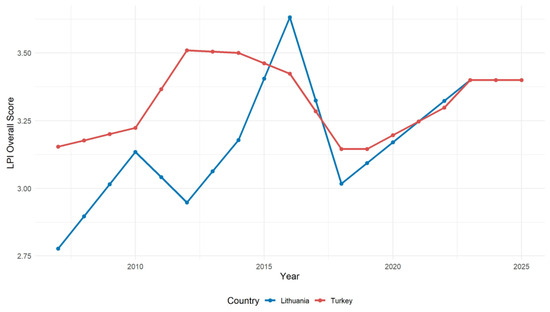
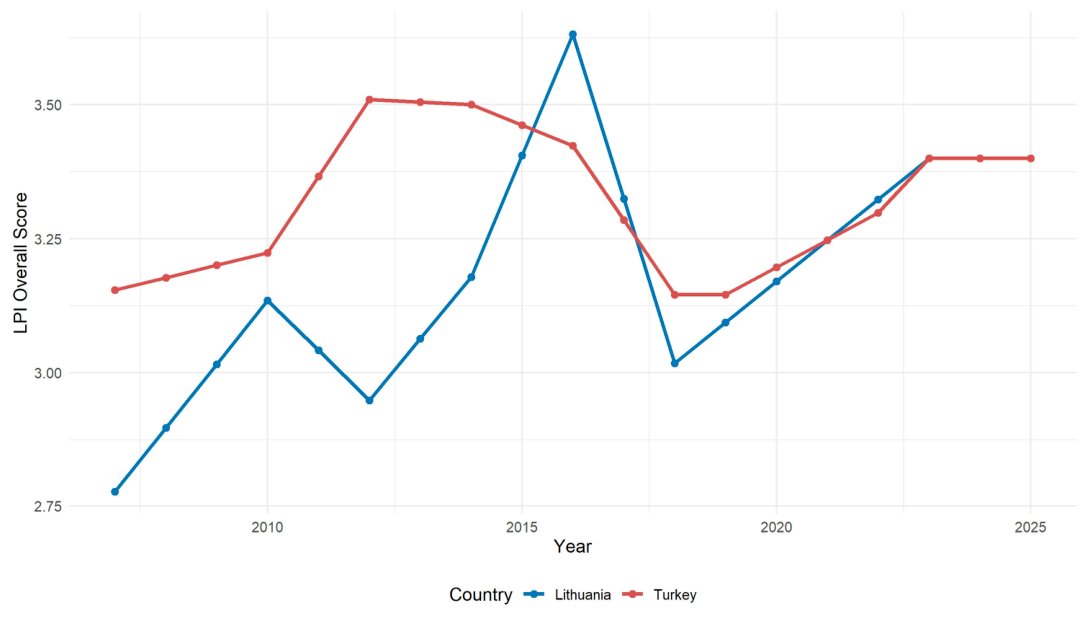
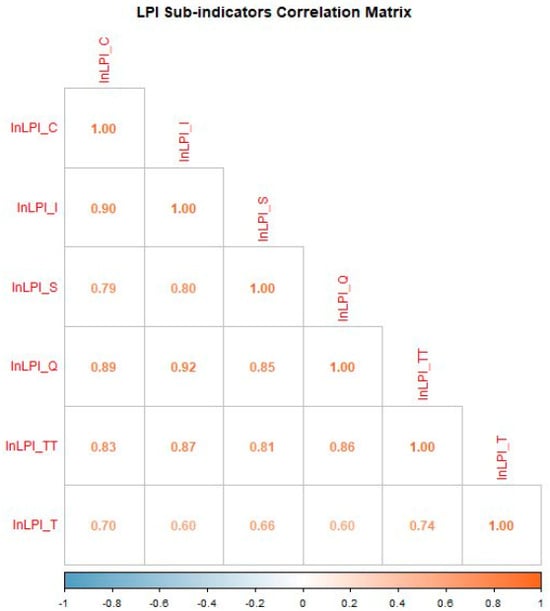
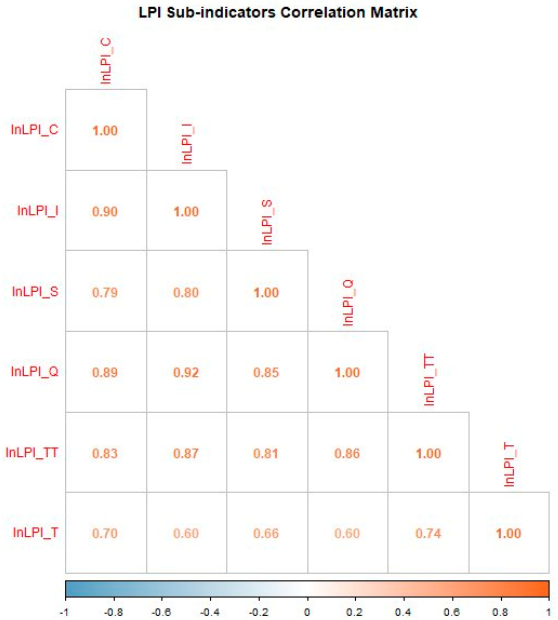
Figure 1 presents the evolution of the overall LPI scores for Lithuania and Turkey over the 2007–2025 period, providing a descriptive overview before the empirical analysis. The analysis then examines the relationships among the LPI sub-indicators. The correlation matrix presented in Figure 2 shows that multiple LPI components demonstrate correlations that exceed 0.80, with infrastructure and quality showing the strongest relationship at 0.921. The literature recognizes multicollinearity among LPI sub-indicators as a major obstacle, yet researchers keep these indicators as separate entities to study their distinct impacts on trade through various logistics dimensions, following the research method used by Song and Lee (2022) and other studies in this field.
Figure 1.
LPI Overall Trend: Lithuania vs. Turkey (2007–2025).
Figure 2.
Correlation matrix of LPI sub-indicators.
To assess the severity of multicollinearity, we computed Variance Inflation Factors (VIFs) for the baseline specification (Table 2). Three LPI dimensions—infrastructure (11.18), quality (10.99), and customs (10.21)—exceed the conventional threshold of 10, while tracking is elevated (7.48). This pattern is consistent with the high pairwise correlations among the LPI sub-indicators reported in Figure 2. We nonetheless retain all six dimensions simultaneously, following Song and Lee (2022) and Wang et al. (2018), because the objective is not to obtain unbiased estimates of each individual coefficient but to identify which logistics dimensions dominate the trade relationship in each economy. Importantly, multicollinearity does not bias the coefficient estimates; it inflates their standard errors and can produce suppression effects, in which a regressor’s sign reverses once correlated regressors are included. The unexpected negative coefficient on shipments in the full model is best understood in this light, and individual coefficient magnitudes should therefore be interpreted with caution.
Table 2.
Variance inflation factors (baseline specification).
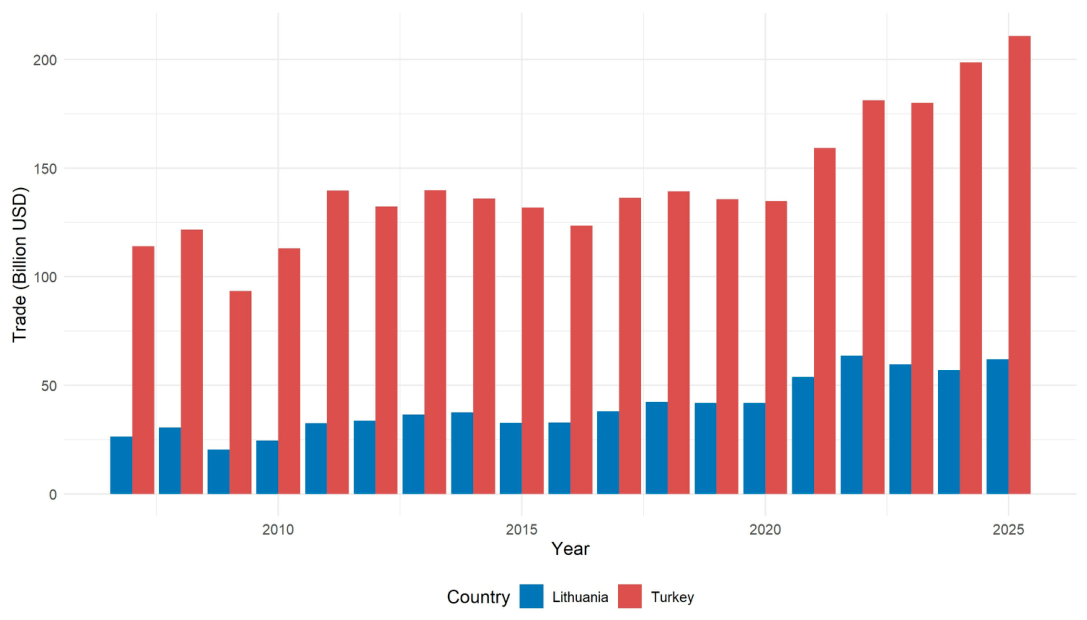
Figure 3 illustrates the total bilateral trade of Lithuania and Turkey with their EU partners over the 2007–2025 period. Turkey’s trade volumes are consistently and substantially higher than Lithuania’s throughout the period, reflecting the much larger scale of the Turkish economy. Both series contracted visibly during the 2009 global financial crisis. Turkey’s trade then fluctuated within a broadly flat range of roughly 110–140 billion USD between 2010 and 2019, before rising sharply after 2020 to reach its highest level of around 210 billion USD by 2025, with a brief dip in 2023. Lithuania’s trade grew more steadily but at a far smaller scale, increasing gradually from about 27 to 60 billion USD over the period. This pattern underscores the importance of controlling for economic size (GDP) and external shocks in the gravity specification.
Figure 3.
Total bilateral trade with EU partners: Lithuania vs. Turkey (2007–2025), billion USD.
5. Analysis Results
5.1. Gravity Model Estimations for Combined Trade
The gravity model estimation results for total bilateral trade are shown in Table 3, which uses three increasingly complex model specifications. The baseline gravity model in Model 1 uses GDP, distance, the Turkey dummy, and all bilateral control variables. The six LPI sub-indicators were added to the existing model through Model 2, which built upon the previous model. Model 3 extends the model by adding new control variables, which include the Liner Shipping Connectivity Index (LSCI), Global Economic Policy Uncertainty (GEPU), and Global Supply Chain Pressure Index (GSCPI).
Table 3.
Gravity model estimations for total trade.
The estimation results show strong alignment with theoretical expectations, which demonstrates that logistics performance plays an essential role in determining international trade patterns. The GDP and distance coefficients in all three model specifications show expected signs which achieve 1% level significance. The GDP elasticity ranges from 0.788 to 0.848, which shows that a 1% GDP increase in trading partner countries will lead to 0.79 to 0.85% higher bilateral trade volumes. The distance coefficient maintains a consistent value of approximately −1.55, which establishes that geographic distance continues to drive trade declines according to established gravity model research.
An important finding was discovered through the analysis, in which The Turkey dummy variable (Turkey_D) produced two notable results The baseline specification (Model 1) shows that the coefficient for Turkey trade with EU partners arrives at a value of −0.480, which achieves high statistical significance because its p value remains below the 0.01 threshold. When the LPI variables are added in Model 2, the coefficient falls to −0.244, and once all control variables are included in Model 3, it becomes statistically non-significant (0.081).The results show a decreasing trend because most trade differences between the two countries arise from their different logistics performance and structural factors that exist in their respective countries.
The LPI sub-indicators show that customs efficiency is the strongest determinant of bilateral trade. The ln(LPI Customs) coefficient shows a positive relationship that reaches statistical significance at the 1% level in both Models 2 and 3, with respective values of 3.265 and 3.475. This indicates that better customs and border management clearance systems lead to higher trade volumes. The study results confirm previous research demonstrating that efficient customs procedures serve as essential components for successful trade facilitation (Celebi, 2017; Puertas et al., 2014).
The analysis includes a significant negative coefficient for ln(LPI Shipments) with a value of −1.999 and a p value below 0.05, according to the results of Model 3. The result demonstrates that high LPI sub-indicator correlation between Shipments and Quality, exceeding 0.85, creates multicollinearity that results in sign reversals. The finding demonstrates a similar pattern to previous literature that LPI components produce unexpected results when all six components are analyzed together (Wang et al., 2018).
The logistics quality coefficient (1.747, p < 0.1) and the Global Supply Chain Pressure Index (0.414, p < 0.05) are positively associated with trade, while GEPU and LSCI do not exhibit statistically significant effects in the combined model. Regional trade agreements demonstrate a consistently positive and significant effect on trade (0.791, p < 0.01), underscoring the importance of preferential trade arrangements in facilitating bilateral commerce.
5.2. Differential Effects on Exports and Imports
Table 4 presents the gravity model estimations separately for exports and imports, revealing important asymmetries in how logistics performance affects the two dimensions of trade.
Table 4.
Gravity model estimations: Export vs. Import.
The findings demonstrate that export and import determinants show a notable asymmetry between their respective factors. The research shows that customs efficiency positively impacts both exports with a value of 3.256 and imports with a value of 3.890, while LPI components show different effects on export and import operations. The three factors of logistics quality (2.352, p < 0.05), tracking and tracing (−2.087, p < 0.05), and timeliness (2.894, p < 0.01) establish their statistical importance for import operations while they fail to show any impact on export operations. The research demonstrates that import-based commerce reacts strongly to logistics performance metrics that measure service quality and operational dependability, because importing businesses prioritize their ability to forecast inbound logistics performance and track logistics quality.
The GDP elasticity for imports shows a higher value of 0.833 compared to the export elasticity which stands at 0.787, demonstrating the economic principle that larger economies tend to import more goods. The Turkey dummy variable shows no statistical significance in both model specifications, supporting the previous conclusion that trade differences between Lithuania and Turkey exist because of logistics capabilities instead of unique country characteristics.
5.3. Country-Specific Analysis
To identify which dimensions of logistics performance are most relevant for each economy, the gravity model is estimated separately for Lithuania and Turkey. The results, presented in Table 5, reveal substantially different logistics–trade dynamics between the two countries.
Table 5.
Country-specific gravity model estimations.
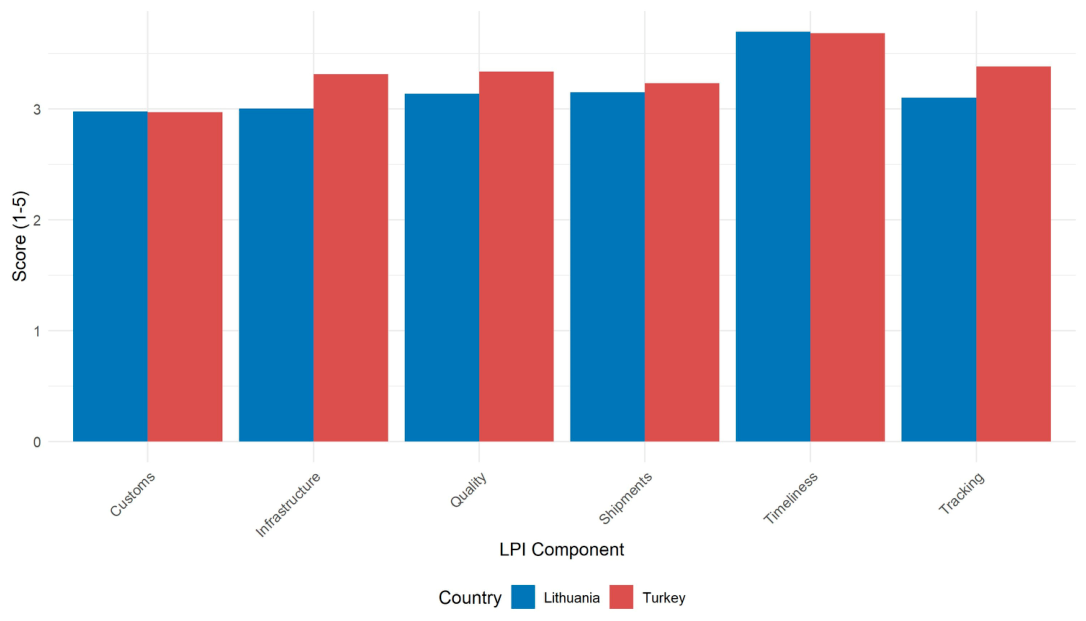
Before presenting the regression results, Figure 4 compares the average scores of Lithuania and Turkey across the six LPI sub-indicators over the study period. The two countries perform at broadly similar levels overall, but with notable differences in emphasis: Turkey shows a relative advantage in infrastructure, while Lithuania performs comparatively better in timeliness and logistics service quality. These descriptive differences foreshadow the divergent logistics–trade channels identified in the country-specific regressions reported in Table 5.
Figure 4.
Average LPI sub-indicators: Lithuania vs. Turkey (2007–2025).
The country-specific results yield several important insights. First, Turkey exhibits a higher GDP elasticity value of 0.906 compared to Lithuania, which shows a lower GDP elasticity value of 0.713. This shows that Turkish trade volumes react more strongly to alterations in economic size than Lithuanian trade volumes do. The distance coefficient shows that Lithuania (−1.789) imposes greater trade restrictions than Turkey (−0.723) because its absolute distance coefficient exceeds that of Turkey. The distance effect shows this pattern because Lithuania occupies a remote position within the EU while Turkey exists at the junction between European and Asian markets.
The two nations exhibit different logistical performance factors that determine their international trade results through their distinct performance metrics. The main element drives total trade in Lithuania, which shows its presence through logistics quality with a significant positive coefficient of 4.726, reaching statistical significance at the 0.01 level. The effect on exports demonstrates stronger impact, with 5.373 at the 0.01 level, and the import effect shows 4.375 at the 0.01 level. The Lithuanian trade system benefits from customs efficiency, which creates a positive impact of 2.942 at the 0.05 level while driving exports with a stronger effect of 3.749 at the 0.05 level.
Turkey depends on infrastructure quality as its main logistics factor, which drives its total trade through a 2.782 coefficient (p < 0.01) and exports through a 3.668 coefficient (p < 0.01). Turkish trade faces negative impacts from customs efficiency, which has a significant trade impact of −2.022 (p < 0.1) and a more intense effect on exports, which reaches −3.483 (p < 0.01). The finding appears to contradict itself because Turkey operates complex customs procedures through its Customs Union with the EU and faces ongoing regulatory problems at border checkpoints. The timeliness of exports from Turkey has a negative impact that reaches −3.382 (p < 0.01) because supply chain disruptions and transit logistics delays affect Turkey’s geographical location.
These divergent patterns carry significant policy implications. Lithuania should prioritize the quality and competence of its logistics services to maintain and enhance its trade competitiveness within the EU single market. Turkey, on the other hand, would benefit more from investments in trade and transport infrastructure while simultaneously streamlining its customs procedures to reduce friction at border crossings.
5.4. Robustness Checks
To validate the baseline results, several robustness checks are conducted using alternative panel data estimation techniques. Table 6 presents the results from pooled OLS, random effects (RE), and time-fixed effects (FE) models for the combined sample.
Table 6.
Robustness check: Panel data estimations.
The Hausman specification test results in a chi-square value of 41.904, which corresponds to a p-value less than 0.001. This result provides strong evidence against the null hypothesis that the random effects estimator is consistent. The time-fixed effects model confirms several key findings from the baseline analysis: GDP remains the strongest determinant of trade (0.731, p < 0.01), logistics quality has a significant positive effect (4.005, p < 0.05), and timeliness significantly promotes trade (4.350, p < 0.01).
The infrastructure variable shows a significant negative impact in the time-fixed effects model with a coefficient of −4.352 and p value below 0.01, while the random effects model shows a positive impact with a coefficient of 1.786 and p value below 0.01. The sign reversal across the estimators happens because LPI sub-indicators show high multicollinearity, which requires researchers to use caution when they interpret individual coefficient estimates. The Turkey dummy loses statistical significance in both the random effects and time-fixed effects models, which confirms that logistics performance variables effectively show the structural differences between the two economies.
To directly evaluate whether the sign reversals in the full model are artifacts of multicollinearity, we re-estimated the gravity model entering each LPI dimension separately (Table 7). When isolated from the correlated dimensions, all six sub-indicators enter positively and are significant at the 1% level. Notably, Shipments—which carries a negative sign in the full specification—becomes positive (1.476, p < 0.01) once collinearity is removed. This indicates that the unexpected signs in the saturated model stem from shared variance among the LPI dimensions, rather than from genuine negative effects. Further checks reported in Table 8 and Table 9 confirm that this conclusion is robust to using only official LPI years and to lagging the logistics variables.
Table 7.
Single-indicator robustness models (each LPI dimension entered separately).
Table 8.
Robustness checks: alternative samples and lag structure (dependent variable: ln(Trade)).
Table 9.
Alternative specifications addressing multicollinearity.
The Hausman specification test results in a chi-square value of 41.904, which corresponds to a p-value below 0.001. This provides strong evidence against the null hypothesis that the random effects estimator is consistent. The time-fixed effects model confirms several key findings from the baseline analysis: GDP remains the strongest determinant of trade (0.731, p < 0.01), logistics quality has a significant positive effect (4.005, p < 0.05), and timeliness significantly promotes trade (4.350, p < 0.01).
Table 8 reports two further robustness checks. First, to address the concern that interpolating biennial LPI data to annual frequency may artificially smooth fluctuations, we re-estimate the model using only official LPI years (N = 354). Second, to mitigate simultaneity, we re-estimate the model with one-period-lagged LPI variables (N = 909); past logistics performance can influence current trade, but current trade cannot affect past logistics performance. Across both specifications, the core results are stable: customs remains positive and significant (2.719 and 2.918, respectively), and GDP and distance are essentially unchanged. This confirms that neither interpolation nor reverse causality drives the reported relationships.
To further address the high correlations among the LPI dimensions, we estimate two alternative specifications that eliminate collinearity by construction (Table 9). In the first, the six sub-indicators are replaced by a single composite index equal to their mean; this index enters strongly and positively (2.686, p < 0.01). In the second, we apply principal component analysis to the six standardized dimensions: the first component, which loads almost equally on all six and explains 82.6% of their variance, captures a general logistics-performance factor and is positive and significant (0.081, p < 0.01). Both specifications confirm that overall logistics performance promotes bilateral trade, and that the unexpected individual signs in the saturated model arise from shared variance among highly correlated dimensions rather than from genuine negative effects. The GDP and distance coefficients remain essentially unchanged across both models, underscoring the stability of the core results.
The robustness checks confirmed the primary results of the study. The researchers found that GDP and logistics quality and timeliness function as essential factors which determine bilateral trade through their multiple estimation methods. The research results show that logistics performance has a major effect which reaches statistical significance on international trade patterns of Lithuania and Turkey, because both countries use different economic structural systems to operate their trade networks.
6. Discussion
The estimation results confirm the fundamental predictions of the gravity model and provide nuanced insights into the logistics–trade nexus. The GDP elasticity of 0.788 and the distance coefficient of −1.550 maintain their validity through existing academic research (Head & Mayer, 2014; Song & Lee, 2022). The research found that the Turkey dummy variable lost its strength, which moved from significant status with a value of negative 0.480 and a p value below 0.01 to non-significant status with a value of 0.081 across the complete analysis. The study found that different logistics performance levels between the two countries created the existing trade difference between them.
The LPI sub-indicators show customs efficiency as the strongest factor that determines two countries to conduct trade with each other (3.475, p < 0.01), which matches the research results of Kareem (2025) and Steinhauser and Khúlová (2025). The negative coefficient on international shipments (−1.999, p < 0.05) is unexpected. It likely reflects the high intercorrelation among LPI dimensions—exceeding 0.80 for several pairs—which produces suppression effects in multivariate regression. Song and Lee (2022) and Wang et al. (2018) show that all six LPI sub-indicators display sign changes when researchers analyze them together. When each dimension is entered separately (Table 7), shipments turns positive and significant, confirming that this negative sign is a collinearity artifact rather than a genuine effect.
The export–import disaggregation shows that import volumes depend on multiple logistics factors, including tracking, timeliness and quality of service. The export markets of the study area depend on customs efficiency as their main operational driver. The study’s results show an asymmetrical relationship that agrees with the findings of Puertas et al. (2014); this is because importing companies prefer to maintain operational reliability and predictability to achieve their inventory management goals and secure their essential operational materials (Hausman et al., 2013).
The country-specific estimations constitute the most distinctive contribution of this study. Lithuania exhibits logistics service quality as its principal element that improves trade activities (4.726, p < 0.01) because, as an EU economy, it competes through differences in service quality differences between markets. The Turkish system depends on infrastructure quality as its most vital component, consistent with the EBRD’s (2024) assessment and the Turkish 2053 Transport and Logistics Master Plan. The negative customs coefficient for Turkey (−2.022, p < 0.1) should not be read as evidence that customs efficiency harms trade. Rather, it reflects Turkey’s asymmetric Customs Union with the EU, under which persistent technical barriers, transit-permit frictions, and the efficiency gap relative to EU partners constrain trade despite domestic improvements. The coefficient therefore captures a relative institutional disadvantage rather than a causal negative effect, consistent with the EBRD (2024) assessment of customs-related bottlenecks in Turkey.
Beyond its empirical findings, the comparison yields a conceptual insight: the logistics–trade relationship is structurally contingent. The same LPI dimension can be trade-enhancing in one context and trade-neutral in another, depending on a country’s position in the international division of labor. For a small open EU economy fully integrated into the single market (Lithuania), regulatory and infrastructural barriers are largely harmonized, so competitive differentiation shifts to service quality and logistics competence. For a large emerging economy operating under an asymmetric Customs Union (Turkey), unresolved infrastructural and customs frictions remain binding constraints, so physical capacity and institutional reform dominate. This suggests that logistics-performance theory should incorporate a country’s integration status and structural position as moderating conditions, rather than treating the logistics–trade link as uniform across economies.
Lithuania shows a greater distance coefficient value of −1.789, compared to Turkey which has a distance coefficient value of −0.723, because Lithuania exists at the edge of EU territory. The distance effect between Turkey and Lithuania shows different results because Turkey has strategic positioning and superior sea transportation access, with an LSCI average of 221, while Lithuania has an LSCI average of 43. The baseline results receive support from robustness tests, including the Hausman test that shows fixed effects (p < 0.001) as the preferred method.
Accordingly, the estimated coefficients are best understood as conditional associations consistent with a logistics-to-trade channel, rather than definitive causal effects, since higher trade volumes may themselves stimulate logistics investment.
7. Conclusions
The research investigates how logistics performance affects international trade by comparing its effects between Lithuania and Turkey from 2007 until 2025, through the use of a gravity model that includes LPI sub-indicators. The study uses 984 bilateral trade observations with 26 EU member states to produce important research results.
Logistics performance affects bilateral trade between nations through different channels that depend on the structural characteristics of each nation. The quality and competence of logistics services stands as the main factor that enables Lithuania to enhance its international trade, whereas infrastructure quality serves as the main factor driving Turkey’s international trade development. This research discovery shows critical export–import disparities demonstrating that import quantities depend on service quality, tracking and timeliness, while export volumes depend mostly on customs processing efficiency. The Turkey dummy variable shows no significance in the complete model because logistics performance explains the trade performance gap which exists between EU member states and EU candidate countries.
The results of the research indicate that different policy approaches need to be developed. Lithuanian policymakers should prioritize investments in logistics service quality, workforce training and digital transformation to maintain their competitive edge in the EU single market. Turkish policymakers should accelerate infrastructure development through multimodal transport and port modernization. At the same time, they should reform customs procedures, which both the EBRD (2024) and Turkey’s 2053 Master Plan identify as regulatory obstacles. The findings show that universal logistics policies will not succeed because essential logistics aspects differ between different economies.
The principal practical contribution of this study lies in showing that logistics strategy cannot be designed independently of a country’s economic structure. The evidence indicates that a one-size-fits-all approach to logistics policy is ineffective: the dimensions that drive trade differ systematically between a small open EU economy and a large emerging economy.
For small open economies such as Lithuania, competitiveness depends primarily on the quality and competence of logistics services. The policy priority should therefore be advanced digital logistics services, value-added supply-chain functions, and workforce upskilling to sustain a niche, quality-based position within the EU single market.
For large emerging economies such as Turkey, trade performance is constrained mainly by physical infrastructure and customs friction. Customs modernization should focus on single-window systems and full alignment with the EU Union Customs Code to reduce border friction under the asymmetric Customs Union; multimodal investment should prioritize port–rail integration along the Middle Corridor; and digital logistics platforms (electronic consignment notes, real-time tracking) would improve timeliness. For small open economies such as Lithuania, regulatory harmonization is already largely achieved, so the priority is digital and value-added logistics services—automated warehousing, customs-IT integration, and data-driven supply-chain analytics—that reinforce its Baltic-gateway role.
More broadly, both economies would benefit from trade-facilitation reforms aligned with the WTO Trade Facilitation Agreement. Recognizing this structural differentiation allows policymakers to allocate scarce resources to the logistics dimensions that yield the greatest trade returns for their specific economic context.
The research has multiple limitations that affect its outcomes. The standard method of using survey-based LPI data will be replaced by the objective LPI 2.0 framework, according to Arvis and his colleagues in 2025. The method of linear interpolation for non-survey years creates estimation uncertainty, while the study does not analyze different commodity sectors. Although our robustness check using only official LPI years (Table 8) shows that interpolation does not materially alter the results, we acknowledge that linear interpolation remains a source of measurement error. By construction, it imposes smooth transitions between survey waves and cannot capture short-term fluctuations in logistics performance, such as those caused by the COVID-19 disruptions or the post-2022 supply-chain shocks. The interpolated values should therefore be viewed as approximations, and the corresponding coefficients interpreted with appropriate caution. The forthcoming annual LPI 2.0 data, based on actual tracking observations, will help address this limitation in future research. The next phase of the research needs to copy the existing framework used by LPI 2.0 indicators, and analyze data at the sector level according to the Song and Lee (2022) study, while testing different country pairs to establish whether the results apply universally. The increasing access to high-frequency supply chain data creates new opportunities that help us better understand how logistics and trade interact during times of ongoing worldwide instability. Further limitation concerns potential endogeneity. The logistics–trade relationship may be bidirectional, as higher trade volumes can induce greater logistics investment. Our estimates are therefore best interpreted as conditional associations; although the lagged-variable check mitigates simultaneity, future research could employ instrumental-variable or dynamic-panel methods to address causality more formally.
Looking ahead, two developments are likely to reshape the logistics–trade relationship. First, emerging technologies—artificial intelligence in demand forecasting and routing, blockchain-based trade documentation, and IoT-enabled tracking—may lower logistics costs and compress the performance gap between economies, as anticipated by the WTO (2025). Second, the shift from efficiency-only logistics toward supply-chain resilience, prompted by recent disruptions, implies that future measures of logistics performance will need to capture not only speed and cost but also the capacity to absorb shocks. Incorporating these dimensions into gravity-model analyses represents a promising avenue for future research.
Author Contributions
Conceptualization, C.Ç. and B.P.; methodology, C.Ç.; software, C.Ç.; validation, C.Ç. and B.P.; formal analysis, C.Ç.; investigation, C.Ç.; resources, C.Ç. and B.P.; data curation, C.Ç.; writing—original draft preparation, C.Ç.; writing—review and editing, C.Ç. and B.P.; visualization, C.Ç.; supervision, B.P.; project administration, C.Ç.; funding acquisition, C.Ç. and B.P. All authors have read and agreed to the published version of the manuscript.
Funding
This research received no external funding.
Institutional Review Board Statement
Not applicable.
Informed Consent Statement
Not applicable.
Data Availability Statement
The compiled dataset is available from the corresponding author upon reasonable request.
Conflicts of Interest
The authors declare no conflict of interest.
References
- Alexander, D. W., & Merkert, R. (2020). Applications of gravity models to evaluate and forecast US international air freight markets post-GFC. Transport Policy, 104, 52–62. [Google Scholar] [CrossRef] [Scilit]
- Arvis, J.-F., Ojala, L., Shepherd, B., Kiiski, T., & Wiederer, C. (2025). Connecting to compete 2025: The new logistics performance indicators 2.0. World Bank. [Google Scholar]
- Arvis, J.-F., Ojala, L., Shepherd, B., Kiiski, T., & Wiederer, C. (2026). The new logistics performance indicators 2.0 (LPI 2.0): Methodology and user guide. World Bank. [Google Scholar]
- Arvis, J.-F., Ojala, L., Wiederer, C., Shepherd, B., Raj, A., Dairabayeva, K., & Kiiski, T. (2018). Connecting to compete 2018: Trade logistics in the global economy. World Bank. [Google Scholar]
- Balbaa, M. E. (2026). Logistics performance and global trade integration: An empirical analysis of the Logistics Performance Index (LPI) across 153 countries. Journal of International Economics Research (JIER), 4(1), 39–45. [Google Scholar]
- Bensassi, S., Márquez-Ramos, L., Martínez-Zarzoso, I., & Suárez-Burguet, C. (2015). Relationship between logistics infrastructure and trade: Evidence from Spanish regional exports. Transportation Research Part A: Policy and Practice, 72, 47–61. [Google Scholar] [CrossRef] [Scilit]
- Bugarcic, F., & Kleinert, J. (2024). Estimating the effects of logistics performance on trade: Evidence from different gravity model approaches. Graz Economics Papers, GEP 2024–13. University of Graz. [Google Scholar]
- Caldara, M., & Iacoviello, M. (2022). Measuring geopolitical risk. American Economic Review, 112(4), 1194–1225. [Google Scholar] [CrossRef] [Scilit]
- Cheung, K. F., Bell, M. G. H., Pan, J. J., & Perera, S. (2020). An eigenvector centrality analysis of world container shipping network connectivity. Transportation Research Part E: Logistics and Transportation Review, 140, 101991. [Google Scholar] [CrossRef] [Scilit]
- Christopher, M. (2016). Logistics & supply chain management. Pearson UK. [Google Scholar]
- Civelek, M. E., Uca, N., & Çemberci, M. (2015). The mediator effect of logistics performance index on the relation between global competitiveness index and gross domestic product. European Scientific Journal, 11(13), 368–382. [Google Scholar]
- Çelebi, D. (2017). The role of logistics performance in promoting trade. Maritime Economics and Logistics, 21, 307–323. [Google Scholar] [CrossRef] [Scilit]
- Çemberci, M., Civelek, M. E., & Canbolat, N. (2015). The moderator effect of global competitiveness index on dimensions of logistics performance index. Procedia—Social and Behavioral Sciences, 195, 1514–1524. [Google Scholar] [CrossRef] [Scilit]
- De, P., & Saha, A. (2013). Logistics, trade and production networks: An empirical investigation. Research and Information System for Developing Countries. [Google Scholar]
- EBRD. (2024). Türkiye private sector diagnostic. European Bank for Reconstruction and Development. Available online: https://www.ebrd.com/content/dam/ebrd_dxp/assets/pdfs/country-strategies/türkiye/Türkiye-Private-Sector-Diagnostic.pdf (accessed on 12 January 2026).
- Fracasso, A. (2014). A gravity model of virtual water trade. Ecological Economics, 108, 215–228. [Google Scholar] [CrossRef] [Scilit]
- Fugazza, M., & Hoffmann, J. (2017). Liner shipping connectivity as determinant of trade. Journal of Shipping and Trade, 2(1), 1–18. [Google Scholar] [CrossRef] [Scilit]
- Ginn, S., & Saadaoui, H. (2025). How global supply chain pressure and economic policy uncertainty impact the prices of energy transition metals. Resources Policy, 101, 105345. [Google Scholar]
- Grant, D. B., Wong, C. Y., & Trautrims, A. (2017). Sustainable logistics and supply chain management: Principles and practices for sustainable operations and management. Kogan Page Publishers. [Google Scholar]
- Hausman, W. H., Lee, H. L., & Subramanian, U. (2013). The impact of logistics performance on trade. Production and Operations Management, 22(2), 236–252. [Google Scholar] [CrossRef] [Scilit]
- Head, K., & Mayer, T. (2014). Gravity equations: Workhorse, toolkit, and cookbook. In G. Gopinath, E. Helpman, & K. Rogoff (Eds.), Handbook of international economics (Vol. 4, pp. 131–195). Elsevier. [Google Scholar]
- Kabak, Ö., Ekici, Ş. O., & Ülengin, F. (2020). Analyzing two-way interaction between the competitiveness and logistics performance of countries. Transport Policy, 98, 238–246. [Google Scholar] [CrossRef] [Scilit]
- Kareem, F. O. (2025). Trade facilitation and manufacturing exports in ECOWAS countries. Journal of Infrastructure, Policy and Development, 9(3), 1–22. [Google Scholar]
- Kowalski, P., & Bates, O. (2025). Lithuania’s trade dependencies. OECD Trade Policy Papers, No. 299. OECD Publishing. [Google Scholar] [CrossRef] [Scilit]
- Mann, C. L. (2012). Supply chain logistics, trade facilitation and international trade: A macroeconomic policy view. Journal of Supply Chain Management, 48(3), 7–14. [Google Scholar] [CrossRef] [Scilit]
- Martí, L., Medina, R. M., & García Menéndez, L. (2012). Relevance of trade facilitation in emerging countries’ exports. The Journal of International Trade and Economic Development, 23(2), 202–222. [Google Scholar] [CrossRef] [Scilit]
- Martí, L., Puertas, R., & García, L. (2014). The importance of the logistics performance index in international trade. Applied Economics, 46(24), 2982–2992. [Google Scholar] [CrossRef] [Scilit]
- Puertas, R., Martí, L., & García, L. (2014). Logistics performance and export competitiveness: European experience. Empirica, 41(3), 467–480. [Google Scholar] [CrossRef] [Scilit]
- Republic of Türkiye Ministry of Transport and Infrastructure. (2023). 2053 transport and logistics master plan. Available online: https://www.uab.gov.tr/media/3cgbeluf/20221025-2053-ulastirma-ve-lojistik-ana-plani-eng.pdf (accessed on 12 January 2026).
- Song, M.-J., & Lee, H.-Y. (2022). The relationship between international trade and logistics performance: A focus on the South Korean industrial sector. Research in Transportation Business & Management, 44, 100786. [Google Scholar] [CrossRef] [Scilit]
- Steinhauser, J., & Khúlová, A. (2025). The impact of logistics performance on countries’ export growth: A global gravity approach. In 25th international joint conference central and eastern Europe in the changing business environment: Proceedings (pp. 328–339). Prague University of Economics and Business. [Google Scholar]
- Suroso, A. I. (2022). The effect of logistics performance index indicators on palm oil and palm-based products export: The case of Indonesia and Malaysia. Economies, 10(10), 261. [Google Scholar] [CrossRef] [Scilit]
- Tang, C. F., & Abosedra, S. (2019). Logistics performance, exports, and growth: Evidence from Asian economies. Research in Transportation Economics, 78, 100743. [Google Scholar] [CrossRef] [Scilit]
- Tinbergen, J. (1962). Shaping the world economy: Suggestions for an international economic policy. The Twentieth Century Fund. [Google Scholar]
- UNCTAD. (2025). Review of maritime transport 2025: Staying the course in turbulent waters. United Nations Conference on Trade and Development. [Google Scholar]
- Wang, M. L., Choi, C. H., Wang, M. L., & Choi, C. H. (2018). How logistics performance promote the international trade volume? A comparative analysis of developing and developed countries. International Journal of Logistics Economics and Globalisation, 7(1), 49–70. [Google Scholar] [CrossRef] [Scilit]
- World Economic Forum. (2025). Green logistics innovation for emerging markets: Driving competitiveness and shared value. WEF. Available online: https://www.weforum.org/publications/green-logistics-innovation-for-emerging-markets-driving-competitiveness-and-shared-value/ (accessed on 12 January 2026).
- WTO. (2025). World trade report 2025: Making trade and AI work together to the benefit of all. World Trade Organization. Available online: https://www.wto.org/english/res_e/publications_e/wtr25presentation_e.pdf (accessed on 12 January 2026).
- Zhang, K. (2022). The effect of logistics performance index of RCEP countries on China’s export trade. Review of Economic Assessment, 1(1), 4. [Google Scholar] [CrossRef] [Scilit]

Disclaimer/Publisher’s Note: The statements, opinions and data contained in all publications are solely those of the individual author(s) and contributor(s) and not of MDPI and/or the editor(s). MDPI and/or the editor(s) disclaim responsibility for any injury to people or property resulting from any ideas, methods, instructions or products referred to in the content. |
© 2026 by the authors. Licensee MDPI, Basel, Switzerland. This article is an open access article distributed under the terms and conditions of the Creative Commons Attribution (CC BY) license.