1. Introduction
Organizations today operate in conditions of ongoing disruption, uncertainty, and increasing complexity. These pressures have become more intense due to rapid digitalization, repeated technological shifts, and the broader instability caused by economic, social, and global crises. In such an environment, organizations are not only expected to respond to change, but to do so repeatedly, quickly, and with enough coherence to preserve both performance and long-term viability. As a result, adaptability has become a central organizational requirement rather than a temporary strategic concern.
This reality has brought change management back to the foreground of organizational research and practice. Change is no longer an occasional event that can be addressed through isolated interventions. In many organizations, it has become a continuous condition that requires structured readiness, coordinated responses, and the ability to realign resources and priorities over time. For this reason, change management capability and organizational change capability (OCC) are increasingly understood as broader organizational capacities rather than as fragmented managerial actions. From the perspective of Dynamic Capabilities Theory, such capacities can be seen as higher-order mechanisms that allow organizations to sense shifts in the environment, seize emerging opportunities or necessary responses, and transform internal structures accordingly. This interpretation is especially relevant in periods of digital transformation, where adaptation depends not only on technological adoption, but also on the renewal of organizational roles, routines, and knowledge bases (
Bari et al., 2022;
Montreuil, 2023). In this respect, change management can be approached as a dynamic organizational capability that supports the continuous reconfiguration of skills and work practices (
Konopik et al., 2021;
Vuchkovski et al., 2023).
One of the most important outcomes associated with this adaptive capacity is organizational resilience. Resilience is often discussed as the ability to withstand shocks, but in organizational settings it involves something broader. It includes the capacity to adjust under pressure, reorganize when needed, and continue functioning in ways that support recovery as well as future preparedness. In other words, resilience is not only about endurance, but also about adaptive renewal. Existing studies suggest that change management capabilities contribute to this process by improving organizational responsiveness, helping firms interpret uncertainty more effectively, and enabling the realignment of strategic and operational priorities when disruption occurs (
Iftikhar et al., 2021;
Supriharyanti & Sukoco, 2023). Related work also shows that change-oriented leadership, transformation governance, and coordinated organizational routines can strengthen adaptive capacity, particularly during periods of crisis such as the COVID-19 pandemic (
He et al., 2023;
Prayag et al., 2024). Recent studies have begun to link digital HRM more directly with organizational resilience. Digital HRM practices appear to support resilience-related capabilities, such as anticipation, coping, and adaptation, particularly when organizations operate under unstable and disruptive conditions (
Ahmić & Ćosić, 2025). This is important for the present study because it shows that HR-related digital practices should not be treated only as administrative or technical improvements. They can also form part of the wider organizational process through which firms prepare for disruption, respond to pressure, and develop adaptive capacity over time.
Still, the link between change management capability and organizational resilience is unlikely to be direct or self-evident. A key issue is the internal process through which adaptation becomes operational inside the organization. In this study, particular attention is given to digital upskilling as one such process. In contexts of continuous transformation, digital upskilling should not be treated simply as employee training in the narrow sense. It can be better understood as a capability-building mechanism through which organizations renew human capital, strengthen digital readiness, and support more effective responses to technological and operational change. Recent literature shows that digital upskilling improves employees’ ability to use digital technologies, engage with innovation, and cope more effectively with uncertainty and disruption (
Awad & Martín-Rojas, 2024;
Dubey et al., 2023). More broadly, research on digital transformation has repeatedly emphasized the importance of digital literacy, adaptability, and agility for organizational continuity and resilience (
Gomes & Silva, 2025;
B. Zhang et al., 2022). However, these elements are often discussed in parallel, without sufficient explanation of how digital skill development is strategically activated within broader change processes.
At this point, the role of Human Resource Management (HRM) becomes particularly important. HRM is not only involved in supporting training activities, but in shaping the broader organizational conditions under which capability development takes place. Through learning systems, talent development, performance management, and digitally enabled people practices, HR can translate change pressures into more structured forms of digital skill development. This means that HR should be viewed not simply as an administrative support function, but as a strategic actor in capability renewal. Prior studies have linked HR digital maturity, digital HRM practices, and strategic alignment with stronger organizational adaptation, resilience-related capabilities, and more systematic development of workforce capabilities (
Ahmić & Ćosić, 2025;
Alrousan et al., 2025;
Shahiduzzaman, 2025;
G. Wang et al., 2024). Even so, the literature has not yet fully clarified whether digital upskilling acts as the mechanism through which change management capability contributes to organizational resilience, or whether the digital maturity of HR strengthens this relationship.
This is where the present study seeks to contribute. Although dynamic capabilities, digital transformation, and organizational resilience have all been widely discussed, there is still limited understanding of how these strands come together in a single explanatory framework centered on workforce capability development. More specifically, the existing literature does not sufficiently explain how change management capability may function as the organizational driver of resilience through digital upskilling, nor how HR digital maturity may act as a boundary condition that reinforces this process. The study therefore offers a more integrated perspective by bringing together three elements that are often examined separately: change management capability as the driver, digital upskilling as the mechanism, and HR digital maturity as the contextual condition that may intensify or support capability development.
Based on this reasoning, the aim of the present study is to examine how change management capability supports organizational resilience through HR-enabled digital upskilling in contexts of continuous change. The theoretical contribution of the study is not simply the confirmation of positive associations among change capability, digital upskilling, and resilience. Rather, the study specifies a capability conversion process through which change management capability becomes consequential for resilience when it is translated into workforce-level digital skill renewal. In addition, it positions digital HR maturity as a boundary condition that shapes how effectively this conversion takes place. In this way, the manuscript extends the dynamic capabilities perspective by showing how higher-order change capability is operationalized through human capital renewal, rather than treating resilience as a direct or automatic outcome of adaptation. The central research question guiding the study is the following: How does digital upskilling, supported by change management capability and HR practices, contribute to strengthening organizational resilience under conditions of continuous volatility and transformation?
2. Theoretical Framework
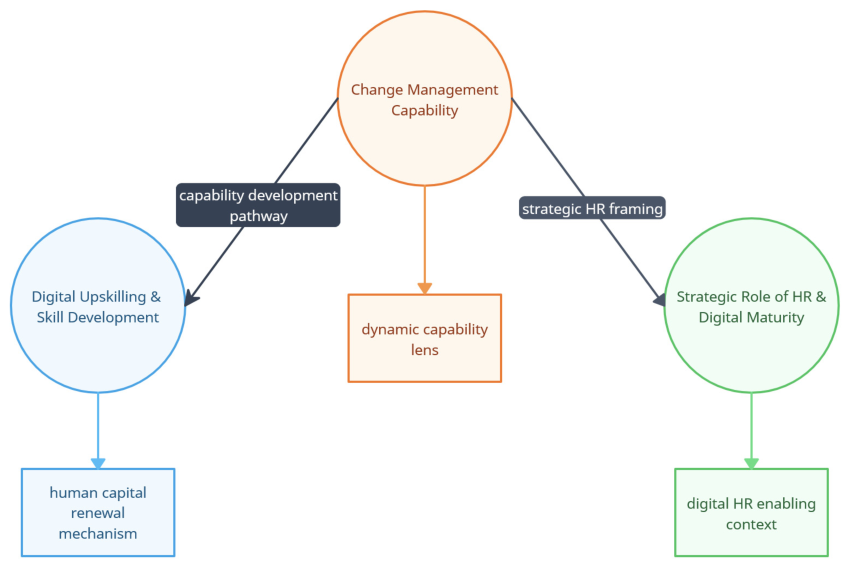
Before moving to the main strands of the literature, it is useful to clarify the logic that guides the discussion in this section. As shown in
Figure 1, the review is organized around three closely connected theoretical pillars that together shape the argument of the study. The discussion starts with change management capability, which is treated as the main organizational point of reference for understanding how firms respond to repeated disruption, uncertainty, and adaptation pressures. This part of the review is approached through a dynamic capability lens, with emphasis on the idea that change should be understood not as a temporary managerial intervention, but as a broader organizational capacity linked to adjustment, reconfiguration, and strategic responsiveness.
Building on this starting point, the review then turns to digital upskilling and skill development, examined here as a human capital renewal mechanism through which adaptation becomes more concrete at the workforce level. The final part of the review focuses on the strategic role of HR and digital maturity, considered as the broader digital HR enabling context within which skill development efforts can become more coordinated, sustained, and strategically aligned. In this way,
Figure 1 is included not to depict the study’s conceptual model, but to make clear how the literature review develops step by step and how the manuscript moves from the wider organizational capability perspective to the more specific mechanisms and conditions that support resilience in contexts of ongoing change.
Since the manuscript draws on several related concepts, it is useful to clarify their boundaries before developing the detailed theoretical discussion. These distinctions are consistent with the literature on dynamic capabilities, organizational resilience, digital transformation, and HR digital maturity, but they are stated here according to the specific way in which the terms are used in the present study (
Bari et al., 2022;
Montreuil, 2023;
Prayag et al., 2024;
Shahiduzzaman, 2025;
L. Wang et al., 2022). As shown in
Table 1, the empirical model focuses on four measured constructs, while some related terms are used only as broader conceptual or contextual expressions.
With these boundaries in place, the next subsection discusses change management capability as the upstream organizational capability on which the model is built.
2.1. Change Management as a Dynamic Organizational Capability
In recent years, change management has increasingly been viewed as something broader than a set of planned interventions used to support organizational transitions. In environments marked by uncertainty, repeated disruption, and ongoing digital pressure, it is more useful to approach it as an organizational capability tied to adaptation itself. This reading fits well with the dynamic capabilities tradition, which explains how organizations remain viable by sensing change, mobilizing responses, and reconfiguring resources and routines over time (
Bari et al., 2022). Seen in this way, change management capability is not limited to implementation support. It becomes part of the wider organizational capacity to adjust direction, redeploy attention, and sustain coordinated responses when existing arrangements no longer fit changing conditions.
This perspective is especially relevant in periods of digital transformation, where organizations are required to introduce new technologies, redesign workflows, and reshape roles in ways that affect both operational continuity and future readiness. In this context, change management capability helps translate disruption into more ordered forms of internal adjustment and supports the strategic responsiveness expected from organizations facing continuous pressure to evolve (
Konopik et al., 2021;
Liang & Li, 2024;
Vuchkovski et al., 2023). This interpretation is also consistent with work that treats dynamic capabilities as patterned forms of organizational change, involving not only resource reconfiguration but also goal development and change orchestration (
Sune & Gibb, 2015).
Even so, the internal process through which change capability becomes actionable remains insufficiently specified. Dynamic capabilities are often used to explain why some organizations adapt more successfully than others, yet less attention is given to how this adaptive capacity supports the renewal of strategic skills. This matters because resilience depends not only on structural flexibility or managerial intent, but also on whether employees can update their skills and respond effectively to shifting technological and operational requirements.
For this reason, change management capability is treated in the present study as a higher-order organizational capability that supports resource adjustment, learning, and capability renewal under conditions of uncertainty (
Sune & Gibb, 2015). The theoretical point is that change capability may strengthen resilience not only through direct adjustment to disruption, but also by creating the internal conditions under which employees and work units renew the skills needed to operate in changing digital environments. This leads to two related questions: the first concerns the capability-building role of change management, while the second concerns its contribution to organizational resilience.
RQ1: How does change management capability operate as a dynamic organizational capability that triggers strategic skill development?
RQ2: To what extent does change management capability influence organizational resilience?
2.2. Digital Upskilling as a Strategic Organizational Capability
Digital upskilling has moved beyond the narrow meaning of employee training and is increasingly discussed as part of a broader organizational effort to build and renew capabilities under technological change. Its strategic value does not lie only in the possession of digital skills by individuals, but in the extent to which these skills are developed, coordinated, and embedded across the organization (
Awad & Martín-Rojas, 2024;
Cosa & Torelli, 2024;
J. Zhang et al., 2021). In the present study, digital upskilling refers specifically to the systematic development and updating of employees’ digital skills, rather than to a general state of digital readiness.
Digital transformation requires organizations to align skills with new processes, decisions, and forms of collaboration. Digital skills create organizational value when they support coordination, innovation, and timely response rather than remaining scattered across individuals or units. Recent research suggests that digital literacy, digital readiness, and workforce adaptability are increasingly important for organizations operating in volatile and technology-intensive environments (
Awad & Martín-Rojas, 2024;
Ben Ghrbeia & Alzubi, 2024). This is particularly relevant because digital competencies age quickly, making episodic training insufficient for organizations that need to sustain adaptation over time. Digital upskilling therefore contributes to human capital renewal by helping employees update their knowledge base and adjust to evolving systems, roles, and work demands (
Dey et al., 2024;
Dubey et al., 2023;
Zhao et al., 2023).
The relevance of digital upskilling becomes clearer when it is linked to organizational resilience. Prior studies suggest that digital skills support resilience through learning, knowledge sharing, operational flexibility, and innovation rather than through training alone (
Awad & Martín-Rojas, 2024;
Browder et al., 2023). When newly developed skills are absorbed into routines and supported by digital infrastructures, they can help organizations respond faster to disruption, recover more effectively, and adapt more flexibly (
Dubey et al., 2023;
Zhao et al., 2023).
At the same time, the mediating role of digital upskilling remains insufficiently specified. Digital transformation studies often refer broadly to digital readiness or digital capability, but they do not always explain how these capabilities become embedded at the workforce level. In the present study, digital upskilling is therefore treated as the mechanism through which change management capability is converted into renewed human capital and, eventually, into stronger organizational resilience. This leads to the following research question:
RQ3: To what extent does digital upskilling function as a strategic mechanism that strengthens organizational resilience?
2.3. The Strategic Role and Digital Maturity of HR
The discussion so far suggests that change management capability helps organizations adapt under pressure, while digital upskilling translates adaptation into workforce-level capability renewal. However, this process is unlikely to unfold in the same way across all organizations. One important condition is the digital maturity of the HR function. When HR is digitally underdeveloped or strategically peripheral, change may still occur, but its translation into systematic skill development is likely to be fragmented or weakly coordinated.
Digital HR maturity refers to the extent to which HR processes, systems, and decision practices are digitally integrated and aligned with broader organizational priorities. It is therefore closer to an organizational capability than to a simple technology adoption indicator, because it involves governance, workforce planning, analytics, learning systems, and the ability of HR to support adaptation over time (
Bansal et al., 2023;
Shahiduzzaman, 2025;
L. Wang et al., 2022). In the present study, digital HR maturity is conceptually distinct from digital upskilling: digital HR maturity refers to the enabling HR systems and practices, while digital upskilling refers to the actual development of employees’ digital skills.
The strategic orientation of HR is equally important. In organizations facing continuous digital and operational change, HR can shape how capability development is prioritized, coordinated, and embedded across the organization. Research on digital transformation, workforce readiness, and learning-oriented environments suggests that reskilling efforts are more effective when HR plays an active strategic role and when learning is supported by communication, leadership commitment, and a wider culture of adaptation (
Alrousan et al., 2025;
Da Silva et al., 2022;
Guerra et al., 2023;
Nankervis & Cameron, 2023).
At the same time, two issues remain insufficiently resolved. First, although digital upskilling has been linked to resilience, fewer studies examine it explicitly as the process through which change management capability may influence organizational resilience. Second, while digital HR maturity is often discussed as part of HR transformation, its role in shaping the relationship between change management capability and digital upskilling remains underexplored. This leaves open whether HR maturity merely accompanies digital change or whether it strengthens the conditions under which change can be translated into repeatable and targeted upskilling efforts.
The present study addresses this gap by treating HR as part of the strategic context within which capability development takes shape. In this view, digital upskilling may explain how change management capability contributes to organizational resilience, while digital HR maturity may condition how strongly change capability is converted into systematic skill development. This leads to the final two research questions of the study:
RQ4: Does digital upskilling mediate the relationship between change management capability and organizational resilience?
RQ5: Does digital HR maturity strengthen the relationship between change management capability and digital upskilling?
2.4. Conceptual Model
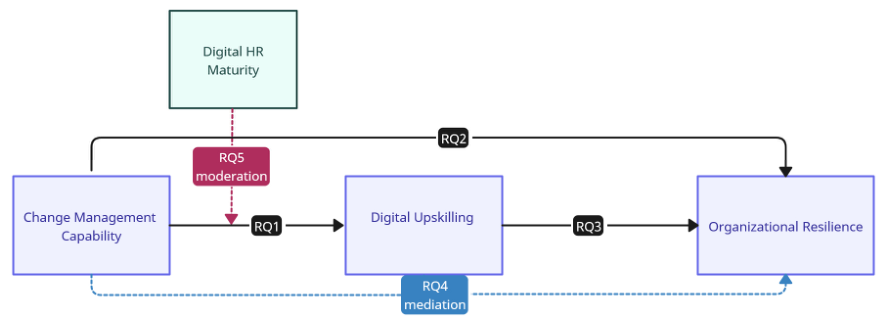
The conceptual model shown in
Figure 2 brings together the main relationships that emerged from the literature review and translates them into a single explanatory structure. At its core, the model assumes that change management capability functions as the main organizational driver, since organizations facing repeated disruption need more than isolated change efforts; they need a broader capacity to coordinate adjustment, reorganize routines, and respond strategically over time. Within this process, digital upskilling is positioned as the mediating mechanism through which change capability becomes more concrete at the workforce level. It is treated as the point where organizational change capacity is translated into updated employee skills, more flexible work routines, and greater ability to respond to digitally shaped disruption. In other words, the model suggests that the effect of change management capability on organizational resilience is not expected to rely only on a direct relationship, but also on the organization’s ability to turn change pressures into systematic digital skill development. This logic is reflected in the solid paths of the model, which represent the core direct relationships among the three main constructs. To make the link between the research questions and the conceptual model clearer,
Figure 2 indicates the corresponding RQ for each relationship. RQ1 refers to the relationship between change management capability and digital upskilling, RQ2 to the relationship between change management capability and organizational resilience, and RQ3 to the relationship between digital upskilling and organizational resilience.
At the same time,
Figure 2 also includes two dashed paths, each serving a different analytical purpose. The lower dashed path corresponds to RQ4 and represents the indirect effect examined in the study, indicating that digital upskilling is expected to mediate the relationship between change management capability and organizational resilience. This path captures the idea that resilience is strengthened not simply because organizations manage change, but because they are able to translate change into capability renewal through workforce development. The upper dashed path corresponds to RQ5 and reflects the moderating role of digital HR maturity, suggesting that the relationship between change management capability and digital upskilling becomes stronger when the HR function is more digitally mature and strategically aligned. Taken together, these two dashed relationships help clarify that the model is concerned not only with whether change capability matters, but also with how and under what conditions it contributes to resilience.
3. Methodology
3.1. Research Design and Data Collection
This study followed a quantitative research design to examine the relationships among Change Management Capability (CM), Digital Upskilling (DU), Organizational Resilience (OR), and Digital HR Maturity (HRM) in private-sector organizations. Data were collected through an online questionnaire administered via Google Forms between November 2025 and February 2026. The survey was circulated through professional networks, corporate contacts, and internal forwarding within companies, with stronger access to HR-related departments and managerial roles. Since the study required respondents with at least some familiarity with organizational change, HR practices, and workforce development issues, a non-probability purposive sampling approach was considered the most suitable.
A total of 819 usable questionnaires were retained for the analysis, representing a response rate of 16.92%. Before the final dataset was formed, the responses were checked for completeness and basic response consistency. Questionnaires that were incomplete or showed evident response irregularities were excluded at this stage, while fully usable cases were carried forward to the statistical analysis. This process helped ensure that the subsequent model estimation was based on a stable and coherent dataset.
3.2. Instrument Development and Measures
The questionnaire included two sections. The first section gathered general demographic information and contained seven questions covering gender, age group, educational level, current position in the organization, years of HR-related professional experience, organization size, and industry sector. The second section formed the main part of the instrument and included 20 statements measured on a five-point Likert scale, ranging from 1 = strongly disagree to 5 = strongly agree. The average completion time was estimated at approximately 14 to 18 min.
The measurement items were drawn from prior literature and were adapted to fit the context of the present study. The instrument captured four reflective first-order latent constructs: CM, DU, OR, and HRM, with five items assigned to each construct. Care was taken to keep the wording clear and relevant for respondents working in organizational settings, while still preserving the conceptual meaning of the original measures. A full overview of the items, their indicative focus, and the supporting literature is presented in
Table 2 and
Table 3. To make the operationalization process clearer, the questionnaire items were organized according to the logic of the research questions and the conceptual model. RQ1 concerns the relationship between change management capability and digital upskilling and is therefore operationalized through the CM and DU items. RQ2 focuses on the relationship between change management capability and organizational resilience and is linked to the CM and OR items. RQ3 examines the contribution of digital upskilling to organizational resilience and is linked to the DU and OR items. RQ4 examines the mediating role of digital upskilling between change management capability and organizational resilience and is therefore based on the CM, DU, and OR constructs. Finally, RQ5 examines the moderating role of digital HR maturity in the relationship between change management capability and digital upskilling and is linked to the CM, HRM, and DU items. In this way, the 20 survey items were not developed as isolated questions, but as construct-level indicators aligned with the theoretical relationships expressed in RQ1–RQ5.
The adaptation of the items followed a construct-driven approach. Items were not copied mechanically from prior studies, but were reworded to fit the context of organizational change, digital upskilling, HR digital maturity, and resilience in private-sector organizations. During this process, the original conceptual meaning of each item was retained, while wording was adjusted to be understandable for respondents in HR-related and managerial roles. The adaptation focused mainly on contextual fit, clarity, and consistency across the four constructs. The two-stage pilot process was also used to check whether the adapted items were interpreted in the intended way before the main data collection.
All four constructs were specified as reflective first-order constructs. This specification was considered appropriate because the items were treated as observable manifestations of the underlying latent variables rather than as separate components forming the construct. For example, the CM items reflect the broader capability of managing change, while the DU items reflect the organization’s tendency to develop and embed digital skills. Similarly, the OR items reflect the broader resilience capacity of the organization, and the HRM items reflect the digital maturity of HR systems and practices. In this sense, changes in the latent construct are expected to be reflected in the corresponding indicators, which is consistent with the reflective measurement logic used in the PLS-SEM model.
Before the main distribution, the questionnaire was reviewed through a two-stage pilot process. First, alpha testing was carried out with 8 participants to identify issues related to clarity, phrasing, item interpretation, and the overall flow of the questionnaire. This was followed by beta testing with 17 participants, which allowed the instrument to be checked under more realistic response conditions, including usability, timing, and the logic of the online format. Minor revisions were made after this phase, mainly to improve wording and the sequence of some items. The final wording of the 20 survey items is provided in
Appendix A to support transparency and reproducibility.
3.3. Ethical and Data Protection Considerations
Participation was voluntary and anonymous throughout the study. The questionnaire did not collect personal or directly identifying information, and respondents were informed at the beginning that they could discontinue participation at any point before submission by simply closing the browser window. An informed consent statement appeared on the opening page of the survey and explained the purpose of the study, the voluntary nature of participation, and the anonymous handling of responses.
The data collection procedure was designed in line with the principles of the General Data Protection Regulation (GDPR; Regulation (EU) 2016/679) and the relevant Greek legal framework, especially Law 4624/2019, which applies the GDPR in the Greek context. Particular attention was given to anonymity, data minimization, restricted use of responses for research purposes only, and the broader protection of participants’ informational rights.
3.4. Common Method Bias Considerations
Given the cross-sectional and self-reported nature of the survey, common method bias was considered as a potential concern. Several procedural steps were used to reduce this risk during the design and administration of the questionnaire. Participation was anonymous, there were no right or wrong answers, and respondents were informed that the data would be used only in aggregated form. The questionnaire also separated general demographic questions from the main construct items, used clear and neutral wording, and avoided leading or evaluative phrasing as far as possible.
In addition to these procedural remedies, collinearity diagnostics were examined as a post hoc indication of possible common method-related problems. The outer model VIF values ranged from 1.000 to 2.404, remaining below the commonly used threshold of 3.3. This suggests that inflated collinearity, and by extension serious common method-related distortion, was unlikely to be a major concern in the estimated model. However, this diagnostic does not fully rule out common method bias. For this reason, the results should still be interpreted with the usual caution applied to cross-sectional self-reported survey data (
Guenther et al., 2023).
Beyond common method bias, potential endogeneity concerns should also be acknowledged. The cross-sectional design does not allow the direction of the relationships to be established with certainty, and reverse causality may be possible. For example, organizations that are already more resilient may also be more likely to invest in digital upskilling or develop more mature digital HR systems. In addition, omitted organizational factors, such as leadership quality, learning climate, innovation orientation, prior digital transformation experience, or organizational performance, may influence both the predictors and the outcome variables. Although the theoretical model is grounded in prior literature and the analysis includes supplementary Bayesian robustness checks, the findings should be interpreted as evidence of theoretically consistent associations rather than definitive causal effects. Future longitudinal, panel, or multi-source research designs could provide stronger evidence on the direction and causal robustness of the proposed relationships (
Antonakis et al., 2010).
3.5. Data Analysis Procedure
The proposed relationships were examined mainly through Partial Least Squares Structural Equation Modeling (PLS-SEM) using SmartPLS v.4.1.1.7 as the primary analytical tool. This approach was selected for three main reasons. First, the study examined several latent constructs measured through multiple indicators and included direct, mediating, and moderating relationships within one integrated model. Second, the purpose of the analysis was mainly explanatory and prediction-oriented, as the study aimed to examine how change management capability, digital upskilling, and digital HR maturity account for variance in organizational resilience. Third, PLS-SEM is suitable for models that combine mediation and moderation effects and for research contexts where theory is being extended by specifying mechanisms among related constructs rather than only testing a well-established covariance-based model (
Hair et al., 2022). For these reasons, PLS-SEM was considered appropriate for the analytical aims of the study.
The measurement model included four reflective first-order latent variables: CM, DU, OR, and HRM. The structural model included the direct paths among these constructs, as well as an interaction term between CM and HRM to examine the proposed moderating effect on DU. To evaluate the stability and significance of the model estimates, a bootstrapping procedure with 5000 subsamples was applied. The analysis followed the usual stages of PLS-SEM assessment, including checks of indicator collinearity, internal consistency, convergent validity, discriminant validity, and the evaluation of the structural paths, together with the proposed mediation and moderation effects.
Alongside the main PLS-SEM analysis, a Bayesian analysis was also planned as a supplementary robustness check using JASP v.0.96.0.0. This additional step was not intended to replace the main analytical strategy, but to provide an extra layer of support when interpreting the proposed relationships.
4. Results
This section presents the empirical findings of the study in three steps. It begins with a brief overview of the sample profile, then moves to the PLS-SEM results, including the assessment of the measurement and structural models, and finally reports the supplementary Bayesian analysis. This sequence was followed in order to present the findings in a clear and coherent way, starting from the composition of the sample and moving gradually to the main analytical results.
4.1. Sample Profile
Before moving to the multivariate analysis, it is useful to briefly describe the composition of the final sample. Since the study draws on responses from HR-related and managerial roles in private-sector organizations, this overview helps place the findings in their organizational context.
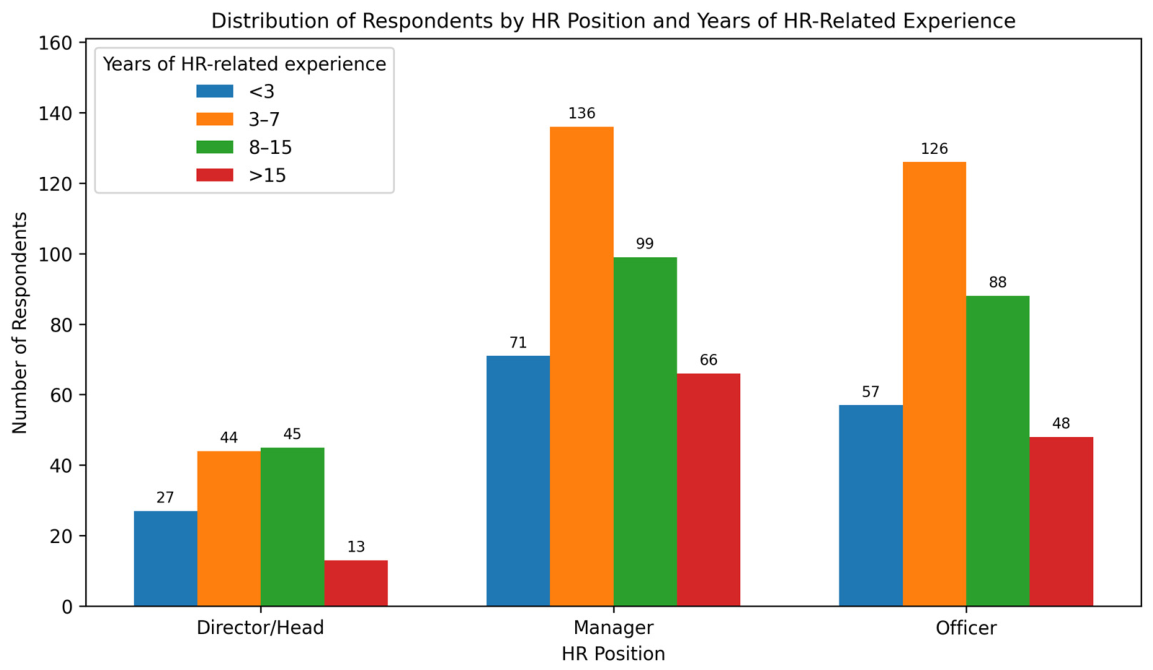
Figure 3 presents the distribution of respondents by organizational position and years of HR-related experience using a grouped bar chart. The highest concentration appears among Managers with 3–7 years of experience, followed by Officers in the same experience group. A second visible concentration appears in the 8–15 years category, especially among respondents in managerial and specialist HR roles. Overall, the figure suggests a sample centered on participants with direct HR responsibility and a meaningful level of professional experience.
The broader demographic profile is consistent with this picture. The sample was almost evenly distributed by gender, with a slight predominance of male respondents (50.2%) over female respondents (47.6%), while 2.2% selected other/prefer not to say. The largest age group was 31–40 years (35.8%), followed by 41–50 years (27.2%). In terms of education, respondents holding a Master’s degree formed the largest category (50.7%), indicating a relatively well-qualified sample. Managers accounted for the largest positional group (45.4%), followed by Officers (38.9%), while the most common experience bracket was 3–7 years (37.4%). The sample also covered organizations of different sizes, with the largest share coming from firms employing 50–249 employees (31.5%), and the services sector represented the strongest industry context (47.5%). Taken together, these characteristics point to a sample with adequate managerial relevance, HR experience, and organizational breadth.
4.2. PLS-SEM Results
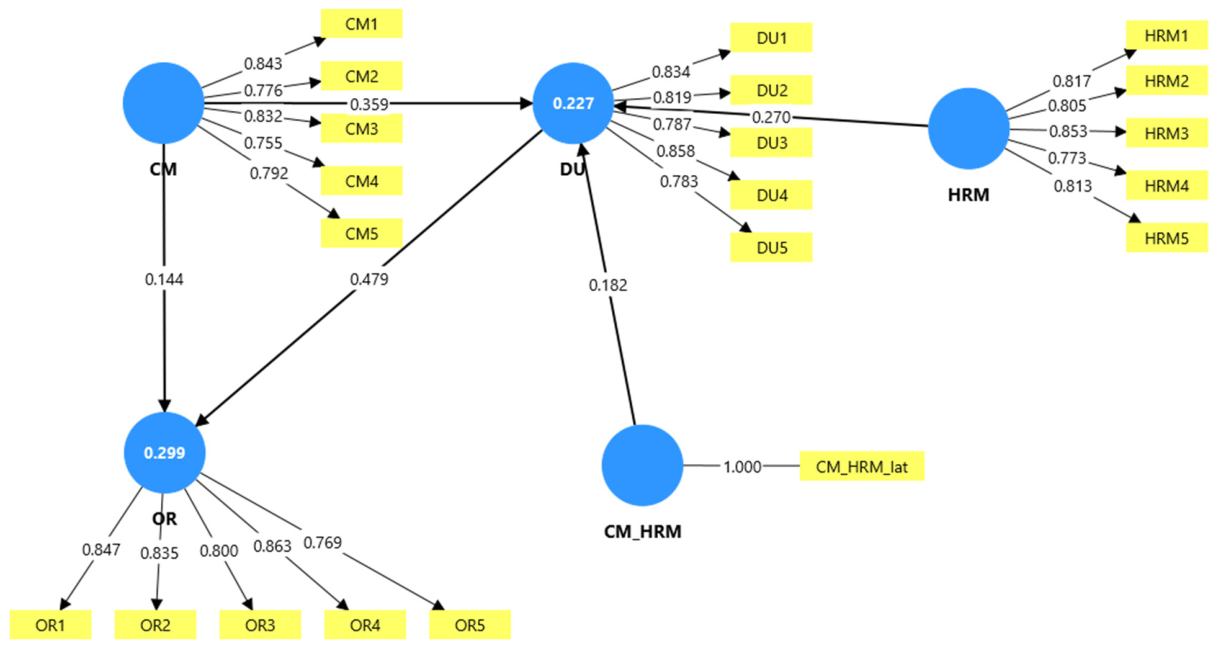
The PLS-SEM results are presented in two steps. First, the adequacy of the measurement model was examined in terms of reliability and validity. Second, the structural relationships were assessed in order to evaluate the direct, indirect, and moderating effects proposed in the study. The overall pattern of the estimated relationships is illustrated in
Figure 4, while the detailed statistical results are reported in
Table 4,
Table 5 and
Table 6.
4.2.1. Measurement Model Assessment
The measurement model was examined first in order to assess the reliability and validity of the four reflective constructs included in the study. As shown in
Table 4, the internal consistency of the measures was satisfactory across all constructs. Cronbach’s alpha values ranged from 0.860 to 0.881, while composite reliability values ranged from 0.899 to 0.913. The AVE values also remained above the accepted threshold, ranging from 0.641 to 0.678, which supports convergent validity for CM, DU, HRM, and OR.
At the indicator level, most outer loadings were strong and in the expected direction. Although one item within CM showed a comparatively lower loading than the rest, the overall measurement quality remained satisfactory and did not suggest a broader problem with the construct. Collinearity was also examined and did not indicate concern, as the outer VIF values remained within acceptable limits. Taken together, these findings suggest that the measurement model was sufficiently stable and internally coherent for further analysis (
Guenther et al., 2023).
Discriminant validity was assessed using both the HTMT ratio and the Fornell–Larcker criterion. The HTMT values remained well below conservative cut-off levels, with the highest observed value at 0.598, while the square roots of the AVE exceeded the corresponding inter-construct correlations. This pattern indicates that the constructs were empirically distinguishable from one another. In addition, the overall model fit was satisfactory, with
SRMR = 0.044 and
NFI = 0.929, suggesting an acceptable degree of fit between the data and the specified model (
Guenther et al., 2023).
4.2.2. Structural Model Assessment
As illustrated in
Figure 4, the estimated model indicates positive relationships among the main constructs, with Digital Upskilling occupying a central role in the link between Change Management Capability and Organizational Resilience. The statistical results reported in
Table 5 and
Table 6 confirm that all direct paths included in the model were positive and statistically significant.
More specifically, Change Management Capability had a significant positive effect on Digital Upskilling (β = 0.359, t = 12.291, p < 0.001) and a smaller but still significant direct effect on Organizational Resilience (β = 0.144, t = 4.927, p < 0.001). In turn, Digital Upskilling showed the strongest direct effect on Organizational Resilience (β = 0.479, t = 18.894, p < 0.001). Digital HR Maturity was also positively associated with Digital Upskilling (β = 0.270, t = 9.342, p < 0.001), while the interaction term between CM and HRM was significant (β = 0.182, t = 6.497, p < 0.001), indicating that the positive effect of change management capability on digital upskilling became stronger under higher levels of HR digital maturity.
The explanatory power of the model was moderate. The predictors explained 22.7% of the variance in Digital Upskilling and 29.9% of the variance in Organizational Resilience. In terms of effect sizes, the contribution of DU to OR was the strongest (
f2 = 0.288), followed by the effect of CM on DU (
f2 = 0.167). The effects of HRM on DU (
f2 = 0.094) and of the interaction term (
f2 = 0.043) were smaller, but still meaningful within the model, whereas the direct effect of CM on OR remained comparatively modest (
f2 = 0.026). This pattern suggests that the relationship between change capability and resilience is present, but becomes more substantial when digital upskilling is taken into account. To separate the structural path estimates from the model-level indices, the explanatory and predictive results are reported separately in
Table 6.
The indirect effects further support this interpretation. The path from CM to OR through DU was positive and significant (β = 0.172, t = 10.203, p < 0.001), indicating that Digital Upskilling mediates the relationship between Change Management Capability and Organizational Resilience. Since the direct effect of CM on OR remained significant, this mediation can be interpreted as partial rather than full. Finally, the PLSpredict assessment indicated positive predictive relevance, with Q2predict = 0.220 for DU and 0.134 for OR, suggesting that the model retained acceptable predictive capacity beyond in-sample explanation.
4.3. Bayesian Robustness Analysis
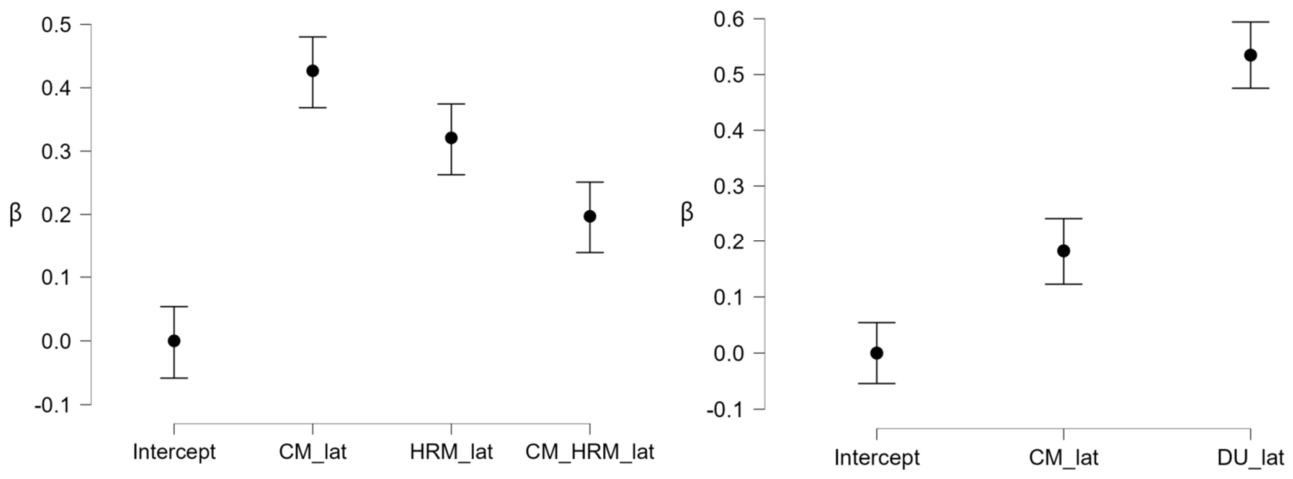
To complement the main PLS-SEM findings, a supplementary Bayesian robustness analysis was conducted in JASP v.0.96.0.0. Two Bayesian linear regression models were estimated in line with the main structure of the proposed model. The first used Digital Upskilling as the dependent variable and included Change Management Capability, Digital HR Maturity, and their interaction term as predictors. The second used Organizational Resilience as the dependent variable and included Change Management Capability and Digital Upskilling as predictors. This additional step was intended to examine whether the core relationships identified through PLS-SEM remained stable when assessed through a different inferential framework.
The Bayesian results were consistent with the main SEM findings. For Digital Upskilling, the best-supported model included CM_lat, HRM_lat, and CM_HRM_lat, with posterior model probability equal to 1.000 and
R2 = 0.315. All three predictors showed positive posterior means and strictly positive 95% credible intervals: CM_lat = 0.427 [0.369, 0.480], HRM_lat = 0.321 [0.263, 0.374], and CM_HRM_lat = 0.197 [0.138, 0.251]. For Organizational Resilience, the best-supported model included CM_lat and DU_lat, again with posterior model probability equal to 1.000 and
R2 = 0.403. Both predictors were positive, with CM_lat = 0.182 [0.123, 0.242] and DU_lat = 0.535 [0.475, 0.594]. As illustrated in
Figure 5, the credible intervals remained fully above zero in both models, providing additional support for the direction and stability of the relationships observed in the PLS-SEM analysis.
The R2 values of the Bayesian models should be interpreted with caution and in relation to the purpose of this supplementary analysis. The values of 0.315 for Digital Upskilling and 0.403 for Organizational Resilience do not indicate very high explanatory power, but they are acceptable for survey-based organizational research, where behavioral and perceptual outcomes are usually influenced by several unobserved contextual factors. More importantly, the Bayesian analysis was not intended to maximize explained variance or replace the PLS-SEM results. Its purpose was to examine whether the main relationships retained the same direction and credibility under a different inferential approach. Since the posterior estimates were positive and their 95% credible intervals remained above zero, the Bayesian results were interpreted as supporting the stability of the main findings rather than as providing an independent high-explanation model.
Taken together, the Bayesian estimates did not alter the substantive interpretation of the main results. Rather, they provided supplementary support for the direction and stability of the relationships identified in the PLS-SEM analysis, without implying that the Bayesian models captured all relevant sources of variance.
5. Discussion
The results suggest that change management capability should not be viewed simply as a supporting function during periods of transition. Its positive association with both digital upskilling and organizational resilience points to a broader organizational role, one that appears to be connected with how firms adjust under pressure, reorganize internal arrangements, and maintain continuity when disruption becomes recurrent rather than exceptional. This reading is consistent with the dynamic capabilities perspective, which treats adaptation as an ongoing organizational capacity rather than as a one-off response to external events (
Bari et al., 2022;
Montreuil, 2023). At the same time, given the cross-sectional nature of the data, the findings should be interpreted as evidence of patterned associations rather than as proof of causal effects. The stronger association between digital upskilling and organizational resilience, together with the observed mediating effect, suggests that resilience may become more tangible when change capability is accompanied by workforce-level capability renewal. This is broadly in line with recent work showing that digital readiness, learning, and skill development are closely connected to an organization’s ability to remain functional and adaptive under uncertain conditions (
Awad & Martín-Rojas, 2024;
Dubey et al., 2023;
Zhao et al., 2023).
The role of digital HR maturity adds a further layer to this picture. Its positive association with digital upskilling, along with the significant interaction effect, suggests that organizations do not translate change capability into structured skill development in the same way or with the same intensity. Part of that difference appears to depend on whether the HR function is digitally mature enough to support learning in a more systematic and strategically aligned manner. In that sense, the findings do not simply confirm that HR matters during transformation; they show more specifically that HR maturity helps shape the conditions under which change can lead to sustained workforce development. This fits well with studies that describe digital HR transformation as an enabling context for learning, capability development, and organizational responsiveness rather than as a narrow technological upgrade of HR operations (
Alrousan et al., 2025;
Bansal et al., 2023;
Ruiz et al., 2024;
L. Wang et al., 2022). Taken together, these findings provide a coherent answer to the study’s research questions by showing how change management capability contributes to organizational resilience, through digital upskilling, and under conditions shaped by digital HR maturity.
5.1. Discussion of the Research Questions
The discussion can be organized around the five research questions that guided the study. RQ1 asked how change management capability operates as a dynamic organizational capability that triggers strategic skill development. The results show a positive and significant relationship between change management capability and digital upskilling. This means that organizations with more structured change processes and stronger capacity to adjust resources also tend to report more systematic support for digital skill development. In this sense, change management capability should not be interpreted only as a general readiness for adaptation. In the present data, it appears to be associated with workforce capability renewal.
RQ2 examined the extent to which change management capability influences organizational resilience. The findings show a positive direct relationship between the two constructs, although this effect was weaker than the effect of digital upskilling on resilience. This is an important point. It suggests that change capability is relevant for resilience, but it may not be enough on its own. Its role appears more meaningful when it is considered together with more concrete workforce-level capabilities.
RQ3 focused on whether digital upskilling strengthens organizational resilience. This was the strongest direct relationship in the model. The finding indicates that resilience is not supported only by formal change structures or managerial planning. It also depends on whether employees are able to update, use, and apply digital skills under changing work conditions. Therefore, digital upskilling should not be seen only as a training activity. In this study, it appears as a central mechanism associated with preparedness, flexibility, and continuity in digitally disrupted environments.
RQ4 examined whether digital upskilling mediates the relationship between change management capability and organizational resilience. The significant indirect effect supports this interpretation. In practical terms, organizations do not become more resilient simply because they manage change in a more structured way. They appear more resilient when change capability is accompanied by systematic digital skill development, which is also associated with more adaptive organizational responses.
RQ5 examined whether digital HR maturity strengthens the relationship between change management capability and digital upskilling. The significant moderating effect shows that this relationship becomes stronger when the HR function is more digitally mature. This finding is useful because it presents digital HR maturity as more than a background condition. It appears to shape how effectively change capability is associated with targeted upskilling practices. Organizations with more digitally mature HR systems seem better placed to identify skill needs, support learning pathways, and align workforce development with change priorities.
Taken together, the findings answer the five research questions by showing that organizational resilience is built through a connected process. Change management capability provides the basis for adaptation, digital upskilling translates this capability into workforce renewal, and digital HR maturity strengthens the conditions under which this translation takes place. The main contribution of the study is therefore not simply that change capability supports resilience, but that this relationship becomes clearer when digital upskilling and HR digital maturity are considered together.
5.2. Practical and Theoretical Implications
A first practical implication concerns the way organizations approach digital transformation and change implementation. The findings suggest that resilience is not associated only with the introduction of change initiatives, but also with the presence of structured efforts to renew workforce capabilities. In practice, this means that organizations should avoid treating digital upskilling as a peripheral training activity or as an occasional response to technological change. Instead, it needs to be embedded more systematically into broader change processes, so that employees are not only exposed to new systems, but are also supported in developing the skills required to work effectively under changing conditions. This point is important because recent research has repeatedly shown that digital readiness and learning capacity shape whether organizations are able to respond to uncertainty in adaptive rather than reactive ways (
Awad & Martín-Rojas, 2024;
Dubey et al., 2023;
Zhao et al., 2023).
A second practical implication concerns the role of the HR function. The results indicate that similar change pressures are not associated with the same upskilling patterns across organizations, and one possible reason appears to be the differing level of digital HR maturity. For managers, this implies that investment in digital learning cannot be separated from the maturity of the HR systems and structures expected to support it. Learning platforms, analytics-based skill mapping, and more strategically aligned HR processes are likely to matter not only because they improve efficiency, but because they help convert change-related intentions into repeatable and targeted development practices. In this sense, the findings suggest that HR should be positioned less as an administrative implementer and more as an active architect of capability development during periods of transformation. This interpretation is consistent with prior work that links digital HR transformation to stronger workforce development, organizational learning, and more coordinated adaptation processes (
Alrousan et al., 2025;
Bansal et al., 2023;
Ruiz et al., 2024;
L. Wang et al., 2022).
In practical terms, managers can assess digital HR maturity through a five-part diagnostic lens. The first dimension is digital integration, referring to whether HR processes are connected through coherent systems rather than fragmented tools. The second is analytics use, meaning whether HR data are used to identify skill gaps, support workforce planning, and guide development decisions. The third is strategic alignment, which concerns the extent to which digital HR initiatives support the wider organizational strategy. The fourth is digital learning infrastructure, referring to whether learning platforms and reskilling tools are embedded in regular HR development practices. The fifth is the strategic role of HR, meaning whether HR participates actively in change management and capability renewal. Assessing these five areas can help managers understand whether their HR function is mature enough to support systematic digital upskilling and, through it, organizational resilience (
Bansal et al., 2023;
Shahiduzzaman, 2025;
L. Wang et al., 2022).
From a theoretical point of view, the study contributes by clarifying the process through which change management capability becomes relevant for organizational resilience. The contribution is not only that change capability, digital upskilling, and resilience are positively related. Such relationships are broadly consistent with existing work on dynamic capabilities and digital transformation. The added value of the present study lies in specifying how this relationship unfolds. The findings suggest that change management capability operates as an upstream organizational capability, digital upskilling functions as the workforce-level conversion mechanism, and digital HR maturity acts as the enabling condition that strengthens this conversion process.
This distinction is theoretically important because it shifts the discussion from a general adaptation logic to a more specific capability conversion logic. In many studies, resilience is treated as a broad outcome of dynamic capabilities, while digital skills are often discussed as part of digital transformation readiness. The present study connects these ideas more directly by showing that resilience is strengthened when change capability is translated into renewed digital competencies at the workforce level. In this way, digital upskilling is not treated as a secondary training outcome, but as the mechanism through which organizational change capability becomes operational and visible in resilience-building.
The study also extends the discussion on digital HR maturity. Rather than presenting HR maturity only as a sign of digital transformation or technological sophistication, the findings position it as a condition that affects whether change capability is converted into systematic upskilling. This adds a more conditional understanding to the model: organizations may have change capability, but its effect on workforce renewal depends partly on the maturity of the HR systems that support learning, skill mapping, and development. In this sense, the study extends the dynamic capabilities perspective in a more applied organizational direction, by linking higher-order change capability with resilience through workforce-level capability renewal and HR-enabled coordination (
Bari et al., 2022;
Montreuil, 2023;
Prayag et al., 2024).
6. Conclusions
This study examined how change management capability, digital upskilling, and digital HR maturity are linked to organizational resilience under conditions of continuous change. The findings show that change management capability is positively related to both digital upskilling and organizational resilience. However, the results also show that digital upskilling has a particularly important role, since it showed the strongest direct relationship with organizational resilience and also mediated the relationship between change management capability and resilience. In addition, digital HR maturity strengthened the relationship between change management capability and digital upskilling. This suggests that the HR function does not simply support training activities, but may also shape the conditions under which change is associated with more systematic workforce capability development.
Overall, the findings point to a clear conclusion. Organizational resilience does not appear to be explained by change efforts alone. It also depends on whether organizations are able to convert change pressures into renewed digital capabilities at the workforce level. This connected interpretation is one of the main contributions of the study, because it moves beyond a simple “positive relationships” model and explains resilience as the outcome of a capability conversion process. Change capability provides the organizational basis for adaptation, digital upskilling converts this capability into workforce-level renewal, and digital HR maturity strengthens the conditions under which this conversion is organized and sustained.
The study also contributes to the field by giving digital upskilling a more specific role in the resilience discussion. Rather than treating digital skills as a general requirement of digital transformation, the findings suggest that digital upskilling can operate as a mechanism through which organizations build resilience. This is relevant for organizations that face repeated disruption, because it shows that resilience depends not only on planning or managerial coordination, but also on the continuous renewal of employee capabilities. For HR managers and organizational decision-makers, the practical implication is that digital upskilling should not be treated as an occasional training response. It needs to be connected with change management processes, skill mapping, digital learning systems, and broader HR maturity.
Several limitations should also be acknowledged. Although the study provides useful evidence on the links among change management capability, digital upskilling, digital HR maturity, and organizational resilience, its findings should be interpreted in light of certain limitations. First, the research was based on a cross-sectional survey design, which does not allow strong causal claims or observation of how capability development unfolds over time. Second, the data relied on self-reported perceptions from respondents in HR-related and managerial roles. Although procedural steps and collinearity diagnostics were used to reduce and assess the risk of common method bias, this risk cannot be fully eliminated in cross-sectional survey research. The findings therefore reflect informed organizational perceptions, but not necessarily objective organizational performance or longitudinal change outcomes. The use of purposive, non-probability sampling also calls for caution when considering broader generalization beyond similar organizational settings. Relatedly, possible endogeneity cannot be fully excluded. Reverse causality may exist, as more resilient organizations may also be more likely to invest in digital upskilling and digital HR maturity. In addition, omitted factors such as leadership, learning climate, digital culture, or prior transformation experience may partly shape the observed relationships. These limitations do not reduce the value of the findings, but they suggest that the results are best understood as evidence of patterned relationships rather than definitive causal proof.
Future research could build on this study in several directions. A useful next step would be to examine the model longitudinally, in order to see whether change management capability, digital upskilling, and organizational resilience evolve in a stable sequence over time. It would also be valuable to test the model in different national, sectoral, and organizational contexts, including public-sector and non-profit organizations, where HR maturity and digital transformation may follow different patterns. Future studies could also extend the framework by examining additional organizational conditions, such as leadership style, learning climate, employee participation, or digital culture, which may further explain when change capability is more successfully translated into sustained workforce development and resilience (
Alrousan et al., 2025;
Guerra et al., 2023;
L. Wang et al., 2022).