1. Introduction
The emergence of artificial intelligence (AI) as a general-purpose technology has coincided with renewed global efforts to tackle persistent and multidimensional poverty. Over the past decade, AI systems have been progressively integrated into the infrastructures that govern social protection, agriculture, health, education, financial services, and public administration. This convergence has stimulated an expanding body of research on whether and how AI can meaningfully contribute to poverty reduction (
Goralski & Tan, 2022;
Thanyawatpornkul, 2024;
Ogbuju et al., 2025). Concurrently, there is growing concern that AI may exacerbate existing inequalities through biased decision-making, exclusion of data-poor populations, and the deepening of digital divides (
Nemorin et al., 2023;
Sinanan & McNamara, 2021).
Conventional poverty governance strategies are constrained by limitations in data, institutional capacity and responsiveness. Household surveys and administrative records are often collected at long intervals and can be incomplete or outdated for programme design. AI-based methods offer a potential remedy by enabling the analysis of large, heterogeneous and frequently updated datasets, ranging from satellite imagery to mobile phone records, thereby enhancing the accuracy and timeliness of interventions (
Hall et al., 2023;
Usmanova et al., 2022).
Given the rapid growth and fragmentation of this literature across multiple disciplines, including development economics, information systems, and public administration, there is a clear need for an integrative synthesis. Several reviews have examined specific subdomains such as AI for poverty prediction (
McBride et al., 2022;
Hall et al., 2023) or AI for sustainable development (
Raman et al., 2025). However, a gap remains for a synthesis focused explicitly on the intersection between AI and poverty governance, a term we define as the set of institutional arrangements, policy frameworks, and decision-making processes through which state and non-state actors design, implement, and evaluate strategies to reduce poverty (
Liang et al., 2022;
Nemorin et al., 2023). This perspective moves beyond a narrow focus on technical applications to examine the political, ethical and institutional dimensions of AI deployment.
The objective of this article is therefore to conduct a systematic review of the literature on AI and poverty governance, with three interrelated objectives:
To map the main domains in which AI is currently applied to poverty-related challenges, identifying the governance mechanisms involved.
To synthesise evidence on the benefits, constraints and risks associated with these applications, paying particular attention to issues of inclusion, equity and accountability.
To identify cross-cutting trends, conceptual gaps and methodological limitations to inform a forward-looking research agenda.
To achieve these objectives, the article applies a structured review methodology aligned with the Preferred Reporting Items for Systematic Reviews and Meta-Analyses (PRISMA) 2020 statement (
Page et al., 2021). The review is global in scope, and country-specific references, including those from South Africa, are used only illustratively where the literature offers contextually relevant insights into AI-enabled poverty governance. The remainder of the article is structured as follows:
Section 2 presents a theoretical and conceptual framework linking AI to poverty governance.
Section 3 details the systematic methodology.
Section 4 synthesises the results.
Section 5 discusses the findings, and
Section 6 concludes with implications and future research directions.
2. Theoretical Framing and Conceptualisation
Understanding how artificial intelligence interacts with poverty requires an integrated theoretical and conceptual lens that spans technological, developmental and ethical dimensions. AI is best understood as a socio-technical system rather than a purely computational artefact. Its performance and impact are co-produced by algorithms, data infrastructures, institutional logics, regulatory regimes and the social contexts in which systems are designed and used (
Liang et al., 2022;
Nemorin et al., 2023;
Sinanan & McNamara, 2021). This view is especially important in low-income settings, where structural inequalities and institutional weaknesses can shape both who is visible in data and who benefits from digital innovation.
The literature on multidimensional poverty provides a first pillar for this theoretical framing. Poverty is used as a deprivation in multiple domains, including income, nutrition, education, health, housing, access to basic services, security and voice. These dimensions interact in complex ways, generating cumulative disadvantage across the life course. AI is particularly relevant to multidimensional poverty because it can process diverse and high-dimensional datasets to capture patterns that conventional indicators might miss. Studies using machine learning and satellite imagery demonstrate that remote sensing data can serve as a proxy for local economic conditions and infrastructure levels, thereby enabling high-resolution poverty mapping in data-poor environments (
McBride et al., 2022;
Hall et al., 2023;
Usmanova et al., 2022). Similar approaches are evident in the analysis of digital footprints, such as mobile phone usage or transaction data.
The capability approach provides a complementary normative framework that emphasises human freedoms and the substantive opportunities people have to lead the kind of life they value. In this perspective, AI applications in development should be evaluated based on whether they expand or constrain capabilities. For example, AI-based health diagnostics and telemedicine can enhance the capability for health by providing early detection and more timely care to populations in remote or underserved regions (
Guru Basava Aradhya et al., 2025;
Arnold, 2025). AI-enabled adaptive learning platforms can expand educational capabilities by tailoring content to the needs and pace of disadvantaged learners, including those in resource-strained systems (
Nemorin et al., 2023;
Thanyawatpornkul, 2024). AI-supported financial inclusion and precision agriculture can enhance economic capabilities by allowing poor households to invest in productive activities, manage risk and build assets (
Mhlanga, 2021;
Del Sarto & Ozili, 2025;
Etuk & Ayuk, 2021;
Bahn et al., 2021;
Miani et al., 2023).
Digital development and ICT for development scholarship offer further conceptual tools. They highlight that technology adoption and impact are mediated by existing power structures, institutional capacities, regulatory frameworks and cultural practices (
Liengpunsakul, 2021;
Raman et al., 2025). The literature cautions against technologically deterministic narratives and emphasises the importance of local adaptation, sustained capacity building and participatory design. Empirical work on AI and digitalisation in public sector entities, for instance, shows that bureaucratic processes, organisational cultures and legacy systems significantly influence whether AI contributes to greater accountability and service quality or simply reproduces existing inefficiencies (
Adekunle et al., 2023;
Harmanpreet et al., 2025;
Mishra et al., 2025). Studies of AI and energy systems similarly demonstrate that digital innovation can either alleviate or intensify energy poverty depending on broader policy environments and financing models (
Wang et al., 2023).
Complexity theory provides a further layer of insight by framing poverty as a product of interactions between economic, social, environmental and institutional subsystems. These interactions are nonlinear, path dependent and subject to feedback loops, which makes prediction and control challenging. AI aligns well with complexity-informed perspectives because its models can capture nonlinear relationships, incorporate multiple scales and update as new data emerge. This is evident in work on early warning systems for climate hazards, disease outbreaks and food insecurity, where AI models integrate climatic, geographic, health and economic data to anticipate shocks and inform anticipatory action (
Etuk & Ayuk, 2021;
McBride et al., 2022;
Hall et al., 2023;
Ogbuju et al., 2025).
Thus, the literature on AI ethics, data justice and responsible innovation is central to any theoretical framing of AI and poverty. Concerns about fairness, transparency, accountability and privacy cut across almost all reviewed domains (
Liang et al., 2022;
Gerlich, 2023;
Al-Emran & Griffy-Brown, 2023). Algorithmic bias can arise from skewed training data or modelling choices and can lead to systematic exclusion of marginalised groups from social protection, credit or services. Data justice perspectives ask who is visible in data, who controls data infrastructures and how benefits and harms are distributed (
Nemorin et al., 2023;
Sinanan & McNamara, 2021). These approaches argue that AI for poverty governance must be embedded in governance frameworks that ensure participatory oversight, clear lines of accountability and meaningful opportunities for affected communities to challenge decisions.
To move beyond a descriptive account of AI applications, this review is also grounded in a conceptual framework that positions AI as a socio-technical system interacting with the core mechanisms of poverty governance. Drawing on scholarship in digital governance, public administration and AI ethics, we identify four key governance mechanisms that AI can potentially reshape: (1) Targeting and Allocation, (2) Delivery and Service Provision, (3) Monitoring and Evaluation, and (4) Accountability and Participation.
Poverty governance refers to the institutional arrangements, administrative mechanisms, regulatory frameworks and coordination processes through which states and development organisations identify, target, support and monitor individuals and communities affected by poverty (
Mhlanga, 2021;
Del Sarto & Ozili, 2025;
Adjei et al., 2022). Unlike broader poverty reduction strategies, which focus on outcomes such as income, education, or health improvements, poverty governance emphasises targeting and eligibility mechanisms, resource allocation and programme coordination, monitoring and learning systems, accountability and citizen oversight, and the data infrastructures that support welfare systems (
Etuk & Ayuk, 2021;
Bahn et al., 2021;
Onyeaka et al., 2023;
Miani et al., 2023;
Munguti et al., 2022). AI becomes relevant to poverty governance not because of its technical novelty, but because it reshapes the logics and modalities of these governance functions. In this manuscript, “poverty governance” refers specifically to the institutional processes through which poverty-related needs are identified, prioritised, administered, monitored and reviewed, whereas “poverty reduction” is used more broadly to denote the developmental outcome itself.
First, the mechanism of Targeting and Allocation is fundamental to poverty governance, determining who receives resources and under what conditions. AI systems, particularly machine learning models, are used to refine this process by moving beyond static, means-tested criteria to dynamic, predictive targeting based on multidimensional data streams (
McBride et al., 2022;
Hall et al., 2023). This can improve allocative efficiency but also introduces risks of algorithmic bias and exclusion if models are trained on unrepresentative data (
Gerlich, 2023).
Second, Delivery and Service Provision involves the operationalisation of poverty governance strategies. AI can automate administrative tasks, optimise supply chains and enable the delivery of personalised services, for example, in health and education, potentially increasing efficiency and reach (
Raman et al., 2025;
Guru Basava Aradhya et al., 2025). However, this mechanism is highly dependent on digital infrastructure and can be undermined by connectivity and capacity constraints (
Avordeh et al., 2024).
Third, Monitoring and Evaluation is critical for adaptive governance. AI facilitates near real-time monitoring of programme performance and poverty dynamics through data from satellites, mobile phones and administrative systems (
Usmanova et al., 2022;
Simon & Khambule, 2022). This can improve responsiveness to shocks but also raises concerns about surveillance and the repurposing of data (
Sinanan & McNamara, 2021).
Finally, Accountability and Participation are the democratic pillars of governance. AI systems can enhance accountability by making decision-making processes more transparent and auditable (
Al-Emran & Griffy-Brown, 2023). Conversely, opaque or proprietary algorithms can obscure accountability, limiting citizens’ ability to contest decisions and participate meaningfully in governance (
Nemorin et al., 2023). This framework guides the subsequent analysis, helping to categorise findings not just by sector but by how they interact with these fundamental governance processes.
This review is therefore guided by an integrated lens in which AI capabilities such as prediction, automation, optimisation and pattern detection interact with governance mechanisms within broader institutional, socio-political and ethical contexts, including structural inequality, data governance, regulatory capacity and digital exclusion. The Materials and Methods and Results sections that follow are informed by this framework.
3. Materials and Methods
This study adopts a systematic literature review methodology, designed to provide a comprehensive, transparent and replicable synthesis of peer-reviewed research. The review procedure was informed by the PRISMA 2020 statement (
Page et al., 2021) and adapted to the interdisciplinary nature of the AI and development field.
3.1. Search Strategy and Databases
The search targeted peer-reviewed journal articles and scholarly book chapters retrieved from Scopus, Web of Science Core Collection and the Directory of Open Access Journals (DOAJ). These databases were selected because together they provide broad interdisciplinary coverage across development studies, public policy, information systems, economics and related social-science fields relevant to AI and poverty governance. The review was designed as an international evidence synthesis and was therefore not restricted to a single national accreditation system. The final search was performed on 15 October 2025.
The search strategy combined keywords related to AI, poverty and governance. The search string was:
(TITLE-ABS-KEY(“artificial intelligence” OR “machine learning” OR “deep learning” OR “predictive analytics”) AND TITLE-ABS-KEY(“poverty” OR “poverty reduction” OR “social protection” OR “livelihoods”) AND TITLE-ABS-KEY(“governance” OR “targeting” OR “delivery” OR “accountability”)) AND (LIMIT-TO (DOCTYPE, “ar”) OR LIMIT-TO (DOCTYPE, “ch”)) AND (LIMIT-TO (LANGUAGE, “English”)).
This search yielded an initial corpus of 387 records.
3.2. Inclusion and Exclusion Criteria
Studies were included if they met the following criteria: (a) were peer-reviewed journal articles or book chapters; (b) were published in English between 1 January 2015 and 15 October 2025; (c) focused on AI as a central subject; (d) addressed a dimension of poverty or poverty-related outcomes (e.g., income, access to services, or vulnerability); and (e) explicitly or implicitly engaged with governance mechanisms. Studies were excluded if they (a) discussed digital technologies without a substantive AI component; (b) applied AI in ways unrelated to poverty or development outcomes; or (c) were editorials, conference abstracts, or non-peer-reviewed reports.
3.3. Screening and Selection Process
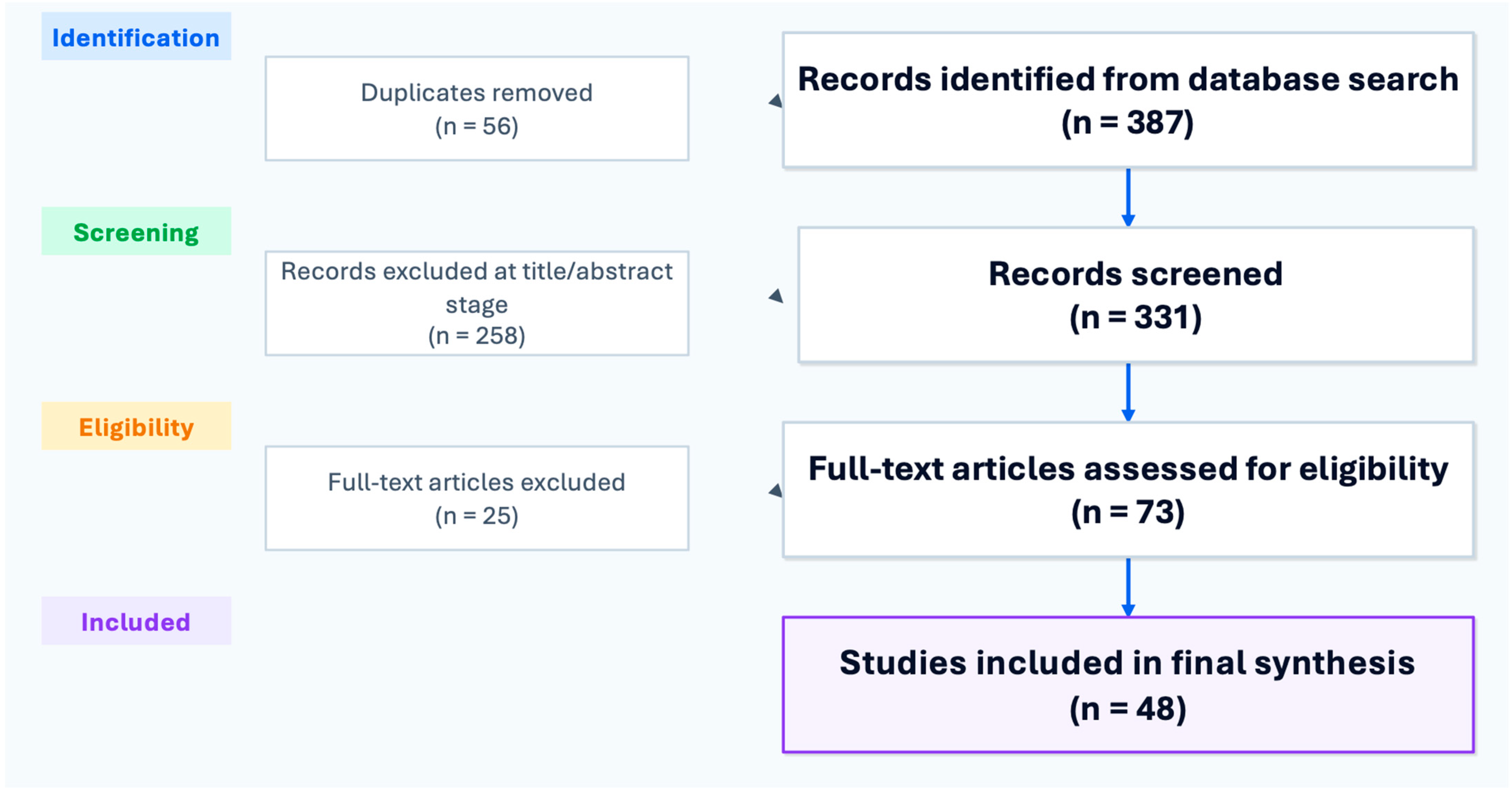
The screening process followed the PRISMA four-phase flow diagram as shown in
Figure 1. After removing duplicates (
n = 56), 331 records were screened at the title and abstract level. Two independent reviewers (the authors) conducted the screening, with disagreements resolved through discussion. This phase excluded 258 records that were clearly irrelevant. The remaining 73 full-text articles were assessed for eligibility, leading to the exclusion of 25 articles for reasons such as insufficient focus on AI (
n = 12), no clear link to poverty governance (
n = 8), or being a non-peer-reviewed format (
n = 5). The final sample comprised 48 studies for synthesis.
3.4. Quality Appraisal
Due to the included evidence comprising qualitative, quantitative and mixed-methods empirical studies, methodological quality was appraised using the Mixed Methods Appraisal Tool (2018 version), which is suited to heterogeneous empirical evidence bases. Conceptual papers and review articles were not assigned empirical quality scores; instead, they were assessed for conceptual relevance and used primarily to inform framing and interpretation rather than to support core empirical claims. Two reviewers independently appraised the empirical studies using the criteria appropriate to each design category. On this basis, studies were grouped as higher-confidence, moderate-confidence or lower-confidence contributions to the synthesis. Lower-confidence studies were not treated as equivalent to stronger evidence; rather, they were retained only where they offered unique sectoral or contextual insight, and their findings were interpreted cautiously in the narrative synthesis.
3.5. Data Extraction and Thematic Synthesis
Data were extracted from each included study using a standardised form that captured: (a) bibliographic information, (b) country/region of focus, (c) sector of application, (d) type of AI method, (e) governance mechanism addressed (targeting, delivery, monitoring, accountability), (f) reported benefits and risks and (g) conceptual frameworks used. A thematic synthesis was then conducted. This involved an iterative process of coding, developing descriptive themes and generating analytical themes that went beyond the findings of individual studies to answer the review’s research questions (
Thomas & Harden, 2008).
To support transparency and replicability, an indicative summary of the distribution of studies across thematic domains and world regions was compiled.
Table 1 illustrates the main clusters of AI applications identified in the review and the core poverty-related functions associated with each. This table is not exhaustive but serves to orient the reader to the structure of the subsequent
Section 4.
Beyond thematic grouping, the synthesis also compared how AI reshaped four governance mechanisms across sectors, namely targeting and allocation, delivery and service provision, monitoring and evaluation and accountability and participation. This comparative lens enabled the review to move beyond descriptive clustering by examining where benefits were most consistently reported, where risks intensified and which institutional conditions shaped variation in outcomes.
4. Results
The systematic synthesis revealed a wide range of empirical and conceptual contributions demonstrating how AI applications are reshaping poverty governance strategies across multiple sectors. The findings are presented through six interconnected thematic domains that emerged consistently across the reviewed literature.
4.1. Theme 1: Enhancing Targeting and Allocation Through Predictive Analytics
A prominent theme is the use of AI to improve the targeting of poverty reduction resources. These contributions demonstrate the capacity of machine learning models to process diverse datasets—such as satellite imagery, mobile phone metadata, demographic information, and digital transaction traces—to generate granular, dynamic and spatially explicit poverty estimates that far exceed the capabilities of traditional survey-based approaches.
A substantial body of work highlights the use of satellite imagery combined with machine learning for poverty prediction. Studies such as
McBride et al. (
2022) and
Hall et al. (
2023) demonstrate that convolutional neural networks trained on nighttime light emissions, building density, land surface patterns and geospatial features can approximate local income levels, asset ownership, food security, or malnutrition with considerable accuracy.
Usmanova et al. (
2022) similarly note that integrating remote sensing with socioeconomic indicators allows development agencies to update poverty maps more frequently, monitor change over time, and detect emerging vulnerabilities in near real-time.
Complementing these geospatial approaches, several studies examine digital trace data, including mobile phone usage, mobile money transactions, call detail records, and online behaviour, to infer economic well-being and classify household vulnerability. These models capture behavioural patterns associated with income volatility, consumption shocks, migration flows or seasonality effects.
Simon and Khambule (
2022) show how such AI models were crucial in monitoring the dynamic impact of the COVID-19 pandemic on household livelihoods, especially in contexts where data collection was disrupted.
Dorgbefu (
2024) similarly demonstrates how advanced predictive modelling and alternative datasets can be applied to identify underserved or “data-poor” populations in broader development interventions.
The reviewed literature consistently reports that AI-enabled poverty prediction improves the ability of governments and NGOs to target social programmes. Predictive models enable early identification of high-risk regions, allowing for anticipatory allocation of food aid, cash transfers or emergency support before conditions deteriorate (
Etuk & Ayuk, 2021;
Ogbuju et al., 2025). They also support beneficiary validation, reducing leakage and ensuring that scarce social protection resources reach those most in need.
Across the empirical studies analysed, a recurring emphasis is placed on the contrast between traditional survey-based identification mechanisms—slow, expensive and often outdated—and AI-enhanced targeting systems that provide continuously updated insights. This theme aligns with broader digital transformation trajectories documented in work on public sector digitisation (
Harmanpreet et al., 2025;
Mishra et al., 2025), where predictive analytics is increasingly embedded into decision-making systems.
4.2. Theme 2: AI-Driven Automation in Social Protection and Service Delivery
A second major domain in the literature concerns the use of AI to optimise the design, targeting and delivery of social protection programmes, including subsidies, welfare payments, food distribution, and public service access. These studies highlight how AI-enabled systems help governments and humanitarian organisations allocate scarce resources with greater precision and efficiency.
Machine learning tools are widely used to determine eligibility for means-tested benefits, combining administrative records, geospatial data, financial transactions, and household surveys into integrated models. Several studies, including
Usmanova et al. (
2022) and
McBride et al. (
2022), indicate that such models reduce inclusion and exclusion errors and streamline programme registration processes. The literature further shows that AI can support dynamic updates to beneficiary lists, ensuring that social protection systems remain responsive to sudden shocks, such as climate events or market disruptions.
Predictive analytics also strengthens anticipatory social protection, enabling governments to deploy support before crises escalate. For instance,
Etuk and Ayuk (
2021) and
Hall et al. (
2023) document how poverty-related early warning systems integrate climate signals, crop forecasts, or macroeconomic risks to forecast periods of heightened vulnerability.
Raman et al. (
2025) similarly demonstrate how AI, when embedded in public sector digital transformation strategies, enhances situational awareness and resource planning, producing more adaptive and resilient service delivery systems.
Another significant finding relates to the use of AI to improve administrative efficiency. By automating eligibility checks, fraud detection, payment scheduling, and compliance verification, AI can reduce operational costs, limit corruption and strengthen accountability. Such innovations are particularly impactful in countries with fragmented information systems or limited administrative capacities, where manual processes historically constrained social protection outcomes (
Harmanpreet et al., 2025;
Mishra et al., 2025;
Al-Emran & Griffy-Brown, 2023).
Studies focusing on digital public infrastructure emphasise the potential of AI to integrate multiple data ecosystems, including identity systems, health records, land registries, and welfare databases, to form a unified poverty intelligence framework. Such system-level consolidation supports holistic social interventions, although it also introduces governance and privacy concerns that are addressed later in the findings.
4.3. Theme 3: AI-Enabled Financial Inclusion, Fintech and Livelihood Expansion
A third major theme in the reviewed literature is the role of AI in expanding financial inclusion, improving access to credit and digital financial services, and supporting livelihood diversification among low-income populations. The literature consistently finds that conventional financial institutions marginalise low-income populations due to the absence of credit histories, limited collateral, or informal employment patterns (
Adjei et al., 2022;
Del Sarto & Ozili, 2025). AI addresses these barriers by leveraging alternative data for credit scoring, thereby expanding access to financial services for previously excluded groups.
Several studies highlight the role of machine learning in analysing mobile money transactions, mobile phone metadata, utility payments, and digital marketplace behaviour to generate creditworthiness profiles.
Mhlanga (
2021) emphasises that such AI-enabled credit scoring reduces information asymmetry and unlocks micro-entrepreneurship and household investment.
Jejeniwa and Mhlongo (
2024) similarly argue that AI-enabled fintech systems foster economic participation by allowing low-income users to access microloans, savings products, insurance schemes and peer-to-peer financial platforms.
The literature also identifies AI as a driver of small enterprise development. AI-powered business analytics tools help micro-entrepreneurs forecast demand, set prices, assess operational risks, and optimise supply chains (
Warale et al., 2025). Studies such as
Miani et al. (
2023) and
Wang et al. (
2023) demonstrate that improved access to financial and market intelligence strengthens livelihoods and economic resilience, particularly in volatile contexts subject to environmental or economic shocks.
Work on digital supply chains (
Nirupama et al., 2025) shows that AI-enhanced logistics and gamified decision-making tools improve resource efficiency and help enterprises operate more sustainably, an outcome closely linked to poverty alleviation in both rural and urban contexts.
Charan et al. (
2025a) further highlight how generative AI and human-AI collaboration can unlock new income opportunities, especially in nascent digital economies.
Studies examining the macro-level impacts of fintech and AI (
Wang et al., 2023;
Del Sarto & Ozili, 2025) show that financial access can drive improvements not only in individual incomes but also in energy access, consumption smoothing, agricultural investment, and local economic development.
4.4. Theme 4: Precision Agriculture, Food Systems and Rural Livelihoods
The agricultural sector features prominently in the reviewed literature because of its direct relationship with rural poverty, food security and livelihood resilience. The reviewed studies emphasise that AI is transforming agriculture through precision farming, crop yield forecasting, pest and disease detection, soil and irrigation optimisation, and climate-smart advisory systems.
AI-enabled precision agriculture is consistently associated with improvements in farm productivity, income stability and resilience.
Etuk and Ayuk (
2021) show that machine learning improves decision-making in crop selection, input use and market engagement, particularly within commercialising agricultural systems.
Bahn et al. (
2021) argue that digitalisation of agrifood systems has the potential to reduce inefficiencies and enhance sustainability, although they highlight structural risks and the need for governance safeguards.
Machine learning models, applied to soil data, weather patterns or crop health imagery, support farmers in mitigating environmental risks.
Miani et al. (
2023) demonstrate that AI contributes to rural livelihood diversification and enhances adaptive capacity, while
Munguti et al. (
2022) provide evidence from aquaculture showing that AI-enabled production systems can improve food security and household incomes. Studies like
Onyeaka et al. (
2023) also highlight the use of AI to reduce food waste, thereby strengthening supply chain efficiency and nutritional resilience.
In multiple contexts, AI improves market access by providing farmers with price forecasts, demand projections and digital marketplaces. These innovations strengthen bargaining power and help rural producers navigate market fluctuations, reducing income volatility. In addition, the reviewed literature points to wider concerns about data colonialism and concentrated platform power. Much of the AI infrastructure used in development contexts, including cloud computing, proprietary models, and data-processing systems, is controlled outside the settings in which poverty interventions are implemented. This creates risks of extractive data practices, dependency and limited local control over development infrastructures.
4.5. Theme 5: AI, Access to Essential Services and Human Development
A further major theme concerns the use of AI to improve access to essential services such as healthcare, education, water, energy and other foundational dimensions of human development. These domains are central to multidimensional poverty and strongly influence livelihood outcomes.
- (a)
Healthcare
AI-driven diagnostic tools, such as image recognition systems for tuberculosis, malaria or maternal health risk, are widely reported to improve diagnostic accuracy in low-resource settings (
Guru Basava Aradhya et al., 2025).
Arnold (
2025) emphasises that AI can overcome service delivery constraints by empowering community health workers, improving triage systems, and enabling early detection of outbreaks. AI also enables remote health service delivery, with telemedicine platforms supporting populations in geographically isolated or underserved areas (
Ogbuju et al., 2025).
- (b)
Education
In education, AI supports adaptive learning systems, language translation, intelligent tutoring and personalised instruction.
Nemorin et al. (
2023) show that debates on AI in education and development have increasingly focused on inclusion, literacy support and equitable learning models.
Thanyawatpornkul (
2024) documents how AI helps align education interventions with Sustainable Development Goals by improving access and learning outcomes among disadvantaged learners.
- (c)
Basic Services and Infrastructure
AI tools are also deployed in water and energy systems, using remote sensing and sensor-based monitoring to detect leakages, predict demand, and optimise distribution (
Onyeaka et al., 2023;
Wang et al., 2023).
Raman et al. (
2025) show how integrated AI–IoT systems in public infrastructures improve service delivery efficiency and sustainability. These improvements directly affect poverty indicators by reducing time burdens, lowering household expenditure on basic services and improving well-being.
4.6. Theme 6: Cross-Cutting Trends, Risks, and the Need for a Proactive Governance Agenda
Across all application domains, the literature identifies several cross-cutting trends and governance risks that shape the future trajectory of AI in poverty governance:
4.6.1. Increasing Integration of Geospatial and Administrative Data
Multiple studies show a convergence between satellite imagery, administrative records and digital trace datasets, yielding more holistic poverty intelligence systems (
Hall et al., 2023;
McBride et al., 2022).
4.6.2. Diffusion of Mobile-First and Low-Resource AI
AI applications are increasingly optimised for deployment in low-connectivity environments, including via edge computing or mobile-based platforms (
Wang et al., 2023;
Raman et al., 2025).
4.6.3. Growth of Generative and Conversational AI for Development
Charan et al. (
2025b) identify emerging uses of conversational agents, generative AI and collaborative systems for service provision, micro-enterprise support and public sector functions.
4.6.4. Ethical, Social and Governance Concerns
The literature documents persistent risks related to:
These concerns recur across almost every application domain reviewed. Taken together, the results suggest that AI contributes most consistently where poverty governance relies on prediction, classification and administrative coordination, such as poverty mapping, beneficiary targeting and fraud detection. By contrast, the evidence becomes more uneven where governance functions require contextual judgement, participatory legitimacy or rights-sensitive decision-making. This cross-sector variation provides the basis for the comparative discussion that follows.
6. Conclusions
This review has examined how artificial intelligence is being mobilised in contemporary poverty governance strategies, the channels through which it affects multidimensional deprivation, and the risks and governance challenges that accompany its deployment. The evidence shows that AI is already reshaping key domains of development practice, including poverty prediction and targeting, social protection, financial inclusion, agriculture, health, education and basic services. The contribution of this review lies not simply in restating that AI carries both promise and risk, but in showing how these promises and risks cluster around distinct governance mechanisms across poverty-related sectors.
Across these domains, AI functions as a powerful amplifier of information and coordination capacity. It enables high-resolution poverty mapping and early warning systems that support anticipatory and more finely targeted interventions (
McBride et al., 2022;
Hall et al., 2023;
Usmanova et al., 2022). It improves the efficiency and responsiveness of social protection and public sector service delivery by automating eligibility checks, fraud detection, and performance monitoring (
Harmanpreet et al., 2025;
Mishra et al., 2025;
Raman et al., 2025). It expands financial inclusion and economic opportunity through alternative credit scoring, digital payments and data-informed microenterprise support (
Mhlanga, 2021;
Jejeniwa & Mhlongo, 2024;
Adjei et al., 2022;
Del Sarto & Ozili, 2025). It strengthens rural livelihoods, health systems and education by providing data-driven insights, adaptive learning tools and remote service delivery channels (
Etuk & Ayuk, 2021;
Bahn et al., 2021;
Munguti et al., 2022;
Guru Basava Aradhya et al., 2025;
Arnold, 2025;
Nemorin et al., 2023;
Thanyawatpornkul, 2024).
At the same time, the review makes clear that AI is not a neutral or risk-free instrument. It operates within existing political economies, data infrastructures and institutional arrangements, and its benefits are unequally distributed. Without robust safeguards, AI systems can replicate and magnify historical patterns of exclusion, subject vulnerable populations to opaque forms of surveillance or scoring and centralise power in ways that weaken democratic oversight (
Liang et al., 2022;
Gerlich, 2023;
Nemorin et al., 2023;
Sinanan & McNamara, 2021).
Harnessing AI for sustainable poverty reduction, therefore, requires a deliberate governance agenda. Key elements include investment in inclusive digital and data infrastructures, development of strong privacy and data protection frameworks, establishment of standards for transparency, auditability and fairness in algorithmic systems, and creation of participatory mechanisms through which affected communities can shape the design, deployment and evaluation of AI interventions (
Al-Emran & Griffy-Brown, 2023;
Jejeniwa & Mhlongo, 2024;
Goralski & Tan, 2022;
Sampene et al., 2022). Equally important are long-term capacity building programmes that equip public officials, civil society and local enterprises with the skills required to steward AI technologies in line with social justice and human rights principles (
Raman et al., 2025;
Wang et al., 2023).
A further implication emerging from this review is that AI in poverty governance should be judged not only by predictive accuracy or administrative efficiency, but also by who controls data infrastructures, whose knowledge shapes model design and whether affected communities can question or appeal automated decisions. The evidence reviewed in this manuscript shows that concerns around data colonialism, human rights, surveillance, explainability and institutional readiness are not peripheral issues; they are central to whether AI reduces poverty or reproduces exclusion. In practice, this means that fairness-aware models, human-in-the-loop review, independent auditing, participatory design and context-sensitive implementation must be treated as core governance requirements rather than optional technical refinements (
Liang et al., 2022;
Nemorin et al., 2023;
Sinanan & McNamara, 2021;
Al-Emran & Griffy-Brown, 2023;
Jejeniwa & Mhlongo, 2024).
The overall conclusion is that AI can play a meaningful role in advancing the global agenda for poverty eradication and sustainable development, but only if it is embedded within comprehensive strategies that address structural drivers of deprivation and that foreground equity, accountability and context sensitivity. When aligned with inclusive governance, strong institutions and locally grounded development visions, AI can support a transition from reactive, short-term poverty responses toward more proactive, resilient and transformative pathways that expand capabilities, enhance livelihoods and strengthen the agency of people living in poverty.