Solving for Engagement: A Systematic Review of Task Variation and Problem-Solving Demands in Motivating Employees



Abstract
1. Employee Engagement in the Workplace
1.1. Observable Work Behavior
1.2. Variation and Variability
1.3. Engagement and Its Relation to Variability
1.4. Aim and Scope
2. Method
2.1. Inclusion and Exclusion Criteria
2.2. Literature Search
2.3. Data Extraction and Selected Variables
2.4. Inter-Rater Agreement
2.5. Risk of Bias
2.6. Appraisal of Methodological Heterogeneity
3. Results
3.1. Search Results and Article Selection
3.2. Study Results
3.2.1. Synthesis of Findings
- -
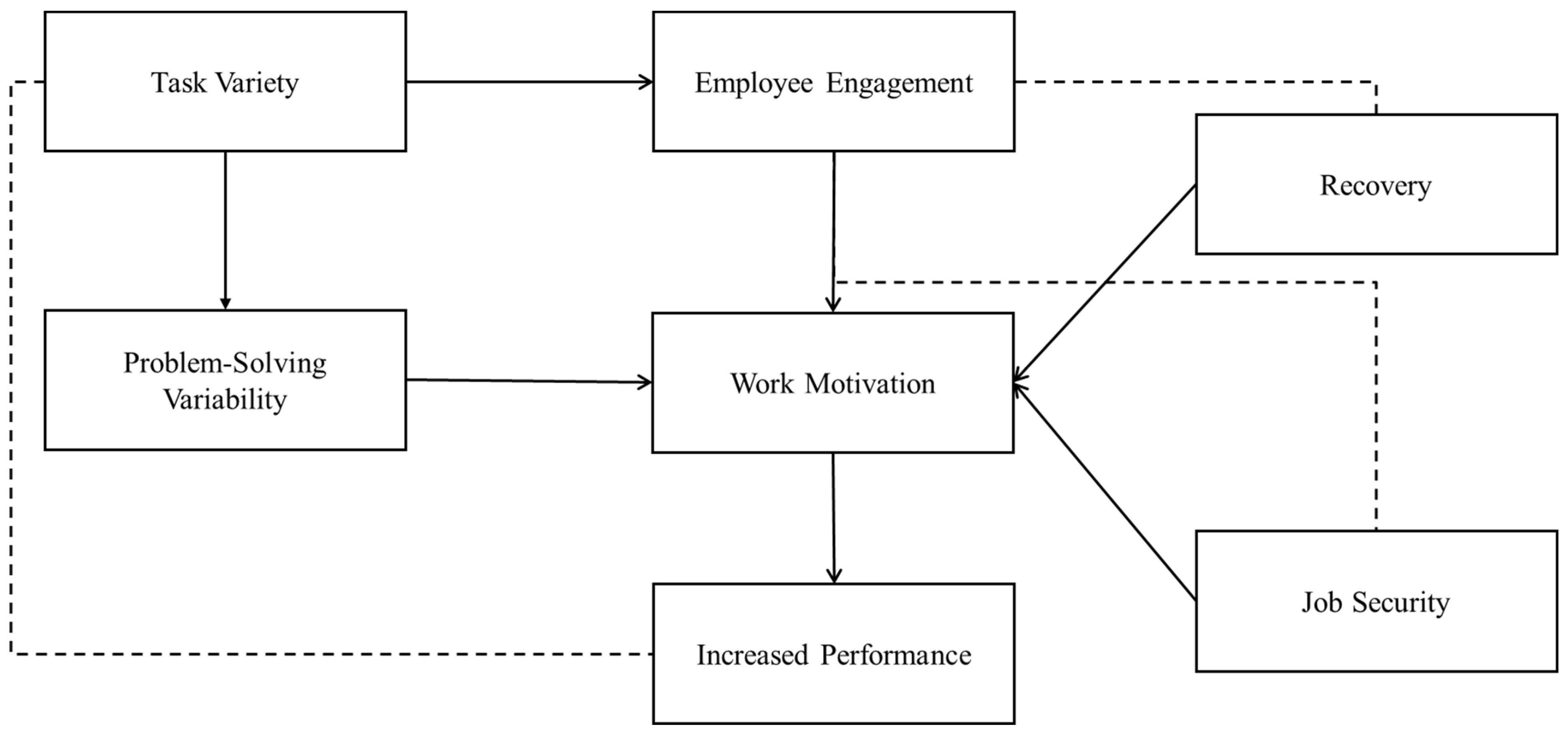
- Task variation refers to changes in work strategies, such as the number of methods used to modify a repetitive task or changes in effort distribution across tasks.
- -
- Motivation is measured through self-report scales, behavioral measures, or selected parameters.
- -
- Performance is considered measurable outcomes, either objectively or experimentally.
- -
- Variability is the gradual change in a measurable variable over time, such as changes in motivation due to task type or feedback.
- -
- Variation refers to differences in approaches, strategies, or methods used to solve a task, reflecting creative problem-solving and adaptation.
3.2.2. Task Variability, Feedback, and Motivation
3.2.3. Task Variability, Recovery, and Work Experience
3.2.4. Refocusing and Adaptive Performance
3.2.5. Contextual and Individual Factors Influencing Task Variability
3.3. Task Variability and Proactive Work Adjustment
3.4. Problem-Solving Demands and Adaptive Performance
3.5. Contextual and Individual Moderators
3.6. Work Design and Structural Conditions
3.7. Triangulation Results
3.8. Assessment of Evidence Certainty
3.9. Assessment of Risk of Bias
4. Discussion
4.1. General Interpretation in Light of Previous Research
4.1.1. Task Variation and Engagement
4.1.2. Problem-Solving as a Resource for Mastery and Performance
4.1.3. Workplace Culture, Flexibility, and Facilitation
4.2. Overall Assessment
4.3. Limitations
Limitations of the Included Studies
4.4. Further Avenues of Research
5. Conclusions
Supplementary Materials
Author Contributions
Funding
Institutional Review Board Statement
Informed Consent Statement
Data Availability Statement
Acknowledgments
Conflicts of Interest
Appendix A
| Database | Search Strategy | Filters | Number of Results | Number of Included Studies | Authors (Year) |
| Business Source Elite | ((“variation” OR “variability”) AND (“task” OR “problem solving”) AND (“workplace” OR “employee”)) | English, Peer-reviewed, 2009–2026 | 254 | 4 | Azizi et al. (2013). Ejlertsson et al. (2018). Van Dijk and Kluger (2011). Schaefer and Bormann (2025). |
| Academic Search Ultimate | ((“variation” OR “variability”) AND (“task” OR “problem solving”) AND (“workplace” OR “employee”)) | English, Peer-reviewed, 2009–2026 | 399 | 2 | Rotundo et al. (2012). Taibah and Ho (2023). |
| PsycINFO | ((“task variation” OR “variable”) AND (“task” OR “problem solving”) AND (“work engagement” OR “employee engagement”)) | English, Peer-reviewed, 2009–2026 | 190 | 1 | Smith et al. (2009) |
| CINAHL | ((“variation” OR “variability”) AND (“task” OR “problem solving”) AND (“workplace” OR “employee”)) | English, Peer-reviewed, 2009–2026 | 126 | 1 | Bledow et al. (2026). |
| ERIC | ((“variation” OR “variability”) AND (“task” OR “problem solving”) AND (“workplace” OR “employee”)) | English, Peer-reviewed, 2009–2026 | 28 | 1 | Herrmann and Felfe (2013). |
| Web of Science | ((“variation” OR “variability”) AND (“task” OR “problem solving”) AND (“workplace” OR “employee”)) | English, Peer-reviewed, 2009–2026 | 710 | 2 | Stasielowicz (2020). Narayanan et al. (2009). |
| Scopus | ((“variation” OR “variability”) AND (“task” OR “problem solving”) AND (“workplace” OR “employee”)) | English, Peer-reviewed, 2009–2026 | 1295 | 2 | Knight et al. (2025). Sun et al. (2020). |
References
- Albrecht, S. L., Green, C. R., & Marty, A. (2021). Meaningful work, job resources, and employee engagement. Sustainability, 13(7), 4045. [Google Scholar] [CrossRef]
- Avgerinos, E., & Gokpinar, B. (2018). Task variety in professional service work: When it helps and when it hurts. Production and Operations Management, 27(7), 1368–1389. [Google Scholar] [CrossRef]
- Azizi, N., Liang, M., & Zolfaghari, S. (2013). Modelling human boredom at work: Mathematical formulations and a probabilistic framework. Journal of Manufacturing Technology Management, 24(5), 711–746. [Google Scholar] [CrossRef]
- Bakker, A. B., & Demerouti, E. (2008). Towards a model of work engagement. The Career Development International, 13(3), 209–223. [Google Scholar] [CrossRef]
- Bekhet, A. K., & Zauszniewski, J. A. (2012). Methodological triangulation: An approach to understanding data. Nurse Researcher, 20(2), 40–43. [Google Scholar] [CrossRef] [PubMed]
- Bledow, R., Eun, H.-J., & Vossaert, L. (2026). A closer look at the innovator: The interplay between divergent and convergent processes of self-regulation. Journal of Occupational and Organizational Psychology, 99, e70102. [Google Scholar] [CrossRef]
- Dalal, R. S., Alaybek, B., & Lievens, F. (2020). Within-person job performance variability over short timeframes: Theory, empirical research, and practice. Annual Review of Organizational Psychology and Organizational Behavior, 7, 421–449. [Google Scholar] [CrossRef]
- Dalal, R. S., Bhave, D. P., & Fiset, J. (2014). Within-person variability in job performance: A theoretical review and research agenda. Journal of Management, 40(5), 1396–1436. [Google Scholar] [CrossRef]
- Demerouti, E., Bakker, A. B., Sonnentag, S., & Fullagar, C. J. (2012). Work-related flow and energy at work and at home: A study on the role of daily recovery. Journal of Organizational Behavior, 33(2), 276–295. [Google Scholar] [CrossRef]
- Denzin, N. K. (1978). Triangulation: A Case for Methodological Evaluation and Combination. Sociological Methods, 339–357. [Google Scholar]
- Dwan, K., Gamble, C., Williamson, P. R., Kirkham, J. J., & Reporting Bias Group. (2013). Systematic review of the empirical evidence of study publication bias and outcome reporting bias—An updated review. PLoS ONE, 8(7), e66844. [Google Scholar] [CrossRef] [PubMed]
- Edmondson, A. (1999). Psychological safety and learning behavior in work teams. Administrative Science Quarterly, 44(2), 350–383. [Google Scholar] [CrossRef]
- Ejlertsson, L., Heijbel, B., Troein, M., & Brorsson, A. (2018). Variation, companionship and manageability important for recovery during working hours: A qualitative focus group study. WORK: A Journal of Prevention, Assessment & Rehabilitation, 61(1), 149–156. [Google Scholar] [CrossRef] [PubMed]
- Engeser, S., & Rheinberg, F. (2008). Flow, performance and moderators of challenge-skill balance. Motivation and Emotion, 32(3), 158–172. [Google Scholar] [CrossRef]
- Federman, B. (2009). Employee engagement: A roadmap for creating profits, optimizing performance, and increasing loyalty. Wiley. [Google Scholar]
- George, R. G., Jonathan, V., & Michael, F. L. (2020). The relationship between task characteristics and employee engagement. Trends in Undergraduate Research, 3(1), e1–e6. Available online: https://publisher.unimas.my/ojs/index.php/TUR/article/download/1837/969 (accessed on 18 May 2026).
- Hackman, J. R., & Oldham, G. R. (1976). Motivation through the design of work: Test of a theory. Organizational Behavior and Human Performance, 16(2), 250–279. [Google Scholar] [CrossRef]
- Hafeez, S., Memon, M. A., Mirza, M. Z., Raziq, M. M., Sarwar, N., & Ting, H. (2023). The dual impact of job variety on employee happiness and stress: The mediating role of employee engagement and burnout. Journal of Management Development, 43(2), 170–186. [Google Scholar] [CrossRef]
- Herrmann, D., & Felfe, J. (2013). Moderators of the relationship between leadership style and employee creativity: The role of task novelty and personal initiative. Creativity Research Journal, 25(2), 172–181. [Google Scholar] [CrossRef]
- Higgins, J. P. T., Morgan, R. L., Rooney, A. A., Taylor, K. W., Thayer, K. A., Silva, R. A., Lemeris, C., Akl, E. A., Bateson, T. F., Berkman, N. D., Glenn, B. S., Hróbjartsson, A., LaKind, J. S., McAleenan, A., Meerpohl, J. J., Nachman, R. M., Obbagy, J. E., O’Connor, A., Radke, E. G., & Sterne, J. A. C. (2024). A tool to assess risk of bias in non-randomized follow-up studies of exposure effects (ROBINS-E). Environment International, 186, 108602. [Google Scholar] [CrossRef] [PubMed]
- Hong, Q. N., Fàbregues, S., Bartlett, G., Boardman, F., Cargo, M., Dagenais, P., Gagnon, M.-P., Griffiths, F., Nicolau, B., O’Cathain, A., Rousseau, M.-C., Vedel, I., & Pluye, P. (2018). The mixed methods appraisal tool (MMAT) version 2018 for information professionals and researchers. Education for Information, 34(4), 285–291. [Google Scholar] [CrossRef]
- Kitchenham, B. (2004). Procedures for performing systematic reviews (Vol. 33, pp. 1–26). Keele University. [Google Scholar]
- Knight, C., McLarnon, M. J. W., Olaru, D., Lee, J. A., & Parker, S. K. (2025). Hybrid work design profiles: Antecedents and well-being outcomes. Journal of Vocational Behavior, 162, 104174. [Google Scholar] [CrossRef]
- Ma, L., Ma, H., Zhan, X., & Wang, Y. (2023). How do problem-solving demands influence employees’ thriving at work: An explanation based on cognitive appraisal. Sustainability, 15(20), 14879. [Google Scholar] [CrossRef]
- Machado, A., & Tonneau, F. (2012). Operant variability: Procedures and processes. The Behavior Analyst, 35(2), 249–255. [Google Scholar] [CrossRef] [PubMed]
- McHugh, M. L. (2012). Interrater reliability: The kappa statistic. Biochemia Medica, 22(3), 276–282. [Google Scholar] [CrossRef]
- Moher, D., Liberati, A., Tetzlaff, J., Altman, D. G., & The PRISMA Group. (2009). Preferred reporting items for systematic reviews and meta-analyses: The PRISMA statement. PLoS Medicine, 6(7), e1000097. [Google Scholar] [CrossRef]
- Narayanan, S., Balasubramanian, S., & Swaminathan, J. M. (2009). A matter of balance: Specialization, task variety, and individual learning in a software maintenance environment. Management Science, 55(11), 1861–1876. [Google Scholar] [CrossRef]
- Neuringer, A. (2002). Operant variability: Evidence, functions, and theory. Psychonomic Bulletin & Review, 9(4), 672–705. [Google Scholar] [CrossRef]
- Nuamah, J. (2024). Effect of recurrent task-induced acute stress on task performance, vagally mediated heart rate variability, and task-evoked pupil response. International Journal of Psychophysiology: Official Journal of the International Organization of Psychophysiology, 198, 112325. [Google Scholar] [CrossRef]
- Page, M. J., McKenzie, J. E., Bossuyt, P. M., Boutron, I., Hoffmann, T. C., Mulrow, C. D., Shamseer, L., Tetzlaff, J. M., Akl, E. A., Brennan, S. E., Chou, R., Glanville, J., Grimshaw, J. M., Hróbjartsson, A., Lalu, M. M., Li, T., Loder, E. W., Mayo-Wilson, E., McDonald, S., McGuinness, L. A., … Moher, D. (2021). The PRISMA 2020 statement: An updated guideline for reporting systematic reviews. BMJ, 372, n71. [Google Scholar] [CrossRef]
- Paul, C. J., Acharya, A., Black, B., & Strosnider, J. K. (1991). Reducing problem-solving variance to improve predictability. Communications of the ACM, 34(8), 80–93. [Google Scholar] [CrossRef]
- Riyanto, S., Endri, E., & Herlisha, N. (2021). Effect of work motivation and job satisfaction on employee performance: Mediating role of employee engagement. Problems and Perspectives in Management, 19(3), 162–174. [Google Scholar] [CrossRef]
- Rotundo, M., Sackett, P. R., Enns, J. R., & Mann, S. (2012). Refocusing effort across job tasks: Implications for understanding temporal change in job performance. Human Performance, 25(3), 201–214. [Google Scholar] [CrossRef]
- Ryan, R. M., & Deci, E. L. (2000). Self-determination theory and the facilitation of intrinsic motivation, social development, and well-being. American Psychologist, 55(1), 68–78. [Google Scholar] [CrossRef] [PubMed]
- Schaefer, A., & Bormann, K. C. (2025). Unpacking the dynamics of illegitimate tasks: How variability and previous experiences ignite job crafting and meaningful work. Work & Stress, 39(4), 396–415. [Google Scholar] [CrossRef]
- Schaufeli, W. B., Salanova, M., González-Romá, V., & Bakker, A. B. (2002). The measurement of engagement and burnout: A two sample confirmatory factor analytic approach. Journal of Happiness Studies: An Interdisciplinary Forum on Subjective Well-Being, 3(1), 71–92. [Google Scholar] [CrossRef]
- Smith, J. L., Wagaman, J., & Handley, I. M. (2009). Keeping it dull or making it fun: Task variation as a function of promotion versus prevention focus. Motivation and Emotion, 33(2), 150–160. [Google Scholar] [CrossRef]
- Stasielowicz, L. (2020). How important is cognitive ability when adapting to changes? A meta-analysis of the performance adaptation literature. Personality and Individual Differences, 166, 110178. [Google Scholar] [CrossRef]
- Sun, S., Wang, N., Zhu, J., & Song, Z. (2020). Crafting job demands and employee creativity: A diary study. Human Resource Management, 59(6), 569–583. [Google Scholar] [CrossRef]
- Taibah, D., & Ho, T. C. F. (2023). The moderating effect of flexible work option on structural empowerment and generation Z contextual performance. Behavioral Sciences, 13(3), 266. [Google Scholar] [CrossRef]
- Van Dijk, D., & Kluger, A. N. (2011). Task type as a moderator of positive/negative feedback effects on motivation and performance: A regulatory focus perspective. Journal of Organizational Behavior, 32(8), 1084–1105. [Google Scholar] [CrossRef]
- Wood, S., & de Menezes, L. M. (2011). High involvement management, high-performance work systems and well-being. The International Journal of Human Resource Management, 22(7), 1586–1610. [Google Scholar] [CrossRef]



| Author(s), Year | Topic | Study Type | Study Design | Number of Participants | Country | Study Summary | Measurement Operation | Conclusion |
|---|---|---|---|---|---|---|---|---|
| Azizi et al. (2013) | Boredom, modeling, task variation, and motivation | Quantitative (modeling) | Mathematical models in case study | 17 | UK/Canada | Apply mathematical models and a Bayesian framework to measure and predict workplace boredom, and its impact on motivation and performance | Model-based: Quantifies how moderate levels of boredom trigger adaptive responses and task variation, which increase motivation and engagement. High boredom weakens these mechanisms. | Moderate boredom stimulates adaptive responses and task variation that increase motivation, while excessive boredom impairs problem-solving and engagement. |
| Bledow et al. (2026) | Creativity, self-regulation, problem-solving | Quantitative | Multilevel study (employee-manager dyads) | 104 dyads | Belgium | Investigates how self-regulation processes influence creative performance | Measures exploration (divergent thinking), planning and outcome focus (convergent processes), and links these to manager-rated creative performance in innovation projects | Effective problem-solving depends on balancing exploratory and goal-directed processes |
| Ejlertsson et al. (2018) | Recovery, task variation, social support, and control | Qualitative | Focus groups | 50 | Sweden | Use qualitative focus groups to identify variation, community, and manageability as key factors for recovery in the workplace | Qualitative classification: Identifies themes such as variation and control as key factors for recovery and engagement. | Variation in work tasks and a supportive work culture promote recovery and increase perceived engagement through improved mastery and creative problem-solving. |
| Herrmann and Felfe (2013) | Leadership, task novelty, personal initiative, creativity | Quantitative | Experimental study | 241 | Germany | Examines moderating effects of task novelty and initiative on creativity | Manipulates task novelty experimentally and measures creativity through idea generation tasks, while assessing personal initiative as an individual difference variable | Task novelty and personal initiative strengthen employees’ ability to respond to task demands with creative problem-solving |
| Knight et al. (2025) | Hybrid work design, autonomy, support, well-being | Quantitative | Cross-sectional (latent profile analysis) | 386 | Australia | Identifies work design profiles across locations | Measures autonomy, support, workload, and monitoring through self-reports and uses latent profile analysis to identify patterns linked to well-being | The impact of task demands depends on broader work design conditions, which shape how employees experience and respond to variability |
| Narayanan et al. (2009) | Task variety, specialization, learning, productivity | Quantitative | Field study | 88 | USA | Examines balance between task variety and specialization | Uses objective task allocation data to calculate degree of task variety and specialization, and links these to individual productivity outcomes | Task variability supports learning and performance, but optimal outcomes depend on balancing variation with task specialization |
| Rotundo et al. (2012) | Refocusing, task variation, and job security | Quantitative | Longitudinal data analysis | 737 | Canada | Analyze the redistribution of effort across tasks using data from professional basketball, exploring how such refocusing affects performance and job security | Quantitative indicator: Measures refocusing as a form of adaptive problem-solving linked to job security and engagement. | Players who refocus their efforts have increased job security, suggesting that the ability to vary tasks and solve problems contributes to higher engagement. |
| Schaefer and Bormann (2025) | Illegitimate tasks, task variability, job crafting, meaningful work | Quantitative | Diary study | 252 | Germany | Examines how variability in illegitimate tasks influence job crafting and meaningful work over time | Measures day-to-day fluctuations in illegitimate tasks and links these to self-reported job crafting behaviors and perceived work meaningfulness | Variability in task demands can trigger adaptive task modification (job crafting), which enhances perceived meaning and supports engagement |
| Smith et al. (2009) | Regulatory focus, task variation, and intrinsic motivation | Quantitative | Laboratory experiment with students | 73 | USA | Investigate how a person’s regulatory focus influences the degree of task variation during monotonous work, with implications for intrinsic motivation | Measured task variation: Records the number of strategies used to vary a repetitive task, as an indicator of creative problem-solving and intrinsic motivation linked to engagement. | Promotive focus leads to increased task variation and intrinsic motivation, while preventive focus results in lower variation. Active problem-solving strengthens engagement. |
| Stasielowicz (2020) | Cognitive ability and performance adaptation | Quantitative | Meta-analysis | 37.963 | Multiple countries (USA, Germany, Australia, Norway, Singapore) | Examine relationship between cognitive ability and adaptation | Aggregates correlations between cognitive ability and performance adaptation, including moderator analyses based on task complexity and measurement type | Higher cognitive ability supports adaptation to changing and complex task demands, especially in dynamic environments |
| Sun et al. (2020) | Job crafting, task demands, creativity | Quantitative | Diary study (10 days) | 91 | China | Examines how employees craft job demands and their relation to creativity | Measures daily job crafting behaviors (changes in task demands) and links these to daily creative output | Actively modifying task demands enhances creativity and supports engagement with challenging or variable tasks |
| Taibah and Ho (2023) | Flexible work options, empowerment, and performance | Quantitative | Cross-sectional survey (online questionnaire) | 109 | Saudi Arabia/Malaysia | Explore how flexible work options affect performance and motivation among Generation Z employees using an online survey | Classifies empowerment dimensions: Task variation is manifested through moderation effects on access to support, information, and opportunities, which affect contextual performance and engagement. | Flexible work options moderate the relationship between empowerment and performance, enhancing the effect of information (increased engagement) and weakening the effect of support. |
| Van Dijk and Kluger (2011) | Feedback, regulatory focus, and task type | Quantitative | Scenario/laboratory experiment | 315 (motivation)–55 (performance) | Israel | Examine how task type moderates the effects of positive and negative feedback on motivation and performance | Assesses task variation through feedback effects: Positive feedback in promotively oriented tasks stimulates creative problem-solving and variation, while negative feedback may be more helpful for preventive tasks. | Positive feedback increases motivation and performance in promotively oriented tasks, while negative feedback is more beneficial for preventive tasks. |
| Study | Method | Context | Main Focus | Key Contribution |
|---|---|---|---|---|
| Azizi et al. (2013) | Mathematical modeling | Theoretical/simulation-based | Task allocation and problem-solving under varying demands | Contributes to a theoretical perspective on how task structures may affect performance efficiency |
| Bledow et al. (2026) | Qualitative multilevel study | Employees and managers (innovation projects) | Creative problem-solving, self-regulation processes | Demonstrates that effective problem-solving depends on balancing exploratory and goal-directed processes |
| Ejlertsson et al. (2018) | Qualitative study | Employees in workplace setting | Recovery, flexibility, and adaptation | Offers contextual insight into how workers experience changing demands and adjustment processes |
| Herrmann and Felfe (2013) | Experimental study | Student participants | Task novelty, personal initiative, creativity | Shows that task novelty and individual initiative strengthen creative responses to task demands |
| Knight et al. (2025) | Quantitative cross-sectional study | Hybrid workers | Work design (autonomy, support, monitoring), well-being | Demonstrates that work design conditions shape how employees experience and respond to task demands |
| Narayanan et al. (2009) | Quantitative field study | Software employees (organizational setting) | Task variety, specialization, productivity | Shows that both task variety and specialization improve performance, but optimal outcomes require balance |
| Rotundo et al. (2012) | Survey-based quantitative study | Working adults | Engagement, task characteristics, and performance | Provides correlational evidence linking task characteristics to perceived engagement and work outcomes |
| Schaefer and Bormann (2025) | Quantitative diary study | Employees (workplace setting) | Task variability (illegitimate tasks), job crafting, meaningful work | Shows that variability in task demands can trigger job crafting and increase perceived meaning in work |
| Smith et al. (2009) | Experimental/survey-based study | Young workers/students | Task variation, boredom, and cognitive engagement | Highlights how variation may influence attentional and motivational processes |
| Stasielowicz (2020) | Quantitative meta-analysis | Multiple contexts | Cognitive ability and performance adaptation | Provides evidence that cognitive ability supports adaptation, especially in complex and changing tasks |
| Sun et al. (2020) | Quantitative diary study | Employees | Job crafting, task demands, creativity | Shows that actively modifying task demands enhances creativity and engagement |
| Taibah and Ho (2023) | Applied empirical study | Professional/organizational setting | Problem-solving capability and adaptive performance | Adds recent evidence on how problem-solving demands relate to adaptation in applied work contexts |
| Van Dijk and Kluger (2011) | Experimental study | Student participants | Task variation and motivational responses | Provides controlled evidence on how task variation may influence motivation under changing task conditions |
Disclaimer/Publisher’s Note: The statements, opinions and data contained in all publications are solely those of the individual author(s) and contributor(s) and not of MDPI and/or the editor(s). MDPI and/or the editor(s) disclaim responsibility for any injury to people or property resulting from any ideas, methods, instructions or products referred to in the content. |
© 2026 by the authors. Licensee MDPI, Basel, Switzerland. This article is an open access article distributed under the terms and conditions of the Creative Commons Attribution (CC BY) license.
Share and Cite
Rørvik-Olsen, O.; Tagliabue, M.; Sandaker, I. Solving for Engagement: A Systematic Review of Task Variation and Problem-Solving Demands in Motivating Employees. Adm. Sci. 2026, 16, 266. https://doi.org/10.3390/admsci16060266
Rørvik-Olsen O, Tagliabue M, Sandaker I. Solving for Engagement: A Systematic Review of Task Variation and Problem-Solving Demands in Motivating Employees. Administrative Sciences. 2026; 16(6):266. https://doi.org/10.3390/admsci16060266
Chicago/Turabian StyleRørvik-Olsen, Oliver, Marco Tagliabue, and Ingunn Sandaker. 2026. "Solving for Engagement: A Systematic Review of Task Variation and Problem-Solving Demands in Motivating Employees" Administrative Sciences 16, no. 6: 266. https://doi.org/10.3390/admsci16060266
APA StyleRørvik-Olsen, O., Tagliabue, M., & Sandaker, I. (2026). Solving for Engagement: A Systematic Review of Task Variation and Problem-Solving Demands in Motivating Employees. Administrative Sciences, 16(6), 266. https://doi.org/10.3390/admsci16060266