Article

How Does Artificial Intelligence Improve Corporate ESG Performance?

1
Yangtze River Delta Cultural Industry Development Institute, Nanjing University of Finance and Economics, Nanjing 210023, China
2
School of Art and Design, Nanjing University of Finance and Economics, Nanjing 210023, China
3
Beedie School of Business, Simon Fraser University, Burnaby, BC V5A 1S6, Canada
4
Business School, Nanjing University, Nanjing 210093, China
5
Department of Industrial Development Research, Shanghai Economic Information Center, Shanghai 200050, China
*
Authors to whom correspondence should be addressed.
Adm. Sci. 2026, 16(6), 243; https://doi.org/10.3390/admsci16060243
Submission received: 20 March 2026 / Revised: 9 May 2026 / Accepted: 18 May 2026 / Published: 22 May 2026

Abstract

Based on a 2012–2023 panel of 1774 Chinese A-share listed firms, this study examines how artificial intelligence transformation affects corporate ESG performance. We identify AI transformation from annual report text and estimate its effect using a DID framework. The estimates indicate that AI transformation is linked to higher ESG performance, with results remaining stable across alternative specifications. Further analysis indicates that green innovation and governance improvement are two main channels, with stronger effects among firms with state ownership, lower technological intensity, and heavier pollution exposure. These findings provide quasi-experimental evidence on the sustainability implications of corporate AI transformation.

1. Introduction

As firms integrate artificial intelligence (AI) into core operations, its firm-level implications have attracted increasing scholarly attention. Existing studies show that AI can enhance productivity and innovation performance (Noy & Zhang, 2023; Babina et al., 2024), reshape organizational structures and corporate governance practices (Babina et al., 2023; Law & Shen, 2025), and improve information processing and pricing efficiency in capital markets (Lopez-Lira & Tang, 2023; Saif-Alyousfi, 2025). As sustainability has become an increasingly central concern, recent studies have shifted attention to the AI–ESG nexus and argued that AI can support ESG improvement by enabling green innovation (Ying & Jin, 2024; H. Li et al., 2025) and more efficient supply-chain coordination and deeper digital integration (Liu et al., 2025). Taken together, this literature suggests that the economic implications of AI are gradually extending beyond conventional efficiency gains toward broader sustainability-related outcomes.
Despite these advances, two issues remain insufficiently addressed. First, prior studies mainly examine particular AI uses or narrowly defined technological capacities (Liu et al., 2025; J. Li et al., 2025), while paying relatively limited attention to AI as a broader organizational transformation embedded in business processes, resource allocation, and internal governance. Second, with respect to mechanisms, prior research has mainly emphasized environmental channels, such as green innovation and supply chain optimization (Liu et al., 2025; Ying & Jin, 2024; Yu et al., 2025), whereas the governance-enabling role of AI remains underexplored. As a result, the broader logic through which AI may shape overall ESG performance has not yet been fully articulated.
Against this backdrop, this study examines Chinese A-share listed firms during 2012–2023, measures firm-level AIT using annual report disclosures, and evaluates its association with ESG performance within a DID framework. The results provide suggestive quasi-experimental evidence that firms undergoing AIT experience higher subsequent ESG scores, with an estimated average effect of 0.206. This pattern is stable under alternative empirical specifications.
More specifically, the parallel-trend test supports the empirical design. To address potential concerns related to “AI washing” and endogeneity, we further construct alternative measures by combining textual disclosure with actual AI investment, and use the National AI Innovation and Development Pilot Zone policy in China as an exogenous policy shock to build an instrumental-variable strategy. In addition, the baseline findings remain stable after multiple robustness exercises, such as placebo tests and PSM-DID estimation, winsorization, exclusion of loss-making firms, alternative measures of key variables, alternative clustering standards, additional high-dimensional fixed effects, and heterogeneity-robust estimators.
Mechanism analyses suggest that AI transformation improves ESG performance through two main channels: a green effect and a governance effect. Specifically, AI transformation promotes green innovation while also reducing firm-level crash risk. Heterogeneity tests further indicate stronger effects for firms with state ownership, lower technological intensity, and heavier pollution exposure.
This study makes three main contributions. First, unlike studies that focus on general AI applications or broad digitalization, this paper adopts a systemic transformation perspective and combines it with a DID framework, thereby providing new evidence on the firm-level mechanisms through which AI may affect corporate sustainability. Second, going beyond the existing literature’s emphasis on environmental channels alone, this study jointly examines green innovation and stock price crash risk, and thus offers a more integrated account of how AI may empower firms along both the environmental and governance dimensions of ESG. Third, by identifying substantial heterogeneity across ownership structure, technological intensity, and pollution characteristics, this paper provides useful firm-level insights for promoting AI transformation in a more targeted manner and for designing differentiated ESG regulatory policies.

2. Theoretical Analysis and Research Hypotheses

Existing studies often treat artificial intelligence as a technological tool for improving efficiency and reducing costs. However, this instrumental view is insufficient to explain how AI may shape firms’ overall ESG performance, which spans environmental, social, and governance responsibilities. To address this limitation, this study draws on the resource-based view, stakeholder theory, and agency theory to conceptualize AI transformation as an integrated strategic capability built around data, algorithms, computing power, and organizational processes. This capability not only improves firms’ information-processing and resource-allocation efficiency, but also strengthens their ability to respond to diverse stakeholder demands, optimize internal governance, and pursue sustainable development (Al-Hajaya et al., 2025). AI transformation may therefore have broader implications for corporate ESG performance.
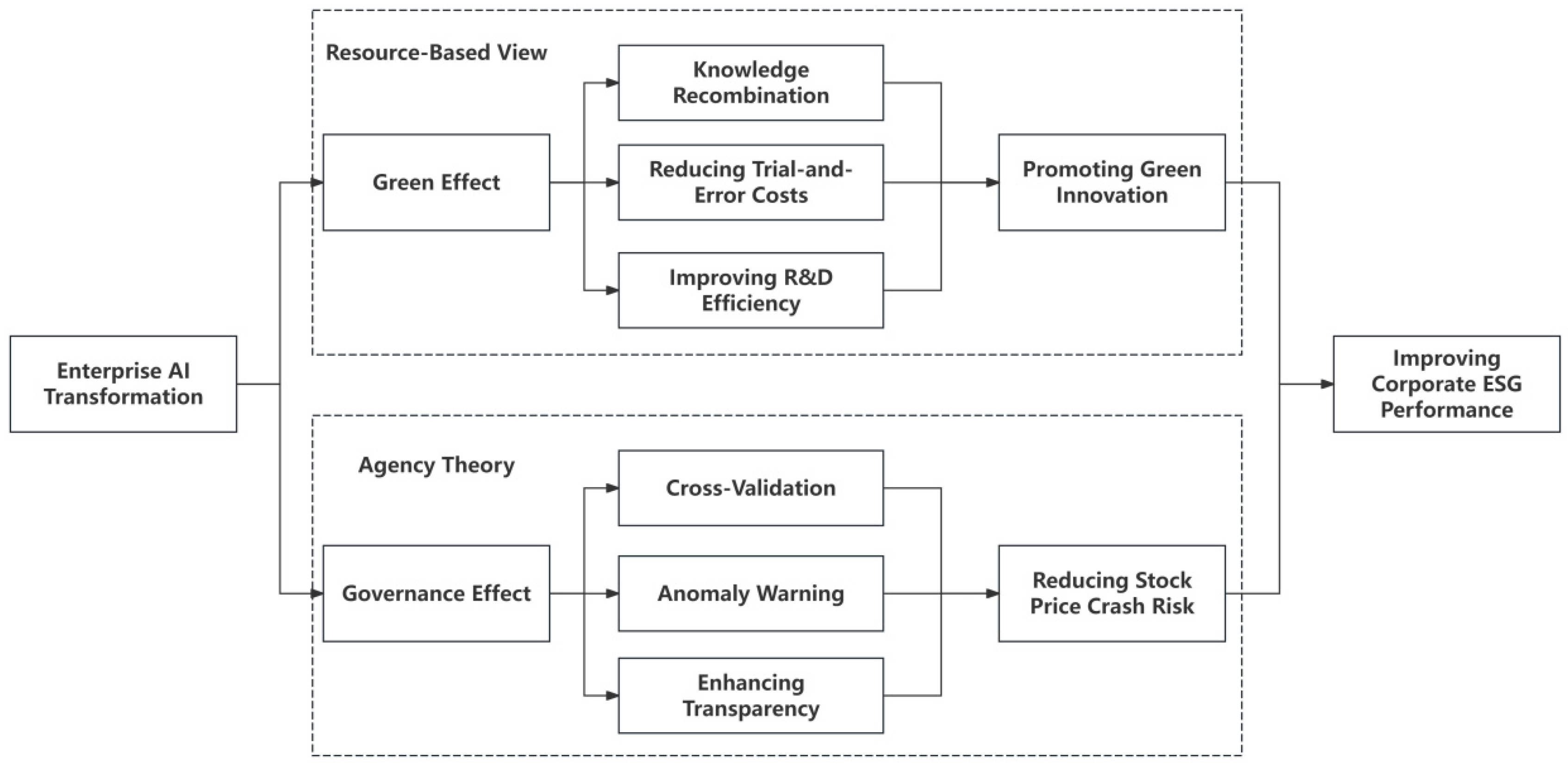
It should also be noted that AI may affect ESG through multiple channels, although not all mechanisms are equally central from either a theoretical or an empirical perspective. Compared with more indirect channels, such as brand reputation, customer relations, or supply chain coordination, AI—as a high-threshold and deeply embedded strategic investment—is more likely to reshape the firm’s value chain in two direct ways. First, it may promote green innovation through technological search, process optimization, and knowledge recombination. Second, it may improve corporate governance by alleviating information asymmetry, strengthening monitoring, and increasing transparency. These two channels correspond closely to the key processes through which firms can achieve substantive improvements in the environmental and governance dimensions of ESG. Accordingly, this study focuses on green innovation and governance improvement as the two core pathways linking AI transformation to ESG performance.
Although AI may also affect the social dimension of ESG, its role there is often more indirect and potentially ambivalent. On the one hand, AI may improve employee training, workplace safety, and customer service. On the other hand, it may also generate concerns related to job displacement, algorithmic bias, and privacy protection. From an institutional perspective, improvements in the social dimension depend not only on technological investment itself, but also on the external institutional environment, industry norms, and labor governance arrangements. As a result, the net effect of AI on the social dimension may not be stable, immediate, or uniformly positive. For this reason, the present analysis does not treat the social dimension as a core mechanism, but instead concentrates on the environmental and governance dimensions. Figure 1 presents the conceptual framework linking AI transformation to corporate ESG performance.
From the resource-based view, AI transformation is a firm-specific capability based on data, algorithms, computing infrastructure, and organizational routines, and its complexity and inimitability may support sustained competitive advantage (Liu et al., 2025). In the context of green innovation, firms often face constraints such as high technological complexity, costly trial and error, and difficulties in cross-departmental coordination. AI can help alleviate these constraints by enhancing firms’ ability to analyze and optimize energy use, emissions processes, and green R&D activities through data mining, intelligent recognition, and predictive optimization. In doing so, it may help firms identify high-energy-consumption and high-emission links while improving the efficiency of green technology search and green process improvement (H. Li et al., 2025; Alassuli et al., 2026). AI transformation may therefore facilitate green innovation and, in turn, contribute to better environmental and overall ESG performance.
From the governance perspective, agency theory suggests that governance failure often arises from information asymmetry and insufficient monitoring. Under short-term performance pressure or opportunistic incentives, managers may delay the disclosure of bad news, thereby undermining long-term firm value. AI can improve data integration, anomaly detection, and risk warning, thereby strengthening internal controls and process monitoring and reducing managerial room for information concealment and opportunistic behavior (Zhang & Yang, 2024). Stock price crash risk can further be viewed as an important proxy for governance effectiveness, as a higher crash risk often reflects accumulated bad news, inadequate transparency, and managerial short-termism. If AI transformation strengthens monitoring and improves governance transparency, firms’ stock price crash risk may decline, which may in turn be associated with better overall ESG performance.
Based on the above analysis, this study proposes the following hypotheses:
H1: 
AI transformation is positively associated with corporate ESG performance.
H2a: 
AI transformation may enhance corporate ESG performance by promoting green innovation.
H2b: 
AI transformation may enhance corporate ESG performance by improving corporate governance and reducing stock price crash risk.

3. Research Design and Variable Construction

3.1. Sample Selection and Data Description

Based on an initial panel of Chinese A-share listed firms covering 2012–2023, we merge four data sources: CSMAR for firm characteristics, financial indicators, and governance variables; Wind’s Huazheng ESG ratings for ESG performance; CNINFO annual reports for textual information on digital and AI transformation; and the CNIPA patent database for patent records.
We apply three sample restrictions. We exclude financial firms because of their distinct accounting and regulatory features, remove observations with missing key variables, and drop firms listed after 2012 to maintain a balanced panel and avoid noise from newly listed firms. These restrictions yield 21,288 firm-year observations from 1774 listed firms.

3.2. Variable Definitions

3.2.1. Corporate ESG Performance

ESG reflects a firm’s environmental, social, and governance performance. In this study, we use the Huazheng ESG rating to proxy for corporate ESG performance. The rating is developed with reference to internationally recognized ESG principles while adapting to China’s institutional and capital-market environment. It evaluates listed firms in both the A-share and Hong Kong markets. Specifically, the overall Huazheng ESG score is used in the regressions, with larger values denoting stronger ESG performance.

3.2.2. Corporate AI Transformation (AIT)

Existing studies generally adopt two approaches to measuring firms’ AI development. One relies on survey-based indicators of information technology or digital capability, while the other uses AI-related patents to capture technological input and output. The former is susceptible to subjective bias, whereas the latter is closer to R&D activity and may not adequately reflect organizational transformation at the application level.
To improve measurement validity and external relevance, this study identifies whether firms have undertaken AIT based on the textual content of annual reports. Annual reports systematically disclose firms’ attention to AI, application scenarios, and resource allocation in sections such as management discussion and analysis, business development, and strategic planning, thereby offering advantages in terms of accessibility, comparability, and temporal clarity. Against this background, we identify AI-related disclosures that point to substantive application or strategic deployment, with particular attention to information contained in core sections such as management discussion and business and technology descriptions. To reduce noise and mitigate the influence of symbolic “buzzword” disclosure, we exclude statements unrelated to firms’ substantive actions, such as macro-level outlooks, generic risk warnings, and third-party commentary.
Based on this procedure, we construct a binary indicator of AIT. If a firm first reports a valid AI-related disclosure that satisfies the above criteria in a given year, the indicator is coded as 1 from that year onward throughout the remaining sample years, reflecting the path dependence and persistence of organizational transformation. Firms that never exhibit such valid disclosure during the sample period are coded as 0. Thus, valid-disclosure firms are classified as treated, while others are used as controls.
To address the possibility that the text-based measure may capture only AI-related disclosure rather than substantive investment, we further validate the measure using AI investment intensity (Zhou et al., 2026). Specifically, CSMAR AI investment data are used to proxy for firms’ substantive AI input. This measure is mainly constructed from capitalized AI-related outlays reported in firms’ financial statements, generally under intangible assets or fixed assets. Because expensed AI-related expenditures are difficult to identify separately by technology category, they are not included in the AI investment measure. As a result, the AI investment variable used in this study mainly captures AI-related capitalized investment that can be directly identified and verified from financial statements, thereby improving objectivity and verifiability.
More specifically, we test whether the text-based AIT indicator is related to AI investment intensity. The two measures are positively and significantly correlated, suggesting that firms identified as having undertaken AIT on the basis of textual disclosure also tend to exhibit higher levels of AI investment. This evidence supports the construct validity of the measure and indicates that it captures firms’ actual AI-related investment behavior to a meaningful extent. In addition, in the subsequent robustness analysis, we combine AI investment intensity with textual disclosure to construct alternative identification measures, so as to further examine the stability of the baseline results.

3.2.3. Control Variables

Following prior studies (Zhao et al., 2024; Yin et al., 2023), this study controls for several firm-level characteristics to reduce potential confounding effects. These variables include return on equity (ROE, calculated as net profit over average shareholders’ equity), the shareholding ratio of the top five shareholders (TOP5), ownership concentration captured by the Herfindahl index of the top five shareholders (Herfindahl5), debt-to-asset ratio (Lev), net profit margin (Net Profit), firm size proxied by the natural logarithm of total assets (Size), Big 4 auditor indicator (Big 4), and independent director ratio (Indep). Firm and year fixed effects are further included to absorb unobserved firm heterogeneity and common annual shocks.

3.3. Model Construction

To estimate the relationship between corporate AI transformation and ESG performance, the following benchmark regression model is specified:
E S G i t = β 0 + β 1 A I T i t +     γ C o n t r o l s i t + μ i + λ t + ε i t
Here, i denotes a firm, t denotes year, and   E S G i t represents the ESG performance of firm i in year t.   A I T i t   is a dummy variable indicating whether firm i has undertaken AI transformation in year t. Controls it denotes the vector of control variables, and firm and year fixed effects account for unobserved firm heterogeneity and common time shocks. The coefficient β 1 captures the estimated effect of AIT, and standard errors are clustered at the firm level.

4. Results of the Baseline Regression

4.1. Descriptive Statistics

4.1.1. Descriptive Statistics for the Full Sample

Table 1 reports summary statistics for the variables used in the analysis. The ESG score has a mean of 72.354 and a median of 72.71. The lower mean suggests that some firms still lag in ESG performance, implying scope for further improvement. The mean of AIT is 0.510. This means that 51.0% of firm-year observations are classified as having undertaken substantive AI transformation. This distribution provides sufficient variation for the following empirical analysis.

4.1.2. Test of Differences Between Groups

As a preliminary comparison, the sample is divided into AIT and non-AIT firms, and a univariate mean-difference test is conducted. Table 2 shows that firms in the AIT group have an average ESG score of 72.819, compared with 71.869 for firms in the non-AIT group. The difference of 0.95 is significant at the 1% level. This initial evidence points to a positive AIT–ESG relationship. However, this comparison is only descriptive, and the relationship must be further tested in regressions that control for potential confounders.

4.2. Regression of the Baseline Model

We first estimate the baseline model to assess the AIT–ESG relationship. Column (1) of Table 3 reports the result. In the specification without controls, AIT has a positive coefficient significant at the 1% level, indicating higher ESG performance among firms undertaking AIT. After adding firm-level controls, Column (2) shows that AIT remains positive and significant, with a coefficient of 0.206. This indicates that, holding other factors constant, AIT is associated with an average increase of 0.206 points in firms’ ESG scores. These findings are consistent with H1.
To examine whether the ESG effect varies across dimensions, we re-estimate the model using E_score, S_score, and G_score as dependent variables. As shown in Columns (3)–(5) of Table 3, AIT is significant and positive for the E and G scores, but is not significant for the S score.
These findings suggest that AI may improve firms’ environmental performance by optimizing resource allocation, enhancing energy efficiency, and facilitating energy conservation and emissions reduction. They also suggest that AIT may improve governance by enhancing transparency, strengthening internal controls, and lowering agency costs (Ni et al., 2026; Alassuli et al., 2025). By contrast, the absence of a significant effect on the social dimension may indicate that current AI applications remain primarily concentrated on internal efficiency gains and compliance-oriented governance, while their influence on external stakeholder relations, social engagement, and broader social responsibility practices has yet to fully materialize and may require a longer time horizon to emerge.

4.3. Parallel Trends Test

To assess pre-treatment dynamics, we adopt the event-study specification following Jacobson et al. (1993). A valid DID setting requires treated and control firms to follow similar ESG trajectories before AIT, while differences may appear after the transformation. We estimate the following model:
ESG it   =   β 0 + k = 3 k = 10 β k × D i , t 0 + k   + γ C o n t r o l s i t + μ i + λ t + ε i t
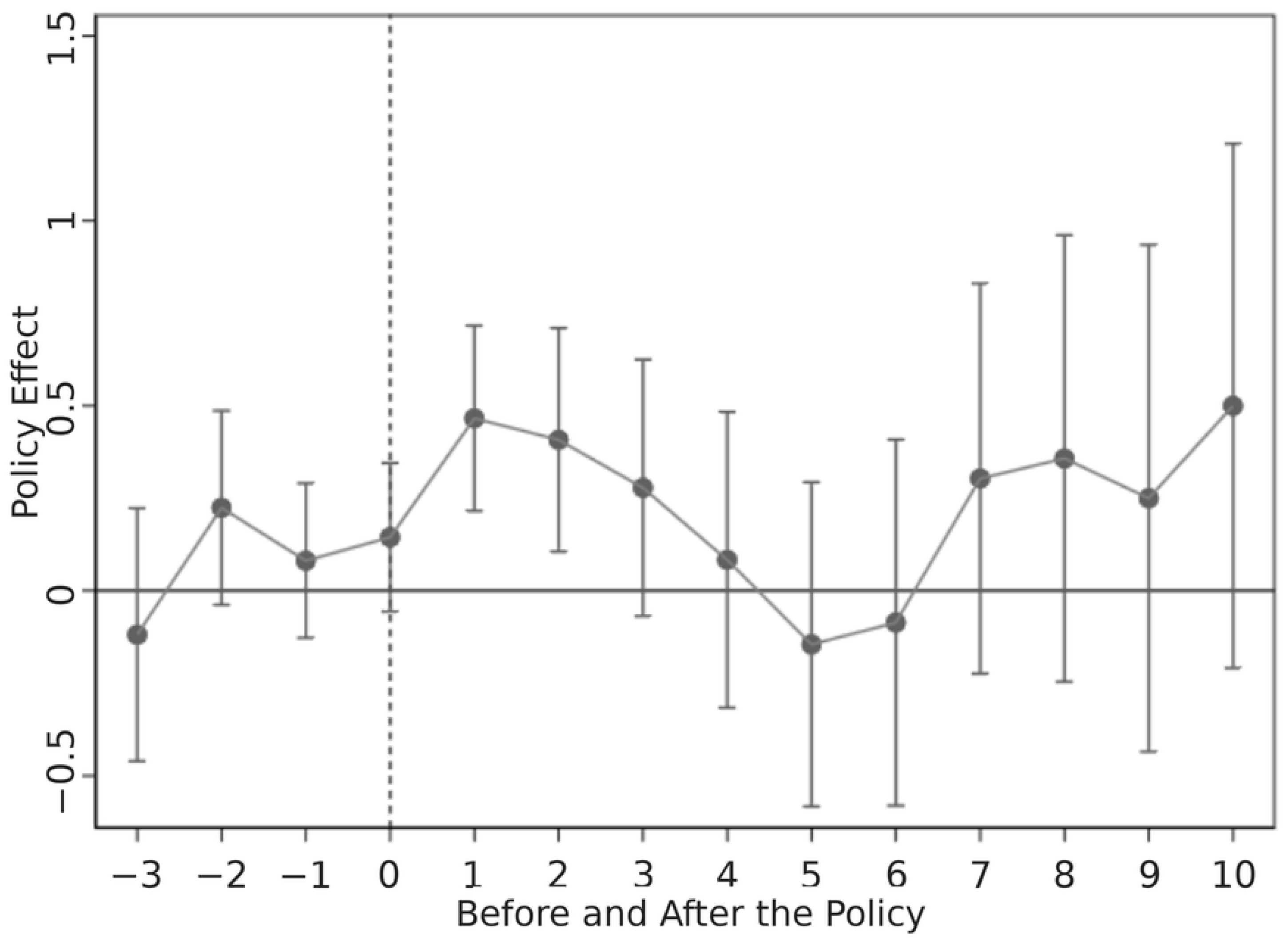
where D i , t 0 + k is a series of time-dependent dummy variables; t0 represents the year a firm first implemented AIT, and tk represents the kth year of the firm’s AIT. Following common practices in the literature, this study uses k = −1 as the base year. The regression coefficient of interest is β k ; if the regression coefficient is not significantly different from 0 during the period when k < 0, this confirms the parallel trends hypothesis.
Figure 2 displays the event-time estimates β k from Model (2) with 90% confidence intervals. Before treatment, the estimates are small and statistically insignificant, suggesting similar ESG trajectories prior to AIT.
Following AIT adoption, the early post-treatment estimates turn positive, particularly in the first two years, consistent with higher ESG performance after AI transformation. However, the estimates in later periods are less precise and some confidence intervals include zero, suggesting that the dynamic effect is not strictly monotonic over time. Overall, the event-study evidence supports the DID design and reinforces the positive AIT–ESG relationship.

4.4. Robustness Estimates

4.4.1. AI Washing

A potential concern with the baseline measure is that identifying AIT solely from annual report text may capture strategic narrative, symbolic disclosure, or firms’ attempts to cater to capital market expectations, thereby introducing AI washing bias. To address this concern, this study adopts a more stringent identification strategy and reconstructs firms’ AIT status. Specifically, beyond identifying whether a firm provides valid AI-related disclosure in its annual report, we further incorporate information on actual AI investment to build alternative measures, thereby improving the objectivity and verifiability of the core explanatory variable.
To capture firms’ substantive AI input, we rely on CSMAR’s AI investment records (Zhou et al., 2026). This measure mainly covers capitalized AI outlays reported by firms, generally classified under intangible or fixed assets. Relative to text-based disclosure, such capitalized investment is more directly verifiable and is more likely to reflect whether a firm has genuinely embedded AI into its production, operations, and resource-allocation processes. At the same time, expensed AI-related expenditures are not included, as they cannot be reliably identified by technology category. The AI investment variable used here therefore focuses on capitalized AI expenditures that can be directly observed and verified in financial statements. Although this approach may understate firms’ total AI investment, it provides a more cautious and reliable basis for identification.
Building on this measure, we compare firms’ AI investment intensity within each industry-year cell. A firm is classified as having undertaken AIT only when two conditions are simultaneously satisfied: it reports valid AI-related disclosure and its AI investment intensity exceeds the relevant industry-year threshold. Specifically, we use the 30th, 40th, and 50th percentiles of industry-year AI investment intensity as alternative cutoffs and construct three corresponding indicators, AIT30, AIT40, and AIT50. These alternative indicators are then used to re-estimate the regressions and assess whether the baseline results are sensitive to potential AI washing.
Table 4 presents the estimates. The coefficients for AIT30, AIT40, and AIT50 are 0.168, 0.264, and 0.204, respectively, with all estimates taking positive values. AIT30 and AIT50 are significant at the 10% level, while AIT40 is significant at the 1% level. These results indicate that the AIT–ESG relationship persists when AIT is identified using both textual disclosure and observable AI investment, even as the investment threshold becomes more restrictive. This evidence helps rule out the possibility that the baseline estimates mainly reflect symbolic AI narratives or concept-driven signaling. It also shows that ESG improvement is more evident among firms combining substantive AI investment with organizational transformation.

4.4.2. Instrumental Variable Approach

To further mitigate endogeneity concerns, we conduct an IV analysis as a supplementary check. The instrument interacts firms’ exposure to China’s AI pilot-zone policy with their pre-policy digital foundation. Pilot-zone information and establishment dates are obtained from official approvals, notices, and public lists released by the Ministry of Science and Technology and other relevant agencies. Firms are then matched to pilot-zone cities based on their registered locations to identify whether they were exposed to the relevant regional AI policy shock. Firms’ pre-policy digital foundation is measured using the digital transformation indicator provided by the CSMAR database and is captured by firms’ digitalization level prior to the policy implementation, reflecting their existing capacity to absorb, adapt, and apply digital technologies. This interaction captures whether firms with stronger digital foundations are more capable of converting regional AI policy support into firm-level AIT under the same policy shock.
Table 5 presents the IV estimates and diagnostic tests. Column (1) shows that the instrument is positive and significant at the 1% level in the first stage, indicating that firms with pilot-zone exposure and stronger pre-policy digital foundations are more likely to adopt AIT. The second-stage coefficient remains positive and significant, suggesting that the AIT–ESG relationship persists after accounting for potential reverse causality and omitted-variable bias.
It should be noted that the IV estimate is substantially larger than the baseline OLS estimate. A possible explanation is that the IV estimate reflects the effect for firms whose AIT is induced by the policy shock. These firms may have stronger digital foundations and greater absorptive capacity, allowing them to translate AI-related policy support into ESG improvements more effectively. However, this large discrepancy also calls for caution. AI pilot-zone policies may affect ESG performance through channels other than AIT, such as regulatory attention, policy incentives, and public scrutiny. Although firm fixed effects, year fixed effects, and firm-level controls are included, the exclusion restriction remains empirically unverifiable. Therefore, the IV results are treated as supplementary evidence rather than the main basis for causal interpretation, and this issue is discussed as a study limitation.
The diagnostic tests further support instrument relevance. The model rejects the null of under-identification (Kleibergen–Paap rk LM = 15.142). Moreover, the Kleibergen–Paap Wald F statistic and the Cragg–Donald Wald F statistic both exceed the Stock–Yogo critical values, suggesting limited weak-instrument concerns. Because the model is exactly identified, an overidentification test is not required.

4.4.3. Placebo Test

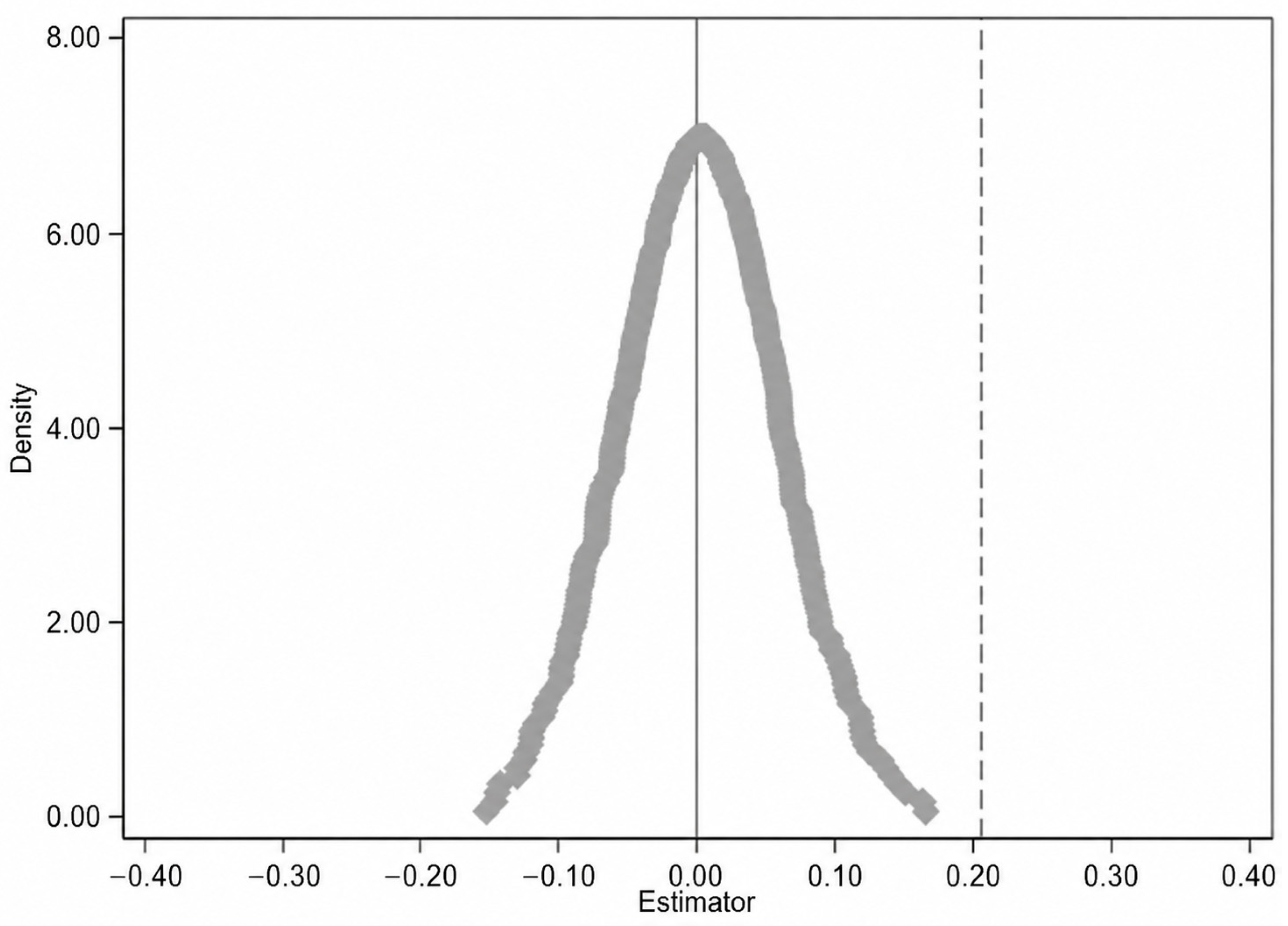
To examine whether the baseline result reflects random patterns rather than the effect of AIT, we conduct a permutation-based placebo test. In each iteration, we randomly draw the same number of firms as in the actual treatment group and classify them as pseudo-treated firms. We then randomly assign pseudo-treatment years to these firms and construct a fictitious treatment indicator. Repeating this procedure 500 times produces a simulated distribution of placebo estimates from the re-estimated baseline model.
Figure 3 plots the kernel density of the 500 placebo coefficients. The placebo coefficients are tightly centered around zero, with a mean close to zero. The actual baseline estimate of 0.206 is located in the tail of the simulated distribution, suggesting that the observed AIT effect is unlikely to be generated by random assignment.

4.4.4. PSM-DID

To reduce self-selection bias in AIT adoption, this study further applies PSM-DID. Since firms’ AIT decisions may depend on their resources and strategic preferences, the baseline estimates could be affected by observable selection. We therefore estimate propensity scores using a Logit model with the baseline controls as matching covariates, and then implement kernel, one-to-one nearest-neighbor, and radius matching. As reported in Table 6, the AIT coefficient remains positive and statistically significant across all three matched samples, with magnitudes close to the baseline estimate. This suggests that the main finding is robust after accounting for potential selection bias.

4.4.5. Winsorization

To limit the effect of outliers, we winsorize all continuous variables at the 1st and 99th percentiles. As reported in Column (1) of Table 7, AIT remains positive and significant at the 5% level, with an estimate close to the baseline result, indicating that outliers do not drive the main finding.

4.4.6. Excluding Loss-Making Firms

Given that firms with negative profits may be in financial distress or operating under abnormal conditions, their decisions regarding AIT and ESG investment may be more easily affected by short-term survival pressure and other atypical factors, thereby introducing substantial statistical noise. We therefore remove firm-year observations with negative net profits and re-estimate the model. Column (2) of Table 7 shows that AIT remains positive and significant at the 5% level, suggesting that the baseline result is not driven by loss-making firms or other atypical observations.

4.4.7. Alternative Measure of the Explanatory Variable

The baseline model uses a binary AIT indicator, which captures the timing of transformation but not its intensity across firms. To test measurement sensitivity, we replace the binary indicator with the frequency of AI-related keywords in annual reports. This alternative measure is intended to capture the intensity of AI-related investment and the depth of application. The results are shown in Column (3) of Table 7. The text-frequency measure has a coefficient of 0.152 and is significant at the 1% level. This finding suggests that whether AIT is captured as a discrete organizational shift or as variation in transformation intensity, its positive association with corporate ESG performance remains robust.

4.4.8. Alternative Measure of the Dependent Variable

Because different ESG rating agencies may vary in their weighting schemes and evaluation standards, relying on a single rating system may introduce measurement bias. To address this issue, we use the Bloomberg ESG score as an alternative dependent variable. Unlike the grade-based Huazheng measure, Bloomberg provides a continuous ESG score constructed from weighted environmental, social, and governance information. As a result, it provides greater continuity and statistical sensitivity. Column (4) of Table 7 shows that, when Bloomberg ESG is used, AIT remains positive and significant at the 1% level, with a coefficient of 0.406. This suggests that the AIT–ESG relationship is robust to an alternative continuous ESG measure.

4.4.9. Alternative Clustering Level

Given that firms within the same industry are often exposed to similar industry-wide policies, market fluctuations, and technological paradigm shifts, the error terms may be correlated within industries, potentially affecting statistical inference. We further cluster standard errors at the industry level to address potential within-industry correlation. Column (1) of Table 8 shows that AIT remains positive and significant at the 5% level, indicating that the baseline inference is robust to industry-level clustering.

4.4.10. Additional Fixed Effects

We further include industry and city fixed effects to absorb unobserved differences across industries and locations. Columns (2) and (3) of Table 8 show that AIT remains positive and significant, indicating that the baseline result is not explained by industry- or city-level heterogeneity.

4.4.11. Accounting for Period Heterogeneity

Because the sample period spans 2012–2023, during which AI technologies underwent substantial changes in development stage, application form, and cost structure, treating AIT as a homogeneous shock across years may obscure important period heterogeneity associated with technological evolution. To address this issue, this study further examines period heterogeneity by using 2020 as the cutoff year and introducing the interaction term AIT × POST2020 to test whether the association between AIT and ESG performance changed after AI entered a phase of accelerated diffusion and deeper application. Column (4) of Table 8 reports the results.
The AIT coefficient is 0.285 and significant at the 5% level, showing that the positive AIT–ESG relationship persists after accounting for period heterogeneity. The interaction term AIT × POST2020 is negative but statistically insignificant. This suggests that, although AI entered a stage of faster diffusion and broader application after 2020, its association with corporate ESG performance did not change in a statistically meaningful way. In other words, the positive relationship identified in the baseline regression does not appear to be driven by a short-lived technological wave concentrated in a particular period, but instead remains relatively stable across different stages of AI development. This further supports the stability of the ESG effect of AIT across different stages of AI development.

4.4.12. Additional Control Variables

To further address omitted-variable concerns, we add firm age and R&D intensity, measured as R&D expenditure divided by operating revenue, to the baseline model. Column (5) of Table 8 presents the results. After these controls are added, the AIT coefficient remains positive at 0.217 and significant at the 5% level, confirming that the baseline result is not driven by these additional firm-level characteristics.

4.4.13. Heterogeneity-Robust Estimator

Because TWFE estimates may be biased when treatment effects vary across cohorts and periods, we further use the doubly robust CSDID estimator developed by Callaway and Sant’Anna (2021). This approach first estimates group-time treatment effects and then aggregates them using suitable weights, helping address bias from treatment-effect heterogeneity.
Table 9 presents the average treatment effects obtained from the CSDID estimation. The CSDID results report a Simple ATT of 0.425, significant at the 5% level, and a Post_avg of 0.625, significant at the 1% level; the corresponding CAverage and GAverage are 0.485 and 0.302. The estimates are consistently positive and statistically significant, in line with the baseline results. Overall, the CSDID evidence indicates that the AIT–ESG relationship persists after accounting for possible bias from heterogeneous treatment effects.

5. Mechanism Analysis

This section examines two potential channels through which AIT may be associated with corporate ESG performance: the green effect and the governance effect.

5.1. Green Effect

AIT may not only improve firms’ information-processing efficiency and resource-allocation capability, but also facilitate green technology development and application, thereby improving environmental performance and, in turn, overall ESG performance. To test this channel, we measure green innovation using green utility patents (EnvrUtyPat).
As shown in Column (1) of Table 10, the AIT coefficient is 0.027 and significant at the 1% level, indicating higher green utility patent output after AIT. After EnvrUtyPat is included in Column (2), it remains positive and significant at the 1% level, and AIT also stays positive and significant at the 5% level. This evidence supports green innovation as a mediating channel between AIT and ESG performance.
To further assess the mediation effect, this study implements a firm-clustered bootstrap procedure with 1000 replications. The bootstrap results report an indirect effect of 0.013, significant at the 5% level, with a confidence interval excluding zero. Together with the positive coefficient of EnvrUtyPat in the ESG regression, this evidence supports the mediating role of green innovation.

5.2. Governance Effect

Beyond green innovation, AIT may enhance ESG performance through governance improvement. Drawing on the role of transparency and external attention in ESG outcomes (Xu & Xu, 2025), this study uses NCSKEW to capture governance deficiencies related to opacity and bad-news accumulation.
As shown in Table 11, AIT significantly reduces stock price crash risk, with a coefficient of −0.100 in Column (1). After NCSKEW is added to the ESG regression, it enters with a negative coefficient significant at the 5% level, and AIT retains a positive coefficient significant at the 10% level. This result is consistent with the view that reduced crash risk serves as a governance-related pathway from AIT to ESG improvement.
The bootstrap result suggests a marginal indirect effect of 0.008 at the 10% level. However, because the 95% confidence interval slightly includes zero, the evidence for the governance channel should be interpreted as relatively weak and complementary.

6. Heterogeneity Analysis

This section examines whether the association between AIT and corporate ESG performance varies along three dimensions: ownership structure, technological intensity, and pollution intensity.

6.1. Ownership Structure

Firm ownership may shape how AIT affects ESG performance. Relative to non-SOEs, SOEs face stronger institutional constraints and broader policy responsibilities. To respond to policy priorities and maintain their advantage in resource access, SOEs may have stronger incentives to allocate AI technologies to areas such as environmental management, compliance, and social responsibility, thereby generating more pronounced ESG gains (Marquis & Qian, 2014; W. Li & Zhang, 2010). The regression results by ownership group are reported in Columns (1) and (2) of Table 12. AIT has a positive and significant coefficient for SOEs, while its coefficient is insignificant for non-SOEs. In addition, the Fisher combined test based on 1000 bootstrap replications further confirms that the coefficient difference between the two groups is statistically meaningful.

6.2. Technological Intensity

Industry technological intensity may also affect the ESG gains from AIT. Compared with high-tech firms, non-high-tech firms generally have a weaker technological endowment and digital foundation. As a result, the introduction of AI may offer greater scope for marginal improvements in production efficiency and resource allocation, thereby generating stronger ESG benefits. Based on the OECD classification by R&D intensity (Hatzichronoglou, 1997; Galindo-Rueda & Verger, 2016), the sample is divided into high-tech and non-high-tech firms. Columns (3) and (4) of Table 12 show that AIT has a significant ESG effect only among non-high-tech firms. This conclusion is further supported by the bootstrap-based test of intergroup differences.

6.3. Pollution Intensity

Differences in environmental regulatory pressure may also generate heterogeneity in the ESG implications of AIT. Heavily polluting firms face stronger regulatory and reputational pressure than non-heavily polluting firms. Under such pressure, AI adoption is more likely to support emissions reduction, pollution monitoring, and environmental compliance, leading to a stronger ESG response. Following the classic definitions of pollution-intensive industries in the literature (Mani & Wheeler, 1998; Grether & De Melo, 2003), this study conducts subgroup regressions accordingly. Columns (5) and (6) of Table 12 show that AIT has a positive but insignificant coefficient among non-heavily polluting firms, whereas the coefficient is larger and statistically significant among heavily polluting firms. The bootstrap-based test of intergroup differences also confirms the statistical significance of this asymmetric effect.

7. Conclusions and Discussion

7.1. Conclusions

Based on Chinese A-share listed firms during 2012–2023, this study identifies AIT from annual report text and evaluates its ESG effect within a DID framework. The evidence shows that AIT is associated with higher ESG performance, and the result is robust to parallel-trend tests, placebo tests, PSM-DID, alternative measures, alternative clustering, additional fixed effects, and CSDID estimation. Further analysis suggests that green innovation and lower stock price crash risk are two key channels linking AIT to ESG improvement. The effect is more evident among firms with state ownership, lower technological intensity, and heavier pollution exposure.

7.2. Discussion

The results indicate that AIT is not only an efficiency-oriented technological change, but also a potential driver of corporate sustainability. Compared with the existing literature, which has focused primarily on specific AI applications or AI capability, this study approaches the issue from the perspective of AIT and extends the mechanism analysis from the green effect to the governance effect, thereby offering empirical evidence on the ESG implications of corporate AI transformation.
Although this study employs a DID design and strengthens identification through an instrumental variable strategy, CSDID estimation, and a series of robustness checks, these approaches cannot fully eliminate residual endogeneity or the influence of unobserved confounding factors. The results therefore should not be interpreted as establishing a strict causal relationship in an absolute sense. In addition, the identification of AIT is primarily based on annual report text. Although this study makes efforts to reduce the measurement bias associated with potential “AI washing,” textual disclosure may still differ from firms’ actual level of transformation. Future research could use more direct indicators, including AI investment, AI patents, IT infrastructure, and workforce structure, to refine AIT measurement and test the generalizability of the findings across firms and institutional contexts.


Author Contributions

Conceptualization, W.R., B.Z. and Y.L.; methodology, W.R.; software, W.R.; validation, Y.Y., Y.Z. and B.Z.; formal analysis, W.R.; investigation, Y.Y. and Y.Z.; resources, B.Z. and Y.L.; data curation, W.R. and Y.Y.; writing—original draft preparation, W.R.; writing—review and editing, B.Z. and Y.L.; visualization, W.R.; supervision, B.Z. and Y.L.; project administration, B.Z.; funding acquisition, W.R. All authors have read and agreed to the published version of the manuscript.

Funding

This research was funded by the National Social Science Fund of China, grant number 22CH190.

Institutional Review Board Statement

Not applicable.

Informed Consent Statement

Not applicable.

Data Availability Statement

The processed data and Stata codes are available from the authors upon reasonable request.

Acknowledgments

The authors thank the anonymous reviewers for their constructive comments and gratefully acknowledge the helpful assistance of Yuying Mu from Nanjing University of Finance and Economics. During the preparation of this manuscript, the authors used ChatGPT, based on GPT-5.5 Thinking, by OpenAI for language editing and proofreading only. The authors reviewed and edited the output and take full responsibility for the content of this publication.

Conflicts of Interest

The authors declare no conflicts of interest.

Abbreviations

AIArtificial Intelligence
AIT Artificial Intelligence Transformation
ESGEnvironmental, Social, and Governance
E_scoreEnvironmental Score
S_scoreSocial Score
G_scoreGovernance Score
DIDDifference-in-Differences
TWFETwo-Way Fixed Effects
PSM-DIDPropensity Score Matching Difference-in-Differences
IVInstrumental Variable
CSDIDCallaway and Sant’Anna Difference-in-Differences Estimator
ATTAverage Treatment Effect on the Treated
SOEState-Owned Enterprise
ROEReturn on Equity
TOP5Top Five Shareholder Ownership Ratio
Herfindahl5Herfindahl Index of the Top Five Shareholders
LevDebt-to-Asset Ratio
NetProfitNet Profit Margin
SizeFirm Size
Big4Big Four Auditor Indicator
IndepIndependent Director Ratio
POST2020Post-2020 Indicator
CSMARChina Stock Market & Accounting Research Database
WindWind Financial Terminal
CNINFOChina Securities Information Disclosure
CNIPAChina National Intellectual Property Administration
R&DResearch and Development
NCSKEWNegative Conditional Skewness
EnvrUtyPatGreen Utility Patents

References

  1. Alassuli, A., Eltweri, A., Thuneibat, N. S., Al-Hajaya, K., & Ismail, S. M. (2026). Artificial intelligence applications and financial forecasting accuracy in banking platforms: Evidence from Jordan. Administrative Sciences, 16(3), 122. [Google Scholar] [CrossRef]
  2. Alassuli, A., Thuneibat, N. S., Eltweri, A., Al-Hajaya, K., & Alghraibeh, K. (2025). The impact of accounting digital transformation on financial transparency: Mediating role of good governance. Journal of Risk and Financial Management, 18(5), 272. [Google Scholar] [CrossRef]
  3. Al-Hajaya, K., Almahameed, E. A. A., Sawan, N., Altarawneh, M. S., Eltweri, A., & Salem, R. (2025). Audit committees and the quality of standalone sustainability reporting, considering the moderating role of external assurance: Evidence from the global chemical industry. Business Strategy and the Environment, 34(5), 6210–6228. [Google Scholar] [CrossRef]
  4. Babina, T., Fedyk, A., He, A., & Hodson, J. (2024). Artificial intelligence, firm growth, and product innovation. Journal of Financial Economics, 151, 103745. [Google Scholar] [CrossRef]
  5. Babina, T., Fedyk, A., He, A. X., & Hodson, J. (2023). Firm investments in artificial intelligence technologies and changes in workforce composition (Vol. 31325). National Bureau of Economic Research. [Google Scholar] [CrossRef]
  6. Callaway, B., & Sant’Anna, P. H. (2021). Difference-in-differences with multiple time periods. Journal of Econometrics, 225(2), 200–230. [Google Scholar] [CrossRef]
  7. Galindo-Rueda, F., & Verger, F. (2016). OECD taxonomy of economic activities based on R&D intensity (OECD science, technology and industry working papers, Vol. 2016, Issue 4). OECD Publishing. [Google Scholar] [CrossRef]
  8. Grether, J. M., & De Melo, J. (2003). Globalization and dirty industries: Do pollution havens matter? (NBER working paper no. 9776). National Bureau of Economic Research. [CrossRef]
  9. Hatzichronoglou, T. (1997). Revision of the high-technology sector and product classification (OECD Science, Technology and Industry Working Papers, Vol. 1997, Issue 2). OECD Publishing. [Google Scholar] [CrossRef]
  10. Jacobson, L. S., LaLonde, R. J., & Sullivan, D. G. (1993). Earnings losses of displaced workers. The American Economic Review, 83, 685–709. Available online: https://www.jstor.org/stable/2117574 (accessed on 17 May 2026).
  11. Law, K. K., & Shen, M. (2025). How does artificial intelligence shape audit firms? Management Science, 71(5), 3641–3666. [Google Scholar] [CrossRef]
  12. Li, H., Lu, Z., Zhang, Z., & Tanasescu, C. (2025). How does artificial intelligence affect manufacturing firms’ energy intensity? Energy Economics, 141, 108109. [Google Scholar] [CrossRef]
  13. Li, J., Wu, T., Hu, B., Pan, D., & Zhou, Y. (2025). Artificial intelligence and corporate ESG performance. International Review of Financial Analysis, 102, 104036. [Google Scholar] [CrossRef]
  14. Li, W., & Zhang, R. (2010). Corporate social responsibility, ownership structure, and political interference: Evidence from China. Journal of Business Ethics, 96(4), 631–645. [Google Scholar] [CrossRef]
  15. Liu, Y., Song, J., Zhou, B., & Liu, J. (2025). Artificial intelligence applications and corporate ESG performance. International Review of Economics & Finance, 104, 104559. [Google Scholar] [CrossRef]
  16. Lopez-Lira, A., & Tang, Y. (2023). Can chatgpt forecast stock price movements? Return predictability and large language models. arXiv, arXiv:2304.07619. [Google Scholar] [CrossRef]
  17. Mani, M., & Wheeler, D. (1998). In search of pollution havens? Dirty industry in the world economy, 1960 to 1995. The Journal of Environment & Development, 7(3), 215–247. [Google Scholar] [CrossRef]
  18. Marquis, C., & Qian, C. (2014). Corporate social responsibility reporting in China: Symbol or substance? Organization Science, 25(1), 127–148. [Google Scholar] [CrossRef]
  19. Ni, Y., Nyhoff, J., Napier, M., & Townsend, D. (2026). AI Innovation and Bank Performance: Evidence from Patent Activity of Large US Commercial Banks. Journal of Risk and Financial Management, 19(4), 247. [Google Scholar] [CrossRef]
  20. Noy, S., & Zhang, W. (2023). Experimental evidence on the productivity effects of generative artificial intelligence. Science, 381(6654), 187–192. [Google Scholar] [CrossRef]
  21. Saif-Alyousfi, A. Y. (2025). Artificial intelligence, information environment, and capital market efficiency. Research in International Business and Finance, 79, 103094. [Google Scholar] [CrossRef]
  22. Xu, R., & Xu, C. (2025). How government open data platforms affect corporate ESG performance. Sustainability, 17(21), 9768. [Google Scholar] [CrossRef]
  23. Yin, Z., Li, X., Si, D., & Li, X. (2023). China stock market liberalization and company ESG performance: The mediating effect of investor attention. Economic Analysis and Policy, 80, 1396–1414. [Google Scholar] [CrossRef]
  24. Ying, Y., & Jin, S. (2024). Artificial intelligence and green product innovation: Moderating effect of organizational capital. Heliyon, 10(7), e28572. [Google Scholar] [CrossRef]
  25. Yu, X., Fan, L., & Yu, Y. (2025). Artificial intelligence and corporate ESG performance: A mechanism analysis based on corporate efficiency and external environment. Sustainability, 17(9), 3819. [Google Scholar] [CrossRef]
  26. Zhang, C., & Yang, J. (2024). Artificial intelligence and corporate ESG performance. International Review of Economics & Finance, 96, 103713. [Google Scholar] [CrossRef]
  27. Zhao, P., Yao, X., & Shen, R. (2024). Capital market internationalization and firms’ ESG performance: Evidence from the inclusion of China A-shares in the MSCI emerging market index. Energy Economics, 133, 107415. [Google Scholar] [CrossRef]
  28. Zhou, Y., Chen, L., Zhou, F., & Ye, M. (2026). Contractual arrangements and information consistency: How ESG executive compensation incentives affect corporate AI disclosure. Journal of Business Research, 207, 116019. [Google Scholar] [CrossRef]
Figure 1. Potential Mechanisms Linking AI Transformation to Corporate ESG Performance.
Admsci 16 00243 g001
Figure 2. Dynamic Effects of AI Transformation on ESG Performance.
Admsci 16 00243 g002
Figure 3. Estimated Coefficients.
Admsci 16 00243 g003
Table 1. Summary Statistics.
VariableNMeanSDMinP25P50P75Max
ESG21,28872.3545.84038.92069.16372.71076.24092.930
AIT21,2880.5100.5000.0000.0001.0001.0001.000
ROE21,2880.0351.560−174.8950.0200.0620.11443.250
TOP521,28850.10515.5670.81138.52849.42360.86696.417
Herfindahl521,2880.1500.1160.0000.0630.1140.2090.810
Lev21,2880.4761.277−0.1950.2950.4580.614178.345
NetProfit21,288−0.10618.190−2637.6940.0150.0520.11547.315
Big421,2880.0670.2500.0000.0000.0000.0001.000
Indep21,28837.4855.76916.67033.33033.33042.860100.000
Size21,28822.4261.37716.11616.51922.28328.34128.606
Table 2. Descriptive Statistics of Grouping Variables and Intergroup Differences.
VarNameAIT = 1AIT = 0Difference
ObsMeanObsMean
ESG10,86372.81910,42571.8690.95 ***
ROE10,8630.0310,4250.041−0.012
TOP510,86349.36710,42550.874−1.507 ***
Herfindahl510,8630.14010,4250.160−0.02 ***
Lev10,8630.46310,4250.490−0.028
NetProfit10,8630.01910,425−0.2360.255
Big410,8630.07110,4250.0620.009 ***
Indep10,86337.85110,42537.1030.747 ***
Size10,86322.67010,42522.1700.500 ***
Note: *, **, and *** indicate significance at the 10%, 5%, and 1% levels, respectively.
Table 3. The Effect of Corporate AI Transformation on Corporate ESG Performance.
(1)(2)(3)(4)(5)
ESGESGE_scoreS_scoreG_score
AIT0.435 ***0.206 **0.328 ***0.1210.351 *
(0.140)(0.098)(0.122)(0.149)(0.179)
ControlsNoYesYesYesYes
FirmFEYesYesYesYesYes
YearFEYesYesYesYesYes
N21,28821,28821,28821,28821,288
Adj.R20.5090.5230.5960.4360.526
Note: Firm-clustered standard errors are shown in parentheses. *, **, and *** denote significance at the 10%, 5%, and 1% levels.
Table 4. Robustness Check for Potential AI Washing.
(1)(2)(3)
ESGESGESG
AIT300.168 *
(0.099)
AIT40 0.264 ***
(0.101)
AIT50 0.204 *
(0.105)
ControlsYesYesYes
FirmFEYesYesYes
YearFEYesYesYes
N21,28821,28821,288
Adj.R20.5390.5390.539
Note: Firm-clustered standard errors are shown in parentheses. *, **, and *** denote significance at the 10%, 5%, and 1% levels.
Table 5. Robustness Check Using the Instrumental Variable Approach.
(1)(2)
AITESG
IV0.020 ***
(0.005)
AIT 11.786 ***
(4.295)
ControlsYesYes
FirmFEYesYes
YearFEYesYes
N21,28821,288
Note: Firm-clustered standard errors are shown in parentheses. *, **, and *** denote significance at the 10%, 5%, and 1% levels.
Table 6. Robustness Check Using the PSM-DID Approach.
(1)(2)(3)
Kernel-MatchingNearest Neighbor MatchingRadius Matching
AIT0.260 *0.266 *0.260 *
(0.143)(0.143)(0.143)
ControlsYesYesYes
FirmFEYesYesYes
YearFEYesYesYes
N17,96318,00017,963
Adj.R20.510.5110.51
Note: Firm-clustered standard errors are shown in parentheses. *, **, and *** denote significance at the 10%, 5%, and 1% levels.
Table 7. Robustness Checks: Winsorization, Excluding Loss-Making Firms, Alternative Explanatory Variable, and Alternative Dependent Variable.
(1)(2)(3)(4)
WinsorizationExcluding Loss-Making FirmsAlternative Explanatory VariableAlternative Dependent Variable
AIT0.216 **0.252 **0.152 ***0.406 ***
(0.097)(0.100)(0.050)(0.146)
ControlsYesYesYesYes
FirmFEYesYesYesYes
YearFEYesYesYesYes
N21,28818,28721,2888965
Adj.R20.5390.5300.5230.814
Note: Firm-clustered standard errors are shown in parentheses. *, **, and *** denote significance at the 10%, 5%, and 1% levels.
Table 8. Robustness Checks Under Alternative Clustering, Additional Fixed Effects, Period Heterogeneity, and Additional Control Variables.
(1)(2)(3)(4)(5)
Industry-Level ClusteringIndustry Fixed EffectsCity Fixed EffectsPeriod HeterogeneityAdditional Control Variables
AIT0.206 **0.234 *0.232 *0.285 **0.217 **
(0.097)(0.139)(0.139)(0.142)(0.098)
AIT × POST2020 −0.223
(0.344)
ControlsYesYesYesYesYes
FirmFEYesYesYesYesYes
YearFEYesYesYesYesYes
IndustryFENoYesNoNoNo
CityNoNoYesNoNo
N21,28821,28821,28821,28821,288
Adj.R20.5230.5250.5260.5250.524
Note: Firm-clustered standard errors are shown in parentheses. *, **, and *** denote significance at the 10%, 5%, and 1% levels.
Table 9. Robustness Check for Heterogeneous Treatment Effects: CSDID Estimates.
(1)(2)(3)(4)
Simple AverageDynamic AverageCalendar AverageGroup Average
Simple ATT0.425 **
(0.186)
Pre_avg 0.255
(0.515)
Post_avg 0.625 ***
(0.228)
CAverage 0.485 ***
(0.172)
GAverage 0.302 *
(0.174)
Note: Firm-clustered standard errors are shown in parentheses. *, **, and *** denote significance at the 10%, 5%, and 1% levels.
Table 10. Mechanism Analysis of the Green Effect.
(1)(2)
EnvrUtyPatESG
AIT0.027 ***0.193 **
(0.008)(0.098)
EnvrUtyPat 0.471 ***
(0.087)
ControlsYesYes
FirmFEYesYes
YearFEYesYes
N21,28821,288
Adj.R20.5480.524
Note: Firm-clustered standard errors are shown in parentheses. *, **, and *** denote significance at the 10%, 5%, and 1% levels.
Table 11. Mechanism Analysis: Governance Effect.
(1)(2)
NCSKEWESG
AIT−0.100 ***0.185 *
(0.016)(0.099)
NCSKEW −0.086 **
(0.044)
ControlsYesYes
FirmFEYesYes
YearFEYesYes
N20,78520,785
Adj.R20.0600.522
Note: Firm-clustered standard errors are shown in parentheses. *, **, and *** denote significance at the 10%, 5%, and 1% levels.
Table 12. Heterogeneity Analysis by Firm Characteristics.
(1)(2)(3)(4)(5)(6)
Ownership StructureTechnological IntensityPollution Intensity
Non-state-owned enterpriseState-owned enterpriseNon-high-techHigh-techNon-heavily pollutedHeavily polluting
AIT0.0130.497 ***0.447 **−0.0240.1260.576 **
(0.207)(0.180)(0.205)(0.188)(0.161)(0.277)
ControlsYesYesYesYesYesYes
FirmFEYesYesYesYesYesYes
YearFEYesYesYesYesYesYes
Between-grouptest−0.484 **0.471 **−0.450 ***
N10,9879965928911,99915,5985690
Adj.R20.5160.5640.5530.5250.5330.535
Note: Firm-clustered standard errors are shown in parentheses. *, **, and *** denote significance at the 10%, 5%, and 1% levels.
Disclaimer/Publisher’s Note: The statements, opinions and data contained in all publications are solely those of the individual author(s) and contributor(s) and not of MDPI and/or the editor(s). MDPI and/or the editor(s) disclaim responsibility for any injury to people or property resulting from any ideas, methods, instructions or products referred to in the content.