2.1. Servant Leadership in NGO Contexts
Servant leadership originates in Greenleaf’s foundational proposition that the leader is servant first, and that leadership legitimacy is judged by whether those served grow and benefit (
Greenleaf, 1970). This orientation prioritizes follower well-being, ethical conduct, and community stewardship over positional authority, and has been formalized into multidimensional behavioral constructs measured through validated instruments (
Liden et al., 2008;
Van Dierendonck, 2011). The Servant Leadership Survey developed by
Van Dierendonck (
2011) identifies eight dimensions, standing back, humility, authenticity, interpersonal acceptance, providing direction, stewardship, courage, and accountability, each reflecting the leader’s orientation toward others rather than toward self-interest.
Liden et al. (
2008) identify seven behavioral dimensions in their parallel instrument, including emotional healing, creating value for the community, conceptual skills, empowering, helping subordinates grow and succeed, putting subordinates first, and behaving ethically. Empirically, servant leadership is distinguishable from transformational leadership, with meta-analytic evidence reporting a moderate corrected correlation between the two constructs (
), confirming that servant leadership captures relational and moral dimensions that transformational leadership does not fully address (
Deng et al., 2023;
Eva et al., 2019).
Among these dimensions, accountability occupies a theoretically pivotal position that has received insufficient attention in NGO research. Unlike accountability in transactional frameworks, which is primarily backward-looking and punitive, servant leadership accountability is prospective and developmental: it holds team members responsible not to enforce compliance but to enable growth and foster ownership of project outcomes (
Liden et al., 2008;
Van Dierendonck, 2011). Servant leaders who exhibit strong accountability behaviors establish clear performance standards, make responsibilities explicit, and create structures within which followers can exercise and develop their own judgment (
Eva et al., 2019;
Greenleaf, 1970). In NGO project settings, where resource constraints and multi-stakeholder environments complicate performance management, this accountability function is especially consequential: it provides the evaluative architecture that team climate later internalizes at the collective level (
Anderson & West, 1998;
West, 1996). When servant leaders consistently model transparent standards and shared responsibility, the team progressively absorbs these norms into its collective climate, reducing the marginal contribution of the leader’s ongoing accountability investment and creating the conditions under which team climate can substitute for formal leadership. Conceptual work linking servant leadership dimensions with job design identifies accountability, clear goals, and responsibility for results as the mechanisms through which servant leadership most directly enhances motivation and team outcomes (
Currie, 2026), while empirical team-effectiveness research confirms that providing accountability, communicating with clarity, and fostering collaboration are among the servant-leadership behaviors most strongly associated with team functioning (
Weber, 2025). Servant leadership should therefore not be interpreted as permissive or relational in isolation; it combines developmental support with disciplined expectations, thereby preserving performance standards while sustaining follower commitment and trust. This substitution dynamic is theoretically central to the Structured Empowerment pathway examined in this study, in which servant leadership’s accountability and stewardship dimensions complement the team’s reflexive norms to produce project success (
Hu & Liden, 2011;
Liden et al., 2014).
The NGO context provides a theoretically rich and practically demanding setting for examining servant leadership effects. NGOs depend heavily on intangible assets such as trust, legitimacy, volunteer engagement, and partnership quality, which are particularly sensitive to leadership orientation (
Minh Little & Martens, 2024;
Wellard & Copestake, 1993). Unlike commercial organizations, NGOs operate with mixed paid and volunteer workforces, resource constraints, and multi-stakeholder accountability structures that render transactional and directive leadership styles insufficient (
Aboramadan, 2022;
Ilyas et al., 2020). Servant leadership is especially well suited to these conditions because its emphasis on follower growth and community stewardship align directly with the prosocial mission that motivates volunteer engagement and staff commitment (
Fransen et al., 2020;
Malik et al., 2022). Empirical evidence supports this alignment: servant leadership demonstrates strong meta-analytic associations with trust in manager (
), organizational commitment (
), and work engagement (
), outcomes that are plausibly upstream of the NGO project effectiveness (
Chaudhry et al., 2021;
Eva et al., 2019).
Within NGO project teams specifically, servant leadership has been linked to project success through mediating mechanisms, including emotional intelligence, work engagement, and extra-role behavior (
Aboramadan, 2022;
Malik et al., 2022). In third-sector organizations, servant leadership is associated with approximately 35% of variance in performance, with this relationship fully mediated by innovative capacity, suggesting that leadership operates through enabling team-level processes rather than through direct influence alone (
Hernández-Perlines & Araya-Castillo, 2020). Evidence on servant leadership’s team-level effects reinforces this process logic: servant leaders facilitate team effectiveness by establishing psychological safety, modeling role-consistent behavior that team members internalize, and creating a shared climate of accountability that raises collective performance standards (
Hu & Liden, 2011;
Liden et al., 2014).
Chiniara and Bentein (
2016) demonstrate that servant leadership enhances team performance by satisfying the basic psychological needs of autonomy, competence, and relatedness simultaneously, a need-satisfaction pattern that closely mirrors the motivational substrate that strong team identification independently provides, supplying a theoretical rationale for why team identification can substitute for servant leadership when these needs are already met at the collective level. Recent evidence further shows that servant leadership improves project success indirectly through stronger team cohesion, and that differentiated support under servant leaders is accepted by followers when leader intentions are perceived as ethical and altruistic, indicating that accountability and differentiated resource allocation are viewed as legitimate when embedded within a servant framework (
Hotta et al., 2025;
Khalil et al., 2025).
Despite this evidence, the literature largely treats servant leadership as a universal additive driver, assuming that more servant leadership is consistently sufficient for better outcomes (
Singh, 2014;
Van Dierendonck, 2011). Leadership substitution theory challenges this universality directly: if team-level relational conditions already fulfill the motivational and normative functions that servant leadership supplies, the marginal return to additional leadership investment diminishes (
Howell & Dorfman, 1986;
Kerr & Jermier, 1978). Recent contingency evidence supports this view, showing that servant leadership reduces turnover intentions and emotional exhaustion, but that these benefits diminish when employees perceive severe job insecurity, consistent with the substitution logic that stable structures reduce the marginal value of formal leadership (
Pircher Verdorfer et al., 2025). Experimental intervention research similarly demonstrates that teams receiving servant-leadership training report greater effectiveness over time, suggesting that servant leadership can institutionalize routines and norms that continue functioning even when direct leader involvement declines (
Weber, 2025). Yet the specific team-level conditions under which substitution obtains in NGO settings, and how those conditions interact with servant leadership’s sub-dimensions, have not been identified using set-theoretic methods capable of detecting the configurational conditions for substitution (
Greckhamer et al., 2018;
Ragin, 2008).
2.2. Team Identification and Team Climate
Team identification refers to the degree to which individuals define themselves through membership in their project team, experience psychological belonging, share goals, and feel an emotional attachment to the collective (
F. Mael & Ashforth, 1992;
Thomas et al., 2019). Drawing on social identity theory (
Tajfel & Turner, 1979) and self-categorization traditions (
J. C. Turner et al., 1987), team identification shifts self-definition from the personal to the collective level, motivating cooperation-relevant behaviors that sustain team functioning (
Haslam, 2004). When individuals categorize themselves as team members, they internalize group goals as personal goals, increasing discretionary effort and reducing the coordination failures that formal leadership ordinarily manages (
Ellemers et al., 2004). In set-theoretic terms, it is through this mechanism, the internalization of collective goals and the motivational alignment it constitutes, that high team identification is a member of sufficient configurations for outcomes that servant leadership would otherwise be required to produce (
Howell & Dorfman, 1986).
Prior research, including both cross-sectional and longitudinal designs, consistently associates team-level identification with team performance through citizenship behaviors, information integration, collective efficacy, and learning (
Ellemers et al., 2004;
Saleem et al., 2023;
Van Knippenberg et al., 2004). Importantly, longitudinal multilevel designs in prior samples establish temporal precedence for this association, with the reverse direction unsupported (
Van Knippenberg et al., 2004); the present study’s cross-sectional design limits inference to set-theoretic co-presence rather than temporal ordering. A large meta-analysis comparing identification targets across 483 studies confirms an identity-matching principle: team identification is most strongly associated with team-level outcomes, and direct effects exceed those transmitted through self-esteem (
Riketta, 2008). In set-theoretic terms, the prior literature is consistent with the view that high team identification is a member of sufficient configurations for team performance. However, it does not, on its own, constitute a necessary condition (
Greckhamer et al., 2018;
Ragin, 2008).
However, the literature flags a theoretically important boundary condition: strong identification can suppress dissent and encourage conformity that impedes critical evaluation (
Jetten & Hornsey, 2014;
M. E. Turner & Pratkanis, 1998;
Van Knippenberg et al., 2004). This conformity risk is directly relevant to NGO project contexts where adaptive problem-solving and reassessment of proposed solutions are essential performance requirements (
Gutheil, 2021;
Ika et al., 2020). Critically, this dark side of identification is also the theoretical reason why team identification alone is insufficient as a leadership substitute, and why its joint presence with a reflexive team climate is required. When climate norms explicitly demand evaluative scrutiny and constructive critique (
Anderson & West, 1998;
West, 1996), the conformity pressures generated by strong identification are structurally counteracted, diverse expertise is leveraged rather than suppressed, and the adaptive problem-solving that servant leadership would otherwise facilitate through accountability and stewardship behaviors is instead embedded in the team’s normative architecture (
Schippers et al., 2014;
Van Dierendonck, 2011). This argument provides the theoretical rationale for the leadership substitution hypothesis (developed formally in
Section 2.5): the conjunction of TI and TC is required rather than either condition alone, because identification without reflexivity risks groupthink, and reflexivity without identification lacks the motivational substrate that sustains discretionary effort (
Haslam, 2004;
Van Knippenberg et al., 2004).
Team climate, operationalized here as shared perceptions of reflexivity, evaluative norms, and constructive critique within the team environment, shapes the collective standards that govern task engagement (
Anderson & West, 1998;
West, 1996). This operationalization deliberately departs from warmth- or safety-oriented climate frameworks (
Edmondson, 1999) to capture the evaluative scrutiny characteristic of task-complex NGO settings, where adaptive problem-solving and critical reassessment of proposed solutions are essential performance requirements (
Ika et al., 2020;
West, 2002). The distinction between reflexivity-based and safety-based climate operationalizations is not merely taxonomic: reflexivity specifically predicts performance in task-complex and uncertain environments where teams must critically evaluate and revise their strategies, whereas psychological safety primarily predicts knowledge-sharing and voice behaviors in stable team contexts (
Edmondson, 1999;
Schippers et al., 2014). Empirical evidence confirms that reflexive team climates produce stronger performance benefits precisely in the adaptive, resource-constrained settings that characterize NGO project work (
Schippers et al., 2014;
West, 2002).
Within a social identity framework (
Haslam, 2004;
Tajfel & Turner, 1979), reflexive climates define the normative context within which identification and leadership dynamics unfold: when climate norms emphasize critical evaluation and structured feedback, teams are better equipped to leverage diverse expertise and counteract the conformity risks associated with strong identification (
Edmondson, 1999;
Van Knippenberg et al., 2004). It is through this normative structuring function, providing the evaluation standards and accountability norms that servant leadership ordinarily supplies through stewardship and ethical conduct behaviors (
Liden et al., 2008;
Van Dierendonck, 2011), that team climate can substitute for formal leadership when identification is simultaneously high (
Siangchokyoo & Klinger, 2022).
Together, team identification and team climate constitute the joint relational architecture within which servant leadership operates. Team identification provides motivational alignment; team climate provides normative structure. When both are sufficiently developed, the functional inputs that servant leadership ordinarily mediates are already present in the team system, rendering formal leadership potentially redundant (
Howell & Dorfman, 1986;
Lee et al., 2020). This configurational logic, that the joint presence of identification and climate may substitute for servant leadership, is the central theoretical proposition examined empirically in this study.
2.3. Leadership Substitution Theory
Leadership substitution theory, introduced by
Kerr and Jermier (
1978), proposes that characteristics of subordinates, tasks, and organizations can substitute for, neutralize, or enhance the effects of formal leader behaviors. The foundational claim is that leadership may explain limited variance in outcomes when other features of the work system already provide the guidance, motivation, or socioemotional support that leaders typically supply. The original theory distinguishes between substitutes, factors that functionally replace leadership by providing equivalent sources of structure or support, and neutralizers. These factors block leader influence without necessarily replacing its function (
Kerr & Jermier, 1978;
Schriesheim, 1997). This distinction is theoretically important: a neutralizer creates an influence vacuum, whereas a substitute renders leadership unnecessary because its function is already fulfilled by other means.
Servant leadership is theoretically among the styles most susceptible to substitution precisely because its core functions, follower development, motivational alignment, community stewardship, and ethical norm-setting (
Sangwa, 2025;
Van Dierendonck, 2011), are the same functions that strong team identification and reflexive team climate independently provide. When team members have already internalized collective goals through identification and already hold one another accountable through evaluative climate norms, the incremental contribution of a servant leader performing these same functions is diminished (
Howell & Dorfman, 1986;
Kerr & Jermier, 1978). This logic does not apply equally to all leadership styles: transactional leadership’s exchange-based functions or transformational leadership’s vision-articulation functions are less directly replicable by team-level relational conditions, making servant leadership the theoretically most proximate candidate for substitution in mission-driven team settings (
Avolio et al., 2009;
Eva et al., 2021).
Recent evidence extends this argument specifically to servant leadership in organizational contexts.
Eva et al. (
2021) demonstrate using configurational analysis that organizational structure, specifically the joint presence of formalization and decentralization, functions as a substitute for servant leadership, producing equivalent project outcomes without formal leadership investment. Critically, their analysis shows that substitution operates configurationally rather than additively: no single structural feature neutralizes servant leadership, but their conjunction renders it functionally redundant. This finding directly anticipates the leadership substitution pathway identified in the present study and provides prior configurational evidence for the theoretical mechanism examined later.
Similarly,
Lisak et al. (
2022) demonstrates that team interdependence substitutes for empowering leadership in producing team meaningfulness and performance, confirming that team-level relational conditions can displace the need for formal leadership investment across different leadership styles and organizational contexts. Together, these findings establish that leadership substitution is not limited to the classical structural variables examined by
Kerr and Jermier (
1978), but extends to team-level relational conditions, as operationalized in the present study.
The teamwork literature further strengthens this claim by documenting the mechanisms through which team-level conditions fulfill functions that servant leadership would otherwise provide.
Hu and Liden (
2011) demonstrate that servant leaders enhance team potency and team effectiveness by establishing clear collective goals and providing a process-oriented support structure—precisely the functions that strong team identification and reflexive climate collectively replicate when sufficiently developed.
Liden et al. (
2014) show that servant leadership influences unit performance partly by creating a serving culture within which accountability norms, discretionary helping, and collective commitment become shared behavioral standards rather than individually managed behaviors. Once such a serving culture is embedded in team climate, the servant leader’s contribution to maintaining it becomes functionally redundant, providing a process-level mechanism for the substitution pathway identified in this study. The accountability sub-dimension of servant leadership is particularly relevant here:
Chiniara and Bentein (
2016) show that servant leaders who satisfy followers’ need for competence, which corresponds closely to the accountability and goal-clarity functions of the construct, generate the strongest team performance effects, but these same competence-need satisfactions are independently cultivated by reflexive team climates that hold members to high evaluative standards (
Anderson & West, 1998;
West, 1996). This convergence of accountability functions across servant leadership and team climate provides the proximate theoretical basis for TC’s participation in both the Structured Empowerment pathway (as a complement to SL’s accountability dimension) and the Substitution pathway (as a functional replacement for it).
Meta-analytic evidence provides strong support for substitutes as direct and joint predictors of outcomes, even where classic moderation evidence remains mixed (
Dionne et al., 2002). In a synthesis of 13 substitute variables across multiple criteria,
Podsakoff et al. (
1996) demonstrates that substitutes uniquely explained 40% of variance in general satisfaction compared with 17% explained by leader behavior alone, and that substitute effects on performance criteria remained significant and practically meaningful after controlling for leadership. This meta-analytic baseline establishes that the substitution mechanism is robust across organizational contexts and outcome criteria, providing empirical grounding for the configurational substitution hypothesis examined in this study.
2.4. Configurational Logic and the Case for fsQCA
Conventional regression-based approaches assume additive, symmetric, and linear relationships among variables, estimating the average net effect of each independent variable while holding others constant (
Fiss, 2011;
Ragin, 2008). This net-effects logic is poorly matched to the causal structure of complex organizational phenomena, where outcomes emerge from combinations of conditions rather than from any single factor in isolation (
Furnari et al., 2021;
Greckhamer et al., 2018). Configurational theory addresses this limitation by treating organizations as integrated gestalts in which conditions combine conjuncturally, such that the effect of any element depends on the presence or absence of others (
Fiss, 2011;
Meyer et al., 1993). Three principles distinguish configurational from variable-centric approaches: conjunctural causation, equifinality, and causal asymmetry (
Fiss, 2011;
Ragin, 2008).
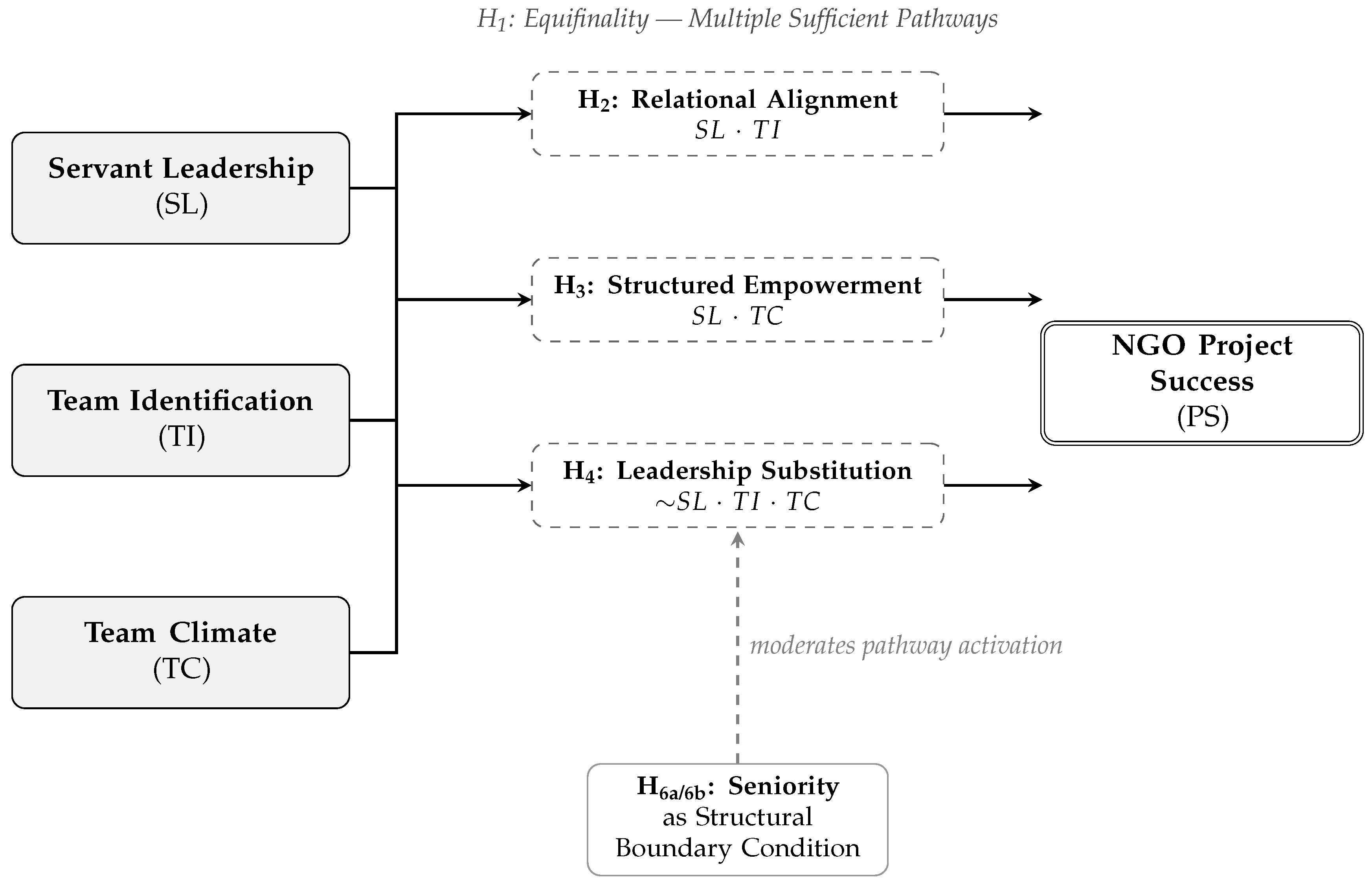
Equifinality—the principle that multiple distinct configurations can produce the same outcome—is particularly relevant to the present study (
Doty et al., 1993;
Ragin, 2008;
von Bertalanffy, 1950). In open systems, comparable end-states can be reached through different trajectories because adaptive pathways are available rather than a single deterministic route (
von Bertalanffy, 1950). Applied to NGO project success, equifinality implies that servant leadership, team identification, and team climate may combine in multiple sufficient ways to produce high performance, with no single combination necessarily dominant (
Greckhamer et al., 2018;
Kumar et al., 2022). This logic is invisible to regression, which identifies average relationships across the full sample, but cannot detect that different subsets of cases follow distinct causal recipes (
Fiss, 2011;
Ragin, 2008).
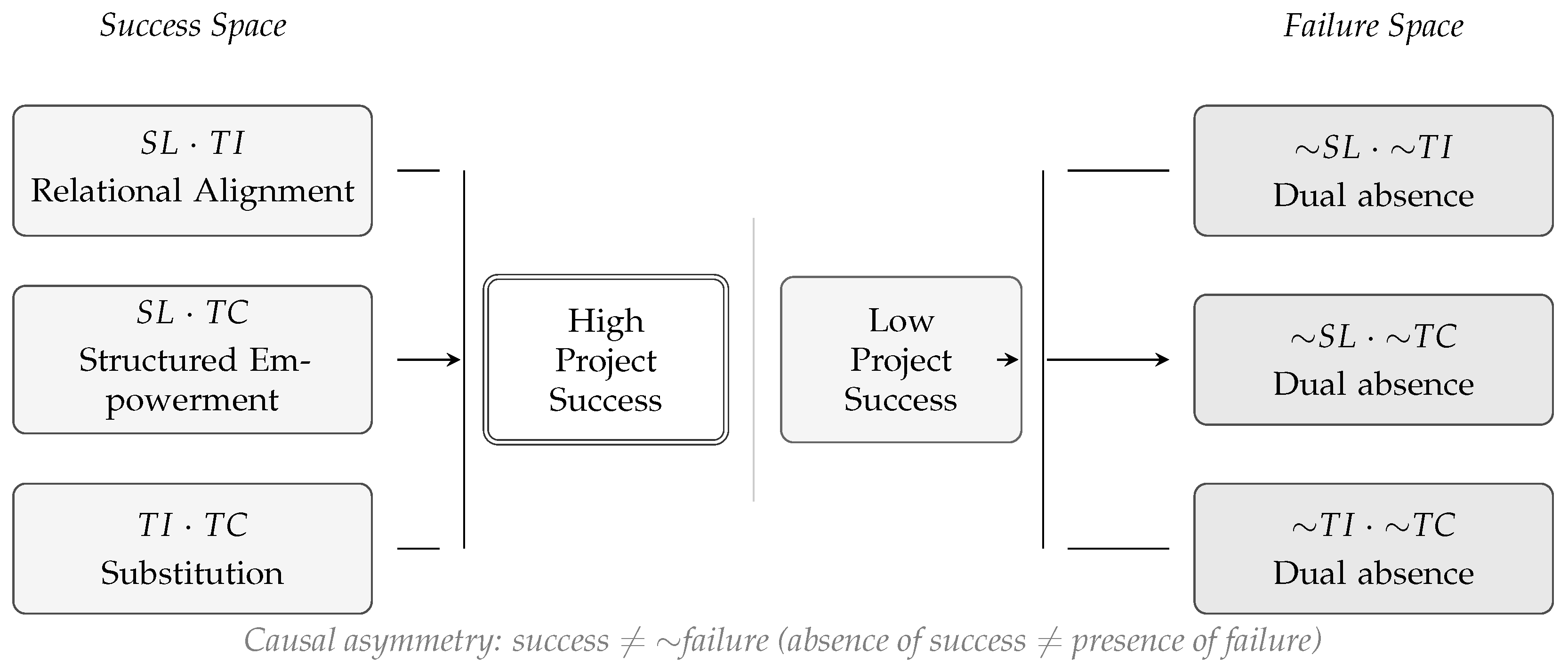
Causal asymmetry further distinguishes configurational from symmetric approaches: the conditions producing project success are not simply the mirror image of those producing failure (
Fiss, 2011;
Ragin, 2008). A configuration sufficient for high success does not, by logical necessity, produce low success when negated. This has direct implications for leadership research, where the absence of servant leadership does not automatically predict project failure if an alternative sufficient configurations exist (
Greckhamer et al., 2018). Fuzzy-set qualitative comparative analysis (fsQCA) is uniquely suited to detect these patterns because it operationalizes outcomes as sets, identifies both necessary and sufficient conditions, and returns multiple solutions terms representing distinct equifinal pathways (
Dul, 2016a;
Ragin, 2008). Unlike regression, fsQCA can reveal that team identification combined with team climate is sufficient for success without servant leadership—revealing a substitution pathway that symmetric methods would either miss or mischaracterize as a moderation effect (
Fiss, 2011;
Furnari et al., 2021).