1. Introduction
Digital transformation and Industry 4.0 paradigms are fundamentally reshaping the global manufacturing sector, driving firms to pursue operational excellence, flexibility, and sustainable competitiveness (
Kagermann et al., 2013;
Lasi et al., 2014;
Xu et al., 2018). This transformation encourages enterprises to progress along a development path extending from the foundational automation competencies of Industry 3.0 to the cyber-physical systems of Industry 4.0. While reaching the Industry 3.0 level enables automation and efficiency gains in repeatable tasks, steps toward Industry 4.0 promise more advanced outcomes such as data-driven decision-making, enhanced flexibility, and personalized production, albeit requiring multi-faceted strategic restructuring by firms (
Kane et al., 2015;
Matt et al., 2015).
This transformation imperative has become unavoidable for the manufacturing industry, particularly the metal processing sector, which holds a critical position in the Turkish economy. The metal processing sector directly supports economic growth through its R&D potential and inputs to other industries (
T.C. Cumhurbaşkanlığı Strateji ve Bütçe Başkanlığı, 2023). However, small and medium-sized enterprises (SMEs), which form the backbone of the sector, face significant disadvantages in this transformation process compared with large-scale firms. The literature recommends that SMEs first acquire foundational Industry 3.0 competencies rather than directly adopting Industry 4.0 technologies designed for large enterprises (
Wu et al., 2024). Here, Firm X’s objective is not to leap directly into Industry 4.0, but to build a solid production and information infrastructure at the Industry 3.0 level. Limited financial resources, skilled labor shortages, inadequate technological infrastructure, and especially uncertainty regarding return on investment emerge as the primary barriers preventing SMEs from transitioning to Industry 4.0 (
Horváth & Szabó, 2019;
Moeuf et al., 2018;
Muller et al., 2024;
Wu et al., 2024).
SMEs’ survival in global competition—through improved productivity, product quality, and more flexible production structures—depends on taking decisive steps in the digitalization process. Although next-generation automation systems, smart sensors, and data analytics technologies offer critical tools for achieving these goals, high initial costs (
Moeuf et al., 2018) and the inability to measure expected benefits (
Dalenogare et al., 2018) constitute significant obstacles for decision-makers. The literature also emphasizes uncertainties concerning the actual economic impacts of digital technology investments (
Ghobakhloo et al., 2022) and highlights the need for formal decision-support models, specifically for SMEs (
Raj et al., 2020;
Zangiacomi et al., 2020).
Despite the extensive literature on digital transformation and Industry 4.0, a specific decision-support gap persists for resource-constrained manufacturing SMEs in emerging economies. Digital maturity models (
Santos & Martinho, 2020;
Schumacher et al., 2016) provide descriptive diagnostics of a firm’s current position but offer no economic valuation, whereas cost–benefit analysis (
Boardman et al., 2018) assesses financial viability without systematically linking it to measured capability gaps. SME decision-makers therefore face a concrete scientific problem: how to translate a diagnosed maturity deficit into a sequenced, economically justifiable, and risk-bounded investment plan under demand uncertainty, exchange-rate volatility, and constrained internal capital. This question is particularly acute in the Turkish metal processing sector, where SMEs form the industry’s backbone yet exhibit maturity scores well below both sector and industrial-zone averages. The present study addresses this gap by integrating maturity assessment with phased cost–benefit appraisal in a reproducible, evidence-based framework grounded in real firm-level data.
Building on this framing, this work examines the digital transformation-oriented investment decisions of an SME operating in the Turkish metal processing sector (hereafter referred to as ‘Firm X’). A prior assessment (
Gül Özdamar et al., 2025) measured Firm X’s digital maturity level using the Boğaziçi University Digital Transformation Assessment Tool (D3A) (
Yildiz, 2021) and found that the firm’s overall maturity score (1.03) lagged considerably behind the sector’s average (1.49). While detailed examinations revealed relatively better performance in areas such as organizational structure and supply chain management, a critical weakness was identified in the production management dimension. The extremely low score of 0.42 obtained in this dimension—encompassing work orders, scheduling, and quality control processes—provides the rationale for directing investment priorities toward production processes.
To address these weaknesses and advance the firm’s digital maturity, a three-year phased transformation strategy is proposed in
Section 3. The proposed strategy presents an integrated investment portfolio that targets the firm’s weakest dimensions. The strategic focus is on strengthening the most critical weakness, the production management dimension (0.42). In the present work, an investment portfolio targeting these gaps was designed, and its economic justifiability was tested using the CBA method. The ultimate goal of this multi-layered approach is to elevate the firm’s current overall digital maturity score of 1.03 (Level 1–Level 2 transition band) to 2.00 (transition threshold/lower boundary of Level 3: use of system-analyzed data), while simultaneously achieving measurable improvements in critical performance indicators, such as production speed, defect rates, and occupational safety.
The primary objective of our analysis is to evaluate whether the proposed technology investment portfolio for Firm X is economically justifiable using CBA. CBA is a well-established analytical framework that methodically compares all expected tangible and intangible benefits of a project against its costs, enabling investment decisions to be rooted in rational, empirically grounded foundations (
Boardman et al., 2018). This analysis aims to provide a concrete response to the frequently noted requirement in the literature that technology investments must be examined from multiple angles, not merely from a cost perspective, but also encompassing expected benefits (
Dalenogare et al., 2018;
Frank et al., 2019).
Against this backdrop, this study makes four distinct contributions to the literature and practice of SME digital transformation. First, methodologically, it develops an integrated D3A–CBA framework that links quantitatively measured digital maturity gaps to investment prioritization and economic appraisal, transforming the decision from an abstract modernization impulse into an empirically grounded strategic choice. Second, it appraises a multi-component investment portfolio (production machinery, ERP, MES, CRM, infrastructure, and human resources) within a single CBA framework, incorporating both financial returns and measurable operational benefits such as production speed, defect reduction, workplace safety, and qualified product rate. Third, it grounds the model’s revenue parameters in 155 production orders recorded over 2021–2023 at a Turkish metal processing SME, anchoring demand estimates in observed operational data rather than theoretical capacity assumptions. Fourth, it embeds the investment in a phased, real-options-informed decision structure and quantifies downside exposure through Monte Carlo simulation (N = 10,000) and deterministic tornado analysis, enabling SME decision-makers to bound capital risk under emerging-market volatility. These contributions are further positioned relative to the existing literature in
Section 2.4.
The results indicate that the Phase-1 core package is economically viable under the base scenario (NPV TRY 3,830,738; IRR 12.4%), while the combined Phase-1 + Phase-2 portfolio reaches an NPV of TRY 17,365,066. However, Monte Carlo simulation reveals a 29.8–33.0% probability of negative NPV, and sensitivity analysis identifies demand-side shocks as the primary risk driver—a moderate revenue decline of −15% is sufficient to render the investment non-viable. These findings underscore the conditional nature of the investment decision and support the phased structure as a strategic risk-limiting mechanism.
The remainder of the paper is structured as follows:
Section 2 outlines the theoretical framework and reviews the relevant literature;
Section 3 presents the case design and transformation strategy;
Section 4 introduces the analytical framework and evaluation metrics;
Section 5 reports the findings together with sensitivity analyses;
Section 6 discusses the results in light of the literature;
Section 7 concludes the study and offers recommendations for future research.
2. Theoretical Framework and Literature Review
To conduct an economic evaluation of an all-encompassing technology investment portfolio targeting the digital transformation of an SME in the metal processing sector, key concepts, methodologies, and studies in relevant literature were examined. This section first outlines the general framework of digital transformation for SMEs and then addresses the strategic role of digital maturity assessment. Next, it examines the theoretical foundations of the CBA methodology and its applications in evaluating digital transformation technologies. This section concludes by identifying the existing gaps in the literature and specifying the original contributions of this paper.
2.1. Digital Transformation and Industry 4.0 in SMEs
Industry 4.0, also known as the Fourth Industrial Revolution, is fundamentally transforming manufacturing paradigms through the integration of technologies such as cyber-physical systems, the Internet of Things, cloud computing, and big data analytics (
Kagermann et al., 2013;
Lasi et al., 2014). Digital transformation refers to a broader process that encompasses not only the application of technology but also the strategic restructuring of business processes, organizational culture, and business models alongside these technologies (
Ulas, 2019;
Vial, 2019).
The manufacturing industry, one of the locomotive sectors of the Turkish economy, and its important subsector, metal processing, are directly affected by this global wave of digital transformation (
T.C. Cumhurbaşkanlığı Strateji ve Bütçe Başkanlığı, 2023). Maintaining the competitiveness of enterprises in the sector requires making strategic and rational investment decisions that enable progress in the digitalization journey of the enterprise. However, SMEs, which form the backbone of the sector, encounter challenges in the digital transformation process, including financial resource constraints, a shortage of qualified personnel, and insufficient technological knowledge (
Battistoni et al., 2023;
Ghobakhloo, 2018;
Müller et al., 2018;
Yildiz, 2021). Barriers, such as uncertainty about return on investment, delay SMEs in taking these strategic steps, thus increasing the need for rational decision-making tools to enable them to reach higher maturity levels.
With this in mind, clarifying the theoretical framework of the Industry 3.0 paradigm, which is the focus of the current study, is essential. Industry 3.0 refers to the third industrial revolution, defined by the integration of automation and information technologies, such as programmable logic controllers (PLCs), computer numerical control (CNC) systems, and enterprise resource planning (ERP) into production, which became widespread from the 1970s onward (
Kagermann et al., 2013). In this phase, production processes are largely automated, but data flows between machines and systems have not yet reached real-time, autonomous levels, which distinguishes it from Industry 4.0 (
Lasi et al., 2014). Given that the vast majority of Turkish metal processing SMEs still operate at the Industry 2.0 level (semi-mechanized, paper-based processes), the Industry 2.0-to-3.0 transition proposed in this study is positioned as a strategic intermediate target that is achievable, makes return on investment measurable, and lays the groundwork for the next digital maturity level (
Ghobakhloo et al., 2022;
Wu et al., 2024).
2.2. Digital Maturity Assessment in SMEs
SMEs must first accurately analyze their current status and develop a strategic transformation plan to successfully manage their digital transformation processes. Digital maturity models have emerged as strategic tools that assess enterprises’ levels of digitalization across different dimensions, helping them identify their current competencies, deficiencies, and areas for development (
Santos & Martinho, 2020;
Schumacher et al., 2016). Three established reference architectures dominate the field. The IMPULS Industrie 4.0 Readiness model (
Lichtblau et al., 2015) operationalizes digital readiness across six dimensions—strategy and organization, smart factory, smart operations, smart products, data-driven services, and employees—on a six-level scale and was among the first instruments specifically designed to benchmark manufacturing firms. The acatech Industrie 4.0 Maturity Index (
Schuh et al., 2017) extends this logic by mapping four structural areas (resources, information systems, organizational structure, and culture) onto a six-stage developmental path from computerization to adaptability, grounding the model in a capability-acquisition rather than a readiness-checklist logic.
Schumacher et al. (
2016) complement these with a nine-dimension model that explicitly incorporates strategic, leadership, and governance dimensions alongside technological ones, using a five-point Likert scale particularly suitable for self-assessment. A critical review of these and related instruments (
Mittal et al., 2018) nonetheless concludes that the dominant frameworks are calibrated to large-firm realities and tend to underweight the resource, skill, and financing constraints that define SME contexts, motivating the development of SME-specific and country-specific instruments. The D3A tool used in the present work sits within this latter stream: it shares the multi-dimensional diagnostic logic of the reference architectures above—assessing production management, organizational structure, supply chain, and customer management on a Likert-type scale—but has been calibrated specifically for Turkish SME contexts, incorporating local regulatory, infrastructural, and workforce characteristics that generic European models do not capture (
Yildiz, 2021). This theoretical grounding positions the D3A–CBA integration proposed here not as an alternative to established maturity frameworks but as an extension that links their diagnostic outputs to economic appraisal.
Studies conducted specifically in Turkey generally reveal that the level of digitalization is not at the desired level and that SMEs, in particular, need support in technology adoption and process integration (
Kasnak & Özkara, 2022;
Merdin et al., 2023;
Senna et al., 2023). These studies indicate that firms in various sectors are at the beginning of their digitalization journey and need concrete analyses to guide their investment decisions.
To address this concrete analytical need identified in the literature, the investment decision process in this research was initiated with a diagnostic step that quantitatively established the firm’s current status. As detailed in
Section 1, a prior assessment (
Gül Özdamar et al., 2025) revealed that Firm X exhibits a low overall maturity level and critical weaknesses in areas such as production management. As a result, maturity assessment served in this research not merely as a starting point, but as an evidence-supported strategic reference point determining which strategic areas the investment portfolio should focus on. This aligns with the literature, which emphasizes the importance of technology investments in serving a firm’s long-term digital transformation objectives (
Wagire et al., 2021).
2.3. Cost–Benefit Analysis: Methodology and Application Areas
CBA is a commonly used analytical framework in which all expected benefits and costs of a specific project, policy, or investment decision are methodically compared (
Boardman et al., 2018). The primary purpose of CBA is to guide decision-makers in directing scarce resources to the most efficient alternatives that maximize profitability (
Mishan & Quah, 2020). Financial performance metrics, such as Net Present Value (NPV), Internal Rate of Return (IRR), Payback Period (PP), and Benefit–Cost Ratio (BCR), are used to evaluate the economic desirability of an investment (
Brent, 2006;
Nas, 1996).
The methodological depth of CBA emerges from its effort to incorporate indirect or unmeasurable benefits and costs that lack market prices. Converting the impacts of an investment on qualitative factors such as customer satisfaction, brand image, or improved workplace safety into monetary values represents one of the most sophisticated aspects of analysis. Various approaches have been developed to carefully evaluate such qualitative effects and approximate them to monetary values (
Boardman et al., 2018). These approaches enrich the decision-making process by providing the opportunity to see not only the direct financial impacts of a project but also its broader strategic and social value.
In the manufacturing and technology domain, CBA studies have also been conducted on automation systems, energy efficiency projects, and digital infrastructure investments; the details of these applications are addressed in
Section 2.4.
However, applying CBA in developing and high-inflation economies presents distinct methodological challenges that the standard literature often underestimates. The selection of an appropriate discount rate becomes particularly consequential when nominal interest rates exceed 40–50%, as small variations in the real discount rate can fundamentally alter investment viability (
Boardman et al., 2018). Similarly, exchange rate volatility directly affects the present value of imported capital equipment, introducing an asymmetric risk channel that is largely absent in stable-currency contexts. The real prices approach—in which all cash flows are held constant at base-year purchasing power and discounted at a real rate—offers a methodological solution to these distortions (
Boardman et al., 2018;
Damodaran, 2024), yet its application to SME-scale digital transformation investments in emerging markets remains underexplored. These considerations shaped the analytical design adopted in
Section 4 of this investigation.
2.4. Evaluation of Digital Transformation Investments with CBA
CBA is vital for placing major capital expenditure decisions, such as digital transformation investments, on a rational foundation. The literature emphasizes that indirect benefits of such strategic investments, such as increased production flexibility, are difficult for traditional metrics to capture, and that detailed CBA frameworks are therefore needed (
Kaplan, 1986;
Matt et al., 2015;
Meng & Gong, 2024;
Teng et al., 2022).
In the literature, CBAs have been conducted for various technologies. For example, radio frequency identification (RFID) technology in hospitals (
Roper et al., 2015), RFID-based systems in automotive logistics (
Kang et al., 2018), blockchain technology for cybersecurity (
Gordon et al., 2020), and solar power plants in the energy sector (
Asad et al., 2022) have been evaluated using CBA. In the context of Industry 4.0, the analysis of automation and robotics investments is prominent.
Aktepe et al. (
2018) compared automated welding machine investment options in a manufacturing firm using a CBA. These studies draw attention to the fact that new technologies may also have non-financial costs and benefits (e.g., employee resistance to change).
The metal processing sector is one of the areas with high expected benefits from automation and digitalization. Next-generation digitally controlled machines used in core production processes, such as welding and cutting, offer significant benefits, including more precise parameter control, lower energy consumption, and higher welding quality (
Mahadevan et al., 2021;
Weman, 2003). Similarly, modern cutting systems optimize material utilization and reduce scrap rates (
Gül Özdamar et al., 2025). Despite the expected benefits of these technological advances, in-depth CBA studies on these technologies are limited. Existing studies generally either focus on a single technology or overlook the strategic benefits of investment by targeting only cost minimization, indicating a lack of a wide-ranging perspective.
Another increasingly prominent methodological approach for evaluating digital transformation investments is real options theory. Systematically framed by
Trigeorgis (
1996), this approach enables managers to financially evaluate the flexibility they possess under uncertainty—options to defer, incrementally expand, or abandon investments. Traditional Discounted Cash Flow (DCF) and CBA methods, built on static assumptions, cannot fully capture this strategic flexibility. The phased investment model applied in this study is informed by real options reasoning: the Phase-2 capacity expansion investment was conditioned on Phase-1 performance thresholds, thus structurally minimizing investment risk under uncertainty. Conceptually, this phased structure functions as a “call option” on the second phase: the firm pays the Phase-1 investment as the option premium, observes performance outcomes during the stabilization period, and retains the right—but not the obligation—to exercise the Phase-2 expansion. It should be noted that the present study adopts this real options reasoning as a strategic design principle for the phased CBA structure rather than applying formal Real Options Valuation (ROV) techniques such as Black–Scholes or binomial lattice pricing; the conditional NPV framework used here captures the go/no-go flexibility without requiring the stochastic process assumptions that formal ROV demands. This logic is particularly valuable for SMEs, where a single failed large-scale investment can threaten firm survival, whereas a phased approach limits the maximum capital at risk to the first tranche while preserving upside potential (
Trigeorgis, 1996). The approach is also consistent with the broader literature recommending real options frameworks for technology investment decisions in emerging markets, where macroeconomic volatility, demand uncertainty, and exchange rate fluctuations amplify the value of managerial flexibility (
Trigeorgis, 1996). Despite this theoretical alignment, empirical applications of real options reasoning to SME digital transformation investments remain scarce—a gap this paper addresses through the conditional Phase-2 mechanism detailed in
Section 3.4.
Viewed as a whole, the studies reviewed above reveal a consistent pattern: existing CBA applications in the technology domain tend to evaluate single, isolated investments—an RFID system in healthcare (
Roper et al., 2015), a sequencing-error-proofing mechanism in automotive logistics (
Kang et al., 2018), a solar power plant (
Asad et al., 2022), or a blockchain solution for cybersecurity (
Gordon et al., 2020). While these contributions are valuable within their respective domains, none addresses the challenge of appraising a multi-component, interdependent investment portfolio that simultaneously targets production equipment, enterprise information systems, and workforce development within a single CBA framework. Equally, the link between a firm’s quantitatively measured digital readiness and its investment prioritization has not been established in the CBA literature: existing studies either assume a predefined technology or evaluate post-implementation outcomes without grounding the investment rationale in a diagnostic maturity assessment.
Teng et al. (
2022) come closest by applying a cost–benefit lens to digital transformation in listed SMEs, yet their analysis remains at the aggregate performance level and does not incorporate firm-specific operational data or phased deployment logic. This synthesis reinforces the methodological space that this work occupies: an integrated D3A–CBA framework that (i) derives investment priorities from measured maturity gaps, (ii) evaluates a full-scope portfolio rather than a single technology, and (iii) manages capital risk through a phased structure informed by real options reasoning.
Building on this synthesis, the original contributions of this work can be specified along three dimensions. First, whereas existing CBA studies in the technology domain generally evaluate a single, isolated investment, this work appraises an integrated, multi-component investment portfolio (production machinery, ERP, MES, CRM, infrastructure, and human resources) within a single CBA framework, incorporating not only direct financial returns but also measurable operational benefits such as increased production speed, reduced defective production, improved workplace safety, and qualified product rate. Second, and methodologically most original, the study proposes an integrated D3A–CBA framework that directly links a firm’s quantitatively measured digital maturity gaps to investment prioritization and economic appraisal, thereby transforming the investment decision from an abstract modernization intention into an empirically informed strategic move targeting the weaknesses identified by maturity analysis. Third, rather than relying on theoretical capacity assumptions, the revenue parameters of the CBA model are derived from 155 production orders recorded over the 2021–2023 period at a Turkish metal processing SME, grounding the model’s input parameters in directly observed production constraints and structurally integrating demand uncertainty into the analysis.
3. Research Methodology and Case Study Design
This section details the study’s research design, case selection criteria, data collection processes, and applied economic evaluation approach. The research followed a unified single-case study design, as analyzing the financial and operational impacts of digital transformation investments requires examination of the firm’s unique dynamics and market conditions. In multilayered and complex processes such as digital transformation, in-depth case examinations provide a more appropriate foundation than quantitative methods for uncovering decision-making mechanisms, hidden costs, and indirect benefits. Here, the study adopts the ‘analytical generalization’ approach defined by
Yin (
2018), aiming to present the findings not as statistical representations but as a ‘decision-support model’ for other manufacturing SMEs facing similar technological and financial constraints.
3.1. Case Selection Rationale
Case selection followed a purposive sampling strategy designed to provide the richest data for the research questions (
Eisenhardt & Graebner, 2007). Firm X is a typical metal processing SME operating in a make-to-order production arrangement, conducting core processes such as sheet metal working, welding, and assembly in a single shift. The predominance of manual/semi-automatic equipment in the firm’s current production infrastructure and the low level of digital integration make it a highly representative case reflecting the technological transformation needs in the sector (
Yin, 2018).
In addition, the fact that the firm currently outsources a significant portion of its cutting activities is another critical factor that strengthens the case selection. This situation allows for the net isolation and measurement of efficiency gains and cost savings that will arise from bringing operations in-house following the technology investment.
3.2. Data Collection and Analysis Process
The study dataset was organized around the principle of data triangulation to ensure methodological reliability. The primary data source for the analysis consisted of financial statements, 155 production work orders, scrap/waste reports, and energy consumption logs from 2021 to 2024, reflecting the firm’s operational reality. These archival data were triangulated with three semi-structured interviews (each 60–90 min) conducted with the general manager, production supervisor, and accounting/finance manager of the firm during January–March 2024, and technical observations on the production floor. The interviews served to interpret numerical data, identify hidden cost items, and verify the alignment of CBA assumptions with the firm’s reality. Sector reports and prior assessment results documenting the firm’s digital maturity level (
Gül Özdamar et al., 2025) were used as supplementary data.
Table 1 summarizes the data sources, their analytical transformation in the CBA model, and validation roles.
Cost and pricing data were collected from January to June 2024. However, given Turkey’s high inflationary environment and macroeconomic volatility, all monetary values were revised in line with sectoral price increase expectations and exchange rate forecasts and indexed to the investment base year of 2026.
The data analysis process proceeded in two phases: in the first phase, field interview records and observation notes were rigorously examined to define the tangible and intangible benefit items that formed the basis of the CBA. In the second phase, the identified items were converted into numerical data based on the firm’s records.
The methodological validity of the research was confirmed through data triangulation (
Denzin, 2017), in which different data sources were cross-compared. Necessary institutional and ethical permissions for data use were obtained from the firm’s management. Ethical approval for this research was granted by the Scientific Research and Publication Ethics Committee of the National Defence University (decision no. E-35592990-050.01.04[050.01.04]-3249693, dated 5 February 2024). This process ensured that the CBA assumptions presented in
Section 4 were built on realistic, firm-specific parameters.
During the preparation of this manuscript, the authors used Claude (Anthropic, Claude 3.5 Sonnet) for language editing, formatting assistance, and figure generation from author-supplied data. The AI tool was not used for data analysis, interpretation, or determination of scientific conclusions. The authors have reviewed and edited all outputs and take full responsibility for the content of this publication.
3.3. Current State of Firm X
Firm X, the subject of the case analysis, is a medium-sized manufacturing enterprise that conducts sheet metal cutting, bending, welding, assembly, and surface treatment operations in the metal processing sector. Current production processes are predominantly carried out with manual labor and semi-automatic machinery, whereas the use of digital systems and data integration is quite limited. Firm management has recognized the importance of digital transformation for competitive sustainability; however, an extensive investment evaluation has not been conducted to date due to high investment costs and uncertainties regarding implementation risks. This paper responds to that evaluation need.
The firm’s current technological competency was measured using the Digital Transformation Assessment Tool (
Yildiz, 2021), with detailed findings reported in a prior study (
Gül Özdamar et al., 2025). The D3A findings served as a methodological starting point for determining the firm’s investment priorities in our analysis.
In the D3A model, maturity levels are scored on a 0–4 scale, where: Level 1 represents the pre-digital phase, where data are not collected at all or are kept entirely on paper; Level 2 represents the phase where data are manually digitized but not processed in an integrated system (
Yildiz, 2021). According to the analysis results, Firm X’s overall digital maturity score was 1.03 out of 4.00, placing the firm in the Level 1–Level 2 transition band.
The firm’s score falls noticeably below both the metal sector average (1.49) and the industrial zone average where the firm is located (1.26). Dimension-based examination revealed the deepest competency gap in Production Management, with a score of 0.42. This low score indicates structural vulnerabilities, such as a lack of automation on the production floor, absence of real-time traceability, and dependence of processes on operator initiative. Performance gaps below sector averages were also observed in the Customer Management (0.82) and Product Development (0.91) dimensions.
These findings reveal the rationale for directing investment priorities toward production infrastructure, as well as the logic for managing the process through a phased transition plan supported by enterprise systems.
3.4. Proposed Digital Transformation Strategy: Phased Investment Structure
The transformation strategy evaluated in this paper was designed as a three-year scenario encompassing two investment phases: (i) Phase-1 (Year 1): commissioning of core production equipment and enterprise information systems; and (ii) Phase-2 (Year 3, conditional): capacity expansion investment to be implemented if Phase-1 performance thresholds are met. Year 2 is dedicated to the stabilization of Phase-1 outputs and the accumulation of data necessary for the Phase-2 decision. This phased structure enables conditioning capital risk on measurable operational outputs and directly aligns with real options reasoning (
Trigeorgis, 1996). The transformation vision bridging the firm’s current state and targeted technological standards is summarized in
Table 2.
3.4.1. Phase-1 (Year 1): Core Production Equipment and Enterprise Information Systems
The focus of Phase-1 is deploying investments that directly target the gap in the production management dimension, which received the lowest score in the D3A analysis. The hardware components consist of a laser cutting machine aimed at insourcing cutting activities currently conducted through outsourcing and a robotic welding cell intended to improve cycle time and quality consistency in welding operations. These pieces of equipment were identified as a high-feasibility starting package under single-shift conditions.
Hardware investments are supported by enterprise system components. An ERP system (inventory, production, and sales modules) is deployed to ensure data integrity across the order–inventory–production–sales pipeline, and a lean MES infrastructure is established to collect data from the production floor and standardize downtime/production records. System usage training for operators and the definition of standard operating procedures are complementary components of this phase. The expected output of Phase-1 is to make production performance measurable and reportable and to establish a reliable data infrastructure that will form the basis for the Phase-2 decision.
3.4.2. Transition Period (Year 2): System Integration and Performance Monitoring
The purpose of Year 2 is to disseminate the automation and information system infrastructure established in Phase-1 throughout the organization and monitor its outputs. The full integration of ERP/MES usage in planning, inventory, and production flows, and the methodical management of customer and deadline management through the CRM module are the priorities of this period. Year 2 also functions as the assessment period in which the operational and financial data needed for the Phase-2 expansion decision accumulate.
3.4.3. Phase-2 (Year 3, Conditional): Capacity Expansion and Process Maturation
Year 3 has two parallel objectives: deploying the Phase-2 capacity expansion investment if Phase-1 outputs meet the thresholds defined in
Table 3 and institutionalizing the data-driven process improvement cycle. Within the scope of Phase-2, if demand growth is confirmed, additional robotic cells, MIG welding machines, and complementary equipment such as hydraulic guillotine shears will be added to the system. The fundamental aim is not merely physical capacity expansion but shifting the product mix toward higher value-added work through quality and delivery performance improvements.
The Phase-2 decision is linked to the phased decision rules defined in
Table 3 (
Trigeorgis, 1996). If the threshold values are not met, the expansion investment will be deferred, and the focus will be directed toward the efficiency optimization of the existing infrastructure.
The financial impacts of Phase-2 on the CBA model if the threshold values defined in the table are met are addressed in detail in
Section 4. Within the scope of process maturation—the second objective of Year 3—ERP and Lean MES data will be processed to classify downtime root causes and transition from a reactive maintenance approach to a planned/preventive maintenance discipline. Production planning processes will be supported by real-time inventory and order data-based reports, and scrap and rework costs will be deliberately monitored through quality records. Also, updating cybersecurity protocols and defining relevant organizational roles (data officer and system administrator) are planned.
The proposed strategy aims to manage capital risk through a phased investment structure conditional on measurable performance thresholds and establish a sustainable production infrastructure that meets Industry 3.0 standards after three years. Detailed cost breakdowns of the investment components and their parametric counterparts in the CBA model are presented in
Section 4.
4. Analytical Framework and Evaluation Methodology
This section presents the analytical framework of the CBA model structured to measure the multi-faceted impacts of digital transformation investments at the SME scale. The model is based on the theoretical framework established by
Boardman et al. (
2018) but adopts an incremental cash flow approach that considers only the marginal revenues and costs created by the new investment rather than incorporating the firm’s existing overhead expenses into the analysis. This section covers the core financial assumptions, the logic of converting qualitative data into quantitative benefit/cost items, and the sensitivity analysis framework.
4.1. General Structure of the Analytical Approach
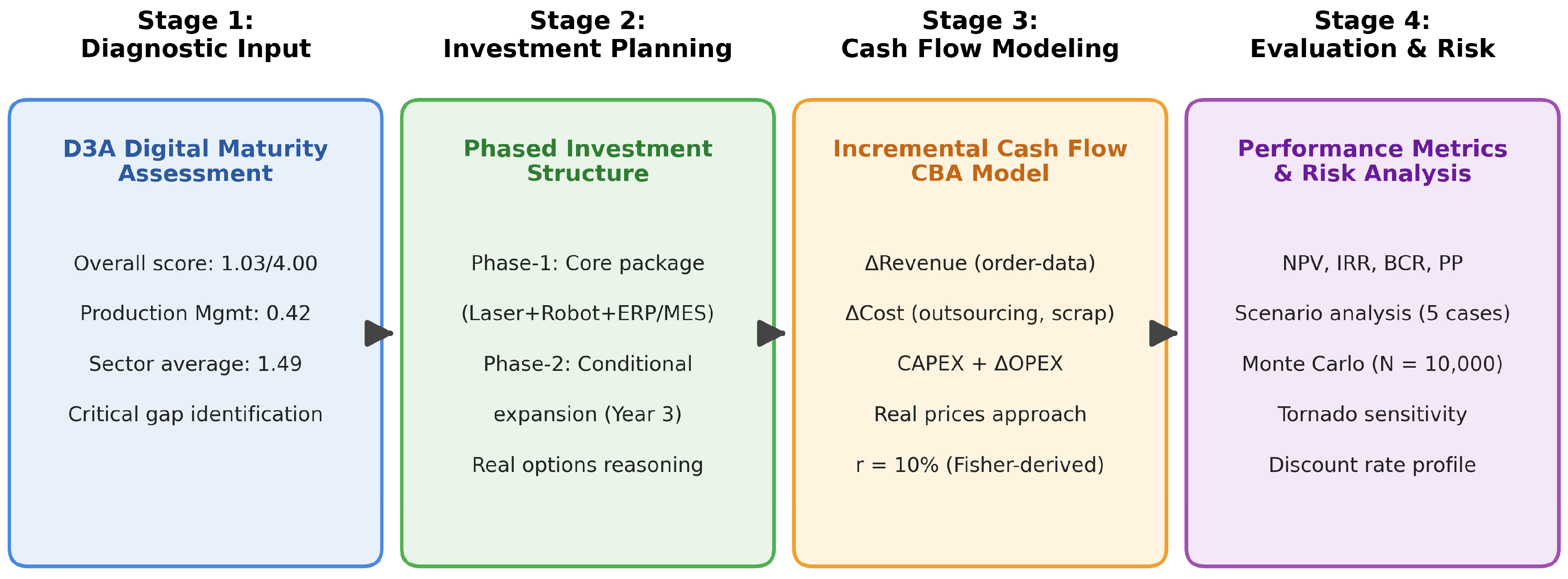
The analytical approach used in this study consisted of four stages. In the first stage, diagnostic data regarding the firm’s digital maturity level were obtained from (
Gül Özdamar et al., 2025;
Yildiz, 2021) and used as the model’s diagnostic inputs. In the second stage, these findings and field realities were synthesized to structure the phased investment plan targeting Industry 3.0 transition: (i) the Phase-1 core package with high feasibility under single-shift and existing financial constraints, and (ii) the Phase-2 capacity expansion option conditioned on Phase-1 performance to manage investment risk under demand uncertainty. In the third stage, the CAPEX (capital expenditure) and OPEX required by the investment packages and the benefits to be obtained were converted into cash flows based on incremental differences between the ‘no investment’ and ‘investment’ scenarios. In the fourth stage, NPV, IRR, PP, and BCR were calculated, and the robustness of model results was tested through scenario-based sensitivity and Monte Carlo analyses. The end-to-end analytical flow is summarized in
Figure 1.
4.2. Structuring Benefit and Cost Parameters
The CBA model addresses cash inflows and outflows that will occur throughout the project lifecycle in terms of CAPEX and OPEX. The cost structure consists of two components: the Phase-1 core package and the Phase-2 capacity expansion option, conditional on Phase-1 performance being confirmed.
On the CAPEX side, the core package includes a fiber laser cutting machine necessary to eliminate the production bottleneck, one robotic welding cell, and ERP/Lean MES installation constituting digital infrastructure, along with integration and training activities. The capacity expansion option encompasses supplementary equipment, such as additional robotic cells, a MIG welding machine, and a hydraulic guillotine shear, to be deployed if the conditions are met. On the OPEX side, only the incremental cost burden created by the new investment was modeled, rather than the total overhead of the factory. Accordingly, energy, maintenance, and license renewal fees were separated from the existing cost pool, and only the marginal consumption of new equipment was used as the basis. For personnel expenses, the net difference between the labor savings achieved through automation and the costs of skilled personnel integrated into the system was considered.
Benefit parameters were addressed along two axes, according to their impact on cash flows. Directly monetizable gains include cost savings from terminating outsourced operations, prevented costs arising from reductions in scrap and waste rates, and increases in capacity and sales revenue created by improvements in production speed. Improvements in workplace safety were incorporated into the model at a conservative lower bound based on the annual accident compensation expected value of the employer liability insurance policy. Qualitative benefits that are difficult to directly convert to cash, such as brand image and organizational learning, were not included in the financial model; qualitative assessment of these benefits is outside the scope of the current study. To prevent double-counting errors in labor productivity calculations, labor savings were accounted for in only a single channel, either as a cost reducer or a revenue increaser. The core benefits and cost items are summarized in
Table 4.
Derivation of Parameters from Qualitative Data Sources
To determine the benefit and cost items used in the CBA model, the field interview records and observation notes described in
Section 3.2 were methodically examined. During the coding process, the firm’s production bottlenecks, loss types, and expected gains were categorized, and these qualitative findings were converted into numerical parameters that constituted inputs for the CBA model. This approach ensured that the financial assumptions were drawing on the firm’s operational reality rather than theoretical estimates. The transformation logic is detailed in
Appendix A.
4.3. Financial Assumptions and Evaluation Criteria
The economic evaluation took place in accordance with literature-accepted standards using NPV, IRR, PP, and BCR metrics (
Boardman et al., 2018). The analysis followed a real prices approach purged of inflationary effects. All cash flows were held constant at 2026 base prices; no additional inflation increase was applied for revenue and cost items. A real discount rate of 10% was used to discount cash flows to present value. The derivation of this rate proceeded as follows: a nominal WACC of approximately 48% was first estimated based on
Damodaran (
2024) Turkey equity risk premium data, then converted to a real rate using the Fisher equation [(1 + r_real) = (1 + r_nominal)/(1 + π)]. With the 25% inflation assumption from Turkey’s 2026 Medium-Term Programme (OVP) and the CBRT Market Participants Survey, the Fisher-implied real rate is 18.4%. However, 10% was adopted rather than 18.4% for four reasons. First, Damodaran’s equity risk premium reflects the aggregate risk profile of publicly traded firms; SMEs with low leverage and no exposure to capital markets face a structurally different cost of capital, and applying the full market-derived premium to a single-project CBA overstates the hurdle rate (
Boardman et al., 2018). Second, the 25% inflation figure is a single-year (2026) projection; over the 10-year evaluation horizon, the OVP targets a gradual decline toward single-digit inflation, which would reduce the average real rate across the project life. Third, the CBA literature recommends private-sector project discount rates in the 8–12% range for investment appraisal (
Boardman et al., 2018;
Nas, 1996), and using 18.4% would effectively double-count macroeconomic risk already captured through the Monte Carlo simulation’s revenue and exchange rate multipliers. Fourth, the adopted rate of 10% provides a margin of safety of approximately 2.4 percentage points below the Phase-1 IRR of 12.4%; this buffer ensures that the ‘accept’ decision is not an artifact of calibrating the discount rate to the boundary of the project’s own return, a methodological concern emphasized by
Boardman et al. (
2018) for projects with narrow viability margins.
To test the sensitivity of this choice, Phase-1 NPV was recalculated across the full range between the adopted rate and the Fisher-implied rate. Results reveal a monotonically declining NPV profile: at r = 8%, NPV is TRY 7,497,084; at the adopted base rate of r = 10%, NPV is TRY 3,830,738 (base scenario); at r = 12%, NPV narrows to TRY 628,281; the break-even point is reached at the IRR of 12.4%, beyond which NPV turns negative; at r = 15%, NPV falls to TRY −3,458,229; and at r = 18%, NPV reaches TRY −6,849,258. The NPV gradient between r = 10% and r = 12% (approximately TRY 1.6 million per percentage point) is notably steeper than the gradient between r = 8% and r = 10% (approximately TRY 1.8 million per percentage point), indicating that the investment’s financial viability is increasingly sensitive to discount rate assumptions as the rate approaches the IRR threshold. This sensitivity profile confirms that the choice of discount rate is the single most consequential methodological decision in the analysis: the investment is viable for any rate below 12.4% and non-viable above it. The adopted rate of 10% places the project within the viable zone with a buffer that accommodates moderate upward revisions, while the Fisher-implied rate of 18.4% would reject the investment outright. This approach aims to measure the true value added by the investment in purchasing power terms by preventing illusory profit distortions that may arise in high inflation environments.
The project evaluation horizon was set at 10 years, aligned with the economic life of the technological equipment. The investment start year (T
0) was defined as 2026, taking into account the installation and commissioning schedule. Due to the learning curve effect during the installation phase, it was assumed that operational benefits would be realized at 75% capacity in the first year of operation (Year 1), reaching full capacity from the second year onward. Accordingly, Year 1 net operating income is adjusted by a 0.75 ramp-up factor reflecting this first-year capacity constraint; Years 2–10 are modeled at full incremental cash flow consistent with the real prices approach (
Boardman et al., 2018). To test the sensitivity of this assumption, the ramp-up factor was varied between 50% and 100%: Phase-1 NPV ranges from TRY 2,346,234 (at 50%) to TRY 5,315,242 (at 100%), remaining positive across the entire range. This confirms that the investment’s viability is robust to the ramp-up assumption and that the first-year capacity realization rate is not a critical risk driver. Core parameters and their bases are presented in
Table 5.
4.4. Sensitivity Analysis and Risk Assessment
Since CBA is based on forward-looking assumptions, deterministic scenario analyses and probabilistic Monte Carlo simulation were applied to test the model’s robustness under uncertainty (
Savvides, 1994).
In scenario analysis, the base scenario represents the expected cash flow effects from deploying the core investment package. To reflect demand and cost uncertainty, a demand contraction scenario (ΔRevenue −15%), a currency and energy-driven cost increase scenario (CAPEX/OPEX +20%), and a compound shock scenario where both shocks occur simultaneously were designed. The Phase-2 capacity expansion component was modeled to be activated upon confirmation of Phase-1 performance indicators, with its marginal contribution to NPV reported separately.
In the Monte Carlo simulation, four key uncertainty drivers were modeled with normal distributions: (i) ΔRevenue multiplier (μ = 1.00, σ = 0.20), reflecting the ±20% demand variability observed in the 2021–2023 order data; (ii) outsourcing savings multiplier (μ = 1.00, σ = 0.15), capturing price volatility in subcontracted laser cutting services; (iii) OPEX multiplier (μ = 1.00, σ = 0.12), representing energy tariff and maintenance cost fluctuations; and (iv) CAPEX multiplier (μ = 1.00, σ = 0.08), reflecting the comparatively lower uncertainty in equipment costs secured through supplier quotations. The choice of normal distribution is based on the assumption that the composite effect of many independent uncertainty factors will converge to normal according to the central limit theorem. The baseline simulation modeled all four variables as mutually independent. However, in emerging-market economies, macroeconomic contractions can simultaneously suppress demand and weaken the domestic currency, thereby raising import-denominated investment and energy costs. To quantify the impact of this co-movement on tail risk, a supplementary correlated simulation was conducted in which pairwise Pearson correlations of ρ = −0.40 were introduced between the ΔRevenue multiplier and each cost multiplier (CAPEX and OPEX), while the remaining variable pairs were kept independent. The compound shock scenario in
Section 5.3 further addresses this limitation by testing the joint effect of simultaneous adverse shocks under deterministic assumptions. Lower bounds were imposed to prevent physically meaningless values (ΔRevenue ≥ 0.30, outsourcing savings ≥ 0.30, OPEX multiplier ≥ 0.50, CAPEX multiplier ≥ 0.70). The N = 10,000 iteration simulation was used to quantitatively assess the probabilistic distribution of NPV, the probability of negative NPV, and which variables most significantly affect the model.
5. Findings and Analysis
This section presents the economic results of the investment portfolio using the CBA model defined in
Section 4. Findings are organized along three axes: (i) identifying the benefit and cost drivers constituting the incremental cash flow, (ii) reporting base scenario performance indicators for the Phase-1 core package and Phase-2 conditional expansion components, and (iii) testing robustness under uncertainty through scenario and sensitivity analyses.
5.1. CBA Inputs: Operational Gains and Cost Projections
In the CBA model, economic impact was defined as the incremental difference between the current state and the transformation scenario. Cash flows consist of three components: (i) incremental contribution margin from increases in sales revenue (and product mix effects in Phase-2), (ii) savings items such as reduction in outsourcing costs and decreases in scrap, waste, and rework losses, and (iii) incremental operating expenses such as software licenses, maintenance, energy, and net personnel changes. Double-counting risk was monitored as explained in the methodology section (
Section 4.2).
5.1.1. Operational Performance Gains
With the deployment of the Phase-1 core investment (laser cutting machine, robotic welding cell, ERP, and Lean MES), insourcing of cutting activities, improvement in cycle time and quality consistency, and making processes traceable are expected. These gains were monetized in the model through ΔRevenue and ΔCost items. Targeted performance indicators and their CBA counterparts are presented in
Table 6.
Table 7.
Phase-1 Incremental Operating Expenses—2026 Base Price.
Table 7.
Phase-1 Incremental Operating Expenses—2026 Base Price.
| Cost Item | Calculation Detail | Annual Amount (2026 TRY) |
|---|
| Energy | 30.2 kW installed power (laser + robot) × 2080 h × TRY 5.84/kWh | TRY 366,845 |
| Maintenance | 1.65% of total machinery investment (incl. spare parts) | TRY 378,021 |
| Software | Annual 12% of ERP and MES license fees (SaaS) | TRY 441,200 |
| IT Infrastructure | Cloud backup (USD 285/month) + server electricity (0.8 kW × 24 h/day × 365 days); TRY 43.64/USD | TRY 190,176 |
| HR | 3 key personnel × TRY 8500 net × 1.45 gross-up factor × 12 months | TRY 443,700 |
| Consumables | Laser lens/nozzle + robot gas + barcode materials (avg. USD 350/month); TRY 43.64/USD | TRY 183,288 |
| Insurance | 0.60% of total asset value (machinery breakdown + cyber risk) | TRY 208,920 |
| TOTAL—Annual ΔOPEX (Phase-1, 2026 base price) | TRY 2,212,150 |
5.1.2. Cost Projections
The cost structure was addressed in two components: Initial Investment Cost (CAPEX) incurred at T
0 and Annual Operating Expenses (OPEX) continuing throughout the project life. As shown in
Table 7 above, the investment-linked incremental annual operating expense (ΔOPEX) calculated for the base year (2026) is TRY 2,212,150.
5.1.3. Incremental Revenue and Contribution Margin Logic
On the revenue side, the investment impact was defined as ΔRevenue = (transformation scenario sales − base sales). The contribution of this incremental revenue to cash flows was calculated not over revenue growth but over the incremental contribution margin remaining after variable costs accompanying the sales increase are deducted. The variable cost ratio (47%), derived from firm records for the 2021–2023 period, reflects the ratio of raw materials, direct labor, energy, and consumable costs to total sales revenue.
The product mix effect was modeled as a Phase-2 revenue parameter rather than a Phase-1 component, reflecting the operational reality that the full quality-driven price premium requires the complete robotic production capability deployed in Phase-2 (three robotic welding cells). Under Phase-1, the single robotic cell and laser cutting machine initiate improvements in dimensional accuracy and weld consistency; however, the ability to systematically offer products in the ‘certified/precision’ class—and command the associated price premium—depends on eliminating manual welding variability across the entire production line, which is achieved only with Phase-2’s full robotization. Accordingly, the quality-driven price premium (TRY 4,200,000 per annum, corresponding to approximately an 8–10% price increase on the expanded qualified order volume) enters the CBA model exclusively through Phase-2 benefits. This design choice has a direct implication for risk assessment: Phase-1 NPV (TRY 3,830,738) is entirely independent of the mix effect assumption, meaning the Phase-1 accept/reject decision is robust to any revision of this parameter. The mix effect influences only the combined Phase-1 + Phase-2 portfolio NPV: if the quality premium is eliminated entirely (0%), the combined portfolio NPV falls from TRY 17,365,066 to TRY −1,152,860, turning negative; at half the assumed premium (4%), the combined NPV is TRY 8,106,103. This sensitivity confirms that the quality premium is a critical value driver for the Phase-2 expansion decision but does not affect the standalone viability of the Phase-1 core package. The cumulative NPV impact of all revenue parameters is reflected in the base scenario results presented in
Table 8.
5.2. Base Scenario Results: Phase-1 and Phase-2 Comparison
Under the base scenario, NPV, IRR, discounted PP, and BCR were calculated for the Phase-1 core package. Phase-2 was modeled as the expansion component to be activated at T
2 conditional on Phase-1 performance thresholds being met, and total portfolio performance was additionally reported in
Table 8. The contribution of Phase-2 to the portfolio was also monitored as marginal impact (ΔNPV).
5.3. Sensitivity and Scenario Analysis
The model’s robustness under uncertainty was tested by applying shocks to the ΔRevenue component on the revenue side and the CAPEX and ΔOPEX components on the cost/exchange rate side. In the base scenario, Phase-1 NPV was calculated as TRY 3,830,738 and BCR as 1.11.
In the demand shock scenario (ΔRevenue −15%), NPV falls to TRY −2,508,096 and turns negative; this finding reveals that revenue-side risk is the most critical vulnerability of the investment. Exchange rate and cost shocks were tested through two separate channels: while NPV remains positive at TRY 1,212,750 in the operations channel (OPEX +20%) where TRY depreciation is reflected in ΔOPEX, NPV falls to TRY −3,133,253 in the investment channel (CAPEX +20%) where it is reflected in EUR-denominated equipment costs. This asymmetry demonstrates that exchange rate risk is much higher at the investment stage compared with the operational stage. In the compound shock scenario where both shocks occur simultaneously with a demand decline, NPV reaches TRY −12,090,075.
These results reveal an asymmetric risk profile: moderate adverse shocks on the revenue side (−15%) turn the investment negative, while resilience against exchange rate shocks through the operations channel is relatively high. Phase-2’s conditional structure limits total downside portfolio risk as it necessitates not proceeding to the second phase under negative scenarios (
Table 9).
Probabilistic Risk Analysis (Monte Carlo)
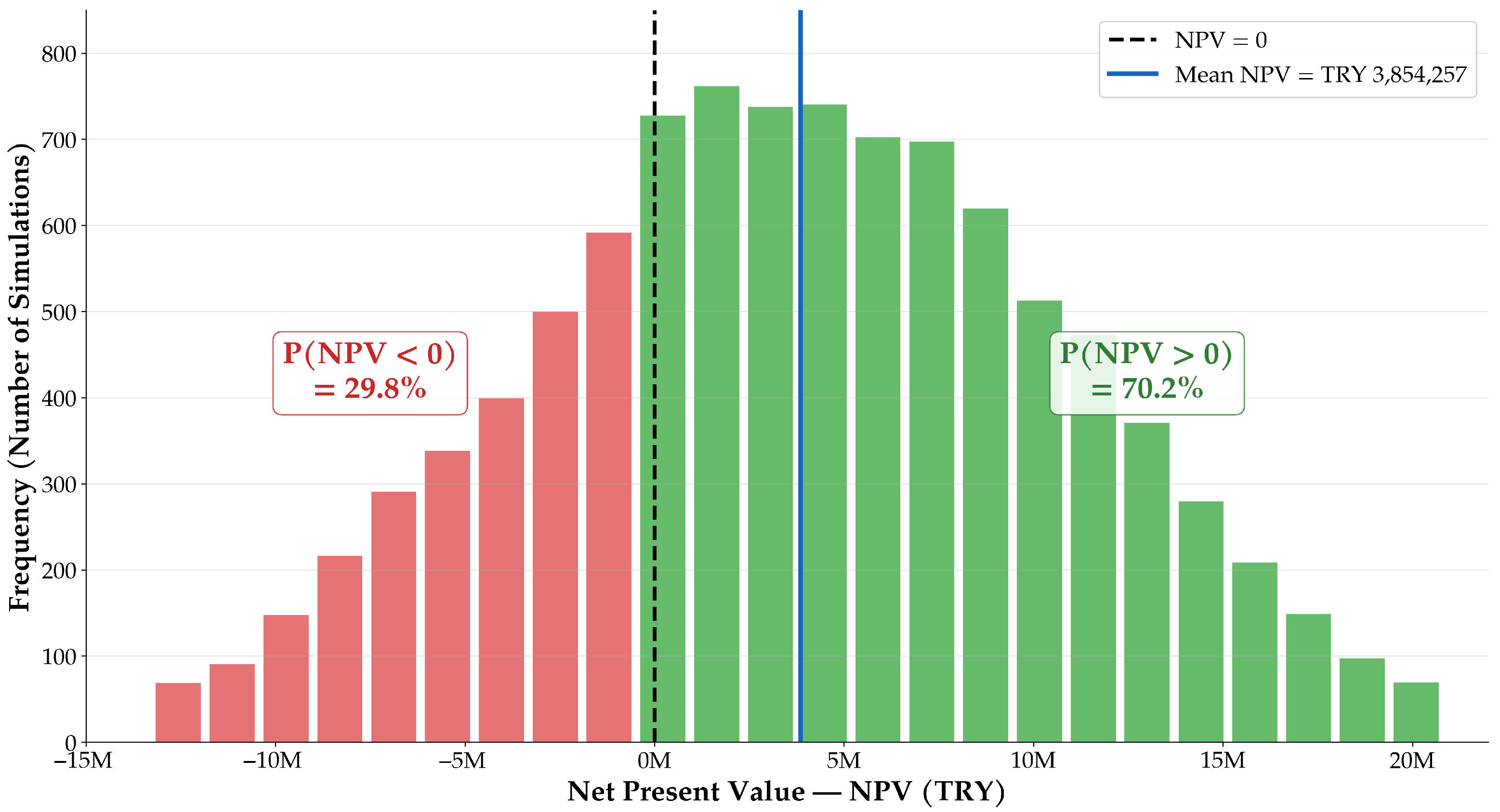
In addition to deterministic scenarios, Monte Carlo simulation was applied to assess the probabilistic distribution of NPV. Four key uncertainty sources (ΔRevenue multiplier, outsourcing savings multiplier, OPEX multiplier, and CAPEX multiplier) were modeled with normal distributions, with distribution parameters selected consistently with the ranges covered by base and shock scenarios. Results of the N = 10,000 iteration simulation are as follows: mean NPV TRY 3,854,257, median NPV TRY 3,824,076, with standard deviation at TRY 7,388,058. The 5th percentile (P5) of the distribution corresponds to TRY −8,262,496 and the 95th percentile (P95) to TRY 15,861,480. NPV turned negative in 29.8% of the simulations. The probability distribution of NPV is presented in
Figure 2.
To assess the impact of inter-variable dependence on tail risk, a supplementary correlated simulation was conducted (N = 10,000). Pairwise Pearson correlations of ρ = −0.40 were introduced between the ΔRevenue multiplier and each cost multiplier (CAPEX and OPEX), reflecting the empirically plausible co-movement in emerging markets where macroeconomic contractions simultaneously suppress demand and elevate import-denominated costs. Under this correlated structure, mean NPV remains essentially unchanged at TRY 3,836,405—as expected, since correlation affects dispersion rather than central tendency—but the standard deviation increases from TRY 7,388,058 to TRY 8,723,091, a 19.0% widening of the risk envelope. The probability of negative NPV rises from 29.8% to 33.0%, and the 5th percentile (P5) worsens from TRY −8,262,496 to TRY −10,513,251, indicating materially heavier left-tail risk. This supplementary analysis confirms that the baseline independence assumption moderately understates downside exposure; the 3.0-percentage-point increase in P (NPV < 0) quantifies the cost of ignoring macro-level co-movement and reinforces the importance of the phased investment structure as the primary risk-limiting mechanism.
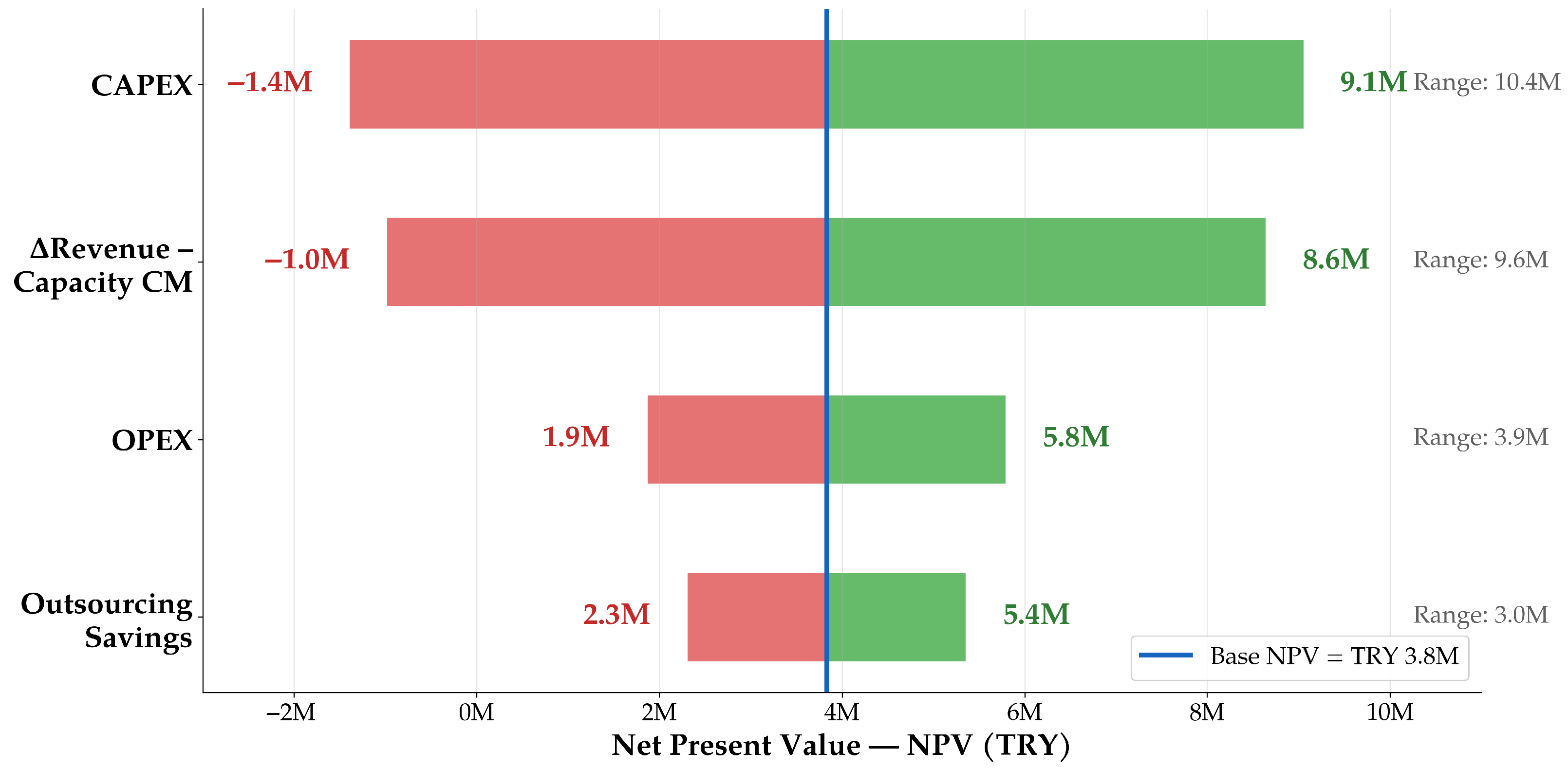
A deterministic tornado analysis was additionally applied to identify which variables most significantly affect the model. As shown in
Figure 3, tornado analysis demonstrates that the CAPEX component creates the widest sensitivity range on NPV (variation range: TRY 10,446,000), followed by ΔRevenue—capacity contribution margin (TRY 9,628,000). However, scenario analysis reveals that only a moderate demand shock (−15%) can turn NPV negative; this finding demonstrates that the revenue side continues to be the most critical component in terms of downside risk. This probabilistic risk profile reinforces the rationale for structuring Phase-2 as a conditional option; the rule of not proceeding to the second phase without Phase-1 performance being confirmed serves as the key mechanism limiting downside risk at the portfolio level.
5.4. Strategic Target Achievements: Digital Maturity Improvement
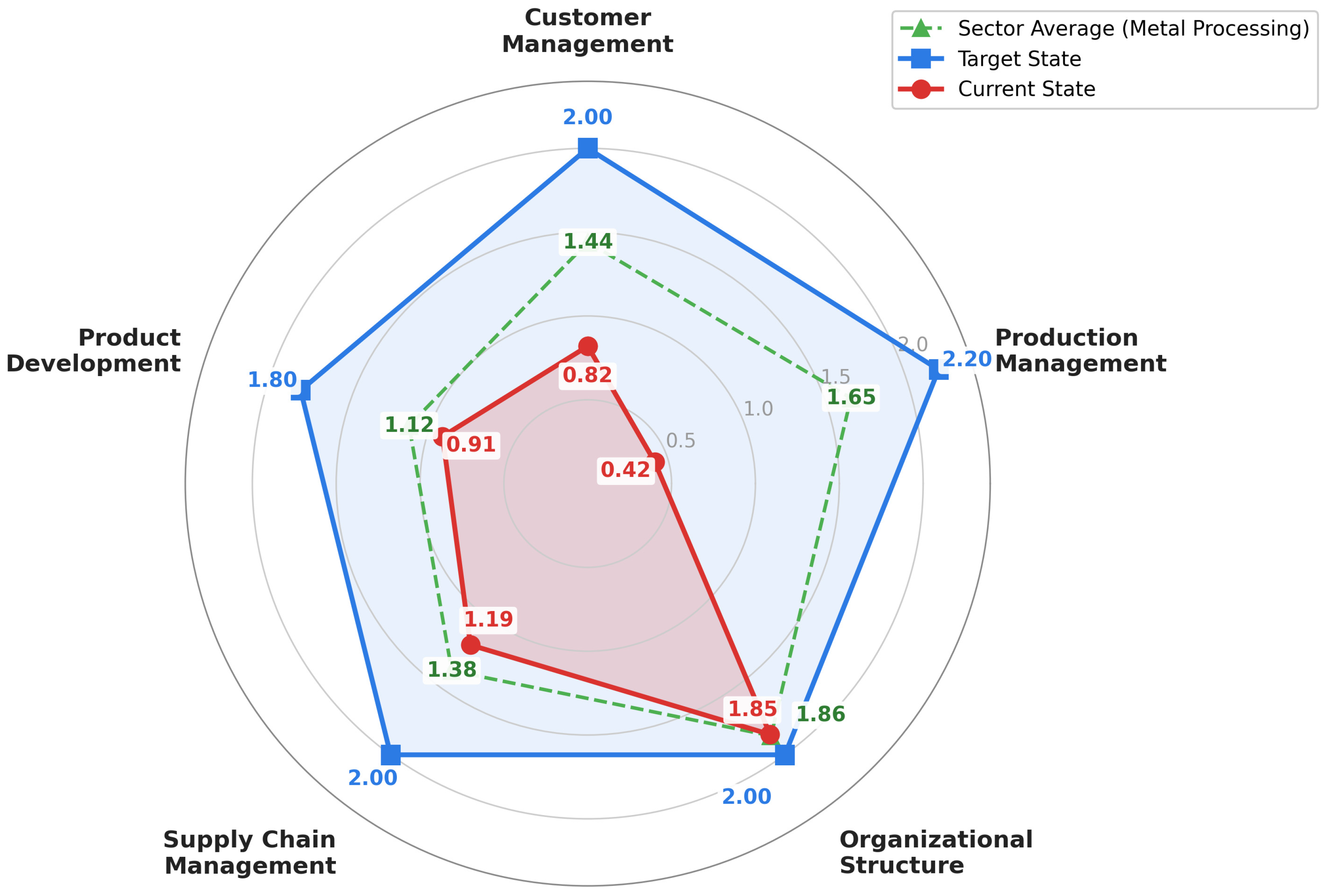
As a complement to the financial evaluation, the investment portfolio contributes to elevating the firm’s digital maturity level by reducing the competency gaps identified in the D3A diagnosis. The current maturity scores used as the baseline (shown in
Figure 4) were obtained from the firm’s prior D3A diagnostic assessment reported in
Gül Özdamar et al. (
2025). Target scores for each D3A dimension were derived by mapping the specific investment components to the D3A sub-dimension items they address, using the tool’s 0–4 Likert scale definitions as the scoring anchor (
Yildiz, 2021). In the D3A framework, Level 2 (score 2.00) represents the phase where data are digitized and processed in an integrated system, and Level 3 (score 3.00) represents system-analyzed, real-time data usage. Since the proposed investment portfolio deploys ERP, Lean MES, and CRM—systems that digitize, integrate, and enable reporting of production, inventory, and customer data—the natural target ceiling is the Level 2–3 boundary (score 2.00), which corresponds to the lower threshold of ‘use of system-analyzed data.’
The dimension-level target scores were determined as follows (visualized in
Figure 4). In Production Management (0.42 → 2.20), the largest projected gain reflects the direct impact of the core investment components: the laser cutting machine and robotic welding cell automate the two primary production processes, while Lean MES enables real-time data collection from the production floor, standardized work order tracking, and automated downtime/quality reporting—capabilities that correspond to D3A Level 2–3 criteria for this dimension. The target of 2.20 (exceeding the 2.00 general average target) is necessary because the other dimensions start from higher baselines and thus require smaller gains; for the weighted average to reach 2.00, Production Management must overperform proportionally. In Customer Management (0.82 → 2.00), the CRM module centralizes customer data, order history, and delivery tracking—shifting from personal-relationship-based management to system-supported processes. In Supply Chain Management (1.19 → 2.00), ERP inventory and procurement modules provide integrated stock visibility and supplier management, addressing the sub-dimension items related to procurement planning and logistics coordination. In Product Development (0.91 → 1.80), the target is set conservatively below 2.00 because the investment portfolio does not include dedicated CAD/CAM or R&D infrastructure; the improvement reflects indirect gains from data availability and production feedback loops rather than direct technology deployment. In Organizational Structure (1.85 → 2.00), the modest increment reflects the dimension’s already relatively high baseline; the planned definition of data officer and system administrator roles (
Section 3.4.3) addresses the remaining sub-dimension gaps. The expected outcome of this broad-ranging approach is elevating the overall digital maturity score from 1.03 to 2.00 (Level 3 threshold).
It should be noted that these target scores represent expert-assessed projections based on the alignment between the planned investments and the D3A sub-dimension definitions, not empirically measured post-implementation outcomes. Actual maturity gains will depend on the depth of system adoption, workforce adaptation, and process standardization achieved during the three-year transformation period. A post-implementation D3A re-assessment is recommended to validate these projections and calibrate Phase-2 decision criteria accordingly.
6. Discussion
This study examined the wide-ranging technology investment portfolio targeting the transition of an SME operating in the metal processing sector from Industry 2.0 to Industry 3.0 level, using Cost–Benefit Analysis (CBA). The findings indicate that the investment decision is based on a delicate balance between financial return and strategic imperatives.
The research findings support the core studies in the literature arguing that technological investments provide productivity gains (
Brynjolfsson, 1993;
Porter & Heppelmann, 2014) by demonstrating the positive impact of digital transformation on operational performance. Notably, the projected capacity utilization increase of 25% would elevate Firm X from a constrained single-shift operation (averaging 103–124% capacity utilization rate in peak periods, indicating recurrent overload) to a balanced production regime, addressing a bottleneck that the 2021–2023 order data documents as a recurring constraint. The targeted 53% reduction in defect rate (from 7.0% to 3.29%) would bring the firm closer to international metal processing benchmarks, where CNC and robotic welding-equipped facilities typically achieve defect rates below 3% (
Mahadevan et al., 2021;
Weman, 2003). Similarly, the 62.5% improvement in workplace accident rate (from 0.8% to 0.3%) represents a substantial advancement in occupational safety, moving toward the Industry 3.0 standard of sensor-monitored, guarded production environments. Beyond this, while Firm X’s current digital maturity score (1.03) falls significantly below the sector average (1.49) and the organized industrial zone average (1.26), the proposed investment portfolio is designed to elevate this score to 2.00—surpassing the sector benchmark and positioning the firm at the threshold of data-driven process management. However, the financial results of the study offer a nuanced contribution to the Productivity Paradox debates raised by
Solow (
1987) from the perspective of high-inflationary economies: while the positive IRR (12.4%) in the base scenario partially refutes the paradox, the vulnerabilities revealed by sensitivity analysis—particularly the rapid turn to negative NPV with moderate demand-side shocks—expose the extent to which financial return is conditional.
In sensitivity analysis, Phase-1 NPV falls to TRY −2,508,096 under the demand shock (−15%) scenario and turns negative; it remains positive at TRY 1,212,750 in the operations-channel exchange rate shock (OPEX +20%) scenario, while turning negative at TRY −3,133,253 in the investment-channel exchange rate shock (CAPEX +20%) scenario. The discount rate sensitivity profile reveals a narrow but clearly delineated viability band: NPV is TRY 7,497,084 at r = 8%, TRY 3,830,738 at the adopted base rate of r = 10%, and TRY 628,281 at r = 12%, crossing zero at the IRR of 12.4% and falling to TRY −3,458,229 at r = 15% and TRY −6,849,258 at r = 18%. Notably, the NPV gradient steepens as the rate approaches the IRR threshold (approximately TRY 1.6 million per percentage point between r = 10% and r = 12%), meaning that even moderate upward revisions to the discount rate assumption rapidly erode the project’s value margin. The adopted rate of 10% places the project within the viable zone with a 2.4-percentage-point buffer below the IRR; however, if the Fisher-implied rate (18.4%) is deemed more representative, the investment would be firmly rejected. This highlights that the discount rate is not merely a technical parameter but the pivotal methodological choice in the analysis—a finding of particular relevance for emerging-market CBA applications where the gap between market-implied and project-appropriate rates can exceed 8 percentage points. Monte Carlo simulation (N = 10,000) estimates the probability of negative NPV at 29.8% under the baseline independence assumption; when macro-level co-movement is introduced through pairwise correlations of ρ = −0.40 between the revenue and cost multipliers, this probability rises to 33.0%, confirming that the independence assumption moderately understates downside exposure but does not fundamentally alter the risk profile. In the deterministic tornado analysis, the CAPEX variation range (TRY 10.4 million) amounts to the widest band, while the ΔRevenue component ranks second (TRY 9.6 million); however, scenario analysis demonstrates that only a moderate demand shock (−15%) can turn NPV negative—cost shocks require much larger deviations to reach this threshold. This asymmetric risk profile reveals the central importance of demand-side management for the financial success of the investment. This finding aligns with the thesis by
Boardman et al. (
2018) on the pressure of forward-looking uncertainties on discount rates, and demonstrates that in emerging market economies, digital transformation is not a guaranteed return investment but a conditional financial preference that must be managed.
The most critical managerial output of the study for practitioners is that the investment decision is less a technical necessity and more a preference tied to the firm’s risk perception and growth strategy. In the current environment, the cash flow security offered by risk-free return instruments creates an opportunity cost pressure on technology investments. For firms prioritizing short-term liquidity and financial stability, the negative NPV values that emerge in demand contraction and investment-channel exchange rate shock scenarios provide a rational justification for deferring the investment. In contrast, for growth-oriented firms targeting increased market share, measurable gains in operational efficiency and the combined portfolio NPV reaching TRY 17.4 million in the base scenario render financial risks tolerable. From this perspective, the investment can be evaluated as a strategic capacity lever that would strengthen the firm’s long-term competitiveness.
Although the empirical setting is a Turkish metal processing SME, the structural conditions that shape the investment decision—high inflation, currency volatility, constrained access to capital, and a workforce transitioning from manual to digital competencies—are by no means unique to Turkey. Manufacturing SMEs in Latin America, Eastern Europe, and Southeast Asia face analogous macroeconomic pressures and resource limitations. The integrated D3A–CBA framework and the phased, conditional investment structure proposed here can therefore serve as a transferable decision-support template for emerging-market contexts, provided that the discount rate, exchange rate, and benefit parameters are re-calibrated to local conditions.
Operationalising this transferability requires explicit guidance on how the model’s parameters should be adapted to other emerging-market contexts. The real discount rate should be re-derived through the Fisher equation using the host country’s nominal cost of capital and inflation expectations; in lower-inflation economies (e.g., Poland, Mexico, Vietnam), this typically yields a real rate in the 6–9% range, which would compress the IRR–hurdle-rate gap and tighten the project’s viability margin. Exchange-rate exposure should be re-parameterized according to the share of imported equipment in CAPEX and the currency denomination of any export revenues; for firms with a higher import dependency than Firm X, the asymmetry between the investment-channel and operations-channel shocks would be amplified. Benefit parameters—particularly the incremental contribution margin per unit of additional capacity, scrap-rate reduction, and OHS gains—should be re-estimated from the host firm’s own historical data rather than transposed from the present case, since these values are sector- and firm-specific. The Monte Carlo input distributions for revenue and cost multipliers should likewise be re-calibrated to reflect the volatility profile of the local macroeconomic environment, with broader distributions warranted in higher-volatility settings.
Beyond geographical transfer, the framework is also adaptable across manufacturing sub-sectors that share the structural profile of the present case—capital-intensive equipment, batch or order-driven production, and a maturity gap concentrated in production management. Plausible adaptation domains include plastics injection molding, food and beverage processing, packaging, and textile and apparel manufacturing, all of which constitute substantial SME segments in emerging economies. Sector-specific adjustments would primarily affect three components: (i) the maturity-assessment dimensions, where the D3A’s production-management sub-criteria may need to be refined to reflect process-specific KPIs (e.g., changeover time in injection molding, traceability requirements in food processing); (ii) the benefit catalog, which should incorporate sector-relevant items such as energy intensity per unit of output for energy-heavy processes or shelf-life extension for perishable goods; and (iii) the Phase-2 trigger thresholds, which should be calibrated to sector-typical capacity-utilization and quality benchmarks rather than transposed directly from the metal-processing case. With these adjustments, the underlying logic of the D3A–CBA framework—diagnose, prioritize, phase, and quantify risk—remains applicable, supporting its use as a generalizable decision-support template for resource-constrained SMEs across both regional and sectoral contexts.
6.1. Strategic Flexibility and Organizational Implications
Beyond its financial dimensions, the phased investment structure functions as a strategic flexibility mechanism that shapes organizational transformation. The Phase-1/Phase-2 conditional design operates as what
Trigeorgis (
1996) conceptualizes as a call option: the firm commits limited capital to the first tranche, observes operational and market outcomes during the stabilization period, and retains the right—but not the obligation—to exercise the expansion. This structure has three strategic implications that extend beyond conventional investment appraisal. First, it enables organizational learning: the two-year stabilization period between phases allows the workforce to develop digital competencies (ERP/MES operation, data-driven planning) before the system is scaled, reducing the implementation risk that frequently undermines SME digitalization efforts (
Battistoni et al., 2023;
Ghobakhloo et al., 2022). Second, the D3A–CBA linkage transforms the investment decision from an intuitive modernization impulse into an evidence-based strategic prioritization process; by grounding investment choices in quantitatively measured maturity gaps, the framework disciplines resource allocation toward the dimensions with the highest operational leverage—in this case, production management (D3A score: 0.42). Third, the conditional Phase-2 trigger rules (capacity utilization > 80%, scrap rate < 2%, sustained order growth) institutionalize a data-driven decision culture that persists beyond the initial investment cycle, contributing to the firm’s long-term strategic capabilities.
6.2. Sustainability Implications
The proposed investment portfolio carries sustainability implications that align with the United Nations Sustainable Development Goals, particularly SDG 9 (Industry, Innovation and Infrastructure) and SDG 12 (Responsible Consumption and Production). The targeted 53% reduction in defective production rate (from 7.0% to 3.29%) directly reduces material waste and rework-related energy consumption, contributing to resource efficiency in manufacturing. Machine-level energy monitoring—enabled by the Lean MES infrastructure—provides the data foundation for systematic energy optimization, moving the firm from unmonitored invoice-based energy management to sub-meter tracking. The 62.5% improvement in workplace accident rate (from 0.8% to 0.3%) advances the social sustainability dimension by transitioning toward sensor-monitored, guarded production environments that reduce occupational health risks. Furthermore, the insourcing of laser cutting operations eliminates transportation-related emissions associated with outsourced logistics. While these sustainability outcomes were conservatively monetized in the CBA (OHS gains at the employer liability insurance lower bound; energy savings as incremental consumption only), their broader strategic value extends beyond the financial model: they position the firm to meet increasingly stringent environmental and safety standards required by European export markets and global supply chain compliance frameworks. For SMEs operating in emerging economies, integrating sustainability outcomes into digital transformation investment decisions—as the D3A–CBA framework enables—can thus serve both as a competitive differentiator and a risk mitigation strategy against tightening regulatory requirements.
7. Conclusions
This study evaluated the economic viability of a phased digital transformation investment portfolio for a Turkish metal processing SME using an integrated D3A–CBA framework. The Phase-1 core package yields a positive NPV (TRY 3,830,738) and an IRR of 12.4% under the base scenario (r = 10%), while the combined Phase-1 + Phase-2 portfolio achieves an NPV of TRY 17,365,066. However, the investment’s financial viability operates within a narrow margin: Monte Carlo simulation estimates a 29.8–33.0% probability of negative NPV, and a moderate demand shock (−15%) is sufficient to render Phase-1 non-viable. The discount rate sensitivity analysis reveals that NPV turns negative above the IRR threshold of 12.4%, confirming the pivotal role of this methodological choice in high-inflation CBA applications.
The primary limitations include (i) limited statistical generalizability due to the single-case design; (ii) revenue projections based on forward-looking demand forecasts; (iii) sensitivity of the investment decision to the discount rate assumption; and (iv) findings denominated in TRY, requiring re-parameterization for other economic contexts.
Four avenues for future research emerge from these limitations and from the structural features of the present design. First, a cross-sectoral comparative study applying the D3A–CBA framework in parallel to SMEs in plastics, textiles, food processing, and packaging would test whether the observed risk asymmetry (demand-side dominance over cost-side) is a general property of resource-constrained SME digitalization or a feature specific to metal processing; such a design would also allow sector-level calibration of Phase-2 trigger thresholds. Second, a cross-country replication across multiple emerging economies—selected to span contrasting inflation regimes and currency volatility profiles—would empirically identify the macroeconomic boundary conditions under which phased investment structures deliver the largest risk-adjusted value; this would strengthen external validity beyond the single-country setting of the present study. Third, a methodological extension could integrate dynamic simulation approaches (system dynamics or discrete-event simulation) and, where data permit, digital-twin architectures, to endogenize the feedback between operational throughput, capacity utilization, and demand response rather than treating revenue trajectories as exogenous inputs; this would produce richer Phase-2 decision rules that adapt to realized operational performance in closer to real time. Fourth, a longitudinal ex-post validation study, tracking the actual financial and operational outcomes of firms that adopted the framework against pre-commitment projections over a five- to ten-year horizon, would provide direct evidence on the predictive accuracy of D3A–CBA-based investment decisions and on the practical reliability of the Phase-2 trigger rules. Pursued in combination, these lines of inquiry would move the framework from a validated single-case proof-of-concept toward a general decision-support methodology for SME digital transformation in emerging economies.
For SME managers and policymakers, the study yields several actionable strategic lessons. First, digital transformation investments should be structured in phases with explicit, data-driven go/no-go decision rules rather than committed as single large-scale deployments; in the present case, the Phase-2 trigger is operationalized as the simultaneous achievement of capacity utilization above 80%, scrap rate below 2%, and sustained order growth observed over the two-year stabilization window. This rule limits maximum capital at risk to the first tranche while preserving upside potential. Second, a formal digital maturity assessment (such as the D3A) should precede any investment decision so that resources target the dimensions with the highest operational leverage rather than following generic technology adoption trends; for Firm X, the production management score of 0.42 directly determined the prioritization of the Lean MES and CNC-laser cutting components over peripheral systems. Third, the asymmetric risk profile revealed by the sensitivity analysis—where demand-side shocks pose a greater threat than cost-side shocks—implies that SME managers should prioritize demand validation and order pipeline diversification as prerequisites for committing to capacity expansion. Practical instruments for this validation include framework agreements or letters of intent from key customers covering at least the Phase-1 incremental capacity, sectoral order-book benchmarking against firms of comparable size, and stress-testing of the customer concentration ratio prior to Phase-2 commitment. Fourth, policymakers designing SME digitalization support programs should consider matching grant structures that align with phased investment logic, releasing public co-funding in tranches conditional on demonstrated operational milestones (for example, verified maturity-score uplift, achieved capacity-utilization thresholds, or audited defect-rate reductions) rather than upfront technology procurement. Finally, the D3A–CBA framework itself can serve as a replicable decision tool: SME managers can apply the methodology by conducting a maturity assessment, mapping gaps to investment components, and subjecting the resulting portfolio to scenario and sensitivity analysis before committing capital.
To translate these lessons into an operational sequence, the D3A–CBA framework can be implemented in five steps. (1) Diagnostic baseline: Complete a D3A (or equivalent) maturity assessment, identify the weakest dimension, and benchmark against sector and industrial-zone averages. (2) Portfolio design: Map each maturity gap to a discrete investment component (machinery, ERP/MES/CRM, infrastructure, workforce training) and estimate CAPEX, OPEX, and incremental revenue parameters from the firm’s own historical order and cost records rather than from generic vendor projections. (3) Phased structuring: Separate the portfolio into an initial core tranche (Phase-1) and a conditional expansion tranche (Phase-2), with an explicit two-year stabilization period between them for organizational learning. (4) Risk quantification: Subject the model to scenario analysis (demand contraction, CAPEX/OPEX shocks, compound shocks), Monte Carlo simulation with at least 10,000 iterations, and tornado analysis to identify the dominant risk drivers; document the probability of negative NPV explicitly. (5) Conditional execution: Define quantitative Phase-2 trigger thresholds before Phase-1 commissioning (e.g., capacity utilization, scrap rate, order growth), monitor them through the integrated MES/ERP system established in Phase-1, and make the Phase-2 commitment only when all thresholds are simultaneously met. This sequence converts the abstract principle of “phased, evidence-based digital transformation” into a reproducible procedure that SME managers and policy advisors can apply across firms and contexts.
Taken together, these findings yield differentiated implications for four stakeholder groups. For SME managers and practitioners, the study provides a replicable five-step procedure for appraising digital transformation investments under resource and demand constraints, with explicit thresholds (Phase-2 trigger metrics, acceptance margins relative to the IRR) that translate strategic intent into executable decisions. For industry associations and chambers of commerce, the diagnostic–appraisal linkage demonstrated here can support cluster-level benchmarking initiatives, enabling member firms to position their maturity scores and investment plans against sector averages rather than assessing them in isolation. For policymakers, the phased investment logic argues for milestone-linked funding instruments over upfront grant disbursement, aligning public support with measurable operational outcomes and reducing the moral-hazard risk associated with one-shot subsidies; it further signals the value of co-financing mechanisms that explicitly account for the asymmetric exposure of SMEs to exchange-rate shocks on imported capital goods. For the research community, the D3A–CBA integration opens several extension pathways, most immediately cross-sectoral replication studies (to test transferability across manufacturing sub-sectors), dynamic simulation-based appraisals (to endogenize operational throughput and demand feedback), and longitudinal validation of phased-investment outcomes against pre-commitment projections.