1. Introduction
Manufacturing and service activities are governed by fundamentally different operational logics. The manufacturing process is typically associated with tangible outputs, standardized processes, efficiency, scalability, and cost optimization (
Cardoso et al., 2024). Service delivery, by contrast, emphasizes intangible value (
Dafiq & Solihat, 2023), customization, and customer-centricity, requiring adaptability and responsiveness. In recent years, these previously distinct sectorial logics have converged as manufacturing companies adopt servitization strategies, reflecting the transformation in which manufacturers combine physical goods and service-based offerings in order to be competitive on the market (
Alp et al., 2024;
Gomes et al., 2021). This shift, often termed digital servitization, constitutes a convergence whereby manufacturers leverage advanced technologies to simultaneously generate value from both physical goods and intangible service offerings (
Minaya et al., 2024;
Shen et al., 2023).
As a result of this transition, dual-sector companies have emerged as a prominent organizational form in the contemporary economy (
Abraheem, 2023), moving beyond purely product-oriented operations and evolving into the hybrid enterprises that offer more comprehensive solutions (
Abuaddous et al., 2018), Although this transition increases customer value and competitiveness it also introduces the organizational complexity. Companies that continue to rely exclusively on single product offerings face growing difficulties in sustaining profitability under intensifying competitive pressures, emergence of new market actors and digitalization (
Gebauer et al., 2020;
Minaya et al., 2024;
Nansubuga & Kowalkowski, 2024). Understanding how organizational performance is shaped under these conditions has become increasingly important in the study of hybrid business models and complex service ecosystems (
Pelli, 2023).
Despite growing interest in servitization and hybrid organizational forms, the literature still provides limited empirical evidence on which internal organizational capabilities and contextual conditions are most strongly associated with performance in firms operating simultaneously under manufacturing and service logics. Existing studies typically focus either on the strategic rationale for servitization or on the structural tensions it generates, but they less often examine, within a single empirical model, how selected internal capabilities and contextual conditions are associated with organizational performance in dual-sector firms. This leaves an important gap in understanding which factors matter most for performance in organizational settings defined by the simultaneous coexistence of heterogeneous operational logics.
The present study focuses on five determinants because they capture two analytically distinct but complementary dimensions of performance in dual-sector firms. Organizational culture, organizational commitment, and knowledge management are conceptualized as internal integrative capabilities that help align employees, routines, and knowledge across manufacturing and service activities. Environmental uncertainty and employee retention are included as contextual and workforce continuity conditions that may constrain, stabilize, or shape the effectiveness of those internal capabilities. Taken together, these variables provide a focused framework for examining performance in organizations required to coordinate heterogeneous operational logics within a single firm. These determinants were selected not as an exhaustive list of performance drivers, but as a theoretically focused set of variables that capture both internal integrative capabilities and contextual conditions relevant to dual-sector firms.
The theoretical gap addressed in this study lies in explaining performance in dual-sector firms not through internal capabilities or contextual conditions alone, but through their combined consideration in organizations that must reconcile manufacturing and service logics within the same organizational setting. The resource-based view explains organizational performance through internal resources and capabilities that are valuable, difficult to imitate, and strategically deployable, whereas contingency theory explains performance through the fit between those internal arrangements and the contextual conditions in which firms operate. According to this view, organizational culture, organizational commitment, and knowledge management can function as strategic internal capabilities, as they support coordination, integration, and execution across heterogeneous activities. Contingency theory complements this perspective by explaining why the performance implications of those capabilities cannot be assumed to be uniform, but instead depend on contextual conditions such as environmental uncertainty and company size. In this way, dual-sector firms represent a setting in which performance depends both on capability development and on contextual fit.
The transition from product-centric to service-oriented business models creates inherent organizational tensions, as manufacturers must simultaneously reconcile the efficiency-driven logic of traditional production with the relational and customization-focused demands of service provision (
Dmitrijeva et al., 2021;
Visnjic et al., 2021). This dichotomy often manifests as organizational ambivalence, where the dominant product-oriented mindset contests the emerging service-oriented paradigm across strategic, structural, and cultural dimensions (
Palo et al., 2019). From a paradox perspective, these logics are not temporary trade-offs but persistent, interdependent demands that must be managed over time, creating enduring tensions around resource allocation, coordination, identity, and performance measurement (
Berti & Simpson, 2019;
Saadallah et al., 2025). From an ambidexterity perspective, dual-sector companies must concurrently exploit existing operational routines while exploring and scaling service-oriented solutions, which increases internal complexity and makes performance contingent on integrative capabilities (
Matusek, 2023;
Kafetzopoulos et al., 2023). Accordingly, performance in dual-sector companies depends less on the presence of individual “best-practice” factors and more on the organization’s ability to integrate and balance competing work systems and objectives within a single firm.
Against this background, the present study examines how selected internal capabilities and contextual conditions are associated with perceived organizational performance in dual-sector companies. Specifically, it investigates the effects of organizational culture, organizational commitment, knowledge management, environmental uncertainty, and employee retention, while also exploring whether these relationships vary according to company size. Empirically, the study draws on survey data collected from 433 employees working in 23 dual-sector companies in the Republic of Serbia. The hypotheses are tested using confirmatory factor analysis and covariance-based structural equation modeling, while hierarchical regression is employed as a supplementary procedure to assess moderation by company size.
This article advances research on servitization and hybrid organizations by conceptualizing dual-sector companies as organizational settings in which performance depends on mechanisms that help reconcile competing manufacturing and service logics. It empirically examines organizational culture, commitment, knowledge management, environmental uncertainty, and retention within the same performance model, providing a more focused explanation of performance in hybrid firms. By examining company size as a contingency factor, it also clarifies whether these relationships vary across organizational contexts, thereby refining resource-based arguments through boundary conditions emphasized in contingency theory.
The next section develops the theoretical framework and hypotheses. This is followed by the
Section 3, which describes the research context and the sample, data collection procedure, measures and analytical strategy. The
Section 4 then presents the measurement and structural model findings. Finally, the
Section 5 and
Section 6 interpret the results, outline theoretical and practical implications, and identify limitations and directions for future research.
2. Theoretical Framework and Hypothesis Development
In dual-sector companies, the central theoretical issue is not simply whether organizational resources are valuable, but whether they are configured in ways that enable coordination across manufacturing and service logics under varying contextual conditions. Unlike single-sector firms, which can align structures and routines around one dominant mode of value creation, dual-sector firms must integrate standardized production processes with relational, adaptive, and customer-facing service processes. Accordingly, the hypotheses developed below are grounded in the view that culture, commitment, and knowledge management function as resources that help reconcile these competing demands, while contextual factors determine how effectively such resources translate into performance. Although these determinants are theoretically connected in the organizational reality of dual-sector firms, the present study does not model them as sequential or causally interdependent mechanisms. Rather, they are specified as parallel determinants within the same empirical framework in order to assess their relative explanatory importance for perceived organizational performance under competing manufacturing and service logics. This modeling choice reflects the analytical purpose of the study, which is not to estimate a full process model of organizational integration, but to identify which internal capabilities and contextual conditions are most strongly associated with performance in dual-sector companies.
2.1. Organizational Culture and Organizational Performance
Drawing upon the resource-based view (RBV), organizational culture is conceptualized as an intangible, inimitable internal resource that generates performance benefits by aligning employee behaviors with strategic objectives, thereby facilitating the achievement of optimal performance (
Setiawan et al., 2025). Specifically, within the context of dual-sector companies, a positive organizational culture is theorized to foster superior performance by acting as a valuable, rare, and imperfectly imitable asset that provides a sustainable competitive advantage (
Samad et al., 2018). In dual-sector companies, organizational culture matters because it provides shared values, coordination routines, and behavioral expectations that help employees navigate the competing demands of manufacturing efficiency and service responsiveness, a relationship supported by extensive literature indicating that strong, congruent cultures significantly influence organizational effectiveness and long-term success (
Flemming, 2016;
Pereira et al., 2021). Empirical evidence suggests that positive cultural norms enhance internal communication, coordination, and innovation, contributing to a cohesive and motivated workforce capable of sustaining performance in complex organizational environments (
Samad et al., 2018;
Setiawan et al., 2025). In hybrid organizational forms, culture becomes a unifying mechanism that helps reconcile divergent operational logics across sectors. Furthermore, cultural dimensions such as involvement, consistency, adaptability, and mission have been shown to positively influence organizational performance across diverse organizational settings (
Ding & Keh, 2017;
Genç, 2013).
H1. Dimensions of organizational culture have a positive and significant effect on the organizational performance of dual-sector companies.
H1a. Involvement has a positive and significant effect on the organizational performance of dual-sector companies.
H1b. Consistency has a positive and significant effect on the organizational performance of dual-sector companies.
H1c. Adaptability has a positive and significant effect on the organizational performance of dual-sector companies.
H1d. Mission has a positive and significant effect on the organizational performance of dual-sector companies.
2.2. Organizational Commitment and Organizational Performance
Organizational commitment, defined as the psychological attachment of employees to their organization, has been widely recognized as a key driver of organizational performance across both manufacturing and service industries (
Gold et al., 2001;
Gyurák Babeľová et al., 2020). It reflects an individual’s acceptance of organizational goals and values, willingness to exert effort on behalf of the organization, and desire to maintain organizational membership (
Hur et al., 2019). Drawing on social exchange theory, organizational commitment is conceptualized as a reciprocal response to perceived organizational support, whereby committed employees respond through heightened dedication, discretionary effort, and sustained engagement, ultimately enhancing organizational performance (
Melkamu, 2023). When employees experience strong value alignment and psychological attachment, they are more likely to demonstrate resilience, role alignment, and proactive behavior in pursuit of organizational objectives (
Muhammad & Abdullah, 2016;
Asfiah et al., 2025). This proposition is grounded in the understanding that employees who exhibit strong engagement, loyalty, and identification with their organization are more likely to channel their efforts toward achieving collective organizational goals (
Aliddin et al., 2024;
Hapsari et al., 2025). In dual-sector companies, organizational commitment is theoretically important not only because committed employees are more motivated, but because commitment can function as an integrative mechanism under conditions of role plurality and operational tension. Employees in such firms are often required to navigate competing expectations associated with efficiency, standardization, responsiveness, and customer interaction. Commitment can reduce the friction created by these competing demands by strengthening willingness to cooperate across functional boundaries, accept role ambiguity, and sustain effort in situations where manufacturing and service priorities are not fully aligned. In this sense, commitment supports performance by helping employees remain psychologically attached to the organization while engaging in the coordination work required by hybrid value creation. In dual-sector companies, where operational complexity and role ambiguity may be heightened, committed employees are essential for sustaining performance across both manufacturing and service activities. Empirical evidence suggests that higher levels of organizational commitment are associated with improved productivity, reduced turnover, and enhanced organizational effectiveness (
Moreno-Menéndez et al., 2025).
H2. Organizational commitment has a positive and significant effect on the organizational performance of dual-sector companies.
2.3. Knowledge Management and Organizational Performance
Knowledge management encompasses the processes through which organizations create, store, share, and apply knowledge to achieve strategic objectives (
Elgargouh et al., 2024). Drawing on the resource-based view and the knowledge-based view of the firm, this study conceptualizes knowledge management as a strategic capability that supports coordination, innovation, and sustained competitive advantage. The resource-based view explains why knowledge-related capabilities can be valuable, difficult to imitate, and performance-relevant, whereas the knowledge-based view clarifies the specific mechanism through which that value is realized, namely through the integration, transfer, and application of distributed knowledge across organizational domains (
Alharbi & Aloud, 2024;
Cui, 2025;
Wu & Hu, 2012).
Knowledge management is particularly salient in dual-sector companies because these firms must combine heterogeneous forms of knowledge generated in different parts of the organization. Performance depends not only on possessing technical production knowledge or customer-facing service knowledge in isolation, but on the organization’s ability to connect these knowledge bases in ways that improve coordination, learning, problem solving, and innovation. In this sense, knowledge management serves as a distinctive integrative mechanism in dual-sector firms by facilitating the synthesis of knowledge streams that single-sector firms do not need to combine to the same extent. Prior research also indicates that robust knowledge management practices enhance innovation capability, decision-making quality, operational efficiency, customer satisfaction, and service agility, thereby strengthening organizational performance (
Alamsjah & Asrol, 2023;
Coffie et al., 2023;
Cui, 2025).
H3. Knowledge management has a positive and significant effect on the organizational performance of dual-sector companies.
2.4. Environmental Uncertainty and Organizational Performance
Environmental uncertainty, characterized by the volatility and unpredictability of external factors such as market fluctuations, technological innovations, and political changes, presents significant challenges for companies operating across dual sectors (
Ozmutlu & Can, 2022). Drawing on contingency theory, organizational effectiveness depends on the alignment between internal structures, strategic responses, and external environmental conditions. In dual-sector companies, uncertainty is particularly problematic because it simultaneously disrupts manufacturing-oriented routines (e.g., planning, standardization, supply reliability) and service-oriented activities (e.g., responsiveness, customer co-production), thereby amplifying coordination costs and increasing the difficulty of balancing competing logics. Under heightened turbulence, managers may be forced to reallocate resources frequently, revise priorities, and respond to shifting customer demands and technological change, which can undermine operational stability and reduce performance outcomes (
Aprisma, 2020;
Ozmutlu & Can, 2022). Empirical research also suggests that perceived environmental uncertainty is often associated with weaker performance when firms face constraints in information processing, strategic consistency, and implementation capacity, especially in complex organizational settings (
Khan, 2021;
Khandwalla, 1972). Therefore, in dual-sector companies—where the need for integration across manufacturing and service units is high—greater environmental uncertainty is expected to reduce organizational performance.
H4. Environmental uncertainty has a significant negative effect on the organizational performance of dual-sector companies.
2.5. Employee Retention and Organizational Performance
Employee retention underscores the strategic importance of retaining skilled and experienced employees to minimize turnover costs and preserve valuable organizational knowledge. Drawing on human capital theory, employee retention is conceptualized as a mechanism through which companies sustain company-specific skills, institutional knowledge, and social capital that enhance operational efficiency and long-term organizational performance (
Alsakarneh et al., 2023). Retaining highly skilled employees enables organizations to maintain continuity, reduce recruitment and training costs, and strengthen competitive positioning (
Tajuddin et al., 2024). This hypothesis is grounded in empirical evidence indicating that stable workforces facilitate the accumulation of company-specific skills and social capital, which are essential drivers of productivity and financial success (
Kurdi et al., 2020;
Maalouf et al., 2023). This relationship is particularly salient in dual-sector companies, where performance depends on the integration of manufacturing expertise and service-oriented competencies. Stable workforces facilitate the accumulation of company-specific human capital and relational knowledge that are essential for coordinating complex operational processes across sectors. Building on concepts of job embeddedness and social capital, employee retention functions as a strategic intervention that stabilizes the workforce, strengthens internal relationships, and supports sustained organizational capability (
Das & Banerjee, 2025;
Devi & Reddy, 2025).
Empirical research consistently demonstrates that higher employee retention rates are associated with improved productivity, enhanced organizational stability, and superior performance outcomes (
Kurdi et al., 2020;
Maalouf et al., 2023;
Kowalkowski et al., 2017).
H5. Employee retention has a positive and significant effect on the organizational performance of dual-sector companies.
2.6. Moderating Role of Company Size
Company size has long been recognized as a key contingency factor influencing organizational behavior, strategic orientation, and performance outcomes (
Kyndt et al., 2009). In dual-sector companies, size can affect structural complexity, formalization, resource availability, communication patterns, and the ease with which manufacturing and service activities are coordinated. For this reason, company size is introduced in this study as a contingency condition that may alter how organizational capabilities are translated into performance, rather than as a determinant expected to reshape all relationships in identical ways. Accordingly, the moderation analysis is treated as a supplementary contingency test examining whether the relationships between the focal determinants and performance vary across firm size categories.
More specifically, company size may alter each focal relationship through distinct contingency mechanisms in dual-sector firms. The culture–performance relationship may vary by size because larger firms typically require stronger shared values, coordination routines, and cross-unit alignment to integrate manufacturing and service activities, whereas smaller firms often rely more on informal coordination. The commitment–performance relationship may also vary because formalization and structural distance in larger firms can weaken the behavioral expression of commitment, while closer interpersonal relations in smaller firms may amplify its performance implications. The knowledge management–performance relationship may differ by size because larger firms operate with more differentiated and dispersed knowledge bases, increasing the need for formal systems that integrate knowledge across organizational domains. The effect of environmental uncertainty may vary because larger firms often face greater coordination burdens and slower adaptation across units, whereas smaller firms may respond more flexibly but possess fewer slack resources. Finally, the retention–performance relationship may vary by size because larger firms depend on preserving specialized expertise across differentiated structures, while smaller firms may be more vulnerable to the loss of a limited number of key employees. For these reasons, accordingly, company size is treated as a contingency condition that may moderate the relationships between the focal determinants and organizational performance, although the direction and magnitude of those differences remain an empirical question.
H6. Company size moderates the relationships between key organizational performance determinants (organizational culture, organizational commitment, knowledge management, environmental uncertainty, and employee retention) and organizational performance in dual-sector companies.
H6a. Company size moderates the relationship between dimensions of organizational culture and organizational performance.
H6b. Company size moderates the relationship between organizational commitment and organizational performance.
H6c. Company size moderates the relationship between knowledge management and organizational performance.
H6d. Company size moderates the relationship between environmental uncertainty and organizational performance.
H6e. Company size moderates the relationship between employee retention and organizational performance.
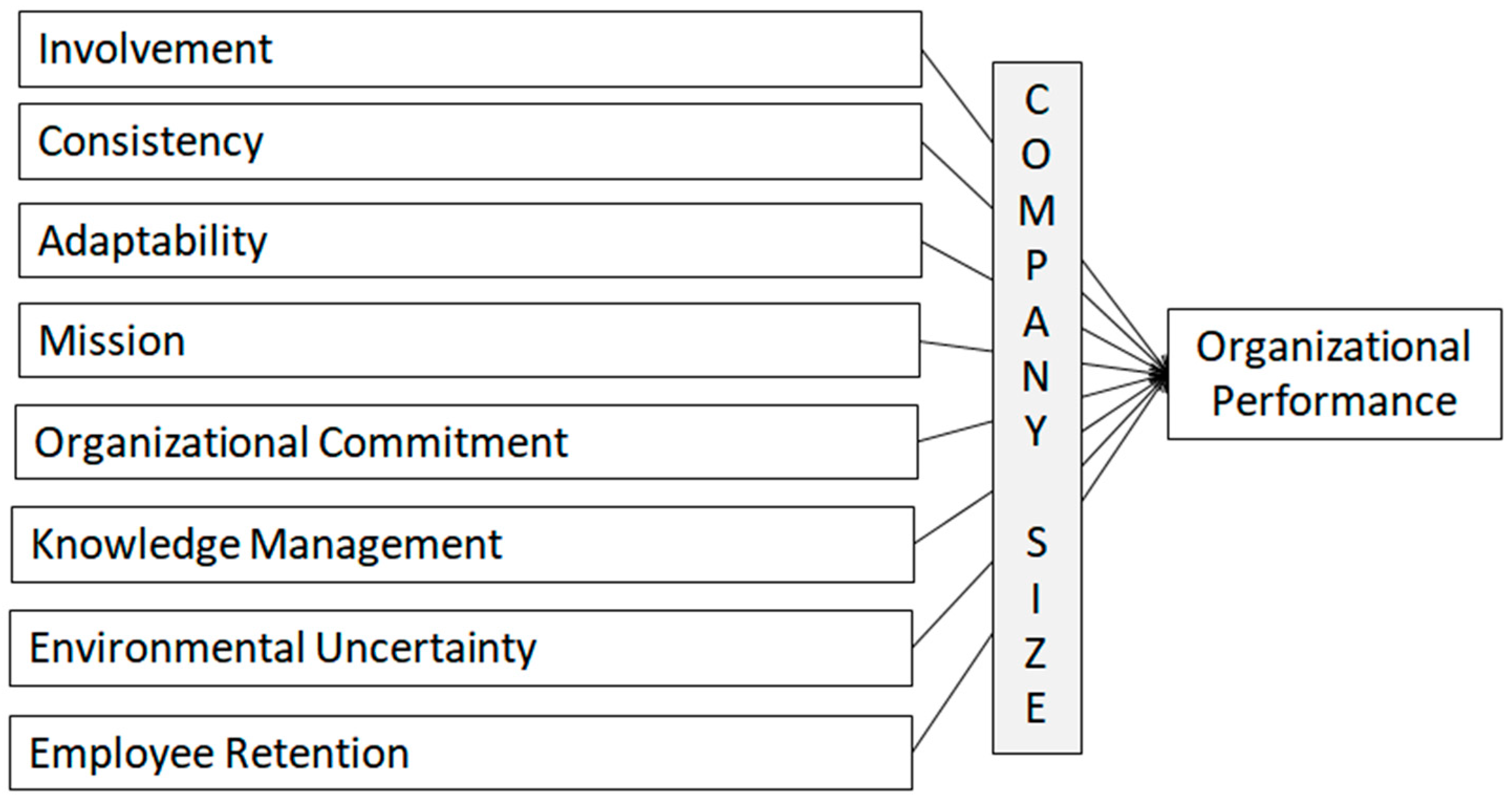
Figure 1 presents the conceptual model tested in this study. Organizational culture (involvement, consistency, adaptability, and mission), organizational commitment, knowledge management, environmental uncertainty, and employee retention are modeled as predictors of perceived organizational performance. Company size is examined as a moderator of these relationships.
3. Materials and Methods
3.1. Research Context and Sample
The study was conducted in the Republic of Serbia. The participating companies operated across several industry segments, including construction materials and building systems, automotive and auto parts/mobility, medical devices and health-tech, agricultural machinery and agri-systems, food and beverage manufacturing.
Data were collected from employees across 23 dual-sector companies, all characterized by simultaneous engagement in manufacturing and service provision within the same organization. A company was classified as dual-sector when three criteria were satisfied. First, the company had to be engaged in the production of tangible goods as a core business activity. Second, it had to provide identifiable service activities linked to those goods, such as installation, maintenance, technical support, consulting, customization, training, or related after-sales solutions. Third, evidence of this combined activity had to be visible both in publicly available company materials and in direct confirmation obtained during company recruitment for the study. Only firms meeting all three criteria were included in the sample.
Table 1 summarizes the main characteristics of the respondent sample, including gender, educational attainment, self-reported economic status, and distribution across company size categories. These characteristics are not treated as focal explanatory variables in the structural model, but they are reported to document the heterogeneity of the sample across gender, education, economic status, and company size. In particular, the relatively balanced representation of respondents across small, medium-sized, and large firms supports the supplementary examination of company size as a moderating condition. A detailed overview of sample characteristics is presented in
Table 1.
3.2. Data Collection Procedure
The empirical data for this study were collected through a structured questionnaire survey administered to employees of dual-sector companies in January 2026.
The target sample comprised employees at different hierarchical levels within dual-sector companies, including operational staff, middle management, and senior management. This multi-level sampling approach was adopted to capture diverse organizational perspectives on culture, commitment, knowledge management practices, environmental uncertainty, employee retention, and organizational performance. Including respondents from multiple organizational levels strengthens the validity of the findings by reducing single-source and role-specific bias.
At the same time, because both the independent variables and the dependent variable were collected through the same survey instrument and from the same respondents, the study is potentially exposed to common method bias.
Data collection was conducted over a defined period using a paper-and-pencil survey. Respondents were informed that participation was voluntary and that their responses would be used exclusively for academic research purposes. To minimize common method bias, respondents were encouraged to answer honestly and were assured that there were no right or wrong answers. Participants were informed about the objectives of the study, the voluntary nature of participation, and their right to withdraw at any time without consequence. No personally identifiable information was collected, and all data were stored securely and analyzed in aggregate form. These measures ensured the protection of respondents’ privacy and upheld the ethical integrity of the research process.
A total of 1000 questionnaires were distributed across the 23 companies, and 450 were returned. After excluding incomplete responses and surveys not meeting the inclusion criteria, 17 questionnaires were rejected from the analysis, resulting in a usable response rate of 433 (43.3%).
In addition, anonymity and the inclusion of respondents from different hierarchical levels were expected to reduce evaluation apprehension and lower the likelihood that the observed relationships were driven primarily by a common response pattern rather than substantive organizational perceptions.
3.3. Measures
Organizational culture was measured using The Denison’s Organizational Culture Questionnaire (
Denison et al., 2006). The instrument comprises 60 items rated on five-point Likert scale, ranging from 1—strongly disagree—to 5—strongly agree. The scale captures four core dimensions: involvement, consistency, adaptability, and mission, each operationalized through three indicators. Involvement includes empowerment, team orientation, and capability development; consistency comprises core values, agreement, and coordination and integration; adaptability reflects creating change, customer focus, and organizational learning; and mission encompasses strategic direction and intent, goals and objectives, and vision.
Organizational commitment was assessed using the Organizational Commitment Scale (
Marsden et al., 1993). The instrument consists of 6 items, with responses recorded on a five-point Likert scale ranging from 1—strongly disagree—to 5—strongly agree.
Knowledge management was measured using the Knowledge Management Process Scale (
Gold et al., 2001). The questionnaire consists of 15 statements, with responses on a five-point Likert scale ranging from 1 (strongly disagree) to 5 (strongly agree).
Organizational performance was measured with the Perceived Organizational Performance Scale (
Akram et al., 2018). The scale comprises 5 items capturing respondents’ perceptions of organizational success, market share, growth, profitability, and innovation. Responses were measured on a five-point Likert scale ranging from 1 (strongly disagree) to 5 (strongly agree). Empirical studies support the validity of these subjective assessments, demonstrating moderate to strong correlations between employee perceptions and objective financial metrics, which suggests that perceptual measures reliably converge on the underlying concept of organizational performance (
Singh et al., 2015). Specifically, a wide range of empirical studies reveal stronger correlations between these two types of performance measures, with reported correlations between perceptual and more objective measures of performance with good metric characteristics (
Nathan & Alexander, 1988;
Ketokivi & Schroeder, 2004;
Vij & Bedi, 2016;
Akram et al., 2018).
Environmental uncertainty was assessed using the Perceived Environmental Uncertainty Scale (
Khandwalla, 1972). The scale comprises 13 items measuring respondents’ perceptions of uncertainty in the organizational environment, rated through 13 statements, with the five-point Likert scale from 1 (strongly disagree) to 5 (strongly agree).
Employee retention was measured by the Employee Retention Scale (
Kyndt et al., 2009). The scale comprises 11 items, with the responses recorded on a five-point Likert scale from 1 (strongly disagree) to 5 (strongly agree).
All measure items and loadings are given in the
Appendix A.
In addition, a set of structured questions was included to collect sociodemographic information (e.g., gender, education level, economic status) and organizational characteristics, including company size and sectoral orientation.
All measures were drawn from previously validated instruments. Given that these scales were originally developed in different institutional and sectoral settings, particular attention was devoted to their suitability for the present research context. The questionnaire was adapted for the present research context through translation and review of item wording for contextual clarity. Where necessary, minor linguistic adjustments were made to improve readability while preserving the original meaning of the items.
3.4. Analytical Strategy
All statistical analyses were conducted using IBM SPSS Statistics version 24 and AMOS. SPSS was used for preliminary data screening, descriptive analyses, reliability assessment, and moderation analysis, while AMOS was used for confirmatory factor analysis (CFA) and structural equation modeling (SEM).
The psychometric adequacy of the adapted measures was reassessed in the present study through reliability analysis and confirmatory factor analysis prior to hypothesis testing.
Prior to the main analyses, the dataset was examined for missing values and distributional properties.
Confirmatory factor analysis (CFA) was conducted to evaluate the factor structure of all latent constructs and to assess the adequacy of the measurement model prior to hypothesis testing. Initial CFAs were performed separately for each measurement scale included in the research model in order to examine standardized factor loadings and overall model fit.
Descriptive statistics were computed for all study variables. Univariate normality was assessed using skewness and kurtosis statistics, which were evaluated against the acceptable range of ±2, supporting the suitability of the data for parametric analyses.
Internal consistency reliability was assessed using Cronbach’s alpha coefficients. All constructs were evaluated against the recommended reliability threshold of 0.70 to ensure adequate internal consistency prior to inclusion in the structural model.
Given that the study relied on same-source self-reported data, additional attention was devoted to the possibility of common method variance. In addition to the procedural remedies applied during data collection, post hoc statistical checks were performed in order to assess whether a substantial proportion of covariance among the study variables could be attributed to a common measurement source rather than to the constructs of interest. Specifically, Harman’s single-factor test and the common latent factor (CLF) approach were used as supplementary diagnostic procedures.
Structural equation modeling (SEM) was employed to test the hypothesized relationships among the study variables. The structural model was estimated using the maximum likelihood estimation method. Dimensions of organizational culture, organizational commitment, knowledge management, environmental uncertainty, and employee retention were specified as exogenous variables, while organizational performance was specified as the endogenous variable. The structural analysis was conducted following validation of the measurement model to examine the direct effects proposed in the research hypotheses.
To examine the moderating role of company size, hierarchical regression analysis was performed. Prior to creating interaction terms, all continuous predictor variables were mean-centered. Company size was operationalized using dummy variables representing medium-sized and large companies, with small companies serving as the reference category. In the first step of the hierarchical regression, the main effects of the predictor variables were entered into the model. In the second step, interaction terms between the centered predictors and company size dummy variables were introduced to assess potential moderation effects.
The hypotheses concerning direct relationships were tested using covariance-based structural equation modeling in AMOS because the study is theory-driven, relies on reflective multi-item measures, and seeks to estimate relationships among latent constructs while accounting for measurement error. Maximum likelihood estimation was used because preliminary screening indicated no severe departures from normality and the sample size was adequate for this estimation approach. Company size moderation was examined through supplementary hierarchical regression rather than latent interaction SEM because company size was operationalized categorically and the number of firms in the sample limited the feasibility of more complex latent or multilevel moderation procedures. This two-step strategy allowed the study to estimate the structural model for the focal direct effects and then assess whether those relationships varied across firm size categories. In this way, the two methods served complementary rather than competing purposes: CB-SEM was used to estimate the measurement and direct structural relationships among latent constructs, whereas hierarchical regression was used as a pragmatic supplementary procedure for testing moderation by categorical company size.
The sampling structure also requires cautious interpretation of the results. Although the number of respondents is substantial, the data originate from 23 companies, meaning that multiple observations are nested within the same organizational contexts. This structure improves coverage of employee perspectives within firms, but it also limits the extent to which the findings can be generalized at the organizational level. Because the number of companies was not sufficient to support a more robust multilevel design for the present model, the results are interpreted primarily as perception-based relationships observed across employees working in dual-sector firms, rather than as fully generalizable firm-level effects.
4. Results
Prior to the analysis, the dataset was examined for missing values. The proportion of missing data was minimal (less than 1%). Given the very low level of missingness, expectation–maximization (EM) estimation was applied.
Confirmatory factor analysis (CFA) was conducted in order to validate the factor structure of each construct and to evaluate the adequacy of the measurement model prior to hypothesis testing. Initial CFAs were performed separately for each scale included in the research model to examine factor loadings and overall model fit.
In cases where the initial CFA results indicated inadequate model fit, items with standardized factor loadings below the recommended threshold of 0.50 (
Hair et al., 1995) were removed, specifically, 3 items from Perceived Environmental Uncertainty Scale, 4 items from Employee Retention Scale and 1 item from Knowledge Management Process Scale. The decision to exclude items was guided by both statistical criteria and theoretical justification, ensuring that the conceptual integrity of each construct was preserved. Several items were removed from the measurement model because their standardized factor loadings fell below acceptable thresholds, indicating insufficient contribution to the representation of their intended latent constructs. Within the employee retention construct, the items “Within the organization I work for, my job gives me satisfaction”, “It does not matter whether I work for this or another organization, as long as I have a job”, “I like working for this organization” and “The work I do is very important to me” were excluded. These items appeared to capture job satisfaction, general employment orientation, and work salience rather than a clear intention to remain with the organization. In the knowledge management construct, the item “The organization I work for has face-to-face communication with employees” was also excluded, as it reflected a specific communication mechanism rather than the broader domain of knowledge management processes. For environmental uncertainty, the items “When it is time to act, uncertainty paralyzes me”, “When I am uncertain, I cannot function well”, and “I cannot stand being surprised” were removed because they were more closely related to individual intolerance of uncertainty than to perceptions of uncertainty in the organizational environment. The exclusion of these items contributed to a more conceptually coherent and psychometrically robust final measurement model.
Additionally, where modification indices indicated theoretically meaningful error covariances within the same construct, these were added. No modifications were introduced that conflicted with the theoretical foundations of the constructs.
Following these refinements, all measurement models demonstrated improved and satisfactory fit indices, meeting commonly accepted thresholds—χ
2/df ≤ 3 (
Brown, 2006), CFI ≥ 0.90 (
Hu & Bentler, 1999), TLI ≥ 0.90 (
Hu & Bentler, 1999), RMSEA ≤ 0.08 (
Brown, 2006), providing a sound basis for subsequent structural equation modeling and hypothesis testing, as presented in
Table 2.
Table 3 represents the descriptive statistics and reliability of the scales included into the model. Univariate normality of the distribution was assessed using skewness and kurtosis. All variables exhibited skewness and kurtosis values within the acceptable range ±2 (
West et al., 1995), indicating no substantial deviations from normality; therefore, the data were considered suitable for parametric analysis. The given results indicate satisfactory internal consistency for all constructs included into the model, with Cronbach’s alpha values ranging from 0.78 to 0.90, exceeding the commonly accepted threshold of 0.70 (
Nunnally & Bernstein, 1994).
To assess potential common method variance (CMV), Harman’s single-factor test and CLF were conducted. Harman’s single-factor test indicates that multiple factors emerged and that the first factor accounted for 34.39% of the total variance, which is below the commonly used 50% threshold (
Howard et al., 2024). Additionally, CLF was added to the measurement model to assess common method variance. The inclusion of the CLF did not meaningfully change standardized loadings or structural path estimates (max change < 0.10), indicating CMV is unlikely to bias the results (
Podsakoff et al., 2003).
In addition to the separate CFAs conducted for each scale, a full measurement model was estimated in which all retained latent constructs were specified simultaneously. The overall fit of the full measurement model was acceptable (χ
2/df = 2.98, CFI = 0.92, TLI = 0.90, RMSEA = 0.08), supporting the adequacy of the measurement structure when all constructs were considered together. Standardized loadings, CR, and AVE of each construct from the model are represented in
Table 4 below.
Discriminant validity was assessed using the Fornell–Larcker criterion (
Fornell & Larcker, 1981). As shown in
Table 5, the square root of AVE for each construct exceeded its correlations with the remaining constructs, supporting the empirical distinctiveness of the constructs in the full measurement model.
H1 is partially supported. Organizational culture received partial support as a predictor of perceived organizational performance. Among the cultural dimensions, Consistency (β = 0.38, p < 0.05) and Adaptability (β = 0.35, p < 0.05) emerged as the significant predictors of organizational performance, whereas Involvement and Mission did not reach significance. The results therefore suggest that specific cultural properties, rather than organizational culture in an undifferentiated sense, are associated with performance in dual-sector companies.
Organizational commitment exhibited a strong and statistically significant positive effect on organizational performance (β = 0.41, p < 0.01). This finding suggests that higher levels of employee commitment are strongly associated with improved organizational performance outcomes; the statistical significance clearly supports the central role of organizational commitment in explaining performance differences.
Knowledge management demonstrated a statistically significant positive direct effect on organizational performance (β = 0.35, p < 0.05).
Environmental uncertainty showed a negative but statistically non-significant direct effect on organizational performance (β = −0.23, p > 0.05). Accordingly, H4 was not supported. Although the coefficient was in the expected direction, the result does not provide empirical evidence of an independent direct relationship between environmental uncertainty and performance within the estimated structural model.
Similarly, employee retention did not demonstrate a statistically significant direct effect on organizational performance (β = 0.18, p > 0.05).
Summary of structural hypotheses testing H1–H5 is shown in
Table 6 below.
Hierarchical regression analysis was applied to examine whether company size of dual-sector companies moderates the relationships between key organizational determinants and organizational performance. Main effects were entered in the first step, while interaction terms between centered predictors and company size dummy variables (medium and large companies, with small companies as the reference category) were entered in the second step.
The inclusion of interaction terms in the second step resulted in a non-significant increase in explained variance in organizational performance (ΔR2 = 0.03, ΔF = 1.45, p = 0.112) indicating that, overall, company size does not provide robust moderation across the model. However, one specific interaction was significant.
Consistent with this, most individual interaction terms were non-significant, suggesting that the effects of organizational culture dimensions, organizational commitment, knowledge management, and employee retention on performance are broadly similar across firm size categories. Accordingly, H6a1–H6c and H6e were not supported.
In contrast, a significant interaction effect was observed between environmental uncertainty and large company size (β = 0.31; SE = 0.09, t = 2.98; p < 0.01). This finding provides limited evidence that the relationship between environmental uncertainty and performance differs between large and small dual-sector companies. This result should therefore be interpreted as limited and specific rather than as evidence of broad company-size moderation across the model. Thus, H6d was partially supported.
Finally, the interaction terms related to employee retention were not statistically significant, indicating that the relationship between employee retention and organizational performance does not vary by company size. Accordingly, H6e was not supported. The results of interaction tests (company size as moderator) on the relationships between organizational determinants and organizational performance is shown in
Table 7 below.
5. Discussion
This study examined which internal capabilities and contextual conditions are most closely associated with perceived organizational performance in companies that simultaneously operate under manufacturing and service logics. Rather than treating all determinants as equally relevant, the findings point to a differentiated pattern in which commitment, knowledge management, and selected cultural dimensions are especially important in dual-sector firms. This suggests that performance in such settings depends less on broad organizational quality and more on capabilities that reduce fragmentation between manufacturing and service domains.
A central theoretical insight concerns the differentiated role of organizational culture. The findings suggest that not all cultural dimensions contribute equally to performance in the examined organizations; rather, performance is primarily explained by Consistency and Adaptability. The significant effect of Consistency indicates that shared core values, agreement, coordination, and an internally integrated system of norms and practices create operational reliability and reduce ambiguity in day-to-day decision-making. Such a culture strengthens implementation capacity by aligning employee behaviors with organizational expectations, which can translate into higher efficiency, better quality outcomes, and more predictable performance. In this sense, Consistency functions as an internal control and coordination mechanism that supports the stable execution of strategic and operational tasks. In dual-sector companies, culture functions as a unifying mechanism that helps reconcile the efficiency-driven logic of manufacturing with the flexibility and customer orientation inherent in service activities (
Dmitrijeva et al., 2021;
Visnjic et al., 2021). This finding suggests more specifically that, in dual-sector firms, culture contributes to performance primarily when it supports both coordinated routines and responsiveness across manufacturing and service domains (
Palo et al., 2019;
Tóth et al., 2022). At the same time, the fact that only Consistency and Adaptability were significant, whereas Involvement and Mission were not, suggests that the performance value of culture in dual-sector firms lies less in broad cultural strength and more in the organization’s capacity to combine internal alignment with external responsiveness. This finding refines the cultural argument of the model by indicating that only some cultural properties appear especially relevant when firms must coordinate standardized production with adaptive service provision.
Knowledge management showed a significant positive independent effect on organizational performance that indicates even when examined alongside other internal capabilities such as organizational culture and organizational commitment, knowledge management contributes uniquely to performance in dual-sector companies, likely by enabling the integration and application of heterogeneous knowledge across manufacturing and service domains. In this context, effective knowledge processes may help reduce coordination costs, support learning and innovation, and strengthen dynamic capabilities needed to manage competing operational logics. Similarly, employee retention did not demonstrate a significant direct relationship with organizational performance once other internal factors were controlled for. Although prior research associated high retention with improved stability and reduced costs (
Kurdi et al., 2020;
Maalouf et al., 2023), the present findings suggest that retention alone may be insufficient to enhance performance in dual-sector companies. Instead, retention appears to be meaningful primarily when it translates into higher commitment, engagement, and effective coordination across manufacturing and service activities (
Kowalkowski et al., 2017). This supports the view that human capital resources generate value not merely through persistence but through active contribution and alignment with organizational goals.
Environmental uncertainty did not exert a significant negative direct effect on organizational performance, supporting contingency theory’s core proposition that environmental conditions do not uniformly determine outcomes (
Khandwalla, 1972;
Khan, 2021). Rather, the findings suggest that uncertainty may influence performance indirectly by shaping the effectiveness of internal organizational capabilities and strategic responses. In the present study, this suggests that environmental turbulence may be less important as an isolated direct condition than as a pressure filtered through the firm’s internal integrative capacities (
Aprisma, 2020;
Ozmutlu & Can, 2022). Together, the non-significant findings for employee retention and environmental uncertainty suggest that not all plausible determinants contribute independently once stronger internal integrative capabilities are considered simultaneously. In theoretical terms, this implies that the proposed model is better understood as one in which some contextual and workforce-related conditions matter primarily through their connection with broader cultural, relational, and knowledge-based capabilities, rather than as equally powerful stand-alone predictors. This interpretation sharpens the contribution of the study by showing that dual-sector performance may depend more on the organization’s capacity to mobilize and coordinate internal capabilities than on the isolated presence of stability or turbulence alone.
The moderation analysis did not provide robust overall evidence that company size alters the relationships included in the model, as the interaction block did not produce a significant increase in explained variance. One isolated interaction suggested that the relationship between environmental uncertainty and performance differed between large and small firms. Because the overall interaction block was non-significant, this pattern should be interpreted as tentative and exploratory rather than as evidence of broad moderation across the model. This means that company size does not appear to operate as a general boundary condition for all focal relationships, but may shape only selected performance linkages under specific circumstances. A plausible interpretation is that larger dual-sector firms may face greater structural inertia, more differentiated internal arrangements, and slower coordination under turbulent conditions, which could make environmental uncertainty more consequential for performance. However, this mechanism was not directly examined in the present study and should therefore be treated as a theoretically informed interpretation rather than an empirically verified explanation.
This selective pattern also has implications for knowledge management and capability development across firms of different sizes. In small and medium-sized dual-sector companies, knowledge management is likely to be most effective when it relies on relatively simple, low-cost, and interaction-based practices, such as direct communication between service and production employees, regular cross-functional meetings, shared problem-solving routines, and rapid feedback loops from customer-facing activities to internal operations. Because smaller firms often have fewer hierarchical layers and closer interpersonal ties, they may benefit more from informal and practice-based knowledge sharing than from highly formalized systems. By contrast, in large dual-sector companies, the key challenge is less the generation of knowledge itself and more its transfer across functionally differentiated and geographically dispersed units. In such settings, effective knowledge management may require more structured mechanisms, including codified repositories, formal cross-unit coordination routines, digital integration of service and manufacturing data, and clearly assigned roles responsible for translating customer and service insights into product, process, and operational improvements.
Taken together, the findings support the combined use of the resource-based view and contingency theory, but in a more nuanced way than initially assumed. The results indicate that internal capabilities explain a substantial portion of perceived performance variation in dual-sector firms, which is consistent with the resource-based emphasis on valuable intangible assets. At the same time, the limited and tentative role of company size suggests that contextual conditions may shape performance in selective rather than uniform ways, which is consistent with contingency logic. The theoretical value of the integrated framework therefore lies not only in confirming that both capability development and contextual fit matter, but also in showing that their relevance is uneven across the model: internal integrative capabilities appear central, whereas contextual effects are more bounded and conditional. This is an important insight for understanding dual-sector firms, because it suggests that the challenge of reconciling manufacturing and service logics is addressed primarily through internal coordination mechanisms rather than through structural or contextual conditions alone.
From a managerial standpoint, this suggests that leaders in dual-sector firms should not assume that one uniform capability-building model is equally suitable for all organizations. Rather, the underlying capabilities may be similarly important across firm sizes, while the appropriate managerial mechanisms differ. Smaller dual-sector firms may benefit from agility, proximity, and informal coordination as vehicles for knowledge integration, whereas larger firms may need more deliberate system design in order to prevent fragmentation between manufacturing and service units. Accordingly, the practical value of the size discussion lies less in claiming a strong statistical moderation effect and more in clarifying how managers in different organizational contexts can translate the same performance-relevant capabilities into workable organizational practices.
The findings suggest that leaders in dual-sector companies should focus less on isolated improvement initiatives and more on building an integrated organizational system capable of linking manufacturing and service activities into a coherent whole. In practical terms, managers should treat organizational commitment as a performance lever by strengthening perceived organizational support, clarifying expectations across manufacturing and service roles, improving internal communication, and ensuring that recognition systems reward collaboration rather than narrow functional performance alone. In relation to organizational culture, the results indicate the importance of simultaneously strengthening consistency and adaptability. Consistency can be reinforced through shared values, common operating norms, cross-unit coordination routines, and clearer interfaces between production and service processes, while adaptability can be supported through structured customer-feedback loops, rapid learning routines, and mechanisms that allow service insights to inform operational and product improvements.
The findings also provide actionable implications for knowledge management in dual-sector firms. Managers should not assume that knowledge will naturally circulate between manufacturing and service domains, particularly when employees work within different routines, time horizons, and performance expectations. Instead, firms should establish explicit practices that support knowledge transfer, such as regular cross-functional review meetings, after-action discussions following customer interventions, shared digital platforms for recurring problems and solutions, and simple codification processes that make field-based service knowledge accessible to production teams. In this regard, knowledge management should be viewed not merely as an information system issue, but as a coordination mechanism that enables the organization to connect product-related expertise with customer-facing experience.
To make these implications more concrete, the findings may be translated into a practical managerial checklist for dual-sector environments. Managers should ask whether employees across manufacturing and service units understand how their roles contribute to a common value proposition; whether shared norms and coordination routines are strong enough to reduce fragmentation; whether customer and service experience is systematically captured and reused inside the organization; whether the firm can respond quickly to external changes without losing internal coherence; and whether retention efforts are linked to capability development, rather than focused solely on keeping employees in place. Such a checklist can help leaders evaluate whether the core capabilities identified in this study are actually embedded in organizational practice.
These results extend existing literature on servitization and hybrid organizations not simply by confirming that internal resources matter, but by indicating which internal capabilities appear especially important when firms must coordinate manufacturing efficiency with service flexibility within the same organizational setting. In this sense, the study reinforces the argument that managing paradoxes between manufacturing efficiency and service flexibility requires not only structural solutions but also strong cultural and relational foundations.
6. Conclusions
This study sought to explain perceived organizational performance in dual-sector companies by examining the simultaneous contribution of selected internal capabilities and contextual conditions. The findings show that organizational commitment, knowledge management, and the cultural dimensions of consistency and adaptability are the most salient predictors of perceived performance, whereas environmental uncertainty and employee retention do not exhibit significant independent direct effects in the structural model.
From a practical standpoint, the findings support a focused managerial agenda rather than a broad set of normative prescriptions. Managers in dual-sector firms should prioritize employee commitment, strengthen coordination-supportive cultural features, and develop knowledge processes that connect manufacturing and service activities. The evidence does not support strong claims that retention practices or environmental conditions independently determine performance; rather, these factors appear to matter in relation to how effectively firms develop and deploy their internal integrative capabilities.
The study contributes to the servitization literature by moving beyond broad claims that hybrid firms are inherently more complex and showing more specifically which internal organizational capabilities appear most relevant for performance when manufacturing and service activities coexist within the same company. In particular, the findings suggest that performance in dual-sector firms is associated most strongly with capabilities that support coordination, shared meaning, and knowledge integration across operational domains. The findings suggest that leaders in dual-sector companies should focus less on isolated improvement initiatives and more on strengthening the internal capabilities that support coordination across manufacturing and service activities. In particular, employee commitment, coordination-supportive cultural features, and knowledge integration appear to be the most relevant practical areas for managerial attention. These implications should be interpreted as evidence-based priorities rather than as directly tested intervention models.
Despite its contributions, this study has limitations that open avenues for future research. Several limitations should be considered when interpreting the findings. First, the cross-sectional design limits causal inference, as the study captures relationships at a single point in time. Second, the analysis relies on perceptual self-report data, which may introduce common method concerns despite the procedural and statistical checks applied. Third, the constructs were measured at the individual level, which means that the findings reflect employee perceptions of organizational conditions rather than direct firm-level observations. Fourth, although the number of respondents was substantial, they were nested within only 23 companies, which constrains firm-level generalization and suggests caution in drawing broader organizational conclusions. These limitations do not invalidate the study, but they do indicate that the findings should be interpreted as evidence of patterned perceptual associations rather than definitive causal organizational effects.
The study responds to the research gap identified in the introduction by showing that, in dual-sector companies, perceived organizational performance is most closely associated with internal capabilities that support integration across manufacturing and service activities. By clarifying the relative importance of selected organizational capabilities and contextual conditions within the same empirical model, the study provides a more precise basis for future research on servitization, hybrid organizational forms, and performance in firms operating under multiple logics.



 ,
,