1. Introduction
In general, people and employees constitute the most critical resources of an organization, and they affect its ability to adapt to change in turbulent and uncertain environments. The level of preparedness or vulnerability of an organization is determined by the skillsets and resources its employees possess, together with the prevailing management systems in place (
Nyaupane et al., 2020). Skill itself is a complex concept; there is no single definition of it, and finding reasonable proxies is even more challenging. Some components of skill that are deemed relevant in a given workplace situation are particularly problematic for a social science researcher; those are: skill in the job, soft skills, and skill in social interactions.
The emergence of the internet has radically transformed globalization in knowledge, information, and data exchanges for people from any geographical location. This has facilitated the emergence of new social media platforms. Social media emerged from social networking and has become a very important means of communication between members of society at large (
El Khatib & Khan, 2017;
Alawamreh et al., 2025a). These are digital platforms that empower and encourage people to communicate, provide information, and interact with other people (
C. Song & Lee, 2016). The increasing use of social media in the workplace has prompted researchers to examine its effects on employees and various organizational outcomes. A central question that often arises is what sets work-related social media use (WSMU) apart from general social media activity. WSMU is broadly defined as the sharing of content related to work experiences within a particular organization or industry, often involving the exchange of documents and work-relevant information (
Liang et al., 2020).
Much of the existing empirical research on workplace social media use falls into four thematic areas. One area explores the relationship between social networking and employee productivity. For instance,
X. Chen et al. (
2020) and
Q. Song et al. (
2019) found that features of social media, such as visibility, association, editability, and persistence, enhance social connections, which, in turn, support creativity and effective job performance (
X. Chen et al., 2020). Another stream of research focuses on how social media enables information sharing and knowledge transfer.
Zhao et al. (
2020) introduced the concept of ambient awareness, suggesting that features like communication tracking and data analysis help spread knowledge more effectively within organizations. Additionally, researchers have investigated how employees use social media for communication, both peer-to-peer (horizontal) and between employees and supervisors (vertical). Studies by
X. Chen et al. (
2020),
Y. Chen et al. (
2016), and others show that this usage improves relationships among team members and between leaders and subordinates. Lastly, a growing body of work examines how social media fosters organizational innovation and employee development. Companies are increasingly using these platforms for marketing communication and customer engagement while also influencing employee attitudes and skill-building. Research by
Muninger et al. (
2019),
Testa et al. (
2020),
Obeidat et al. (
2026) and
Demircioglu (
2018) suggests that social media plays a vital role in motivating employees to perform well, invest effort, and develop professionally.
The current literature indicates that social media has become an integral part of the modern workplace, contributing to enhanced communication and collaboration among employees. Previous studies have also demonstrated the impact of social media on job performance and work behavior. However, the relationship between social media use and employee skills development remains an underexplored area. While studies have addressed the impact of social media in workplaces, a clear knowledge gap exists regarding how these platforms specifically affect employee skills, particularly from a self-determination theory perspective. Questions about how employees leverage the autonomy, competence and relatedness associated with social media use to develop their skills remain. This study aims to bridge this gap by exploring the relationship between social media use at work and employee skills development, focusing on the role of autonomy, competence and relatedness as an intermediary. In doing so, this study will contribute new insights into the importance of social media in enhancing employee effectiveness, making it a timely and relevant area of research.
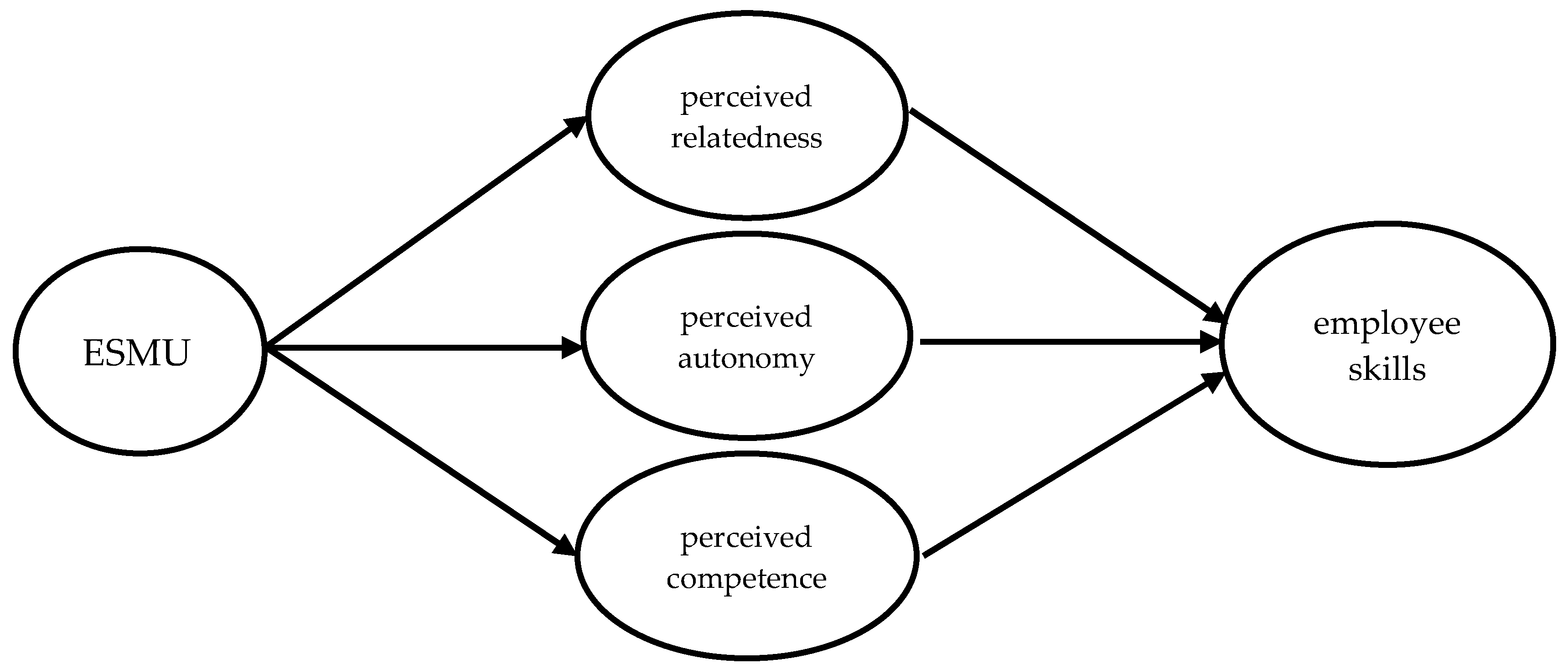
Through the use of structural equation modeling (SEM), this study seeks to investigate the direct and indirect effects of work-related social media usage on employee skills that are mediated by autonomy, competence, and relatedness. Self-determination theory (SDT) is concerned with social and environmental contexts that either aid or impede positive facets of self-motivation. This paradigm suggests that positive self-motivation originates from both internal and external components that face an organism directly (
Ryan & Deci, 2000, p. 54). This article contends that using social media at work either directly or indirectly increases employee skills by fostering their sense of self-determination.
4. Results
The study findings give an in-depth insight into the way Work Social Media Usage (WSMU) affects the skills of employees via the mediation of fundamental psychological needs. In particular, the roles of perceived relatedness, perceived autonomy, and perceived competence were considered in the study as mediating factors. The sections below will provide the descriptive statistics of the measurement items, the measurement model test, and the test of the structural relationship between the constructs.
The descriptive statistics of the items measured in the study, namely, means and standard deviations, are determined and presented in
Table 1. This information shows that perceived autonomy and relatedness were reported as moderate to high by the participants (the average scores of 3.788 and 3.790 on items PA4 and PR3, respectively, were the highest), and that the participants tended to agree with statements such as PA4 (I engage in activities that genuinely interest and motivate me) and PR3 (I experience a strong sense of closeness and connection to important people in my life). By contrast, the scores of the items pertaining to certain work-related social media activities, e.g., WSMU5 (I use social media to share documents and files with colleagues), were lower on the mean (3.012), which indicates that even though social media is a common element of everyday behaviors (WSMU1 mean = 3.582), sharing of documents via social media is less common. The standard deviations of all items are between 1.068 and 1.309, indicating that there is a steady amount of variability in the responses of the participants and serving as a strong base for further structural equation modeling.
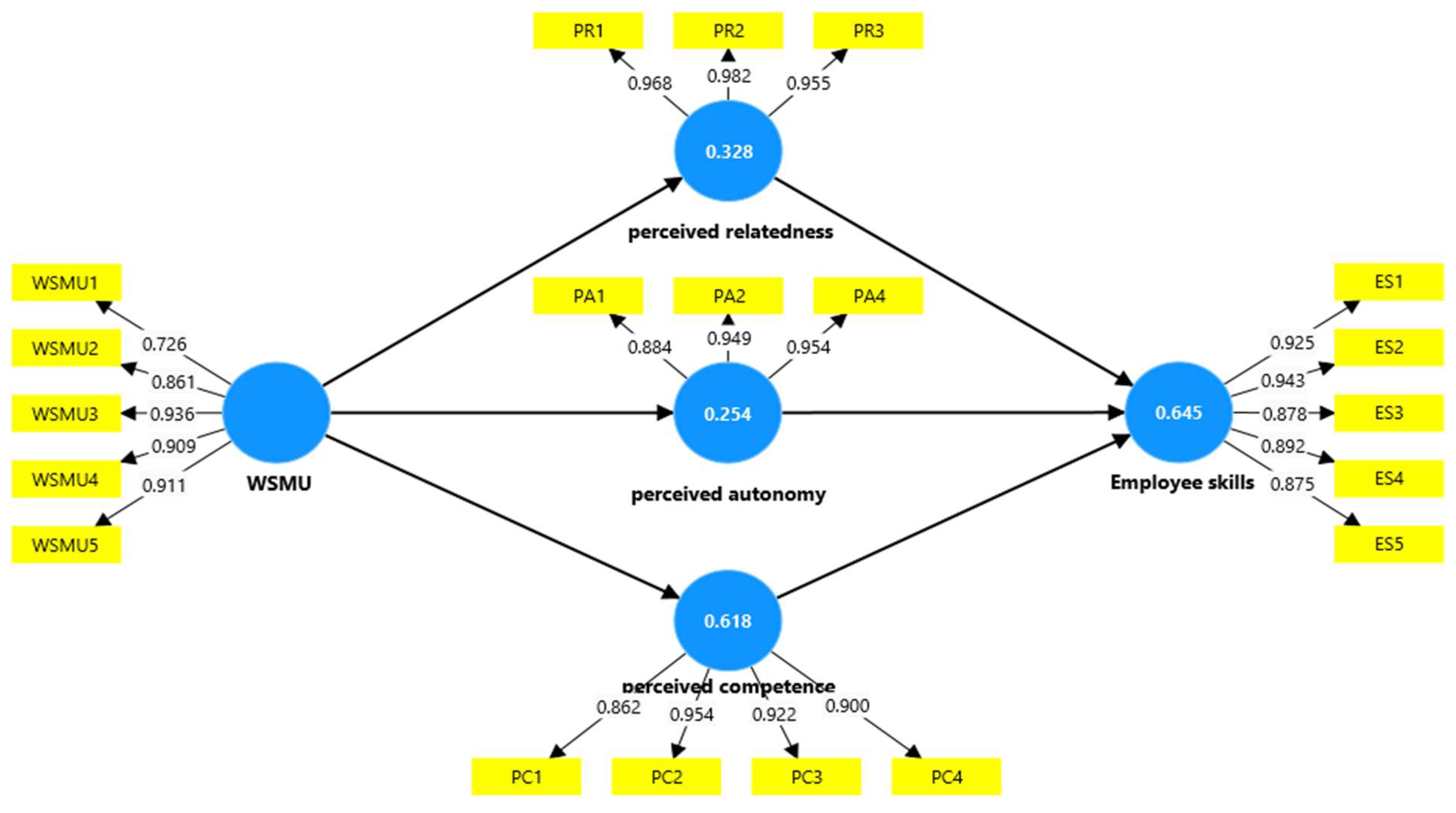
The analysis suggests that Work Social Media Usage (WSMU) has a profound, favorable effect (0.645) on employee skills because of its effect on perceived relatedness (0.328), perceived autonomy (0.254), and perceived competence (0.618). Of these mediators, perceived competence has the highest impact, which indicates its importance in the development of skills. The model’s validity is supported by the findings of observed variables, along with the constructs’ measurement, showing high reliability, which confirms the model’s explanation of the impact of WSMU on employee skills.
Figure 2 shows the measurement model, which illustrates the structural relationships between WSMU, the mediating variables, and employee skills. This helps to visually represent these relationships and measurement pathways.
4.1. Construct Reliability and Validity
The outer model explains the relationship between each indicator and other related variables (
Priyadi et al., 2020). The purpose of validity testing is to establish the degree to which a specific measuring tool can accurately assess the reality it intends to measure (
Manullang & Mesra, 2024). Thus, this research study performed validity and reliability tests.
Table 2 shows the results of the construct reliability, validity tests, and Cronbach’s alpha for each variable.
The measurement model was carried out with Cronbach’s alpha and composite reliability (CR) to determine its reliability. Although all constructs met the generally suggested 0.7 threshold, which is considered an acceptable internal consistency, extremely high scores, especially on the perceived relatedness construct, can be an indication of the redundancy of some items. So, despite the overall reliability of the scales, these large scores cannot be considered as clear-cut indicators of a notion such as trustworthiness and should be treated with caution (
Waluyo & Mohammad, 2020). In the same manner, the scores of the composite reliability prove the internal consistency of the constructs, that is, the measurement items are sufficient to reflect the theoretical concepts.
The heterotrait–monotrait ratio (HTMT) was used to determine discriminant validity. All values are lower than the suggested value of 0.85, which proves that the constructs are quite different. Nonetheless, the value of the HTMT that compares WSMU and perceived competence is almost equal to this value (0.847), which means that there is some conceptual closeness between the two constructs. This closeness should also be taken into consideration when interpreting full discriminant validity, and one should take great care to provide theoretical justification when distinguishing these constructs (
Hair & Alamer, 2022). On the whole, the measurement model shows a sufficient level of reliability and discriminant validity, which explains a strong basis for further structural model analyses and outlines the areas where the overlap of the items can affect the meaning of the constructs.
The results of the correlations between employee skills and Work Social Media Usage (WSMU), perceived autonomy, perceived competence, perceived relatedness and the diagonal values, which show construct reliability, are presented in
Table 3. All constructs have high internal consistency, as has been exhibited by the diagonal values (0.872 to 0.968). The correlations are positive, and WSMU is strongly correlated with perceived competence (0.786) and moderately with autonomy (0.504) and relatedness (0.573), indicating that the use of social media promotes various dimensions of employee development (
Hammadi et al., 2024;
Hair & Alamer, 2022).
Perceived autonomy and perceived relatedness have a high correlation (0.862), which signifies conceptual proximity. Despite the fact that the diagonal values indicate that the constructs are discriminately valid for the Fornell–Larker criterion, the large correlation indicates that the constructs refer to related but different aspects of the employee experience. In particular, autonomy conveys employees’ feelings of power and autonomy in their work, and relatedness shows the level of social and human relations. It is theoretically right to treat them as separate mediators regardless of their high level of association,
Table 4 show the result for Fornell–Larcker criterion as below. Moreover, the elaborate
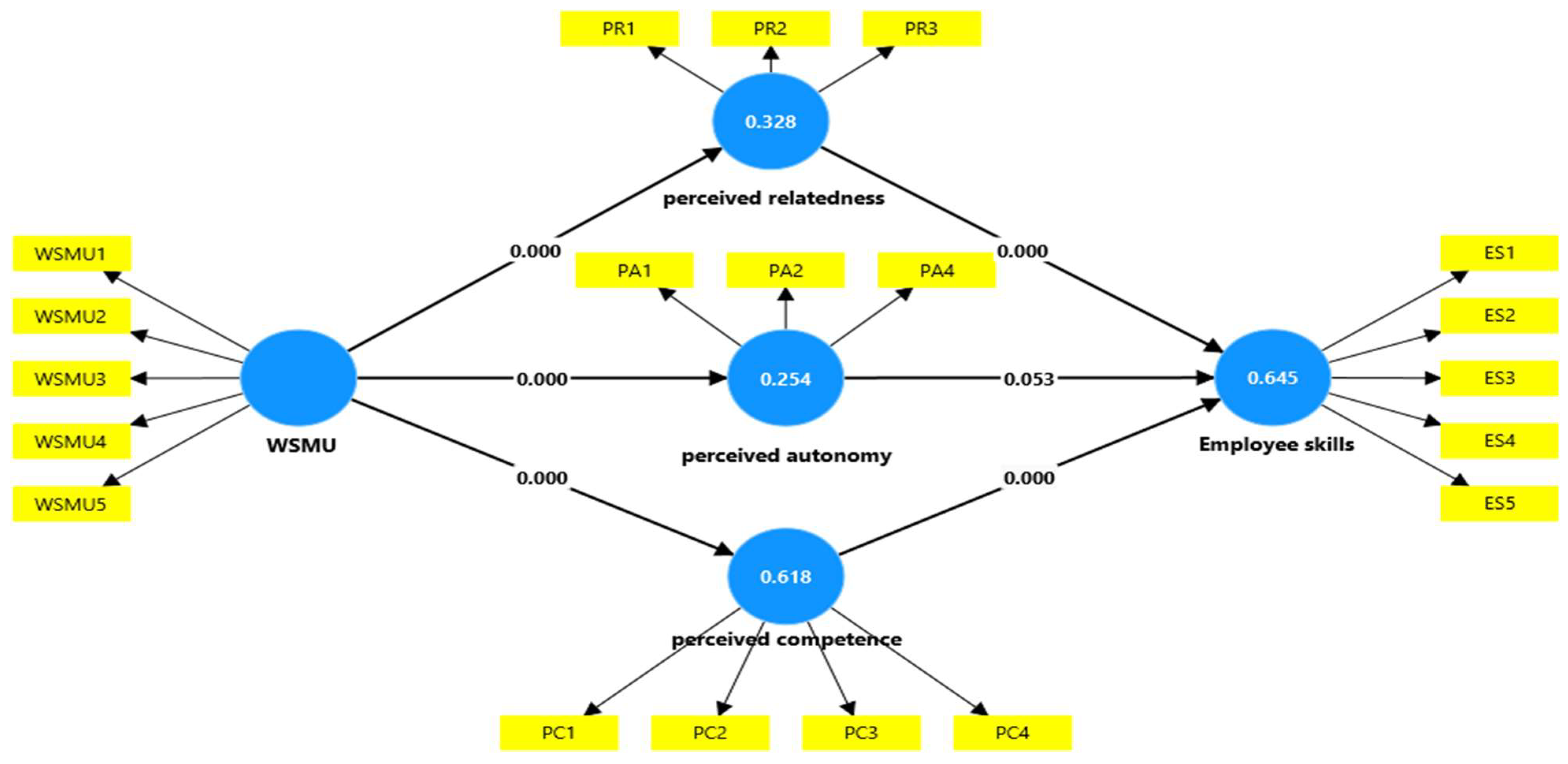
Figure 3 show the structural model.
Table 5 shows that the overall model fit was examined before determining the structural relationships. SRMR was also 0.065, which is lower than the suggested value of 0.08, showing that the model fits well. In addition, the normed fit index was 0.920, which is higher than the recommended value of 0.90, once again confirming the suitability of the model. These findings demonstrate that the model is suitable and the error between the actual and the predictive covariance matrices is small (
Hair & Alamer, 2022;
AlRaggad et al., 2025). Furthermore, as it was determined in the measurement model assessment, the constructs exhibit reasonable reliability and validity, which proves the measurement items are suitable for use in the structural model analysis.
Table 6 shows the variance inflation factor (VIF) that was used to measure collinearity between the constructs. The VIF values are between 1.523 and 2.105, which is significantly lower than the recommended VIF value of 5, as well as the more conservative value of 3.3 proposed in the PLS-SEM literature. In particular, the VIF values of WSMU (1.523), perceived autonomy (1.876), perceived competence (2.105), and perceived relatedness (1.987) are low, and therefore, multicollinearity is not a problem in the model.
Notably, all the values reported are not near critical levels, with the biggest VIF (2.105) value being well within the range of acceptable values. This indicates that the predictor constructs are not too close, do not have problematic overlap with each other, and, hence, may bias the estimation of path coefficients. Accordingly, it is reasonable to interpret the structural relationships with certainty since there is no multicollinearity to guarantee the stability and reliability of the estimates of regression. Altogether, the findings validate the structure of the model, as the collinearity assumptions that have to be satisfied are met in order to conduct PLS-SEM analysis, and no corrective actions (e.g., the removal of constructs or model re-specification) are needed.
4.2. Hypotheses Testing
Table 7 shows the path coefficients, standard deviation, t-value, and
p-value of the structural relations between Work Social Media Usage (WSMU), the mediating variables (perceived autonomy, perceived competence, and perceived relatedness) and employee skills. The findings reveal that WSMU is significantly related to the three mediators, perceived autonomy (β = 0.504,
p < 0.001), perceived competence (β = 0.786,
p < 0.001), and perceived relatedness (β = 0.573,
p < 0.001), with a significant value of the relationship. These results confirm that WSMU is significant in improving the psychological perceptions of the employees in the workplace.
Concerning the impacts of the mediators on employee skills, perceived relevance (β = 0.532, p = 0.001) and perceived relatedness (β = 0.263, p = 0.001) have significant positive values, which implies the importance of the mediators in enhancing the skills of the employees. On the contrary, perceived autonomy lacks a statistically significant influence on employee skills (β = 0.098, p-value =0.053), as the p-value is above the 0.05 threshold. This result is a clear indication that mediation using perceived autonomy is not substantiated in this example. Generally, the results indicate that though WSMU contributes to a significant increase in all three psychological variables, only perceived competence and perceived relatedness can be considered as significant mediating variables in the conversion of WSMU into better employee skills. Thus, the mediating mechanism works more on competence and relatedness, as opposed to autonomy, and the difference must be maintained at all times when describing and discussing the results.
The mediation analysis has looked at the indirect influences of WSMU on the skills of employees, as perceived relatedness, perceived autonomy and perceived competence. The specific indirect effects and the total indirect effect are given in
Table 8. The indirect effects through perceived competence (beta = 0.419 and
p = 0.001) and perceived relatedness (beta = 0.151 and
p = 0.001) were significant, showing that they played a significant role in mediating the effect of WSMU on skill development. On the other hand, the perceived autonomy effect was not statistically significant (beta = 0.049,
p = 0.066), which supports the observation that perceived autonomy is not a significant mediator in this model. The overall mediation of WSMU on worker skills, including all three of the mediators, was also strong (beta = 0.619,
p < 0.001). This indicates that the effect of WSMU on skill development is mostly mediated by psychological states, which are considered to be perceived competence and relatedness, and that perceived autonomy does not affect a given mediation ability.
5. Discussion and Conclusions
Considering the significance of employee skills, the current study intended to design a new model for improving these skills within the boundaries of an organization. This study concentrated on analyzing the connections between social network usage at the workplace and employee skills in the context of self-determination theory, which involved formulating and testing ten hypotheses. The findings are outlined below:
Our findings suggest that the developmental value of the use of work social media is not in digital interaction per se but in the degree to which the latter enhances the perceived competence and relatedness of employees. The theoretical relevance of this point is that recent digital studies have demonstrated that the blistering development of technology-related studies is typically accompanied by conceptual fragmentation (
Medina & Lodeiros-Zubiria, 2025). Considering that, the current findings suggest that not every psychological process linked to digital tools is equally effective since the impact varies based on the type of psychological need that is triggered in the organizational setting. The factual data affirm that the use of social media in the work environment has a direct and positive relationship with employee skill development. WSMU platforms create a special space for self-expression, knowledge sharing, and feedback, which are fundamental to the process of acquiring modern skills (
M. Chen et al., 2023). The benefits of such interaction with social media professionals help employees to see varied viewpoints and self-directed learning opportunities that may not be available in a traditional organizational structure. This observation supports the notion that digital tools are not communication streams but active agents of professional development.
Moreover, owing to the interactive features of social media, real-time feedback can be established, which is not always achievable in formal training programs. In cases where employees post their work or ideas on these platforms, the instantaneous feedback from their colleagues and managers may also constitute micro-learning, where incremental skills are enhanced through repeated social validation and criticism. This indicates that WSMU promotes a more vibrant and organic process of skill development, which is more appropriate to the fast-evolving needs of the modern workplace. One of the main conclusions of this paper is that the most influential mediator between WSMU and employee skills is perceived competence (H9: beta = 0.419, p = 0.001). This implies that the main way in which social media improves skills is by increasing one’s confidence to believe that he/she is capable of doing something well. WSMU enables staff to show mastery, positive reinforcement, and collaborative problem-solving, all of which strengthen their feeling of mastery.
This imbalance of mediators indicates that in the newer digital domains, research expansion does not discredit the necessity of increased conceptual aura in the method of technology absorption (
Medina & Lodeiros-Zubiria, 2025). The findings suggest that the social media value of work is specifically whether this interaction supports competence perceptions. Once employees feel more competent due to their online communication, they are more willing to take up more demanding tasks and continue to overcome difficulties, which results in quantifiable growth in their professional competence (
Kultalahti et al., 2023;
AlKhawaldah et al., 2025).
Theoretically, this result is consistent with the competence-first perspective of skill learning, in which the psychological motivation of mastery is the main force driving learning. When it comes to digital tools, this implies that the most efficient ones are those that give clear signs of success and improvement, including likes, shares, or positive feedback from reputable colleagues. These online validations are external verifications of the internal feeling of competence of a worker, and the virtuous circle of motivation and skill development occurs.
It was also found that WSMU generates a significant impact on perceived relatedness (H1), which also positively correlates with the skills of employees (H4). The concept of perceived relatedness is also a strong mediator (H7), which implies that the sociability and community spirit brought about by Enterprise Social Media (ESM) preconditions an environment where the culture of information sharing and skill development may flourish. Employees are more likely to take part in open communication, which is a requirement of collective problem-solving and sharing of ideas, when they feel part of and integrated into their workplace (
Martela & Riekki, 2018;
Pitafi & Xie, 2024). This is especially relevant in online situations because, in the online world, the absence of physical proximity may easily create a feeling of isolation. WSMU can be useful in this area by offering an informal socializing environment, which creates a sense of trust and psychological safety that allows employees to take risks and learn through their errors. A more supportive learning atmosphere can be established by encouraging the feeling of a digital community in which employees feel free to seek assistance and share their expertise with others.
Unlike the competence and relatedness roles, perceived autonomy was not supported as an important mediator (H8) or a driving force of employee skills (H5). Although the positive influence of WSMU on perceived autonomy was identified to be positive (H2), this augmented sense of independence proved not to be translated into the development of skills within this specific sample.
This result is important in the conceptual sense because it shows that not every psychological process related to digital technologies works identically. The absence of a meaningful mediating effect of autonomy implies that access to information and the right to take action through social media alone is not enough to build skills without at the same time strengthening the sense of competence or relatedness. In other organizational settings, the perceived benefits of independent decision-making may be diluted by information overload or a sense of being monitored all the time, which can be compensated for with the perceived advantage of autonomy offered by digital tools (
Ahmad et al., 2022;
Sahebi & Formosa, 2022). Additionally, the insignificance of autonomy can be due to the character of the tasks or the organizational culture at the firms that were surveyed. Workers in highly standardized work settings or those who act in areas of strong collective performance may not require as much individual freedom as they do social bonds and technical mastery in the development of skill. This implies that the effects of digital tools are very contextual and that organizations need to pay detailed attention to the interaction between their own culture and structure and the psychological needs of their employees.
5.1. Practical Implications
These findings are important to management and policy makers, especially in the teaching and consulting areas, because they recommend that management in the surveyed firms formulate effective training instruments concerning social media with the aim of enhancing employees’ feelings of competence and connection, which, in turn, will help in developing their skills and productivity (
Pitafi & Xie, 2024). In addition to social media, it is also possible to improve the work environment by emphasizing the platform’s role in communication and collaboration among employees, which further fosters their sense of belonging and job satisfaction. Furthermore, training and consulting firms should mitigate potential unfavorable outcomes resulting from overuse, such as a reduction in productivity, by formulating clear usage policies. There is a need for organizations to formulate policies that would allow the desired positive effects to be achieved without negative consequences on job performance. Lastly, there is a need for these firms to establish social programs in which employees can be motivated to utilize social media in a way that aids in developing their competencies and enhances their sense of skills by sharing achievements and knowledge.
5.2. Theoretical Implications
The study makes an important theoretical contribution, in light of self-determination theory, to determining the impact of social media use at work on employees’ skills. The research has some theoretical ramifications, which are described here. First, the study improves the theoretical framework on intrinsic motivation. The findings indicate that social media use while at work can foster the experience of competence and a sense of belonging among employees. This positive result aligns with self-determination theory, which stresses the need to meet fundamental psychological needs within a social system in order to enhance intrinsic motivation (
Demircioglu, 2018). Second, the results relate to self-determination theory and broaden its domain. The study aids in the application of self-determination theory by examining the influence of social media usage on employee skill acquisition, which is a relatively new area of study, and stimulates further research in this field.
5.3. Limitations and Future Research Directions
Though this study offers some valuable insights, it faces quite a number of limitations. The use of a convenience sample consisting of consulting and training firms in Jordan can also restrict the external validity of the results to other sectors or cultures. The cross-sectional design does not allow for establishing the cause–effect links or tracking the development of skills over time. Moreover, the self-reported data implies the risk of common method bias. To the extent that it is measured, the WSMU and employee skills measurement, though based on existing scales, may not be a complete measure of what these constructs entail in every organizational context. Finally, the insignificance of perceived autonomy should also be examined in greater detail, as it does not align with some of the overall expectations of SDT and may be affected by a particular context that is not considered in detail in this study.
Future studies can overcome these limitations by using longitudinal research to trace how the capabilities of employees change in response to WSMU. An increase in the sample to different industries and geographical locations would increase the generalizability of the results. To understand the subtle processes by which employees understand autonomy and its interaction with WSMU in various organizational settings, qualitative methods, like interviews or case studies, might be more informative. Moreover, it would be useful to examine the peculiarities and capabilities of social media platforms that can best encourage competence and relatedness. Researchers might also examine possible moderators, including organizational culture, leadership styles or personal differences, which may mediate the observed relationships in this study. Last but not least, the analysis of the negative effects that WSMU may have, including digital distraction or privacy issues, and how they interact with the process of skill formation, would provide a deeper insight into this multifaceted phenomenon.