1. Introduction
Over the past decade, the Chilean public administration has incorporated tools such as managerial performance evaluation and strategic planning; however, the diagnosis issued by the Organization for Economic Cooperation and Development (OECD) identifies significant weaknesses in inter-institutional coordination, the use of evidence for decision-making, and the implementation of long-term policies (
OECD, 2024). In addition, a sustained deterioration of citizens’ trust in public institutions has been observed, along with growing social pressure for greater transparency, equity, and service quality (
UNDP, 2024). As a result, Chilean public administration faces the paradox of being called upon to lead transformative processes while operating under internal constraints that limit its capacity to respond effectively. This complexity makes the Chilean context a particularly relevant setting for analyzing the motivational and leadership processes that sustain the commitment of those working in the public sector.
Given this tension between increasing institutional demands and growing social expectations, it is crucial to examine which work-related and personal conditions enable the maintenance of positive motivational states and adequate performance in the public sector. This issue can be addressed through the Job Demands–Resources (JD-R) theory, an integrative framework that explains how job demands and resources influence employee well-being, motivation, and performance, and which has proven especially useful in contexts characterized by high pressure and organizational complexity (
Bakker et al., 2014,
2023;
Bakker & Demerouti, 2017;
Van Veldhoven et al., 2020). From this perspective, job resources play a central role by buffering the impact of demands and fostering motivational processes that promote both work engagement and organizational outcomes (
Bakker et al., 2014;
Bakker & Demerouti, 2017).
Complementarily, the Healthy and Resilient Organizations (HERO) model (
Salanova et al., 2012) provides an appropriate framework for identifying the key elements underlying the generation and maintenance of well-being and performance within organizations. Both JD-R theory (
Tummers & Bakker, 2021) and the HERO model (
Salanova et al., 2012) recognize leadership as a central social resource capable of promoting employee well-being and fostering healthy organizational outcomes. From these perspectives, leadership plays a key role in activating positive states and sustaining motivational processes at work. Among the various leadership approaches that may fulfill this function, servant leadership stands out due to its strong prosocial orientation and its emphasis on the well-being and development of individuals.
Servant leadership is an approach that engages followers through multiple dimensions, empowering them to grow and reach their full potential (
Eva et al., 2019;
Xu et al., 2020). Its central purpose is the development of people, grounded in leaders’ altruistic and ethical orientations (
Greenleaf, 1970;
Jonker & Dube, 2025). Moreover, this leadership style extends its focus beyond the organization, considering the well-being of clients, communities, and society at large (
Eva et al., 2019;
Liden et al., 2008).
From a broader perspective, servant leadership is situated within the group of so-called positive leadership styles, alongside transformational, authentic, empathetic, and ethical leadership, insofar as they share a prosocial orientation and a people-centered focus (
Decuypere & Schaufeli, 2019). Nevertheless, despite these conceptual similarities, moral leadership approaches differ in their underlying moral focus. Ethical leadership emphasizes compliance with normative standards, authentic leadership centers on leaders’ self-awareness and self-concordance, whereas servant leadership is distinguished by its emphasis on promoting the well-being and development of multiple stakeholders, both within and beyond the organization (
Lemoine et al., 2019).
Regarding the motivations that drive individuals to work in the public sector, the symbolic value attributed to public employment as an expression of service to citizens constitutes a central element in the construction of work meaning. This value may help explain why many individuals maintain high levels of commitment even in contexts marked by institutional tensions (
Bakker, 2015). This orientation has been described as a “general altruistic motivation to serve the interests of a community of people, a state, a nation, or humankind” (
Rainey & Steinbauer, 1999, p. 23), as well as an “individual predisposition to respond to motives grounded primarily in public institutions and organizations” (
Perry & Wise, 1990, p. 368), conceptualized as public service motivation. Empirical evidence supports the relevance of this construct, identifying it as a distinctive individual factor within the public sector and consistently linking it positively to work engagement (
Borst, 2018;
Borst et al., 2019;
De Simone et al., 2016;
Ugaddan & Park, 2017;
Zahari & Kaliannan, 2022).
Within the framework of motivational processes at the workplace, work engagement constitutes a central psychological state, defined as “a positive, fulfilling, work-related state of mind characterized by vigor, dedication, and absorption” (
Schaufeli et al., 2002, p. 74). Empirical evidence has shown that work engagement not only contributes to employee well-being but is also consistently associated with positive organizational outcomes. In this regard,
Park et al. (
2020) indicate that employees with high levels of work engagement display elevated energy and concentration in their daily performance, enabling them to anticipate challenges, identify deficiencies in work processes, and cope more effectively with environmental demands.
From a gender perspective, although some studies have incorporated gender as a moderating demographic variable, available meta-analyses indicate that its specific role in the interaction between leadership, public service motivation, and work engagement has not been systematically examined (
Mazzetti et al., 2023). In particular, within motivational and resource-based models, empirical evidence remains limited; with the exception of the study by
Lemoine and Blum (
2019), few investigations have directly addressed these relationships. It is therefore pertinent to examine supervisor gender as a contextual dimension that may moderate motivational processes associated with leadership.
Despite the extensive research on leadership in the public sector, as well as advances in the study of public service motivation and work engagement from motivational frameworks such as JD-R theory, important gaps persist in the integrated understanding of these processes. In particular, there is a scarcity of empirical studies that jointly examine how servant leadership operates as a social resource capable of activating specific motivational processes—such as public service motivation and work engagement—and how these processes translate into healthy organizational outcomes. Although the HERO model of Healthy and Resilient Organizations provides an appropriate conceptual framework for understanding the generation of healthy organizational outcomes based on organizational practices and resources, its empirical integration with motivational models such as JD-R remains limited in the public sector. Moreover, evidence is still insufficient regarding whether these resource-based motivational pathways manifest similarly or differently depending on the gender of the individual occupying the supervisory role, especially within public administration contexts.
To address these gaps, the present study aims to empirically examine, drawing on JD-R theory and the HERO model of healthy and resilient organizations, the relationships between servant leadership, public service motivation, work engagement, and healthy organizational outcomes within Chilean public sector organizations. In addition, the study examines whether supervisor gender moderates the proposed motivational pathways. The contribution of this study lies in the empirical integration of JD-R theory and the HERO model within a specific institutional context—namely, Chilean public administration—by incorporating supervisor gender as a contextual dimension analyzed through a moderation logic, in order to examine the stability of motivational processes associated with servant leadership and their linkage to the generation of healthier public organizations.
2. Theoretical Framework
2.1. The Job Demands–Resources (JD-R) Theory as a Motivational Framework
JD-R theory has become one of the most widely used theoretical frameworks for understanding the mechanisms linking working conditions to well-being, motivation, and performance across different organizational contexts (
Mazzetti et al., 2023;
Bakker et al., 2023). This theory posits that the characteristics of any job can be described through two main dimensions: job demands and job resources (
Bakker et al., 2014). Job demands are defined as the physical, psychological, social, or organizational aspects of work that require sustained physical, cognitive, and/or emotional effort and are therefore associated with physiological and/or psychological costs (
Demerouti et al., 2001). In contrast, job resources refer to the physical, psychological, social, or organizational aspects of work that have motivational potential, are functional in achieving work goals, help regulate the impact of job demands, and foster learning and personal growth (
Bakker & Demerouti, 2017).
From this perspective, JD-R theory not only explains processes of work-related stress but also provides a general motivational framework for understanding how working conditions influence positive psychological states and performance.
Within this conceptualization, the interaction between job demands and job resources gives rise to two distinct processes. On the one hand, the health-impairment process is activated when job demands are frequent or intense, requiring sustained effort that, over time, may lead to physical and emotional exhaustion as well as various health problems (
Demerouti et al., 2001). On the other hand, the motivational process emerges when job resources enable employees to effectively cope with job demands and satisfy basic psychological needs, thereby fostering work engagement and facilitating high performance (
Bakker & Demerouti, 2017). These two processes may interact, jointly influencing health, well-being, and performance (
Bakker et al., 2005).
This motivational process is particularly relevant for the present study, as it allows for an understanding of how resources within the work environment are translated into positive psychological states that sustain individual and organizational functioning.
Subsequently, JD-R theory was extended to include personal resources, defined as individuals’ positive self-evaluations regarding their ability to successfully control and impact their environment (
Hobfoll et al., 2003). This extension was empirically developed by
Xanthopoulou et al. (
2007), who incorporated personal resources into the JD-R model and demonstrated that variables such as self-efficacy, optimism, and organizational-based self-esteem mediate the relationship between job resources and work engagement, and influence employees’ perceptions of their work environment. This inclusion is consistent with psychological foundations emphasizing that human behavior results from the interaction between environmental factors and personal characteristics (
Taris & Schaufeli, 2015).
Following this extension, several studies (
Christian et al., 2011;
Halbesleben, 2010;
Young et al., 2018) have explored the role of personal resources within the JD-R model.
Taris and Schaufeli (
2015) identified at least five ways in which personal resources have been incorporated into empirical research: (1) as antecedents of both strain and motivation, analogous to job demands and job resources; (2) as moderators of the associations between job characteristics and organizational outcomes; (3) as mediators of the relationships between job characteristics and organizational outcomes; (4) as potential antecedents of job characteristics; and (5) as confounding factors that may distort associations between job demands, job resources, and outcomes if not adequately controlled.
Taris and Schaufeli (
2015) concluded that a wide variety of personal resources can be meaningfully integrated into JD-R theory and that their effects may be significant. However, given the absence of a clearly defined theoretical position, their function may vary depending on the type of personal resource considered.
Finally, a meta-analytic review based on longitudinal evidence concluded that JD-R theory provides a robust theoretical framework for explaining occupational well-being across diverse organizational contexts (
Lesener et al., 2018), constituting a solid conceptual basis for analyzing motivational and well-being processes at work in different settings, including the public sector.
2.2. The HERO Model and Its Adaptation to the Chilean Public Sector
The HERO model developed by
Salanova et al. (
2012) is grounded in the tradition of positive organizational psychology and offers an approach aimed at understanding the motivational processes that promote occupational well-being and healthy organizational functioning. From an integrative perspective, the HERO model is conceptually consistent with JD-R theory, insofar as it also emphasizes the role of job demands and resources in the generation of positive psychological states and healthy organizational outcomes (
Bakker et al., 2014;
Salanova et al., 2012;
Salanova, 2021). In line with this approach, the model highlights the dynamic balance between job demands and job resources as a foundation for promoting both psychosocial health and performance.
The model comprises three interrelated components. The first, healthy organizational resources and practices, includes aspects of the work environment that facilitate goal attainment, reduce the impact of job demands, and foster development and professional growth. The second, healthy employees, refers to positive affective and motivational states that emerge from an adequate interaction between job demands, organizational practices, and job resources. The third, healthy organizational outcomes, encompasses indicators such as in-role performance, extra-role performance, and affective organizational commitment. The interaction among these three components establishes a positive feedback cycle: investment in healthy practices and job resources fosters engaged employees, which in turn enhances positive organizational outcomes (
Acosta-Antognoni et al., 2013;
Llorens et al., 2017;
Salanova et al., 2012;
Olvera et al., 2017).
Within the context of the Chilean public sector, the HERO model was operationalized through the HEROCheck Public instrument, which was validated using a structure specifically adapted to this context and incorporating job demands, servant leadership, and public service motivation (
Villarroel-Núñez et al., 2024). Empirical results confirmed the adequacy of the proposed structure and its usefulness for analyzing well-being and performance processes within Chilean public organizations.
In sum, the HERO model converges with JD-R theory by offering a conceptual and empirical framework for examining how organizational resources and practices are related to positive psychological states and healthy organizational outcomes. This articulation is particularly relevant for studying public organizations, where motivational processes play a key role in sustaining work engagement and positive organizational results.
2.3. Servant Leadership as a Social Job Resource Within the JD-R Framework
From the perspective of JD-R theory, leadership has been conceptualized as a social resource that influences the work environment and psychological processes such as employee well-being. In a systematic review grounded in this framework,
Tummers and Bakker (
2021) identified three mechanisms through which leadership may influence employees: (1) by directly shaping job demands, job resources, and personal resources; (2) by moderating the impact of job demands and job resources on well-being; and (3) by influencing how employees actively transform their work environment, either by generating resources, making proactive adjustments, or producing negative effects that undermine their coping capacity.
The present study focuses specifically on the first mechanism proposed by
Tummers and Bakker (
2021), examining how servant leadership operates as a social job resource that contributes to the activation of personal resources—particularly public service motivation—within the context of the Chilean public sector.
In this regard, servant leadership is a relational leadership style oriented towards employee development and empowerment, altruism, empathy, ethical awareness, and community responsibility (
Greenleaf, 1970;
Liden et al., 2008). The central premise of servant leadership is that individuals who enact this leadership style influence organizational outcomes by fostering employee growth and well-being, specifically through the satisfaction of employees’ needs (
Liden et al., 2008;
Mayer, 2010).
Chiniara and Bentein (
2016) examined the psychological mechanisms underlying the influence of servant leadership on individual performance, using self-determination theory (
Ryan & Deci, 2000) as an explanatory framework. Their study provides empirical evidence showing that servant leadership promotes increases in task performance and organizational citizenship behavior (OCB) through intrinsic motivational mechanisms.
Complementarily, prior research has indicated that these effects are not limited to behavioral outcomes but are also explained by the activation of motivational dispositions aligned with work meaning, particularly in public sector contexts. In this vein, the study by
Schwarz et al. (
2016) shows that public service motivation may play a mediating role between servant leadership and employee performance. Their findings indicate that this leadership style not only exerts a direct impact on organizational behaviors but also activates internal dispositions such as public service motivation, which foster prosocial behaviors in the workplace.
The servant leadership model proposed by
van Dierendonck and Nuijten (
2011) conceptualizes this leadership style through a set of behaviors oriented towards empowerment, humility, authenticity, and service to others, which can be understood as social resources within the JD-R framework.
Decuypere and Schaufeli (
2019) argue that positive leadership styles influence work engagement through multiple pathways, including the configuration of job resources (a material pathway) and the satisfaction of basic psychological needs (a motivational pathway), in line with JD-R theory and self-determination theory. Although they acknowledge that each leadership style has a specific focus, they maintain that all such styles can activate these general processes, thereby contributing to work engagement through affective, behavioral, and cognitive mechanisms.
From this integrative perspective, motivational variables aligned with work meaning and prosocial orientations such as public service motivation may play a relevant mediating role in this process, particularly in public contexts characterized by a strong connection to collective interests (
Eva et al., 2019). In this regard, servant leadership has been theoretically linked to public service motivation due to its altruistic orientation. In a study conducted with public servants in China,
Schwarz et al. (
2016) examined the relationship between servant leadership and public service motivation and found a positive association between both constructs. Drawing on
Bandura’s (
1977) social learning theory, they suggest that leaders who prioritize the well-being of others may inspire their subordinates to adopt attitudes and behaviors consistent with values oriented toward the collective good.
Along similar lines,
Hameduddin and Engbers (
2021) argue that when individuals in leadership or supervisory roles are perceived as credible role models who exhibit behaviors oriented toward public service, employees are more likely to develop normatively appropriate behaviors aligned with higher levels of public service motivation. Given the status and power differences that exist in the workplace, leaders occupy a unique position as credible referents for shaping attitudes and behaviors at work, communicating expectations, and aligning incentives (
Hunter et al., 2013).
In sum, the theoretical and empirical evidence reviewed suggests that servant leadership can operate as a key social resource within the JD-R framework by activating personal resources oriented toward the collective good. Among these, public service motivation emerges as a particularly relevant personal resource, which justifies its specific examination within the proposed theoretical model.
2.4. Public Service Motivation as a Key Personal Resource
According to
Bakker (
2015), public service motivation can be integrated within the JD-R theory as a key psychological resource that influences how public sector employees cope with job demands and mobilize their resources at work. From this perspective, PSM is not only directly associated with higher levels of work engagement and performance but also moderates the loss and gain processes characteristic of the JD-R theory by attenuating the impact of job demands on burnout and strengthening the relationships between job resources and work engagement, as well as between work engagement and performance (
Bakker, 2015). Moreover, this author notes that public service motivation is associated with lower levels of exhaustion and that it may be strengthened or weakened depending on the quality of the work environment. Factors such as alignment between personal and organizational values and perceptions of fairness may either foster or undermine this prosocial motivation (
Christensen et al., 2017).
Within the context of the Chilean public sector, the study by
Villarroel-Núñez et al. (
2024), which focused on validating the public HEROCheck instrument, shows that incorporating public service motivation as an additional dimension within the HERO model enhances its explanatory capacity. This finding provides empirical support for the usefulness of including this variable to capture key aspects of psychosocial well-being in the context examined.
Along similar lines,
Gross et al. (
2018), in a study conducted in the German public sector, provide empirical evidence supporting the integration of public service motivation within the JD-R framework, demonstrating its positive relationship with work engagement and job performance, thereby reinforcing its value as a motivational resource. Similarly, a meta-analysis of twenty-eight studies conducted with public sector employee samples revealed a moderately positive relationship between public service motivation and work engagement, indicating that although this association is consistent, it should not be overestimated or considered in isolation from other relevant organizational factors. The findings show that work engagement is strengthened when enabling conditions such as autonomy, value congruence, and institutional support are present, reinforcing the interaction between personal and job resources postulated by JD-R theory (
Ding & Wang, 2023).
2.5. Servant Leadership and Public Service Motivation
Building on the arguments developed in the preceding sections, servant leadership can be understood as a social resource that, within the JD-R framework, contributes to the activation of personal resources oriented toward the collective good (
Tummers & Bakker, 2021). In public sector contexts, this function is particularly relevant, given that work meaning and prosocial orientation constitute central elements of the work experience (
Perry & Wise, 1990;
Rainey & Steinbauer, 1999).
In this regard, the theoretical and empirical evidence reviewed suggests that servant leadership, through behaviors oriented toward altruism, ethics, and the development of others, may strengthen employees’ public service motivation, acting as a key antecedent within the proposed motivational process (
Schwarz et al., 2016;
Hameduddin & Engbers, 2021).
On this basis, the following hypothesis is proposed:
H1. Servant leadership is positively related to public service motivation.
2.6. Work Engagement in the Public Sector
From the perspective of Job Demands–Resources (JD-R) theory, the motivational process is activated when job and personal resources enable employees to effectively cope with job demands, thereby fostering higher levels of work engagement, which in turn are associated with positive outcomes such as improved performance and stronger organizational commitment (
Bakker & Demerouti, 2008). Within this framework,
Mazzetti et al. (
2023) emphasize that resources not only help employees manage the demanding aspects of their work but also stimulate learning and development, thereby promoting work engagement. Empirical evidence has shown that work engagement is associated with a range of favorable outcomes, including affective organizational commitment, job satisfaction, extra-role behavior, and superior job performance (
Han et al., 2020;
Tian et al., 2019).
In the public sector, work engagement acquires particular characteristics linked to the social meaning of work and orientation toward the collective good. However, much of the research grounded in JD-R theory has adopted a sector-neutral perspective, extrapolating findings from the private sector without fully considering the specificities of the public context (
Borst et al., 2019). These authors highlight that factors such as rigid hierarchical structures, political leadership turnover, an emphasis on legality, and the tension between efficiency and equity influence how work engagement is expressed and translated into organizational outcomes in the public sector.
Within this context, public service motivation constitutes a particularly relevant personal resource for explaining the activation of work engagement in public organizations. As proposed by
Bakker (
2015), this prosocial motivation strengthens the motivational process of the JD-R model by providing meaning and value orientation to work, thereby facilitating sustained investment of energy and dedication even in contexts characterized by high demands. In this way, public service motivation may act as a key antecedent of work engagement by aligning individual values with the demands and objectives of the public work environment.
Understanding this relationship is especially relevant for the public sector, where work engagement not only reflects a positive motivational state but also constitutes a mechanism through which public service motivation is translated into healthy organizational outcomes.
On this basis, the following hypothesis is proposed:
H2. Public service motivation is positively related to work engagement.
2.7. Healthy Organizational Outcomes: Performance and Affective Organizational Commitment
Within the HERO model, healthy organizational outcomes in the present study are operationalized through in-role performance, extra-role performance, and affective organizational commitment (
Salanova et al., 2012). According to
Goodman and Svyantek (
1999), job performance can be conceptualized through two complementary dimensions: in-role performance, which refers to behaviors and outcomes expected in accordance with contractual responsibilities and aligned with organizational objectives, and extra-role performance, which refers to discretionary behaviors that, although not explicitly part of assigned tasks, contribute to the effective functioning of the organization. Affective organizational commitment, as defined by
Cook and Wall (
1980), refers to the extent to which individuals feel emotionally attached to the organization, take pride in belonging to it, and express a desire to remain within it.
Empirical evidence has consistently demonstrated that work engagement is associated with healthy organizational outcomes. Its core dimensions—vigor, dedication, and absorption—have been found to be significantly related to supervisor-rated job performance (
Torrente et al., 2012). Complementarily,
Schaufeli et al. (
2006b) concluded that employees with high levels of work engagement exhibit higher performance both in-role and in extra-role behaviors across a wide range of organizations. More recently, the meta-analysis by
Mazzetti et al. (
2023) reported a strong association between work engagement and affective organizational commitment (r = 0.63). Specifically, within the public sector,
Borst et al. (
2019) found that work engagement was related to in-role performance (r = 0.36), extra-role performance (r = 0.46), and affective organizational commitment (r = 0.63), with significant differences observed when compared to the semi-public and private sectors. Taken together, the evidence supports the conclusion that work engagement is consistently associated with healthy organizational outcomes.
Based on these findings, it is proposed that work engagement operates as a central motivational mechanism through which social and personal resources are translated into healthy organizational outcomes. Accordingly, the following hypothesis is formulated:
H3. Work engagement is positively related to healthy organizational outcomes.
As a whole, the preceding sections allow for the formulation of a sequential mediation process consistent with JD-R theory and the HERO model, in which servant leadership, as a social resource, is linked to healthy organizational outcomes through public service motivation and work engagement as key personal resources and motivational states (
Bakker & Demerouti, 2017;
Salanova et al., 2012;
Xanthopoulou et al., 2007). Within this framework, the following hypothesis is proposed:
H4. Public service motivation and work engagement mediate the relationship between servant leadership and healthy organizational outcomes.
2.8. Supervisors’ Gender as a Moderator of the Relationships Between Public Service Motivation, Work Engagement, and Organizational Outcomes
From a gender perspective, leadership literature has indicated that gender-related stereotypes may influence how leadership behaviors are perceived and evaluated. Role congruity theory (
Eagly & Karau, 2002) posits that social expectations linked to gender generate differentiated prescriptions regarding agency and communion, dimensions traditionally used to describe masculine and feminine stereotypes in work contexts (
Bakan, 1966;
Broverman et al., 1972). These dimensions have been employed to explain differences in the evaluation and acceptance of leadership exercised by women and men; however, the accumulated empirical evidence shows mixed and context-dependent results, varying according to organizational settings and the leadership style under consideration (
Duehr & Bono, 2006;
Hentschel et al., 2019).
Within this framework, several authors have suggested that servant leadership represents an approach that simultaneously integrates agentic and communal attributes, thereby challenging the traditional dichotomy that has characterized classical leadership models (
Barbuto & Gifford, 2010;
Reynolds, 2011,
2014). By emphasizing care, ethics, and the development of others, servant leadership has been conceptualized as a potentially integrative style from a gender perspective, whose behaviors may be similarly valued regardless of the gender of the individual occupying the supervisory role (
Duff, 2013;
Hogue, 2016). In this sense, supervisor gender can be understood as a relevant contextual variable for examining the stability of the relationships proposed in leadership models across specific organizational contexts.
There is empirical evidence that supports this interpretation, although it remains limited.
Lemoine and Blum (
2019) found that supervisors’ gender did not significantly moderate the effects of servant leadership on motivational and performance-related variables. The authors suggest that service-oriented behaviors tend to be valued in themselves, irrespective of the gender of the individual exhibiting them, which may reflect normative shifts in the conceptualization and evaluation of leadership in contemporary organizational contexts. However, empirical research that directly examines the role of leader gender in structural models of servant leadership remains scarce. In this context, the present study seeks to provide additional evidence within a specific institutional setting—the Chilean public administration—thereby contributing to the examination of the stability of the relationships proposed in the model.
In line with these considerations, the present study incorporates supervisor gender as a contextual moderating variable to examine whether the proposed relationships between servant leadership, public service motivation, work engagement, and healthy organizational outcomes remain stable regardless of the gender of the individual occupying the supervisory role. This approach is grounded both in the integrative nature of the agentic and communal attributes characteristic of servant leadership and in the limited empirical evidence available regarding the role of leader gender in this type of model. Therefore, the theoretical expectation is that gender will not moderate the relationships proposed in the model.
On this basis, the following hypothesis is formulated:
H5. Supervisors’ gender does not moderate the relationships in the structural model; that is, the effects of servant leadership on public service motivation, work engagement, and healthy organizational outcomes remain stable regardless of supervisors’ gender.
2.9. Proposed Conceptual Model and Research Hypotheses
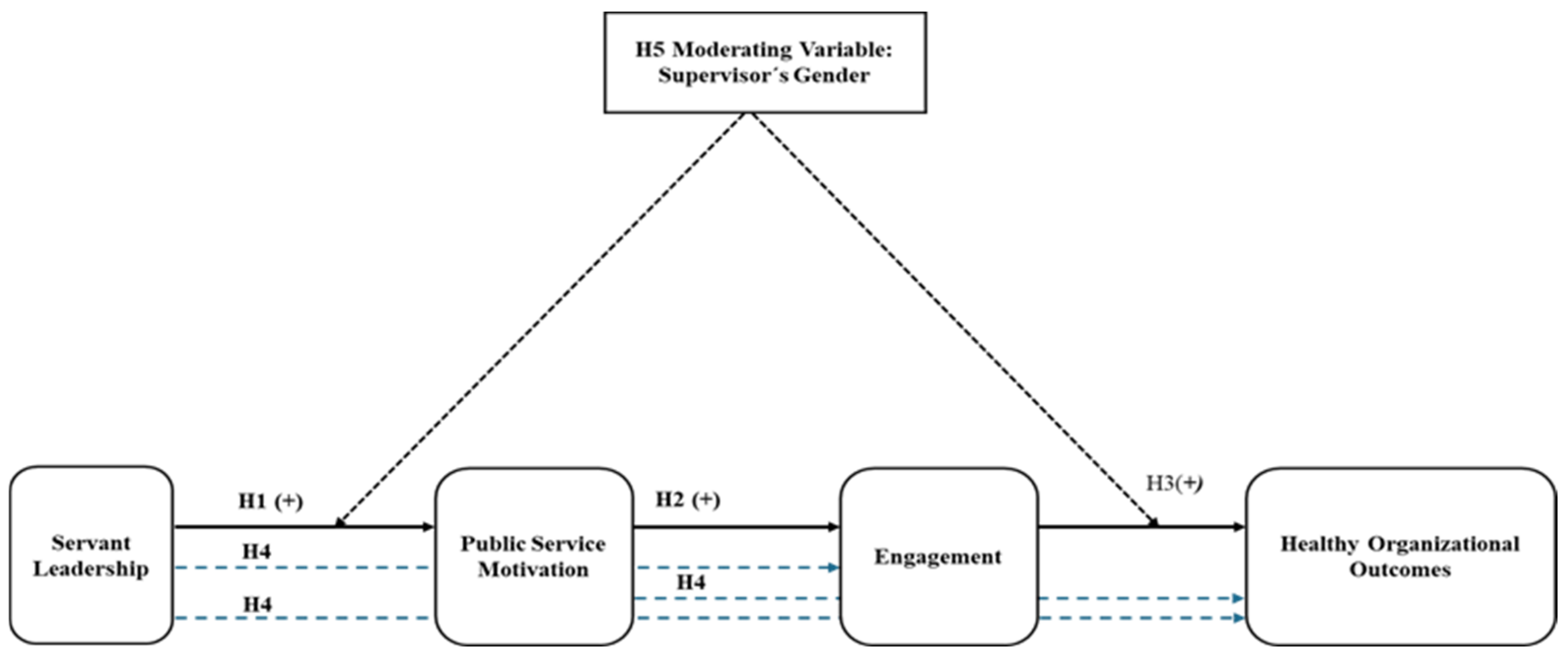
Based on the theoretical review conducted, the present study proposes a conceptual model that integrates the Job Demands–Resources (JD-R) theory and the HERO model of Healthy and Resilient Organizations to analyze the relationships among servant leadership, public service motivation, work engagement, and healthy organizational outcomes in the Chilean public sector (see
Figure 1).
The conceptual model graphically represents the theoretical relationships developed in the theoretical framework and synthesized in hypotheses H1–H5 (see
Figure 1), integrating servant leadership, public service motivation, work engagement, and healthy organizational outcomes within the JD-R theory and the HERO model. In addition, supervisor gender is included as a contextual moderating variable.
3. Materials and Methods
3.1. Study Design
The present study employed a non-experimental, cross-sectional, and correlational design developed within a quantitative approach. This design made it possible to examine the relationships proposed in the theoretical model without manipulating the variables and based on a single measurement occasion.
The unit of analysis was at the individual level. Employees from the participating Chilean public-sector institutions evaluated their direct supervisors and completed self-report measures of public service motivation and work engagement. The research model was grounded in the JD-R theory and the HERO model of Healthy and Resilient Organizations, integrating servant leadership, public service motivation, work engagement, and healthy organizational outcomes as the main variables, and incorporating supervisors’ gender as a moderating variable.
In line with the study objective, the model assumes that servant leadership (eight factors) operates as a social job resource that influences public service motivation (four factors), which in turn functions as a personal resource that enhances work engagement (three factors). This latter construct, as a positive motivational state, is associated with healthy organizational outcomes, assessed through three variables: in-role performance, extra-role performance, and affective organizational commitment.
Supervisors’ gender was included as a moderating variable to examine whether the relationships proposed in the model differed depending on whether supervision was exercised by a man or a woman.
3.2. Participants
The sample consisted of 428 employees from the Chilean public sector, belonging to 22 institutions affiliated with the Senior Public Management System (Alta Dirección Pública, ADP). Within this system, senior managers are selected through competitive public processes, constituting a mixed model in which criteria of technical suitability converge with considerations of political trust. The institutions represent different sectors of the public administration (see
Table 1), selected through convenience sampling, and account for 15.38% of the total 143 public institutions that make up this system. As an inclusion criterion, participants were required to hold a formal employment contract with the participating institutions. Of the total sample, 65% (
n = 278) were women and 35% (
n = 150) were men. Regarding age, 34.8% (
n = 149) were under 40 years old, 35% (
n = 150) were between 40 and 49 years old, 20.6% (
n = 88) were between 50 and 59 years old, and 9.6% (
n = 41) were 60 years old or older. In terms of tenure, 53.5% (
n = 229) had been in their position for more than five years, 43% (
n = 184) for between six months and five years, and 3.5% (
n = 15) for less than six months.
3.3. Procedure
The study was conducted in collaboration with the National Civil Service Directorate of Chile (Dirección Nacional del Servicio Civil, DNSC), an agency under the Ministry of Finance responsible for strengthening the public service and contributing to the modernization of the State through human resource management and development. The DNSC invited organizations belonging to the Senior Public Management System to participate voluntarily in the study.
Data collection took place between February and March 2021 using the Qualtrics online platform. The process was coordinated by the heads of the human resources and personnel development departments within the participating organizations, under the supervision of the principal investigator.
Data were obtained from two sources. Employees completed measures of public service motivation and work engagement and evaluated their direct supervisor’s servant leadership. In parallel, supervisors reported healthy organizational outcomes for their employees.
This design allowed the separation of the measurement of predictors and mediators from that of the outcome variable, thereby reducing the risk of common method bias in the dependent variable.
3.4. Measures
Servant leadership was assessed using the Servant Leadership Survey developed by
van Dierendonck and Nuijten (
2011). This questionnaire consists of thirty items distributed across eight factors: empowerment, accountability, standing back, humility, authenticity, courage, forgiveness, and stewardship. In the original validation, the authors reported adequate internal consistency indices, with Cronbach’s alpha coefficients ranging from 0.74 to 0.91. Examples of items include: “My supervisor gives me the authority I need to make decisions that facilitate my work” (empowerment); “My supervisor holds me accountable for my performance” (accountability); “My supervisor works behind the scenes and lets others take the credit” (standing back); “My supervisor learns from criticism” (humility); “My supervisor shows his or her true feelings to employees” (authenticity); “My supervisor takes risks even when unsure of support from his or her own supervisor” (courage); “My supervisor criticizes people for the mistakes they have made in their work (R)” (interpersonal acceptance); and “My supervisor emphasizes the social responsibility of our work” (stewardship). The items in the interpersonal acceptance factor were reverse-coded so that higher scores consistently reflected higher levels of servant leadership.
In this research, the version adapted and validated for the Chilean public sector was used (
Villarroel-Núñez et al., 2026). This validation confirmed the factorial validity and reliability of the scale in this context, supporting its relevance for assessing servant leadership in Chilean public institutions.
Public service motivation was measured using the Chilean validated version (
Meyer-Sahling et al., 2019) of the scale developed by
Kim et al. (
2013). This version comprises 16 items grouped into four factors: attraction to public service, commitment to public values, compassion, and self-sacrifice. The original instrument showed adequate reliability indices, with Cronbach’s alphas ranging from 0.70 to 0.86 across factors (
Kim et al., 2013). Examples of items include: “A meaningful public job is very important to me” (attraction to public service); “It is essential that the interests of future generations be considered when developing public policies” (commitment to public values); “I feel compassion for the hardships of disadvantaged people” (compassion); and “I am willing to risk personal losses to help society” (self-sacrifice).
Work engagement was assessed using the short version of the
Utrecht Work Engagement Scale (UWES-9;
Schaufeli et al., 2006a). The questionnaire consists of three factors—vigor, dedication, and absorption—each evaluated with three items. In its international validation, the UWES-9 showed adequate reliability, with Cronbach’s alphas ranging from 0.85 to 0.92 across factors and countries (
Schaufeli et al., 2006a). Examples of items include: “We feel strong and vigorous while working” (vigor); “We are enthusiastic about our work” (dedication); and “When we are working, we forget everything else around us” (absorption).
Healthy organizational outcomes were measured through the outcomes block of the
HEROCheck Public questionnaire (
Villarroel-Núñez et al., 2024). This block includes single-item factors: in-role performance, extra-role performance, and affective organizational commitment. These items capture both the fulfilment of core job tasks and the voluntary tasks performed beyond what is prescribed, as well as the emotional bond expressed through commitment, pride, and the desire to remain in the institution. The instrument showed adequate validity and reliability indices in its Chilean validation (
Villarroel-Núñez et al., 2024).
All questionnaires used a seven-point Likert scale (0 = never; 6 = always).
3.5. Data Analysis
Analyses were conducted using SPSS (Version 27) to compute descriptive statistics, estimate internal consistency, and calculate bivariate correlations, and IBM AMOS (Version 24.0) was used to perform structural equation modeling (SEM) analyses.
First, means, standard deviations, skewness and kurtosis were calculated for each dimension and total scale score to assess data distribution. Skewness and kurtosis values below |2| and |7|, respectively, were considered acceptable, following
Kline’s (
2012) recommendations.
Internal consistency was estimated using Cronbach’s alpha (α) and McDonald’s omega (ω), with values ≥ 0.70 interpreted as adequate (
Nunnally & Bernstein, 1995).
Subsequently, bivariate correlations were computed using Spearman’s rho (ρ), as some dimensions did not fully meet normality assumptions. Harman’s single-factor test (
Podsakoff et al., 2003) was conducted on the variables self-reported by employees to assess potential common method variance. Given that healthy organizational outcomes were reported by supervisors, the study design incorporates source separation for the dependent variable, thereby reducing the risk of single-source bias.
To test the proposed theoretical model, a structural equation model (SEM) was estimated at the individual level. Model fit was evaluated using the following indices: χ2/df, Comparative Fit Index (CFI), Tucker–Lewis Index (TLI), Root Mean Square Error of Approximation (RMSEA), and Standardized Root Mean Square Residual (SRMR). Values of CFI and TLI ≥ 0.90, RMSEA ≤ 0.08, and SRMR ≤ 0.08 were considered indicative of good model fit.
Additionally, two alternative specifications of the structural model were estimated: a partial mediation model (M2), which incorporated an additional direct path between servant leadership and healthy organizational outcomes, and an alternative model (MA), which reorganized the variables proposed in the M1 to test the robustness of the theoretical model.
Furthermore, the potential moderating effect of supervisor gender was examined through a multigroup analysis within the structural equation modeling framework. To this end, the sample was divided into two groups according to supervisor gender (male supervisors and female supervisors), and the structural model was estimated separately for each group. Subsequently, the coefficients of the structural paths were compared across groups using the p-value as the criterion for determining statistically significant differences between the estimated parameters.
4. Results
4.1. Descriptive Statistics and Reliability of the Scales
Table 2 presents the means, standard deviations, skewness and kurtosis indices, as well as reliability coefficients (McDonald’s ω and Cronbach’s α), for each factor and for the total scores of servant leadership, public service motivation, work engagement, and healthy organizational outcomes scales.
Regarding servant leadership factors, means ranged from 2.80 (standing back) to 4.39 (accountability), with a total servant leadership score of 3.78 (SD = 1.11). Public service motivation factors showed higher values, particularly commitment to public values (M = 5.74, SD = 0.51) and compassion (M = 5.53, SD = 0.67), whereas self-sacrifice obtained the lowest mean (M = 3.86, SD = 1.06). The overall public service motivation score was 5.04 (SD = 0.54). For work engagement, means ranged from 3.88 (absorption) to 4.67 (dedication), with an overall mean of 4.30 (SD = 1.00). Finally, for healthy organizational outcomes, means ranged from 3.68 (extra-role performance) to 5.49 (in-role performance), with a total score of 4.63 (SD = 0.72).
Skewness and kurtosis indices were mostly within the recommended ranges (
Kline, 2012), except for the commitment to public values and compassion dimensions, which showed elevated kurtosis values, indicating a concentration of responses at the upper end of the scale. Internal reliability was adequate for most dimensions (ω and α ≥ 0.70), reaching very high values for empowerment and humility (≥0.95). However, low levels of internal consistency were observed for the accountability dimension of servant leadership, as well as for attraction to public service and self-sacrifice within public service motivation (ω and α < 0.60); therefore, these results should be interpreted with caution. Reliability for the global healthy organizational outcomes index was also lower, which may reflect the heterogeneous nature of the indicators included in this composite measure.
4.2. Correlations Among Study Variables
Table 3 presents the nonparametric correlations (Spearman’s ρ) among the study variables.
The results show positive and statistically significant associations between global servant leadership and global public service motivation (ρ = 0.139, p < 0.01), global work engagement (ρ = 0.406, p < 0.01), and global healthy organizational outcomes (ρ = 0.167, p < 0.01).
Likewise, global public service motivation was positively and significantly associated with global work engagement (ρ = 0.147, p < 0.01), whereas its relationship with global healthy organizational outcomes was of smaller magnitude and did not reach statistical significance (ρ = −0.087, p > 0.05).
In turn, global work engagement showed positive but small associations with global healthy organizational outcomes (ρ = 0.035, p > 0.05), with more consistent relationships observed between its dimensions and the specific indicators of in-role performance and extra-role behavior. Overall, the pattern of correlations supports the direction of the relationships proposed in the theoretical model and provides a preliminary basis for the subsequent structural analyses.
4.3. Common Method Variance Analysis
As a preliminary analysis, the potential presence of common method variance was assessed using Harman’s single-factor test (
Podsakoff et al., 2003) on the individual-level dataset (N = 428). The results indicated that the single-factor model showed a poor fit to the data, χ
2 (135) = 1212.19,
p < 0.001, RMSEA = 0.137, CFI = 0.652, NFI = 0.629, TLI = 0.559, IFI = 0.656, AIC = 1320.192.
Given the well-documented limitations of Harman’s single-factor test, the fit of the single latent factor model was compared with that of a model including four latent factors. The results showed a significantly poorer fit of the single-factor model compared with the multifactor model, χ2 (129) = 313.245, p < 0.001, RMSEA = 0.058, CFI = 0.940, NFI = 0.904, TLI = 0.921, IFI = 0.941, AIC = 433.245, Δχ2 (6) = 898.945, p < 0.001.
Taken together, these results suggest that common method variance does not represent a substantial threat to the interpretation of the subsequent analyses.
4.4. Hypothesized Structural Model
Subsequently, structural equation models (SEM) were tested at the individual level, considering the proposed relationships among servant leadership, public service motivation, work engagement, and healthy organizational outcomes.
Structural equation models (SEM) were estimated at the individual level in order to empirically test the relationships proposed between servant leadership, public service motivation, work engagement, and healthy organizational outcomes.
The initial full mediation model (M1) showed an adequate fit to the data: χ2/df = 2.34, CFI = 0.961, TLI = 0.954, RMSEA = 0.056 [90% CI 0.048–0.063], SRMR = 0.041. These indices fall within the commonly accepted criteria for good model fit. The standardized direct effects indicated that servant leadership positively and significantly predicted public service motivation (β = 0.18, p < 0.001); that public service motivation significantly predicted work engagement (β = 0.15, p = 0.002); and that work engagement positively and significantly predicted healthy organizational outcomes (β = 0.47, p < 0.001). The model explained 3% of the variance in public service motivation, 2% of the variance in work engagement, and 22% of the variance in healthy organizational outcomes.
4.5. Model Comparison: Partial Mediation (M2) and Alternative Model (MA)
To evaluate the robustness of the proposed model, a partial mediation model (M2) and an alternative model (MA) were additionally estimated. The M2 model incorporated an additional direct path between servant leadership and healthy organizational outcomes, whereas the alternative model (MA) reorganized the structural order of the relationships among the variables in the model. The fit indices for the three models, as well as the comparison between models M1 and M2, are presented in
Table 4.
As shown in
Table 4, the partial mediation model exhibited a better statistical fit than the total mediation model, showing significant differences in the comparison between nested models (Δχ
2 = 115.18, Δdf = 3,
p < 0.001). Nevertheless, the total mediation model (M1) was retained as the final model based on the criteria of theoretical coherence and greater parsimony in representing the proposed relationships. In contrast, the alternative model showed a clearly poor fit (χ
2/df = 9.20, RMSEA = 0.14, CFI = 0.65), which further supports the adequacy of the proposed model.
Regarding the proposed hypotheses, the results of the structural model support H1, H2, and H3. Hypothesis H4 is also supported.
4.6. Moderation Analysis According to Supervisor Gender
The multigroup analysis did not show statistically significant differences in the structural paths of the model between male supervisors and female supervisors. Consequently, the proposed relationships remained stable regardless of the supervisor’s gender. These results indicate that the motivational pathways proposed in the model operate in a comparable manner across both groups, thus supporting Hypothesis H5.
5. Discussion
This study provides empirical evidence on the motivational processes that link servant leadership with healthy organizational outcomes in the Chilean public sector, integrating the assumptions of JD-R theory and the HERO model. The findings offer insight into how these mechanisms operate within public institutions characterized by high levels of regulation, accountability demands, and persistent challenges related to legitimacy and trust.
Overall, the findings highlight the role of servant leadership as a relevant social resource within the JD-R framework, particularly in public-sector contexts strongly oriented toward the common good. In this regard, servant leadership is associated with the activation of motivational processes related to meaningful work and positive motivational states, which are linked to healthy organizational functioning.
These results confirm that servant leadership constitutes a relevant social resource in the public context examined by contributing to the activation of motivational processes related to work meaning and positive motivational states, without operating as a sole explanation for work behaviors and outcomes. The explained variance and the magnitude of the observed effects—particularly for public service motivation and work engagement—indicate that, although servant leadership plays a significant role, these processes are multifactorial in nature. This is consistent with JD-R theory and the HERO model, which conceptualize well-being and performance as the result of the interaction between multiple job demands and resources.
5.1. Theoretical Implications
From a theoretical perspective, the results of this study contribute to the literature on servant leadership and public service motivation by empirically articulating a motivational chain that links these constructs to work engagement and healthy organizational outcomes. This approach extends the logic of JD-R theory through the HERO model by incorporating healthy organizational outcomes as a relevant endpoint of motivational processes in Chilean public institutions.
In this regard, servant leadership emerges as a pertinent social resource in the public sector, as it is associated with the activation of personal resources oriented toward work meaning—such as public service motivation—and with positive motivational states such as work engagement. This relationship is particularly relevant in the public sector, where motivation to contribute to the common good represents a distinctive element of work identity. Moreover, the inclusion of healthy organizational outcomes allows these processes to be examined beyond individual well-being, providing an organizational-level interpretation of the effects of servant leadership.
A theoretically relevant aspect of the model concerns the nature of the observed mediation. Although more complex model specifications showed a better statistical fit, the final model was selected based on the criteria of theoretical coherence and parsimony. From this perspective, the partial mediation observed suggests that servant leadership exerts its influence on healthy organizational outcomes through public service motivation and work engagement, albeit not exclusively. This pattern is consistent with the logic of the JD-R and HERO models, which do not conceptualize social resources as unique determinants, but rather as components that interact with other resources and organizational conditions.
Likewise, the moderate magnitude of the effects and the relatively low explained variance in some constructs should not be interpreted as a weakness of the model, but rather as an expression of the inherent complexity of motivational processes in the public-sector context.
Collectively, these theoretical implications reinforce the relevance of integrating servant leadership within broader motivational frameworks such as JD-R and HERO for the study of well-being and performance in the public sector. By explicitly positioning public service motivation and work engagement as central mechanisms, the model provides a solid and context-sensitive conceptual basis for future research aimed at deepening our understanding of how different social and personal resources interact to generate healthy organizational outcomes in public-sector settings.
5.2. The Role of Supervisor Gender: Absence of Moderation in the Structural Model
The analysis of the moderating effect of supervisor gender did not reveal statistically significant differences in the structural paths of the model; the proposed relationships remained stable regardless of the supervisor’s gender.
From a theoretical perspective, the absence of a moderating gender effect can be interpreted in light of the characteristics inherent to servant leadership. This leadership approach emphasizes relational, ethical, and prosocial values such as humility, authenticity, care for others, and orientation toward the common good—attributes that are often considered relatively gender-neutral or, in some cases, aligned with communal role expectations traditionally associated with femininity. According to role congruity theory, leadership behaviors perceived as incongruent with gender role expectations may generate biases in the evaluation of leaders. In this sense, servant leadership may attenuate such role incongruity dynamics by providing a framework of leadership behaviors that integrates communal and agentic elements without reinforcing rigid gender dichotomies.
Within the context of the Chilean public administration, these findings suggest that the relationships proposed in the model remain stable regardless of the supervisor’s gender. The motivational processes linking leadership, public service motivation, and work engagement appear to operate in a comparable manner for men and women in supervisory roles, indicating that the effects associated with servant leadership function consistently within the organizational context examined. This pattern may also reflect the normative orientation toward public service values that characterizes many public sector institutions, where leadership effectiveness may be more strongly associated with service-oriented behaviors than with gendered leadership expectations.
Taken together, the absence of gender moderation suggests that servant leadership may represent a potentially integrative leadership approach from a gender perspective, as the motivational relationships proposed in the model do not differ between male and female supervisors. However, the absence of statistically significant differences should be interpreted with caution, as it does not necessarily imply that gender-related dynamics are entirely absent, but rather that such differences were not detected within the present data. Future research could further examine the interaction between servant leadership, gender, and institutional context through longitudinal designs or by incorporating additional variables that allow these dynamics to be explored with greater precision.
5.3. Implications for Public Management
Beyond providing empirical validation of the proposed model, this study offers relevant guidance for public management by highlighting the importance of considering the motivational processes that link servant leadership to healthy organizational outcomes in the Chilean public sector. In a context characterized by persistent challenges related to institutional legitimacy and public trust, the results suggest that servant leadership, public service motivation, and work engagement function as important resources for sustaining healthy organizational dynamics, although they do not constitute unique or sufficient factors on their own.
Given the central role of public service motivation in this context, the findings suggest that its strengthening may be fostered through systematic practices aimed at reinforcing the meaning and social impact of public work. Previous studies have indicated that public service motivation can be enhanced through organizational actions such as aligning work with prosocial values, providing opportunities for meaningful contribution, and recognizing efforts oriented toward the common good (
Christensen et al., 2017). In this regard, the results of the present study suggest that interventions focused on developing servant leadership behaviors—such as leadership training programs centered on authenticity, service orientation, and concern for others—may contribute to strengthening public service motivation, work engagement, and, consequently, healthy organizational outcomes.
However, it is important to consider that comparative evidence indicates that the manifestation and effectiveness of servant leadership are shaped by cultural and institutional contexts. In particular, research conducted in Latin America suggests that, in settings characterized by higher levels of power distance and persistent challenges of institutional trust, servant leadership does not emerge spontaneously, but rather requires active facilitation through organizational practices that explicitly reinforce prosocial values, clarify expectations regarding the leadership role, and legitimize these behaviors within formal management structures (
Neubert et al., 2022). From this perspective, the results of the present study underscore the importance of understanding servant leadership not only as an individual characteristic but as an organizational practice that can be intentionally fostered in public management, taking into account the cultural and organizational features specific to the Latin American context.
In addition, the psychometric results observed for the “accountability” subscale of servant leadership, which showed low internal consistency, suggest the need to interpret this dimension with caution in the Chilean context. This weakness may be linked to specific cultural and institutional factors, such as the coexistence of highly hierarchical formal control mechanisms with predominantly vertical accountability practices (
Montecinos et al., 2020), which may generate heterogeneous interpretations of the meaning of responsibility and delegation of authority in servant leadership. In contexts characterized by a prolonged crisis of institutional trust, the notion of “holding others accountable” may be perceived more as a demand for control than as a practice associated with empowerment. From an applied perspective, these findings invite critical reflection on how practices of accountability and empowerment are promoted in complex public-sector contexts.
5.4. Limitations and Future Research
However, several limitations must be acknowledged, which at the same time open relevant avenues for future research. Cross-sectional design prevents the establishment of causal relationships among the variables analyzed; therefore, future studies should adopt longitudinal designs to explore the directionality and stability of the effects of servant leadership on public service motivation, work engagement, and healthy organizational outcomes. Such designs would allow a more precise examination of the temporal processes through which social and personal resources are activated and translated into motivational states and organizational outcomes, thereby strengthening the causal inference of the proposed model.
Likewise, the use of self-report questionnaires may be subject to common method variance. Accordingly, future research could incorporate complementary data collection strategies—such as interviews, focus groups, or objective performance indicators—to reduce single-source bias and enrich the understanding of the motivational mechanisms involved. In particular, mixed-methods approaches could provide convergent evidence for the relationships examined, as well as capture qualitative dimensions of servant leadership and public service motivation that are difficult to reflect through exclusively quantitative measures.
The composition of the sample, focused on employees working in the Chilean public sector, enhances the contextual relevance of the findings but limits their generalizability to other organizational or cultural settings. In addition, the use of convenience sampling and online data collection introduces potential selection biases, which preclude population-level inferences about the Chilean administrative system as a whole. Therefore, it would be advisable for future studies to include samples from other Latin American countries in order to broaden the empirical evidence in the region and examine how cultural variations influence the proposed motivational and resource-based pathways, particularly given that most existing studies have been conducted in Anglo-Saxon or Asian contexts.
Regarding the gender perspective, the analysis was restricted to a binary conceptualization of gender because, although a non-binary option was included, its representation was practically nonexistent, preventing statistical analysis. This suggests that future studies should attend to the institutional and cultural factors that may hinder the disclosure of diverse gender identities and should foster safer and more inclusive research environments that encourage the expression and visibility of gender diversity within the public sector.
Finally, the accountability factor of servant leadership showed low reliability and a nonsignificant loading, which may attenuate the explanatory strength of the construct. This issue—already documented in previous research (
van Dierendonck et al., 2017)—underscores the need to review its cultural relevance in the Chilean public-sector context. In this regard, future iterations of this study could explore the refinement or eventual replacement of this subscale to improve measurement reliability and its fit with the institutional context analyzed. This component, which refers to ethical responsibility, transparency, and accountability for decision-making, is particularly salient in environments where institutional legitimacy and public trust remain critical challenges. Examining how this factor is manifested and perceived could provide valuable insights both into the cultural adequacy of the scale and into the broader role of servant leadership in promoting more transparent and trustworthy public institutions.
6. Conclusions
The study empirically supported the five hypotheses proposed, demonstrating positive relationships between servant leadership and public service motivation, between public service motivation and work engagement, and between work engagement and healthy organizational outcomes, in line with the assumptions of the JD-R theory and the HERO model of healthy and resilient organizations. Although the partial mediation model (M2) showed a slightly better statistical fit, the initial model (M1) was preferred due to its greater parsimony and theoretical coherence, supporting its adequacy for explaining the motivational mechanisms operating within the public institutions analyzed.
Furthermore, the absence of moderating effects of supervisor gender provides empirical evidence that the motivational and resource pathways proposed in the model operate in a comparable manner within the context of the Chilean public administration, regardless of whether supervision is exercised by a man or a woman.
In conclusion, this study contributes to the empirical integration of the JD-R theory and the HERO model within the field of public administration by providing evidence on the motivational processes linking servant leadership to healthy organizational outcomes through the activation of personal resources and positive motivational states. By considering the gender dimension, this study expands the existing empirical base on servant leadership in the public sector, showing that supervisor gender does not alter the motivational relationships examined, which may inform future research and support the design of public management policies and practices aimed at promoting healthier and more inclusive organizations.